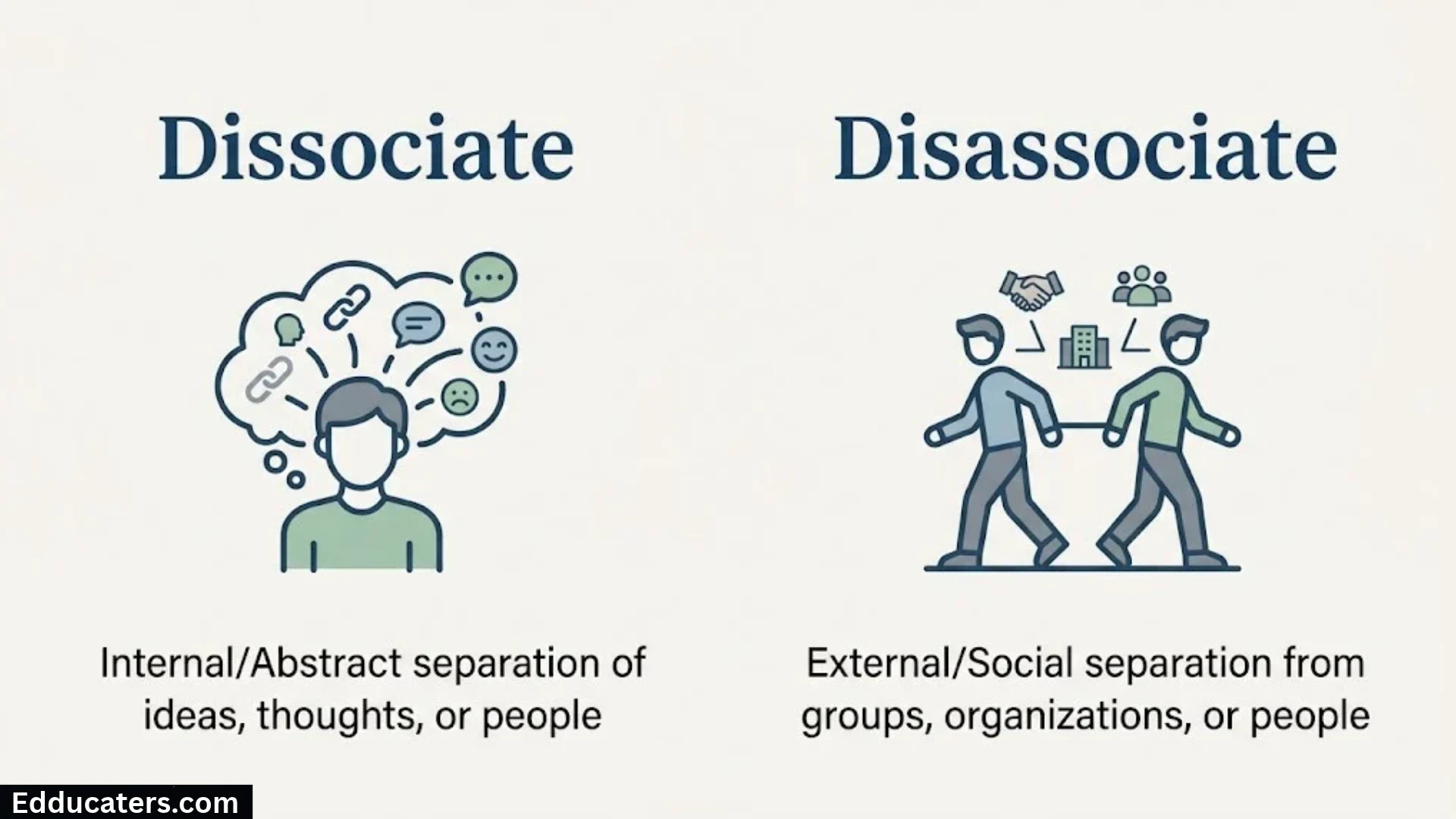
Have you ever paused while writing an email because you couldn’t decide between dissociate or disassociate? Both spellings look reasonable, and both appear in standard English. So, which one should you use?
The good news is that both words are correct. Dissociate is the shorter form, while disassociate is an accepted alternative. Both can mean to separate, disconnect, or distance someone or something from a person, group, idea, or action.
However, the best choice depends on your sentence and the context. For example, you might dissociate two ideas in an academic paper or disassociate a company’s brand from a controversial campaign. In psychology and chemistry, dissociation also has established technical meanings.
This guide explains the difference between dissociate or disassociate, their definitions, spelling, word origins, grammatical forms, and usage in everyday English, formal writing, science, and psychology.
What Do Dissociate or Disassociate Mean?
The verbs dissociate or disassociate mean to separate things that were connected or to treat them as distinct. They can also describe distancing yourself or an organization from a person, statement, belief, or activity.
According to Cambridge Dictionary, dissociate means to consider people or things separate and unrelated. The dictionary also lists disassociate as an alternative spelling.
Here is a simple comparison:
| Word | Definition | Example |
| Dissociate | To separate or treat as unrelated | She tried to dissociate the two ideas. |
| Disassociate | To separate or distance from an association | The company wanted to disassociate its brand from the campaign. |
Both words can describe a physical, conceptual, social, or professional separation. The precise meaning depends on what you’re separating and why.
For example, a researcher might dissociate two variables to examine their effects separately. A business might disassociate itself from a partner whose actions conflict with its policies. Someone discussing a difficult experience might use dissociate in a psychological sense.
The main point: Neither spelling is inherently incorrect. Choose the form that suits your context and follow any terminology requirements that apply to your writing.
What Is the Difference Between Dissociate or Disassociate?
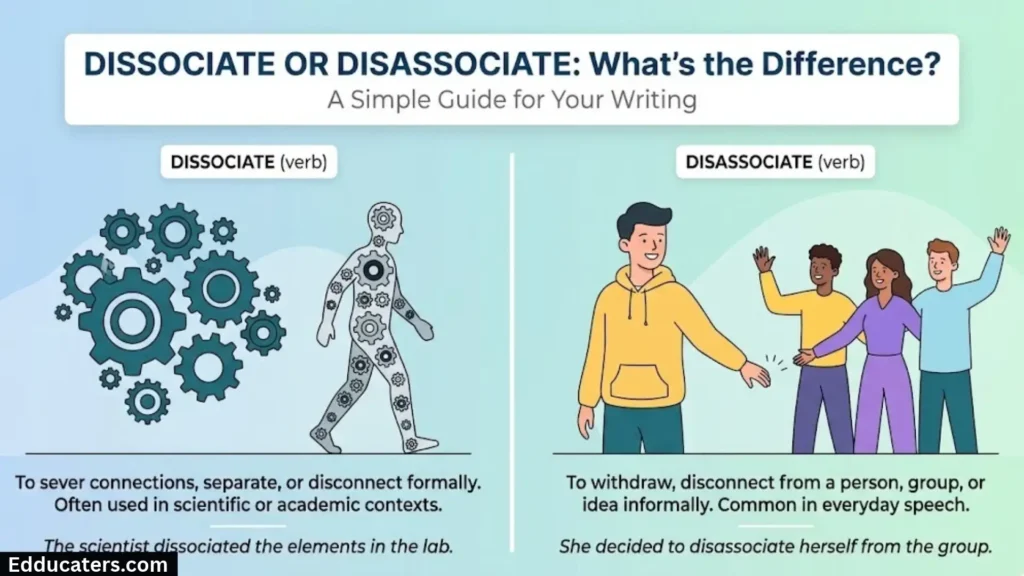
The difference between dissociate or disassociate is mainly one of spelling and usage preference rather than a fundamental difference in meaning.
Both verbs can express separation or disconnection. Major dictionaries recognize the relationship between the two forms, although individual entries may present them differently.
Meaning and Usage
Consider these examples:
- Dissociate: The researcher wanted to dissociate the effects of age from the effects of experience.
- Disassociate: The researcher wanted to disassociate the findings from unrelated assumptions.
Both sentences describe separating concepts for clearer analysis.
The same overlap appears in personal and professional communication:
- She wanted to dissociate herself from the group’s controversial position.
- She wanted to disassociate herself from the group’s controversial position.
Both sentences communicate that she does not want to be connected with or appear to support the group’s position.
According to the Oxford Advanced Learner’s Dictionary, dissociate can describe separating people or things in thought or making it clear that someone does not support a person, plan, or action. Oxford also recognizes disassociate as an alternative.
The two forms can therefore be interchangeable in many general-English sentences. However, specialist terminology and editorial preferences can make one form more suitable in a particular document.
The Shorter Word or the Longer Word
The most obvious difference is their length.
- Dissociate: Nine letters.
- Disassociate: Twelve letters.
The shorter word often appeals to writers who prefer concise language. The longer form may feel more transparent because readers can recognize the familiar word associate within it.
However, neither spelling is automatically more formal or precise.
For example, both sentences work:
- The manager chose to dissociate the project from the earlier proposal.
- The manager chose to disassociate the project from the earlier proposal.
You don’t need to add extra letters to make your writing sound professional. Choose the word that communicates your meaning clearly.
Which Word Is More Common?
Usage depends on the source, subject, and type of writing. Both spellings appear in published English, including professional and academic material.
If you need to establish which form appears more frequently, consult a reliable text corpus and compare the same grammatical forms across similar collections. A fair comparison should account for differences between academic papers, news articles, books, and everyday writing.
Google Trends can help you compare search interest in the two phrases. However, it measures relative search interest rather than the frequency of the words in published writing.
For most readers, the practical distinction matters more than popularity: both spellings are accepted, and both can communicate the same general idea.
How to Use Dissociate in a Sentence
Dissociate works in everyday conversation, academic writing, professional communication, and technical contexts. It often appears when someone wants to separate two ideas or distance a person from a particular association.
Examples of Dissociate in Everyday English
These sentences show how the word works in ordinary situations:
- She struggled to dissociate the memory from the emotions it brought back.
- I can’t dissociate his public image from his recent comments.
- The author asked readers to dissociate the narrator from the writer.
- He wanted to dissociate himself from the group’s controversial position.
- It’s difficult to dissociate that song from my childhood memories.
- She learned to dissociate her personal feelings from the decision.
Notice the construction dissociate something from something. It identifies the two things that the writer wants to separate.
You can also use dissociate oneself from something when someone wants to make their lack of connection or support clear.
Examples of Dissociate in Formal Writing
In formal writing, dissociate can help explain distinctions between ideas, findings, responsibilities, or positions.
- The report dissociates the two findings to avoid confusion.
- Researchers attempted to dissociate the effects of the two variables.
- The organization sought to dissociate its work from the disputed proposal.
- The committee decided to dissociate the recommendation from the earlier report.
- The author carefully dissociated personal opinion from the evidence presented.
These examples show why the word appears in academic papers and professional reports. It can express a distinction more precisely than a vague phrase such as “keep things apart.”
However, don’t use it simply because it sounds sophisticated. In some sentences, separate, distinguish, or disconnect will be clearer.
Dissociate in Different Word Forms
The verb changes form according to tense and grammatical structure.
| Form | Example |
| Dissociate | They dissociate the two issues. |
| Dissociates | She dissociates personal beliefs from professional duties. |
| Dissociated | The report dissociated the two findings. |
| Dissociating | He is dissociating the argument from its original context. |
| Dissociation | The dissociation of the variables improved the analysis. |
| Dissociative | The paper discusses dissociative processes. |
These forms are related, but they don’t all serve the same grammatical role. Dissociate is a verb, dissociation is a noun, and dissociative is an adjective.
How to Use Disassociate in a Sentence
Disassociate is useful when you want to describe separating a person, organization, idea, or brand from an association. It often appears in discussions about reputation, relationships, public statements, and professional responsibilities.
Examples of Disassociate in Everyday English
Here are several natural examples:
- He wanted to disassociate himself from the argument.
- She tried to disassociate the experience from her current decisions.
- The artist chose to disassociate her personal identity from the character.
- I find it difficult to disassociate the film from the controversy surrounding it.
- They decided to disassociate themselves from the online discussion.
- The student tried to disassociate the two concepts while studying.
Each example describes a separation in thought, identity, or association. The word doesn’t necessarily mean that a relationship has ended permanently. Sometimes it means only that someone wants to distinguish one thing from another.
Examples of Disassociate in Business and Professional Writing
Businesses may use disassociate when discussing public image, partnerships, controversial remarks, or brand identity.
- The company issued a statement to disassociate its brand from the unauthorized campaign.
- The executive sought to disassociate the organization from the disputed remarks.
- The team decided to disassociate the new project from the earlier proposal.
- The agency wanted to disassociate its services from misleading advertising.
- The organization publicly disassociated itself from the contractor’s actions.
These sentences illustrate a common use: making it clear that an organization doesn’t support, control, or identify with something.
For example, if an employee makes a controversial statement in a personal capacity, a company might issue a public statement explaining that the remarks don’t represent its official position.
The word describes the separation the company wants to communicate. It doesn’t, by itself, establish whether the company has legal responsibility for the statement.
Disassociate in Different Word Forms
The longer verb also has several related forms.
| Form | Example |
| Disassociate | They disassociate the project from the controversy. |
| Disassociates | The organization disassociates itself from the statement. |
| Disassociated | The company disassociated itself from the campaign. |
| Disassociating | The team is disassociating the new brand from the old one. |
| Disassociation | The report describes the disassociation of the two groups. |
| Disassociative | The term may appear in some contexts, but specialist usage requires care. |
The first four forms follow the ordinary patterns for English verbs. The noun disassociation is also valid.
However, don’t assume that every related form is equally common in every field. In psychology and other technical disciplines, established terminology often favors dissociation or dissociative.
Should You Use Dissociate or Disassociate in Formal Writing?
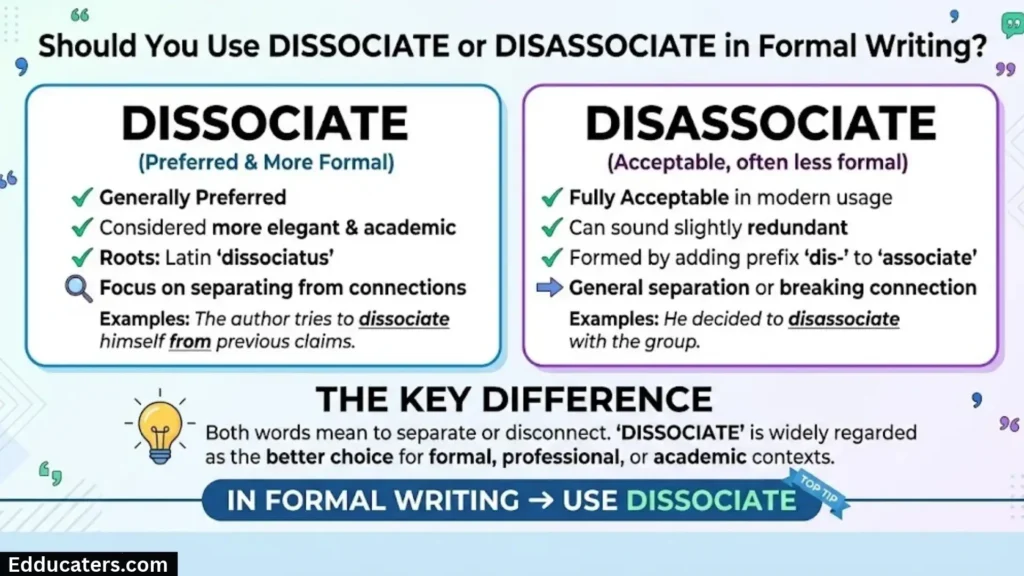
Both forms can appear in formal writing. The important questions are whether the word fits the meaning, whether your audience understands it, and whether a relevant style guide specifies a preference.
Everyday English and Formal English
In everyday conversation, either word can work:
- I want to dissociate myself from that decision.
- I want to disassociate myself from that decision.
In a formal report, the same principle applies. You can choose either spelling when the intended meaning is separation or distancing.
The shorter form may be a convenient choice when you want concise prose. The longer form is equally suitable when it matches your established wording.
Neither word automatically makes a sentence more professional.
Academic and Professional Writing
When writing an essay, report, research paper, or business document, follow these guidelines:
- Check the terminology: Use the term preferred by your academic discipline or professional field.
- Follow the style guide: Apply any spelling requirements established by your publication or organization.
- Stay consistent: Avoid switching between dissociate or disassociate without a reason.
- Prioritize clarity: Use a simpler alternative when it communicates the meaning more directly.
- Check technical definitions: Don’t assume that a general-English synonym works in a scientific or medical context.
For example, a chemistry paper discussing the separation of molecular entities should generally use the established term dissociation. A company statement about distancing its brand from a controversy may use either dissociate or disassociate.
Which Spelling Should You Choose?
Use this simple guide:
| Situation | Recommended approach |
| Everyday writing | Either form can work. |
| Formal reports | Follow your preferred spelling consistently. |
| Academic papers | Use the terminology established in your discipline. |
| Scientific writing | Prefer the accepted technical term. |
| Business statements | Choose the clearer form and maintain consistency. |
| Publication with a style guide | Follow the publication’s rules. |
If you’re unsure, dissociate is a sensible default because it is widely recognized and shorter. However, there’s no need to replace disassociate when it’s already correct and fits your writing.
Is Dissociate or Disassociate American English or British English?
Neither word belongs exclusively to American English or British English. Both forms appear in major dictionaries, and the difference is not a simple regional spelling contrast.
Dissociate in American English
American English uses dissociate in general and technical writing. American dictionaries also recognize disassociate.
For example:
- The company decided to dissociate its brand from the disputed campaign.
- The company decided to disassociate its brand from the disputed campaign.
Both sentences are acceptable in American English.
If you’re writing for a US audience, choose the form that fits your document and follow any relevant editorial rules.
Dissociate in British English
British English also recognizes both words.
The Cambridge Dictionary lists disassociate as an alternative to dissociate. The Oxford Advanced Learner’s Dictionary likewise identifies dissociate as an alternative form of disassociate.
This means you shouldn’t treat the pair like color and colour, where regional spelling conventions create a well-known difference.
Canadian, Australian, Indian, and Other English Varieties
English speakers in Canada, Australia, India, Pakistan, South Africa, and other countries may encounter both forms in international writing.
However, the existence of both spellings doesn’t establish that every country uses them equally often. Regional preferences can vary by publication, subject, and editorial tradition.
If you’re writing for an international audience, use the spelling accepted by your intended reference or style guide. Avoid labeling one form as exclusively British or American without reliable evidence.
What Is the Origin of Dissociate or Disassociate?
The similar meanings of these words become easier to understand when you examine their origins.
The Latin Origin of Dissociate
The word dissociate comes from the Latin verb dissociare, meaning to separate or disunite. Its structure includes the prefix dis- and a form related to sociare, meaning to join or unite.
The Latin noun socius means companion or ally. This root also helps explain the relationship between English words such as associate and association.
According to the Oxford Advanced Learner’s Dictionary, dissociate entered English around the middle of the 16th century.
The word’s history reflects a movement from connection toward separation. That idea remains central to its modern meaning.
Why Does Disassociate Have Extra Letters?
The spelling disassociate makes the relationship to associate easy to recognize. It combines dis- with associate, creating a longer form that conveys separation from an association.
The spelling dissociate comes through the Latin word dissociare. Although the two words developed through different word-formation patterns, modern English uses them with substantially overlapping meanings.
The prefix dis- often expresses separation, reversal, or negation. You can see a similar idea in words such as disconnect and disengage.
However, don’t assume that every English word beginning with dis- follows exactly the same historical pattern. Word origins can be more complicated than modern spelling suggests.
What Are the Related Word Forms of Dissociate or Disassociate?
Understanding related word forms helps you use the correct grammatical structure.
| Word | Part of speech | Meaning or use |
| Dissociate | Verb | Separate or treat as unrelated |
| Dissociated | Verb form | Past tense or past participle |
| Dissociating | Verb form | Ongoing action |
| Dissociation | Noun | Separation or disconnection |
| Dissociative | Adjective | Relating to dissociation |
| Disassociate | Verb | Alternative form meaning to separate |
| Disassociated | Verb form | Past tense or past participle |
| Disassociating | Verb form | Ongoing action |
| Disassociation | Noun | Separation from an association |
| Disassociative | Adjective | A less common related form |
What Is the Noun Form of Dissociate?
The noun form is dissociation.
For example:
- The dissociation of the two variables improved the analysis.
- The researcher examined the dissociation of the molecular components.
- The discussion focused on dissociation in psychology.
The noun can describe separation in general English, but its precise meaning depends on the field.
What Is the Noun Form of Disassociate?
The corresponding noun is disassociation.
For example:
- The organization announced its disassociation from the campaign.
- The report examined the disassociation of the two concepts.
Although disassociation is a valid word, dissociation is the established term in several scientific and psychological contexts.
What Is the Adjective Form of Dissociate or Disassociate?
The familiar adjective is dissociative.
For example:
- The researchers studied dissociative processes.
- The article explains dissociative experiences.
- The paper examined dissociative responses under specific conditions.
The adjective disassociative also exists, but its use is less established in many specialist contexts. When writing about psychology or medicine, follow the terminology used by authoritative references.
How Is Dissociation Used in Psychology or Medicine?
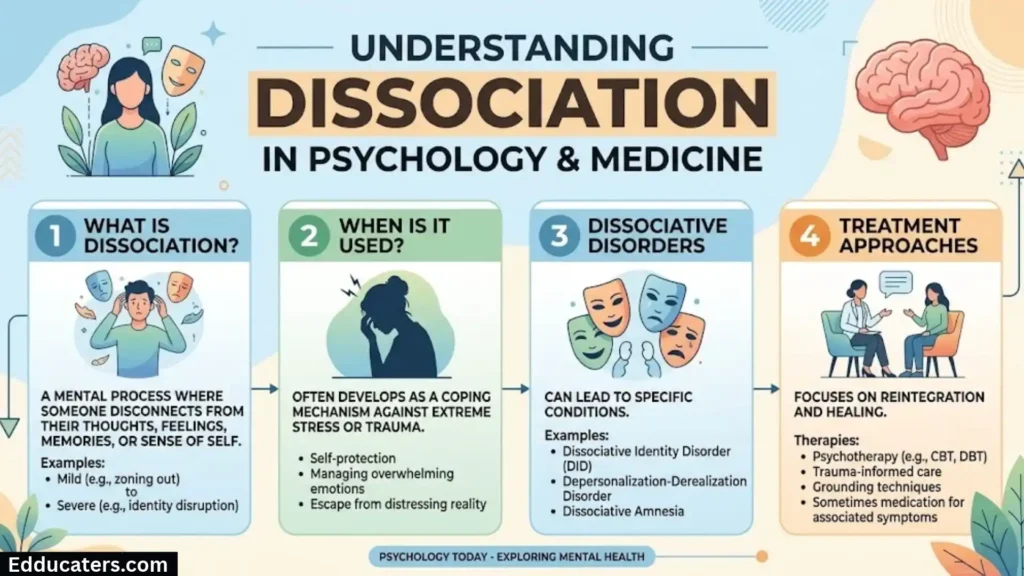
In psychology, dissociation has a more specialized meaning than simply distancing yourself from an organization or idea.
The American Psychological Association’s Dictionary of Psychology describes dissociation in terms that include keeping conflicting impulses apart or separating threatening ideas and feelings from other aspects of the psyche. The term also has uses in psychological research.
What Does Dissociation Mean in Psychology?
Psychological dissociation can involve a disruption in the usual integration of experiences such as awareness, memory, identity, perception, or a sense of connection with oneself and one’s surroundings.
For example, someone might describe feeling detached from their surroundings during an overwhelming experience. Another person might have difficulty recalling aspects of an event.
These examples don’t establish a diagnosis. Dissociative experiences vary, and ordinary distraction is not automatically a psychological disorder.
The distinction matters because dissociation is an established psychological term. Writers shouldn’t replace it with disassociation simply to vary their vocabulary.
What Does It Mean to Dissociate During a Stressful Event?
Some people report feelings of detachment during intense stress or frightening experiences. They may feel disconnected from their surroundings or describe an experience as unreal.
However, not everyone responds to stress in the same way. The presence of stress alone doesn’t establish that dissociation has occurred.
When discussing an individual’s experience, use careful wording and avoid assigning a clinical label without sufficient information.
Dissociation or Disassociation in Medical Terminology
In medical and psychological writing, established terms matter more than stylistic variation.
Use dissociation when referring to the recognized psychological concept. Use dissociative when the intended adjective matches the relevant clinical or research terminology.
For clinical definitions, consult authoritative resources such as the American Psychological Association and relevant medical references.
What Does Dissociation Mean in Chemistry?
In chemistry, dissociation refers to a process in which a molecular entity separates into two or more entities or the components of an aggregate separate. The exact process depends on the substance and the conditions.
The International Union of Pure and Applied Chemistry (IUPAC) defines dissociation in terms of the separation of molecular entities, including processes that produce separate ions.
What Is Chemical Dissociation?
Chemical dissociation occurs when a substance separates into smaller components. Depending on the process, those components may include molecules, ions, or other molecular entities.
For example, an ionic compound may separate into its constituent ions when it dissolves in water. Other dissociation processes involve molecular species separating into smaller entities.
Dissociation doesn’t always mean the same thing as dissolving. Dissolving describes the formation of a solution, while dissociation describes the separation of entities within a substance or aggregate. The processes can occur together, but the terms aren’t interchangeable.
What Happens When Acids Dissociate Into Ions?
Consider hydrochloric acid in water. In a simplified description, the acid transfers a proton to a water molecule, producing hydronium and chloride ions:
HCl + H₂O → H₃O⁺ + Cl⁻
This example is more precisely described as acid ionization in water. It illustrates why scientific terminology requires care: related processes can have specific names.
The broader term dissociation is appropriate for other processes involving the separation of molecular entities or ions.
Should You Write Dissociate or Disassociate in Chemistry?
Use dissociate when discussing the established chemical process unless your specific source or technical convention indicates otherwise.
Examples include:
- The compound dissociates into ions in solution.
- The researchers measured the dissociation of the molecular species.
- The experiment examined the conditions that influence dissociation.
Although disassociate is a valid general-English word, the established scientific noun is dissociation. Technical accuracy should take priority over stylistic variation.
What Preposition Goes With Dissociate or Disassociate?
The preposition often depends on what you’re trying to express. In sentences about distancing yourself from a person, group, action, or belief, from is a common choice.
Dissociate From or Disassociate From
Use from to identify the person or thing someone wants to separate from.
Examples:
- She chose to dissociate herself from the organization.
- He wanted to disassociate himself from the controversial remarks.
- The company dissociated its brand from the campaign.
- The committee decided to disassociate the proposal from the earlier report.
The structure is straightforward:
Dissociate or disassociate + person or thing + from + the association
You can also use the reflexive forms dissociate oneself from and disassociate oneself from.
Dissociate With or Disassociate With
The preposition with appears in some English constructions, including certain examples of disassociate. However, it isn’t the best choice for every sentence.
When you mean that someone wants to distance themselves from a group, position, or action, from is usually the clearest option.
For example:
- Preferred for this meaning: She wanted to dissociate herself from the group.
- Also acceptable: She wanted to disassociate herself from the group.
Don’t assume that every sentence containing with is grammatically wrong. Instead, examine the intended relationship and check a reliable dictionary when the construction seems uncertain.
Dissociate or Disassociate: Common Mistakes to Avoid
Although both main spellings are correct, writers can still make mistakes when spelling the words or choosing their meanings.
Adding or Removing Letters Incorrectly
Remember these two accepted spellings:
- Dissociate
- Disassociate
Avoid accidental forms such as dissassosiate or disassosiate. These are misspellings, not accepted alternatives.
The past-tense forms are dissociated or disassociated. Don’t add unnecessary letters or change the spelling inconsistently within the same document.
Confusing Dissociate With Dissolve
The words dissociate and dissolve can both involve separation, but they don’t mean the same thing.
| Word | Meaning | Example |
| Dissociate | Separate or treat as unrelated | The report dissociated the two findings. |
| Dissolve | Cause something to enter a solution or bring something to an end | Sugar dissolves in water. |
| Dissolve | End a formal body or arrangement | The board voted to dissolve the committee. |
You wouldn’t normally replace dissociate with dissolve when describing the separation of ideas or a person’s decision to distance themselves from a group.
Mixing Dissociate or Disassociate
Switching between the two forms isn’t automatically a grammatical error. However, inconsistent spelling can distract readers and make a document look poorly edited.
For example, if your report uses dissociate throughout, there’s little reason to switch to disassociate halfway through unless the context calls for it.
Choose a form and use it consistently.
Assuming the Longer Word Is More Correct
The extra letters in disassociate don’t make it more accurate, more formal, or more professional.
Both forms are accepted. The right choice depends on meaning, context, and established terminology rather than word length.
What Are the Synonyms of Dissociate or Disassociate?
Several English words can replace dissociate or disassociate, but each carries a slightly different meaning.
| Synonym | Meaning | Example |
| Separate | Divide or keep things apart | Separate the two documents. |
| Disconnect | Break a connection | Disconnect the device from the network. |
| Detach | Remove or separate something | Detach the label from the package. |
| Disengage | Withdraw from involvement | The company disengaged from the negotiations. |
| Distance oneself from | Reduce an association or connection | She distanced herself from the statement. |
| Sever ties with | End a relationship or affiliation | The organization severed ties with the supplier. |
| Withdraw from | Leave an activity or commitment | The group withdrew from the agreement. |
| Distinguish | Identify differences between things | Distinguish evidence from opinion. |
Are These Words Exact Synonyms?
No. Their meanings overlap, but they aren’t interchangeable in every situation.
For instance, sever ties usually suggests a stronger break in a relationship than dissociate. Distinguish focuses on recognizing a difference rather than ending an association.
Likewise, disconnect can refer to a physical or technical connection. Dissociate can express a conceptual distinction or a person’s desire to avoid being linked with something.
Choose a synonym based on the meaning you need, not simply to avoid repeating a word.
Frequently Asked Questions About Dissociate or Disassociate
Is Dissociate or Disassociate Correct?
Both are correct English words. They share substantially overlapping meanings, including separating things or distancing someone from an association.
Is Disassociate a Real Word?
Yes. Major dictionaries recognize disassociate as a valid word and link it to dissociate.
Can Dissociate or Disassociate Be Used Interchangeably?
In many general-English contexts, yes. However, technical writing may favor a particular form, and an editorial style guide may require consistent usage.
Is Dissociate More Common Than Disassociate?
The answer depends on the collection of texts and the field being examined. A reliable corpus can help establish relative frequency, but search interest alone doesn’t prove which word appears more often in published writing.
Is Dissociate British or American English?
Neither exclusively. Both forms appear in American and British English, so the pair shouldn’t be treated as a simple regional spelling difference.
What Is the Difference Between Dissociation or Disassociation?
Both nouns can describe separation or disconnection. However, dissociation is the established term in several scientific and psychological contexts, so it is usually the better choice in those fields.
What Is the Noun Form of Dissociate?
The noun form is dissociation. For example, “The dissociation of the two components changed the result.”
What Is the Noun Form of Disassociate?
The corresponding noun is disassociation. For example, “The organization announced its disassociation from the campaign.”
Do You Say Dissociate From or Dissociate With?
When describing the act of distancing yourself from a person, group, or position, dissociate from is a common and clear construction.
Does Dissociate Mean Dissolve?
No. Dissociate means to separate or treat as unrelated, while dissolve can mean to disperse in a liquid or bring something to an end. The words aren’t interchangeable in every context.
What Does Dissociate Mean in Psychology?
In psychology, dissociation can involve a disruption in the usual integration of experiences such as memory, awareness, identity, or perception. The term has a specialized meaning and doesn’t automatically indicate a disorder.
What Does Dissociate Mean in Chemistry?
In chemistry, dissociation describes the separation of molecular entities or components of an aggregate. Some processes involve the separation of ions, depending on the substance and conditions.
Conclusion: Dissociate or Disassociate?
When choosing between dissociate or disassociate, remember that both spellings are correct. Their general meanings overlap, and either can describe separating ideas, distancing yourself from a group, or making it clear that you don’t support a particular action.
Dissociate is the shorter form, while disassociate is an accepted alternative. Neither is automatically more formal or more accurate.
For everyday and professional writing, choose the form that fits your sentence and use it consistently. In psychology, chemistry, and other specialist fields, follow established terminology rather than replacing a technical term for stylistic variety.
The simplest rule is this: both words work in general English, but context determines which form is the best choice.

Hello, I’m Claire Holloway. I have always been passionate about the English language and enjoy turning complex grammar rules into simple, easy-to-follow lessons. I believe that every learner can become a confident English writer with the right guidance.
I create educational content focused on grammar, vocabulary, sentence structure, and writing improvement. Every article I publish is designed to help readers learn with confidence and accuracy.
Books
Grammar Without Confusion
Modern English Usage Guide
 Nathan Whitmore
 Julian Mercer