
We have all been there—staring at a blank document, fingers hovering over the keyboard, debating the spelling of a common word. Is it “suprise” or “surprise”? You might find yourself leaning toward the phonetic spelling, but your spellchecker keeps flagging it. You are certainly not alone; this is one of the most frequent spelling errors in the English language.
Understanding why this happens and how to fix it will elevate your writing and ensure your communication remains professional and polished. In this guide, we will break down the spelling of this word, explore its nuances, and provide you with tools to ensure you never make this mistake again.
Suprise or Surprise:(Quick Answer)
The correct spelling is surprise. The version “suprise” is always incorrect. The word contains an “r” after the first “s,” originating from the Old French surprendre. Always use “surprise” for both the noun and verb forms to ensure your writing is grammatically accurate and professional in all contexts.
Comparison Table
| Category | Correct Word | Incorrect Word |
| Spelling | Surprise | Suprise |
| Meaning | An unexpected event or feeling | N/A |
| Part of Speech | Noun, Verb, Adjective | N/A |
| Grammar Rule | Etymological origin | Phonetic misspelling |
| Usage | “What a lovely surprise!” | “What a lovely suprise!” (Wrong) |
| Pronunciation | /sərˈpraɪz/ | /səˈpraɪz/ |
| Memory Tip | Remember the ‘r’ as in ‘reward’ | None |
The Meaning of Surprise
Surprise acts as a versatile term in English, functioning as a noun, a verb, or an adjective depending on the context. Its core definition relates to an unexpected event, fact, or thing that causes someone to feel astonishment.
As a Noun
When used as a noun, it describes the emotional state or the event itself.
- “The party was a complete surprise to everyone involved.”
- “To my surprise, the doors were already open.”
As a Verb
When used as a verb, it describes the act of catching someone unprepared or providing them with something they did not anticipate.
- “Don’t sneak up on me; you will surprise me.”
- “She wanted to surprise her brother with a visit.”
As an Adjective
It can also function as a modifier for other nouns.
- “The team launched a surprise inspection this morning.”
Key Differences and Why the Error Occurs

The primary reason for the misspelling “suprise” is phonetic. When we say the word quickly, the first “r” sound is often muted or blended into the “s,” leading writers to rely on how they hear the word rather than how it is rooted historically.
- The “r” is mandatory: Because the word stems from the prefix sur- (meaning “over”) and prendre (meaning “to take”), the “r” is a structural necessity.
- Consistency: Unlike some words that have variant spellings in US versus UK English, “surprise” is universally spelled with an “r” in every English-speaking country. There is no acceptable “surprise” variant anywhere.
Grammar Rules: Root Origins
In English, spelling often follows etymology rather than sound. “Surprise” originates from the Old French surprendre. The prefix sur- denotes “beyond” or “over,” and prendre means “to take.” By skipping the “r,” a writer effectively erases the etymological root of the word. Furthermore, there is no legitimate linguistic suffix or prefix rule that would justify omitting that first “r.” It is a hard-coded spelling that must be memorized as a single, consistent unit.
When to Use Surprise
Whether you are writing a formal business proposal or a casual text to a friend, the spelling remains identical.
- Academic and Professional Writing: Always use the full spelling. Using “suprise” can undermine your authority and make your work appear careless.
- Business Emails: In professional correspondence, precision is vital. Use “surprise” to maintain a high standard of communication.
- Social Media: While internet shorthand is common, misspelling “surprise” is often perceived as a lack of basic literacy rather than a stylistic choice.
- Daily Conversation: The word is used frequently to describe sudden news, gifts, or visitors. Ensure your digital communication reflects your spoken clarity.
Common Mistakes
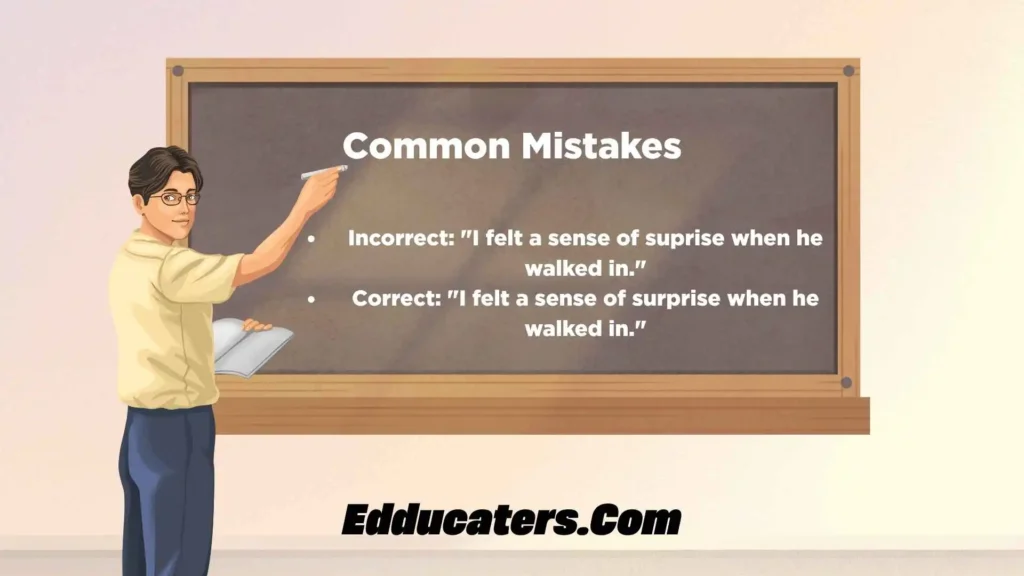
The most common mistake is simply dropping the first “r.” People often fall into this trap because they prioritize the phonetic output over the established orthography.
- Incorrect: “I felt a sense of suprise when he walked in.”
- Correct: “I felt a sense of surprise when he walked in.”
- Tip to avoid: When proofreading, look specifically for the “r” after the first “s.” If you are using word processing software, set your language dictionary to US English to catch these discrepancies automatically.
Original Examples
- The CEO’s surprise announcement left the shareholders speechless.
- I managed to surprise my mother with a bouquet of lilies.
- The sudden rainfall was a major surprise during our outdoor picnic.
- Nothing can surprise a veteran detective after twenty years on the job.
- He kept the engagement ring a surprise until the very last moment.
- The surprise ending of the novel kept me awake until 3:00 AM.
- We planned a surprise birthday party for our favorite coworker.
- It came as no surprise that the project was finished ahead of schedule.
- The cat managed to surprise the mouse in the tall grass.
- Please try not to surprise the guests when they enter the room.
- Her success in the competition was a pleasant surprise to her coaches.
- The news reporter delivered a surprise update on the local election.
- They scheduled a surprise drill to test the building’s emergency response.
- It is never a surprise to see him working late at the office.
- The children shrieked in delight at the surprise appearance of the magician.
Memory Trick: The “Red Ribbon” Rule
To remember the “r,” imagine you are tying a red ribbon around the word. A gift (a surprise) often comes with a ribbon. Because “ribbon” starts with “r,” it serves as a mnemonic device to remind you that the word “surprise” also starts with the “r” sound early on. Think: “Surprise requires an R for the Ribbon.”
Mini Quiz
1. Which spelling is correct?
A) Suprise
B) Surprise
C) Suprrise
D) Surpise
2. What part of speech is “surprise” in: “She wanted to surprise her friend”?
A) Noun
B) Adverb
C) Verb
D) Adjective
3. Why is “suprise” considered incorrect?
A) It is only used in British English.
B) It has no etymological basis and is a spelling error.
C) It is an archaic form of the word.
D) It is only used in formal writing.
4. In which context should you spell it “suprise”?
A) Formal emails
B) Academic essays
C) Never
D) Text messages
5. Which of the following sentences is correct?
A) The party was a big suprise.
B) The party was a big surprise.
C) The party was a big su-prise.
D) The party was a big surprise.
Answers: 1:B, 2:C, 3:B, 4:C, 5:B
Frequently Asked Questions (FAQs)
Is “suprise” ever the correct spelling in British English?
No. There is no dialect of English where “surprise” is considered correct. The only valid spelling in all varieties of English—including American, British, Canadian, and Australian—is “surprise.” The inclusion of the first “r” is non-negotiable in standard English orthography.
Why do I see “surprise” online so often?
The frequency of “surprise” online is due to phonetic misspelling. Because the “r” sound is sometimes soft, writers often spell it based on their internal pronunciation rather than the dictionary standard. It is a common error resulting from habit, not a legitimate variant.
Is “surprise” a formal word?
Yes, “surprise” is a standard English word suitable for all registers of writing. It is perfectly acceptable in formal academic papers, professional business reports, and casual daily conversation. It carries no negative connotations and is essential for clear communication.
Does “surprise” change spelling when it becomes a verb?
No. Whether you are using it as a noun (“a surprise”) or a verb (“to surprise”), the spelling remains identical. You do not need to alter the word regardless of its grammatical function in the sentence, which makes it easier to remember.
Are there any synonyms for surprise that are easier to spell?
If you are struggling with the spelling, you could use synonyms like “astonishment,” “amazement,” or “shock,” depending on the context. However, learning the correct spelling of “surprise” is more beneficial, as it is a common word you will use frequently.
How can I stop making this mistake?
The best way to stop the error is to intentionally write the word correctly ten times while focusing on the “r.” Alternatively, use the “Red Ribbon” mnemonic: remember that the word needs the “r” for the “ribbon” of a surprise gift. Consistent practice will build muscle memory.
Key Takeaways
- The only correct spelling is surprise.
- The version “suprise” is always misspelled.
- The word functions as a noun, verb, or adjective.
- The spelling is universal across all English-speaking regions.
- Use mnemonics, like the “Red Ribbon” trick, to solidify your memory.
- Precision in spelling enhances your professional credibility and writing clarity.
Conclusion
Mastering the correct spelling of common words is the hallmark of a strong writer. By removing “surprise” from your vocabulary and exclusively using “surprise,” you ensure your writing meets professional standards.
If you are crafting a formal report or a simple note, remember that the “r” is the defining feature of this word. Keep this guide in mind whenever you find yourself doubting your spelling, and you will navigate the English language with newfound confidence.

I’m Julian Mercer, an English language writer dedicated to helping people master grammar through practical examples and clear explanations. I enjoy teaching grammar in a way that is both engaging and easy to remember.
My work focuses on grammar rules, punctuation, word usage, and writing techniques that readers can apply in everyday life. I believe learning English should be simple, enjoyable, and useful.
Books
English Grammar in Practice
Writing with Precision
 Nathan Whitmore
 Claire Holloway