Have you ever written “Thank you, mam” and wondered whether you should have used an apostrophe? You’re not alone. Ma’am or mam is a common spelling question because both forms appear in everyday English, yet they don’t always mean the same thing.
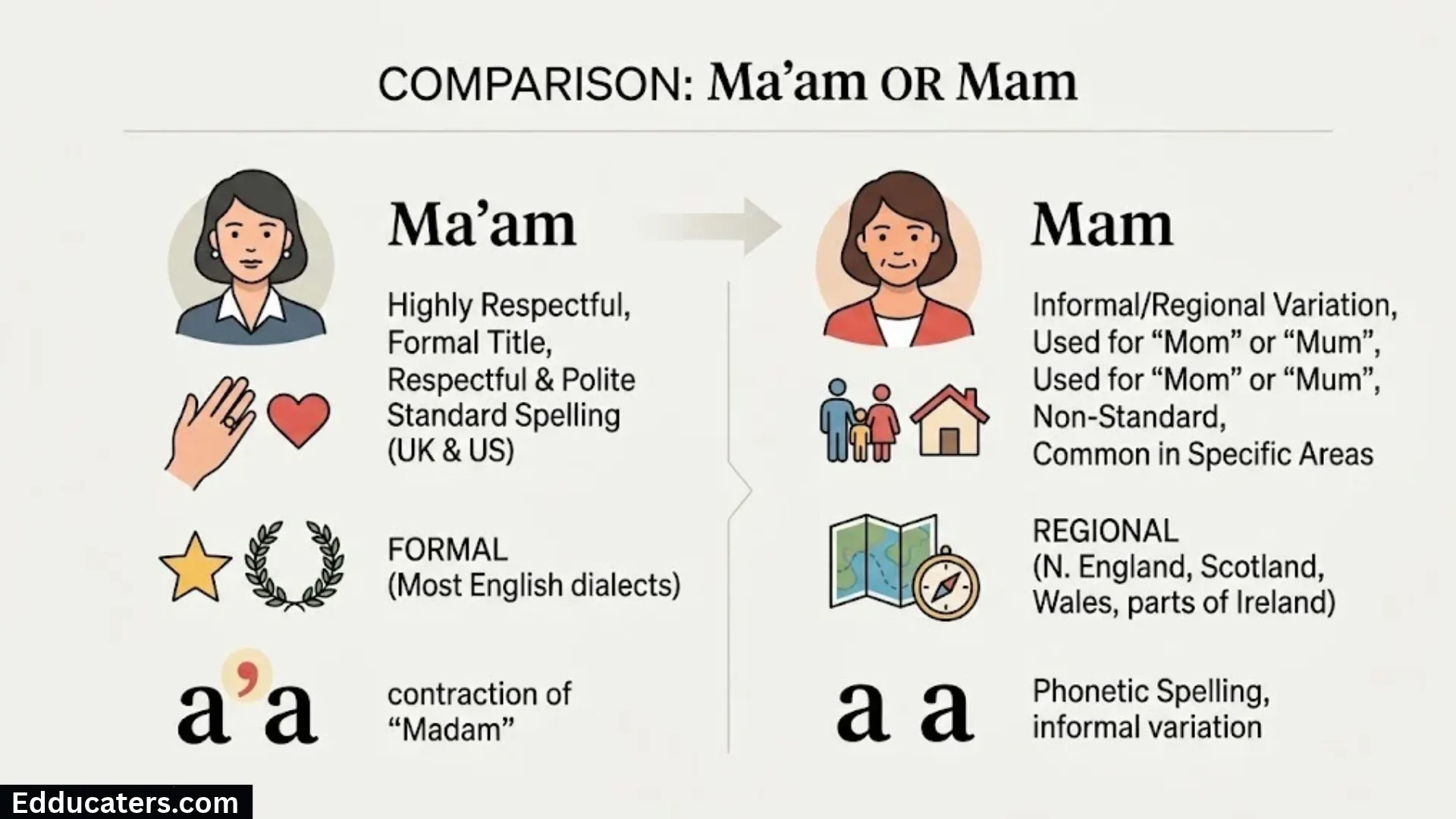
The short answer is that ma’am is the standard spelling in American English when you address a woman politely. It is the shortened form of madam. However, mam is also a real word in several regional varieties of English, where it often means mother or serves as a regional form of address.
The difference comes down to meaning, English usage, and regional conventions. Choosing the right spelling becomes much easier once you understand how each word works.
If you’re writing a professional email, speaking to a customer, addressing a teacher, or texting your mother, this guide explains when to use ma’am or mam, why the apostrophe matters, and which form fits your situation.
Ma’am or Mam: Which Is Correct?
Ma’am is the standard choice when you want to address a woman politely in American English. Mam is appropriate in regional English when it carries a recognized local meaning, particularly as a term for mother.
Neither spelling works as a universal replacement for the other. You need to consider what you mean and where the word is being used.
| Word | Meaning | Typical usage | Example |
| Ma’am | A polite form of address for a woman | Standard American English and other English varieties | Thank you, ma’am. |
| Mam | Often means mother; can also be a regional form of address | Regional and informal English | My mam is at home. |
| Madam | The full form associated with the polite address ma’am | Formal address and certain titles | Please direct your question to Madam Chair. |
| Maam | Usually a nonstandard spelling of ma’am | Informal typing or spelling mistakes | Write “Yes, ma’am,” in standard English. |
The most important distinction is that ma’am or mam have different spelling conventions and can carry different meanings.
For example, if you’re thanking a customer in the United States, write:
Thank you, ma’am, for your patience.
If you’re talking about your mother in a community where mam is the customary term, you might write:
My mam is visiting this weekend.
Both sentences can be correct in their intended contexts.
Quick rule: Use ma’am for the standard American English polite address. Use mam when the regional meaning or convention calls for it.
What Does Ma’am Mean?
Ma’am is a polite form of address used when speaking directly to a woman. It can express respect, courtesy, or professional politeness without requiring you to know her name.
According to the Cambridge Dictionary, ma’am is a noun used as a form of address. It is also a contraction, or shortened form, of madam.
In everyday American English, you might hear it in shops, restaurants, workplaces, schools, and other public settings.
Consider these examples:
- “Excuse me, ma’am. You dropped your wallet.”
- “Yes, ma’am. I’ll take care of that.”
- “Thank you, ma’am, for explaining the situation.”
- “May I help you, ma’am?”
Each example uses ma’am to address a woman directly.
Is Ma’am a Noun or a Title?
Grammatically, ma’am is a noun used as a form of address. It isn’t a personal name or a professional qualification like Dr. or Professor.
You can use it by itself without adding a name:
“Good afternoon, ma’am. How can I help you?”
However, if you know someone’s professional title, using that title may be more appropriate.
For example:
- “Good morning, Professor Smith.”
- “Thank you, Dr. Ahmed.”
- “Excuse me, ma’am.”
All three examples can show respect. The best choice depends on the person’s role and the situation.
Does Ma’am Always Sound Respectful?
Not necessarily. Although ma’am generally communicates politeness, tone, culture, and personal preference affect how people interpret it.
Some women appreciate the respectful address. Others associate it with age or excessive formality and prefer their names.
For instance, a customer might appreciate hearing “How can I help you, ma’am?” from a service representative. A younger woman might find the same expression unnecessarily formal.
The word itself isn’t inherently rude. However, the relationship between the speakers and the way someone delivers it can change its effect.
What Does Mam Mean?
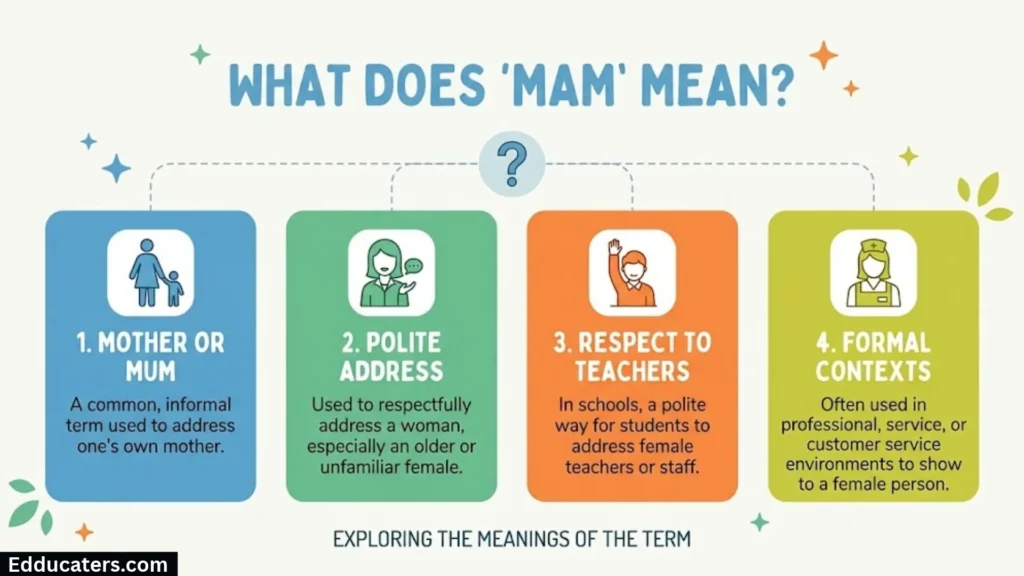
Mam is an established English word, not simply a misspelling of ma’am. In British regional English, it can mean mother. Some communities also use it as a familiar or respectful form of address.
The Oxford Advanced Learner’s Dictionary identifies mam as an informal British English dialect word meaning mother. The dictionary traces it to the late 16th century and suggests that it may imitate the early sounds children make.
That history helps explain why the word has a different role from ma’am, which developed as a shortened form of madam.
Mam as a Regional Term for Mother
In some communities, people use mam as a familiar name for their mother. Its use depends on local speech and family traditions.
For example:
- “My mam is making dinner.”
- “I’ll ask my mam when she gets home.”
- “I bought my mam a birthday present.”
- “My mam taught me how to cook.”
These sentences use mam to refer to a mother rather than to address an unfamiliar woman politely.
In standard American English, mom is much more common for this meaning. In British English, mum is also widely used, while mam occurs in certain regional varieties.
You shouldn’t assume that every British or Irish speaker uses mam. Regional vocabulary varies even within the same country.
Mam as a Form of Address
Some speakers use mam when speaking directly to a woman, following their local language conventions.
For example, someone might use a regional form of address in a familiar shop or neighborhood conversation. The word can sound natural to local speakers even if someone from another region expects ma’am.
This is an important point about regional English: a form that differs from standard American spelling or usage isn’t automatically wrong in every context.
However, if you’re writing for an American audience and intend to address a woman politely, ma’am is generally the safer choice.
Is Mam Informal or Incorrect?
The answer depends on its intended meaning.
| Situation | Is mam appropriate? |
| Referring to your mother in a community that uses mam | Yes |
| Using a recognized regional form of address | Yes, where customary |
| Addressing a customer in standard American English | Usually use ma’am |
| Writing a formal American business email | Usually use ma’am or a professional title |
| Replacing ma’am with mam simply to omit the apostrophe | No, not in standard American English |
The key is to distinguish regional spelling from a spelling error. Mam has its own established meaning, but that doesn’t make it a standard substitute for ma’am in every sentence.
Why Does Ma’am Have an Apostrophe?
The apostrophe in ma’am marks omitted letters in the shortened form of madam. It isn’t decorative punctuation. It reflects how the word developed and how English conventionally writes it.
The Oxford Advanced Learner’s Dictionary identifies ma’am as a contraction of madam, dating the shortened form to the mid-17th century.
Compare the two forms:
- Madam: The full word.
- Ma’am: The conventional shortened form.
- Maam: A common nonstandard spelling when the intended word is ma’am.
- Mam: A separate word with regional meanings.
Why Is Ma’am Spelled With an Apostrophe?
English uses apostrophes in some contractions to indicate missing letters. Common examples include don’t for do not and you’re for you are.
The same broad idea helps explain ma’am. Its spelling represents a shortened form of madam, rather than an unrelated word created by removing punctuation.
However, not all contractions follow one simple spelling pattern. English has developed many conventional forms over centuries, and writers generally need to learn their accepted spellings.
For standard written English, the correct form is ma’am, with an apostrophe between the a and the m.
Can You Write Ma’am Without an Apostrophe?
In informal digital communication, people sometimes omit apostrophes because they’re typing quickly or using a keyboard that makes punctuation inconvenient.
You might encounter maam in a text message, search query, or unedited online comment. Readers may understand the intended word, but that doesn’t make it the preferred spelling in polished writing.
Use the apostrophe in:
- Professional emails.
- Academic correspondence.
- Business letters.
- Articles and blog posts.
- School assignments.
- Customer service messages.
Remember: Mam and maam aren’t interchangeable. One has established regional meanings, while the other is usually a spelling error when intended to mean ma’am.
Ma’am or Mam: Key Differences
Although the words look and sound similar, they differ in meaning, spelling, word origin, and usage.
| Feature | Ma’am | Mam |
| Standard American English use | Polite address for a woman | Not the usual American term for mother |
| Regional meaning | Polite address; certain specialized uses | Often means mother |
| Word origin | Shortened form of madam | Possibly based on early child speech |
| Apostrophe | Required in the conventional spelling | Not used |
| Formal writing | Commonly appropriate as a direct address | Depends on regional meaning and context |
| Informal communication | Appropriate when addressing a woman politely | Appropriate in communities where it is customary |
| Example | “Thank you, ma’am.” | “My mam is at work.” |
Ma’am or Mam: Which Word Should You Choose?
Ask yourself what you want to communicate.
If you’re addressing a woman politely, use ma’am in standard American English.
“Excuse me, ma’am. Is this seat taken?”
If you’re referring to your mother and mam is your community’s customary term, use mam.
“I’ll call my mam after work.”
If you’re writing for an international audience, consider whether another form of address would be clearer. For example, using someone’s name or professional title can avoid regional confusion.
The distinction isn’t merely about punctuation. The words can serve different purposes, so replacing one with the other can change the meaning of a sentence.
When Should You Use Ma’am?
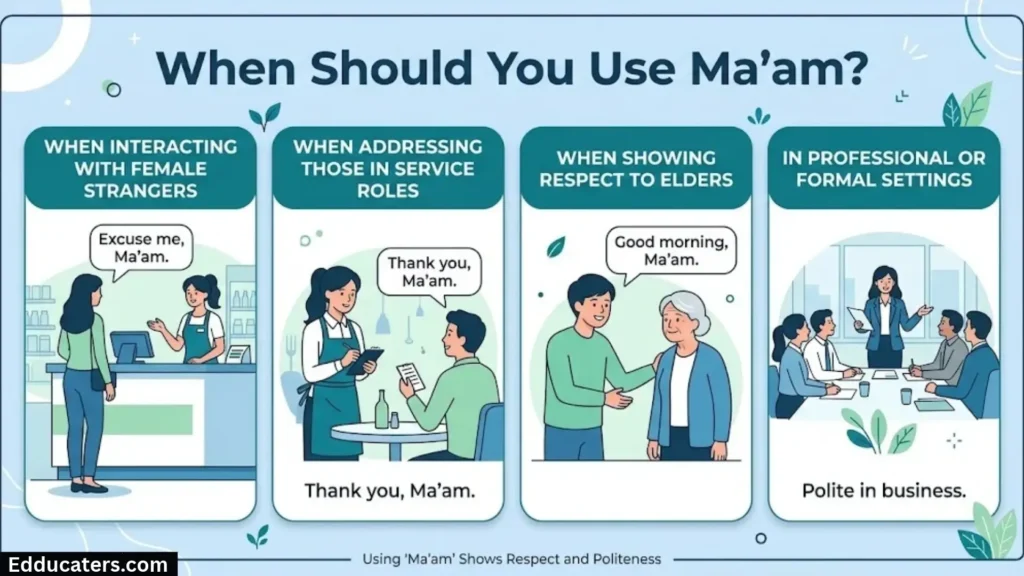
Use ma’am when you want to address a woman politely and the word fits the situation. It appears in everyday conversation as well as certain professional and formal settings.
In Everyday Conversation
In American English, ma’am can help you sound courteous when asking a stranger a question, offering assistance, or thanking someone.
Examples include:
- “Excuse me, ma’am. Could you help me?”
- “Thank you, ma’am.”
- “Good morning, ma’am.”
- “Would you like a receipt, ma’am?”
The word is particularly familiar in parts of the American South, where it can be a routine expression of courtesy rather than a sign of great formality.
Still, regional customs differ. In some places, people rarely use ma’am in casual conversation.
In Customer Service
Customer service workers may use ma’am to address a customer whose name they don’t know.
For example:
“Thank you for waiting, ma’am. I’ll check your order now.”
The expression can sound professional and respectful, particularly when delivered naturally.
However, using someone’s name may feel warmer if you already know it. Repeating ma’am in every sentence can sound stiff or overly formal.
A more natural exchange might look like this:
Customer: “Could you check whether my order has shipped?”
Representative: “Of course, ma’am. Let me look that up for you.”
Customer: “Thank you.”
Representative: “You’re welcome.”
The form of address serves its purpose without becoming the focus of the conversation.
When Addressing a Teacher or Professor
Whether ma’am is suitable for a teacher depends on the school, region, and teacher’s preference.
In some schools, students routinely address female teachers as ma’am. In others, students use a teacher’s surname and professional title.
Examples:
- “Yes, ma’am. I’ll submit the assignment tomorrow.”
- “Good morning, Professor Smith.”
- “Thank you for your feedback, Dr. Ahmed.”
Use the form that fits your institution’s language conventions. If you’re unsure, a teacher’s preferred title is a reliable starting point.
In Professional Communication
You can use ma’am when addressing a woman directly in a professional conversation, but it isn’t necessary in every business interaction.
For example:
“Thank you, ma’am. I’ll send the updated file this afternoon.”
This can work in a workplace where the expression sounds natural. In other settings, addressing the recipient by name may be more suitable.
For a formal email, you might write:
Dear Dr. Ahmed,
rather than:
Dear Ma’am,
The first option is more specific when you know the recipient’s professional title. The second may sound impersonal or overly formal in some workplaces.
When Should You Use Mam?
Use mam when its meaning matches your sentence and the word is customary in your community. The most familiar use is as a regional term for mother.
When Talking About Your Mother
If you grew up calling your mother mam, using that word in everyday writing is natural.
Examples:
- “My mam will be home soon.”
- “I spoke to my mam this morning.”
- “My mam is visiting us next week.”
These sentences don’t need an apostrophe because mam isn’t a shortened spelling of madam in this context.
A writer from the United States would more commonly write mom, while a British writer might use mum. The best choice depends on the speaker’s regional vocabulary.
In Regional Conversation
Words often develop different meanings across English-speaking communities. A form of address that sounds ordinary in one region might sound unfamiliar elsewhere.
The same principle applies to mam. Where a community uses it as a familiar or respectful address, the word can fit naturally into conversation.
However, don’t assume that mam is universally accepted as a polite form of address across Britain, Ireland, or South Asia. Usage varies by location and community.
In Text Messages and Informal Writing
Informal messages often reflect the words people use in everyday speech.
For example:
“I’ll ask my mam and let you know tonight.”
If mam is your usual term for mother, there’s no reason to change it to ma’am. Doing so would alter the intended meaning.
Likewise, don’t replace ma’am with mam simply because you want to avoid typing an apostrophe.
The right spelling follows the intended meaning, not the convenience of the keyboard.
Is Ma’am or Mam Better for Formal Writing?
For formal writing, ma’am is the standard choice when you need a polite form of address in American English. However, a professional title or the recipient’s name may be better in many situations.
The important thing is to distinguish formal spelling from formal etiquette. A word can be spelled correctly but still sound unnatural in a particular message.
In Business Emails
Suppose you’re replying to a customer who has asked for help with an order.
You could write:
Thank you for your patience, ma’am. I’ve reviewed your request and attached the updated invoice.
The spelling is correct, and the tone is courteous.
However, many business emails don’t need ma’am at all. You can write a clear, professional response without adding a form of address to every message.
For example:
Thank you for your patience. I’ve reviewed your request and attached the updated invoice.
Both versions are grammatically sound. Choose the one that fits the relationship and communication style.
In Academic Emails
When writing to a professor, instructor, or administrator, use the title that fits the person’s role.
Examples:
- “Dear Professor Smith,”
- “Dear Dr. Ahmed,”
- “Hello, Ms. Johnson,”
If you’re unsure whether someone uses Dr., Professor, Ms., or another title, check their institutional profile or previous correspondence when possible.
Using ma’am as a greeting may be appropriate in some contexts, but it isn’t a universal substitute for a person’s professional title.
In Customer Service Messages
Customer service messages should sound respectful without feeling mechanical.
Compare these examples:
Natural and professional:
Thank you for contacting us. How can I help you today?
Polite direct address:
Certainly, ma’am. I’ll check that for you.
Potentially too formal for the situation:
Yes, ma’am. Certainly, ma’am. Thank you, ma’am.
The last example isn’t necessarily grammatically incorrect, but repeated forms of address can make the conversation sound unnatural.
In Text Messages
Text messages give you more flexibility, but the intended meaning still matters.
| Intended message | Appropriate wording |
| Thanking a woman politely | “Thanks, ma’am!” |
| Talking about your mother in regional English | “I’ll ask my mam.” |
| Talking about your mother in American English | “I’ll ask my mom.” |
| Writing to a professor | “Thank you, Professor Smith.” |
Apostrophes sometimes disappear in quick messages, but standard spelling remains useful when clarity and professionalism matter.
Ma’am or Mam Pronunciation
The pronunciation of ma’am varies across English-speaking regions. In common American usage, it often sounds like a single syllable that rhymes with ham. Some speakers use a vowel closer to the one in palm.
The Cambridge Dictionary’s pronunciation entry gives /mæm/ for US pronunciation and /mɑːm/ for UK pronunciation.
These differences help explain why written forms can be confusing.
How Do You Pronounce Ma’am?
In many American accents, ma’am sounds like “mam,” with a short vowel. In other accents, the vowel may sound longer or different.
The apostrophe doesn’t create an extra spoken syllable. The word is generally pronounced as one syllable.
How Do You Pronounce Mam?
Mam is also generally pronounced as one syllable, but the exact vowel sound depends on regional speech.
Because mam or ma’am may sound alike or nearly alike, listeners can’t always determine the intended spelling from pronunciation alone.
For that reason, spoken pronunciation and written spelling need to be considered separately.
If you’re writing a sentence, start with the meaning. Then choose the conventional spelling for that meaning and audience.
Common Ma’am or Mam Spelling Mistakes
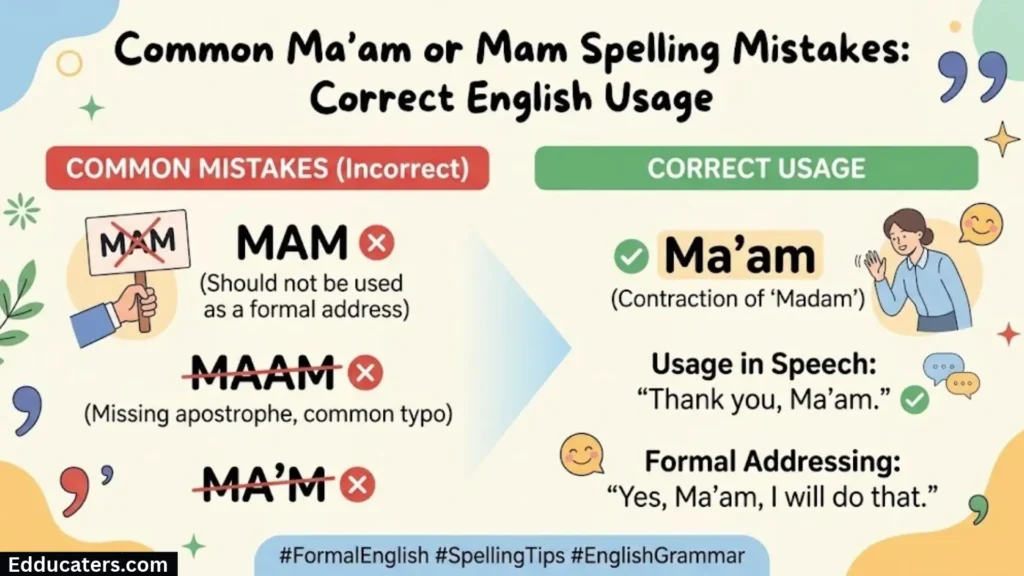
Even fluent English speakers can confuse these forms. Most mistakes happen when writers focus on sound rather than meaning.
Writing Maam Without an Apostrophe
The standard spelling is ma’am, not maam.
Incorrect: “Thank you, maam.”
Correct: “Thank you, ma’am.”
Although readers can usually understand the first version, the second follows standard written English.
Treating Mam as Always Incorrect
Some writers assume that mam is simply a misspelling of ma’am. That overlooks its regional use as a word for mother.
Incorrect assumption: “Mam is never a real English word.”
Better explanation: Mam is a regional English word, but it isn’t the standard American English spelling of the polite address ma’am.
Using Ma’am When You Mean Mother
If you’re talking about your mother, use the term customary in your region.
For example:
- Regional English: “My mam is waiting outside.”
- American English: “My mom is waiting outside.”
- Standard polite address: “Thank you, ma’am.”
These sentences serve different purposes. Their meanings determine the spelling.
Forgetting the Comma in Direct Address
When you address someone directly, punctuation helps separate the form of address from the rest of the sentence.
Compare:
- “Thank you, ma’am.”
- “Excuse me, ma’am, could you move your bag?”
- “Yes, ma’am. I’ll be there soon.”
A comma usually separates ma’am from the rest of the sentence. When the direct address begins or ends a sentence, its position determines where the comma belongs.
This is a direct address punctuation rule, not a special rule that applies only to ma’am.
Assuming Everyone Likes Being Called Ma’am
Correct spelling doesn’t guarantee that a form of address will suit every person.
Some women associate ma’am with respect. Others feel that it makes them sound older or creates unnecessary distance.
When possible, follow the person’s affirming name or title. Courtesy involves both accurate language and awareness of your audience.
Ma’am or Mam: Examples in Sentences
The easiest way to remember the difference is to see each word in context.
| Sentence | Explanation |
| “Thank you, ma’am.” | Correct polite address in standard American English |
| “Excuse me, ma’am. Is this yours?” | Uses ma’am to address a stranger politely |
| “Yes, ma’am. I’ll send the report today.” | Uses ma’am in a respectful response |
| “My mam makes excellent bread.” | Uses mam to mean mother in regional English |
| “I’ll visit my mam this weekend.” | Uses the regional term for mother |
| “Can I help you, ma’am?” | A common customer service expression |
| “Dear Professor Smith,” | Uses a professional title in an academic email |
| “Thank you, ma’am, for your help.” | Uses commas around the direct address |
Examples of Correct and Incorrect Spelling
| Sentence | Assessment | Reason |
| “Thank you, ma’am.” | Correct | Standard spelling of the polite address |
| “Thank you, maam.” | Nonstandard | Missing apostrophe |
| “My mam lives nearby.” | Correct in the appropriate regional context | Mam means mother |
| “My ma’am lives nearby.” | Usually incorrect for the intended meaning | Ma’am doesn’t normally mean mother |
| “Yes, ma’am.” | Correct | Polite direct address |
| “I’ll call my mam.” | Correct in the appropriate regional context | Uses the regional word for mother |
Remember that an example can be appropriate in one variety of English and unusual in another. Regional vocabulary deserves context rather than a blanket label of right or wrong.
Frequently Asked Questions
Is Mam a Real Word?
Yes. Mam is an established regional English word, often meaning mother. It can also function as a form of address in some communities. However, it isn’t the standard American English spelling of ma’am.
Is Ma’am Grammatically Correct?
Yes. Ma’am is a recognized shortened form of madam and a standard polite form of address in American English. Use the apostrophe in formal and polished writing.
Can I Use Mam in a Formal Email?
You can use mam when its regional meaning is appropriate, but it usually isn’t the best choice for addressing a woman in standard American English. Consider ma’am, the person’s name, or a suitable professional title.
Is Ma’am Only Used for Older Women?
No. Ma’am isn’t restricted to older women. However, some people associate it with age or formality, so preferences vary. If someone tells you they prefer another form of address, respect that preference.
What Is the Shortened Form of Madam?
Ma’am is the conventional shortened form of madam. It uses an apostrophe to reflect omitted letters in the shortened form.
Does Mam Mean Mother?
Yes. In some regional varieties of English, mam means mother. American English more commonly uses mom, while British English widely uses mum. The appropriate word depends on regional convention.
Why Do People Write Mam Instead of Ma’am?
Some people write mam because it is their regional word or customary form of address. Others may omit the apostrophe by mistake. The intended meaning and regional context help determine whether the spelling is appropriate.
Is Ma’am Appropriate for a Female Teacher?
It can be, especially in schools where students commonly address teachers as ma’am. In other settings, Professor, Dr., Ms., or the teacher’s preferred title may be more appropriate.
Can You Write Ma’am Without an Apostrophe?
In standard English, use the apostrophe. The spelling maam is generally nonstandard when the intended word is ma’am. Informal messages may omit punctuation, but that doesn’t make the spelling preferred.
What Is the Difference Between Madam or Ma’am?
Madam is the full form, while ma’am is its shortened form used as a polite address. Madam also appears in formal greetings and certain titles. The two forms aren’t interchangeable in every sentence.
Conclusion: Ma’am or Mam?
The difference between ma’am or mam becomes clear once you consider meaning and context.
Ma’am is the standard American English spelling for politely addressing a woman. It comes from madam and uses an apostrophe to mark its shortened form.
Mam is also a real English word. In some regional varieties, it means mother or serves as a familiar form of address.
Keep these three rules in mind:
- Use ma’am when politely addressing a woman in standard American English.
- Use mam when its regional meaning or local convention fits the sentence.
- Use maam only with the understanding that it is generally a nonstandard spelling of ma’am.
When you’re unsure, focus on what you mean and who will read your writing. The right word will usually become clear.

Hello, I’m Claire Holloway. I have always been passionate about the English language and enjoy turning complex grammar rules into simple, easy-to-follow lessons. I believe that every learner can become a confident English writer with the right guidance.
I create educational content focused on grammar, vocabulary, sentence structure, and writing improvement. Every article I publish is designed to help readers learn with confidence and accuracy.
Books
Grammar Without Confusion
Modern English Usage Guide
 Nathan Whitmore
 Julian Mercer