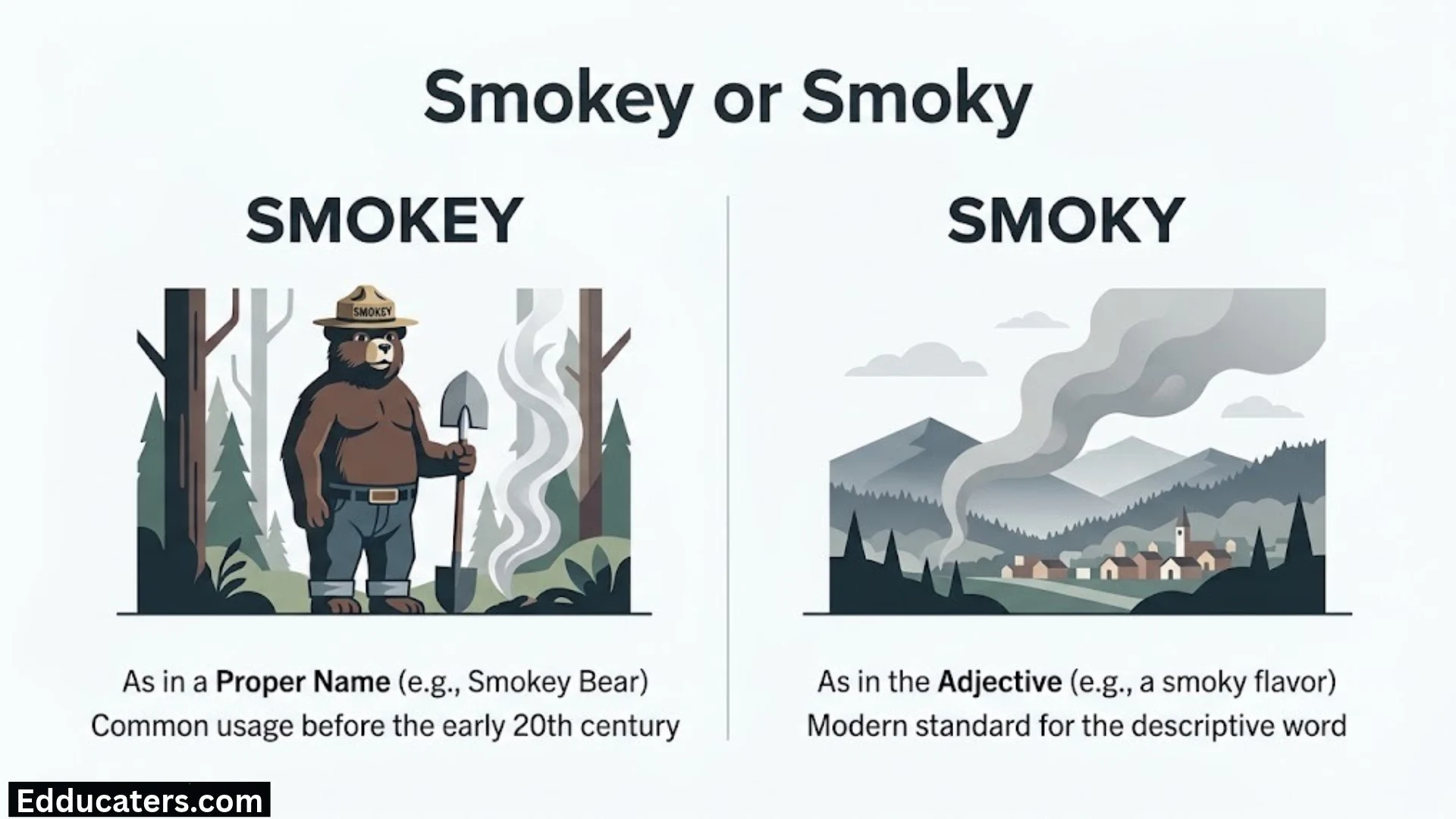
Have you ever wondered whether a room is smokey or smoky? The difference looks tiny, but that extra letter changes how you use the word.
Both smoky and Smokey appear in English. However, they don’t serve the same grammatical purpose. One is the standard spelling of an adjective, while the other commonly appears in proper names.
Smoky is the correct standard adjective when describing something filled with smoke, resembling smoke, or having a smoke-like smell or flavor. Smokey is the established spelling in names such as Smokey Bear. It can also appear as a personal name, nickname, or surname.
For example:
- The kitchen became smoky after the food started burning.
- We enjoyed the smoky flavor of the grilled chicken.
- Smokey Bear teaches people about wildfire prevention.
- My neighbor’s dog is named Smokey.
The easiest way to remember the distinction is simple: use smoky when describing smoke and Smokey when writing an established name.
Let’s explore their meanings, spelling differences, grammatical roles, and everyday uses so you can choose the right form confidently.
Smokey or Smoky: Which Spelling Is Correct?
The correct spelling depends on what you want to communicate. Although both forms exist, smoky is the standard spelling of the descriptive adjective in American English.
Smokey is primarily a proper-name spelling. Its most recognizable use appears in the name Smokey Bear, the famous American wildfire-prevention mascot.
Here’s a quick comparison:
| Feature | Smoky | Smokey |
| Standard adjective | Yes | No |
| Part of speech in ordinary use | Adjective | Proper noun when used as a name |
| Describes smoke-filled air | Yes | Not the standard spelling |
| Describes flavor | Yes | Not the standard spelling |
| Describes appearance | Yes | Not the standard spelling |
| Used in personal names | Possible | Yes |
| Famous example | Smoky air | Smokey Bear |
The distinction becomes easier when you consider how each word functions in a sentence.
For example, if you describe a room filled with smoke, write smoky room. If you’re referring to the famous forest-fire prevention mascot, write Smokey Bear.
One important detail deserves attention: Smokey isn’t automatically incorrect whenever it appears outside the mascot’s name. People can have Smokey as a given name, nickname, or surname. Personal names follow their established spelling rather than ordinary adjective rules.
Therefore, don’t treat the two spellings as interchangeable. Choose the form that matches the meaning and context.
What Does Smoky Mean?
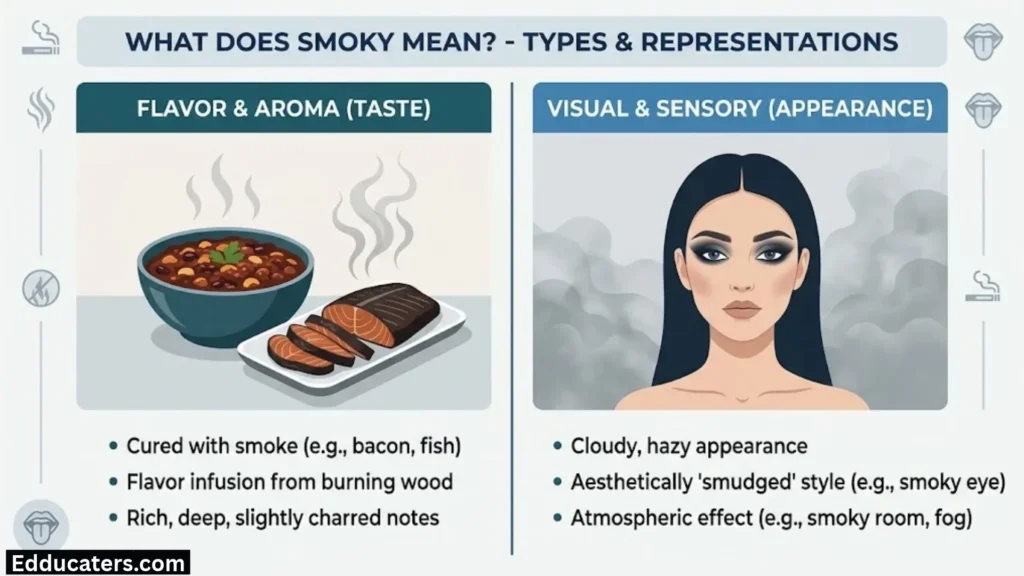
Smoky is an adjective that describes something containing smoke, producing smoke, or resembling smoke. It can also describe a smell, flavor, appearance, or sound associated with smoke.
The word has several related meanings. Its precise interpretation depends on the noun it modifies and the surrounding sentence.
For example:
- A smoky room contains visible smoke.
- A smoky smell resembles the odor of burning wood.
- A smoky flavor suggests the taste associated with smoke.
- Smoky eyes describes a particular makeup style.
- A smoky voice has a deep, husky, or slightly raspy quality.
These examples demonstrate why smoky works in several different contexts. It doesn’t always describe actual smoke.
Smoky as a Description of Smoke or Air
The most common meaning of smoky relates directly to smoke in the air.
When something burns, it can release smoke containing tiny particles and gases. If enough smoke gathers in an area, the surrounding air becomes smoky.
You might encounter this description around fireplaces, campfires, cooking areas, factories, or wildfires.
Consider these examples:
- The living room became smoky after someone forgot to open the fireplace damper.
- A smoky haze covered the neighborhood after the nearby wildfire.
- The firefighters entered the smoky building wearing protective equipment.
- We moved outside because the kitchen had become too smoky.
- The campfire produced thick, smoky air as the wood burned.
Notice how the adjective helps readers imagine the surrounding conditions. Instead of simply saying that smoke appeared, you describe the atmosphere created by it.
The word can also describe something that produces noticeable smoke.
For instance, a smoky fire produces considerable smoke rather than burning cleanly. Similarly, a smoky chimney may indicate that smoke isn’t escaping properly.
However, remember that smoky describes the condition or appearance. It doesn’t automatically identify the source of the smoke.
Smoky as a Description of Taste or Flavor
A smoky flavor is another common use of the adjective. It describes a taste or aroma associated with smoke, burning wood, or smoke-based cooking methods.
You might notice this flavor in barbecue, grilled vegetables, smoked cheese, or certain spices.
Wood plays an important role in creating traditional smoky flavors. Hickory, oak, applewood, and mesquite can each contribute different aromatic qualities to food.
For example, hickory often gives barbecue a bold, rich smoke character. Applewood generally produces a milder, slightly sweet impression.
Common expressions include:
- Smoky barbecue sauce
- Smoky grilled chicken
- Smoky bacon
- Smoky roasted peppers
- Smoky cheese
- Smoky coffee
- Smoky grilled vegetables
Consider these sentences:
- The restaurant serves ribs with a rich smoky flavor.
- Hickory wood gives the meat a distinctive smoky aroma.
- I added smoked paprika to create a deeper, smoky taste.
- The grilled vegetables developed a delicious smoky character.
Interestingly, a food can have a smoky flavor without containing visible smoke when you eat it. Manufacturers can create smoke-like flavors through ingredients and flavoring processes.
The adjective describes the sensory experience rather than requiring actual smoke to remain present.
Smoky as a Description of Appearance
The word smoky can also describe something that looks hazy, muted, dark, or similar to drifting smoke.
This meaning appears frequently in fashion, makeup, photography, interior design, and artistic descriptions.
One familiar expression is smoky eyes, a makeup style that uses blended eyeshadow to create a soft, dark, shaded appearance around the eyes.
A traditional smoky eye often combines darker shades near the lash line with lighter or softer colors around the edges.
For example:
- She chose a smoky eyeshadow look for the evening party.
- The makeup artist created beautiful smoky eyes using charcoal and brown shades.
- A smoky gray color softened the appearance of the living room.
- The photographer used a hazy effect to create a smoky atmosphere.
In these examples, the word describes visual qualities rather than literal smoke.
The same principle applies to colors and artistic effects. A smoky blue or smoky gray shade may look muted, soft, or slightly hazy.
Smoky as a Description of a Voice or Sound
A smoky voice is a figurative expression describing a particular vocal quality.
It generally refers to a deep, husky, raspy, or slightly breathy sound. The description often appears in music reviews and discussions of singers.
For example:
- The singer’s smoky vocals gave the blues recording a distinctive character.
- Her smoky voice suited the slow jazz performance.
- The actor spoke in a deep, slightly smoky tone.
The adjective doesn’t suggest that smoke literally comes from someone’s mouth. Instead, it creates an impression of texture and depth.
This is similar to describing a voice as warm, bright, rough, or velvety. Such expressions help readers imagine sounds that are difficult to explain through technical terms alone.
What Does Smokey Mean?
Smokey is best known as a proper name, particularly through the famous American character Smokey Bear. However, the spelling has other uses in English.
It can function as a personal name, nickname, surname, or fictional character name. In some dictionaries, lowercase smokey is also recognized as an alternative spelling of the adjective smoky.
This last point is important because the distinction isn’t quite as absolute as some spelling guides suggest.
For example, Cambridge Dictionary and Collins recognize smokey as an alternative adjective spelling. Nevertheless, smoky remains the more conventional spelling in standard American writing.
English meaning – Cambridge Dictionary+2
Here are some contexts in which you’ll encounter Smokey:
- Proper name: Smokey Bear.
- Personal name: Someone named Smokey.
- Nickname: A nickname given to a friend or family member.
- Surname: A family name spelled Smokey.
- Character name: A fictional character named Smokey.
- Alternative adjective spelling: Lowercase smokey in certain dictionary-recognized uses.
The most important distinction involves capitalization and context. When you write Smokey Bear, you’re using an established proper name. When you write smokey flavor, you’re using an alternative adjective spelling rather than referring to a person or character.
Smokey Bear: The Famous American Mascot
A notable example of the proper-name spelling
One of the most recognizable uses of Smokey appears in Smokey Bear, the American mascot associated with preventing unwanted wildfires.
The character first appeared in 1944 as part of a public education campaign organized by the U.S. Forest Service, the National Association of State Foresters, and the Advertising Council.
The campaign encouraged Americans to take responsibility for preventing human-caused forest fires. Its creators chose a bear because the animal represented strength, familiarity, and a connection to the outdoors.
Artist Albert Staehle created the first illustration of Smokey Bear. The character wore a ranger-style hat and blue jeans and quickly became a familiar face in American public service advertising.
Why does the mascot’s name use an E?
The answer is simple: Smokey is the character’s established name. It isn’t an attempt to spell the ordinary adjective differently.
There is also an interesting story behind the name. The mascot was reportedly named after Joseph B. “Smokey Joe” Martin, a former assistant chief of the New York City Fire Department.
The campaign became famous for its memorable slogan:
Only You Can Prevent Forest Fires.
The slogan appeared in 1947 and became closely associated with the character. In 2001, the campaign updated it to:
Only You Can Prevent Wildfires.
The revised wording reflected the fact that dangerous wildfires can occur beyond traditional forest areas.
Another interesting detail involves the mascot’s official name.
People often call him Smokey the Bear. However, his official name is Smokey Bear, without the word “the.”
The additional word became popular after songwriters Steve Nelson and Jack Rollins included it in their 1952 song. They added “the” to maintain the song’s rhythm. The song’s popularity helped the alternative name spread.
A real bear cub later became the living symbol of the campaign. Rescuers found the injured cub during a 1950 wildfire in New Mexico’s Capitan Mountains. After receiving treatment, he moved to the National Zoo in Washington, D.C., where he became a popular attraction.
The cub lived at the zoo until 1976. His story further strengthened the connection between the Smokey Bear character and wildfire prevention.
Today, Smokey Bear remains an important American cultural figure. His name is also protected under federal law, which makes accurate spelling especially important when referring to the official character.
Smokey as a Personal Name or Surname
Not every use of Smokey refers to the famous bear. People can also use it as a personal name, nickname, or family name.
Personal names don’t always follow ordinary spelling conventions. Their spelling depends on the choices of individuals and families.
For example, someone might have Smokey as a childhood nickname that eventually becomes their preferred name. Another person might inherit Smokey as a family surname.
Consider these sentences:
- Smokey joined his friends for dinner.
- The author introduced a character named Smokey in her latest novel.
- Mr. Smokey owns a small restaurant downtown.
- Everyone calls their friendly neighborhood dog Smokey.
In each sentence, Smokey identifies a particular person, animal, or character. That’s why it begins with a capital letter.
You shouldn’t automatically replace the E with a Y-ending adjective spelling when writing someone’s name.
For example, if someone’s legal or preferred name is Smokey, writing Smoky changes the name itself. The standard spelling of an adjective doesn’t override an individual’s established name.
Smoky vs. Smokey: Key Differences
The main difference between smoky vs. Smokey involves spelling conventions, grammatical function, and context.
Smoky is the preferred standard spelling of the adjective. Smokey is the familiar spelling in proper names and is also recognized as an alternative adjective spelling by some dictionaries.
That distinction matters because not every appearance of the E-ending form represents a spelling mistake.
Here’s a more detailed comparison:
| Feature | Smoky | Smokey |
| Common function | Adjective | Proper name; alternative adjective spelling |
| Dictionary recognition | Standard adjective spelling | Recognized adjective variant in some dictionaries |
| Describes smoke-filled air | Yes | Yes, as an alternative spelling |
| Describes flavor | Yes | Yes, as an alternative spelling |
| Describes appearance | Yes | Yes, as an alternative spelling |
| Famous proper-name example | None particularly associated with the spelling | Smokey Bear |
| Personal names | Possible | Possible |
| Capitalization | Usually lowercase | Capitalized when used as a proper name |
The comparison reveals an important detail: smokey isn’t always wrong as an adjective.
However, if you’re writing for a general American audience, smoky is the safer and more conventional choice. It also matches the standard spelling used in major American dictionary entries.
Why Does the Extra E Matter?
The extra E doesn’t create a completely different pronunciation. Both forms are generally pronounced the same way.
The difference is primarily orthographic, meaning it concerns written spelling rather than spoken sound.
For example:
- Smoky air
- Smokey air
Both can communicate that smoke fills the air. However, the first is the conventional spelling in standard American prose.
Now consider these examples:
- Smoky Bear
- Smokey Bear
The second spelling is correct because it preserves the mascot’s official name.
This distinction illustrates why context matters more than simply counting letters.
When to Use Smoky or Smokey
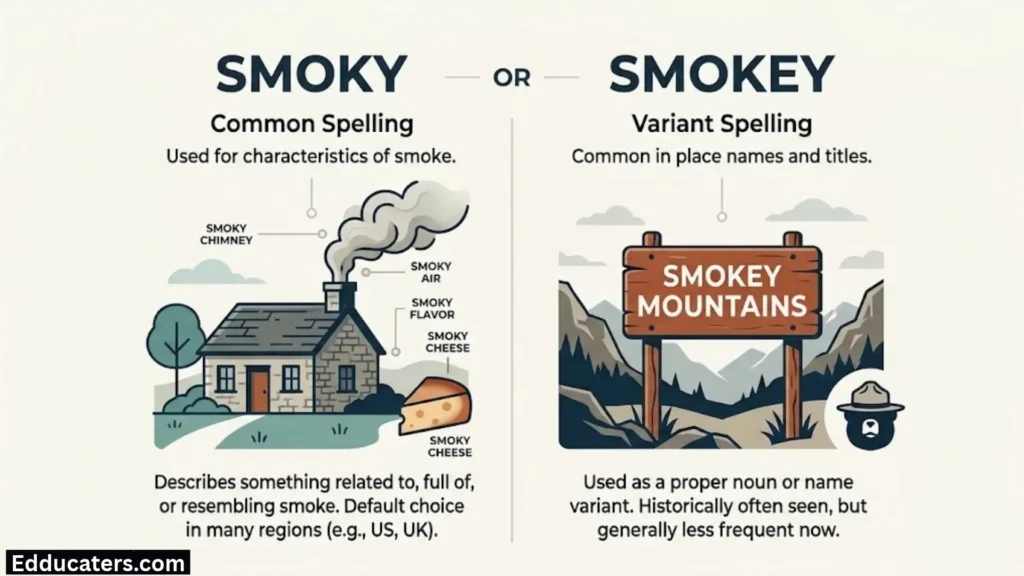
Choosing between the two forms becomes much easier when you consider the purpose of your sentence.
Use smoky as your default adjective spelling in ordinary American writing. Use Smokey when the spelling belongs to a proper name.
You may also encounter lowercase smokey as an accepted adjective variant. However, consistency matters, especially in formal writing.
When to Use Smoky
Use smoky when you want to describe something related to smoke or possessing smoke-like qualities.
It works naturally in several situations.
1. Describing smoke-filled surroundings
- The restaurant became smoky after the kitchen fire.
- We walked away from the smoky campfire.
- Firefighters entered the smoky building.
2. Describing food and flavor
- The sauce has a rich smoky flavor.
- I prefer smoky barbecue ribs.
- The chef added paprika for a deeper smoky taste.
3. Describing colors and appearance
- She selected a smoky gray paint color.
- The artist used smoky shades to create depth.
- The window contained smoky glass.
4. Describing makeup
- Her smoky eyeshadow complemented the evening dress.
- The makeup artist created a dramatic smoky eye.
- Dark brown eyeliner completed the smoky makeup look.
5. Describing voices and sounds
- The singer had a deep, smoky voice.
- His smoky vocals suited the blues arrangement.
- The actress delivered the line in a soft, smoky tone.
In all these situations, smoky acts as an adjective. It modifies a noun by describing its condition, quality, taste, or appearance.
When to Use Smokey
Use Smokey when the spelling belongs to an established proper name or personal naming choice.
Here are the most common situations:
1. Referring to Smokey Bear
- Smokey Bear promotes wildfire prevention.
- Children learn about fire safety through Smokey Bear.
- Smokey’s message encourages people to protect forests and wildlands.
2. Writing someone’s personal name
- Smokey arrived early for the meeting.
- My cousin named his dog Smokey.
- Smokey lives with his family in Texas.
3. Using a surname
- The Smokey family organized a reunion.
- Dr. Smokey delivered a presentation.
- The invitation was addressed to the Smokey family.
4. Writing a fictional character’s name
- Smokey appears in the opening chapter.
- The detective asked Smokey to explain what happened.
- The animated film introduces a character named Smokey.
The important rule is to preserve the established spelling of the name. Don’t change it simply because another spelling looks more familiar.
Can Smoky and Smokey Be Used Interchangeably?
The answer depends on how you’re using the words.
As adjectives, smoky and smokey can be interchangeable because dictionaries recognize the latter as an alternative spelling.
For example:
- The kitchen became smoky.
- The kitchen became smokey.
Both sentences communicate the same basic idea.
However, the spellings aren’t interchangeable in established proper names.
For example:
- Smokey Bear is the official name.
- Smoky Bear changes the character’s name.
Likewise, if a person spells their name Smokey, you shouldn’t change it to Smoky.
For everyday American writing, choose smoky as your default adjective. Reserve Smokey for proper names and use lowercase smokey only when the alternative spelling suits your style or reference.
Smokey or Smoky: Example Sentences
Examples make spelling differences easier to remember because they show how words behave in real sentences.
The following examples cover ordinary adjective usage, alternative spelling, and proper names.
Examples of Smoky in Sentences
Use smoky when you want the conventional adjective spelling.
- The kitchen became smoky after the bacon started burning.
- We enjoyed the smoky flavor of the grilled chicken.
- A smoky haze covered the mountains after the wildfire.
- She wore dark eyeshadow to create a beautiful smoky eye look.
- The singer’s smoky voice gave the song a distinctive sound.
- The restaurant served smoky barbecue ribs with homemade sauce.
- Thick, smoky air filled the room after the fireplace malfunctioned.
- The chef added smoked paprika for a deeper smoky taste.
- The artist selected a smoky gray shade for the background.
- Firefighters wore protective equipment inside the smoky building.
- The whiskey had a pleasant smoky aroma.
- Her smoky vocals suited the slow blues recording.
Examples of Smokey in Sentences
Use Smokey when referring to a proper name or someone who uses this spelling.
- Smokey Bear teaches children about wildfire prevention.
- The children recognized Smokey from the forest safety posters.
- Smokey visited the school during a fire prevention event.
- My grandfather’s nickname was Smokey.
- The author introduced a character named Smokey in her novel.
- The Smokey family invited everyone to their annual reunion.
- We watched a documentary about Smokey Bear.
- The children learned why Smokey encourages people to prevent wildfires.
Examples of Smokey as an Alternative Adjective Spelling
Lowercase smokey can also appear as an adjective. Some dictionaries recognize it as a variant of smoky.
For example:
- The cabin had a smokey smell after the fireplace burned all night.
- The sauce developed a rich, smokey flavor.
- She selected a smokey gray eyeshadow for her makeup.
- The room became smokey after the firewood started burning.
These sentences demonstrate an accepted spelling variation. However, smoky remains the more conventional choice in standard American writing.
Common Spelling Mistakes to Avoid
Even though the distinction seems simple, writers sometimes confuse these spellings. Most mistakes happen when people assume that both forms have exactly the same usage rules.
Here are some common problems to watch for.
Using Smokey as the Default Adjective Spelling
A common mistake involves choosing smokey whenever you describe smoke.
For example:
- Less conventional: The kitchen became smokey.
- Preferred: The kitchen became smoky.
The first sentence isn’t necessarily grammatically incorrect. However, the second follows the conventional American adjective spelling.
Misspelling Smokey Bear
The mascot’s name has an established spelling. Writing Smoky Bear changes that name.
- Incorrect: Smoky Bear teaches children about fire safety.
- Correct: Smokey Bear teaches children about fire safety.
Remember that proper names don’t always follow ordinary spelling patterns.
Forgetting Capitalization
Capitalization helps distinguish a proper name from an ordinary adjective.
Compare these examples:
- Smokey visited the school.
- The room smelled smoky after dinner.
- The Smokey family hosted a celebration.
- The restaurant served smoky grilled vegetables.
The capital letter identifies a name at the beginning of a sentence or a proper noun. The lowercase form works for ordinary descriptive usage.
Changing Someone’s Name
Never assume someone’s name should follow the standard adjective spelling.
If a person uses Smokey, preserve that spelling in letters, invitations, documents, and other writing.
For example:
- Incorrect for someone named Smokey: Mr. Smoky attended the ceremony.
- Correct: Mr. Smokey attended the ceremony.
This isn’t merely a stylistic preference. Names identify people, so their established spellings matter.
Treating Smokey as Universally Incorrect
Some writers insist that smokey is always a spelling error. That’s too restrictive.
Major dictionaries recognize it as an alternative adjective spelling. The real distinction involves preferred usage, dictionary recognition, and proper-name conventions.
How to Remember the Difference Between Smokey and Smoky
A simple memory trick can help you choose the right spelling without checking a dictionary every time.
Remember the E in Smokey Bear.
- Smoky: Think of smoke, flavor, smell, or appearance.
- Smokey: Think of Smokey Bear or a person’s established name.
For ordinary descriptive writing, remember this sentence:
Smoke makes the air smoky.
The word smoky describes the condition created by smoke. You don’t need an extra E to communicate that meaning.
For proper names, remember:
Smokey Bear has an E in his name.
This small association makes the difference easier to recall.
You can also use this quick reference:
| If you’re writing about… | Remember |
| Smoke-filled air | Smoky |
| Barbecue flavor | Smoky |
| A smoky voice | Smoky |
| Smoky eye makeup | Smoky |
| The famous wildfire mascot | Smokey |
| Someone named Smokey | Smokey |
| A person with the surname Smokey | Smokey |
One additional tip: when you aren’t sure whether smokey is acceptable as an adjective, choose smoky. It’s the conventional spelling and works naturally across everyday writing, academic work, and professional communication.
Is Smokey or Smoky the Correct American English Spelling?
In American English, smoky is the conventional spelling of the adjective. However, smokey is also recognized as an alternative spelling in major dictionaries.
This distinction is worth understanding because spelling references don’t always treat every variant as an error.
Cambridge Dictionary lists smokey as an alternative spelling of smoky in its American English entry. Collins also recognizes the E-ending form as an alternative spelling.
Nevertheless, if you’re writing a school assignment, business document, article, or formal email, smoky is generally the better choice.
Here are the main American English spelling guidelines:
- Use smoky as your default descriptive adjective.
- Use Smokey when writing the official name Smokey Bear.
- Preserve Smokey when it appears in someone’s established personal name or surname.
- Recognize lowercase smokey as a dictionary-listed adjective variant.
- Follow a consistent spelling style throughout your document.
American English also uses the regular comparative and superlative forms smokier and smokiest.
For example:
- This room is smokier than the kitchen.
- That was the smokiest barbecue restaurant I’ve ever visited.
Other related forms include:
| Word | Part of speech | Meaning |
| Smoke | Noun or verb | The visible substance produced by burning or the act of producing it |
| Smoky | Adjective | Full of smoke or resembling smoke |
| Smokier | Comparative adjective | More smoky |
| Smokiest | Superlative adjective | Most smoky |
| Smokily | Adverb | In a smoky manner |
| Smokiness | Noun | The quality or condition of being smoky |
These related forms help you use the word naturally in different grammatical situations.
Frequently Asked Questions
What Is the Difference Between Smokey and Smoky?
Smoky is the conventional spelling of the adjective describing smoke, smoke-like appearances, smells, and flavors. Smokey is commonly used in proper names, including Smokey Bear, and is also recognized as an alternative adjective spelling by some dictionaries.
Is It Smoky or Smokey?
Use smoky when describing something in ordinary American English. For example, write “a smoky room” or “smoky barbecue sauce.” Use Smokey when referring to Smokey Bear or someone whose name has that spelling.
What Does Smoky Mean?
Smoky means filled with smoke, producing smoke, or resembling smoke. It can also describe something with a smoke-like taste, smell, color, or appearance.
For example, smoky air contains smoke, while smoky barbecue has a flavor associated with smoke.
What Does Smokey Mean?
Smokey commonly appears as a proper name, nickname, or surname. Its best-known use is Smokey Bear, the American wildfire-prevention mascot.
Some dictionaries also recognize lowercase smokey as an alternative adjective spelling.
Is Smokey a Proper Noun?
Yes, Smokey functions as a proper noun when it identifies a particular person, character, or mascot.
For example, Smokey Bear is a proper name. The word should retain its established capitalization and spelling when referring to the mascot.
Is Smoky an Adjective?
Yes. Smoky is an adjective that describes something containing smoke, producing smoke, or having smoke-like qualities.
Examples include:
- A smoky kitchen.
- A smoky flavor.
- Smoky gray eyes.
- A smoky voice.
Can Smokey Be Used as an Adjective?
Yes. Some dictionaries recognize lowercase smokey as an alternative spelling of the adjective smoky.
However, smoky is the more conventional spelling in American English. Use it when you want a straightforward, widely accepted spelling in formal or general writing.
Why Is Smokey Bear Spelled With an E?
Smokey is the mascot’s established proper name. The character was introduced in 1944 as part of a U.S. Forest Service wildfire-prevention campaign.
The name was reportedly inspired by Joseph B. “Smokey Joe” Martin, a former New York City firefighter. The E-ending spelling distinguishes the mascot’s name from the conventional adjective smoky.
Is Smokey Bear or Smokey the Bear Correct?
Smokey Bear is the official name. Many people say Smokey the Bear because a popular 1952 song added “the” to the character’s name to maintain its rhythm.
Although the longer version became widely recognized, the official name remains Smokey Bear.
Can Smokey Be a Surname?
Yes. Smokey can appear as a family surname or personal name. Proper names retain their established spelling even when that spelling differs from conventional English vocabulary.
If someone’s surname is Smokey, don’t change it to Smoky.
Does Smoky Describe Taste or Smell?
Yes. Smoky can describe both taste and smell.
A smoky flavor often suggests food cooked over burning wood or treated with smoke. A smoky smell resembles the odor of burning wood, charcoal, or other materials.
For example, grilled meat may have a smoky flavor, while a fireplace can produce a smoky smell.
Can Smoky Describe Eye Makeup?
Yes. Smoky eyes is a common makeup expression describing a blended eyeshadow style.
The look typically uses dark shades around the eyelids and softer, blended edges to create depth. People often use black, gray, brown, or other complementary shades.
Are Smoky and Smokey Interchangeable?
They can be interchangeable when used as adjectives because dictionaries recognize smokey as an alternative spelling of smoky.
However, you shouldn’t change established proper names. Always write Smokey Bear with an E, and preserve the spelling of personal names.
Conclusion: Smokey or Smoky?
The difference between Smokey or Smoky comes down to spelling conventions and context.
Smoky is the conventional American English adjective for describing smoke-filled surroundings, smoky flavors, hazy appearances, and certain vocal qualities.
Smokey is the familiar spelling in proper names such as Smokey Bear. It can also appear as a personal name, nickname, or surname. Some dictionaries recognize lowercase smokey as an alternative adjective spelling.
If you want the safest choice for everyday writing, use smoky when describing something related to smoke. When referring to a person or the famous American mascot, preserve the established spelling Smokey.

I’m Julian Mercer, an English language writer dedicated to helping people master grammar through practical examples and clear explanations. I enjoy teaching grammar in a way that is both engaging and easy to remember.
My work focuses on grammar rules, punctuation, word usage, and writing techniques that readers can apply in everyday life. I believe learning English should be simple, enjoyable, and useful.
Books
English Grammar in Practice
Writing with Precision
 Nathan Whitmore