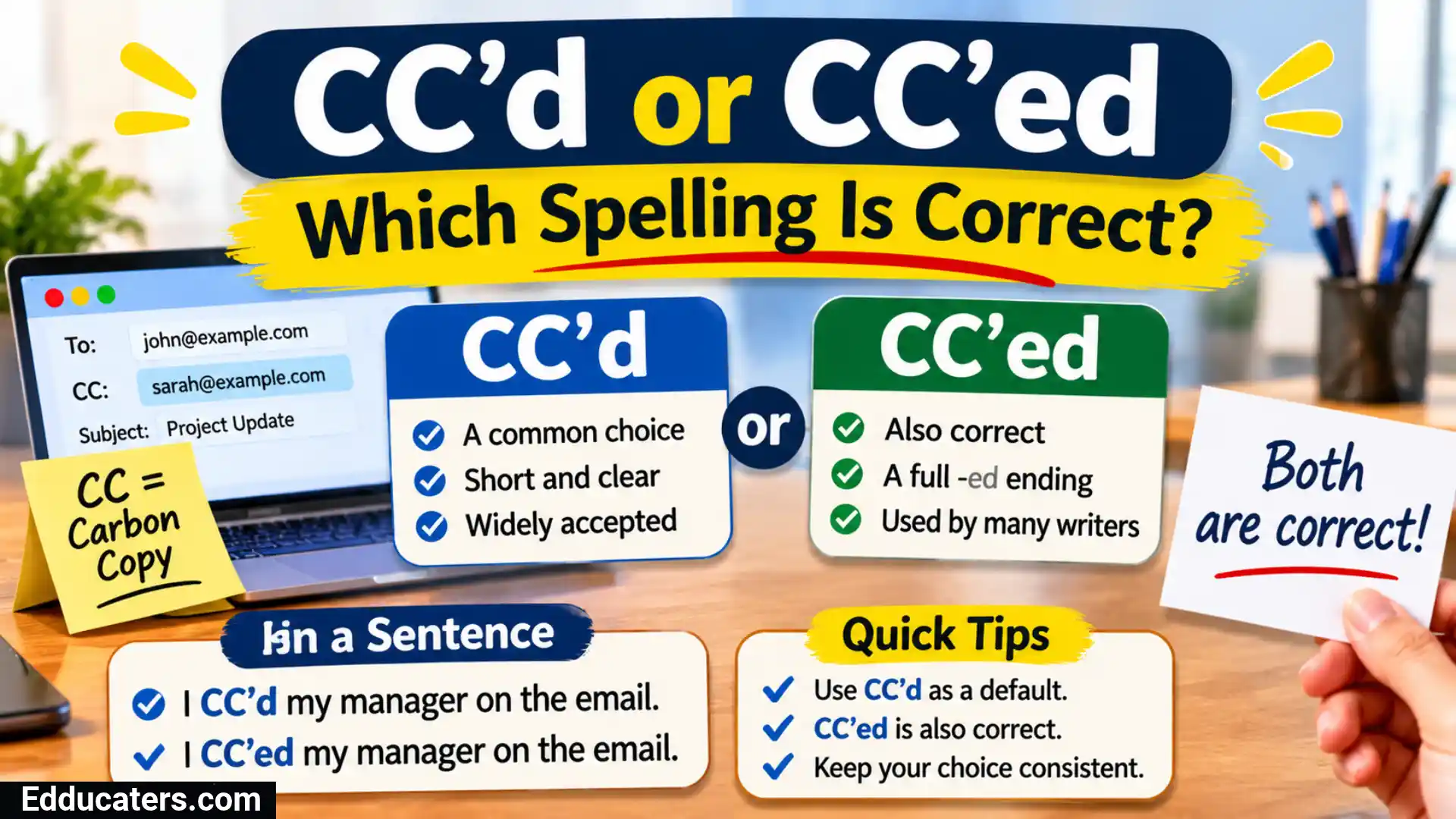
When writing an email, you might hesitate between CC’d and CC’ed. Both spellings look reasonable, but which one should you use in professional correspondence?
Both CC’d or CC’ed are acceptable spellings of the past tense of CC. CC’d is the shorter and generally preferred form in everyday email writing.
The two spellings have the same meaning. They describe the act of adding someone to an email’s carbon copy field so that person receives the message. The difference comes from how writers attach a past-tense ending to an abbreviation.
Although CC’d is a practical default for workplace communication, CC’ed isn’t a spelling mistake. You can use either form as long as you maintain consistency throughout your writing.
Let’s explore the spelling differences, grammatical rules, email examples, and situations where one form may be more suitable than the other.
CC’d or CC’ed: Which One Is Correct?
Both CC’d and CC’ed are correct and commonly understood forms of the past tense of the verb CC. Neither spelling changes the meaning of the sentence.
The abbreviation CC stands for carbon copy. When you use it as a verb, you’re describing the action of sending someone a copy of an email or message.
- CC’d: A concise past-tense form of CC that uses an apostrophe and the letter d.
- CC’ed: An alternative past-tense form that adds an apostrophe followed by ed.
For example, these two sentences communicate exactly the same information:
- I CC’d Sarah on the email.
- I CC’ed Sarah on the email.
In both examples, Sarah received a copy of the email alongside the primary recipient. The spelling doesn’t change Sarah’s role or the meaning of the sentence.
Quick answer: Use CC’d as your default spelling. CC’ed is also acceptable and doesn’t require correction.
If you’re writing a business email, either form will generally be understood. However, copied is another useful alternative when you want to avoid abbreviated wording altogether.
What Does CC’d Mean?
CC’d means someone was included in the carbon copy field of an email. It indicates that the sender sent a copy of the message to that person.
For example:
- I CC’d my supervisor on the project update.
- Maria CC’d the accounting department on the invoice.
- The client was CC’d on our latest discussion.
In each sentence, CC’d describes an action that happened in the past or an inclusion that resulted from that action.
The term also appears in everyday workplace expressions such as keep someone CC’d, get CC’d, and be CC’d on an email. These expressions help people explain who received a message without lengthy descriptions.
What Does CC’ed Mean?
CC’ed has the same meaning as CC’d. It’s an alternative spelling of the past tense and past participle of the verb CC.
For example:
- I CC’ed my colleague on the announcement.
- She CC’ed the director on the email.
- We were CC’ed on the original message.
These sentences communicate the same information as their CC’d counterparts. The additional letter e doesn’t introduce another meaning or grammatical function.
Some writers prefer CC’ed because it resembles the regular -ed ending used in English verbs. Others choose CC’d because it looks shorter and more streamlined.
Both preferences are understandable.
What Does CC Mean in an Email?
Before comparing CC’d and CC’ed more closely, it’s useful to understand what CC means in email communication.
CC stands for carbon copy. The expression originally referred to a method of creating duplicate documents using carbon paper.
When people typed documents on typewriters, they could place carbon paper between sheets of paper. The pressure from typing transferred the characters onto the sheet underneath. This allowed them to produce another copy without typing the entire document again.
Email adopted the term because its CC field serves a similar purpose. It lets a sender distribute a copy of a message to additional recipients.
Today, the CC field appears in email services and applications such as Gmail and Outlook. It allows you to include people who should receive the message without necessarily being its primary audience.
How Does the CC Field Work?
The CC field allows you to include additional email recipients alongside the people listed in the To field.
Imagine that you’re sending a project update to your client. Your project manager also needs to know about the discussion. Instead of sending a separate email, you can CC your manager.
A typical email recipient arrangement might look like this:
| Email field | Recipient | Purpose |
| To | Client | Primary recipient who needs the message |
| CC | Project manager | Additional recipient who should stay informed |
| BCC | Optional recipient | Additional recipient whose address is hidden from other recipients |
CC recipients can generally see the other recipients listed in the To and CC fields. BCC recipients aren’t visible to the other recipients in the same way.
CC is useful when you want to keep colleagues, supervisors, clients, or other stakeholders informed. It can also help maintain transparency during workplace discussions.
However, adding someone to CC doesn’t automatically mean that person must respond. A CC recipient may simply need the information for awareness, coordination, or record-keeping.
CC vs. BCC
CC and BCC both allow you to send copies of an email to additional recipients. The main difference involves recipient visibility.
| Feature | CC | BCC |
| Full form | Carbon copy | Blind carbon copy |
| Recipient visibility | Visible to other recipients | Hidden from other recipients |
| Main purpose | Keeping people openly informed | Sending a copy without revealing the recipient |
| Typical use | Copying a supervisor or colleague | Protecting recipient privacy in group emails |
For example, if you CC your supervisor on an email to a client, the client can generally see your supervisor’s email address. If you BCC your supervisor, the client won’t see that address in the recipient list.
Understanding this distinction makes email communication clearer and helps you avoid privacy mistakes.
Why Are CC’d and CC’ed Spelled Differently?
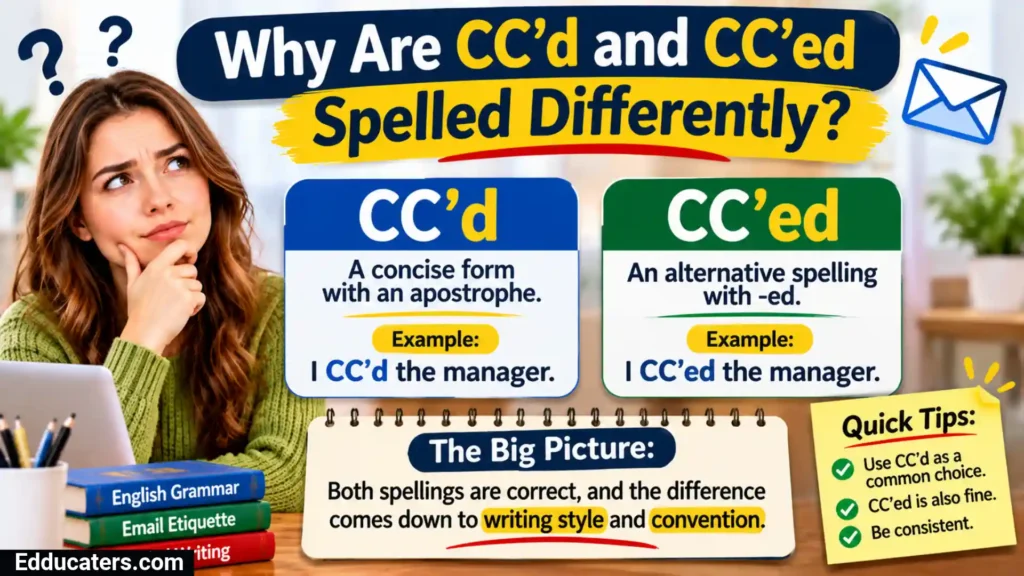
The spelling variation comes from how English writers add grammatical endings to abbreviations used as verbs.
Ordinary English verbs often form their past tense by adding -ed. For example, walk becomes walked and update becomes updated. However, CC isn’t an ordinary word with a conventional spelling pattern. It’s an abbreviation made up of two letters.
When writers use CC as a verb, they need to attach an ending to the abbreviation. That’s where the two spellings come in.
Why Does CC’d Use an Apostrophe?
The spelling CC’d uses an apostrophe before the d to show that the verb ending has been shortened.
Instead of writing the full -ed ending, the writer attaches just the letter d after the abbreviation. The apostrophe helps readers recognize the boundary between the abbreviation and its grammatical ending.
Consider these examples:
- CC → Please CC my supervisor.
- CC’d → I CC’d my supervisor.
- CC’ing → I am CC’ing my supervisor.
The apostrophe doesn’t indicate possession. It marks the abbreviated ending attached to the verb.
Similar constructions appear with other abbreviated verbs:
| Abbreviation | Past-tense form | Example |
| OK | OK’d | The manager OK’d the request. |
| RSVP | RSVP’d | We RSVP’d to the invitation. |
| CC | CC’d | She CC’d her colleague. |
| ID | ID’d | Security ID’d the visitor. |
These forms illustrate how English writers sometimes attach grammatical endings to abbreviations while using apostrophes to separate the letters from the ending.
The pattern isn’t universal for every abbreviation. Writing conventions can differ depending on the word, style guide, and context.
Why Do Some Writers Use CC’ed Instead?
Some writers prefer CC’ed because it follows a more visibly complete -ed pattern.
In ordinary English, the past tense often involves adding ed to the base verb. For example:
- Email → emailed
- Update → updated
- Notify → notified
CC’ed uses the abbreviation followed by an apostrophe and the complete ed ending. This spelling can feel more familiar to writers who want to make the past-tense form visually obvious.
For example:
- I CC’ed the department manager.
- She CC’ed her assistant on the email.
- We CC’ed the client yesterday.
The extra e doesn’t make CC’ed more grammatical than CC’d. It simply represents a different spelling convention for the same abbreviated verb.
Is the Apostrophe Necessary?
The apostrophe is a common and recognizable feature of these abbreviated verb forms. However, writers sometimes use CCed without an apostrophe.
You may encounter all three forms:
- CC’d
- CC’ed
- CCed
The first two are particularly recognizable in ordinary email writing. CCed also appears in some publications and writing styles.
If you want a straightforward choice, use CC’d. It keeps the spelling compact and makes the abbreviated verb recognizable.
For formal writing, you can always use copied instead.
Is CC’d Grammatically Correct?
Yes, CC’d is grammatically correct. It’s an accepted past-tense and past-participle form of the verb CC.
English allows abbreviations to function as verbs. Once an abbreviation becomes a verb, writers can use it in different grammatical structures, including present tense, past tense, present participle, and passive constructions.
CC’d works in each sentence where the grammatical structure requires the past tense or past participle.
CC’d as a Past-Tense Verb
Use CC’d when describing an action that happened in the past.
Examples:
- I CC’d the finance manager yesterday.
- She CC’d her colleague on the announcement.
- They CC’d the entire department.
- He CC’d the client after the meeting.
- We CC’d our supervisor on the final report.
In each sentence, the action of adding someone to the email occurred in the past.
CC’d as a Past Participle
CC’d also works as a past participle. The past participle appears in grammatical structures involving helping verbs such as have, has, and had.
Examples:
- I have CC’d the project manager.
- She has CC’d everyone involved.
- We had CC’d the director before the meeting started.
- They haven’t CC’d the client yet.
In these examples, the past participle forms part of a verb phrase.
The distinction between past tense and past participle matters because English uses different verb forms in different grammatical structures. However, CC’d looks the same in both functions.
CC’d in Passive Voice
CC’d also appears in passive constructions when the sentence focuses on the recipient rather than the person who sent the email.
Examples:
- I was CC’d on the message.
- The manager was CC’d on the announcement.
- Several employees were CC’d on the report.
- She was CC’d on the original conversation.
These sentences emphasize who received the email rather than who added the recipient.
Passive voice can be useful in email communication when the sender’s identity isn’t important or isn’t known.
CC’d in Questions
You can also use CC’d in questions when asking whether someone has already been included.
Examples:
- Have you CC’d the manager?
- Who was CC’d on the original email?
- Has the client been CC’d on the update?
- Did you CC the department head?
Notice the difference in the last example. Because the sentence uses did, the main verb stays in its base form. You don’t use CC’d after did.
That grammatical distinction becomes important when writing questions and negative statements.
Is CC’ed Grammatically Correct?
Yes, CC’ed is grammatically correct. It functions as an alternative past-tense and past-participle form of CC.
CC’ed doesn’t represent a different action or grammatical structure. It simply uses another spelling convention.
For example, the following sentences are equally understandable:
- I CC’d my supervisor on the email.
- I CC’ed my supervisor on the email.
Both describe the same action. Neither sentence changes the recipient’s role or the email’s purpose.
CC’ed as a Past-Tense Verb
CC’ed works when describing an action that occurred previously.
Examples:
- I CC’ed the marketing team yesterday.
- She CC’ed her assistant on the update.
- They CC’ed the client before sending the report.
- We CC’ed everyone who needed the information.
These sentences follow the same grammatical patterns as sentences containing CC’d.
CC’ed as a Past Participle
CC’ed also works with helping verbs such as have, has, and had.
Examples:
- I have CC’ed the department manager.
- She has CC’ed the client on the latest email.
- We had CC’ed the supervisor before the discussion.
- They haven’t CC’ed the other team yet.
The spelling remains CC’ed regardless of whether it functions as a simple past-tense verb or a past participle.
CC’ed in Passive Voice
CC’ed can also appear in passive constructions.
Examples:
- I was CC’ed on the original message.
- The department head was CC’ed on the report.
- Several colleagues were CC’ed on the announcement.
- The client has been CC’ed on the conversation.
These sentences focus on the people who received the copies rather than the sender who added them.
CC’d or CC’ed in Formal Emails?
Both CC’d and CC’ed are acceptable in professional correspondence. Neither form is inherently unprofessional.
However, CC’d is generally a convenient default because it’s concise and widely recognizable in modern email communication. CC’ed remains a reasonable alternative when a writer prefers the fuller ending.
For business emails, consistency and clarity matter more than choosing between these two spellings.
Which Spelling Should You Use in Business Emails?
Use CC’d as your default spelling in business emails unless your organization follows a different editorial convention.
CC’d works well in workplace communication because it keeps sentences short and clear.
For example:
- I’ve CC’d my manager so she can review the proposal.
- The finance team was CC’d on the invoice.
- Please make sure the client is CC’d on the revised document.
These sentences are straightforward and easy to understand.
However, if you’re writing to someone unfamiliar with email abbreviations or communicating in formal correspondence, copied can be a better option.
For example:
- I’ve copied my manager on this email so she can review the proposal.
- The finance team was copied on the invoice.
- Please make sure the client is copied on the revised document.
The full verb copied avoids the spelling variation altogether.
CC’d vs. Copied in Formal Writing
CC’d is widely understood in professional settings. Nevertheless, copied can sound more polished in certain contexts.
| Expression | Best use | Example |
| CC’d | Everyday business emails | I’ve CC’d my manager. |
| CC’ed | Everyday emails when preferred by the writer | I’ve CC’ed my manager. |
| Copied | Formal, clear, or international correspondence | I’ve copied my manager on this email. |
| Included in the CC field | Precise technical or administrative wording | I’ve included the manager in the CC field. |
The choice depends on the audience and the purpose of your message.
If you’re emailing colleagues who regularly use CC, CC’d is perfectly natural. If you’re writing a formal letter or an official notice, copied may be a cleaner choice.
How to Use CC’d Naturally in Professional Emails
CC’d works well when explaining why someone is included in a message.
Here are several practical examples.
Keeping a manager informed
I’ve CC’d my manager on this email so she can follow the discussion.
Including a colleague who can help
I’ve CC’d Daniel here because he can answer your questions about the project.
Sharing a document with the relevant team
The finance department was CC’d on the revised invoice.
Adding someone to an ongoing conversation
I’ve CC’d our account manager on this thread so she can help resolve the issue.
Explaining a recipient’s role
I’ve CC’d Sarah for visibility. She doesn’t need to respond unless she has additional questions.
These examples show how CC’d can support clear and concise email writing.
When Should You Avoid CC’d or CC’ed?
Although both forms are useful, they aren’t always the best choice.
Consider using copied or another expression when:
- You’re writing a formal letter or official notice.
- Your audience may not understand email abbreviations.
- You’re communicating with international readers who may find abbreviations less familiar.
- You want to avoid discussing spelling variations altogether.
- You need to explain precisely where someone was added.
For example, I’ve copied the regional manager on this email is clear without requiring readers to recognize the abbreviation CC.
Similarly, I’ve included the regional manager in the CC field is useful when describing the email’s recipient settings rather than the general act of sharing information.
CC’d or CC’ed: Examples in Sentences
Examples can make spelling and grammar rules easier to understand. Both CC’d and CC’ed work in everyday correspondence, business emails, questions, and passive constructions.
The following examples demonstrate how each spelling fits naturally into different situations.
Everyday Examples of CC’d and CC’ed
| CC’d | CC’ed |
| I CC’d my friend on the invitation. | I CC’ed my friend on the invitation. |
| She CC’d me on the latest update. | She CC’ed me on the latest update. |
| He CC’d his colleague yesterday. | He CC’ed his colleague yesterday. |
| We CC’d the entire group. | We CC’ed the entire group. |
| They CC’d their teacher on the message. | They CC’ed their teacher on the message. |
| I CC’d my brother on the email. | I CC’ed my brother on the email. |
| She CC’d the organizer on the announcement. | She CC’ed the organizer on the announcement. |
Both columns express the same ideas. The spelling variation doesn’t affect the meaning or grammatical correctness of the sentences.
Examples of CC’d or CC’ed in Professional Emails
CC is particularly common in workplace communication. Employees often use it to keep managers, colleagues, clients, and stakeholders informed.
Here are several realistic situations where CC’d or CC’ed might appear.
Keeping a supervisor informed
I’ve CC’d my supervisor on this email so she can follow the discussion.
Sharing project updates
We CC’ed the development team on the latest project update.
Including a client
The account manager was CC’d on the final response.
Sending meeting information
I’ve CC’ed the department head on the meeting invitation.
Sharing an important document
Please make sure the relevant team members are CC’d when you send the revised document.
Keeping someone informed about a decision
I CC’d the operations manager so he can stay informed about the changes.
Adding a colleague to an ongoing discussion
I’ve CC’ed Rachel here because she handles the billing questions.
Confirming that someone received an email
The customer was CC’d on the confirmation message.
These examples demonstrate how both spellings fit naturally into business emails, workplace conversations, and professional correspondence.
Examples in Questions and Negative Sentences
CC’d and CC’ed also work in questions and negative statements. However, the correct verb form depends on the sentence’s grammatical structure.
Questions
- Have you CC’d the project manager on the latest email?
- Have you CC’ed the client on the proposal?
- Who was CC’d on the original message?
- Has the department head been CC’ed on the announcement?
Negative sentences
- I haven’t CC’d the marketing team yet.
- She didn’t CC her supervisor on the email.
- We haven’t CC’ed the other department.
- He hadn’t CC’d the client before the meeting.
The last examples also demonstrate an important grammar rule: after didn’t, use the base form of the verb. After have, has, or had, use the past participle.
Different Forms of the Verb CC
CC can take several grammatical forms depending on the sentence. Understanding these forms helps you use the abbreviation correctly without confusing its endings.
| Verb form | Grammatical use | Example |
| CC | Base form | Please CC me on the email. |
| CCs | Present tense, third-person singular | She CCs her manager on important updates. |
| CC’d | Past tense or past participle | I CC’d my colleague yesterday. |
| CC’ed | Alternative past tense or past participle | I CC’ed my colleague yesterday. |
| CC’ing | Present participle | I’m CC’ing my supervisor now. |
These forms allow CC to function like an ordinary verb in different grammatical situations.
CC in the Present Tense
Use CC when describing an action in the present or when the sentence requires the base form of the verb.
Examples:
- I CC my manager on important emails.
- Please CC the project coordinator.
- I will CC you on the next update.
- You should CC the department head.
The spelling stays CC when the sentence uses the base form.
With a singular third-person subject such as he, she, or it, the verb takes an s.
Examples:
- She CCs her assistant on important messages.
- He CCs his supervisor whenever necessary.
- The administrator CCs the department manager on official notices.
The present-tense form CCs doesn’t require an apostrophe. The apostrophe in CC’d belongs to the past-tense spelling convention.
CC’d or CC’ed in the Past Tense
Use either spelling when describing an action that occurred in the past.
Examples:
- I CC’d the director yesterday.
- She CC’ed the entire department last week.
- We CC’d the client on the latest response.
- They CC’ed the manager before the meeting.
Both forms describe completed actions.
You can also use either form with helping verbs:
- I have CC’d the manager.
- I have CC’ed the manager.
- She had CC’d the client before the meeting.
- She had CC’ed the client before the meeting.
The grammatical structure remains the same. Only the spelling changes.
CC’ing in the Present Participle
CC’ing describes an action that is happening or appears in a grammatical structure requiring the present participle.
Examples:
- I’m CC’ing the entire team.
- She is CC’ing her supervisor on the message.
- They were CC’ing the department head during the discussion.
- We’re CC’ing the relevant stakeholders on the update.
CC’ing is a widely recognized spelling of the present participle. Some writers use CCing without the apostrophe, but the apostrophe helps distinguish the abbreviation from the added ending.
CC’d After Did or Didn’t
This is one of the most common grammatical mistakes involving the abbreviation.
After did or didn’t, use CC rather than CC’d or CC’ed.
| Incorrect | Correct |
| Did you CC’d the manager? | Did you CC the manager? |
| She didn’t CC’ed the client. | She didn’t CC the client. |
| Did they CC’d the department head? | Did they CC the department head? |
| I didn’t CC’ed my supervisor. | I didn’t CC my supervisor. |
The helping verb did already expresses the past tense. The main verb therefore remains in its base form.
This rule applies to regular verbs too.
- Incorrect: Did you emailed the client?
- Correct: Did you email the client?
- Incorrect: Did she updated the document?
- Correct: Did she update the document?
The same principle applies to CC.
CC’d After Will, Can, Should, and Must
Modal verbs such as will, can, should, and must take the base form of the main verb.
Examples:
- I will CC the manager tomorrow.
- You can CC me on the email.
- She should CC the project coordinator.
- They must CC the supervisor on the report.
Don’t use CC’d or CC’ed after these modal verbs.
| Incorrect | Correct |
| I will CC’d the manager. | I will CC the manager. |
| You should CC’ed me. | You should CC me. |
| She can CC’d the client. | She can CC the client. |
The rule is straightforward: when a modal verb requires the base form, use CC.
CC’d or CC’ed: Which Spelling Is More Common?
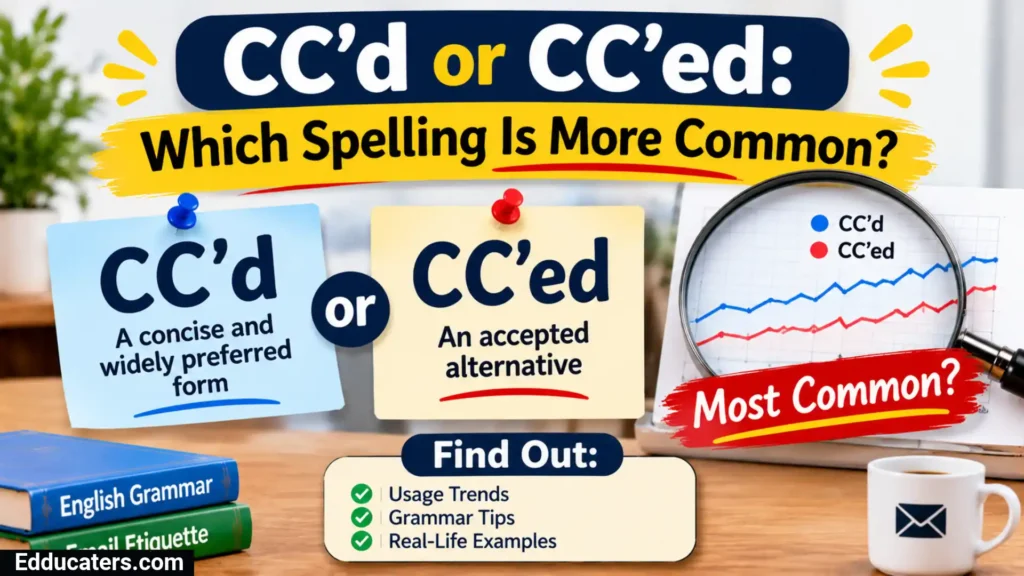
CC’d is a practical, concise spelling that many writers prefer in everyday email communication. CC’ed also appears in English writing and remains a recognizable alternative.
However, establishing which form appears more frequently requires reliable usage evidence. A spelling’s popularity doesn’t automatically determine whether another spelling is incorrect.
Why CC’d Is a Practical Default
CC’d offers several advantages in modern email writing:
- Conciseness: It uses fewer characters than CC’ed.
- Recognition: Readers familiar with email abbreviations generally recognize it immediately.
- Consistency: It fits a common convention for inflecting abbreviations with an apostrophe.
- Convenience: It works naturally in everyday business emails and informal messages.
For example, I CC’d the manager is short and clear. It communicates the action without requiring additional explanation.
Nevertheless, CC’ed isn’t inherently inferior. Writers who prefer the fuller ending can use it without changing the sentence’s meaning.
Can Google Ngram Viewer Compare CC’d and CC’ed?
Yes. Google Ngram Viewer can help compare the frequency of CC’d and CC’ed in its indexed book collection.
The Google Ngram Viewer is a tool that tracks how frequently words and phrases appear in a collection of digitized books over selected periods.
You can use it to compare the relative frequency of different spellings.
For this topic, you could enter:
- CC’d
- CC’ed
The tool may show how their recorded usage changes over time. However, interpreting those results requires care.
Google Ngram Viewer has several limitations:
- It tracks books: Its data doesn’t directly represent everyday email communication or workplace messages.
- It measures recorded usage: A higher frequency doesn’t establish that a spelling is grammatically superior.
- It may include unrelated contexts: Abbreviations can appear in technical, historical, or specialized writing.
- Its data depends on the collection: The availability of books and their publication dates affect the results.
- Typography can influence searches: Apostrophes, capitalization, and punctuation may complicate comparisons.
If CC’d appears more frequently than CC’ed in a particular Ngram search, that result may support a usage preference. It doesn’t establish that CC’ed is incorrect.
The relative frequency of these spellings in everyday email correspondence isn’t established here by a verified numerical comparison. Avoid treating book-based frequency as an email usage statistic.
Does the More Common Spelling Automatically Become Correct?
No. English spelling conventions don’t always require writers to choose the most frequent form.
Some words have multiple accepted spellings. Their usage may vary by region, editorial style, historical convention, or personal preference.
CC’d and CC’ed illustrate this principle. Both spellings communicate the same action, and both are used in English.
When choosing between them, prioritize clarity, consistency, and your organization’s preferred writing conventions.
CC’d vs. CC vs. Carbon Copied
CC, CC’d, CC’ed, and carbon copied are related expressions. However, they serve slightly different grammatical functions.
CC is the abbreviation. CC’d and CC’ed are alternative inflected forms of the verb. Carbon copied is the full verb phrase.
Understanding these distinctions helps you select the right expression in different sentences.
| Term | Meaning or grammatical function | Example |
| CC | Abbreviation and base verb | Please CC the manager. |
| CCs | Present-tense form | She CCs her manager. |
| CC’d | Past tense or past participle | I CC’d the manager. |
| CC’ed | Alternative past tense or past participle | I CC’ed the manager. |
| CC’ing | Present participle | I’m CC’ing the manager. |
| Carbon copy | Noun phrase | Add her to the carbon copy field. |
| Carbon copied | Full verb phrase | He carbon copied his supervisor. |
| Copied | Plain-English alternative | I copied my supervisor on the email. |
CC vs. CC’d
CC is the base form of the verb. CC’d is a past-tense or past-participle form.
Examples:
- Present: Please CC the manager.
- Past: I CC’d the manager.
- Present perfect: I’ve CC’d the manager.
- Passive: The manager was CC’d on the email.
The grammatical structure determines which form you need.
CC’d vs. Carbon Copied
CC’d is the abbreviated form of the past tense. Carbon copied is the full verb phrase.
For example:
- I CC’d my supervisor on the email.
- I carbon copied my supervisor on the email.
Both sentences communicate the same action. The second sentence spells out the expression rather than using the abbreviation.
However, carbon copied can sound slightly more formal or less conversational. In modern email communication, CC’d is generally more natural.
CC’d vs. Copied
Copied is often the simplest alternative to CC’d.
For example:
- I CC’d Sarah on the email.
- I copied Sarah on the email.
Both sentences are correct. The second avoids the abbreviation entirely.
Copied is particularly useful when you want to make your writing straightforward, professional, and easy to understand.
How to Use CC’d or CC’ed Correctly
The easiest way to use CC’d or CC’ed correctly is to understand the grammatical structure of your sentence.
Both forms can appear in past-tense sentences, past-participle constructions, and passive voice. However, you shouldn’t use them after helping verbs that require the base form.
Use CC’d or CC’ed to Describe a Completed Action
When describing someone you added to an email previously, use either spelling.
Examples:
- I CC’d my manager on the report.
- I CC’ed the client yesterday.
- She CC’d the department head before the meeting.
- They CC’ed the entire team on the announcement.
These sentences describe actions that occurred in the past.
Use CC’d or CC’ed With Have, Has, and Had
Use the past-participle form after helping verbs such as have, has, and had.
Examples:
- I have CC’d my supervisor.
- She has CC’ed the project manager.
- We had CC’d the client before the discussion.
- They haven’t CC’d the department head yet.
Both spellings work in these grammatical structures.
Use CC’d or CC’ed in Passive Voice
Use either spelling when the sentence focuses on the recipient rather than the sender.
Examples:
- I was CC’d on the message.
- She was CC’ed on the announcement.
- The manager has been CC’d on the report.
- Several employees were CC’ed on the email.
These sentences emphasize the people who received the copies.
Use CC in Requests
When asking someone to include another recipient, use the base form CC.
Examples:
- Please CC the project manager.
- Could you CC me on the email?
- Please CC the finance team on the revised invoice.
- Make sure you CC the relevant department.
The base form is appropriate because the sentence expresses a request rather than a completed action.
Use CC in Questions With Did
When asking about a completed action using did, use the base form.
Examples:
- Did you CC the manager?
- Did she CC the client?
- Did they CC the entire department?
- Did someone CC the supervisor on the original email?
Don’t add the past-tense ending because did already indicates the past tense.
Common Mistakes When Using CC’d or CC’ed
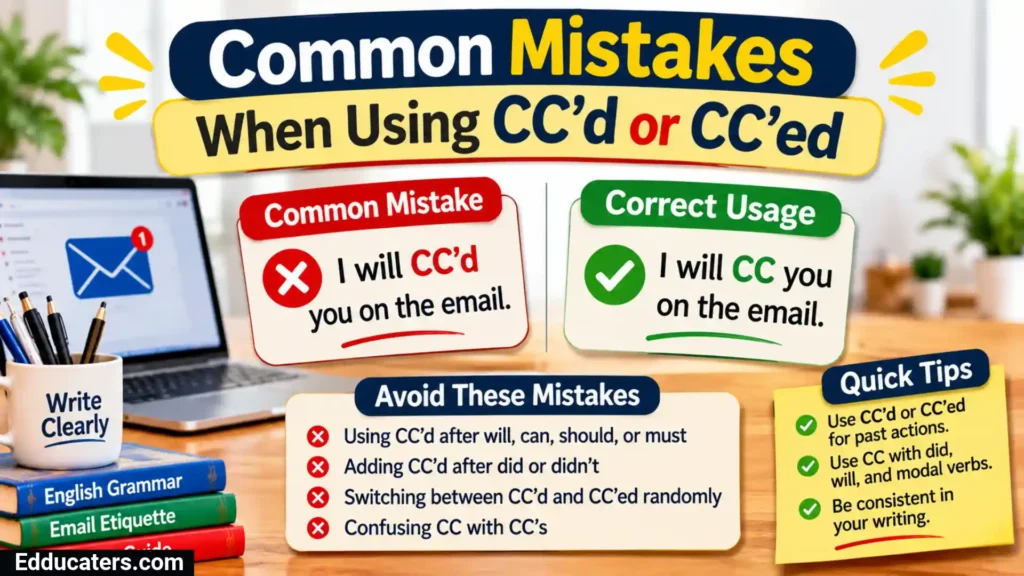
Although CC’d and CC’ed are straightforward expressions, a few mistakes can make your email confusing or grammatically incorrect.
Using CC’d After Will
Incorrect: I will CC’d you on the email.
Correct: I will CC you on the email.
The modal verb will requires the base form of the main verb. Therefore, CC remains unchanged.
Using CC’d After Did
Incorrect: Did you CC’d your manager?
Correct: Did you CC your manager?
The helping verb did already indicates the past tense. Adding CC’d would create an unnecessary second past-tense marker.
Using CC’ed After Didn’t
Incorrect: She didn’t CC’ed the client.
Correct: She didn’t CC the client.
After didn’t, the main verb must remain in its base form.
Confusing CC’d With CC’s
CC’d and CC’s don’t mean the same thing.
- CC’d: Past tense or past participle of the verb CC.
- CC’s: Can represent a possessive form or, in some contexts, a contraction or plural convention.
For example:
- Correct: I CC’d my supervisor.
- Incorrect for past tense: I CC’s my supervisor.
The apostrophe in CC’d marks an abbreviated verb ending. It isn’t a possessive apostrophe.
Forgetting the Apostrophe
Writing CCd instead of CC’d may look inconsistent or less familiar to readers.
Although some writing conventions use forms without apostrophes, CC’d is a recognizable spelling that helps readers identify the abbreviation and its grammatical ending.
If you’re following a particular style guide, use its preferred form consistently.
Confusing CC With BCC
CC and BCC serve different purposes. Using the wrong field can expose recipients’ email addresses or create unnecessary confusion.
- CC keeps additional recipients visible to other recipients.
- BCC hides the additional recipients’ addresses from the other recipients.
For example, if you CC your manager on an email to a client, the client can generally see that your manager received a copy. If you BCC your manager, the client’s recipient list won’t reveal that address.
Always choose the appropriate field based on the recipients’ privacy and communication needs.
Switching Between CC’d and CC’ed Without a Reason
Both spellings are accepted. However, switching between them repeatedly in the same email, document, or publication can make your writing look inconsistent.
For example, avoid writing:
I CC’d the manager yesterday. The client was CC’ed on the latest update.
There’s nothing grammatically wrong with this passage. However, using one spelling throughout a document creates a more consistent appearance.
Choose CC’d or CC’ed and stick with it unless you’re quoting someone or following a different spelling convention.
Frequently Asked Questions
Is CC’d or CC’ed correct?
Both CC’d and CC’ed are correct spellings of the past tense and past participle of the verb CC. They have the same meaning and describe the act of sending someone a copy of an email. CC’d is a concise, widely preferred form.
Is CC’d grammatically correct?
Yes, CC’d is grammatically correct. It’s an accepted past-tense and past-participle form of CC, meaning to send someone a copy of an email. You can use it in active sentences such as I CC’d my manager or passive sentences such as I was CC’d on the email.
Is CC’ed grammatically correct?
Yes, CC’ed is grammatically correct. It’s an alternative spelling of CC’d and functions in the same grammatical structures. The extra e doesn’t change the meaning, pronunciation in ordinary usage, or grammatical function.
Is CC’d more common than CC’ed?
CC’d is a concise and widely recognized spelling that many writers prefer. CC’ed is also used. However, a verified numerical comparison of these spellings in everyday email communication isn’t available here.
What is the past tense of CC?
The past tense of CC is CC’d or CC’ed. Both forms are accepted. For example, I CC’d my manager yesterday and I CC’ed my manager yesterday are grammatically correct.
How do you spell CC’d?
Spell it CC’d when using the concise past-tense form of CC. The apostrophe separates the abbreviation from the shortened d ending. It’s a widely recognized spelling in email communication.
How do you spell CC’ed?
Spell it CC’ed when using the alternative past-tense form of CC. It includes an apostrophe followed by ed. This spelling is also accepted and has the same meaning as CC’d.
Can you use CC’d in formal emails?
Yes, CC’d is acceptable in formal and professional emails. However, copied may be preferable when writing formal correspondence or communicating with readers unfamiliar with email abbreviations.
Can you use CC’ed in business emails?
Yes, CC’ed is acceptable in business emails. It isn’t inherently unprofessional or grammatically incorrect. You can use it when explaining that someone received a copy of an email.
What does CC’d mean in an email?
CC’d means someone was included in the carbon copy field of an email. The person receives a copy of the message alongside the primary recipient. CC recipients can generally see the other recipients listed in the To and CC fields.
Is CC’d the same as carbon copied?
Yes, CC’d describes the past-tense action of carbon copying someone. Carbon copied is the full verb phrase while CC’d is the abbreviated form.
Is CC’d or CCed correct?
CC’d is a common spelling that uses an apostrophe before the d. CCed is another spelling used by some writers without an apostrophe. CC’d is a convenient default in ordinary email writing.
Should I write CC’d or copied in a professional email?
Both are appropriate. CC’d is concise and familiar in workplace correspondence. Copied is a straightforward alternative that avoids abbreviations and may suit formal or international communication.
Conclusion: CC’d or CC’ed?
Both CC’d or CC’ed are accepted spellings of the past tense and past participle of the verb CC. They describe the same action and don’t differ in grammatical meaning.
CC’d is a practical default because it’s concise and widely recognized in email communication. CC’ed is equally understandable and doesn’t need correction.
When writing professional emails, choose the spelling you prefer and use it consistently. If you want to avoid the spelling variation altogether, copied is a simple alternative.
The next time you include someone in an email, you can confidently write I CC’d my manager or I CC’ed my manager. Both are correct.

I’m Julian Mercer, an English language writer dedicated to helping people master grammar through practical examples and clear explanations. I enjoy teaching grammar in a way that is both engaging and easy to remember.
My work focuses on grammar rules, punctuation, word usage, and writing techniques that readers can apply in everyday life. I believe learning English should be simple, enjoyable, and useful.
Books
English Grammar in Practice
Writing with Precision
 Claire Holloway