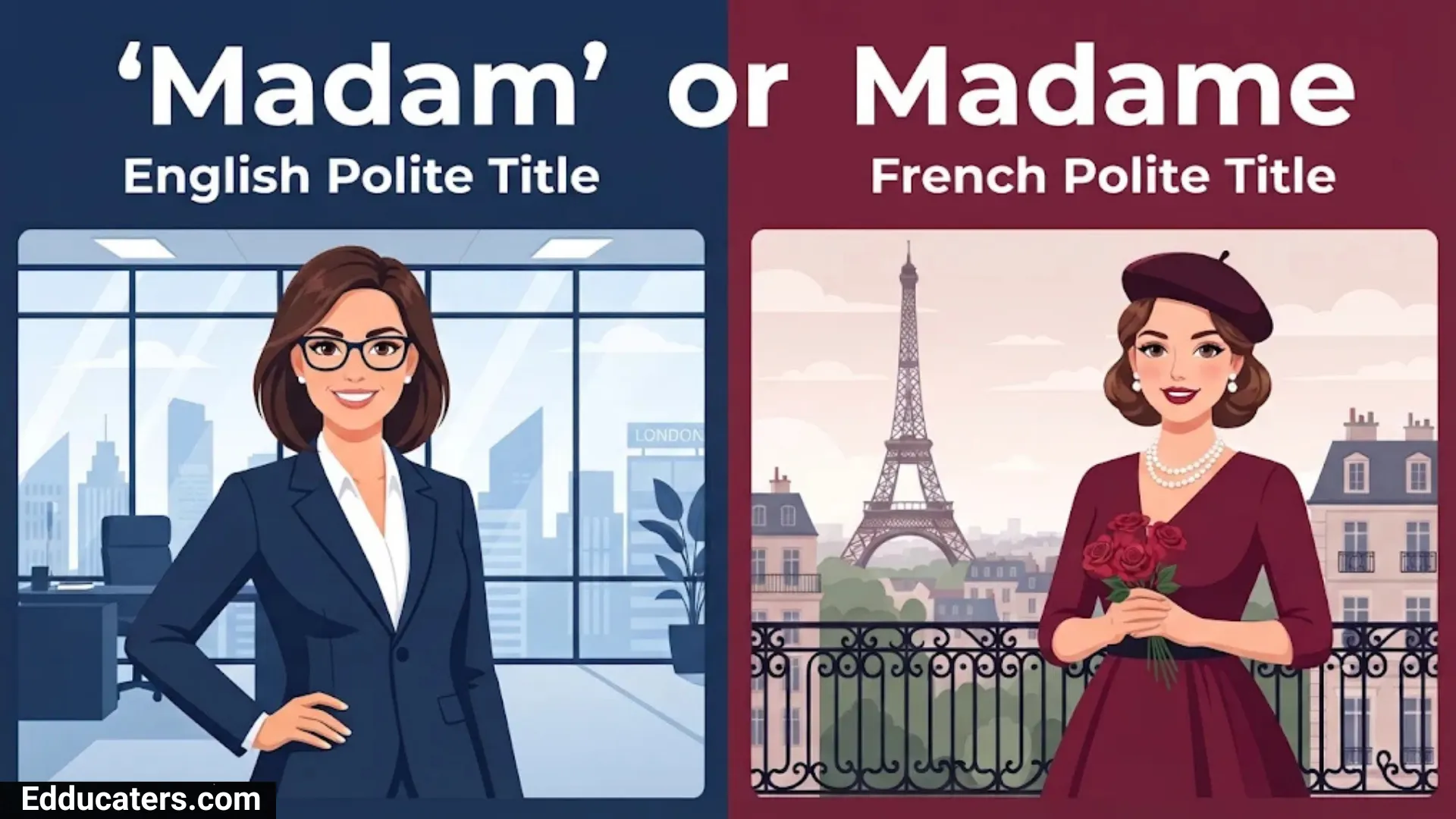
Madam or madame are both correct spellings, but they have slightly different meanings, usage patterns, and cultural associations. Madam is the standard English form of formal address, while madame is the French form commonly used in French-speaking settings and certain English expressions.
If you’re writing an email, addressing a woman formally, using an official title, or referring to a French woman, choosing the right spelling matters. Although the words look nearly identical, their contexts aren’t always interchangeable.
In American English, madam is generally the preferred spelling for formal address. Madame is usually associated with French language, French culture, traditional titles, or specific names and expressions.
Let’s explore the difference between madam or madame, including their meanings, pronunciation, grammar, examples, and common mistakes.
What Is the Difference Between Madam or Madame?
The main difference between madam or madame is their language and conventional usage. Both words are polite forms of address for women, but they don’t carry exactly the same tone.
| Word | Meaning | Common Usage |
| Madam | A formal English title or respectful way to address a woman | Formal conversations, official titles, business letters, customer service |
| Madame | A French title of respect for a woman | French-speaking settings, French names, cultural references, historical titles |
Madam is more common in formal American English. You may encounter it in professional correspondence, official speeches, customer service, or situations requiring respectful address.
Madame retains a French identity. It appears when addressing women in French, referring to French women, or preserving a traditional French title.
For example:
- Madam President, thank you for your leadership.
- Dear Madam, we have received your application.
- Madame Dupont will meet us at the entrance.
- Madame Curie became famous for her scientific discoveries.
The first two examples use the English form. The last two reflect French naming and cultural conventions.
Although the distinction is helpful, madame can also appear in English writing. English speakers sometimes use it for distinguished women, historical figures, or established cultural names.
What Does Madam Mean?
Madam is a formal term used to address or refer to a woman respectfully. It often appears when you don’t know a woman’s name or when the situation calls for a polite, professional tone.
The word can communicate courtesy, authority, dignity, or formality. However, it may sound stiff or old-fashioned in everyday American conversation.
For example:
- How may I help you, madam?
- Madam, your appointment is ready.
- Dear Madam, thank you for your inquiry.
- Madam President, the floor is yours.
You can use madam in several different situations.
Madam as a Formal Title of Address
You can use madam when speaking directly to a woman in a formal setting. It’s particularly common in traditional customer service, official interactions, and polite conversations.
For example:
- Would you like a receipt, madam?
- Please follow me, madam.
- I’m sorry, madam, but your table isn’t ready yet.
- Madam, may I ask you a question?
This usage emphasizes respect. It may feel natural in formal hospitality or ceremonial situations, but less so in casual American conversations.
In the United States, people often use a woman’s name, ma’am, or another appropriate form of address instead.
Madam in Formal Letters and Emails
Madam often appears in formal correspondence when the recipient’s name is unknown or when the writer wants to use a traditional formal greeting.
For example:
- Dear Madam,
- Dear Madam or Sir,
- Dear Sir or Madam,
These greetings can work when you don’t know who will read your message. However, modern professional writing often favors more specific greetings when possible.
For example, Dear Hiring Manager may sound more natural than Dear Madam when applying for a job.
You can also use madam in formal complaints, business requests, official notices, or traditional letters.
Madam in Official Titles
Madam is widely used before certain official titles, especially when addressing women who hold positions of authority.
Examples include:
- Madam President
- Madam Speaker
- Madam Secretary
- Madam Chair
- Madam Ambassador
- Madam Justice
These expressions recognize the person’s position rather than simply identifying her gender.
For example:
Madam Speaker, I would like to address the committee.
Madam President, we appreciate your continued support.
Madam Chair, may I present the next proposal?
In these cases, madam is part of a formal title. It isn’t usually replaced with madame in standard English.
Madam as a Common Noun
The word madam can also function as a common noun. In this usage, it refers to a woman who manages a brothel or organizes prostitution.
For example:
The novel describes a madam who ran an establishment in the city.
This meaning differs from the polite form of address. Context makes the intended meaning clear.
Because this sense can carry a negative or sensitive association, be mindful of the context when using the word.
What Does Madame Mean?
Madame is the French form of a respectful title used for women. It’s traditionally equivalent to Mrs. or Ms. in English, although modern French usage doesn’t necessarily indicate a woman’s marital status.
The title can be used before a woman’s surname, as a standalone form of address, or as part of a recognized name.
Examples include:
- Madame Dupont
- Madame Laurent
- Madame Bernard
- Madame Lefèvre
- Madame Dubois
In French, Madame is a standard respectful way to address an adult woman. It doesn’t automatically mean she’s married.
Madame as a French Title
In French, madame is a conventional title of respect. It’s used in everyday conversation, professional settings, correspondence, and formal introductions.
For example:
- Bonjour, Madame.
- Merci, Madame.
- Madame Dupont est ici.
- Excusez-moi, Madame.
The title can be used with a surname or without one when addressing a woman directly.
French speakers don’t necessarily use madame to indicate a woman’s marital status. Its modern usage is much broader.
Madame Before a French Surname
Madame commonly appears before French surnames. It helps establish a respectful tone and identifies the person by her family name.
Examples:
- Madame Martin
- Madame Moreau
- Madame Petit
- Madame Rousseau
- Madame Girard
In English writing, these forms may appear when discussing French people, translating French dialogue, or maintaining a French cultural setting.
For example:
Madame Martin welcomed the guests into her home.
We met Madame Moreau at the gallery.
Madame Girard teaches French literature.
The spelling madame preserves the French title and convention.
Madame in Historical and Cultural Names
Madame appears in many established names associated with literature, history, art, science, and popular culture.
Examples include:
- Madame Curie — a familiar historical form associated with Marie Curie.
- Madame Tussaud — the name connected with the wax museum founder.
- Madame Bovary — the central character in Gustave Flaubert’s novel.
- Madame Butterfly — the title of a famous opera and its central character.
These names often retain madame because of tradition, cultural identity, or the title’s historical significance.
In modern writing, you may sometimes see a woman’s personal name used instead. For example, Marie Curie is commonly called Marie Curie rather than Madame Curie in contemporary scientific and educational contexts.
Madam or Madame in American English
In American English, madam is generally the standard spelling for formal English address. It appears in official titles, traditional greetings, formal speech, and certain professional situations.
Madame is also recognized in English, but it usually carries a French, cultural, historical, or stylistic association.
| Situation | Preferred Form | Example |
| Formal English address | Madam | May I help you, madam? |
| Official title | Madam | Madam President |
| Formal letter | Madam | Dear Madam |
| French title | Madame | Madame Laurent |
| French surname | Madame | Madame Dupont |
| Historical name | Madame | Madame Tussaud |
| French conversation | Madame | Bonjour, Madame. |
If you’re writing for an American audience and need a formal English title, choose madam unless a specific name or French context calls for madame.
Is Madame Incorrect in English?
No. Madame isn’t an incorrect English word. It’s recognized and used in English writing.
However, using it in place of madam can make a sentence appear French-influenced, stylized, or unusual.
For example:
- Standard English: Madam President, welcome to the conference.
- French or stylized usage: Madame President, welcome to the conference.
The second form may be intentional in a particular cultural or literary setting, but Madam President is the conventional English title.
Madam President or Madame President?
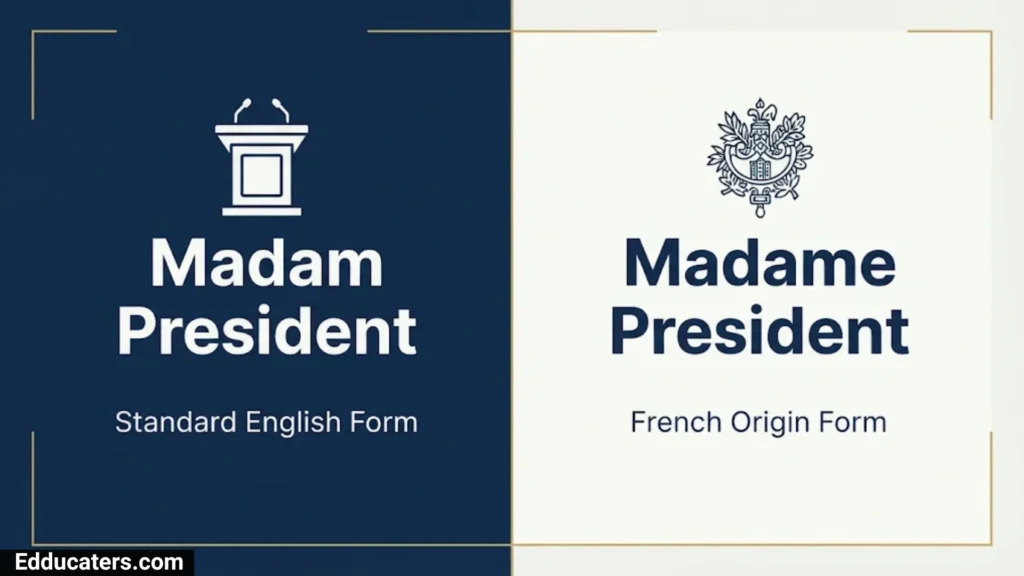
Madam President is the standard form in English.
It’s used when addressing a woman who holds the office of president, whether in a government, organization, association, or meeting.
Examples:
- Madam President, the committee is ready.
- Madam President, may I ask a question?
- We welcome Madam President to today’s ceremony.
The spelling Madame President is not the standard English title. It may appear in stylized writing, French-influenced contexts, or unusual translations, but it isn’t the conventional choice in American English.
Madam Speaker or Madame Speaker?
Madam Speaker is the standard English title for a female speaker of a legislative body.
For example:
Madam Speaker, I rise to support this proposal.
The title is formal and reflects the speaker’s position of authority. Madame Speaker is generally not the standard form in English parliamentary or legislative usage.
Madam Secretary or Madame Secretary?
Madam Secretary is the conventional English form when addressing a woman holding the position of secretary, particularly a government secretary.
For example:
Madam Secretary, we appreciate your presence today.
You may also encounter Madam Secretary as a title in political discussions or popular culture.
Madam Chair or Madame Chair?
Madam Chair is a recognized form used to address a woman presiding over a meeting or committee.
For example:
Madam Chair, I would like to introduce a new motion.
You may also encounter Madam Chairman in traditional settings. However, Madam Chair is a widely used gender-neutral alternative for the office itself.
Madam Before a Last Name or Madame Before a Last Name?
The difference becomes clearer when you place either word before a surname.
Madame is commonly used before French surnames. Madam is not generally used as a modern English title before an ordinary surname.
For example:
| Expression | Correctness and Usage |
| Madame Dupont | Correct French title and surname combination |
| Madame Laurent | Correct French title and surname combination |
| Madam President | Correct formal English title |
| Madam Wilson | Unusual in modern English; generally not a standard surname title |
| Mrs. Wilson | Traditional title for a married woman |
| Ms. Wilson | Neutral title that doesn’t specify marital status |
If you want to address an American woman by her surname, Ms. is usually more appropriate than Madam.
For example, Ms. Wilson sounds natural in a business email. Madam Wilson generally sounds archaic, overly formal, or unfamiliar unless the setting specifically requires it.
Can You Use Madam With a Woman’s Name?
You can use madam before a name in some historical, ceremonial, literary, or unusual contexts. However, it isn’t the standard modern English title for ordinary surnames.
If you’re unsure, choose Ms., Mrs., Dr., or the person’s professional title when appropriate.
Madam vs. Madame vs. Ma’am
Madam, madame, and ma’am are related words, but their usage differs.
Ma’am is the shortened spoken form of madam. It’s widely used in American English as a polite way to address a woman.
| Word | Meaning | Typical Context |
| Madam | Formal English address | Formal speech, official titles, letters |
| Madame | French title of respect | French names, French conversations, cultural settings |
| Ma’am | Spoken form of madam | Everyday polite conversation, customer service, respectful speech |
What Does Ma’am Mean?
Ma’am is a contraction of madam. It usually appears in spoken English and is much more common than the full word in everyday American conversations.
For example:
- Yes, ma’am.
- Excuse me, ma’am.
- Thank you, ma’am.
- Would you like some help, ma’am?
Unlike madam, which can sound formal or ceremonial, ma’am is often a natural conversational expression.
However, some people dislike being addressed as ma’am because it can make them feel older. The tone, regional culture, and personal preference matter.
Is Ma’am the Same as Madame?
No. Although the words are related historically, they serve different purposes in modern English.
Ma’am is an English contraction used in conversation. Madame is the French title that retains its French spelling and cultural association.
For example:
- Thank you, ma’am. — Natural English conversation.
- Bonjour, Madame. — French formal address.
- Madame Dupont is waiting. — French title followed by a surname.
Don’t confuse the three simply because they share a similar origin.
Madam or Madame Pronunciation
Madam and madame have different common pronunciations in American English.
| Word | Pronunciation | Simple Sound |
| Madam | /ˈmædəm/ | MAD-um |
| Madame | /məˈdɑːm/ | muh-DAHM |
| Ma’am | /mæm/ | MAM |
How to Pronounce Madam
Madam is generally pronounced with two syllables. The stress falls on the first syllable.
The first vowel sounds like the vowel in mad. The second syllable is short and unstressed.
How to Pronounce Madame
In American English, madame is often pronounced with two syllables and stress on the second syllable.
The first syllable is relatively weak. The second has a broader vowel sound.
Pronunciation may vary depending on the speaker, region, and whether the word is pronounced in its French or Anglicized form.
How to Pronounce Ma’am
Ma’am is usually pronounced as one syllable in American English. It rhymes with ham or jam for many speakers.
The word is often used in quick, natural conversation rather than formal written language.
Madam or Madame Examples in Sentences
Examples make the difference easier to remember. Notice how each spelling fits a particular situation.
Examples Using Madam
- Madam, your taxi is waiting outside.
- Madam President, the meeting may begin.
- Dear Madam, we are pleased to confirm your reservation.
- The receptionist politely addressed the visitor as madam.
- Madam Speaker introduced the new legislation.
- May I help you, madam?
- Madam Chair, I have a question about the budget.
- The letter began with the greeting Dear Madam.
- The ambassador addressed the guest as madam.
- Madam Secretary, the committee is ready for your remarks.
Examples Using Madame
- Madame Dupont teaches French at the local school.
- We greeted Madame Laurent at the entrance.
- Madame Curie made important contributions to science.
- Madame Tussaud is associated with the famous wax museum.
- The students called their teacher Madame.
- Madame Bovary is a well-known literary character.
- Bonjour, Madame. Comment allez-vous?
- Madame Bernard invited everyone to dinner.
- The painting belonged to Madame Rousseau.
- Madame Butterfly is a celebrated operatic story.
Examples Using Madam or Madame in Different Contexts
| Context | Example |
| Customer service | May I help you, madam? |
| Official meeting | Madam Chair, the report is ready. |
| Government title | Madam President, welcome to the ceremony. |
| Formal letter | Dear Madam, please review the attached notice. |
| French conversation | Bonjour, Madame. |
| French surname | Madame Dubois will arrive shortly. |
| Historical reference | Madame Curie is remembered for her scientific work. |
| Literary reference | Madame Bovary is the protagonist of Flaubert’s novel. |
Should Madam or Madame Be Capitalized?
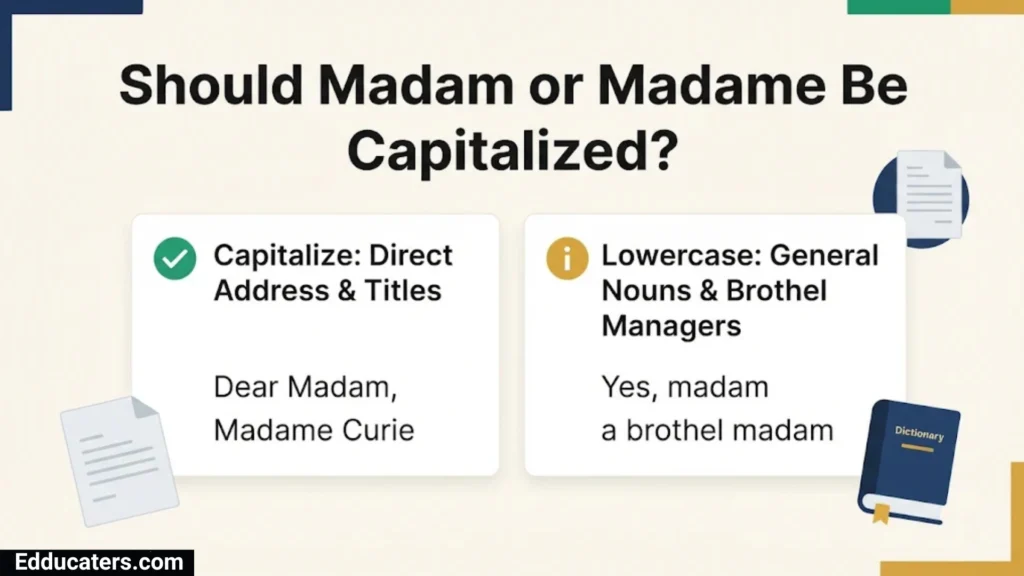
Capitalization depends on how you use the word. Both madam and madame can appear with uppercase or lowercase letters.
When to Capitalize Madam
Capitalize Madam when it’s used as part of a formal title or at the beginning of a sentence.
Examples:
- Madam President, welcome to the meeting.
- Madam Speaker, the committee is waiting.
- Madam Secretary, please take your seat.
- Dear Madam, thank you for contacting us.
Lowercase madam when it’s used as a general form of address in the middle of a sentence.
Examples:
- Thank you, madam.
- The visitor asked the receptionist for help, madam.
- How can I assist you, madam?
When to Capitalize Madame
Capitalize Madame when it’s used as a title before a surname or as a standalone respectful address in French.
Examples:
- Madame Dupont is here.
- We met Madame Laurent yesterday.
- Bonjour, Madame.
- Madame Curie is a familiar historical name.
When madame appears as a common noun in English writing, capitalization depends on the sentence and style.
Is Madam Formal or Old-Fashioned?
Madam is formal, but its tone depends on context. In some settings, it sounds respectful and appropriate. In others, it may feel outdated or excessively polite.
When Madam Sounds Appropriate
You may hear madam in:
- Formal ceremonies
- Government or parliamentary settings
- Traditional customer service
- Official correspondence
- Formal speeches
- Legal or administrative conversations
- Situations where a person’s name isn’t known
For example, Madam President sounds appropriate in an official speech. May I help you, madam? can sound polite in traditional hospitality.
When Madam Sounds Old-Fashioned
In everyday American conversations, people don’t always use madam. They may prefer a person’s name or ma’am.
For example:
- Can I help you? sounds neutral and natural.
- Can I help you, ma’am? sounds polite.
- Can I help you, madam? sounds more formal or traditional.
The third option isn’t wrong. It simply carries a different tone.
Can You Use Madame in English?
Yes, you can use madame in English. It’s a recognized word, not a spelling mistake.
English speakers use madame in French-related contexts, cultural references, historical names, literature, and occasionally to create a particular formal or sophisticated tone.
However, don’t use madame automatically whenever you’re addressing a woman formally.
For example:
- Madam President is standard English.
- Madame Dupont is a conventional French title and surname combination.
- Madame Curie is a familiar historical form.
- Thank you, madam is standard English formal address.
The best choice depends on the context, not just how formal you want the sentence to sound.
Why Are Madam and Madame Spelled Differently?
The two spellings reflect the history of the words and the differences between English and French conventions.
Both trace their origins to the French expression ma dame, meaning “my lady.” The expression combined ma, meaning “my,” with dame, meaning “lady.”
English borrowed the expression from French during the Middle English period. Over time, the spelling madam became established in English.
French retained madame as its conventional spelling.
The spelling difference reflects linguistic development rather than a difference in the words’ basic origins.
Madam and Madame Word History
| Period | Development |
| Old French | The expression ma dame means “my lady.” |
| Middle English | English adopts forms influenced by French. |
| English usage | Madam becomes the established English spelling. |
| French usage | Madame remains the standard French title. |
| Modern English | Both spellings are recognized, but their usage differs. |
The words share a historical relationship. Their modern spelling and usage, however, follow different language conventions.
Common Mistakes When Using Madam or Madame
Even experienced writers can confuse the two forms. Here are some mistakes worth avoiding.
Using Madame President in Standard English
The conventional English title is Madam President, not Madame President.
Use madam when the title follows English conventions. Reserve madame for French or intentionally stylized contexts.
Using Madam Before an Ordinary Surname
Madam Smith or Madam Wilson may sound unusual in contemporary American English.
Use Ms. Smith or another appropriate title instead. Madam is generally used without a surname in English address or before an official position.
Assuming Madame Always Means a Married Woman
In modern French, madame doesn’t necessarily indicate marriage.
It functions as a general respectful title for adult women. Its usage has changed over time and doesn’t follow the traditional English distinction between Miss and Mrs.
Confusing Madame With Ma’am
Madame is the French title. Ma’am is the shortened English form of madam.
They aren’t interchangeable in every sentence. Choose the spelling and form that matches the language and tone.
Using Madam in Casual Conversations
Although madam is correct, it can sound overly formal in casual situations.
If you’re speaking to someone in a relaxed environment, you may not need a title at all. A simple greeting or the person’s name may feel more natural.
Choosing a Title Without Considering Context
Don’t choose madam or madame merely because one looks more sophisticated.
Consider the language, audience, situation, person’s preference, and whether you’re using a formal title or addressing someone directly.
Frequently Asked Questions About Madam or Madame
Is It Madam or Madame?
Both spellings are correct, but they have different conventional uses. Madam is the standard English form of formal address. Madame is the French title used in French-speaking contexts and certain cultural or historical names.
Is Madame a French Word?
Yes. Madame is a French title of respect for a woman. It’s used before a surname or as a standalone form of address. English also uses the word in French-related contexts.
Is Madam Correct in American English?
Yes. Madam is correct in American English. It’s used in formal address, official titles, letters, and certain traditional expressions.
Is Madame Correct in English?
Yes. Madame is a recognized English word. It appears in French names, cultural references, historical contexts, and expressions that retain French conventions.
Is Madam More Formal Than Madame?
Neither word is automatically more formal than the other. Madam is formal English. Madame is the French title of respect. Their formality depends on the setting and how they’re used.
Can I Write Madame in an English Email?
Yes, but it usually isn’t necessary unless the recipient’s title or cultural context calls for it. For most formal English emails, Dear Madam or a more specific greeting is more conventional.
Should I Use Madam or Madame for a Female Boss?
Use the person’s name or professional title when possible. If you need a formal title, madam is the standard English form. Madame would generally be appropriate only when French usage or a particular style calls for it.
Is Madam President Correct?
Yes. Madam President is the standard English form for addressing a female president. It’s used in government, organizations, formal meetings, and other official settings.
Is Madame President Incorrect?
Madame President isn’t the conventional English title. It may appear in French-influenced, translated, or stylized contexts, but standard English uses Madam President.
What Is the Difference Between Madam and Ma’am?
Madam is the full formal word. Ma’am is its shortened spoken form, commonly used in American English. Both can express respect, but ma’am is more natural in everyday speech.
Can Madam Be Used Before a Last Name?
It’s generally not standard modern English to use madam before an ordinary surname. Use Ms., Mrs., or an appropriate professional title instead. French surnames commonly take Madame.
Does Madame Mean Mrs.?
Not exactly. Madame is a French title of respect, while Mrs. is an English title traditionally used for married women. Modern French madame doesn’t necessarily indicate marital status.
Is Madam Old-Fashioned?
It can sound old-fashioned in casual American conversations, but it’s still appropriate in formal situations. Official titles such as Madam President remain conventional and widely recognized.
Conclusion
The difference between madam or madame comes down to language, context, and convention.
Madam is the standard English form used for formal address, official titles, business correspondence, and respectful conversations. Madame is the French form used in French-speaking settings, before French surnames, and in cultural or historical names.
Both spellings are correct. The key is knowing when each one belongs.
When writing in American English, choose madam for standard formal address. Use madame when French language or established cultural convention calls for it. That simple distinction will help you choose the right word with confidence.

I’m Julian Mercer, an English language writer dedicated to helping people master grammar through practical examples and clear explanations. I enjoy teaching grammar in a way that is both engaging and easy to remember.
My work focuses on grammar rules, punctuation, word usage, and writing techniques that readers can apply in everyday life. I believe learning English should be simple, enjoyable, and useful.
Books
English Grammar in Practice
Writing with Precision
 Claire Holloway