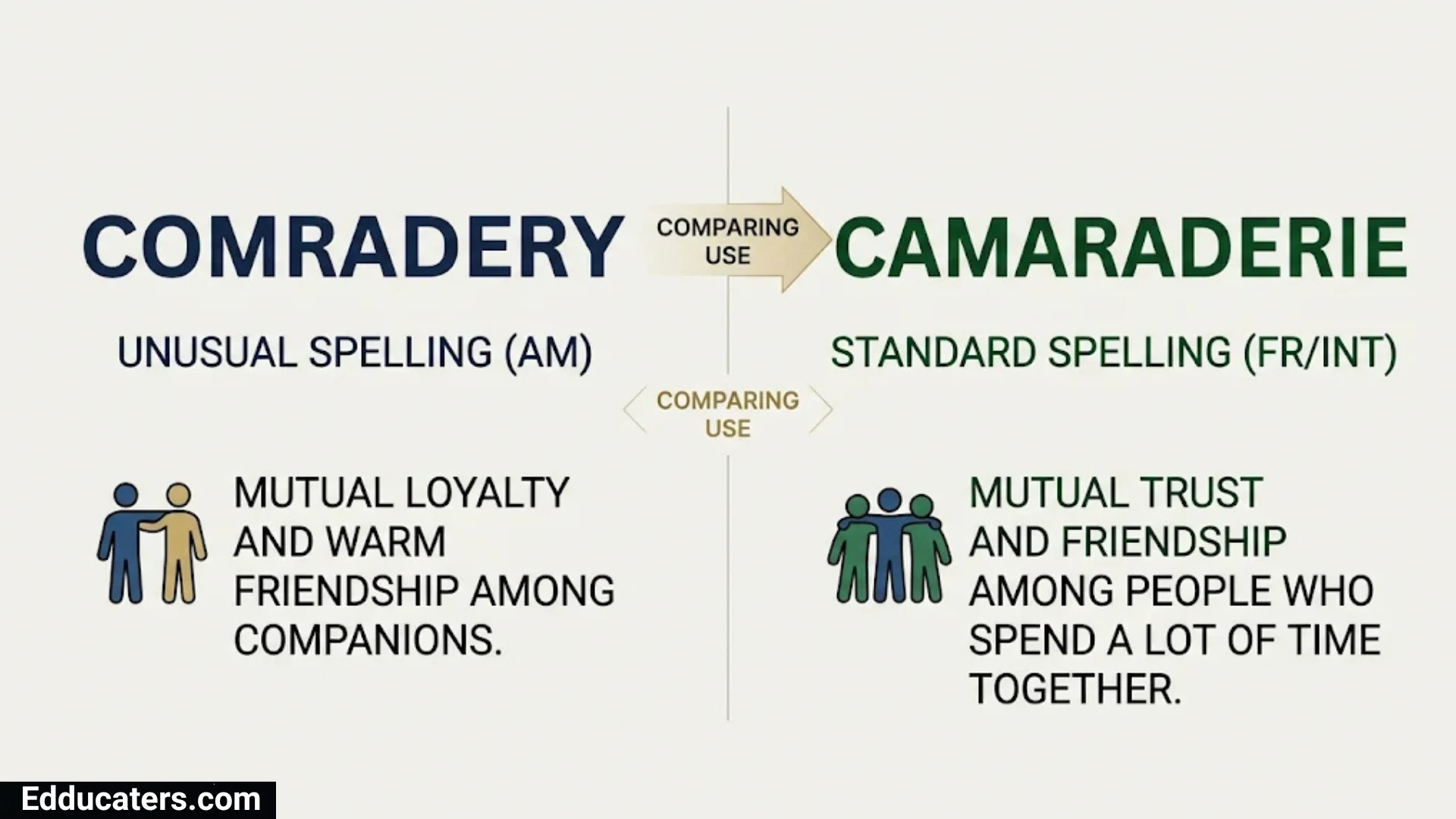
Have you ever stopped while writing because you couldn’t decide between comradery or camaraderie? You’re not alone. These two spellings look different but share a closely related meaning. That similarity makes the choice confusing, especially when both forms appear in published English.
The good news is that both camaraderie or comradery are accepted English words. However, they don’t enjoy equal recognition or usage. Camaraderie is the more established and widely preferred spelling. Comradery is a recognized alternative, particularly in North American English.
Both words describe a feeling of friendship, trust, and mutual support among people who work together or share meaningful experiences. You might encounter this bond among coworkers, soldiers, classmates, teammates, or close companions.
Although the two forms communicate essentially the same idea, their histories and spelling patterns differ. Understanding those differences will help you choose the right word for your writing.
This guide explores their definitions, origins, pronunciation, regional usage, differences, and practical examples. You’ll also learn why camaraderie remains the safer choice in formal and professional communication.
Camaraderie or Comradery: Which Spelling Is Correct?
Both camaraderie or comradery are correct English spellings. Neither word is inherently a spelling mistake. However, camaraderie is the traditional and more widely established form.
The word camaraderie entered English from French during the 19th century. It developed from the French word camarade, meaning a companion or comrade. English speakers later developed comradery by combining comrade with the suffix -ery.
Although both spellings have legitimate histories, dictionaries don’t always give them equal prominence. Oxford recognizes comradery as a noun meaning friendship and trust among people who work or spend considerable time together. It also labels the form as especially North American English.
Here’s the simplest way to remember the distinction:
- Camaraderie: The traditional, standard, and more widely preferred spelling.
- Comradery: An accepted alternative spelling, especially associated with North American English.
- Meaning: Both words describe friendship, companionship, trust, and mutual support.
- Formal writing: Camaraderie is generally the safer choice.
For example:
- The employees developed strong camaraderie while working on the project.
- The employees developed strong comradery while working on the project.
Both sentences communicate the same idea. However, the first uses the more familiar spelling.
If you’re writing an academic paper, business report, newspaper article, or professional email, choose camaraderie. It follows the more established convention and is less likely to distract readers.
Camaraderie vs Comradery: What’s the Difference?
The primary difference between camaraderie and comradery involves their spelling, historical development, and frequency of use. Their central meanings overlap.
Camaraderie comes directly from French, whereas comradery developed in English through the word comrade. Both eventually express the idea of companionship and friendly relationships.
Consider the following comparison:
| Feature | Camaraderie | Comradery |
| Correct spelling | Yes | Yes |
| Part of speech | Noun | Noun |
| Meaning | Friendship and mutual support | Friendship and mutual support |
| Origin | French camaraderie | English comrade + -ery |
| Historical appearance | Around 1840 | Around 1862 |
| Regional association | Used internationally | Especially North American |
| Usage frequency | More established | Less common |
| Formal writing | Preferred choice | Accepted alternative |
The historical dates come from etymological records, which trace camaraderie to approximately 1840 and comradery to 1862.
Etymology, Origin & Meaning+2
Do Camaraderie and Comradery Have Different Meanings?
No. Both words describe a friendly connection between people who share activities, responsibilities, experiences, or common interests.
Neither spelling automatically suggests a stronger relationship or a different emotional connection.
For example, consider these sentences:
- The team’s camaraderie improved after several successful seasons.
- The team’s comradery improved after several successful seasons.
Both describe a positive relationship among teammates.
You can use either spelling without changing the intended message. The difference concerns word choice rather than a meaningful distinction in definition.
Why Are There Two Spellings?
English regularly develops alternative word forms through pronunciation, word formation, and influence from related vocabulary.
Camaraderie preserves its French spelling. However, some English speakers found a connection between its meaning and the familiar word comrade.
That connection encouraged the formation of comradery. Writers could recognize the familiar root comrade and add the English suffix -ery to create a related noun.
This process produced two forms with similar meanings but different spelling histories.
What Does Camaraderie Mean?
Camaraderie means a feeling of friendship, trust, and mutual support among people who work together or share experiences.
It describes the connection that develops when individuals cooperate, face challenges, pursue common goals, or spend meaningful time together.
The relationship often involves more than ordinary politeness. People feel comfortable around one another and develop a sense of belonging.
For example, imagine a group of employees working together to complete an important project. They share responsibilities, solve unexpected problems, and encourage one another when deadlines become difficult.
Over time, their cooperation can develop into genuine workplace camaraderie.
The same feeling appears in sports teams, military units, classrooms, volunteer organizations, and friendship groups.
According to the Cambridge Dictionary, camaraderie describes friendliness toward people with whom you work or share an experience. Oxford also highlights the friendship and trust that develop among people who spend considerable time together.
Meaning of Comradery
Comradery means essentially the same thing as camaraderie. It describes a friendly relationship built through companionship, shared responsibilities, and mutual support.
The word connects naturally with comrade, which refers to a companion, associate, or fellow member of a group.
For example:
- Their comradery helped them complete the difficult assignment.
- The volunteers developed lasting comradery during their community work.
- Years of military service strengthened the soldiers’ comradery.
You don’t need to learn a separate definition for this alternative spelling. Its meaning closely matches that of camaraderie.
What Does Camaraderie Look Like in Everyday Life?
Camaraderie becomes easier to understand when you see how it develops in ordinary situations.
It often appears when people cooperate, support one another, and build relationships through shared experiences.
Here are some practical examples:
- At work: Coworkers help each other meet deadlines and celebrate collective achievements.
- In sports: Teammates encourage one another after difficult matches and celebrate victories together.
- In the military: Soldiers develop strong relationships through shared training, responsibilities, and challenging circumstances.
- At school: Students build friendships while completing group assignments and participating in extracurricular activities.
- Among friends: People strengthen their connection by supporting each other during difficult times.
- In volunteer groups: Members develop trust while working toward a common community goal.
In each situation, the relationship involves more than simply being in the same place. People develop a shared sense of responsibility and connection.
Origin and History of Camaraderie or Comradery
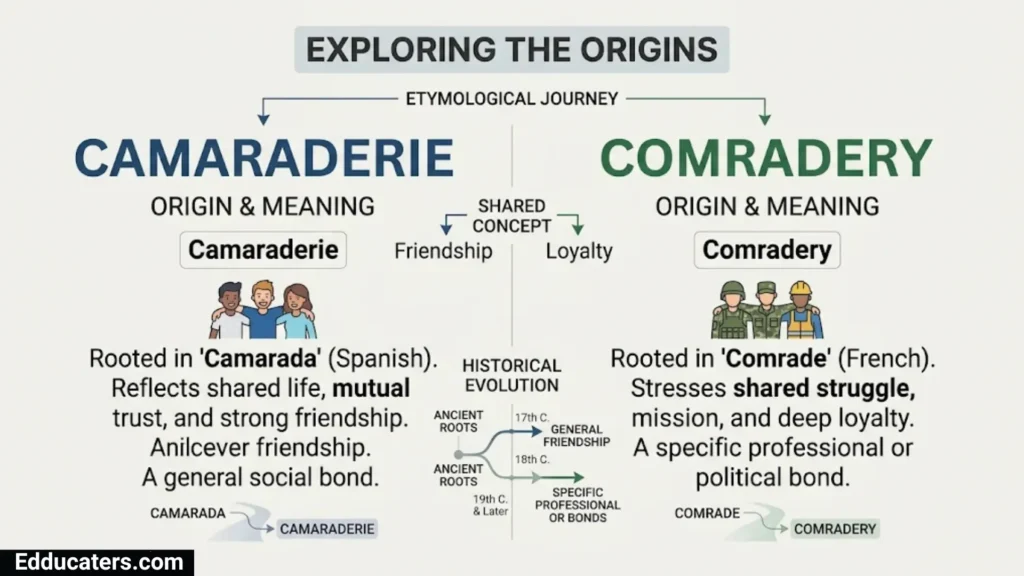
The histories of camaraderie and comradery explain why English contains two spellings for such closely related concepts.
Although both words ultimately connect with the idea of companionship, they developed through different word-formation processes.
Camaraderie came into English through French. Comradery developed later from the English word comrade.
Understanding this distinction also helps explain their spelling patterns.
Where Does the Word Camaraderie Come From?
The English word camaraderie comes from the French noun camaraderie. French developed this word from camarade, meaning a companion or comrade.
Historically, camarade carried an association with people sharing a room or chamber.
The word’s deeper history connects with Spanish camarada, which referred to a group of companions sharing a room. The Spanish word traces back to cámara, meaning a room or chamber.
This historical connection ultimately reaches the Latin word camera, meaning a chamber or vaulted room.
The development can be represented as follows:
Simplified historical word development
Latin camera
Room or chamber
Spanish camarada
Chamber companion
French camarade
Comrade or companion
French camaraderie
Companionship and friendly relationships
English camaraderie
Friendship, trust, and mutual support
The word entered English around 1840. Its meaning gradually became associated with friendly relationships among companions, colleagues, and people sharing common experiences.
The historical connection with sharing a chamber is interesting because the modern meaning extends far beyond physical living arrangements.
Today, two people can develop camaraderie without ever sharing a home, room, or workplace.
How Did Comradery Become an Alternative Spelling?
Comradery developed through a different process.
English speakers already had the word comrade, which referred to a companion or associate. By adding the suffix -ery, they formed a related noun describing the state or feeling of being comrades.
The word appeared around 1862, approximately 22 years after camaraderie entered English.
The formation is straightforward:
- Comrade: A companion or fellow member of a group.
- -ery: A suffix used to form nouns describing a condition, activity, or collective association.
- Comradery: The feeling or relationship associated with being comrades.
This formation made the word look more familiar to English speakers.
However, comradery didn’t replace camaraderie. Both forms continued to exist, although the French-derived spelling remained more established.
Is Comradery Related to the Word Comrade?
Yes. The connection is direct.
A comrade is someone who shares an activity, responsibility, organization, or cause with another person. The word can describe a friend, colleague, fellow soldier, or associate.
For example:
- The soldiers supported their comrades during training.
- She remained close to her former political comrades.
- The workers treated each other as trusted comrades.
Comradery takes this relationship and turns it into an abstract noun.
The distinction is similar to the relationship between friend and friendship. One identifies a person while the other describes the relationship.
However, camaraderie follows its own French-derived historical path rather than simply adding a suffix to the English word comrade.
How Do You Pronounce Camaraderie or Comradery?
The pronunciation of camaraderie can confuse English learners because its spelling doesn’t follow some familiar English spelling patterns.
In American English, camaraderie is commonly pronounced:
IPA: /ˌkæm.əˈrɑː.dɚ.i/
The pronunciation has five syllables, with the main stress falling on the third syllable.
The word comradery has a different, more English-looking pronunciation pattern. Oxford gives the American pronunciation as /ˈkɑːmrædri/.
Here are the important pronunciation points:
- Camaraderie: The main stress falls on the third syllable.
- Comradery: The pronunciation follows the familiar sound pattern of comrade.
- Spelling: The two words don’t necessarily sound identical, even though their meanings are closely related.
Why Is Camaraderie Difficult to Pronounce?
The unusual spelling creates most of the difficulty.
Many English learners expect the word to sound exactly as its letters suggest. However, camaraderie retains a French-derived spelling that doesn’t always match familiar English pronunciation patterns.
To pronounce it more confidently:
- Break the word into smaller sound units.
- Pay attention to the stressed syllable.
- Avoid rushing through the middle sounds.
- Listen to an American English dictionary recording.
- Practice using the word in complete sentences.
For example:
“The camaraderie among the employees made the workplace enjoyable.”
Practicing the word in context can make its pronunciation easier to remember.
Camaraderie or Comradery in American and British English
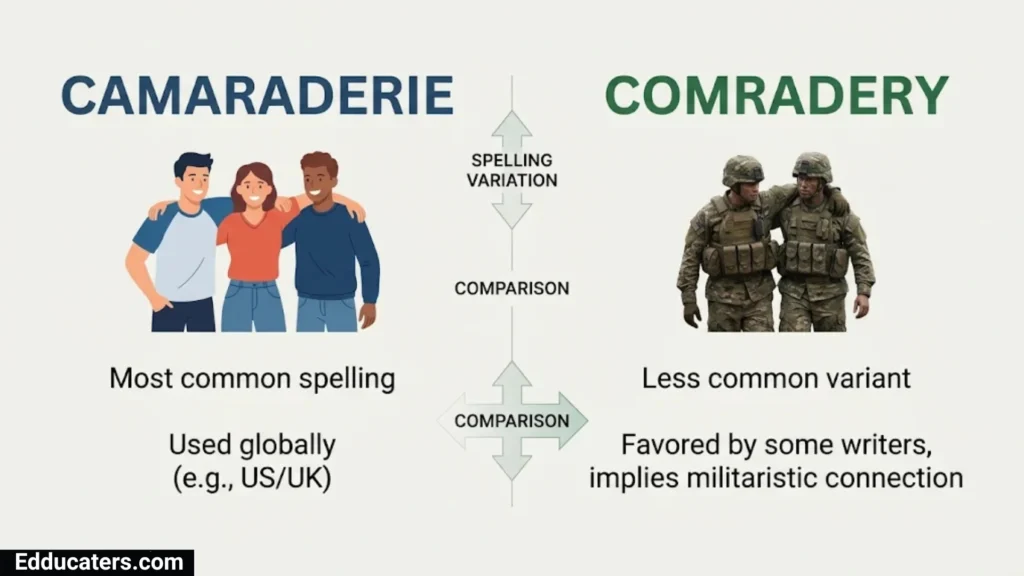
Both American English and British English recognize camaraderie. However, the alternative comradery has a particularly strong association with North American English.
This distinction matters because some writers assume that the two spellings represent a standard American-versus-British spelling difference. That’s not quite accurate.
Camaraderie is used internationally. It appears in American, British, Canadian, Australian, and other varieties of English.
Oxford identifies comradery as especially North American English. This makes it a useful regional distinction rather than an absolute rule separating two national spelling systems.
Camaraderie in American English
American writers commonly use camaraderie in everyday communication, journalism, academic writing, and professional documents.
The alternative comradery also appears in American English.
For example:
- The employees developed strong camaraderie during the training program.
- The team’s comradery improved after several months of cooperation.
Both examples are understandable and grammatically acceptable.
However, camaraderie remains the more familiar editorial choice.
Camaraderie in British English
British English also uses camaraderie as its established spelling.
The word appears in newspapers, books, workplace communication, and ordinary conversation. British writers generally don’t need to substitute another spelling to follow British English conventions.
For example:
“The camaraderie among the players created a positive atmosphere throughout the season.”
The spelling remains the same in both British and American English.
What About Canadian, Australian, and Other English Varieties?
The spelling camaraderie works across different English-speaking countries.
You can comfortably use it in:
- Canada
- Australia
- New Zealand
- India
- South Africa
- Ireland
- The United Kingdom
- The United States
These countries follow different editorial conventions in certain areas of spelling and punctuation. However, camaraderie doesn’t require a special regional spelling adjustment.
Practical advice: If you’re writing for an international audience, choose camaraderie. It offers the most familiar and widely established form.
Which Spelling Is More Common: Camaraderie or Comradery?
Camaraderie is more common than comradery in established English usage.
Although both spellings have existed for more than a century, the French-derived form has maintained stronger recognition in dictionaries and published writing.
Several factors explain this preference.
First, historical usage favors camaraderie. The word entered English earlier and became established in literature, newspapers, and professional communication.
Second, dictionaries recognize its international use. Major English dictionaries provide definitions and pronunciation guidance for camaraderie. Oxford also includes comradery as an alternative form, particularly in North American English.
Third, editorial familiarity matters. Writers and editors often choose the spelling that readers recognize most easily. Camaraderie generally fulfills that expectation.
Why Is Camaraderie More Popular?
The spelling has several advantages:
- It preserves the word’s historical French form.
- It has a long record in published English.
- It appears in major international dictionaries.
- It is familiar to readers across different English-speaking regions.
- It works naturally in academic, professional, and everyday writing.
However, less frequent doesn’t mean incorrect. Comradery remains a recognized English noun.
Does Google Trends Show Which Spelling Is Correct?
Google Trends can help compare public search interest between two spellings. However, search interest doesn’t establish grammatical correctness or dictionary acceptance.
A spelling can receive fewer searches while remaining perfectly legitimate.
Similarly, a high search volume may reflect confusion rather than widespread preference.
For a reliable spelling decision, consider:
- Dictionary recognition.
- Historical development.
- Published usage.
- Regional editorial conventions.
- The intended audience.
These factors provide a stronger basis for word choice than search popularity alone.
How to Use Camaraderie or Comradery in a Sentence
Both words function as nouns. They describe a relationship or feeling rather than an individual person or a specific action.
You can use them when discussing friendship, group cooperation, shared experiences, and mutual support.
For example:
- The team’s camaraderie made every training session enjoyable.
- Their comradery helped them overcome several difficult challenges.
- A strong sense of camaraderie developed among the new employees.
Notice how each sentence describes a relationship that develops among people.
Examples of Camaraderie in Sentences
Here are additional examples showing how to use the preferred spelling naturally.
- The camaraderie among the firefighters helped them work effectively under pressure.
- Years of working together created a strong sense of camaraderie.
- The students developed camaraderie while preparing for their final examination.
- Team camaraderie played an important role in their championship victory.
- The new manager encouraged camaraderie among employees from different departments.
- Their shared experiences created lasting camaraderie.
- The soldiers developed deep camaraderie during their military service.
- Everyone appreciated the friendly atmosphere and camaraderie within the organization.
- The annual trip strengthened the camaraderie among coworkers.
- Genuine camaraderie helped the volunteers remain motivated throughout the campaign.
Each example uses the noun to describe a friendly connection built through shared experiences.
Examples of Comradery in Sentences
You can also use the alternative spelling in sentences without changing the intended meaning.
- The volunteers developed strong comradery while helping their community.
- Their shared experiences created lasting comradery among the group.
- The team’s comradery helped everyone remain motivated.
- The project encouraged comradery among employees from different departments.
- Military training often develops a sense of comradery among soldiers.
- Their comradery became stronger after completing several difficult assignments.
- The friendly atmosphere encouraged comradery between the students.
- Years of cooperation created genuine comradery among the workers.
These examples demonstrate that comradery can function naturally as a noun.
Common Expressions With Camaraderie
Certain expressions frequently appear with the word camaraderie.
Learning these combinations can help you use the noun more naturally.
| Expression | Example |
| A sense of camaraderie | The event created a sense of camaraderie. |
| Strong camaraderie | The group developed strong camaraderie. |
| Build camaraderie | Shared activities help build camaraderie. |
| Develop camaraderie | The employees developed camaraderie over time. |
| Foster camaraderie | Team activities can foster camaraderie. |
| Spirit of camaraderie | A spirit of camaraderie filled the room. |
| Workplace camaraderie | Workplace camaraderie improves team relationships. |
| Team camaraderie | Team camaraderie encouraged cooperation. |
The expression a sense of camaraderie is especially useful when describing the feeling of belonging within a group.
Is Camaraderie Countable or Uncountable?
Camaraderie is generally an uncountable noun.
You normally don’t use an indefinite article directly before it. You also don’t usually form its plural by adding -s.
Correct examples:
- The camaraderie among the players was impressive.
- We developed a strong sense of camaraderie.
- Their workplace has a friendly atmosphere and genuine camaraderie.
Incorrect in standard usage:
– A camaraderie developed among the players.
Better:
– A sense of camaraderie developed among the players.
This distinction helps you use the word correctly in formal and everyday sentences.
Where Is Camaraderie Commonly Used?
Camaraderie can describe relationships in almost any setting where people cooperate or share experiences.
However, certain environments provide particularly strong examples because they involve teamwork, common goals, and mutual responsibilities.
Workplace Camaraderie
Workplace camaraderie describes friendly relationships among coworkers.
It develops when employees trust each other, communicate openly, and offer support during challenging assignments.
For example, imagine a team preparing an important business presentation. One employee handles research while another prepares the slides. A third checks the final document.
When everyone contributes and helps colleagues overcome problems, their professional relationship can become stronger.
Workplace camaraderie can encourage:
- Better communication.
- Mutual respect.
- Team collaboration.
- Employee morale.
- A supportive environment.
- Stronger professional relationships.
- A greater sense of belonging.
However, camaraderie doesn’t mean employees must become close personal friends. Professional respect and reliable cooperation can create a healthy sense of connection without requiring personal intimacy.
Military Camaraderie
Military camaraderie describes the strong bonds that develop among service members through shared training, responsibilities, and difficult experiences.
Soldiers often depend on their fellow service members for practical assistance and emotional encouragement.
This environment can strengthen mutual trust, loyalty, and solidarity.
For example, soldiers completing demanding training exercises may develop strong relationships because everyone faces similar challenges.
Their shared responsibilities create a sense of connection that goes beyond ordinary workplace relationships.
Sports Camaraderie
Sports provide another familiar example of camaraderie.
Players train together, compete against other teams, celebrate achievements, and support teammates after disappointing results.
These shared experiences can strengthen team spirit and cooperation.
Consider a soccer team that loses an important match. Instead of blaming individual players, teammates encourage each other and focus on improving their performance.
That supportive attitude demonstrates genuine camaraderie.
It also shows why teamwork involves more than individual talent. Strong relationships can help people work toward shared goals.
School and College Camaraderie
Students develop camaraderie through classroom activities, group assignments, sports, clubs, and extracurricular events.
For example, classmates preparing for a difficult examination might exchange study materials and explain challenging topics to each other.
Their cooperation creates mutual understanding and strengthens social connections.
School camaraderie can also help students feel included in their academic environment.
Camaraderie Among Friends and Volunteers
Camaraderie isn’t limited to professional or organized groups.
Friends can develop it through shared interests, travel, hobbies, and difficult life experiences.
Volunteer organizations also provide excellent examples. Members work toward common community goals while supporting one another.
Whether people organize a charity event, clean a neighborhood, or help families after a disaster, their shared efforts can create lasting bonds.
Camaraderie Synonyms and Related Words
Several English words express ideas similar to camaraderie, including friendship, fellowship, companionship, and solidarity.
However, these terms aren’t always interchangeable. Each one emphasizes a slightly different aspect of human relationships.
Understanding their differences can help you choose more precise vocabulary.
| Synonym | Meaning | Example |
| Fellowship | Friendly association among people with shared interests | The organization encouraged fellowship among members. |
| Companionship | The state of spending time with others | Their companionship made the journey enjoyable. |
| Friendship | A close personal relationship | Their friendship lasted for decades. |
| Solidarity | Unity based on shared interests or responsibilities | The workers demonstrated solidarity during the difficult period. |
| Togetherness | A feeling of connection and unity | The celebration created a sense of togetherness. |
| Brotherhood | A close bond among members of a group | The team developed a strong sense of brotherhood. |
| Team spirit | Enthusiasm and loyalty within a team | Their team spirit helped them win. |
| Mutual support | Helping and encouraging one another | Mutual support strengthened their relationship. |
| Companionship | Friendly association and shared experiences | The companionship made the experience memorable. |
| Comradeship | Friendship among people sharing responsibilities or experiences | Their comradeship grew during military service. |
Camaraderie vs Friendship
Although camaraderie and friendship share similar meanings, they aren’t exactly interchangeable.
Friendship usually describes a personal relationship between individuals. Camaraderie more often describes a friendly connection among members of a group.
For example:
- Two childhood friends may share a close friendship.
- Employees working toward a shared goal may develop camaraderie.
- Soldiers serving together may experience both friendship and comradeship.
Camaraderie doesn’t necessarily require deep personal affection. Mutual respect, cooperation, and shared experiences can create it.
Camaraderie vs Comradeship
Comradeship refers to friendship and mutual support among people who work or live together, particularly during difficult circumstances.
It is closely related to camaraderie and often emphasizes shared responsibilities.
For example:
“The comradeship among the soldiers remained strong long after their service ended.”
Camaraderie and comradeship are often synonyms, although their tone and context can differ.
Common Mistakes When Writing Camaraderie or Comradery
Even experienced writers sometimes hesitate when choosing between these spellings.
Most mistakes happen because people assume one form must be incorrect or misunderstand the relationship between the two words.
Here are some common problems to avoid.
Treating comradery as completely incorrect: This is a common misconception. Comradery is a recognized English word, not simply a typing error.
Assuming both words have different meanings: Their central definitions overlap. Both describe companionship, friendship, and mutual support.
Confusing comradery with comrade: A comrade is a person. Comradery describes the relationship or feeling associated with companionship.
Assuming the difference is exclusively regional: Camaraderie is used in both American and British English. Comradery has a stronger North American association but isn’t simply the British equivalent.
Using the less familiar spelling in formal documents: Although comradery is accepted, camaraderie is generally the more recognizable choice.
Mispronouncing camaraderie: Its French-derived spelling can confuse readers who expect every letter to follow familiar English pronunciation patterns.
A little attention to spelling and context can prevent these problems.
Frequently Asked Questions
Is Camaraderie or Comradery Correct?
Both camaraderie and comradery are correct English spellings. However, camaraderie is the more established and widely preferred form. Use it when writing academic papers, professional documents, and formal communication.
Is Comradery a Real Word?
Yes. Comradery is a recognized English noun. It developed from comrade and the suffix -ery. It describes friendship, trust, and mutual support among companions. Oxford recognizes it as an alternative form, especially in North American English.
Do Camaraderie and Comradery Mean the Same Thing?
Yes. Both words describe friendly relationships among people who share experiences, responsibilities, or common interests. Neither spelling indicates a different level of friendship or loyalty.
Why Is Camaraderie Spelled With an A?
The spelling reflects its French origin. English borrowed camaraderie from French, where it developed from camarade, meaning a companion or comrade. The word preserves this historical spelling rather than following the modern English spelling of comrade.
Is Camaraderie More Common Than Comradery?
Yes. Camaraderie is the more established and widely used spelling in English. It has a longer history in published writing and enjoys broader dictionary recognition. Comradery remains an accepted but less common alternative.
Can You Use Comradery in Formal Writing?
Yes. Comradery is a legitimate word, so using it isn’t automatically a grammatical mistake. However, camaraderie is generally preferable in formal writing because it is more widely recognized and established.
Is Camaraderie an American or British Word?
Camaraderie is used in both American and British English. It is also common in other English-speaking countries, including Canada, Australia, and New Zealand. It isn’t an exclusively American or British spelling.
What Is the Plural of Camaraderie?
Camaraderie is generally an uncountable noun, so it doesn’t normally have a plural form. Use expressions such as a sense of camaraderie, strong camaraderie, or different forms of camaraderie instead.
Is Camaraderie the Same as Friendship?
Not exactly. Friendship usually describes a personal relationship between individuals. Camaraderie emphasizes friendly connections, cooperation, and mutual support within a group. Both involve positive relationships, but camaraderie often develops through shared experiences.
What Is the Difference Between Comrade and Comradery?
A comrade is a companion, colleague, or fellow member of a group. Comradery describes the friendly relationship or sense of companionship among such people.
For example, soldiers may call one another comrades because they serve together. Their mutual trust and shared experiences can create comradery.
Conclusion: Camaraderie or Comradery?
The choice between camaraderie or comradery doesn’t involve choosing between a correct and an incorrect spelling. Both are accepted English words with essentially the same meaning.
However, camaraderie remains the more established and widely preferred spelling. It comes from French camaraderie, which developed from camarade. The alternative comradery appeared later through the English word comrade and the suffix -ery.
Both words describe friendship, mutual trust, companionship, and support among people who share experiences or responsibilities.
If you’re writing an academic paper, professional email, business report, or everyday article, choose camaraderie. It’s the more familiar form and works naturally across American, British, and international English.

Hi, I’m Nathan Whitmore, and I enjoy making English grammar easy for learners of all ages. I believe grammar should be practical, not confusing. I write simple, well-researched guides that help readers improve their writing, speaking, and overall communication skills.
I spend a lot of time studying grammar patterns, sentence construction, punctuation, and modern English usage. My goal is to create lessons that anyone can understand, whether they are students, teachers, or professionals.
Books
Clear English Grammar
The Smart Writer’s Grammar Handbook
 Julian Mercer
 Claire Holloway