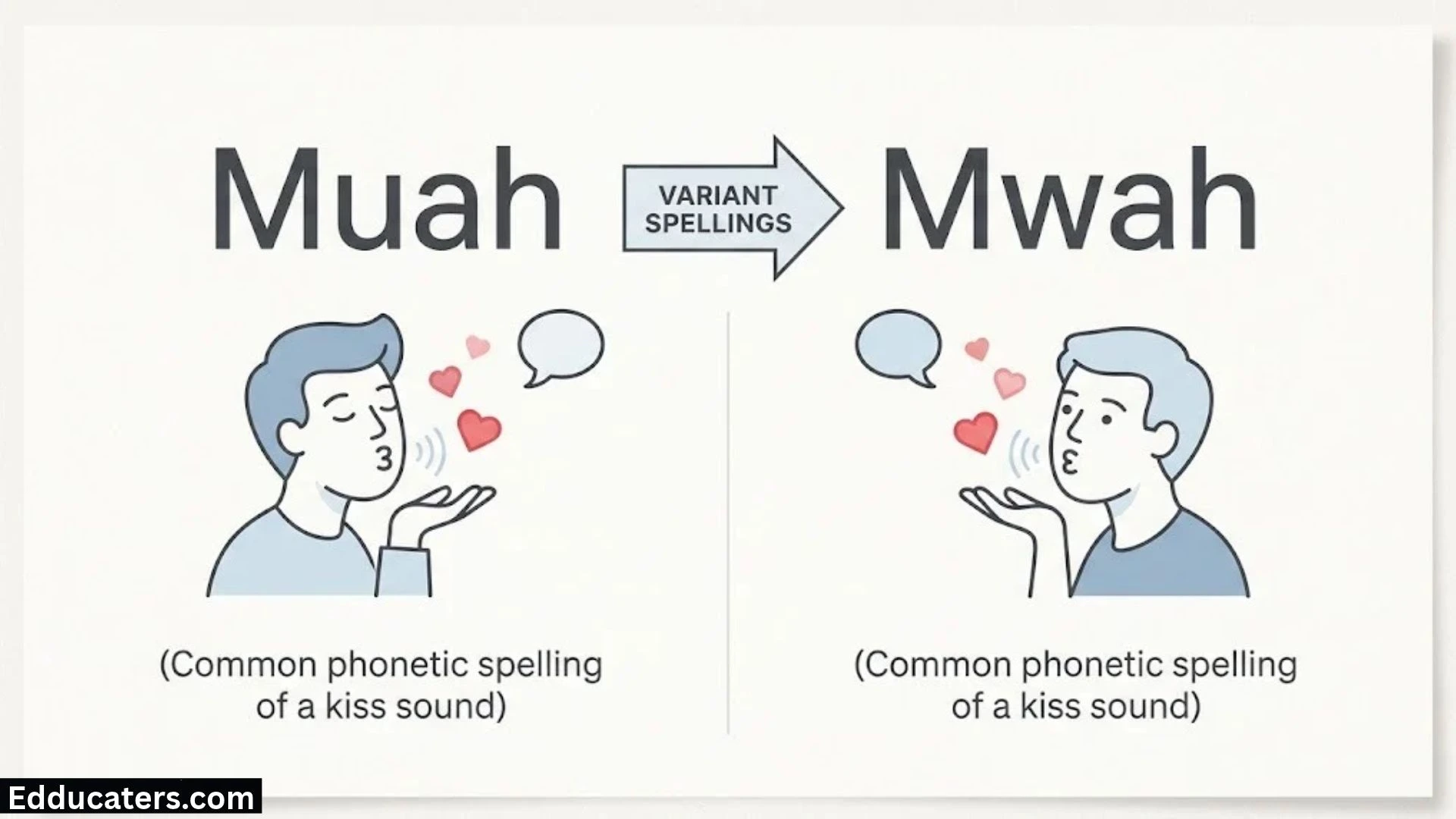
Have you ever typed a kiss in a text message and wondered whether to write muah or mwah? Both spellings appear in casual conversations, affectionate messages, social media captions, and playful goodbyes. But is one more correct than the other?
The good news is that both muah or mwah are commonly used informal expressions that represent the sound of a kiss. Neither spelling has an exclusive claim to correctness in everyday texting. The choice usually comes down to personal preference, writing style, and the tone you want to convey.
Although the two expressions share the same basic meaning, understanding their use can help you communicate more naturally. A quick mwah! to a friend may sound playful, while muah ❤️ to a partner can feel affectionate or romantic.
In this guide, you’ll learn the muah or mwah meaning, whether either spelling is incorrect, how people use these expressions, and which alternatives work better in formal situations. You’ll also find practical examples to help you choose the right expression for different conversations.
Muah or Mwah: Which Is Correct?
Both muah or mwah are acceptable informal spellings of a kiss sound. English doesn’t prescribe one mandatory spelling for this kind of sound imitation.
These expressions work differently from ordinary words such as kiss, love, or hello. They imitate a sound rather than follow a fixed spelling rule. As a result, people can represent the same sound in slightly different ways.
For example, you might send either of these messages:
- “Goodnight, muah!”
- “Goodnight, mwah!”
Both messages communicate a similar idea. The sender is adding a kiss-like expression to a friendly or affectionate goodbye.
The main difference is how each person prefers to write the sound. Some people favor muah, while others naturally type mwah. Neither choice automatically makes the message more romantic, friendly, or sincere.
| Feature | Muah | Mwah |
| Basic meaning | A written kiss sound | A written kiss sound |
| Spelling type | Informal sound representation | Informal sound representation |
| Typical tone | Affectionate or playful | Affectionate or playful |
| Common settings | Text messages, chats, captions | Text messages, chats, captions |
| Formal writing | Generally unsuitable | Generally unsuitable |
| Is it inherently incorrect? | No | No |
The simple rule: Use whichever spelling feels natural in casual communication. If you’re writing a formal report, academic paper, or professional email, a standard expression will usually serve you better.
What Does Muah Mean?
The expression muah represents the sound associated with giving a kiss. People use it in writing to send a symbolic kiss, express affection, or add warmth to a message.
Unlike the ordinary word kiss, muah imitates the sound rather than naming the physical action. This makes it especially useful in informal digital conversations, where a few letters can communicate emotion without a lengthy explanation.
Muah Meaning in English
In everyday English, muah means a kiss or a playful imitation of a kissing sound. Its exact emotional meaning depends on the surrounding words and the relationship between the people communicating.
Consider these examples:
- “Muah! Have a wonderful day.”
- “Sending you a big muah.”
- “Thanks for everything, muah!”
- “Love you. Muah ❤️”
Each example uses the expression to communicate affection or warmth. However, the messages don’t necessarily express the same kind of affection.
A person might send muah to a close friend as a cheerful goodbye. A romantic partner might use it to express love. Someone else might add it to a humorous message simply to sound dramatic or playful.
The expression itself doesn’t determine the relationship. Context does much of that work.
What Does Muah Mean in a Text?
The meaning of muah in a text usually centers on affection, friendliness, or a symbolic kiss. It can appear at the beginning or end of a message, although people often use it as a sign-off.
For example:
“Thanks for checking on me today. Muah!”
Here, muah adds warmth to a message of appreciation. It makes the note feel more personal than a plain thank-you.
Now consider another example:
“Goodnight, sweetheart. Muah ❤️”
This message has a more romantic tone because the affectionate greeting and heart emoji reinforce the meaning.
You can also use the expression playfully:
“You saved me the last slice of cake? Muah!”
In this case, the writer uses a pretend kiss to show delight or appreciation. The expression adds personality without requiring a literal kiss.
Does Muah Mean Love?
Not always. Muah can express love, but it doesn’t automatically mean romantic love.
Its interpretation depends on several factors:
- Relationship: A romantic partner, close friend, and family member may use the expression differently.
- Conversation: A loving message gives it a different tone from a sarcastic or humorous exchange.
- Personal habits: Some people frequently send kisses in messages, while others reserve them for special moments.
- Additional symbols: Hearts and affectionate words may strengthen the emotional tone.
For example, a parent might text, “Good luck today, muah!” to a child. A friend might send “Mwah, thanks!” after receiving a favor. A romantic partner might use the same expression before saying goodnight.
All three uses can be natural.
If someone sends you muah, consider the whole conversation rather than assuming the message reveals romantic interest. One informal expression rarely tells the entire story.
What Does Muah Mean at the End of a Message?
At the end of a message, muah often functions as an affectionate sign-off. It can suggest a symbolic kiss, a warm goodbye, or a playful way to finish a conversation.
Compare these examples:
- “Talk to you tomorrow. Muah!”
- “Thanks for being there for me. Muah ❤️”
- “Okay, I’m off to bed. Muah!”
- “Love you lots. Muah, see you soon!”
The placement helps the expression act like a closing gesture. Instead of ending the message abruptly, the writer adds a little warmth.
However, muah isn’t a conventional business closing. You wouldn’t normally replace Best regards with Muah in a message to an unfamiliar client or formal business contact.
The key is to match your sign-off to the relationship and setting.
What Does Mwah Mean?
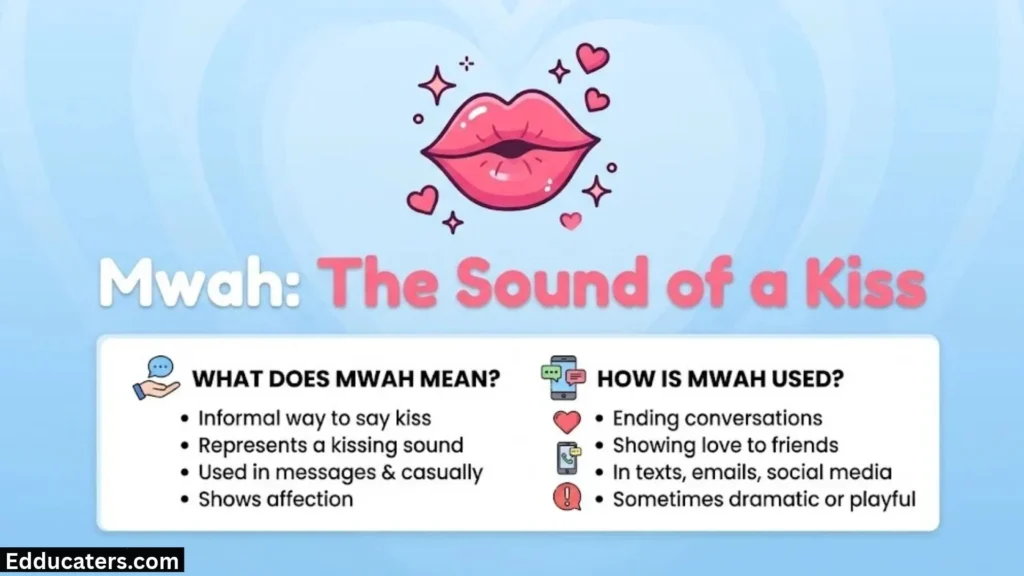
Mwah is another informal way to represent a kiss sound. Like muah, it appears in personal messages, social media interactions, and casual conversations.
People often use it to send a symbolic kiss without describing the action directly. It can also make a message sound cute, enthusiastic, affectionate, or exaggerated.
Mwah Meaning in English
The mwah meaning is essentially the same as the meaning of muah: a written imitation of a kissing sound.
For example:
- “Mwah! Have a great weekend.”
- “Sending you kisses, mwah!”
- “You’re the best. Mwah!”
- “See you soon, mwah ❤️”
These messages show how mwah can fit different situations. It might express gratitude, affection, excitement, or a playful goodbye.
The spelling doesn’t carry one fixed emotional meaning. A short, cheerful message can make it feel friendly, while romantic wording can give it a more intimate tone.
What Does Mwah Mean in Texting?
The meaning of mwah in texting depends on what the sender wants to communicate. It commonly represents a kiss and adds an affectionate or playful touch to a conversation.
Imagine your friend helps you prepare for an important interview. You might write:
“Thank you for helping me practice. Mwah! I owe you one.”
The expression makes the message sound warm and familiar. It doesn’t necessarily imply romance.
In another conversation, someone might text:
“Goodnight, my love. Mwah 😘”
Here, the romantic wording and kiss emoji make the affection clearer.
People also use mwah in social media comments, birthday greetings, group chats, and celebratory messages. Its informal style makes it particularly suited to communication that values personality over formality.
What Does Mwah Mean From a Girl?
When a girl sends mwah, she may be expressing affection, friendship, appreciation, playfulness, or flirtation. The expression alone doesn’t prove romantic interest.
For example, a close friend might write:
“You’re such a sweetheart. Mwah!”
This could simply be a friendly way to show appreciation.
On the other hand, someone you’re dating might write:
“Wish you were here. Mwah ❤️”
The surrounding message makes the expression sound more intimate.
To interpret it fairly, consider the person’s usual communication style, the nature of your relationship, and the broader conversation. If she regularly sends affectionate expressions to friends, mwah may be entirely platonic.
Avoid reading too much into a single word. The meaning comes from the interaction as a whole.
Does Mwah Mean a Kiss?
Yes. In informal written English, mwah commonly represents the sound of a kiss or a symbolic kiss sent through a message.
However, it isn’t exactly the same grammatical kind of expression as the noun kiss.
Compare these sentences:
- “She gave him a kiss.” — Kiss names the action.
- “She sent him a kiss.” — Kiss names the affectionate gesture.
- “Mwah! See you later.” — Mwah imitates the sound associated with that gesture.
This distinction explains why mwah feels natural in casual messages but may look out of place in formal prose. It adds an expressive sound rather than supplying a standard descriptive word.
What Is the Difference Between Muah or Mwah?
The muah or mwah difference mainly comes down to spelling and personal preference. Both expressions usually communicate the same basic idea: a kiss represented through writing.
However, there are a few details worth understanding before choosing one.
Spelling and Visual Style
The most obvious difference is the way the expressions look.
- Muah: Includes the letter u after m.
- Mwah: Places w directly after m.
Some readers may find muah softer-looking or more stylized. Others may prefer mwah because it resembles the sound they associate with a kiss.
These impressions are subjective. Neither spelling has a universally accepted emotional quality, and writers use both in casual communication.
Meaning and Emotional Tone
Neither spelling automatically expresses stronger affection.
For example:
- “Love you, muah!”
- “Love you, mwah!”
Both messages can communicate warmth and affection. The words surrounding the expression provide much of the emotional meaning.
A message such as “Thanks for the help, mwah!” may sound friendly. Meanwhile, “Goodnight, my love. Muah ❤️” may sound romantic.
The difference comes from the complete message rather than the spelling alone.
Pronunciation and Sound
The Cambridge Dictionary defines mwah as an informal exclamation representing the sound of kissing, especially when people kiss each other on or near the cheek. Its entry gives the pronunciation as /mwɑː/. Read the dictionary definition of mwah.
Muah is commonly used as an alternative spelling of the same expression. Although individual readers may imagine slightly different sounds, the spelling doesn’t establish a universal pronunciation distinction.
Which One Should You Choose?
Use this practical guide:
| Situation | Suggested choice |
| Casual text to a friend | Muah or mwah |
| Romantic message | Muah or mwah |
| Playful social media comment | Muah or mwah |
| Affectionate family message | Muah or mwah |
| Formal business email | A conventional closing |
| Academic paper | Standard descriptive language |
Remember: You don’t need to learn a complicated spelling rule. Choose the version you prefer and consider how your audience will interpret the message.
Muah or Mwah Pronunciation
Both expressions imitate a kissing sound, so their pronunciation isn’t governed by the same rules as ordinary English vocabulary.
The spelling mwah has a recognized dictionary pronunciation of /mwɑː/ in British and American English. The exact sound can vary with accent and speaking style.
In everyday speech, the expression typically begins with an m sound, moves into a rounded glide, and ends with an open vowel. It may sound exaggerated when someone blows a kiss dramatically.
The spelling muah commonly represents a similar sound, although people don’t necessarily pronounce every informal spelling identically.
Three points can help you understand the difference:
- Written sound: The letters approximate a sound rather than follow a strict spelling pattern.
- Expressive delivery: A quick kiss sound may feel casual, while an exaggerated one may feel playful.
- Regional variation: Speakers can shape the vowel differently according to their accents.
You may also encounter stretched forms such as mwahh or mwaah. These spellings usually emphasize the expression rather than introduce a new meaning.
For example, compare “Mwah!” with “Mwaaaah!” The second version visually suggests a longer or more dramatic expression.
There is no need to treat these variations as separate formal vocabulary items. They’re creative ways to represent a sound in informal writing.
Is Muah a Real Word? Is Mwah a Real Word?
The answer depends partly on what you mean by a real word.
An expression doesn’t need to behave like an ordinary noun or verb to have an established meaning. English includes interjections, sound imitations, and other informal expressions that people recognize and understand.
Is Muah a Real English Word?
Muah is a recognizable informal expression used to represent a kiss sound. People write it in messages, online conversations, and affectionate sign-offs.
It doesn’t function like a typical verb. For example, you wouldn’t ordinarily write “I muah the letter” to mean that you kissed a letter.
Instead, it often stands alone:
- “Muah! Take care.”
- “Sending you a big muah.”
- “Thanks again, muah!”
In these examples, the expression adds emotion to the message. It doesn’t describe an action through conventional sentence structure.
Is Mwah a Real English Word?
Mwah is also an established informal expression. The Cambridge Dictionary lists it as an informal exclamation, and Wiktionary identifies muah among its alternative forms.
That means the claim that mwah isn’t a real word simply because it imitates a sound is too broad.
A better distinction is between informal vocabulary and formal language. An expression can have a recognized meaning without being appropriate in every situation.
For instance, mwah works naturally in a personal message:
“Mwah! See you tomorrow.”
But it would usually sound out of place in a research paper:
“The findings conclude, mwah.”
The second example doesn’t fit the purpose or tone of academic writing.
Are Muah or Mwah Standard English?
Both expressions belong primarily to informal English. However, mwah has a dictionary entry that identifies its meaning and informal status.
This distinction matters because an expression’s informal status doesn’t automatically make it incorrect. It simply tells you something about where and how to use it.
Consider three examples:
| Expression | Language category | Typical use |
| Kiss | Standard English noun or verb | Everyday speech and formal writing |
| Mwah | Informal exclamation | Personal messages and playful dialogue |
| Muah | Informal kiss-sound expression | Texts, chats, and affectionate sign-offs |
If you’re discussing language itself, either expression can appear in an article or academic explanation. If you’re writing a formal document, describe the kiss or use standard vocabulary instead.
When to Use Muah or Mwah
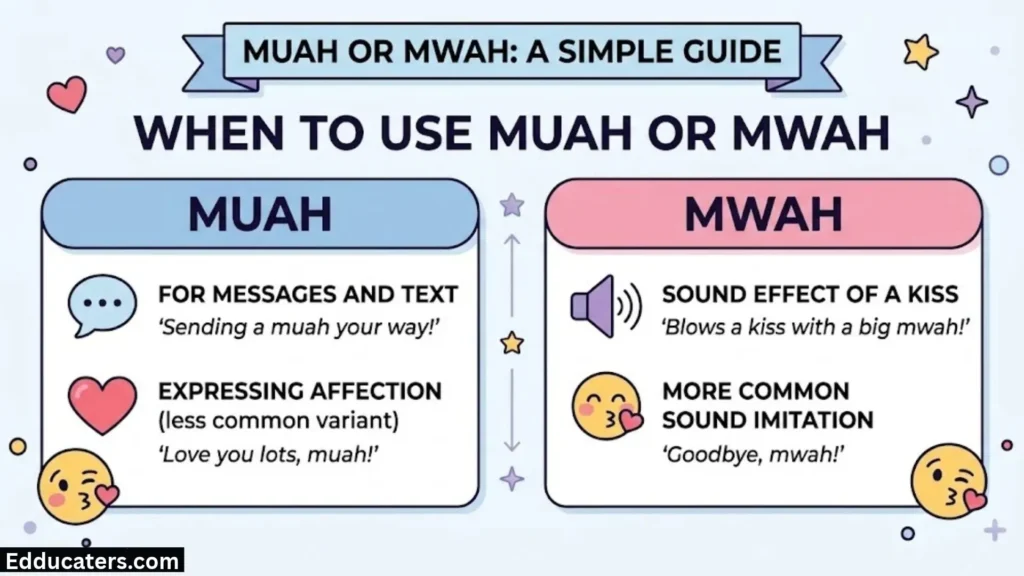
Choosing between muah or mwah is less about grammar and more about audience, tone, and context. Both can fit naturally into personal communication, but not every message needs a kiss sound.
Muah or Mwah in Texting and Chat
Text messages often rely on short expressions to communicate feelings that facial expressions and vocal tone would otherwise convey.
A simple muah or mwah can make a goodbye feel warmer or a thank-you more playful. It can also add personality to a conversation between people who already communicate affectionately.
Examples include:
- “Goodnight, mwah!”
- “Thanks for listening. Muah!”
- “You’re amazing. Mwah ❤️”
- “Talk to you later, muah!”
Use these expressions when they match your usual communication style. If the other person rarely uses affectionate language, a sudden kiss sound might feel unexpected.
Muah or Mwah With Friends and Family
You don’t need a romantic relationship to send someone a written kiss. Friends and relatives may use these expressions to show appreciation, affection, or friendly warmth.
For example:
“Happy birthday! Hope you have the best day ever. Muah!”
Or:
“Thanks for picking me up. Mwah, you’re a lifesaver!”
Neither message necessarily suggests romance. Both can express friendly affection.
Still, consider your relationship and the other person’s preferences. Some families use kiss sounds freely, while others reserve them for intimate relationships. Personal habits shape how these expressions feel.
Muah or Mwah in Romantic Messages
In romantic communication, either spelling can add an affectionate touch to a greeting, goodbye, or goodnight message.
Examples include:
- “Missing you already. Muah ❤️”
- “Sleep well, sweetheart. Mwah!”
- “Wish I could give you a real kiss. Muah.”
- “See you tonight, love. Mwah 😘”
The surrounding words help establish the romantic meaning. A heart emoji, a term of endearment, or a reference to missing someone can make the intention clearer.
However, don’t assume that muah is more romantic than mwah. The two spellings don’t carry a fixed ranking of affection.
Muah or Mwah in Social Media Captions
Social media encourages expressive, conversational writing. That’s why a kiss sound may appear in birthday captions, comments, celebratory posts, and replies to friends.
Here are a few examples:
- “Celebrating another year with my favorite people. Muah!”
- “You all made my day special. Mwah ❤️”
- “Sending love to everyone who showed up today. Muah!”
- “Best surprise ever. Mwah!”
These examples work best when the tone is personal and informal.
You can also repeat the expression for emphasis, such as “Mwah, mwah!” However, repeated kiss sounds can seem overly familiar in a public comment if you don’t know the recipient well.
Use the same judgment you’d apply to any affectionate expression online: consider the audience, relationship, and message.
Can You Use Muah or Mwah in Professional Emails?
Usually, you should avoid both expressions in formal professional emails. They can sound overly intimate, playful, or out of place when the message calls for a clear business tone.
For example, this closing might not suit a client you barely know:
“Thank you for reviewing the proposal. Mwah!”
A more appropriate version would be:
“Thank you for reviewing the proposal. I appreciate your time and feedback.”
The second message communicates gratitude without introducing an unexpected affectionate gesture.
There are exceptions. Colleagues who share an established, informal communication style may use playful expressions in personal exchanges. Even then, the setting matters.
Choose a conventional closing when you’re unsure:
- Best regards — a versatile professional closing.
- Kind regards — polite and slightly warm.
- Sincerely — suitable for formal correspondence.
- Thank you — useful when appreciation is the main purpose.
The goal isn’t to remove all personality from professional writing. It’s to make sure your tone suits the relationship and purpose.
Muah or Mwah Example Sentences
Examples make it easier to understand how these expressions work in real conversations. The following examples show different tones without suggesting that one spelling has a different fixed meaning.
Friendly Examples
Use either expression to add warmth to a casual exchange.
- “Thanks for helping me today. Muah!”
- “Good luck with your exam! Mwah!”
- “You all are too sweet. Mwah!”
- “See you soon, muah!”
These messages communicate appreciation or friendly affection. They work best when both people feel comfortable with this style of communication.
Romantic Examples
In romantic messages, a kiss sound can reinforce affection or make a goodbye feel more personal.
- “Goodnight, muah ❤️”
- “Missing you already. Mwah!”
- “Sending you a kiss before bed. Muah!”
- “Can’t wait to see you tonight. Mwah 😘”
The additional wording helps establish the romantic tone. The spelling alone doesn’t determine how intimate the message feels.
Playful Examples
Sometimes, a written kiss is simply a fun response to something nice or unexpected.
- “You saved me the last slice of cake? Mwah!”
- “That was the sweetest surprise. Muah!”
- “You remembered my favorite snack? Mwah!”
- “You’re officially my favorite person today. Muah!”
These examples use the expression humorously. They show that a kiss sound can communicate excitement or appreciation without necessarily expressing romantic feelings.
Social Media Examples
On social media, muah or mwah can add personality to a caption or comment.
- “Celebrating another year with my favorite people. Muah!”
- “Love you all for making today special. Mwah!”
- “A little appreciation for my favorite humans. Muah!”
- “You made this day unforgettable. Mwah ❤️”
These captions suit informal posts. For a professional company announcement or formal organizational statement, a straightforward expression of thanks would usually work better.
Formal Alternatives in Context
If a kiss sound doesn’t fit your audience, choose wording that communicates your intended message directly.
| Informal message | More formal alternative |
| “Thanks for your help, mwah!” | “Thank you for your assistance.” |
| “Goodnight, muah!” | “Goodnight. Take care.” |
| “Sending you a kiss!” | “Sending my best wishes.” |
| “Love you all, mwah!” | “Thank you all for your support.” |
| “Mwah! See you soon.” | “I look forward to seeing you soon.” |
The best alternative depends on what you’re trying to communicate. A professional closing shouldn’t replace a personal expression of love when the relationship calls for genuine affection.
Muah or Mwah or Muack
Muack is another informal spelling associated with a kissing sound. Like muah or mwah, it appears in playful communication and affectionate messages.
All three expressions can represent a symbolic kiss. However, people may perceive them differently because their spelling and visual style vary.
| Expression | Meaning | Typical impression |
| Muah | A written kiss sound | Affectionate or playful |
| Mwah | A written kiss sound | Affectionate or playful |
| Muack | An alternative kiss-sound spelling | Often playful or stylized |
These descriptions indicate possible impressions rather than strict definitions. There’s no universal rule requiring muack to sound more exaggerated or affectionate.
For example:
- “Goodnight, muah!”
- “Goodnight, mwah!”
- “Goodnight, muack!”
All three can serve as playful sign-offs. The best choice depends on what feels natural to you and your audience.
If you’re writing for readers unfamiliar with these expressions, kiss or sending you a kiss may communicate the meaning more clearly.
Is Muah or Mwah Appropriate in Formal Writing?
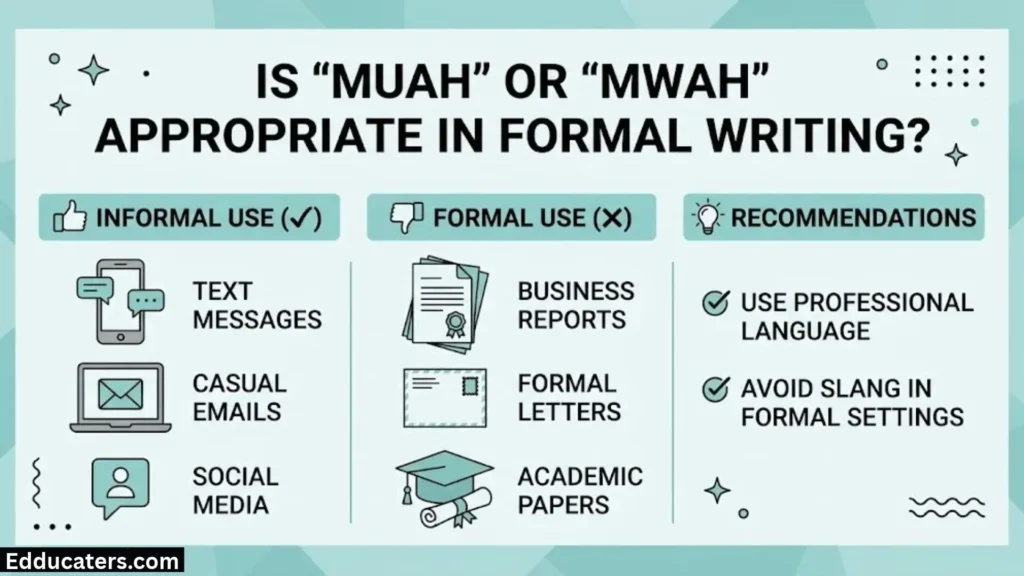
In most formal situations, neither expression is the best choice. Both belong primarily to informal communication and can distract readers when used in academic papers, business reports, or official documents.
However, you can still discuss these expressions in formal writing when the subject requires it.
For example, a linguistics article might examine mwah as an informal interjection or sound imitation. In that context, the expression serves as the subject of analysis rather than an affectionate sign-off.
The distinction is simple:
- Discussing the expression: Appropriate when relevant to the topic.
- Using it as an informal sign-off: Generally unsuitable for formal documents.
- Describing a physical action: Use standard wording such as “she blew him a kiss.”
- Expressing professional appreciation: Write “Thank you for your assistance.”
Formal writing doesn’t require complicated language. It requires wording that suits the purpose, audience, and setting.
Alternatives to Muah or Mwah
If you want to express affection without using a written kiss sound, several alternatives are available. Each communicates a slightly different feeling.
| Alternative | Meaning or purpose | Example |
| Kiss | Names the affectionate gesture | “She gave him a kiss.” |
| Sending you a kiss | Expresses affection directly | “Sending you a kiss before bed.” |
| Sending kisses | A warm, affectionate sign-off | “Take care and sending kisses!” |
| XOXO | Informal expression of hugs and kisses | “Happy birthday, XOXO!” |
| ❤️ | A heart symbol associated with love or affection | “Thank you ❤️” |
| 😘 | A face blowing a kiss | “Goodnight 😘” |
| Love you | Expresses affection directly | “Love you. Talk tomorrow!” |
| Best regards | Professional email closing | “Best regards, Alex” |
| Sincerely | Formal or professional closing | “Sincerely, Alex” |
These alternatives aren’t exact synonyms. For example, a heart emoji doesn’t necessarily represent a kissing sound, and best regards doesn’t express romantic affection.
Choose the expression that matches your intended message rather than simply replacing one term with another.
Common Mistakes When Using Muah or Mwah
Although these expressions are simple, a few misunderstandings can lead to awkward communication.
Assuming Only One Spelling Is Correct
Both muah and mwah are used to represent a kiss sound. Treating one as automatically incorrect ignores the flexible nature of informal sound-based spelling.
Assuming the Expression Always Means Romantic Love
A friend, relative, or romantic partner might use either expression. The sender’s relationship with you and the surrounding message help determine its meaning.
Using It in the Wrong Setting
A kiss sound might feel natural in a personal text but inappropriate in a formal report. Always consider your audience before choosing an informal expression.
Assuming the Spellings Have Different Emotional Meanings
There is no universal rule stating that muah expresses more affection than mwah. Any perceived difference is usually a matter of individual preference.
Treating Every Sound Variation as a Separate Word
Forms such as muahh and mwaah often exaggerate the original expression. They don’t necessarily represent separate words with distinct dictionary definitions.
Confusing a Kiss Sound With the Standard Word Kiss
The word kiss names a gesture or action. Mwah imitates a sound associated with that gesture. Both have uses, but they don’t serve exactly the same grammatical function.
Frequently Asked Questions About Muah or Mwah
Is muah or mwah correct?
Both are used as informal spellings of a kiss sound. Neither has an exclusive claim to correctness in casual communication.
What is the difference between muah and mwah?
The main difference is spelling. Both generally represent a kiss sound, and neither has a universally fixed emotional meaning.
What does muah mean in texting?
Muah usually represents a kiss and can communicate affection, warmth, appreciation, or playfulness. The surrounding message helps establish its tone.
What does mwah mean in texting?
Mwah is an informal expression that imitates a kissing sound. People commonly use it in affectionate messages, casual conversations, and playful sign-offs.
Is muah a real English word?
Muah is a recognizable informal expression. It functions as a written representation of a kiss sound rather than as an ordinary noun or verb.
Is mwah a spelling mistake?
No. Mwah is a recognized informal expression listed in the Cambridge Dictionary. It’s not automatically a misspelling of muah. See the Cambridge Dictionary entry.
Does muah mean love?
Not necessarily. It can express romantic love, friendly affection, appreciation, or playfulness depending on the context.
Can you use muah or mwah with friends?
Yes. Both can work in friendly messages, especially when the people communicating are comfortable with affectionate language.
Can muah or mwah sound flirtatious?
Yes. Either expression can sound flirtatious in the right context, but neither proves that someone has romantic feelings.
What is the difference between muah and muack?
Both can represent a kiss sound. Muack is another informal spelling, and any difference in perceived tone depends on the person using it.
Is muah appropriate in a professional email?
Generally, no. A conventional closing such as Best regards or a direct expression of appreciation usually works better in professional correspondence.
How do you spell a kissing sound?
Common informal spellings include mwah and muah. Neither requires a universally prescribed spelling rule.
Conclusion: Muah or Mwah
When choosing muah or mwah, you don’t need to worry about a strict spelling rule. Both expressions commonly represent the sound of a kiss and work well in informal communication.
The main difference is their written form, not a fixed difference in meaning. Either can express affection, friendliness, gratitude, or playful enthusiasm, depending on the conversation.
Use muah or mwah in casual texts, personal chats, and social media posts when the expression suits your audience. For professional correspondence and formal documents, choose standard wording instead.
The bottom line: Both spellings work as informal kiss expressions. Choose the one you prefer, and let your message and relationship guide the tone.

Hi, I’m Nathan Whitmore, and I enjoy making English grammar easy for learners of all ages. I believe grammar should be practical, not confusing. I write simple, well-researched guides that help readers improve their writing, speaking, and overall communication skills.
I spend a lot of time studying grammar patterns, sentence construction, punctuation, and modern English usage. My goal is to create lessons that anyone can understand, whether they are students, teachers, or professionals.
Books
Clear English Grammar
The Smart Writer’s Grammar Handbook
 Julian Mercer