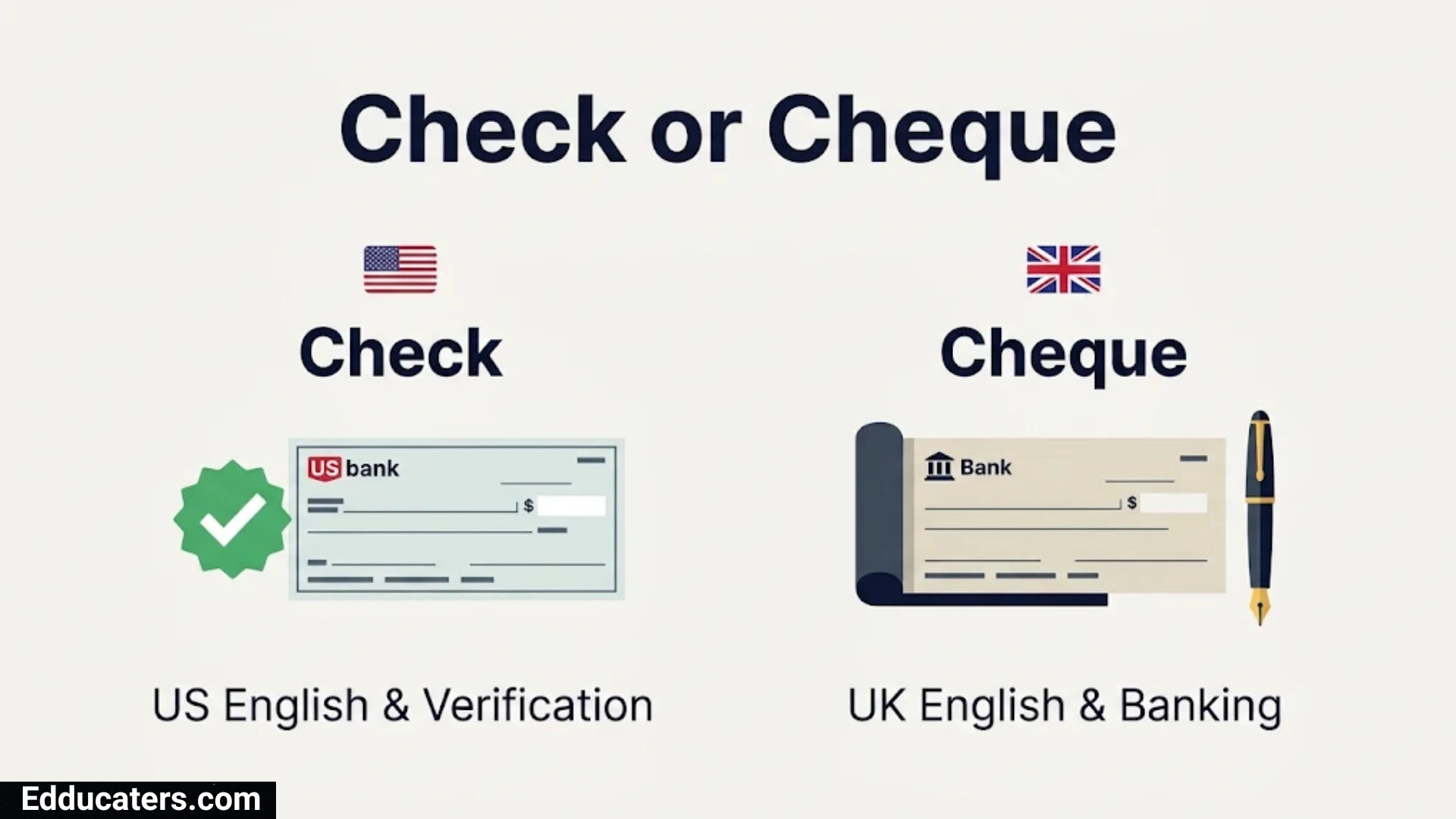
If you’ve ever wondered whether to write check or cheque, you’re not alone. Both spellings look familiar and sound identical. However, the correct choice depends on where you live and which variety of English you’re using.
Check is the standard spelling in American English. Cheque is the standard spelling for the banking term in British English, Canadian English, Australian English, and New Zealand English. Both words refer to the same type of bank payment.
Although the difference looks small, choosing the right spelling matters when you’re writing a business letter, completing financial paperwork, paying someone, or communicating with readers in another country. Using the regional spelling makes your writing feel natural and consistent.
The confusion doesn’t stop there. The word check has several meanings beyond banking. It can mean examining something, confirming information, stopping progress, or even referring to a restaurant bill. Meanwhile, cheque specifically refers to the banking payment in British-style spelling.
Let’s explore the check or cheque spelling, meaning, regional differences, examples, banking terminology, and common mistakes so you can confidently choose the right word every time.
Check or Cheque: Meaning and Definition
The words check and cheque describe a written banking payment that allows someone to transfer money without handing over cash. The person who owns the bank account writes the document and authorizes the bank to pay a specified amount to another person or business.
The recipient, known as the payee, can deposit the payment into a bank account or cash it when the bank allows. The bank processes the payment and verifies that the account can cover the amount.
In modern banking, checks and cheques are considered paper-based payment instruments. Although electronic transfers, debit cards, and online banking have reduced their use in many places, paper checks remain a payment option in several countries.
Check Definition
A check is a written order directing a bank to pay a specific amount of money from the account holder’s account to a named person or business.
In American English, check is the standard spelling for this financial document. People commonly use checks to pay rent, settle bills, pay contractors, send money, or distribute wages.
For example, someone might write a check for $500 to pay a repair company. The recipient deposits it into a bank account. The bank then processes the payment and transfers the money from the payer’s account if the payment clears.
Example sentences:
- I wrote a check to cover my monthly rent.
- She deposited the check into her bank account yesterday.
- The company mailed me a check for my refund.
- He paid the contractor with a personal check.
Cheque Definition
A cheque is a written payment order that instructs a bank to pay money from an account to a designated recipient. It has the same financial meaning as check but follows British-style spelling conventions.
People use cheques to pay bills, make business payments, give money to individuals, or settle financial obligations. A cheque typically includes the payee’s name, payment amount, date, account details, and the account holder’s signature.
For instance, a British homeowner might write a cheque to a plumber after completing a repair. The plumber can deposit it into a bank account rather than receive cash directly.
Example sentences:
- She wrote a cheque to pay the electricity bill.
- I received a cheque from my insurance company.
- He deposited the cheque at his local bank.
- The customer paid for the furniture by cheque.
The definitions are identical in the banking context. Only the spelling changes.
Check vs. Cheque: Key Differences
The primary difference between check and cheque is regional spelling. Both words refer to the same financial document and share the same pronunciation.
However, the word check has additional meanings that cheque doesn’t carry in British-style spelling. You can use check as a verb meaning to inspect, verify, examine, or control something. You can also use it as a noun for a mark of correctness, an inspection, or a restaurant bill.
| Feature | Check | Cheque |
| Meaning in banking | Written order to pay money | Written order to pay money |
| Spelling | American English | British English |
| Pronunciation | /tʃek/ | /tʃek/ |
| Part of speech | Noun and verb | Noun (banking) |
| Standard in the US | Yes | No, generally |
| Standard in the UK | For non-banking meanings | For banking meaning |
| Common in Canada | Less common for banking | Preferred |
| Common in Australia | Not standard for banking | Standard |
| Common in New Zealand | Not standard for banking | Standard |
Neither spelling is universally superior. If you’re writing for an American audience, use check. If you’re writing for a British audience, use cheque when discussing bank payments.
The same rule applies to other regional varieties. Follow the spelling conventions your readers expect.
Check or Cheque in British English and American English
English spelling varies across countries. Some differences involve individual letters while others affect entire words. The check/cheque distinction is one of the most recognizable differences between American and British English.
Check in American English
Americans use check for bank payments as well as for the word’s other meanings. The spelling applies across everyday writing, financial documents, business communication, and banking terminology.
The United States also uses related words such as checking, checkbook, and checkwriter. These terms retain the same spelling pattern.
Examples include:
- Checking account
- Checkbook
- Payroll check
- Personal check
- Cash a check
- Write a check
- Deposit a check
- Check payment
In the United States, writing cheque in a financial document may look unfamiliar or foreign to some readers. Although people can understand it, check is the preferred spelling in American English.
Cheque in British English
British English uses cheque when referring to the bank-payment document. The spelling helps distinguish the financial noun from other meanings of check.
British writers still use check for examining, verifying, inspecting, or confirming something. They don’t replace every occurrence of check with cheque.
For example:
- Please check the door before leaving.
- I need to check my exam answers.
- She wrote a cheque for the deposit.
- The company sent a cheque to its supplier.
Notice how both spellings can appear in the same British English paragraph. The correct spelling depends on the meaning rather than the country alone.
Check or Cheque in Canada, Australia, and New Zealand
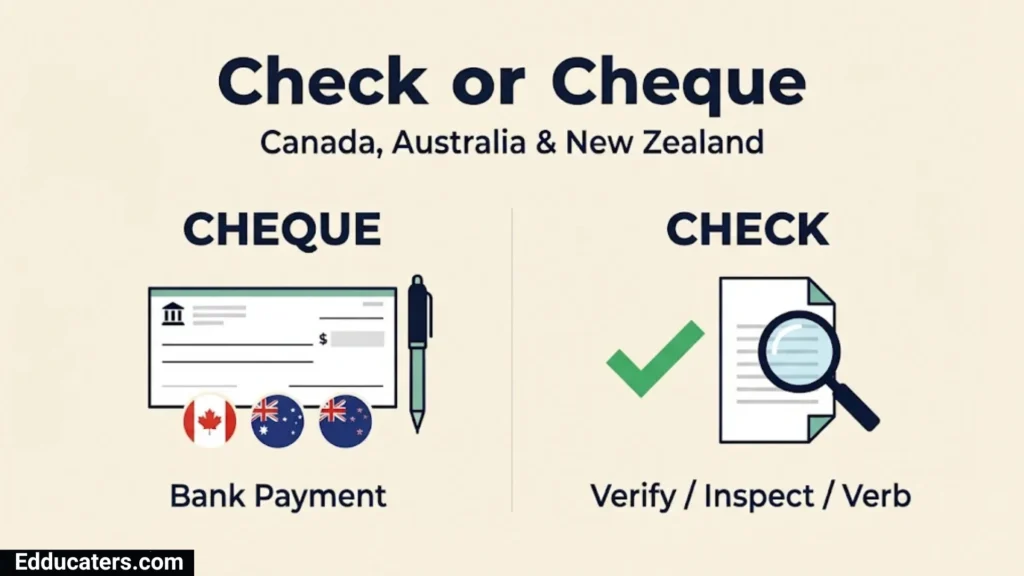
British and American English aren’t the only varieties with spelling differences. Canada, Australia, and New Zealand also have their own established writing conventions. Although these countries share many British spellings, their usage can sometimes differ.
Check or Cheque in Canada
Canadian English generally uses cheque for the banking term. Canadian spelling combines British and American influences, but this particular word usually follows the British convention.
Canadians use check for the verb meaning to verify, inspect, or confirm something. They also use it for other nonfinancial meanings.
| Canadian Usage | Example |
| Cheque | She wrote a cheque for $250. |
| Check | Please check the balance before paying. |
| Chequebook | He kept his chequebook in the drawer. |
| Checking | I’m checking the payment details. |
If you’re writing for a Canadian audience, cheque is the safer choice for bank payments.
Check or Cheque in Australia
Australian English follows British spelling conventions for this banking term. Therefore, cheque is the standard spelling for a paper bank payment.
Although Australians increasingly use electronic payments, the spelling remains part of everyday financial vocabulary. Terms such as cheque book, bank cheque, and pay cheque commonly appear in Australian English.
Examples:
- He received his pay by cheque.
- I sent the deposit using a bank cheque.
- The cheque arrived in the mail this morning.
- She wrote a cheque to cover the purchase.
Australia also uses check as a verb when someone examines or confirms something.
Check or Cheque in New Zealand
New Zealand English also uses cheque for the banking noun. The spelling follows the country’s British-influenced conventions.
For example, a New Zealand writer might say:
- The customer paid by cheque.
- I deposited the cheque yesterday.
- The bank returned the cheque because it couldn’t process the payment.
The spelling remains cheque even when the payment involves a large amount of money. The amount doesn’t change the regional spelling preference.
Check or Cheque Across Different Countries
Here’s a quick regional guide to help you choose.
| Country | Banking Spelling | General Preference |
| United States | Check | American English |
| United Kingdom | Cheque | British English |
| Canada | Cheque | Canadian English |
| Australia | Cheque | Australian English |
| New Zealand | Cheque | New Zealand English |
| Ireland | Cheque | Irish English |
Regional preferences can vary in some contexts. However, the spellings shown above are the standard choices for the banking term.
When to Use Check or Cheque
Choosing between check and cheque becomes easy once you know your audience. You don’t need to memorize complicated grammar rules or worry about the word’s pronunciation.
Simply follow the spelling convention of the English variety you’re using.
Use Check for American English
Choose check when writing for American readers or following US spelling conventions.
You’ll commonly use it in:
- American banking documents
- Business letters and emails
- Payment instructions
- Financial reports
- Personal correspondence
- Payroll records
- Receipts and transaction records
Examples:
- Please send the payment by check.
- I wrote a check to the insurance company.
- The bank processed my check this morning.
- Your refund check will arrive within seven business days.
Use Cheque for British-Style English
Choose cheque when writing for readers who use British spelling conventions for banking.
You’ll commonly see it in:
- UK financial paperwork
- British business correspondence
- Canadian banking documents
- Australian financial transactions
- New Zealand banking communication
Examples:
- Please make the payment by cheque.
- I received a cheque from the company.
- The bank accepted my cheque for deposit.
- She wrote a cheque to pay the outstanding amount.
Keep Your Spelling Consistent
Consistency matters when you write longer documents. Mixing American and British spelling conventions can distract readers and make your writing appear less polished.
For example, an American business letter should generally use check, color, and organize. A British letter would normally use cheque, colour, and organise.
You don’t have to follow every spelling convention perfectly in informal writing. However, consistency makes professional communication easier to read.
Check or Cheque Examples in Sentences
Examples make the spelling difference easier to remember. Both words work in similar sentences because they share the same meaning.
Examples Using Check
- I paid the electrician with a personal check.
- She received a check for her holiday bonus.
- The bank rejected the check because the account lacked sufficient funds.
- He wrote a check for the full purchase price.
- Please deposit the check before the end of the month.
- My employer sends payroll checks every Friday.
- I need to cash this check today.
- The company issued a check to the recipient.
Examples Using Cheque
- I paid the electrician with a personal cheque.
- She received a cheque for her holiday bonus.
- The bank rejected the cheque because the account lacked sufficient funds.
- He wrote a cheque for the full purchase price.
- Please deposit the cheque before the end of the month.
- My employer sends payroll cheques every Friday.
- I need to cash this cheque today.
- The company issued a cheque to the recipient.
The meaning stays the same in every example. Only the regional spelling changes.
How to Write a Check or Cheque
Writing a check or cheque requires accurate information. Even a small mistake can delay a payment or cause the bank to reject the document.
Although cheque formats differ between countries, most contain similar details. These details identify the payer, recipient, payment amount, and account involved.
Parts of a Check or Cheque
| Component | Purpose |
| Date | Shows when the check or cheque was issued |
| Payee | Names the person or business receiving the money |
| Amount in numbers | Specifies the payment value numerically |
| Amount in words | States the amount in written form |
| Memo | Records the payment’s purpose, if needed |
| Signature | Authorizes the payment |
| Check or cheque number | Helps identify and track the document |
| Bank details | Identifies the financial institution and account information |
Steps for Writing a Check or Cheque
1. Write the date. Enter the date you’re issuing the payment. Use the date format accepted in your country.
2. Enter the payee’s name. Write the correct name of the person or company receiving the money. Avoid abbreviations that might cause confusion.
3. Write the amount in numbers. Enter the payment value in the designated box. Make sure the amount is clear and difficult to alter.
4. Write the amount in words. Spell out the amount where the check or cheque requires it. This helps confirm the payment value.
5. Add a memo if necessary. Use this section to explain what the payment covers. For example, you might write “June rent” or “Invoice 104.”
6. Sign the document. Add your authorized signature. An unsigned check or cheque generally won’t be accepted for normal payment processing.
7. Review everything. Check the date, payee, amount, and signature before handing over the document.
Accuracy matters. If the payment amount, recipient, or signature doesn’t match the bank’s requirements, the payment may be delayed or rejected.
How to Deposit a Cheque or Cash a Check
Receiving a check or cheque doesn’t automatically mean the money is available in your account. You must usually deposit it or cash it through an eligible bank or financial service.
The process depends on your bank, account type, payment amount, and local banking rules.
Depositing a Check or Cheque
A deposit means placing money into a bank account. When you deposit a check or cheque, the bank processes the payment and collects funds from the issuing bank.
Depending on your bank, you may be able to deposit it through:
- A bank branch
- An ATM that accepts check deposits
- A mobile banking app
- A deposit service offered by your financial institution
After depositing the document, the bank may place a hold on some or all of the funds. This hold allows the bank to process the payment and confirm that it can collect the money.
A deposit receipt doesn’t always mean the payment has fully cleared. The bank may still return the payment later if it encounters a problem.
Cashing a Check or Cheque
Cashing a check means exchanging the payment document for cash instead of depositing it into your bank account.
For example, if someone gives you a $200 check and you cash it at an eligible bank, you may receive $200 in cash after the bank verifies the payment and your eligibility.
Banks may require identification. They might also charge fees if you aren’t their customer or if the payment comes from another financial institution.
| Action | What It Means |
| Deposit a check | Add the payment to a bank account |
| Cash a check | Receive cash in exchange for the payment |
| Issue a check | Write and authorize a payment |
| Clear a check | Complete the bank’s payment processing |
| Endorse a check | Sign it as required for deposit or transfer |
In British-style English, you can use deposit a cheque, cash a cheque, issue a cheque, and cheque clearance. American English uses check for the same banking terms.
What Happens When a Check or Cheque Bounces?
A bounced check or cheque is a payment that the bank returns instead of completing. The recipient may not receive the money even after depositing the document.
A payment can bounce for several reasons. Insufficient funds are among the most common.
Common Reasons a Check or Cheque Bounces
- Insufficient funds: The account doesn’t contain enough available money to cover the payment.
- Incorrect account details: The payment contains inaccurate or invalid banking information.
- Missing signature: The payer hasn’t properly authorized the document.
- Payment stop: The account holder has instructed the bank not to process the payment.
- Closed account: The account is no longer active.
- Altered document: The bank suspects that someone changed the payment amount, payee, or other details.
- Processing issues: Certain errors or irregularities prevent the bank from completing the transaction.
A bounced payment can create problems for both parties. The recipient may have to wait longer for the money. The payer may face bank fees or other consequences under the applicable rules.
What Does NSF Mean on a Check?
NSF stands for non-sufficient funds. Banks use this term when an account doesn’t have enough available money to cover a payment.
Suppose you write a check for $800 but only have $500 available in your account. The bank may return the payment because the account can’t cover the full amount.
Depending on the bank and circumstances, an NSF payment may trigger fees. It can also affect the recipient’s plans if the payment was meant to cover rent, a bill, or another important expense.
The terms NSF check, NSF cheque, bounced check, and bounced cheque describe related payment problems. Their spelling follows the same regional rule.
Common Banking Terms Related to Check or Cheque
Banking documents contain several terms that can confuse people unfamiliar with paper payments. Understanding them makes it easier to read financial paperwork and communicate with banks.
| Banking Term | Definition |
| Payee | The person or business named to receive the payment |
| Payer | The person issuing the payment |
| Account holder | The person who owns the bank account |
| Payment amount | The amount of money the check or cheque instructs the bank to pay |
| Check number | A reference number identifying an individual check |
| Checking account | A bank account commonly used for payments and everyday transactions |
| Bank deposit | Money placed into a bank account |
| Cheque clearance | The process through which a bank processes and settles a cheque |
| NSF | Non-sufficient funds |
| Bounced check | A payment document returned or rejected by the bank |
| Cashier’s check | A check issued by a bank using its own funds after receiving payment from the customer |
| Payroll check | A check issued to an employee to pay wages |
| Payment authorization | Approval allowing a financial transaction to proceed |
| Encashment | The process of converting a payment document into cash |
These terms appear in both American and British banking discussions. However, the spelling of related words may change.
For example, Americans write checkbook and checking account. British-style English uses chequebook for the banking document but generally retains checking account when referring to the American banking product.
Check as a Noun or Verb: Different Meanings
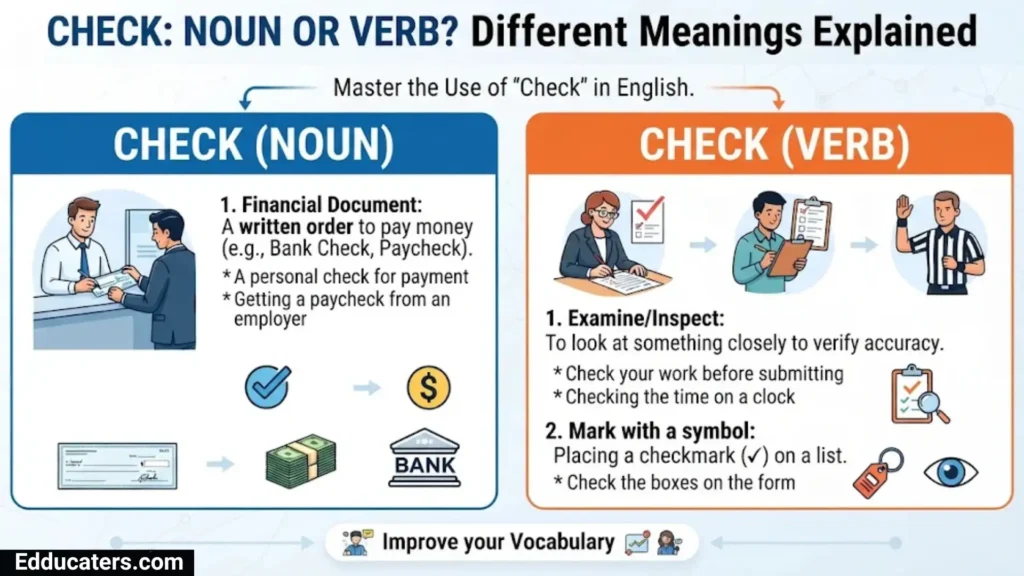
One reason people confuse check and cheque is that check has several meanings. It can describe a financial document or an action performed to confirm something.
The word’s meaning depends on the sentence. In British English, the banking noun takes the spelling cheque. The other meanings generally retain check.
Check as a Verb
As a verb, check means to examine, inspect, verify, or confirm something. You use it when you want to make sure something is correct, safe, present, or working properly.
Common examples include:
- Check the mail: Look through the mail to find something.
- Check the premises: Inspect a building or property.
- Check the tire: Examine a tire’s pressure or condition.
- Check an exam: Review answers or evaluate a test.
- Check for missing items: Confirm that everything is present.
- Check payment status: Confirm whether a payment has been processed.
- Check financial transactions: Review transactions for accuracy.
- Check the funds: Confirm that money is available.
Example sentences:
- Please check the front door before leaving.
- I need to check my bank balance.
- She checked the report for spelling errors.
- The technician checked the tire pressure.
- We checked the inventory before shipping.
These meanings use check in American and British English. You wouldn’t replace the verb with cheque.
Check as a Noun
The noun check can describe something other than a banking payment. Its meaning changes depending on the context.
| Meaning | Example |
| A mark indicating correctness | Put a check next to the right answer. |
| An inspection | The airport security check took longer than expected. |
| A restaurant bill in American English | Could we get the check, please? |
| A restraint or limit | The new rules provide a check on spending. |
| A pattern of squares | He wore a check shirt. |
These meanings explain why check remains a widely used word throughout English-speaking countries, even where cheque is the preferred spelling for bank payments.
Check In vs. Check-In, Check Over, Check Out, and Fact-Check
Words containing check can have different meanings and grammatical roles. Some are phrasal verbs while others function as nouns, adjectives, or compound words.
Understanding these expressions helps you avoid spelling mistakes unrelated to the check or cheque banking distinction.
Check In vs. Check-In
Check in is a verb phrase that means registering your arrival or reporting to a place.
Check-in is a noun or adjective describing the registration process or location.
| Form | Part of Speech | Example |
| Check in | Verb | We need to check in at the hotel. |
| Check-in | Noun | The check-in desk is near the entrance. |
| Check-in | Adjective | She received a check-in confirmation email. |
The spelling depends on how you use the expression. The verb remains two words while the noun and adjective generally use a hyphen.
Check Over
Check over means to examine something carefully. You use it when reviewing information, inspecting an object, or looking for errors.
Examples:
- Check over the contract before signing.
- She checked over the equipment.
- Please check over your answers one more time.
Check Out
Check out has several meanings. It can refer to leaving a hotel, examining something, borrowing materials, or completing a purchase.
Examples:
- We checked out of the hotel at 11 a.m.
- Check out the new restaurant downtown.
- I checked out three books from the library.
- Customers can check out online.
The noun checkout is generally written as one word in American English. It can refer to the payment area of a store or the process of completing a purchase.
Fact-Check
Fact-check means verifying whether information is accurate. Journalists, researchers, editors, and readers fact-check statements before relying on them.
Examples:
- The journalist fact-checked the politician’s statement.
- Always fact-check statistics before publishing them.
- The editor requested a fact-check before releasing the article.
These expressions use check regardless of whether the writer follows American or British English.
Check or Cheque Pronunciation
The words check and cheque have the same pronunciation. The extra letters in cheque don’t change the sound.
Pronunciation
/tʃɛk/
The word contains one syllable. It starts with the “ch” sound heard in chair and ends with a k sound.
Both spellings sound like the word Czech, referring to the nationality or language of the Czech Republic. This makes them homophones.
| Word | Pronunciation | Meaning |
| Check | /tʃɛk/ | Banking payment or other meanings |
| Cheque | /tʃɛk/ | Banking payment in British-style spelling |
| Czech | /tʃɛk/ | Related to the Czech Republic, its people, or language |
The spelling difference is purely orthographic in this context. You don’t need to change how you pronounce the word when switching from American to British English.
Why Does Cheque Have a Q? Origin and Etymology
The spelling cheque has an interesting history. It didn’t develop because people wanted a different pronunciation. Instead, the spelling emerged through historical changes in English financial terminology.
The word check has older roots connected to chess. English borrowed it through Old French eschec, which referred to a check in chess. The word ultimately traces back through Arabic and Persian origins associated with the word shah, meaning king.
Over time, check developed several meanings related to stopping, controlling, examining, and verifying something. Its banking meaning grew from the idea of using a written document as a means of checking or controlling payments.
The spelling cheque became associated with the financial instrument in British English. Historical spelling influences, including the word exchequer, may have helped establish the additional letters.
A Brief History of Check and Cheque
| Historical Development | Explanation |
| Old French eschec | An early form associated with chess and the idea of check |
| Middle English chek | An early English spelling |
| Check as verification | The word developed meanings related to examining and confirming |
| Banking use | A written financial instrument became associated with checking or controlling payments |
| Cheque | A regional spelling developed and became established for the banking term in British English |
| Modern English | American English uses check while British-style English commonly uses cheque |
The word’s spelling history explains why the two forms look different today. The difference doesn’t represent two separate banking concepts.
How to Remember Check or Cheque Spelling
If you frequently confuse these spellings, a simple memory trick can help.
Check = United States
Use the shorter spelling for American English banking documents.
Cheque = British-style English
Remember the extra letters for British, Canadian, Australian, and New Zealand banking usage.
You can also remember the difference with these examples:
- US bank: Write a check.
- UK bank: Write a cheque.
- Canadian bank: Write a cheque.
- Australian bank: Write a cheque.
- New Zealand bank: Write a cheque.
Don’t confuse the spelling mnemonic with a grammar rule. It’s simply an easy way to remember the regional preference.
Common Mistakes When Using Check or Cheque
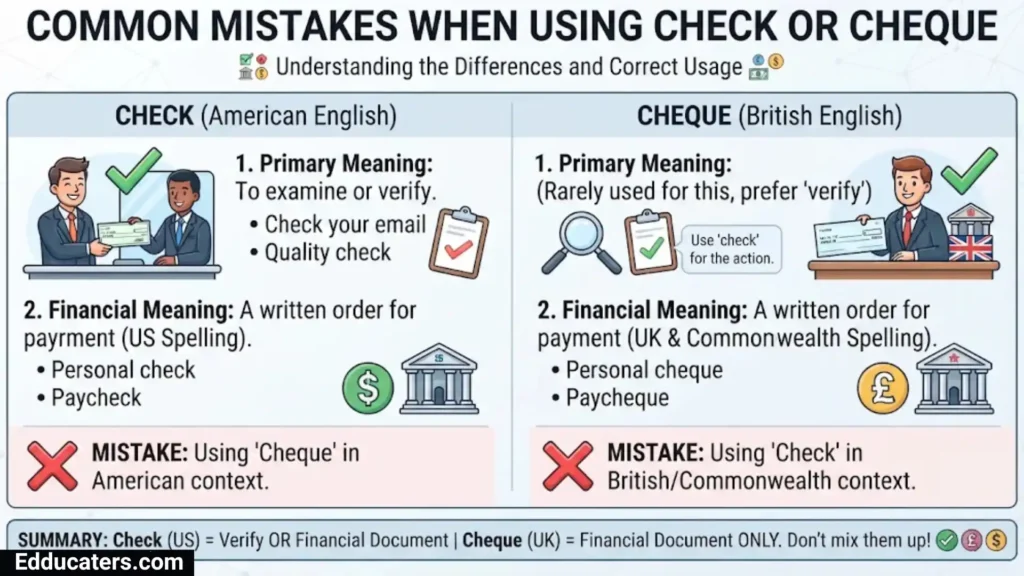
Even though the spelling difference is simple, several mistakes can cause confusion.
Assuming Cheque Is Incorrect
Some American writers assume cheque is a misspelling because they rarely see it. However, the word is standard in British-style English banking.
It’s perfectly correct to write cheque when following British, Canadian, Australian, or New Zealand conventions.
Using Cheque for Every Meaning of Check
The spelling cheque applies to the banking noun. It doesn’t replace the verb check or other meanings of the noun.
For example, a British writer should still write:
- Check your work.
- Check the door.
- Check the payment details.
- Put a check next to the answer.
Writing cheque your work would be incorrect.
Mixing American and British Spelling
Switching between regional spelling conventions can make a document look inconsistent.
For example:
I wrote a cheque to pay the landlord and mailed the color brochure yesterday.
This sentence mixes British banking spelling with American color. If you’re following British English, colour would normally be preferred.
Consistency is especially important in formal writing, academic work, business communication, and publications.
Confusing a Check With a Money Order
A check and a money order aren’t exactly the same thing. Both can be used to make payments, but their funding arrangements differ.
- Personal check: Draws money from the payer’s bank account when processed.
- Money order: Usually purchased in advance with funds provided to the issuer.
- Cashier’s check: Issued by a bank using its own funds after the customer pays the bank.
A money order isn’t simply another spelling of check. It represents a different payment instrument.
Check or Cheque: Quick Comparison
If you’re in a hurry, use this table to choose the correct spelling without overthinking it.
| Question | Answer |
| Is check correct? | Yes, it’s the standard American banking spelling. |
| Is cheque correct? | Yes, it’s the standard British-style banking spelling. |
| Do check and cheque mean the same thing? | Yes, when referring to a bank payment. |
| Are check and cheque pronounced differently? | No, they’re homophones. |
| Is cheque a misspelling? | No, it’s a legitimate regional spelling. |
| Which spelling should Americans use? | Check. |
| Which spelling should British writers use? | Cheque for the banking meaning. |
| Which spelling is used in Canada? | Cheque is generally preferred for banking. |
| Which spelling is used in Australia? | Cheque. |
| Which spelling is used in New Zealand? | Cheque. |
| Can check be a verb? | Yes, it means examine, verify, inspect, or confirm. |
| Can cheque be used as a verb? | No, cheque is the regional banking noun spelling. |
Frequently Asked Questions
Is Check or Cheque the Correct Spelling?
Both spellings are correct. Check is the American English spelling for the banking document while cheque is the British English spelling. Choose the version that matches your region or intended audience.
Is Cheque British or American English?
Cheque is the standard British English spelling for a bank-payment document. It’s also used in Canada, Australia, New Zealand, and several other countries that follow British-style spelling conventions.
How Do Americans Spell Cheque?
Americans spell the banking term check. They use this spelling for personal checks, payroll checks, cashier’s checks, checkbooks, and checking accounts.
Is Cheque a Spelling Mistake?
No. Cheque is a correct spelling in British English and other regional varieties. It isn’t an error simply because American English uses check.
Do Check and Cheque Mean the Same Thing?
Yes. When referring to a bank payment, both words describe a written instruction directing a bank to pay money from an account to a recipient. The spelling changes by region but the meaning stays the same.
Can Check Be Used as a Verb?
Yes. Check is a verb in American and British English. It means to examine, verify, inspect, confirm, or control something.
For example, you can check your bank balance, check the tire pressure, or check your answers before submitting an exam.
How Do You Spell Check in the UK?
In British English, the banking term is spelled cheque. However, the verb check and other nonbanking meanings retain the spelling check.
How Do You Spell Cheque in the US?
The standard American spelling is check. Americans generally don’t use cheque for the banking document in everyday or formal writing.
Is It Check or Cheque in Canada?
Canadian English generally uses cheque for the banking noun. Canadians use check for meanings such as inspecting, confirming, or verifying something.
Is It Check or Cheque in Australia and New Zealand?
Both Australia and New Zealand use cheque as the standard spelling for the banking term. The word follows British-style spelling conventions in both countries.
How Do You Write a Check or Cheque?
Write the date, payee’s name, payment amount, and signature. Add the memo and any other details required by the document or bank. Review everything before handing it to the recipient.
What Is the Difference Between a Check and a Money Order?
A check typically instructs a bank to pay money from the account holder’s account. A money order is usually prepaid when purchased. Both can be used to pay someone but their funding methods differ.
What Does NSF Mean on a Check?
NSF means non-sufficient funds. Banks use this term when an account doesn’t have enough available funds to cover a payment. An NSF check may be returned unpaid and could result in fees.
What Is a Payee on a Cheque?
A payee is the person or business named to receive the payment. When writing a cheque, enter the payee’s name correctly so the intended recipient can deposit or cash it according to the applicable banking rules.
How Does a Cheque Clear?
Cheque clearing is the process through which banks handle a cheque and transfer payment between financial institutions. The bank verifies and processes the payment before making the funds available under its rules. Processing time depends on the banking system, the cheque’s origin, and the institutions involved.
Can You Use Check in British English?
Yes. British English uses check for the verb meaning to examine, inspect, or verify something. The banking noun is usually spelled cheque.
How Do You Remember Check or Cheque?
Use this simple association: Check = US; Cheque = UK-style banking spelling. Remember that Canada, Australia, and New Zealand also generally use cheque for the banking term.
Conclusion: Check or Cheque?
The difference between check and cheque comes down to regional spelling conventions. Both words describe the same bank-payment document and have the same pronunciation.
Use check when writing American English. Choose cheque when following British English banking conventions, including the standard usage in Canada, Australia, and New Zealand.
Remember that check also works as a noun and verb in many nonbanking contexts. You can check information, check your work, check the mail, or check the condition of something. Those meanings retain the spelling check in both American and British English.
Once you understand the regional distinction, choosing between the two becomes straightforward. Just match your spelling to your audience and keep it consistent throughout your writing.

Hello, I’m Claire Holloway. I have always been passionate about the English language and enjoy turning complex grammar rules into simple, easy-to-follow lessons. I believe that every learner can become a confident English writer with the right guidance.
I create educational content focused on grammar, vocabulary, sentence structure, and writing improvement. Every article I publish is designed to help readers learn with confidence and accuracy.
Books
Grammar Without Confusion
Modern English Usage Guide
 Julian Mercer