Ambiance or ambience are two correct spellings of the same English word. Both describe the atmosphere, mood, character, or overall feeling of a place. The difference between them is spelling rather than meaning or pronunciation. Ambiance is more commonly associated with American English while ambience is often preferred in British English.
You can use either spelling when describing a restaurant’s cozy atmosphere, a hotel’s relaxing environment, a candlelit room, or the mood of an event. Neither spelling is incorrect. Your choice usually depends on your audience, regional spelling preference, or writing style.
If you’re unsure which spelling to use, don’t worry. Understanding the difference between ambiance or ambience will help you choose the right word for reviews, descriptive writing, everyday conversations, and professional content.
Ambiance or Ambience: Which Spelling Is Correct?
Both ambiance or ambience are correct English spellings. They refer to the distinctive atmosphere, mood, or feeling created by a place, environment, or situation.
The two words have the same definition and grammatical function. You can use them interchangeably without changing the meaning of your sentence.
| Word | Correct or Incorrect? | Meaning |
| Ambiance | Correct | The atmosphere, mood, or character of a place |
| Ambience | Correct | The same atmosphere, mood, or character |
For example:
- The restaurant has a warm and welcoming ambiance.
- The restaurant has a warm and welcoming ambience.
Both sentences are grammatically correct and convey the same message. The restaurant feels inviting and pleasant because of its surroundings, lighting, furniture, music, or other features.
The spelling ambiance comes directly from French and is widely accepted in modern English. Ambience is an anglicized spelling that also appears in English dictionaries and everyday writing.
Which spelling should you choose?
- Use ambiance if you’re writing for an American audience or prefer this spelling.
- Use ambience if you’re writing for a British audience or prefer this spelling.
- Use either spelling in international English when no specific spelling style is required.
- Choose one spelling and use it consistently throughout your writing.
You don’t need to memorize two separate definitions. Both spellings describe the same concept.
What Does Ambiance or Ambience Mean?
Ambiance or ambience refers to the overall atmosphere, mood, character, or feeling of a particular place or environment. It describes the impression you experience when you enter a space or spend time in a certain setting.
That impression can come from several things working together. Lighting, colors, music, furniture, decoration, architecture, people, and even smells can influence the ambiance or ambience of a place.
For example, imagine entering a small coffee shop with wooden furniture, soft jazz, warm lighting, and the smell of freshly brewed coffee. Those details combine to create a relaxing ambiance.
The word doesn’t describe just one object. Instead, it captures the overall feeling created by the surroundings.
Examples of Ambiance or Ambience
- A cozy restaurant creates a welcoming ambiance through soft lighting and comfortable seating.
- A luxury hotel has an elegant ambience that makes guests feel relaxed.
- A quiet library offers a peaceful ambiance for reading and studying.
- A crowded nightclub has a lively ambience with loud music and colorful lights.
- A candlelit dining room creates a romantic ambiance for couples.
In each example, the word describes the atmosphere rather than a specific physical feature.
What Creates the Ambiance or Ambience of a Place?
Several elements can shape how a place feels. Some contribute to comfort while others create excitement, tension, relaxation, or sophistication.
| Element | How It Influences Ambiance or Ambience |
| Lighting | Bright lights can create an energetic feeling while soft lights often feel relaxing. |
| Music | Background music can make a place feel peaceful, romantic, cheerful, or lively. |
| Colors | Color choices influence the visual mood and emotional impression of a space. |
| Furniture | Comfortable furniture can make a room feel inviting and practical. |
| Decoration | Artwork, plants, candles, and accessories add character to a space. |
| Architecture | Building design, ceilings, windows, and layouts influence the overall atmosphere. |
| Sounds | Natural sounds, conversations, and background noise affect how a place feels. |
| Smells | Fresh flowers, coffee, food, or scented candles can contribute to a memorable environment. |
| People | Guests, employees, and visitors can make a setting feel welcoming, tense, or energetic. |
| Service | Friendly service can improve the atmosphere of restaurants, hotels, and other businesses. |
These elements don’t work independently in every situation. Their combination often creates the ambiance or ambience people notice and remember.
Is Ambiance or Ambience a Noun?
Yes, ambiance and ambience are nouns. They refer to the atmosphere, mood, or character of a place, setting, or environment.
Both words are generally used as uncountable nouns when describing the overall atmosphere of a place.
For example:
- The ambiance of the restaurant was beautiful.
- We enjoyed the peaceful ambience of the garden.
- The hotel offers a relaxing ambiance.
- The room has a modern ambience.
You can also use the words with an article when referring to a particular atmosphere.
- The café has an inviting ambiance.
- The room creates an unusual ambience.
Although the words are usually uncountable, plural forms such as ambiances or ambiences can occasionally appear when discussing multiple distinct atmospheres. However, the singular form is far more common in everyday English.
Ambiance or Ambience: Is There Any Difference?
There is no meaningful difference between ambiance and ambience. Both spellings refer to the same atmosphere, mood, or character of a place.
The difference is primarily related to spelling preference and regional usage. You don’t need to change the sentence structure, definition, or meaning when switching from one spelling to the other.
| Feature | Ambiance | Ambience |
| Spelling | Ambiance | Ambience |
| Meaning | Atmosphere, mood, or character | Atmosphere, mood, or character |
| Part of speech | Noun | Noun |
| Pronunciation | Generally the same | Generally the same |
| American English | Common | Also accepted |
| British English | Also accepted | Common |
| Correctness | Correct | Correct |
| Interchangeability | Interchangeable | Interchangeable |
For example, these sentences mean exactly the same thing:
- The hotel is known for its luxurious ambiance.
- The hotel is known for its luxurious ambience.
The spelling doesn’t change the hotel’s appearance, atmosphere, or character. It simply changes how the word is written.
Why Are Ambiance or Ambience Spelled Differently?
The difference comes from the word’s French origin and the way English adapted its spelling.
The French word ambiance refers to the atmosphere or environment of a place. English adopted this word and also developed the spelling ambience, which follows a more English-style spelling pattern.
Both forms became established in English usage. That’s why modern writers, dictionaries, restaurants, travel publications, and other sources use both spellings.
The spelling difference is similar to other English words that have more than one accepted form. Regional spelling preferences can influence which version appears more frequently in a particular publication or country.
However, the difference isn’t a strict rule. You can find ambiance in British writing and ambience in American writing.
Is Ambiance a Misspelling of Ambience?
No, ambiance is not a misspelling of ambience. Both forms are accepted English words.
Some people assume ambience is the only correct spelling because it looks more familiar in certain English-speaking regions. Others prefer ambiance because they encounter it more frequently in American publications or restaurant descriptions.
Neither assumption makes the other spelling incorrect.
You can use ambiance in a sentence without worrying about spelling errors. Likewise, ambience is perfectly acceptable when you prefer that spelling.
The important thing is to use the word correctly and maintain consistency throughout your writing.
Ambiance or Ambience in American or British English
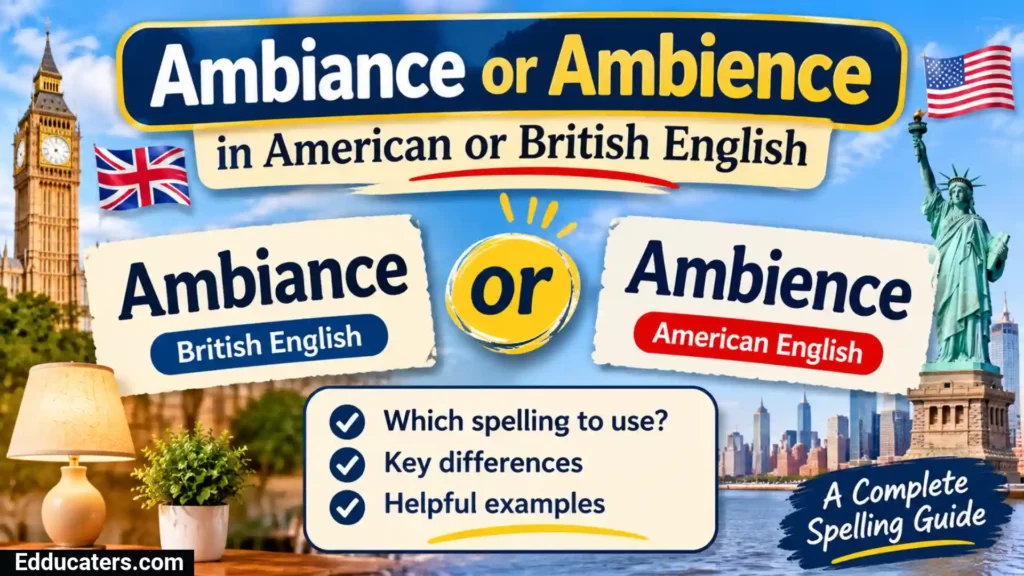
Both ambiance and ambience are used in American and British English. However, one spelling may feel more familiar depending on the region, publication, or audience.
Ambiance in American English
Ambiance is a familiar spelling in American English. American writers often use it when describing restaurants, hotels, homes, entertainment venues, and other places.
Examples:
- The restaurant’s ambiance makes it a perfect place for a romantic dinner.
- We chose the hotel because of its peaceful ambiance.
- The coffee shop has a relaxed ambiance that encourages customers to stay longer.
- The wedding venue offers a beautiful ambiance for special occasions.
- The office has a modern ambiance with comfortable furniture and natural lighting.
The spelling ambience is also correct in American English. You may see it in books, newspapers, restaurant reviews, travel articles, and other publications.
If you’re writing for American readers, ambiance is a natural choice. However, you don’t need to avoid ambience.
Ambience in British English
Ambience is a familiar spelling in British English. British writers frequently use it to describe the atmosphere or character of restaurants, hotels, homes, gardens, and public spaces.
Examples:
- The pub has a traditional ambience that attracts local visitors.
- We enjoyed the peaceful ambience of the countryside.
- The hotel combines modern facilities with a relaxing ambience.
- The restaurant offers an elegant ambience for evening dining.
- The gallery’s ambience makes the artwork feel more impressive.
British English also accepts ambiance. You may encounter this spelling in British magazines, websites, advertisements, and restaurant descriptions.
If you’re writing for a British audience, ambience is a reasonable choice. It doesn’t mean you must avoid ambiance.
Ambiance or Ambience: Which Spelling Should You Use?
The best spelling depends on your audience, personal preference, and writing style.
| Writing Situation | Recommended Spelling |
| American English writing | Ambiance is a familiar choice |
| British English writing | Ambience is a familiar choice |
| International English | Either spelling |
| Restaurant reviews | Either spelling |
| Hotel descriptions | Either spelling |
| Academic writing | Follow your style guide |
| Business writing | Follow your company’s style |
| Creative writing | Choose the spelling that suits your preference |
If you’re writing a blog, review, description, or business page, consistency matters more than choosing one spelling over the other.
For example, if you use ambiance in your introduction, continue using ambiance throughout the article. Avoid switching between ambiance and ambience without a reason.
This approach keeps your writing consistent and easier to read.
How to Pronounce Ambiance or Ambience
Both ambiance and ambience are generally pronounced the same way. The spelling difference doesn’t usually change their pronunciation.
| Word | IPA Pronunciation | Simple Pronunciation |
| Ambiance | /ˈæm.bi.əns/ | AM-bee-uhns |
| Ambience | /ˈæm.bi.əns/ | AM-bee-uhns |
Both words have three syllables and stress the first syllable.
Pronunciation Breakdown
You can divide the pronunciation into three parts:
- AM: Pronounce the first syllable like the beginning of the word am.
- bee: Pronounce the second syllable like the insect bee.
- uhns: Pronounce the final syllable like the ending of audience, without the initial sound.
Put the syllables together to say AM-bee-uhns.
The pronunciation may vary slightly between speakers and accents. However, the two spellings generally share the same pronunciation.
You don’t need to learn two separate pronunciations because ambiance and ambience are spelling alternatives rather than different words with different meanings.
Ambiance or Ambience in a Sentence
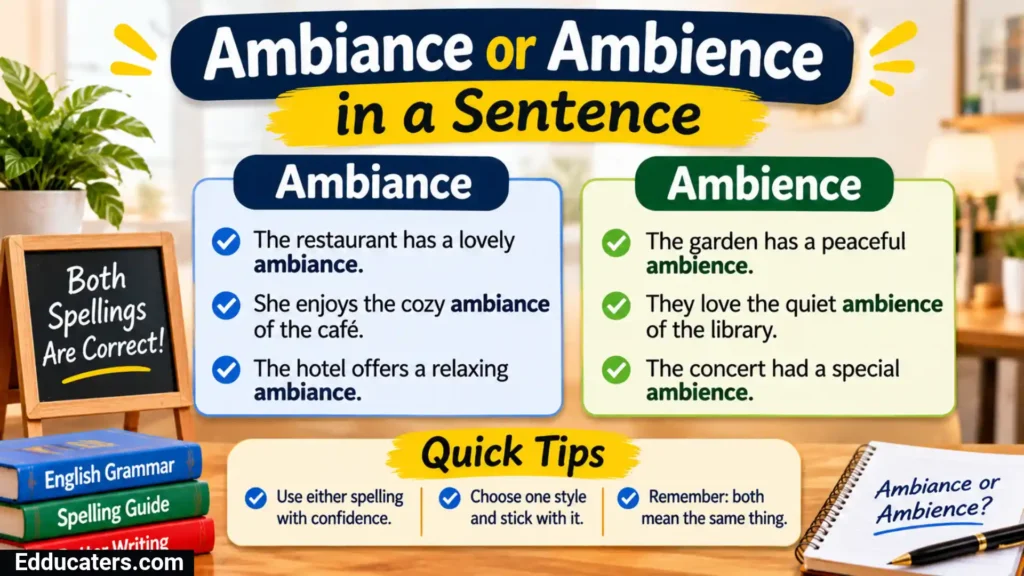
Understanding how to use ambiance or ambience in sentences makes the spelling difference easier to remember. Both words can describe the atmosphere of restaurants, homes, hotels, gardens, offices, events, and other environments.
Here are examples of how you can use each spelling in everyday English.
Ambiance in Example Sentences
- The restaurant’s warm ambiance made our dinner feel special.
- Soft music and candlelight created a romantic ambiance.
- The hotel offers a peaceful ambiance for guests who want to relax.
- We loved the cozy ambiance of the small coffee shop.
- The office has a professional ambiance without feeling too formal.
- The garden’s natural ambiance made it a perfect place for meditation.
- The fireplace added a comfortable ambiance to the living room.
- The wedding venue had a beautiful ambiance that impressed every guest.
- The spa creates a calming ambiance through soft lighting and soothing music.
- The restaurant’s lively ambiance attracted families and groups of friends.
Ambience in Example Sentences
- The restaurant’s warm ambience made our dinner feel special.
- Soft music and candlelight created a romantic ambience.
- The hotel offers a peaceful ambience for guests who want to relax.
- We loved the cozy ambience of the small coffee shop.
- The office has a professional ambience without feeling too formal.
- The garden’s natural ambience made it a perfect place for meditation.
- The fireplace added a comfortable ambience to the living room.
- The wedding venue had a beautiful ambience that impressed every guest.
- The spa creates a calming ambience through soft lighting and soothing music.
- The restaurant’s lively ambience attracted families and groups of friends.
How to Use Ambiance or Ambience in Different Contexts
| Context | Example Sentence |
| Restaurant | The restaurant has a warm ambiance with soft lighting and comfortable seating. |
| Hotel | The hotel provides a relaxing ambience for visitors. |
| Home | We created a cozy ambiance with candles and decorative pillows. |
| Garden | The garden has a peaceful ambience during the early morning. |
| Office | The office ambiance encourages teamwork and creativity. |
| Wedding | The venue’s elegant ambience made the ceremony unforgettable. |
| Café | The café’s friendly ambiance attracts students and remote workers. |
| Spa | The spa has a calming ambience that helps guests unwind. |
| Library | The quiet ambiance makes the library suitable for focused reading. |
| Nightclub | The nightclub has a lively ambiance with energetic music. |
These examples demonstrate that the two spellings work in the same contexts. You can replace ambiance with ambience in any of the sentences without changing their meaning.
How to Describe Ambiance or Ambience in Writing
When describing the ambiance or ambience of a place, focus on the details that create its atmosphere.
Instead of simply saying that a restaurant has a good ambiance, explain what makes it enjoyable. You might mention its lighting, music, furniture, colors, layout, or service.
For example:
Basic description:
The restaurant has a nice ambiance.
More descriptive version:
The restaurant has a warm ambiance with dim lighting, wooden tables, soft jazz, and friendly staff.
The second sentence gives readers a clearer picture. They can imagine the restaurant instead of relying on a vague description.
You can use the word to describe different moods, including:
- Relaxing ambiance: Soft lighting, quiet music, comfortable furniture, and peaceful surroundings.
- Romantic ambiance: Candlelight, gentle music, elegant decoration, and intimate seating.
- Lively ambiance: Energetic music, conversation, bright colors, and active surroundings.
- Elegant ambiance: Sophisticated decoration, refined furniture, attractive lighting, and polished details.
- Rustic ambiance: Wooden furniture, natural materials, earthy colors, and traditional decoration.
- Modern ambiance: Minimalist design, clean lines, contemporary furniture, and uncluttered spaces.
- Spooky ambiance: Dim lighting, unusual sounds, dark decoration, and mysterious surroundings.
The word can describe both positive and negative environments. A place doesn’t need to feel pleasant to have an ambiance.
For example, a gloomy room, uncomfortable restaurant, or tense workplace can also have a distinctive ambiance.
Ambiance or Ambience or Atmosphere: What’s the Difference?
Ambiance, ambience, and atmosphere are closely related words. All three can describe the feeling, mood, or character of a place or situation. However, atmosphere is often the broader term.
Ambiance and ambience usually emphasize the overall impression created by the surroundings. People commonly use them when describing restaurants, hotels, homes, cafés, gardens, and entertainment venues.
Atmosphere can describe a physical environment or an abstract situation. You can use it to discuss the mood of a room, a workplace, a political meeting, a conversation, or a social gathering.
Ambiance or Ambience
Both spellings describe the character or feeling of a place.
Examples:
- The restaurant has a cozy ambiance.
- The hotel offers a luxurious ambience.
- The garden has a peaceful ambiance.
- The café has a relaxed ambience.
These words often appear in descriptions of interior design, hospitality, travel, and entertainment.
Atmosphere
Atmosphere describes the general feeling, mood, or emotional character of a place, event, or situation.
Examples:
- The classroom had a friendly atmosphere.
- The meeting had a tense atmosphere.
- The town has a welcoming atmosphere.
- The concert created an exciting atmosphere.
You can use atmosphere in more situations than ambiance or ambience. It can describe physical surroundings and abstract emotional conditions.
Comparison Table
| Word | Meaning | Common Usage |
| Ambiance | The overall feeling or character of a place | Restaurants, hotels, homes, cafés, interior spaces |
| Ambience | The same meaning as ambiance | Restaurants, gardens, hotels, descriptive writing |
| Atmosphere | The general mood, feeling, or environment of a place or situation | Physical places, social situations, events, conversations |
Can You Use Ambiance or Ambience Instead of Atmosphere?
Yes, you can use ambiance or ambience instead of atmosphere when describing the overall feeling of a physical place.
For example:
- The restaurant has a pleasant atmosphere.
- The restaurant has a pleasant ambiance.
- The restaurant has a pleasant ambience.
All three sentences are correct.
However, atmosphere may sound more natural when discussing abstract situations.
For example:
- There was a tense atmosphere during the negotiations.
- The political atmosphere had changed significantly.
- The atmosphere in the classroom became uncomfortable.
You could use ambiance or ambience in some of these contexts, but atmosphere often fits more naturally.
Synonyms for Ambiance or Ambience
Several words can replace ambiance or ambience depending on the context. These alternatives can help you avoid repetition and make descriptions more precise.
| Synonym | Meaning | Example |
| Atmosphere | The general feeling or mood of a place or situation | The restaurant has a welcoming atmosphere. |
| Mood | The emotional feeling created by a place or situation | The soft lighting created a peaceful mood. |
| Vibe | An informal description of the feeling or character of a place | The café has a relaxed vibe. |
| Character | The distinctive qualities that make a place recognizable | The old building has plenty of character. |
| Feel | The general impression or emotional quality of a place | The room has a comfortable feel. |
| Environment | The surroundings or conditions in which people exist or work | The office provides a friendly environment. |
| Setting | The place or surroundings where something happens | The garden offers a beautiful setting for dinner. |
| Surroundings | The nearby environment or physical features of a place | The peaceful surroundings made the hotel attractive. |
When Should You Use These Synonyms?
The best synonym depends on what you want to describe.
- Use atmosphere when discussing the overall mood or environment.
- Use mood when focusing on the emotional feeling.
- Use vibe in informal conversations or casual descriptions.
- Use character when describing distinctive qualities or personality.
- Use feel when you want a simple and conversational expression.
- Use environment when discussing surroundings, conditions, or a setting.
- Use setting when describing the location or background of an event.
- Use surroundings when focusing on the physical environment.
For example, you could describe a restaurant as having a cozy ambiance, a relaxed vibe, a welcoming atmosphere, or a comfortable feel.
Each expression emphasizes a slightly different aspect of the restaurant. However, they can overlap in meaning.
Common Mistakes When Using Ambiance or Ambience
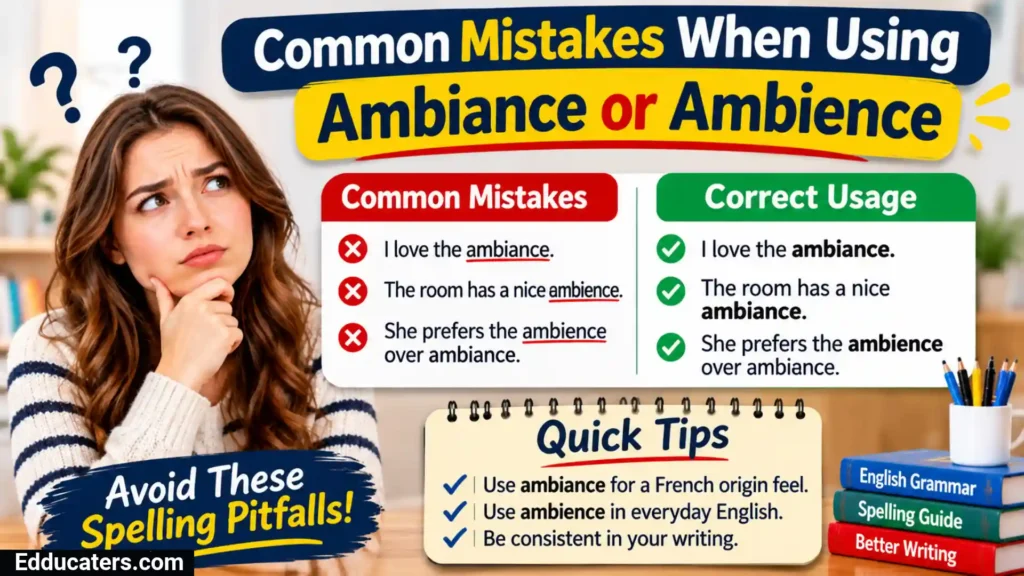
Although ambiance or ambience are easy to understand, writers sometimes make mistakes when choosing or using these words.
Knowing the common mistakes can help you write more clearly.
1. Treating Ambiance or Ambience as Incorrect
One common mistake is assuming that ambiance or ambience is incorrect.
Both are accepted spellings. You don’t need to correct one to the other when editing a sentence.
Incorrect assumption:
Ambiance is wrong because ambience is the only correct spelling.
Correct understanding:
Ambiance and ambience are both correct English spellings.
2. Assuming Ambiance Is Only American English
Another mistake is believing that ambiance can only be used in American English.
Although ambiance is a familiar American spelling, it isn’t restricted to the United States. British English also accepts it.
Likewise, ambience isn’t exclusively British. American writers can use it without making a spelling error.
Regional preferences can influence your choice, but they don’t establish an absolute rule.
3. Switching Between Ambiance or Ambience Without a Reason
Using both spellings in the same article can make your writing inconsistent.
For example:
Inconsistent:
The restaurant has a beautiful ambiance. Its ambience attracts many visitors every weekend.
Consistent:
The restaurant has a beautiful ambiance. Its ambiance attracts many visitors every weekend.
The second example maintains the same spelling throughout. Consistency makes your article easier to read and gives it a more polished appearance.
4. Confusing Ambiance or Ambience With Ambient
Ambiance or ambience are nouns. Ambient is an adjective.
The adjective ambient describes something surrounding or present in the environment.
Examples:
- The ambient lighting creates a peaceful atmosphere.
- Ambient noise made it difficult to concentrate.
- The ambiance of the room feels relaxing.
- The ambience of the garden is peaceful.
The words are related in meaning but serve different grammatical purposes.
5. Assuming Ambiance or Ambience Always Means Pleasant
Some writers use ambiance or ambience only to describe beautiful, relaxing, or luxurious places.
However, the words can describe unpleasant, uncomfortable, gloomy, or tense environments as well.
Examples:
- The abandoned building had a gloomy ambiance.
- The restaurant’s noisy ambience made conversation difficult.
- The room had an uncomfortable ambiance.
- The office developed a tense ambience after the announcement.
The word describes the overall feeling or character of the environment. That feeling doesn’t have to be positive.
Frequently Asked Questions About Ambiance or Ambience
Is ambiance or ambience correct?
Both ambiance and ambience are correct spellings. They have the same meaning and refer to the atmosphere, mood, character, or feeling of a place. You can use either spelling without making a spelling mistake.
Is ambiance or ambience American or British English?
Ambiance is a familiar spelling in American English while ambience is commonly preferred in British English. However, both spellings are accepted in American and British English.
Is ambience a misspelling of ambiance?
No, ambience isn’t a misspelling of ambiance. Both are legitimate English spellings. They refer to the same atmosphere, mood, or character of a place.
Is ambiance a misspelling of ambience?
No, ambiance isn’t a misspelling of ambience. Both spellings are correct. The difference is a spelling preference rather than a difference in meaning.
Do ambiance or ambience mean the same thing?
Yes, ambiance and ambience mean the same thing. Both describe the overall atmosphere, mood, character, or feeling of a place or environment. You can use them interchangeably.
How do you spell ambiance or ambience?
You can spell the word in two accepted ways: ambiance or ambience. Both are correct English spellings. Choose the spelling that suits your audience or preferred writing style.
Should I use ambiance or ambience in American English?
Ambiance is a familiar choice in American English. However, ambience is also correct and widely understood. You can use either spelling in American writing.
Should I use ambiance or ambience in British English?
Ambience is a familiar choice in British English. However, ambiance is also accepted. Both spellings are correct and understandable to British readers.
Are ambiance or ambience pronounced differently?
No, they are generally pronounced the same way. Both are commonly pronounced AM-bee-uhns. The spelling difference doesn’t normally change their pronunciation.
Is ambiance or ambience a noun?
Yes, both ambiance and ambience are nouns. They describe the atmosphere, character, mood, or overall feeling of a place or situation.
What is the difference between ambiance or ambience and atmosphere?
Ambiance and ambience have the same meaning and generally describe the overall feeling or character of a place. Atmosphere is a broader term that can describe physical surroundings, emotional situations, social settings, and other environments.
Can I use ambiance or ambience in formal writing?
Yes, both spellings are suitable for formal and informal writing. You can use them in business descriptions, restaurant reviews, travel articles, academic writing, and other contexts. Follow your publication’s spelling preferences when necessary.
Conclusion
Ambiance or ambience are both correct spellings of the same English word. They describe the atmosphere, mood, character, or overall feeling of a place or environment. Neither spelling is wrong.
Ambiance is a familiar spelling in American English while ambience is commonly preferred in British English. However, both forms are accepted in each variety of English.
You can use either spelling when describing a restaurant, hotel, café, garden, home, office, or event. Choose the spelling that suits your audience and keep it consistent throughout your writing.
The easiest way to remember this difference is that ambiance and ambience have the same meaning, pronunciation, and grammatical function. Only their spelling differs.

Hello, I’m Claire Holloway. I have always been passionate about the English language and enjoy turning complex grammar rules into simple, easy-to-follow lessons. I believe that every learner can become a confident English writer with the right guidance.
I create educational content focused on grammar, vocabulary, sentence structure, and writing improvement. Every article I publish is designed to help readers learn with confidence and accuracy.
Books
Grammar Without Confusion
Modern English Usage Guide
 Julian Mercer