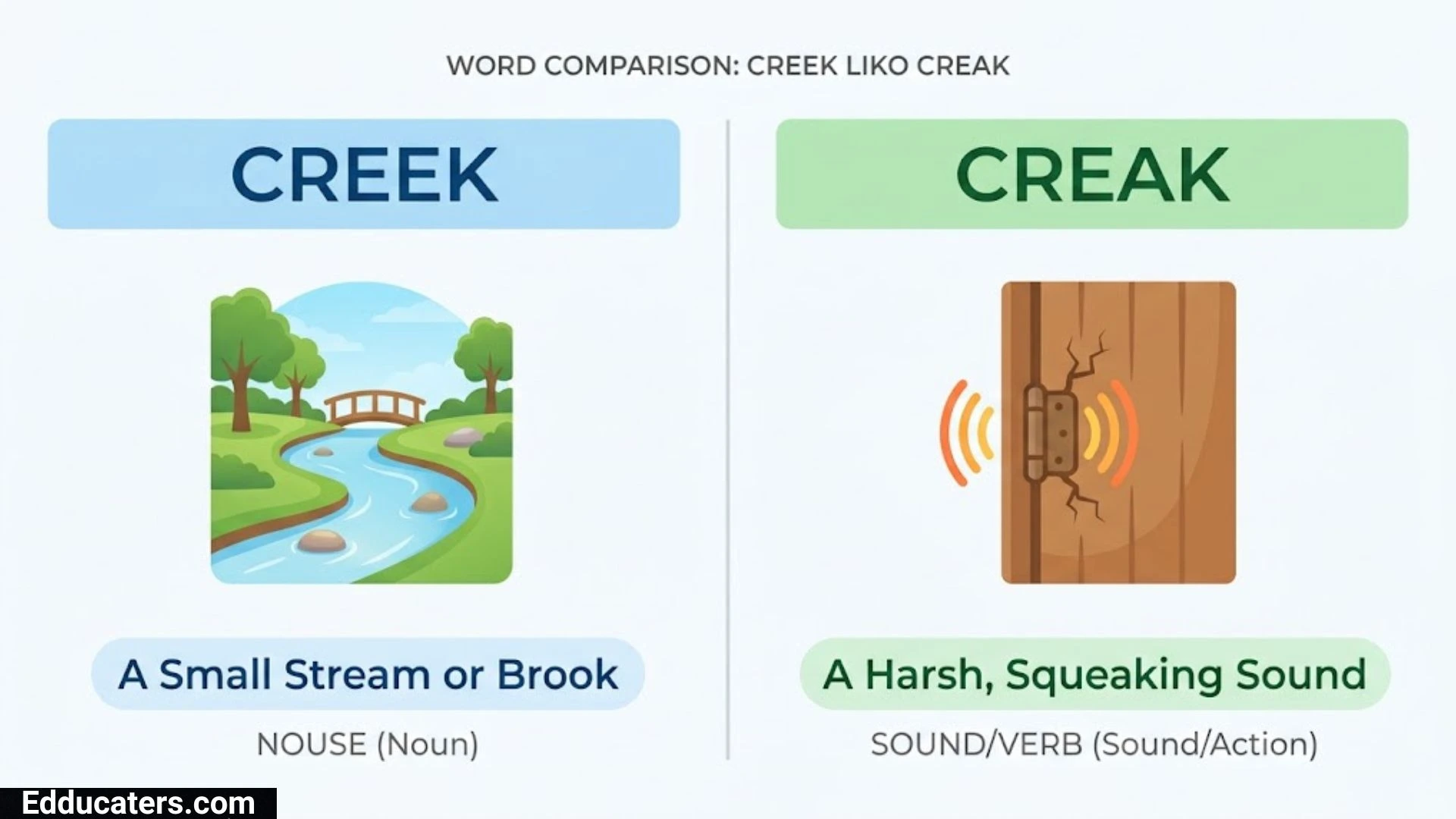
Have you ever wondered whether to write creek or creak? These two words sound almost identical, but their meanings have nothing to do with each other. One describes a sound, while the other usually refers to a small waterway. Choosing the wrong spelling can change the entire meaning of your sentence.
The difference is easy to remember once you understand how each word works. Creak describes a squeaking, groaning, or grating noise made by something moving. Creek refers to a natural stream of water, often smaller than a river.
For example, an old wooden door might creak when you open it, while a narrow creek might flow through the woods behind your house. Both words are correct English spellings, but you cannot use them interchangeably.
In this guide, you’ll learn the meaning of each word, how to pronounce them, how to use them in sentences, and how to avoid common spelling mistakes. You’ll also discover simple memory tricks that make choosing the right word much easier.
What Is the Difference Between Creek or Creak?
The main difference between creek and creak is their meaning and grammatical use. Although they sound the same in common American English, they describe different things.
Creak can function as a verb or a noun. As a verb, it describes making a squeaky or groaning sound. As a noun, it refers to the sound itself.
Creek is a noun that usually describes a small stream of flowing water. It may wind through a forest, cross a field, or run alongside a hiking trail.
Here’s a quick comparison:
| Feature | Creak | Creek |
| Meaning | A squeaky, groaning, or grating sound | A small stream or narrow waterway |
| Part of speech | Verb and noun | Noun |
| Pronunciation | /kriːk/ | /kriːk/ |
| Related words | Creaks, creaked, creaking | Creeks |
| Common associations | Doors, floorboards, chairs, hinges | Water, streams, riverbanks, forests |
| Example | The stairs creak at night. | The creek flows through the valley. |
The simplest way to remember the distinction is to connect each spelling with its meaning.
- Creak = sound. Think of an old door making a noise.
- Creek = water. Picture a small stream flowing over rocks.
Consider these two sentences:
- The wooden bridge began to creak under our weight.
- We crossed a shallow creek using a wooden bridge.
Both sentences are correct, and they even describe the same scene. However, creak identifies a noise, while creek names the waterway.
When you’re unsure which spelling to choose, examine the surrounding words. If the sentence describes a noise, creak is probably correct. If it describes a water feature, choose creek.
What Does Creak Mean?
The word creak describes a harsh, squeaky, or groaning sound. It often occurs when an object moves, bends, shifts under pressure, or rubs against another surface.
Imagine opening an old wooden door late at night. Its hinges produce a long, rough noise as the door swings open. That sound is a creak.
Creaks often come from everyday objects, including:
- Old wooden doors and rusty hinges
- Wooden floorboards and stairs
- Rocking chairs and other furniture
- Beds and mattresses that shift under weight
- Gates, boats, and wooden bridges
- Machines with moving or worn parts
- Joints that make audible noises during movement
A creak can be quiet and brief or loud enough to attract someone’s attention. In a suspenseful story, a creaking floorboard might alert a character that someone has entered the house. In everyday life, it may simply mean that a piece of furniture needs attention.
The word doesn’t always describe wood, either. Metal structures, mechanical parts, and other objects can produce creaking noises.
Creak as a Verb
As a verb, creak means to make a squeaky, groaning, or grating sound. It can describe the sound itself or the movement that produces it.
For example:
- The old door began to creak when I pushed it.
- The wooden stairs creak whenever someone walks upstairs.
- The rusty gate creaked in the strong wind.
- The floorboards were creaking beneath our feet.
- The rocking chair creaks whenever Grandpa sits in it.
In these examples, the word describes an audible noise associated with movement.
You can use creak in both literal and figurative ways. Literally, a door may creak because its hinges or frame produce noise. Figuratively, a system or organization may be described as creaking when it struggles under pressure or begins to show signs of weakness.
For instance, a writer might say, “The aging transportation system is beginning to creak under the pressure of rising demand.” The sentence uses the sound of a strained structure to suggest that the system is struggling.
Creak as a Noun
As a noun, creak refers to the sound itself rather than the action of making it.
Here are some examples:
- A sudden creak came from the hallway.
- I heard the creak of an old wooden chair.
- Every creak in the house seemed louder after midnight.
- The door gave a long creak as it slowly opened.
- A faint creak came from the boat as the waves rocked it.
Notice the difference between these sentences:
- The door creaks when it opens. Here, creaks is a verb.
- The door makes a loud creak when it opens. Here, creak is a noun.
The meaning stays closely related, but the grammatical role changes.
What Do Creaked and Creaking Mean?
The forms creaked and creaking follow ordinary English verb patterns.
| Word form | Grammatical use | Example |
| Creak | Base form | I heard the door creak. |
| Creaks | Present tense with he, she, or it | The old gate creaks loudly. |
| Creaked | Simple past tense or past participle | The floorboard creaked yesterday. |
| Creaking | Present participle or gerund | The creaking stairs woke us up. |
| Creaks | Plural noun | The house makes strange creaks at night. |
Creaked describes a sound that occurred in the past. For example, “The chair creaked when I sat down.”
Creaking can describe an ongoing action or serve as an adjective. In “The door is creaking,” it forms part of a verb phrase. In “The creaking door needs repair,” it describes the door.
One common spelling mistake is writing creek-ing when describing a squeaky noise. The correct form is creaking, with an a.
What Does Creek Mean?
A creek is a natural waterway, usually smaller than a river. It may carry water through a forest, across farmland, around a residential area, or down a mountain valley.
Creeks vary considerably in their size, depth, and flow. Some contain water throughout the year, while others flow mainly during wet seasons or after rainfall. A creek may feed into a larger waterway or form part of a wider drainage system.
The U.S. Geological Survey describes a creek as a natural stream normally smaller than and often tributary to a river. However, geographical naming conventions aren’t perfectly consistent, so not every creek follows the same pattern.
You can read the agency’s water science glossary for more information about waterways and related terms.
People commonly use creek when discussing:
- A small stream running through a forest
- A shallow waterway crossing a walking trail
- A creek bank lined with grass and trees
- A freshwater fishing spot
- A stream passing through farmland
- A narrow water channel near a campsite
- A waterway flowing toward a larger river
For example, “The children spent the afternoon skipping stones across the creek” describes a small waterway where people can enjoy an outdoor activity.
The word also appears in place names throughout the United States. A location might be called Pine Creek, Willow Creek, or Mill Creek. In these names, Creek identifies a geographical feature.
Creek in American English
In American English, creek commonly refers to a small natural stream. However, the word doesn’t have one universally enforced size limit.
Some creeks are shallow enough to cross on foot under suitable conditions. Others may be deep, wide, or fast-moving, particularly after heavy rain. The name alone doesn’t tell you whether a waterway is safe to cross.
The term can also vary by region. Some communities use creek, brook, run, or branch for local waterways. The names often reflect local history and naming traditions rather than precise measurements.
In British English, creek can also refer to a narrow inlet or bay extending inland from a larger body of water. This meaning is especially relevant in coastal settings.
Therefore, context matters when interpreting the word. A creek in a woodland hiking guide probably refers to a stream, while a creek on a coastal map may describe an inlet.
Creek in Everyday Sentences
Here are several examples showing how to use creek naturally:
- A narrow creek runs behind our farmhouse.
- We followed the creek until we reached a wooden bridge.
- The children watched tiny fish swim through the shallow creek.
- Heavy rain caused the creek to rise overnight.
- We stopped beside the creek to eat lunch.
- A family of ducks swam along the creek near the park.
- Wildflowers grew along the banks of the creek.
- The hiking trail follows a winding creek through the forest.
Each example refers to a physical waterway. None describes a noise.
Are Creek or Creak Homophones?
Yes. Creek and creak are homophones in common American English. Homophones are words that share the same pronunciation but have different meanings and spellings.
The two words are pronounced /kriːk/ in the International Phonetic Alphabet (IPA). Their sounds match even though their written forms differ.
The pronunciation has three main parts:
- /k/ — the initial consonant sound.
- /r/ — the following consonant sound.
- /iːk/ — the long vowel sound followed by the final k.
The vowel is the same long ee sound heard in words such as week, seek, and speak.
Because both words sound alike, pronunciation alone usually won’t help you select the correct spelling. You need to understand what the sentence means.
For example, imagine hearing someone say, “The creek is rising.” You can identify the intended word from the context if you know the speaker is talking about water levels.
Similarly, “The door will creak” clearly describes a sound because a door can make a noise as it moves.
Other familiar homophones include:
| Homophones | Meaning |
| Week / weak | A seven-day period / lacking strength |
| See / sea | To perceive with your eyes / a large body of salt water |
| Right / write | Correct or a direction / to form words |
| Pair / pear | Two things considered together / a type of fruit |
| Flower / flour | A plant’s bloom / a powder used in baking |
These examples demonstrate why spelling depends on meaning rather than sound alone.
One additional point is worth remembering: pronunciation can vary across English-speaking regions. Some speakers have regional pronunciations of creek that differ from the common American form. Nevertheless, creak and creek rhyme and are generally treated as homophones in standard American English.
How to Use Creek or Creak in a Sentence
Choosing the correct spelling becomes easier when you identify what the sentence describes. Ask yourself whether you’re talking about a sound or a waterway.
Creak Sentence Examples
Use creak when describing a squeaky or groaning noise.
- The old wooden door began to creak as I pushed it open.
- I heard the floorboards creak while someone walked upstairs.
- The rocking chair gave a loud creak when Dad sat down.
- The rusty gate creaked in the evening breeze.
- A strange creak came from the attic.
- The wooden boat creaked as the waves moved beneath it.
- The stairs are creaking because the boards shift under our weight.
- My knees sometimes creak when I stand after sitting for a long time.
- The bed creaked when the dog jumped onto it.
- Every creak in the old house made the children turn around.
In each example, the word relates to a sound. It may describe the noise directly or identify an object that makes the noise.
Creek Sentence Examples
Use creek when referring to a stream or another type of waterway.
- We walked beside the creek until sunset.
- A small creek flows through the woods behind our house.
- The hikers crossed the creek using a wooden footbridge.
- Rainwater flowed into the creek after the storm.
- We found a quiet fishing spot beside the creek.
- The children watched leaves float down the creek.
- Wildflowers covered the banks of the creek.
- A shallow creek crossed the path near the campsite.
- The farmers built a fence along the edge of the creek.
- The creek eventually joins a larger river downstream.
These sentences describe water, its movement, or the landscape around it.
Incorrect and Correct Word Choices
Sometimes, seeing the wrong spelling beside the correct one is the fastest way to understand the distinction.
| Incorrect sentence | Correct sentence | Why? |
| The old door began to creek. | The old door began to creak. | The sentence describes a sound. |
| We sat beside the creak. | We sat beside the creek. | The sentence describes a waterway. |
| The stairs were creek-ing. | The stairs were creaking. | The -ing form comes from creak. |
| We heard a loud creek from the chair. | We heard a loud creak from the chair. | The word names a noise. |
| The creek made a squeaky noise as I opened it. | The door creaked as I opened it. | The door makes the noise; the creek is a waterway. |
The best proofreading method is to replace the word temporarily with a simpler synonym.
If squeak or groan fits the sentence, choose creak. If stream or waterway fits, choose creek.
This quick substitution test works because it checks meaning rather than relying on sound.
Creek or Creak: Common Spelling Mistakes
Writers often confuse these words because English spelling doesn’t always follow a predictable sound pattern. Since creak and creek sound alike, it’s easy to choose the wrong vowel when typing quickly.
Fortunately, a few simple checks can prevent most mistakes.
Using Creek for a Squeaking Sound
The most common error is writing creek when describing a noise.
Incorrect: “The wooden floor began to creek.”
Correct: “The wooden floor began to creak.”
The sentence describes a sound produced by the floorboards as someone walks across them. Therefore, creak is the correct choice.
Using Creak for a Waterway
Another mistake is using creak when referring to a stream.
Incorrect: “We went fishing beside the creak.”
Correct: “We went fishing beside the creek.”
Fishing beside a natural waterway makes sense, so creek is the appropriate spelling.
Writing Creek-ing Instead of Creaking
The spelling creek-ing isn’t the standard form for describing a squeaky noise.
Incorrect: “The old door is creek-ing.”
Correct: “The old door is creaking.”
The word creaking comes from the verb creak. Adding -ing doesn’t change the word’s central meaning.
Assuming Pronunciation Reveals the Correct Spelling
Reading the sentence aloud may help you understand its meaning, but it usually won’t distinguish these homophones.
For example, the sentences “The creek is shallow” and “The door will creak” contain words with the same pronunciation. You must rely on context to determine which spelling belongs in each sentence.
When proofreading, pay attention to the surrounding nouns and verbs. Words such as hinges, floorboards, and squeak often point toward creak. Words such as water, riverbank, and flow often point toward creek.
These are useful clues, not absolute rules. The sentence’s meaning remains the deciding factor.
How to Remember the Difference Between Creek or Creak
You don’t need to memorize complicated spelling rules to distinguish these words. A simple mental picture can help you choose the correct spelling almost every time.
Remember Creak With a Sound
Connect creak with a squeak or groan.
Picture an old wooden door swinging open slowly. Its hinges produce a long, rough noise.
You might say, “The door goes creak.”
The spelling contains ea, just as in speak and squeak. These words share a similar vowel pattern, although their meanings differ.
Try remembering this phrase:
Creak means a sound that you hear.
This association is especially useful when writing about old furniture, stairs, doors, or other objects that make noise.
Remember Creek With Water
Connect creek with a stream of water.
Picture a narrow waterway winding through a forest. You might see rocks along its banks, leaves floating on the surface, or fish swimming beneath the water.
The word creek contains ee, just like green. You can picture green trees growing beside a creek to reinforce the spelling.
Try remembering this phrase:
Creek means a waterway you can see.
The rhyme makes the distinction easy to recall.
Use the Context Test
If you’re still uncertain, ask yourself one question:
Am I describing a sound or a place with water?
- If you’re describing a noise, use creak.
- If you’re describing a waterway, use creek.
You can also replace the word with a synonym.
- “The chair made a ___.” Try squeak. The correct word is creak.
- “We crossed the ___.” Try stream. The correct word is creek.
This approach is more reliable than memorizing the spelling in isolation because it connects the word to its actual meaning.
Quick Practice: Creek or Creak?
Test your understanding with these sentences.
- The wooden stairs began to ___ as I climbed them.
- We spent the afternoon beside a shallow ___.
- The rocking chair made a loud ___.
- A narrow ___ flows through the valley.
- The old gate kept ___ whenever the wind blew.
Answers:
- Creak
- Creek
- Creak
- Creek
- Creaking
If you answered all five correctly, you’ve mastered the basic distinction. If you missed one, revisit the sound-versus-water test.
Creek or Creak: Creek vs. Stream vs. River
When learning the meaning of creek, it’s useful to compare it with stream and river. All three words relate to flowing water, but their typical usage differs.
A creek is commonly understood as a relatively small natural waterway. A stream is a broad term for flowing water in a natural channel. A river generally describes a larger watercourse.
Here’s a practical comparison:
| Word | General meaning | Example |
| Creek | A natural waterway, often relatively small | We followed the creek through the woods. |
| Stream | A general term for flowing water | A stream runs past the meadow. |
| River | A natural watercourse generally larger than a creek | The river flows toward the sea. |
The distinction between these terms isn’t always exact. The U.S. Geological Survey notes that names such as creek, stream, and river can overlap. In some contexts, they are used almost interchangeably rather than following strict size categories.
You can explore the agency’s explanation in its article about rivers, streams, and creeks.
Creek vs. Stream
The word stream is more general. It can refer to many types of flowing water, including small channels and larger watercourses.
A creek is often a type of stream, but local naming conventions vary. A waterway’s official name doesn’t necessarily reveal its width, depth, or flow rate.
For example, a local feature called Willow Creek might be wider than another feature named Little Stream. The names alone don’t establish their actual sizes.
Creek vs. River
A river is generally larger than a creek, but the distinction isn’t governed by one universal measurement.
Creeks may flow into rivers, lakes, wetlands, or other waterways. However, a creek doesn’t have to connect to a river to deserve the name.
The U.S. Geological Survey’s geographical naming FAQ explains that generic geographical terms don’t always have official, rigid definitions.
The key point for everyday writing is simple: creek refers to a waterway, while creak refers to a sound. Comparing creek with stream or river can clarify its meaning, but those comparisons don’t change the spelling rule.
Frequently Asked Questions About Creek or Creak
Is It Creek or Creak?
Both spellings are correct, but they have different meanings. Use creak for a squeaky or groaning noise and creek for a natural waterway.
For example, “The old door began to creak” describes a sound, while “We walked beside the creek” describes a place.
What Is the Correct Spelling for a Squeaking Door?
The correct word is creak. A door creaks when it makes a squeaky, groaning, or grating noise as it moves.
You can also use creaking to describe the ongoing sound. For example, “The creaking door woke everyone in the house.”
Are Creek or Creak Pronounced the Same?
Yes, the words are homophones in common American English. Both are typically pronounced /kriːk/, with the same consonant sounds and long vowel.
Their meanings and spellings differ even though their pronunciation matches.
Can Creak Be Used as a Noun?
Yes. Creak functions as both a verb and a noun.
As a noun, it names a sound: “I heard a creak from the hallway.”
As a verb, it describes making that sound: “The floorboards creak when I walk across them.”
Does Creek Mean a Sound?
No. In ordinary geographical usage, creek refers to a natural stream or waterway. It doesn’t mean a squeaky or groaning noise.
If you hear a sound coming from a door, chair, or floorboard, use creak instead.
Is a Creek the Same as a River?
Not exactly. A creek is commonly smaller than a river, while a river generally carries water through a larger channel.
However, geographical names don’t follow one universal size standard. The terms can overlap, and local naming practices vary.
What Is the Difference Between Creaking and Creek?
Creaking is the -ing form of the verb creak. It describes an ongoing sound or can act as an adjective, as in “the creaking stairs.”
Creek is a noun referring to a waterway. The two words aren’t interchangeable.
How Can I Remember the Difference Between Creek or Creak?
Remember creak = sound and creek = water.
Picture a squeaky wooden door when you think of creak. Picture a stream winding through green woods when you think of a creek.
If you’re unsure, replace the word with squeak or stream and see which meaning fits the sentence.
Conclusion
The difference between creek or creak comes down to meaning. Both words are correctly spelled, and they usually sound identical in American English. However, each serves a different purpose.
Use creak as a verb for making a squeaky or groaning sound or as a noun for the sound itself. Use creek as a noun when describing a natural waterway, often smaller than a river.
Keep these simple examples in mind:
- The old door began to creak.
- We followed the creek through the forest.
When you understand the context, choosing the right spelling becomes much easier. Remember the sound-versus-water trick, check the meaning of the sentence, and you’ll avoid this common spelling mistake in your everyday writing.

Hello, I’m Claire Holloway. I have always been passionate about the English language and enjoy turning complex grammar rules into simple, easy-to-follow lessons. I believe that every learner can become a confident English writer with the right guidance.
I create educational content focused on grammar, vocabulary, sentence structure, and writing improvement. Every article I publish is designed to help readers learn with confidence and accuracy.
Books
Grammar Without Confusion
Modern English Usage Guide
 Nathan Whitmore
 Julian Mercer