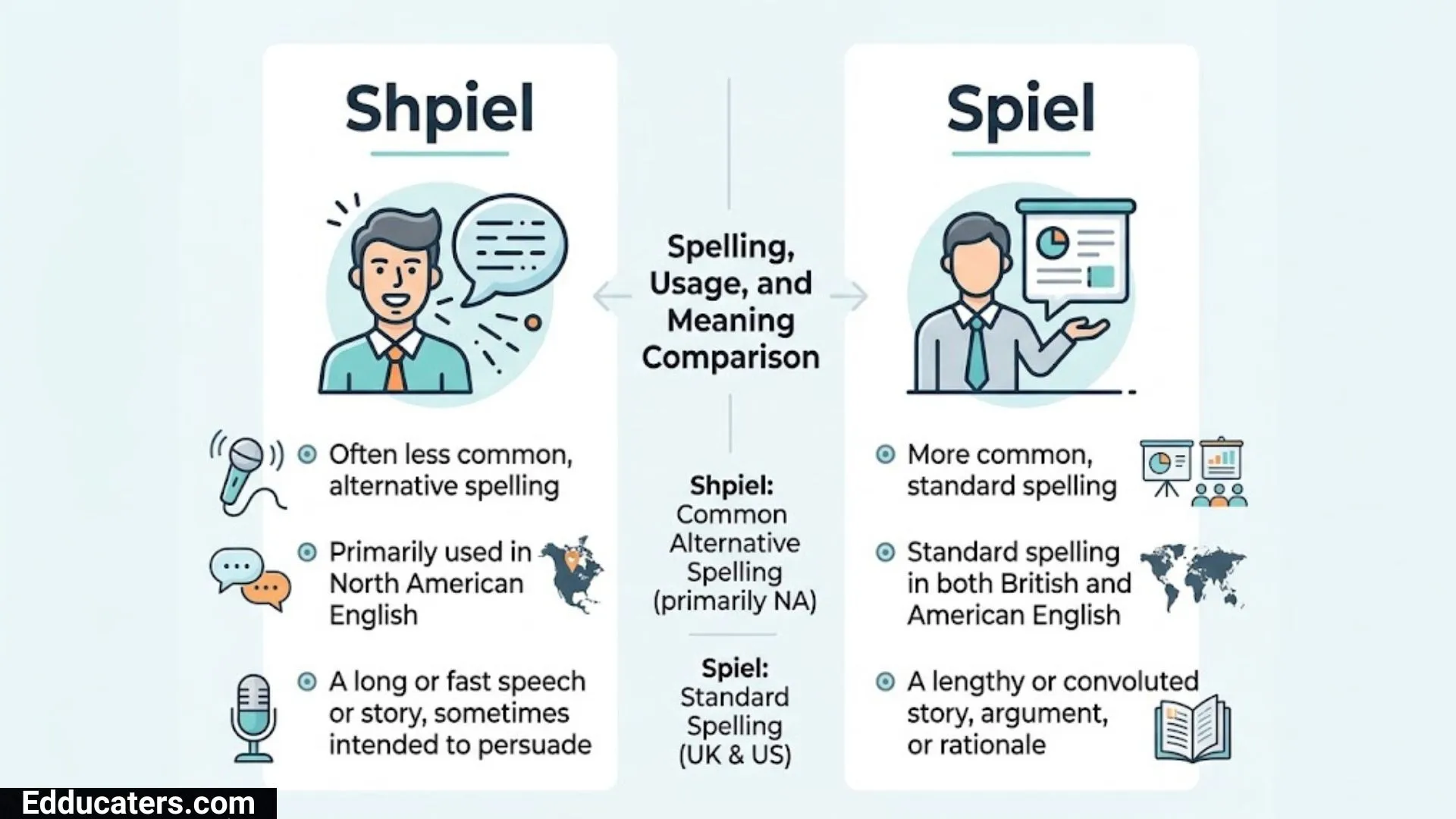
Have you ever heard someone deliver a long sales pitch or repeat the same explanation for the tenth time? You might describe it as a spiel. But when you hear the word pronounced with an initial “sh” sound, the spelling shpiel or schpiel can seem more natural.
So, which spelling should you use?
Spiel is the established English spelling, while shpiel or schpiel are alternative forms found in some English-language and Yiddish-influenced contexts. If you’re writing a general article, professional email, or school assignment, spiel is the safest choice. However, understanding the alternatives helps explain why you may encounter different spellings in conversation and published writing.
The word usually describes a rehearsed, persuasive, or lengthy speech. It often refers to a salesperson’s pitch, a familiar explanation, or an argument someone repeats so often that it starts to sound predictable.
In this guide, you’ll learn the spiel or schpiel meaning, the correct spelling to use, how to pronounce both forms, where the word comes from, and how to use it naturally in sentences.
Spiel or Schpiel: Which Spelling Is Correct?
When choosing between spiel or schpiel, start with the spelling you see in established English dictionaries. Spiel is the standard English spelling and the best default for general writing.
However, the spelling question has a little more nuance than simply labeling every alternative incorrect. The Jewish English Lexicon records schpiel among the alternative spellings associated with the Yiddish-derived word. The related form shpiel also appears in English usage.
The key distinction is between the standard spelling used in general English and alternative spellings that reflect the word’s linguistic and cultural background.
Spiel vs. Schpiel: Quick Comparison
| Feature | Spiel | Schpiel |
| Spelling status | Established English spelling | Attested alternative spelling |
| Main meaning | A speech, pitch, performance, or lengthy explanation | Generally the same |
| Pronunciation | Commonly /spiːl/ or /ʃpiːl/ | Usually /ʃpiːl/ |
| Typical tone | Informal; sometimes disapproving | Informal or culturally marked, depending on context |
| Best use | General English writing | Contexts where the alternative spelling is appropriate |
| Example | The salesperson gave us the usual spiel. | He launched into another long schpiel. |
Oxford Learner’s Dictionaries lists spiel as the main entry and records both the S and SH pronunciations. The Jewish English Lexicon also documents schpiel as an alternative spelling. These references show why it’s useful to distinguish the standard English headword from other forms people use.
Sources: Oxford Learner’s Dictionaries and Jewish English Lexicon.
Is Schpiel a Real Word?
Yes, schpiel is an attested spelling variant, although it isn’t the usual headword spelling in general English dictionaries. It appears in connection with the Yiddish word shpil, which can mean a game, play, performance, or extended speech.
That doesn’t mean every spelling is equally suitable for every situation. In edited English prose, consistency and reader expectations matter. Most readers will recognize spiel immediately, especially in expressions such as sales spiel and the usual spiel.
Use schpiel when the alternative spelling serves a clear purpose, such as reflecting a particular cultural context, a writer’s established style, or a quoted source. Otherwise, stick with spiel.
Why Do People Spell Spiel as Schpiel?
The main reason is pronunciation. Many English speakers pronounce spiel with an initial SH sound. When people write a word the way they hear it, adding sch may seem logical.
English also contains familiar words with a sch spelling, including school, scheme, and schmooze. Those examples can make schpiel look plausible, even though spiel remains the standard English spelling.
Remember this simple rule: pronunciation and spelling don’t always match letter for letter. A word can have a recognized pronunciation that differs from what its written form might lead you to expect.
What Does Spiel Mean?
The word spiel meaning usually centers on a practiced speech or explanation. A spiel may aim to persuade someone, sell a product, defend a decision, or repeat a familiar message.
Oxford defines the noun as an informal, usually disapproving term for a speech someone has used many times to persuade others to believe something or buy something. That definition captures the word’s common modern use.
For example:
The salesperson gave us a long spiel about the benefits of the new phone.
Here, spiel refers to a prepared sales presentation. The salesperson may have delivered the same explanation to dozens of customers.
The word can also describe a familiar excuse or a lengthy argument. Imagine a friend who always explains why they’re late using exactly the same story. You might say you’ve heard that spiel before.
Common Meanings of Spiel
Depending on the situation, spiel can refer to:
- A sales pitch: A prepared talk designed to encourage someone to buy a product or service.
- A rehearsed explanation: A familiar account someone repeats regularly.
- A persuasive speech: An argument intended to influence someone’s opinion or decision.
- A lengthy monologue: An extended stretch of talk, especially when it feels repetitive or overly polished.
- A performance or play: In some German- or Yiddish-related contexts, the word can retain a broader sense connected with playing or performing.
The first four meanings are especially useful when reading contemporary English. The performance-related meaning matters when exploring the word’s history and cultural uses.
Does Spiel Always Have a Negative Meaning?
No. Although spiel often carries a skeptical or mildly critical tone, the word doesn’t automatically suggest dishonesty.
Consider these examples:
- “The guide gave us his usual spiel before the tour.” This sounds casual and may be neutral.
- “I’m tired of hearing the same spiel about how everything will improve.” This expresses frustration.
- “She delivered a polished spiel explaining the charity’s mission.” This can describe an effective presentation without accusing anyone of lying.
Context makes the difference. Words such as usual, same old, and endless often add a negative edge because they suggest repetition or boredom.
Calling something a spiel may imply that the speaker sounds rehearsed rather than spontaneous. However, a practiced presentation can still contain accurate information and sincere promises.
Does Spiel Mean Lie?
Not necessarily. A lie is a deliberately false statement. A spiel is a speech or explanation, often rehearsed or persuasive.
Someone can give an honest spiel about a product’s benefits. Another person might deliver a misleading spiel full of exaggerated promises. The word describes the way the message is presented more than it proves whether the message is true.
Compare these examples:
- Honest explanation: The technician gave me a spiel about how the new system saves energy.
- Misleading pitch: The company gave customers a spiel promising results that its product couldn’t deliver.
The second example describes deceptive communication, but the dishonesty comes from the false promise rather than from the word spiel itself.
What Does Schpiel Mean?
The schpiel meaning is generally the same as the meaning of spiel: a speech, performance, persuasive pitch, or lengthy explanation. The spelling reflects a form associated with Yiddish-influenced English.
For example:
Every time we discuss the project, he gives us the same schpiel about the deadline.
The sentence means that the speaker repeatedly offers the same explanation about the deadline. Writing spiel instead would preserve the meaning.
The distinction is mainly about spelling and context, not a separate definition. You shouldn’t assume that schpiel describes a dishonest speech while spiel describes an honest one. Neither spelling creates that difference.
When Should You Use Schpiel?
In most everyday English writing, spiel is the more straightforward choice. Still, schpiel can make sense in particular contexts.
You might encounter it when:
- A writer wants to preserve a culturally specific spelling.
- A text discusses Yiddish-influenced English vocabulary.
- A quotation uses that exact spelling.
- A publication follows a style that accepts the variant.
- A character’s dialogue deliberately uses the form.
For instance, a writer discussing a traditional Jewish performance might use shpiel or Purim shpiel in keeping with the relevant cultural terminology. The appropriate form depends on the specific term and the source being followed.
When in doubt, check a reliable dictionary or a relevant cultural-language reference. Don’t change a quoted spelling merely to make it match your preferred style.
How to Pronounce Spiel or Schpiel
One reason people search for spiel pronunciation is that the word can begin with either an S sound or an SH sound.
Oxford Learner’s Dictionaries records both pronunciations for spiel. The Jewish English Lexicon also provides the pronunciations SPEEL or SHPEEL.
| Spelling | Approximate pronunciation | IPA |
| Spiel | SPEEL | /spiːl/ |
| Spiel | SHPEEL | /ʃpiːl/ |
| Schpiel | Usually SHPEEL | /ʃpiːl/ |
IPA stands for the International Phonetic Alphabet. It provides a consistent way to represent speech sounds regardless of ordinary spelling.
In the transcription /spiːl/, the first symbol represents the S sound. In /ʃpiːl/, the symbol /ʃ/ represents the SH sound, as in ship or sheep.
Both pronunciations have one syllable. The vowel is the long E sound found in feel, peel, and wheel.
Is Spiel Pronounced Shpeel or Speel?
Both pronunciations are recognized in English dictionaries. The SH pronunciation is especially familiar in North American English, while the S pronunciation reflects the German form more directly.
You don’t need to change the spelling to match the pronunciation. If you say shpeel, you can still write spiel in ordinary English prose.
Similarly, someone who says speel isn’t necessarily mispronouncing the word. The pronunciation may vary with the speaker’s language background, community, or preferred form.
Why Does Spiel Have an SH Sound?
The SH pronunciation connects with the Yiddish form shpil. German Spiel, by contrast, begins with an S sound.
English speakers have encountered the word through German-related and Yiddish-related linguistic traditions. That history helps explain why two pronunciations exist under the same English spelling.
The important lesson is that spelling doesn’t always determine pronunciation in a simple, predictable way. English has borrowed words from many languages, and speakers don’t always pronounce them exactly as the source language does.
For a reliable reference, consult Oxford’s entry for spiel.
Where Does the Word Spiel Come From?
The spiel etymology connects the English word with German Spiel, meaning “game” or “play,” and with the related Yiddish form shpil.
The history helps explain both the spelling and the pronunciation. German preserves the initial sp in Spiel, while the Yiddish form begins with an SH sound. English usage reflects these related linguistic traditions.
According to Oxford Learner’s Dictionaries, the English noun dates to the late nineteenth century and comes from German Spiel. Etymonline records the noun meaning “glib speech” or “pitch” in 1896 and traces earlier verb usage to the nineteenth century.
German Spiel and English Spiel
In German, Spiel commonly means a game or play. It appears in words such as Glockenspiel, the name of a musical instrument made of tuned bars struck with mallets.
In modern English, spiel most often refers to a rehearsed or persuasive speech. The word’s meaning has therefore developed beyond its broader associations with games and performance.
| Context | Meaning of Spiel |
| German | Game, play, or related forms of playing |
| English conversation | A practiced speech or familiar explanation |
| Sales and marketing | A persuasive pitch for a product or service |
| Performance-related usage | A play, show, or performance in relevant cultural contexts |
These meanings are related historically, but you shouldn’t substitute the German definition into an ordinary English sentence without considering the language.
What Is the Connection Between Spiel and Yiddish?
Yiddish is a Jewish language with Germanic roots and influences from Hebrew, Aramaic, and other languages. The Yiddish word shpil can refer to a game, play, performance, or lengthy speech.
The Jewish English Lexicon lists shpil, shpiel, or schpiel as alternative spellings associated with its entry for spiel. It also documents the word’s use in North America, Great Britain, and South Africa.
This cultural history is particularly relevant to expressions such as Purim shpiel, which refers to a humorous performance associated with the Jewish holiday of Purim. That specific expression has its own cultural meaning and shouldn’t be reduced to a generic sales pitch.
How to Use Spiel in a Sentence
The easiest way to understand a word is to see how people use it. In contemporary English, spiel appears most often as a noun, although it can also function as a verb.
Spiel as a Noun
As a noun, spiel refers to the speech, pitch, or explanation itself.
Examples:
- The salesperson gave us the usual spiel about the warranty.
- I’ve heard the same spiel from three different representatives.
- His political spiel focused on taxes and public services.
- The manager delivered a lengthy spiel about improving productivity.
- She listened politely while the recruiter explained the company’s benefits.
- The tour guide gave a brief spiel before showing us the building.
- His explanation sounded more like a rehearsed spiel than a personal response.
Notice that each sentence describes a stretch of talk. The tone ranges from neutral to skeptical, depending on the wording and situation.
Spiel as a Verb
Spiel can also work as an informal verb meaning to talk at length, fluently, or extravagantly. This use is less common than the noun.
Examples:
- He began to spiel about the benefits of his new business.
- The representative spieled on about the service’s premium features.
- She can spiel confidently when customers ask about the product.
The verb often suggests an extended or practiced flow of speech. Because it is informal, you may prefer explain, talk, pitch, or present in formal documents.
How to Choose the Right Word
Ask yourself what you want to emphasize.
- If you mean a practiced persuasive talk, use spiel.
- If you mean an attempt to sell something, use sales pitch.
- If you mean a neutral account of information, use explanation.
- If you mean an organized talk for an audience, use presentation.
- If you mean a long stretch of one person’s speech, use monologue when that emphasis fits.
Choosing the right word makes your writing more precise. A long explanation isn’t automatically a spiel; the word often suggests a familiar, rehearsed, or persuasive quality.
Common Expressions With Spiel
Several everyday expressions use spiel to describe a repeated or familiar message. Learning these phrases will help you recognize the word in conversation, articles, reviews, and informal workplace communication.
Give Someone the Spiel
This phrase means to deliver a familiar explanation or persuasive speech to someone.
Example: The representative gave me the spiel about upgrading my account.
It often refers to a standard explanation that a person has delivered many times before.
The Usual Spiel
The usual spiel refers to the familiar speech someone routinely gives.
Example: Before every meeting, the manager gives us the usual spiel about meeting our targets.
The phrase can sound neutral, but it often suggests that the message has become predictable.
The Same Old Spiel
This expression usually conveys impatience or skepticism. It suggests that someone has repeated the same explanation or promise too often.
Example: He promised to finish the project by Friday, but we’d heard that same old spiel before.
The words same old create the critical tone. The noun spiel alone doesn’t necessarily express that much frustration.
Sales Spiel
A sales spiel is a persuasive talk designed to promote a product, service, or membership.
Example: The salesperson launched into a sales spiel about the phone’s upgraded camera.
A sales spiel may explain real benefits, but the phrase can suggest that the presentation follows a prepared script.
Launch Into a Spiel
To launch into a spiel means to begin a lengthy or practiced speech, often without much introduction.
Example: As soon as I mentioned the new software, my colleague launched into a spiel about its features.
The expression emphasizes the speaker’s sudden start and extended explanation.
Repeat the Spiel
To repeat the spiel means to deliver a familiar message again.
Example: The company repeated its spiel about better customer service during the annual meeting.
This phrase works well when discussing recurring explanations, promotional messages, or repeated promises.
Spiel or Sales Pitch: What’s the Difference?
A spiel and a sales pitch overlap, but they aren’t exact synonyms.
A sales pitch specifically aims to persuade someone to buy a product or service. A spiel can serve that purpose, but it can also describe a familiar excuse, a lengthy explanation, or a repeated argument.
The word spiel often draws attention to how the speaker delivers the message. It may suggest rehearsed language, repetition, or a polished performance.
| Word | Meaning | Typical tone |
| Spiel | A practiced or lengthy speech or explanation | Informal; sometimes skeptical |
| Sales pitch | A persuasive attempt to sell something | Business-oriented |
| Speech | A talk delivered to an audience | Neutral or formal |
| Explanation | An account that makes something clear | Usually neutral |
| Presentation | An organized delivery of information | Neutral or professional |
| Monologue | An extended stretch of speech by one person | Depends on context |
| Patter | Quick, fluent talk used to entertain or persuade | Often informal |
For example, a salesperson’s presentation might include a demonstration, a price breakdown, and a question-and-answer session. The salesperson’s rehearsed persuasive section could be described as a spiel.
Similarly, a politician may deliver a speech to voters. Calling the speech a spiel adds a suggestion that the message sounds familiar, rehearsed, or overly persuasive.
The words aren’t interchangeable in every sentence. Choose the one that captures the purpose and tone you want.
Is Spiel Formal or Informal?
Spiel is generally an informal English word. Oxford labels it informal and usually disapproving in its main learner-dictionary entry. That label reflects a common use in which the speaker sounds rehearsed or overly persuasive.
However, informal doesn’t mean incorrect. You can use spiel naturally in everyday conversation, journalism, reviews, and many forms of casual writing.
For example:
- Everyday conversation: “I’ve already heard the spiel.”
- Informal business communication: “Let’s skip the usual spiel and get to the numbers.”
- Journalism or commentary: “The candidate returned to his familiar campaign spiel.”
- Formal report: “The representative delivered a prepared presentation outlining the service’s benefits.”
The formal example uses prepared presentation because it sounds more neutral. If the report needs to criticize a repetitive or manipulative pitch, spiel may be the more accurate choice.
Better Alternatives for Formal Writing
When spiel feels too casual, choose a substitute that matches the intended meaning.
| If you mean… | Consider using… |
| A neutral account of information | Explanation |
| A structured talk | Presentation |
| A persuasive attempt to sell | Sales pitch |
| A public statement | Address or speech |
| A defense of a decision | Argument or justification |
| A repeated statement | Familiar explanation or standard message |
| A scripted promotional message | Promotional presentation |
Don’t replace spiel automatically. If the informal or skeptical tone matters, the original word may communicate your meaning more clearly than a formal substitute.
Common Spelling Mistakes and Misconceptions
The difference between spiel or schpiel creates several common misunderstandings. Here’s how to avoid them.
Assuming Schpiel Is the Only Correct Spelling
The SH pronunciation makes schpiel look reasonable, but spiel is the established English spelling. The alternative form is documented in some references, so it’s more accurate to describe it as a variant rather than dismissing every use as an error.
For general-purpose writing, use spiel unless you have a clear reason to choose another form.
Assuming Spiel Always Means a Sales Pitch
A sales pitch is one common type of spiel, but the word has a broader range. It can describe a repeated explanation, an excuse, or a persuasive argument.
For example, a friend who repeatedly explains why a project is late may deliver a spiel without trying to sell anything.
Assuming Spiel Always Means a Lie
A spiel may sound exaggerated or unconvincing, but the word doesn’t prove that the speaker is dishonest. It describes the speech and its style rather than establishing whether every claim is true.
Use lie, deception, or false claim when you specifically mean dishonesty.
Confusing German Spiel With English Spiel
German Spiel usually means “game” or “play.” English spiel commonly means a rehearsed or persuasive speech.
The shared history helps explain the relationship, but the modern meanings differ by language and context.
Assuming Every Long Speech Is a Spiel
Length alone doesn’t make a speech a spiel. The word often carries an additional sense of familiarity, rehearsal, persuasion, or formulaic delivery.
A scientist’s detailed lecture may be long without being a spiel. A salesperson repeating the same promotional claims to every customer is a more typical example.
Changing the Spelling to Match the Sound
Both S and SH pronunciations are recorded for spiel. You don’t need to add letters to represent the SH sound when using the standard English spelling.
Write spiel and choose the pronunciation that fits your language background and usage.
Frequently Asked Questions
Is Spiel or Schpiel Correct?
Spiel is the established English spelling and the best default for general writing. Schpiel is also documented as an alternative spelling in the Jewish English Lexicon. Both forms generally refer to a speech, performance, or lengthy explanation, but spiel is the more familiar choice in standard English prose.
What Does Spiel Mean?
Spiel usually means a rehearsed, persuasive, or lengthy speech. It often describes a salesperson’s pitch, a repeated explanation, or a familiar argument. The word is informal and can sound critical when the speaker suggests that the message is predictable or overly polished.
What Does Schpiel Mean?
Schpiel generally has the same meaning as spiel. It is an alternative spelling associated with Yiddish-influenced English. Writers may use it in particular cultural contexts or when following a source that uses that form. In general English writing, spiel is the safer default.
How Do You Pronounce Spiel?
Spiel has two established English pronunciations: /spiːl/, which begins with an S sound, and /ʃpiːl/, which begins with an SH sound. Both pronunciations have one syllable and end with the long E sound, as in feel.
Why Is Spiel Sometimes Pronounced With an SH Sound?
The SH pronunciation connects with the Yiddish form shpil. German Spiel begins with an S sound. English usage reflects both linguistic influences, which helps explain why speakers may pronounce the same spelling differently.
Is Spiel Formal or Informal?
Spiel is generally informal. It works well in everyday conversation, commentary, reviews, and casual writing. In formal reports or academic work, explanation, presentation, speech, or sales pitch may sound more appropriate when those words accurately express the intended meaning.
Does Spiel Always Have a Negative Meaning?
No. Spiel often carries a mildly skeptical or disapproving tone, especially when someone describes a repetitive sales pitch. However, it can also be relatively neutral. The surrounding words and situation determine whether it sounds humorous, critical, or matter-of-fact.
Is Spiel a Noun or a Verb?
Spiel is most commonly used as a noun for a practiced speech or persuasive explanation. It can also function as an informal verb meaning to talk at length or extravagantly. The noun is more familiar in everyday expressions such as sales spiel and the usual spiel.
What Does the Usual Spiel Mean?
The usual spiel means a familiar explanation or speech that someone regularly repeats. For example, “The guide gave us the usual spiel before the tour” suggests that the guide routinely delivers the same introductory talk.
What Is the Origin of Spiel?
English spiel comes from German Spiel, meaning “game” or “play,” and has connections with the related Yiddish form shpil. The English noun meaning a persuasive or rehearsed speech is recorded from the late nineteenth century.
Can You Use Spiel in Professional Writing?
Yes, when the informal tone suits the subject. It can work in business commentary, internal emails, or writing that critiques a repeated sales message. For a neutral report, however, presentation, explanation, or sales pitch may be a better fit.
Conclusion: Choose the Right Spelling
When deciding between spiel or schpiel, use spiel as your default in standard English writing. It is the established English spelling for a rehearsed speech, persuasive pitch, or lengthy explanation.
The alternative spelling schpiel also appears in documented usage, particularly in Yiddish-influenced contexts. Both forms generally share the same meaning, so the main distinction concerns spelling and context rather than a separate definition.
Remember three practical points:
- Spelling: Use spiel in general English prose.
- Pronunciation: Both SPEEL or SHPEEL are recognized pronunciations.
- Meaning: A spiel is often a familiar or persuasive speech, but it doesn’t automatically mean a lie.
Once you understand those distinctions, the choice becomes much easier. Whether you hear someone deliver a sales pitch or repeat the same old explanation, you’ll know what the word means and which spelling to reach for.

Hi, I’m Nathan Whitmore, and I enjoy making English grammar easy for learners of all ages. I believe grammar should be practical, not confusing. I write simple, well-researched guides that help readers improve their writing, speaking, and overall communication skills.
I spend a lot of time studying grammar patterns, sentence construction, punctuation, and modern English usage. My goal is to create lessons that anyone can understand, whether they are students, teachers, or professionals.
Books
Clear English Grammar
The Smart Writer’s Grammar Handbook
 Claire Holloway
 Julian Mercer