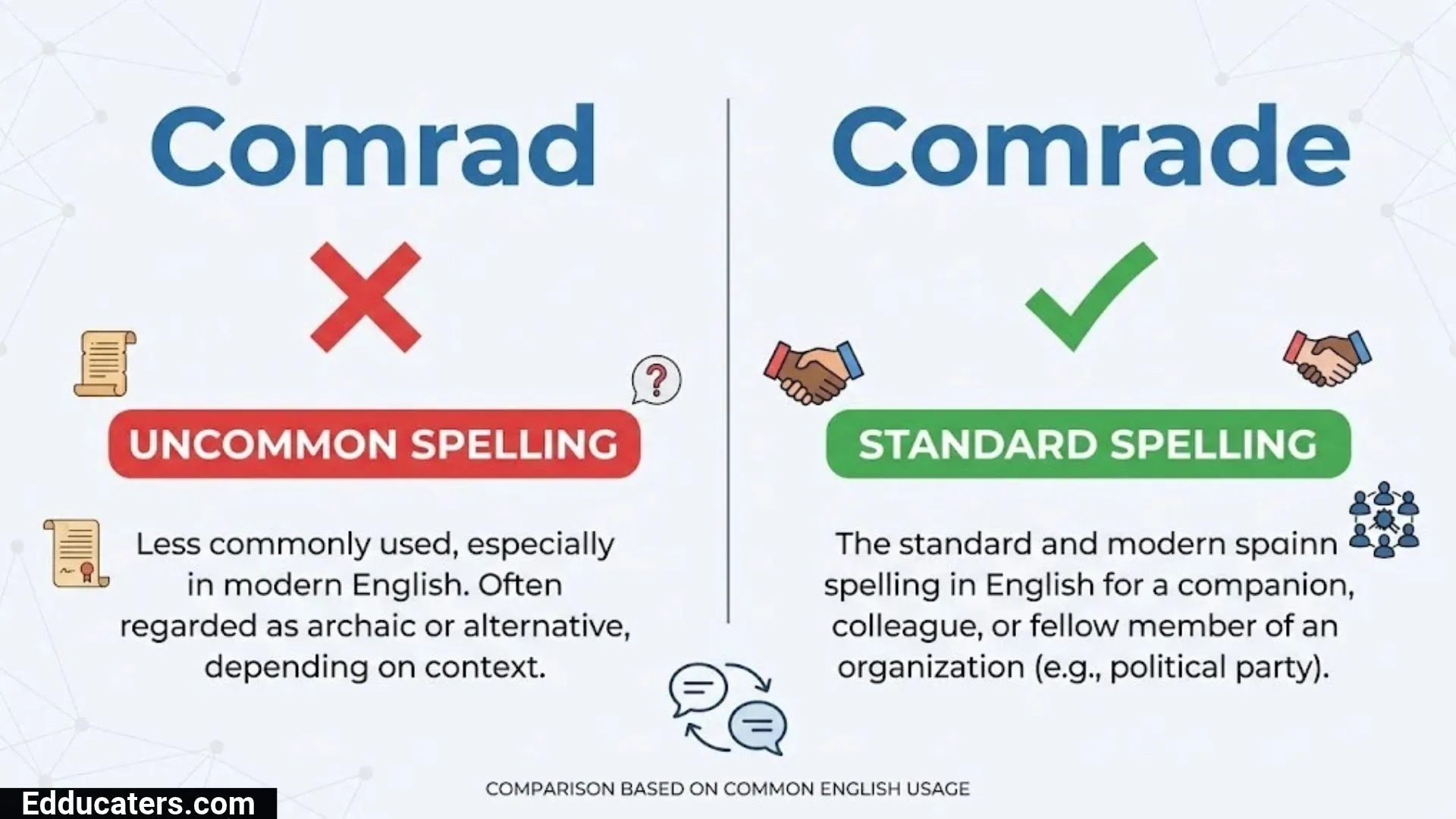
If you’ve seen the word comrade in a history book, heard it in a Russian movie, or encountered it in a political speech, you may wonder whether comrad or comrade is the correct spelling. The two forms look almost identical, but only one is the standard English spelling.
Comrade is the correct spelling. Comrad is a common misspelling because the final e is easy to overlook when pronouncing the word. A comrade is a companion, colleague, or fellow member of a group who shares a common goal, cause, or experience.
The word also has a special place in Russian language and culture, where it is associated with friendship, solidarity, and political movements. Its meaning can vary depending on the situation, so let’s look at its spelling, pronunciation, and different uses.
Comrade Meaning: What Does Comrade Mean?
A comrade is someone who shares an activity, organization, struggle, or purpose with another person. The word often suggests a sense of mutual support, loyalty, or solidarity.
For example:
- Friend or companion: She thanked her comrades for standing beside her during difficult times.
- Fellow worker: The soldiers supported their comrades during the mission.
- Political associate: The speaker addressed his fellow party members as comrades.
- Member of a shared cause: The activists worked together as comrades to protect the environment.
Although comrade can describe someone who is a friend, it doesn’t always mean a close personal friend. Two people may be comrades because they work together, serve in the same organization, or share a political belief.
The word is especially associated with military settings, socialist and communist movements, and revolutionary history. However, it can also appear in everyday conversation when people want to emphasize teamwork and shared experiences.
In modern English, the tone depends on context. Calling someone a comrade can sound warm and respectful, politically charged, humorous, or deliberately old-fashioned.
Comrade in Russian: Meaning and Translation
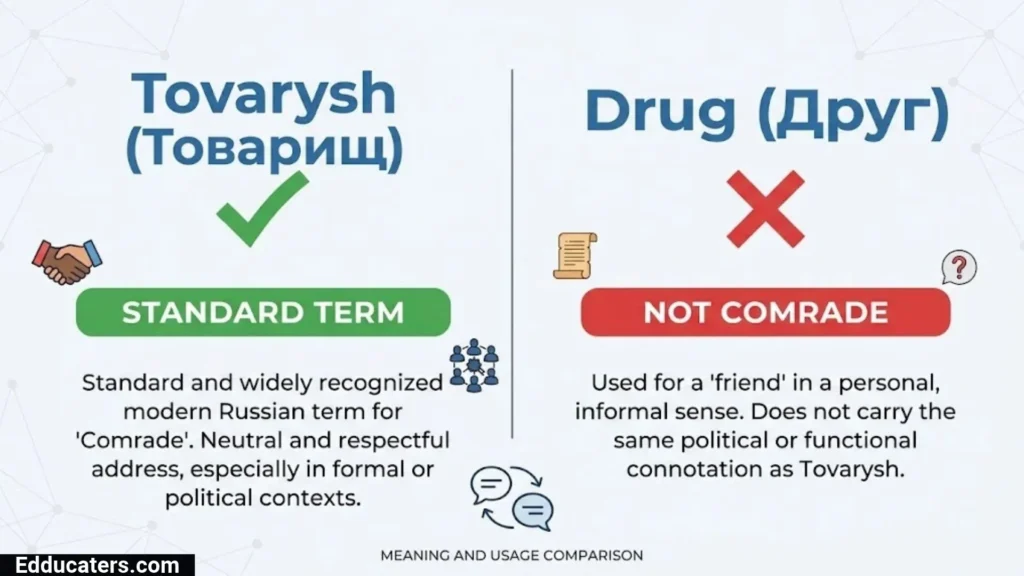
The Russian word for comrade is товарищ, transliterated as tovarishch. It can refer to a friend, companion, colleague, or fellow member of a group. Historically, it has also been used as a formal way to address people in military and socialist or communist settings.
Russian word
Товарищ
Transliteration: tovarishch
Approximate pronunciation: tuh-VAH-rishch
Examples in Russian
- Он мой товарищ. — He is my comrade or companion.
- Привет, товарищ! — Hello, comrade!
- Товарищи по работе — Work colleagues or fellow workers.
The word товарищ became particularly recognizable in the Soviet Union, where it served as a common form of address among members of the Communist Party and other people. It remains understandable today, although its tone can depend on the speaker and context.
Keep in mind that comrade is the English word, while товарищ is its common Russian equivalent. They have closely related uses, but their cultural associations are not identical in every situation.
Comrade Meaning in Love
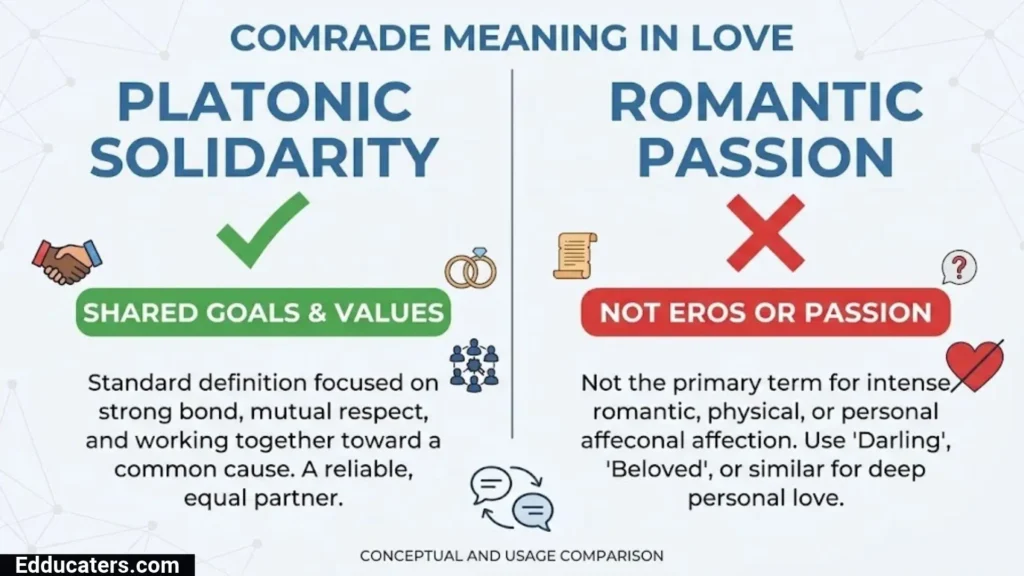
In a romantic context, comrade usually means a companion or partner who shares your journey, rather than a romantic partner by definition.
If someone calls their partner a comrade, they may be emphasizing friendship, loyalty, equality, and mutual support. The intended meaning depends on the relationship and the way the word is used.
For example:
- You are not only my lover but also my comrade. This suggests a romantic partner who also feels like a trusted teammate.
- She stood beside him as a faithful comrade. This emphasizes loyalty and support through difficult times.
- We started as comrades and eventually fell in love. This describes a relationship that developed from companionship into romance.
The word can express a meaningful connection, but it does not automatically indicate love or attraction. If someone calls you a comrade, they might mean you are a friend, ally, colleague, or fellow member of a shared cause.
In romantic writing, companion, partner, or soulmate may communicate affection more directly. Comrade is a distinctive choice when the relationship centers on shared struggles, ideals, or a strong sense of teamwork.
Comrade Pronunciation: How Do You Say It?
The pronunciation of comrade varies slightly between British English and American English. The spelling stays the same, but the vowel sounds differ.
| Variety | IPA pronunciation | Easy guide |
| British English | /ˈkɒm.reɪd/ | KOM-rayd |
| American English | /ˈkɑːm.ræd/ | KAHM-rad |
The stress falls on the first syllable in both varieties.
To pronounce the word clearly:
- Start with com, using the appropriate vowel sound for your accent.
- Move directly into the second syllable.
- Finish with a clear d sound.
In British English, the second syllable generally sounds like rayd. In American English, it usually sounds closer to rad.
The spelling can cause confusion because the final e does not have the same sound in every accent. However, this variation in pronunciation does not create a different spelling.
Comrad or Comrade Pronunciation
If you are deciding between comrad or comrade based on how the word sounds, remember that pronunciation does not determine the standard spelling.
Both spellings may appear to represent the same spoken word, especially in informal phonetic writing. However, comrade is the correct spelling in standard written English.
For example:
- Correct: The soldier helped his wounded comrade.
- Incorrect in standard English: The soldier helped his wounded comrad.
You may see comrad in casual messages, spelling mistakes, or phonetic attempts to write the word as it sounds. It is not the standard English spelling.
Is It Comrad or Comrade?
The correct form is comrade, with an e at the end.
Comrad is generally a misspelling, not a recognized British or American spelling variant. Standard English dictionaries list comrade as the noun used for a companion, fellow soldier, colleague, or political associate.
Use this quick comparison to remember the difference:
| Spelling | Status | Example |
| Comrade | Correct | He remained loyal to his comrades. |
| Comrad | Nonstandard misspelling | He remained loyal to his comrads. |
The plural of comrade is comrades, not comrads. You also use comrade in the singular when referring to one person.
Here are a few correct sentences:
- My comrade helped me finish the assignment.
- She reunited with her old comrades after many years.
- Every comrade contributed to the group’s success.
- He addressed his fellow party members as comrades.
A simple way to remember the spelling is to learn the complete word as com-rade. The final e belongs to the standard spelling even when you barely hear it in speech.
FAQs
1. What does comrade mean in simple words?
A comrade is a companion, friend, colleague, or fellow member of a group who shares an activity, experience, or common goal.
2. Is comrad a correct English word?
No. Comrad is not the standard spelling of the English noun. Use comrade in formal writing, schoolwork, professional communication, and everyday text.
3. What is comrade in Russian?
The common Russian translation is товарищ (tovarishch). Depending on context, it can mean comrade, companion, colleague, or friend.
4. How do you pronounce comrade in American English?
In American English, comrade is commonly pronounced /ˈkɑːm.ræd/, approximately KAHM-rad, with the stress on the first syllable.
5. Does comrade mean boyfriend or girlfriend?
Not necessarily. Comrade can describe a romantic partner who is also a trusted companion, but the word itself does not specifically mean boyfriend or girlfriend.
6. Why is comrade associated with Russia?
The word became strongly associated with Soviet political culture because Russian товарищ was widely used as a form of address among Communist Party members and in official or military contexts.
7. What is the plural of comrade?
The plural is comrades. For example, The soldiers supported their comrades during the battle.
8. Can you use comrade to describe a friend?
Yes. You can call a friend a comrade when you want to emphasize companionship, shared experiences, or loyalty. In ordinary conversation, friend is more common.
Conclusion
Comrade is the correct spelling, while comrad is a nonstandard misspelling. The word describes a companion, colleague, fellow soldier, or person who shares a common cause. In Russian, its common equivalent is товарищ (tovarishch).
The pronunciation differs slightly between British and American English, but the spelling remains unchanged. When writing about friendship, politics, military service, or shared struggles, use comrade and add the final e.

I’m Julian Mercer, an English language writer dedicated to helping people master grammar through practical examples and clear explanations. I enjoy teaching grammar in a way that is both engaging and easy to remember.
My work focuses on grammar rules, punctuation, word usage, and writing techniques that readers can apply in everyday life. I believe learning English should be simple, enjoyable, and useful.
Books
English Grammar in Practice
Writing with Precision
 Nathan Whitmore
 Claire Holloway