If you are wondering whether requester or requestor is the correct spelling, the answer is more nuanced than simply choosing one and calling the other wrong.
Requester and requestor are both recognized English words. Both refer to a person or entity that makes a request. However, requester is generally the better choice for ordinary English and general professional writing, while requestor is also used, especially in legal, administrative, technical, organizational, and specialized contexts.
For example:
The requester submitted the application yesterday.
This is a natural choice for general writing.
You may also see:
The requestor submitted the application yesterday.
This is also understandable and legitimate, particularly when requestor is the established terminology of a particular organization, system, policy, or document.
The important lesson is that requestor is not simply a misspelling of requester.
In this guide, you will learn what requester and requestor mean, whether they have different meanings, when to use each form, which one is better for business and academic writing, how they work in legal and technical contexts, common mistakes to avoid, and a simple decision guide for choosing the right word.
Requester or Requestor: The Quick Answer
Is the requester or requestor correct?
Both are correct.
Requester is usually the safest choice when you are writing for a general audience.
Requestor is an accepted alternative and may be preferred when it is part of established terminology.
| Word | Basic meaning | Best default |
| Requester | A person or entity that makes a request | General and professional writing |
| Requestor | A person or entity that makes a request | Specialized or established terminology |
Cambridge Dictionary defines requester as a person who asks to see or have something and lists requestor as an alternative form.
So, if you simply need to choose one form and there is no special terminology to follow, requester is the practical choice.
What is the easiest rule to remember?
Use this rule:
General writing → requester
Established specialized terminology → requestor
For example:
The requester asked for a copy of the report.
But if a company’s software consistently labels the person making a request as a requestor, it is reasonable to preserve that terminology.
The choice is therefore usually about usage, audience, and consistency, not whether one word is grammatically valid and the other is not.
What Does “Requester” Mean?
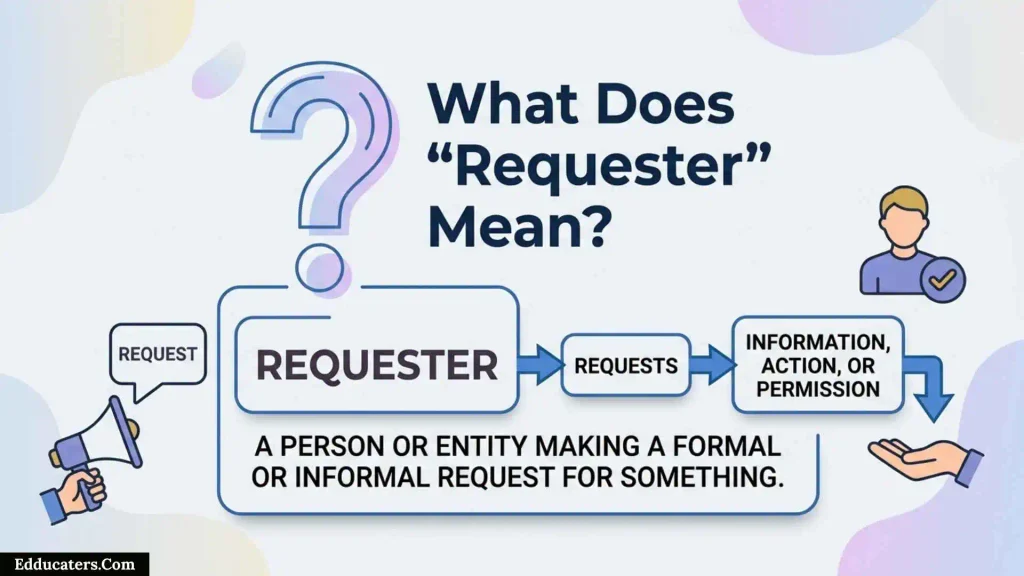
Definition of requester
A requester is a person or entity that makes a request.
The request could involve:
- information
- permission
- access
- assistance
- a document
- a service
- a refund
- a change
- an explanation
- a record
For example:
The requester asked for access to the archived records.
The word requester identifies the person who made the request.
Another example:
The support team contacted the requester for more information.
Here, the requester is the person who originally asked for assistance.
Cambridge’s definition similarly describes a requester as someone who asks to see or have something, such as an official record or document.
How requester is formed
Requester is closely connected to the verb request.
The basic idea is:
request → requester
The suffix -er commonly forms nouns referring to a person who performs an action.
For example:
teach → teacher
write → writer
drive → driver
manage → manager
request → requester
This makes the request easy for readers to understand, even when they encounter it for the first time.
What Does “Requestor” Mean?
Definition of requestor
Requestor refers to the same basic role: a person or entity that makes a request.
For example:
The requestor submitted the form online.
This means:
The person who made the request submitted the form online.
The word may appear more often in specialized terminology, depending on the field or organization.
Is requestor a misspelling?
No.
It is important not to tell readers that the requestor is always incorrect.
Cambridge Dictionary explicitly lists requestor as an alternative form of requester.
That means a sentence such as:
The requestor will receive an email.
should not automatically be corrected to:
The requester will receive an email.
The better question is:
Which form is appropriate for this particular context?
If you are writing a general article, email, or business message, requester is usually the more natural default.
If you are documenting an existing system that calls users requestors, retaining that terminology may be the better editorial decision.
Requester or Requestor: What Is the Difference?
The core meaning is the same
In ordinary usage, both words identify someone who makes a request.
Compare:
The requester submitted a request for information.
and:
The requestor submitted a request for information.
The central meaning is the same.
Neither sentence says that the person did something different merely because a different spelling was used.
The real difference is usually context
The more useful distinction is not:
requester = correct
requestor = incorrect
Instead, think:
requester = common general-purpose form
requestor = alternative form often retained in specialized terminology
This distinction matters because professional writing often has its own vocabulary.
A government agency, software platform, legal document, company policy, or technical specification may consistently use one form.
When that happens, consistency can be more important than replacing one recognized form with another.
Why requester is a good default
If your audience includes ordinary readers who are not familiar with specialized terminology, requester is usually the clearest choice.
For example:
The requester will receive a confirmation email.
The word is immediately understandable.
There is little reason to make a general audience learn a specialized-looking alternative when the requester communicates the idea clearly.
Requester or Requestor in General English
Use requester when there is no special terminology
For everyday and general professional English, requester is a strong default.
Examples include:
The requester asked for additional information.
We contacted the requester by email.
The requester submitted the form before the deadline.
Please notify the requester when the document is ready.
The requester can update the application before submitting it.
These sentences are clear and natural.
Why audience matters
Good word choice depends partly on who will read your writing.
A general website visitor may prefer familiar language.
A technical administrator may already understand terminology such as requestor ID, requestor permissions, or requestor authentication.
Neither audience is necessarily wrong. They simply have different expectations.
A useful writing principle is:
Choose terminology that is clear to the intended reader and consistent with the system you are describing.
Requester or Requestor in Business Writing
Requester is usually the better general business choice
In ordinary business communication, the requester is professional and clear.
For example:
We will contact the requester if additional documentation is required.
The requester has been notified that the application is incomplete.
Please forward the response to the requester.
The requester can review the revised proposal before approval.
There is no reason to avoid requester simply because you are writing a formal business document.
When requestor may be appropriate in business
A business may already have an internal terminology system.
For example, an employee portal might contain fields such as:
- Requestor Name
- Requestor Department
- Requestor ID
- Requestor Email
- Requestor Manager
If the actual software uses a requestor, changing the documentation to requester could make it harder for employees to match the instructions with what they see on screen.
In that situation, keeping a requestor may be the better choice.
Consistency is more important than unnecessary correction
Suppose a company policy defines the role as Requestor.
You might write:
The Requestor must submit the form through the employee portal.
It would be unhelpful to change some sections to Requester while leaving others as Requestor.
Choose the organization’s established terminology and use it consistently.
Requester or Requestor in Legal and Administrative Writing
Legal documents may use either form
Legal and administrative writing can contain either requester or requestor.
For example:
The requester submitted a public records request.
or:
The requestor submitted a public records request.
The correct editorial choice depends on the terminology used by the relevant law, agency, policy, contract, or document.
Follow a defined term
This is especially important when a document defines a term.
Suppose a policy states:
“Requestor” means an individual who submits a request under this policy.
After that definition, changing the term throughout the document to requester can create unnecessary inconsistency.
If a term has a defined meaning within a document, use the defined term consistently.
This is not because the requestor suddenly becomes more grammatically correct. It is because legal and administrative documents depend heavily on precise terminology.
Do not confuse requester with petitioner
Legal language also contains other words for people who ask for action.
For example, petitioner has a more specific legal meaning in certain contexts. Cambridge defines a petitioner, in a legal context, as someone asking a court to take action.
Therefore, these words should not automatically be treated as interchangeable:
- requester
- requestor
- petitioner
- applicant
- claimant
- complainant
The correct term depends on the person’s role and the procedure involved.
Requester or Requestor in Technical Writing
Why requestor appears in technical contexts
Technical systems often need a precise label for the party that initiates an action.
For example, documentation might refer to:
the requestor
when describing a system, user, application, or client that sends a request.
You might see phrases such as:
- requestor identity
- requestor ID
- requestor permissions
- requestor authentication
- requestor information
- requestor access
- requestor account
In such contexts, requestor may be part of the established vocabulary.
Requester is also acceptable in technical prose
Do not assume that technical writing always requires a requestor.
A technical guide can also say:
The requester must authenticate before accessing the resource.
The important factor is not whether the word looks technical. It is whether the terminology is clear and consistent with the system or standard being documented.
Follow the terminology of the product or specification
If you are writing documentation for an existing software platform, API, protocol, or enterprise system, check its official terminology.
If the product consistently uses a requestor, use requestor when referring to that specific concept.
If it uses a requester, use a requester.
This approach prevents a common technical-writing problem: using a synonym that is linguistically valid but does not match the terminology users see in the actual system.
Requester or Requestor in Academic Writing
Requester is suitable for general academic prose
If you are simply describing someone who makes a request, requester works well.
For example:
The requester received a written response from the research office.
Each requester was asked to provide additional documentation.
The researchers recorded whether the requester received a response.
The word does not make academic writing informal.
Use field-specific terminology when necessary
Academic writing sometimes discusses systems, policies, records, information requests, or institutional processes.
If the source or system being studied uses a requestor, retaining that term may be appropriate.
For example, if a research paper analyzes a database in which the user role is officially called requestor, changing every instance to requester could blur the distinction between the system’s terminology and the writer’s general language.
The key is to distinguish between general English and defined terminology.
Requester or Requestor in Forms
Both forms can appear on forms
A form may contain:
Requester Name
or:
Requestor Name
Both are understandable.
If you are creating a new form for a general audience, Requester Name is usually a straightforward choice.
If you are updating an existing form that already uses Requestor Name, consistency may be preferable.
Common labels
You may encounter:
Requester Name
Requester Email
Requester Department
Requester ID
or:
Requestor Name
Requestor Email
Requestor Department
Requestor ID
The important thing is to choose one terminology set and use it consistently.
Requester or Requestor in Emails
Use requester in ordinary business emails
For a normal email, a requester is usually the easiest choice.
For example:
We have contacted the requester and are waiting for additional information.
Another example:
Please send the completed form back to the requester.
These sentences are professional without sounding unnecessarily technical.
When requestor may be better
If you are communicating with a team that already uses requestor as an internal role name, follow the team’s terminology.
For example:
The requestor can view the ticket status in the portal.
If the portal itself uses “Requestor,” changing the word in an instruction email could make the message less consistent with the interface.
Requester or Requestor: Real-World Examples
Everyday example
Imagine someone asks a library for an old newspaper article.
The requester asked for a copy of the article.
The word simply identifies the person making the request.
Customer service example
A customer asks a company for a refund.
The requester will receive an email once the refund request has been reviewed.
Here, the requester is clear for a general audience.
Workplace example
An employee asks the IT department for access to a software application.
The requester must obtain approval from their manager.
Again, requester is a natural choice.
Government records example
A person asks an agency for access to a public record.
The requester received a response from the agency.
Depending on the agency’s terminology, a requestor may also be used.
Technical example
A client application sends a request to a server.
The requestor must provide valid credentials.
If the technical documentation uses a requestor as an established role, keeping that term makes sense.
Legal or policy example
A policy defines the person submitting a request as a “Requestor.”
The Requestor must provide the information required under this policy.
Here, the capitalized defined term should be preserved because it has a specific role within the document.
Requester or Requestor: Sample Sentences
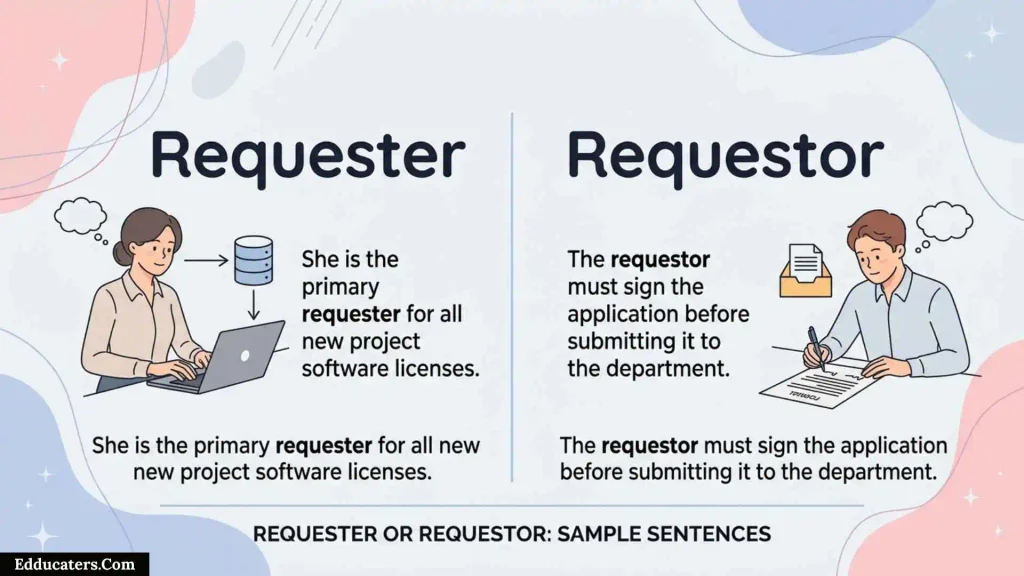
Sentences using requester
The requester submitted the application online.
Please contact the requester for clarification.
The requester received a confirmation message.
The requester asked for access to the records.
We informed the requester that the request had been approved.
The requester must provide a valid email address.
The report was sent directly to the requester.
Sentences using requestor
The requestor submitted the application online.
Please contact the requestor for clarification.
The requestor received a confirmation message.
The requestor asked for access to the records.
We informed the requestor that the request had been approved.
The requestor must provide a valid email address.
The report was sent directly to the requestor.
The parallel examples show why the question is mainly about form and context rather than a change in basic meaning.
Requester, Requestor, Applicant, and Petitioner
These terms can look similar because they all describe people involved in requests or applications, but they are not always interchangeable.
Requester
A requester makes a request.
The requester asked for a copy of the report.
Requestor
A requestor also makes a request.
The requestor asked for a copy of the report.
Applicant
An applicant applies for something.
The applicant submitted an application for the position.
An applicant may also make a request, but the two words emphasize different roles.
Petitioner
A petitioner is a person who presents or signs a petition, and the word also has a specialized legal meaning for someone asking a court to take action.
Therefore, do not replace requester with petitioner simply because both involve asking for something.
Requester or Requestor: Common Misconceptions
“Requestor is always wrong”
This is the most important misconception to avoid.
Requestor is a recognized alternative form.
If someone uses a requestor in a technical document or organizational policy, that does not automatically mean the document contains a spelling error.
“Requester is only informal”
That is also incorrect.
Requester works in professional and formal writing.
For example:
The requester must provide supporting documentation.
There is nothing grammatically informal about this sentence.
“Requestor is always more professional”
Not necessarily.
A word can look technical without being more appropriate.
For a general audience, requesters may actually be clearer because readers are more likely to recognize the relationship between request and requester immediately.
“You should use both words in the same article”
Usually, no.
If both words refer to the same role, switching between them without a reason can make your writing look inconsistent.
Choose a default and explain the alternative when necessary.
Common Mistakes to Avoid
Mistake 1: Treating requestor as a typo
Do not automatically mark the requestor as incorrect.
Instead, check the context.
If the document uses requestor as an established term, preserve it.
Mistake 2: Calling requester the only correct form
Requester is an excellent general-purpose choice, but it is misleading to say that it is the only valid form.
Both forms are recognized.
Mistake 3: Switching forms randomly
Avoid writing:
The requester submitted the request. The requestor then received an email.
If both words refer to the same person, this creates unnecessary variation.
Use one form consistently.
Mistake 4: Confusing requester with applicant
An applicant applies for something.
A requester makes a request.
The roles may overlap, but they are not automatically identical.
Mistake 5: Confusing requester with recipient
The requester is the person making the request.
The person receiving the request is not necessarily the requester.
For example:
Sarah asked David for the report.
Sarah is the requester.
David is the person receiving the request.
Mistake 6: Making the sentence unnecessarily complicated
Instead of:
The person who made the request submitted the request.
write:
The requester submitted the request.
Clear nouns can make professional writing more concise.
How to Choose Between Requester and Requestor
Step 1: Identify your audience
Ask who will read the document.
If it is intended for a broad audience, a requester is usually the safer choice.
If it is written for a specialized audience, check whether that field uses established terminology.
Step 2: Check for defined terminology
Look for terms already defined in:
- policies
- contracts
- technical documentation
- software interfaces
- government forms
- organizational procedures
- legal documents
If the document officially uses a requestor, maintain that terminology.
Step 3: Check the surrounding vocabulary
Look at related labels.
If your system says:
Requestor ID
Requestor Department
Requestor Email
then changing one label to Requester Email creates inconsistency.
Step 4: Choose the clearest form
If no established terminology exists, choose the form that is easiest for your audience.
For general readers, that will usually be requester.
Step 5: Stay consistent
Once you choose a form, use it consistently throughout the same document unless there is a specific reason to distinguish between terms.
A Practical Decision Tree
Use this quick guide whenever you are unsure.
Are you writing general English for a broad audience?
→ Yes: Use a requester.
Are you writing a normal business email or website?
→ Yes: Usually use a requester.
Does your organization officially use “requestor”?
→ Yes: Use a requestor for consistency.
Does a legal, policy, administrative, or technical document define “requestor”?
→ Yes: Follow the defined terminology.
Does a software system or specification use “requestor”?
→ Yes: Keep a requestor when describing that system.
Is there no established terminology?
→ Choose a requester.
This decision tree is more useful than memorizing that one spelling is “right” and the other is “wrong.”
How to Proofread Requester or Requestor
Check the role
First, make sure you actually need a noun for the person making the request.
For example:
The requester submitted the form.
If you mean the person who applied for something, applicant might be more precise.
Check your terminology
Search the document for both:
requester
and:
requestor
If you find both, ask whether there is a legitimate reason for using both.
If not, choose one and make the wording consistent.
Check official terminology
If the document belongs to an organization or software system, compare your wording with its official terminology.
Do not “correct” a recognized term simply because another spelling feels more familiar.
Check for unnecessary repetition
Consider:
The requester requested a request for additional information.
This is awkward.
A better sentence would be:
The requester asked for additional information.
Good proofreading checks more than spelling. It also improves clarity and removes repetitive wording.
Requester or Requestor: Singular and Plural Forms
Requester and requesters
The singular form is:
requester
The plural is:
requesters
Examples:
The requester submitted the form.
Several requesters contacted the office.
The possessive singular is:
requester’s
Example:
The requester’s application was incomplete.
The plural possessive is:
requesters’
Example:
The requesters’ applications were reviewed.
Requestor and requestors
The singular form is:
requestor
The plural is:
requestors
Examples:
The requestor submitted the form.
Several requestors contacted the office.
The singular possessive is:
requestor’s
Example:
The requestor’s information was verified.
The plural possessive is:
requestors’
Example:
The requestors’ records were reviewed.
Can Requester Refer to a Company or System?
Requester can describe an entity
In some contexts, the requester does not have to be an individual person.
A company, organization, application, or system may be described as the requester when it initiates a request.
For example:
The client application acts as the requester in this transaction.
In technical contexts, however, the exact terminology depends on the system being described.
Sometimes a document may use terms such as:
- client
- caller
- requesting application
- request initiator
- requestor
- requester
These terms are not always interchangeable, so use the terminology appropriate to the system.
When “Requesting Party” Is Better
Sometimes requesting a party is a useful alternative, especially in formal documents.
For example:
The requesting party must provide sufficient identification.
This phrase can be useful when the party may be an individual, company, organization, or other entity.
However, it is longer than the requester.
Compare:
The requester must provide identification.
with:
The requesting party must provide identification.
If there is no reason to use the longer phrase, the requester is usually more concise.
When You Should Avoid Both Words
There are situations where neither requester nor requestor is the best choice.
When a simpler sentence works
Instead of:
The requester who requested the document should contact the office.
write:
If you requested the document, please contact the office.
The second version is shorter and more direct.
When another role is more precise
Instead of:
The requester submitted an application for the position.
you may need:
The applicant submitted an application for the position.
If the person’s role is specifically that of an applicant, the applicant provides more precise information.
This is an important writing principle:
Do not choose a word merely because it matches your keyword. Choose the word that best describes the person’s role in the sentence.
Expert Tip: Match Terminology to the Reader’s Mental Model
A useful editing principle is to think about what the reader expects to see.
If you are writing a public-facing help page, the reader may simply want to know:
“What do I call the person who submitted the request?”
In that situation, the requester is easy to understand.
If you are documenting an internal ticketing system where every screen says Requestor, changing the term could make the documentation harder to follow.
This gives you a practical hierarchy:
- Follow defined terminology when one exists.
- Use the clearest general term when no terminology is defined.
- Keep the wording consistent throughout the document.
- Do not change a recognized term simply because another form is more familiar.
That framework works beyond requester and requestor. It is a useful approach whenever two valid terms compete for the same role.
Frequently Asked Questions About Requester or Requestor
Is the requester or requestor correct?
Both requester and requestor are recognized forms. Requester is generally the better default for general writing, while requestor may be used in specialized or established terminology.
Is requestor a real word?
Yes. Requestor is a recognized English form and is listed by Cambridge as an alternative to requester.
Is requester a real word?
Yes. Requester is a standard noun for someone who makes a request.
Which is better, requester or requestor?
For most general writing, requester is the safer choice. If a specific organization, policy, technical system, or document uses a requestor, follow that terminology.
Is requestor a misspelling of requester?
No. Requestor is not simply a misspelling. It is an established alternative form.
Is requester more formal than requestor?
Neither word is automatically more formal. Requestor may appear more technical in some contexts, but requester is fully suitable for professional and formal writing.
Should I use a requester in a business email?
Usually, yes. Requester is clear and professional in ordinary business communication.
Should I use a requestor in a legal document?
Use the terminology required by the specific legal document, policy, agency, or organization. If the document defines a requestor, retain that term consistently.
Is requester used in British English?
Yes. Requester is used in British English as well as American English. The choice between requester and requestor should not be treated as a simple British-versus-American spelling difference.
Is requestor used in American English?
Yes. Requestor can be found in American English, particularly in specialized, administrative, and technical contexts.
What is the plural of requester?
The plural is requesters.
What is the plural of requestor?
The plural is requestors.
What is the difference between requester and applicant?
A requester makes a request, while an applicant applies for something. The same person can sometimes be both, but the terms describe different roles.
What is the difference between requester and petitioner?
A requester makes a request. A petitioner can be someone who presents or signs a petition and, in specialized legal usage, someone asking a court to take action.
What is the difference between requester and recipient?
The requester makes the request. The recipient receives something, such as a message, document, or response. They may be different people.
Can a requester refer to a company?
Yes. Depending on the context, a requester can describe an organization or other entity that makes a request.
Can a requestor refer to a system?
Yes. In technical contexts, requestor can be used for a system, application, or other entity that initiates a request when that terminology is appropriate.
Which word should I use on a website?
For a general audience, requester is usually the clearest choice. If the website documents a specific system that officially uses a requestor, retain that terminology.
Which word should I use on a form?
If you are creating a new form for a broad audience, Requester is a straightforward label. If the form belongs to an existing system that uses Requestor, maintain the existing terminology.
Can requester be used in academic writing?
Yes. Requester is appropriate in academic writing when you need to describe someone who makes a request. Use specialized terminology when a particular field or system requires it.
Is the requestor more professional?
Not automatically. Professionalism comes from accuracy, clarity, consistency, and appropriate terminology, not from choosing the spelling that looks more technical.
Should I use requester and requestor in the same document?
Usually, no, if they refer to the same role. Choose one form and use it consistently unless there is a specific contextual reason to distinguish them.
How can I remember which one to use?
Remember:
General audience → requester
Established terminology → requestor
If you have no special terminology to follow, requester is the simplest default.
Key Takeaways
- Requester and requestor are both recognized English forms.
- Both generally mean a person or entity that makes a request.
- Requester is usually the safest choice for general English.
- Requestor is also legitimate and may be preferred in specialized contexts.
- Do not automatically mark the requestor as a spelling mistake.
- Business, academic, and general professional writing can use requesters naturally.
- Legal, administrative, and technical documents may use either form depending on established terminology.
- If an organization or software system officially uses a requestor, follow that terminology.
- Avoid switching randomly between requester and requestor.
- Requester is not the same as applicant, petitioner, recipient, or customer in every context.
- Choose terminology based on the person’s actual role.
- When no special terminology exists, requester is the best general-purpose choice.
Conclusion
The question of requester or requestor is not really a battle between a correct spelling and an incorrect one.
Both forms are recognized. The main difference is how they are used and which terminology fits the situation.
For general English, websites, ordinary business communication, and writing aimed at a broad audience, requester is usually the clearest and safest choice.
For a technical system, legal document, administrative process, company policy, or established organizational vocabulary, requestor may be the appropriate form if that is the terminology already in use.
The best approach is therefore simple:
Use requester when you need a general-purpose term. Use requestor when a specific context or established terminology calls for it.
Most importantly, do not “correct” requestor automatically. Check the context first. Good writing is not only about choosing a dictionary-approved word; it is also about choosing the term that gives the reader the clearest and most consistent understanding.

Hi, I’m Nathan Whitmore, and I enjoy making English grammar easy for learners of all ages. I believe grammar should be practical, not confusing. I write simple, well-researched guides that help readers improve their writing, speaking, and overall communication skills.
I spend a lot of time studying grammar patterns, sentence construction, punctuation, and modern English usage. My goal is to create lessons that anyone can understand, whether they are students, teachers, or professionals.
Books
Clear English Grammar
The Smart Writer’s Grammar Handbook
 Julian Mercer
 Claire Holloway