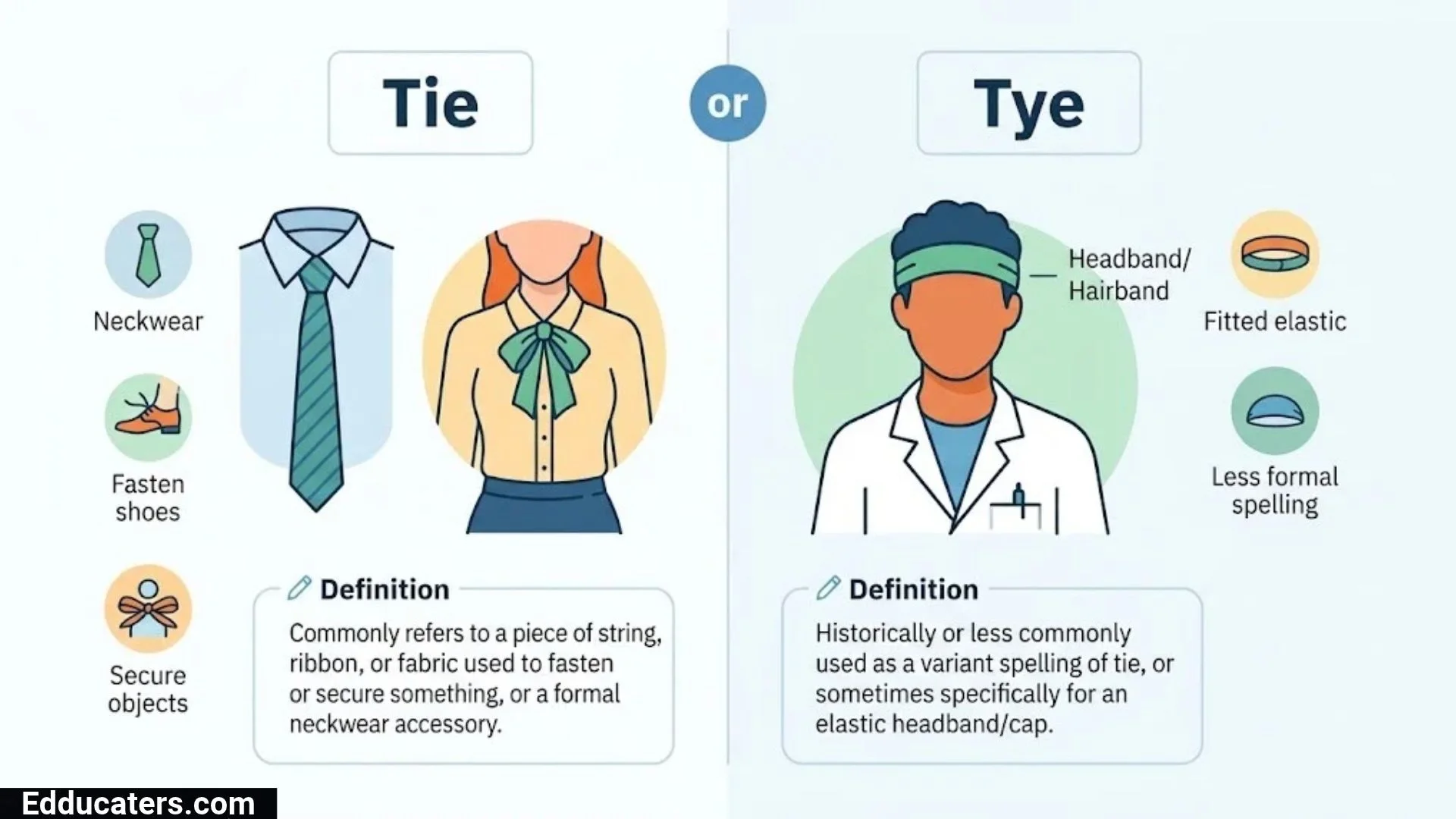
If you’re unsure whether to write tie or tye, the right choice depends on the context. In modern English, tie is the standard spelling for the familiar word that means to fasten something, a piece of neckwear, an equal score, or a connection between people. However, tye isn’t simply a meaningless string of letters. It appears in historical English word forms and can also be used as a surname or proper name.
The important distinction is between a spelling’s historical existence and its place in modern writing. You might encounter tye in an old text or someone’s name, but you should normally write tie in an email, school assignment, article, or business document.
This guide explains the tie or tye spelling, the meaning of each form, their historical background, and the situations in which each may appear. You’ll also find practical examples, common mistakes, and simple ways to remember the correct spelling.
Tie or Tye: What Is the Difference?
The main difference is that tie is the standard modern English spelling, while tye is a historical spelling form or a proper name in particular contexts. The two forms shouldn’t be treated as interchangeable in ordinary writing.
The word tie has several everyday meanings. You can tie your shoes, wear a tie with a suit, finish a game in a tie, or describe a close connection as a family tie. The spelling remains the same across these uses.
By contrast, you shouldn’t write tye when you mean a necktie or the action of fastening something. Unless you’re reproducing a historical spelling or using a person’s actual name, choose tie.
| Feature | Tie | Tye |
| Standard spelling in modern English | Yes | No, not for ordinary uses of the word |
| British English | Correct | Not the standard spelling |
| American English | Correct | Not the standard spelling |
| Clothing accessory | Yes | No, not in standard modern usage |
| Verb meaning “to fasten” | Yes | No, not in standard modern usage |
| Equal score in a competition | Yes | No, not in standard modern usage |
| Historical English texts | Common modern form; related older forms exist | May appear as a historical spelling form |
| Surname or proper name | Possible | Possible |
Quick answer: Write tie for the ordinary modern English word. Preserve Tye when it is someone’s actual name or when a historical source specifically uses that spelling.
What Does Tie Mean?
The word tie works as both a noun and a verb. Its meaning depends on the sentence, but the central ideas often involve fastening, connection, or equality.
The Cambridge Dictionary entry for tie lists meanings related to fastening, neckwear, relationships, and equal results. These uses explain why the word appears in so many different contexts.
Tie as a Clothing Accessory
A tie is a piece of fabric worn around the neck, usually under a shirt collar and fastened in a knot at the front. People often wear one with a suit or other formal clothing.
For example:
- He wore a blue tie to his job interview.
- She bought a silk tie as a birthday gift.
- The invitation requested black-tie attire.
- His striped necktie matched his shirt.
A necktie is only one kind of tie. Other familiar expressions include bow tie, silk tie, and black tie. In the phrase black tie, the words can refer to a formal dress code rather than just the accessory itself.
The spelling doesn’t change with the material, color, or occasion. Whether you’re describing a red tie for a wedding or a black tie for a formal event, tie is correct.
Tie as a Verb Meaning to Fasten
As a verb, to tie means to fasten something by forming a knot or using a cord, string, ribbon, or similar material. It can also describe securing something so it stays in place.
Consider these examples:
- Please tie your shoes before you start running.
- She used a ribbon to tie the gift box.
- He learned how to tie a simple knot.
- They tied the boat securely to the dock.
- I tie my hair back when I exercise.
Notice how the spelling changes with tense and grammatical form:
| Form | Example |
| Tie | Tie the package securely. |
| Ties | She ties her hair back. |
| Tied | He tied the rope to the post. |
| Tying | They are tying the ribbon into a bow. |
The spelling rule for tying deserves special attention. When you add -ing to tie, you remove the final e and write tying, not tieing or tyeing.
This pattern also appears in words such as lie becoming lying and die becoming dying. Learning the word forms helps you avoid spelling errors beyond the original tie or tye question.
Tie as an Equal Result in Sports
A tie occurs when two or more competitors finish with the same score or achieve an equal result. The word appears in sports, quizzes, elections, competitions, and other situations where results can match.
For example:
- The football match ended in a tie.
- Both teams scored two goals, resulting in a tie.
- The students tied for first place in the spelling competition.
- The two candidates finished in a tie after the vote count.
In American English, tie is a common term for an equal score. In some sports and other English-speaking contexts, especially British usage, draw may be more familiar. The preferred term depends on the sport and the rules involved.
For instance, a soccer match may be described as a draw in many contexts, while American sports commonly use tie for an equal result. The terms overlap, but their use isn’t identical in every sport.
Regardless of which term a commentator chooses, the spelling of tie doesn’t change. Writing tye for an equal score is not standard modern English.
Tie as a Connection or Relationship
The word tie can also describe a connection between people, groups, places, ideas, or events. In this sense, it doesn’t refer to a physical object or a knot.
Common expressions include:
- Family ties: connections among family members.
- Business ties: professional or financial relationships.
- Diplomatic ties: relationships between governments or countries.
- Historical ties: connections that developed through past events.
- A close tie: a strong relationship or link between people or things.
For example, “The two countries have strong economic ties” describes a relationship between them. Similarly, “She maintains close family ties despite living abroad” refers to personal connections rather than a piece of clothing.
These meanings show why understanding the sentence matters. The word tie can describe something you wear, an action you perform, a result in a competition, or an abstract connection.
In all these ordinary meanings, tie remains the correct spelling.
Is Tye a Word?
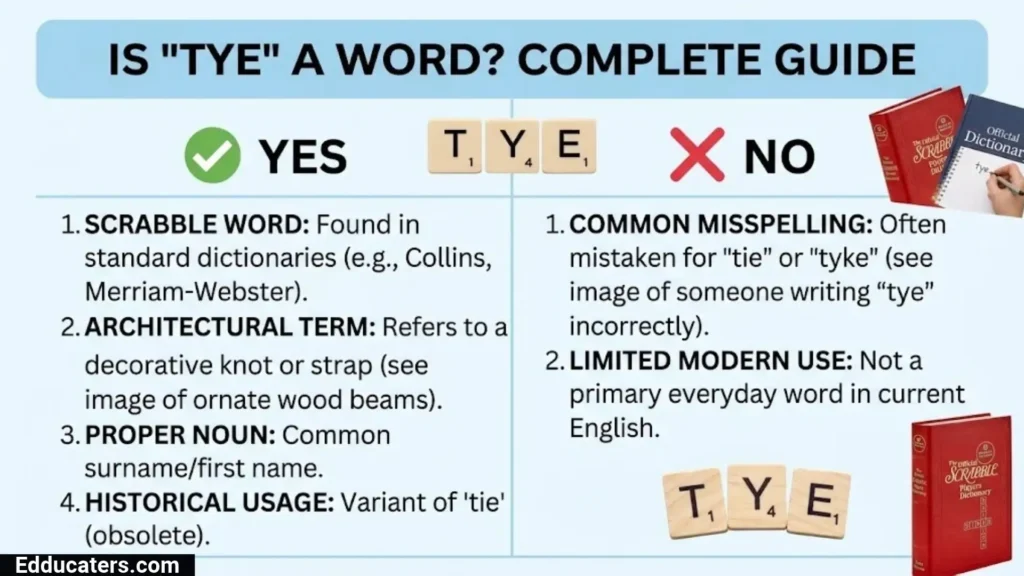
Yes, Tye can be a name, and tye also appears in historical English word forms. However, that doesn’t make it the standard modern spelling of the everyday word tie.
This distinction matters because people often ask whether a spelling is either completely correct or completely wrong. Language doesn’t always work that way. A form may be documented historically or used as a proper name without being appropriate as the standard spelling in a modern sentence.
For example:
- Standard modern usage: “He wore a navy-blue tie.”
- Standard modern usage: “Please tie the two pieces of string together.”
- Proper name: “Tye sent the completed document.”
- Historical quotation: A source may preserve an older spelling that differs from today’s standard form.
In the third example, Tye is correct if that is the person’s actual name. Changing it to Tie could introduce an error in the person’s identity.
The key question isn’t simply whether the letters tye have ever appeared in English. It’s whether you’re using them as a historical form, a proper name, or the ordinary word used in modern writing.
Is Tye an Old English Spelling of Tie?
The history requires a little care. It would be inaccurate to say that tye has never existed as an English spelling form.
Merriam-Webster’s entry for tie traces the noun through Middle English forms, including teg and tye, to Old English tēag. The entry also connects the word’s history with Old Norse taug and Old English tēon, meaning “to pull.”
That historical information shows why tye may appear in discussions of the word’s origin. However, it doesn’t mean modern writers should use tye as an alternative spelling in everyday English.
Historical spelling often differs from present-day spelling. English developed over many centuries, and written forms changed as pronunciation, scribal habits, printing, and spelling conventions evolved. A form documented in an earlier period may be unsuitable in contemporary formal writing.
It’s also important to distinguish Old English from Middle English. Old English refers to the earliest stage of the English language, used before the Norman Conquest and continuing for several centuries. Middle English developed afterward and included substantial changes in vocabulary, spelling, and grammar.
If a historical text uses tye, check the text’s date and source before deciding what the spelling tells you. Don’t assume every old-looking form belongs to Old English specifically.
Is Tye an Outdated Spelling?
For the everyday modern word, tye is not the standard spelling. However, calling it simply an “outdated spelling” can oversimplify its history.
A spelling may survive in an old document, a family name, a place name, or a quoted passage. In those situations, the form may be appropriate within its context. That doesn’t make it interchangeable with tie in standard contemporary writing.
Think of historical spelling like an old map. The map may accurately show how a place was named at a particular time, but that doesn’t mean you should automatically use the old name in every modern document.
Use tie when writing the current everyday word. Preserve tye when the historical source or proper name requires it.
Is Tye a Surname?
Yes. Tye can be a surname or given name, so it may appear in records, correspondence, publications, and other contexts involving people.
Names don’t always follow the spelling conventions of common words. For example, someone named Tye may use that spelling throughout their life, even though the ordinary word for a necktie is spelled tie.
Compare these sentences:
- “The speaker wore a red tie.”
- “Tye delivered the presentation.”
- “The report quoted a historical document that used the spelling tye.”
Each example uses the letters for a different reason. The first uses the standard common noun. The second uses a proper name. The third discusses a spelling found in a source.
When writing a person’s name, follow the person’s established spelling rather than correcting it to match a common word.
Tie or Tye in British English or American English
There is no standard British-versus-American spelling difference here. Both British English and American English use tie for the ordinary noun and verb.
Some English words have distinct regional spellings. For example, British English generally uses colour, while American English uses color. The difference between tie or tye doesn’t follow that pattern.
| Context | British English | American English |
| Neckwear | Tie | Tie |
| Fastening something | Tie | Tie |
| Equal result in a competition | Tie, or draw in common contexts | Tie |
| Relationship or connection | Tie | Tie |
| Present participle | Tying | Tying |
| Past tense | Tied | Tied |
British and American dictionaries both recognize the familiar spelling tie. The Cambridge Dictionary includes British and American usage, with meanings for fastening, clothing, relationships, and equal results.
The term draw is worth noting because it can be more common than tie in certain British sports contexts. That difference concerns vocabulary choice, not the spelling of tie itself.
If you’re writing for a British audience, an American audience, or an international audience, you can confidently use tie in the ordinary meanings covered here.
Why Do People Confuse Tie or Tye?
The confusion is understandable. Both forms look plausible to someone who isn’t sure of the standard spelling, and both can be pronounced the same way when tye appears as a name or historical form.
Several factors can contribute to the mistake.
- Sound-based spelling: English spelling doesn’t always match pronunciation in an obvious way. A reader may guess a spelling based on the sound alone.
- Historical references: Someone may encounter tye in an old text and assume it remains a normal modern alternative.
- Proper names: A person may see Tye as a surname and mistakenly treat it as a general spelling variant.
- Typing mistakes: Fast typing can produce an incorrect letter even when the writer knows the correct form.
- Uncertainty about regional spelling: Readers know that British and American English sometimes differ, so they may wonder whether tye belongs to one variety.
The best way to resolve the confusion is to check the word’s role in the sentence. If you’re talking about clothing, fastening, an equal result, or a relationship, choose tie. If you’re writing a person’s name or reproducing a historical source, verify the specific context.
Don’t rely on pronunciation alone. In this case, the ordinary word’s standard spelling is straightforward: tie.
How to Use Tie Correctly in a Sentence
Examples make the difference easier to remember because they show the word in natural contexts. The following sentences cover the most common meanings of tie.
| Example sentence | Meaning |
| He wore a blue tie to the interview. | Clothing accessory |
| Please tie your shoes before leaving. | Fasten with a knot |
| She tied the ribbon around the box. | Past-tense verb |
| The teams finished in a tie. | Equal result |
| The two countries have strong economic ties. | Relationships or connections |
| I’m tying the package with string. | Present participle |
| The dress ties at the waist. | Fastening or closure |
| They tied for second place. | Equal ranking |
More Examples of Tie in Everyday English
Here are some additional examples that show how the word works in different situations:
- Clothing: “His black tie completed the formal outfit.”
- Sports: “The match ended in a tie after both teams scored once.”
- Fastening: “Tie the bag tightly so nothing falls out.”
- Relationships: “Their shared history created a lasting tie.”
- Business: “The company has close ties with local suppliers.”
- Competition: “The contestants tied for the highest score.”
Notice that the same spelling works across these examples. The sentence changes the meaning, not the spelling.
If you catch yourself typing tye, pause and ask what you mean. In ordinary modern writing, one quick correction will usually solve the problem.
Tie or Tye in Formal, Academic, and Professional Writing
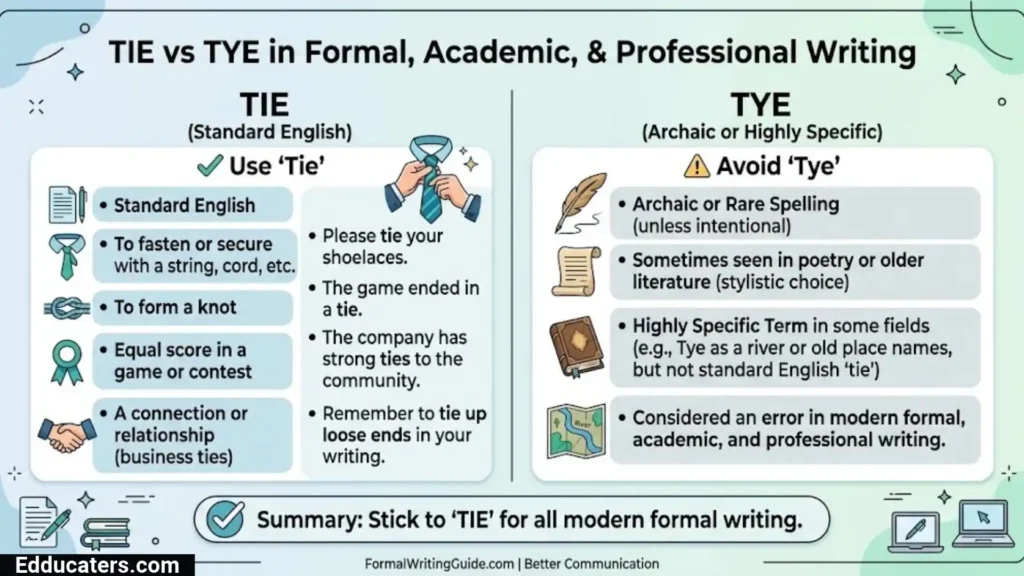
The correct choice matters in school assignments, work documents, formal correspondence, and published material. Standard spelling helps readers understand your meaning without being distracted by avoidable errors.
Academic Writing and Exams
Use tie in essays, research assignments, school tests, and English-language exams when the ordinary word is intended.
For example:
- “The two teams finished in a tie.”
- “The researcher examined the ties between income and education.”
- “Participants were asked to tie the labels to the correct categories.”
If you’re preparing for IELTS, TOEFL, or another English test, learn the standard spelling and its common word forms. Don’t use tye simply because it looks like a possible spelling.
If an assignment asks you to analyze an older English text, however, preserve the spelling in the original quotation. You can explain the historical form in your discussion without adopting it in your own modern prose.
Professional Emails and Business Documents
In a professional email, use tie for the ordinary noun or verb:
- “Please tie the documents together before sending them.”
- “The two departments have close working ties.”
- “The result was a tie between the finalists.”
If a colleague, client, or manager is named Tye, use the correct name. A person’s name is not a spelling mistake simply because it resembles another word.
The same rule applies to reports, presentations, contracts, and business records. Use the standard word where appropriate and preserve verified proper names.
Everyday Writing and Social Media
Text messages, social media captions, blogs, and casual posts still use the standard spelling tie when referring to the ordinary word.
For example, “Finally learned how to tie a bow tie!” is correct. So is “The game ended in a tie.” Informal writing may relax some conventions, but it doesn’t make tye the standard spelling for these meanings.
If you’re quoting an old text or discussing a person’s name, Tye may be necessary. Otherwise, stick with tie.
Common Mistakes to Avoid When Choosing Tie or Tye
Most mistakes happen when writers assume that a plausible-looking spelling must be correct. A quick review of the sentence can help you choose the right form.
Using Tye for a Necktie
Incorrect: “He bought a silk tye for the wedding.”
Correct: “He bought a silk tie for the wedding.”
The standard spelling doesn’t change according to the fabric, color, or occasion. Use tie for a necktie, bow tie, or any other ordinary clothing accessory described by this word.
Writing Tye Instead of the Verb Tie
Incorrect: “Please tye the rope to the post.”
Correct: “Please tie the rope to the post.”
The verb follows the same spelling as the noun. Whether you’re tying a rope, fastening a package, or securing your shoes, write tie.
Assuming British English Uses Tye
Incorrect assumption: “Tye is British English, while tie is American English.”
Correct explanation: Tie is the standard spelling in both British English and American English.
Some regional spelling differences are real, but this isn’t one of them. Don’t apply a British-versus-American rule where no such distinction exists.
Calling Every Use of Tye Incorrect
A different mistake is to assume that tye can never be legitimate. Historical sources document older forms, and Tye can be a proper name.
For example, if an archive contains a historical spelling, reproducing it accurately may be necessary. Likewise, changing a person’s surname from Tye to Tie would be incorrect if the original name is genuinely spelled Tye.
The solution is to consider the context rather than applying a blanket rule.
How to Remember the Correct Spelling of Tie
A simple memory trick can help you avoid the mistake:
A necktie is a tie, and you tie your shoes.
Both common meanings use the same spelling. You don’t need a separate rule for clothing, fastening, sports, or relationships.
Remember these three points:
- Tie is the standard spelling for the ordinary modern English word.
- Tying, tied, or ties are common grammatical forms.
- Tye may appear in historical material or as a proper name, but it isn’t the standard replacement for tie.
Quick Practice Quiz
Choose the correct word for each sentence.
Question 1: She wore a red ___ to the ceremony.
- A. Tye
- B. Tie
Correct answer: B. Tie is the standard spelling for the clothing accessory.
Question 2: Please ___ the package before putting it in the car.
- A. Tie
- B. Tye
Correct answer: A. Tie is the verb meaning to fasten or secure something.
Question 3: The two teams finished with the same score, resulting in a ___.
- A. Tie
- B. Tye
Correct answer: A. Tie describes an equal result in a competition.
Question 4: A historical document spells the word tye. Should you silently change the spelling in a direct quotation?
Correct answer: No. Preserve the original wording when quoting a source accurately. If needed, explain the historical spelling separately.
Question 5: Your colleague’s surname is Tye. Should you change it to Tie in an email?
Correct answer: No. Use the person’s verified name.
If you answered these questions correctly, you’ve learned the essential distinction: choose tie for the ordinary modern word and preserve Tye when the context genuinely requires it.
Frequently Asked Questions About Tie or Tye
Is Tie or Tye the Correct Spelling?
Tie is the correct standard spelling for the ordinary modern English word. It can refer to a neckwear accessory, the act of fastening something, an equal score, or a connection between people or things. Tye may appear in historical contexts or as a proper name.
Is Tye a Correct Word?
Tye does occur in English historical word forms and can be used as a proper name. However, it isn’t the standard modern spelling for the everyday word tie. Check the context before deciding whether the spelling is appropriate.
Is Tye an Old English Spelling of Tie?
Historical dictionaries document older forms related to the modern word. Merriam-Webster traces tie through Middle English forms that include tye to Old English tēag. That evidence doesn’t mean tye is a standard spelling for modern everyday writing. You should also distinguish Old English forms from Middle English forms when discussing the word’s history.
Is Tie Spelled the Same Way in British and American English?
Yes. Tie is the standard spelling in both varieties. British and American English may differ in vocabulary or in the preferred term for certain sports results, but tye isn’t the standard British spelling of tie.
What Does Tie Mean?
The word has several common meanings. It can describe a necktie, the act of fastening something, an equal result in a competition, or a relationship between people, organizations, or places. The surrounding sentence tells you which meaning applies.
Can I Use Tye in Modern English?
You can use Tye when it is the correct spelling of a person’s name or when a specific source requires that form. You shouldn’t use tye as a routine alternative to tie in modern writing.
Is Tye a Surname?
Yes. Tye can be a surname or another proper name. Always check the established spelling of the person or place you’re referring to. Proper names don’t need to match the spelling of similar common words.
How Do You Spell a Necktie?
The correct spelling is necktie. It combines neck and tie. You can also use tie by itself when the meaning is clear, as in “He wore a tie to work.”
Why Do People Confuse Tie or Tye?
The spellings look similar, and readers may encounter Tye as a name or in a historical source. Some writers also guess spellings from pronunciation or mistakenly assume that British and American English use different forms. Remembering that tie is the standard spelling in both varieties resolves the usual confusion.
Should I Use Tie or Tye in Academic Writing?
Use tie when you mean the ordinary word. This applies to essays, reports, research papers, and English-language exams. If you’re quoting a historical source, preserve its original spelling when accuracy requires it.
Does Tie Mean a Draw in Sports?
Yes. A tie can describe a competition in which two or more participants finish with equal scores or results. The word draw is also used, particularly in some sports and English-speaking contexts. The preferred term depends on the sport and its conventions.
Conclusion: Tie or Tye?
When choosing between tie or tye, use tie for the standard modern English word. It is the correct spelling whether you’re talking about a necktie, fastening your shoes, describing an equal score, or discussing a relationship.
The spelling is the same in British English and American English. You should also use the correct grammatical forms, including ties, tied, or tying.
Tye has a more specific role. It appears in historical English word forms and may be used as a surname or proper name. Those contexts don’t make it a standard alternative for the everyday word.
The easiest rule is simple: write tie in ordinary modern English, and use Tye only when the historical source or proper name calls for it. That distinction will help you write clearly in emails, academic assignments, professional documents, and everyday messages.

Hi, I’m Nathan Whitmore, and I enjoy making English grammar easy for learners of all ages. I believe grammar should be practical, not confusing. I write simple, well-researched guides that help readers improve their writing, speaking, and overall communication skills.
I spend a lot of time studying grammar patterns, sentence construction, punctuation, and modern English usage. My goal is to create lessons that anyone can understand, whether they are students, teachers, or professionals.
Books
Clear English Grammar
The Smart Writer’s Grammar Handbook
 Claire Holloway
 Julian Mercer