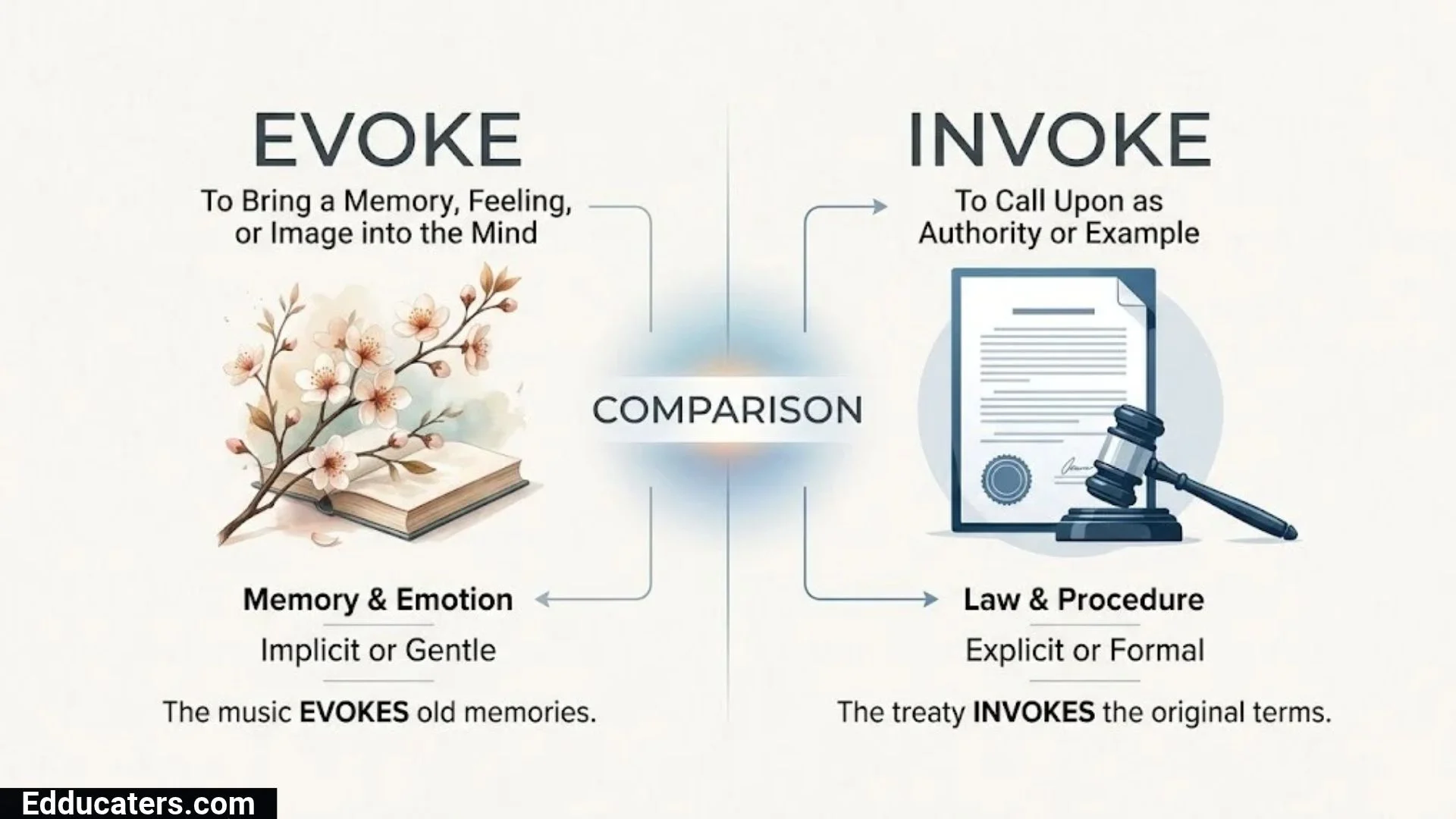
Have you ever wondered whether a song invokes memories or evokes them? These two words look similar, sound somewhat alike, and sometimes appear in contexts involving feelings, reactions, or ideas. However, choosing the right word depends on what you want to say.
The difference between evoke or invoke becomes easier to understand when you focus on their main meanings. Invoke means to call upon something, cite it, or put it into effect. Evoke means to bring something to mind or elicit a feeling, image, memory, or reaction.
For example, a lawyer might invoke a legal right, while a familiar song might evoke childhood memories. A programmer can invoke a function, while a painting can evoke a feeling of peace.
Although the verbs share some similarities, they aren’t interchangeable in most situations. Let’s explore their definitions, common expressions, sentence examples, and practical differences so you can choose the right word with confidence.
Evoke or Invoke: What’s the Difference?
The main difference lies in what the verb describes. Invoke usually involves calling upon, citing, or activating something. Evoke usually describes bringing something into someone’s mind or producing a mental or emotional response.
Consider these examples:
- Invoke: The attorney invoked the client’s right to remain silent.
- Evoke: The old photograph evoked memories of the family’s summer vacations.
In the first sentence, the attorney formally relies on a legal right. In the second, the photograph brings past experiences to mind.
Neither word is more correct than the other in general. The intended meaning determines which verb fits the sentence.
Invoke vs. Evoke at a Glance
| Feature | Invoke | Evoke |
| Main meaning | Call upon, cite, or activate | Bring to mind or elicit |
| Typical object | A law, right, rule, principle, or function | A memory, feeling, image, or reaction |
| Common context | Legal, formal, religious, technical | Emotional, descriptive, artistic, psychological |
| Typical example | Invoke a legal right | Evoke nostalgia |
| Action or effect | Calls upon something or puts a process into effect | Produces a mental association or response |
| Memory aid | Call upon | Bring to mind |
Here’s a simple way to remember the distinction:
- Invoke = call upon something.
- Evoke = bring something to mind.
For example, a public official might invoke an emergency procedure. A photograph of an old neighborhood might evoke a sense of nostalgia.
The first action refers to a formal process. The second describes the memories or feelings the photograph brings back.
What Does Invoke Mean?
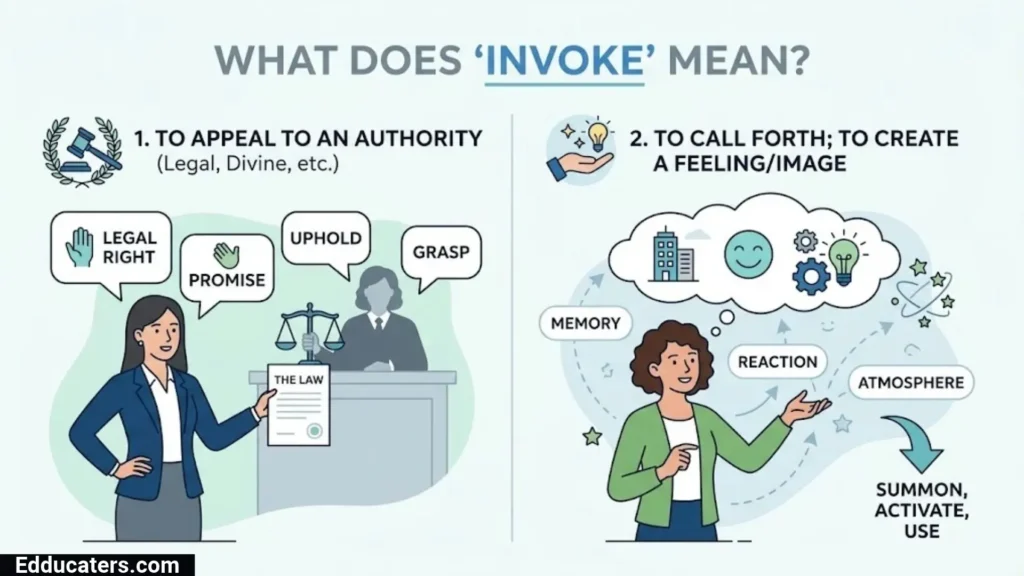
Invoke is a verb that means to call upon something, refer to it as support, or put a particular power, rule, or process into effect.
People use the word when they rely on an established authority, appeal to a principle, or initiate a defined action. It often appears in formal writing, legal discussions, religious contexts, and computing.
According to the intended context, invoke can carry several related meanings:
- To cite or rely on a law, right, rule, or principle.
- To call upon a person, power, deity, or source of assistance.
- To activate or initiate a formal process.
- To call a function or method in a computer program.
For example:
The employee invoked the company’s appeal procedure after the manager rejected the complaint.
Here, invoked means the employee formally used an established procedure.
Similarly, a programmer might invoke a function to perform a particular operation. In both cases, the verb describes calling upon something for a specific purpose.
Invoke Meaning in Different Contexts
The word’s meaning becomes clearer when you examine how people use it in different situations.
Invoke a Law or Legal Right
In legal terminology, invoke means to cite, rely on, or call upon a law or legal right in a relevant situation.
A person might invoke a constitutional right when responding to a legal question. An attorney might invoke a relevant law to support a client’s position. A party in a dispute might invoke a contractual provision to explain its obligations.
Examples:
- The defendant invoked the right to remain silent.
- The attorney invoked a relevant law during the hearing.
- The employee invoked the protections outlined in the applicable policy.
In each example, the person relies on an established legal protection or rule.
However, invoking a right doesn’t automatically guarantee a particular outcome. The right’s scope and application depend on the relevant law and circumstances.
Invoke Authority, Rules, and Principles
People also invoke authority or established principles to support a decision or argument.
For example, a manager might invoke company policy when explaining why a request cannot be approved. A judge might invoke a legal principle when discussing how a rule applies to a case.
Common expressions include:
- Invoke authority: Appeal to a recognized source of authority.
- Invoke a rule: Cite or rely on a specific rule.
- Invoke a principle: Use an established idea to support an argument.
- Invoke a policy: Call upon a policy as the basis for an action.
- Invoke emergency powers: Activate or exercise special powers when legally authorized.
Consider this sentence:
The committee invoked the principle of equal treatment when reviewing the applications.
The committee relied on a guiding principle to explain its decision. It didn’t create a feeling of equality; it appealed to an established standard.
Invoke Divine Protection or Religious Power
In religious and spiritual contexts, invoke can mean calling upon a deity, spiritual power, or source of protection.
For example:
- The community invoked divine protection during the ceremony.
- The prayer invoked the name of a deity.
- The ritual called upon a spiritual power for guidance.
In these examples, the verb describes an appeal for help, guidance, or protection. The wording reflects the beliefs and traditions of the people involved.
This use differs from evoke. A religious painting might evoke a feeling of peace, while a prayer might invoke divine protection.
Invoke a Function in Programming
In computing and programming, invoke means to call a function, method, or procedure so that the program can execute the associated instructions.
For example:
The application invokes a function to calculate the final price.
The function performs a task when the program calls it. Depending on the programming language, this might involve passing arguments, receiving a return value, or triggering another operation.
Compare these expressions:
- Invoke a function to calculate a total.
- Invoke a method to update an object.
- Invoke a procedure to perform a defined operation.
In everyday language, people might say that a program calls a function. In technical writing, function invocation is another common term for this action.
The important distinction is that invoke doesn’t mean bringing a memory or feeling to mind in this context. It refers to program execution.
Invoke in a Sentence: Examples
Here are additional examples showing how to use invoke naturally.
| Sentence | Meaning of Invoke |
| The lawyer invoked the client’s constitutional rights. | Relied on legal protections |
| The manager invoked company policy to explain the decision. | Cited an established rule |
| The committee invoked the principle of fairness. | Appealed to a guiding principle |
| The organization invoked its emergency procedures. | Activated a formal process |
| The villagers invoked divine protection during the ceremony. | Called upon spiritual protection |
| The developer invoked a function to validate the input. | Called a function for execution |
Notice the common pattern: someone calls upon, cites, or activates something for a particular purpose.
That pattern is a useful clue when deciding whether invoke fits your sentence.
What Does Evoke Mean?
Evoke is a verb that means to bring something to mind or cause someone to experience a feeling, emotion, or mental image. It often describes how an experience, object, sound, smell, or piece of art affects someone’s thoughts or feelings.
For example, the smell of freshly baked bread might evoke memories of visiting your grandparents. A familiar song might evoke nostalgia, while a moving film might evoke sadness.
In these examples, the object or experience creates a connection with something in the person’s mind. That connection might involve an old memory, a strong emotion, or an image of something familiar.
Common expressions include:
- Evoke a memory: Bring a past experience to mind.
- Evoke emotions: Cause someone to experience feelings.
- Evoke nostalgia: Bring back warm or sentimental feelings about the past.
- Evoke sympathy: Inspire concern for another person’s situation.
- Evoke laughter: Make people laugh.
- Evoke an image: Cause someone to picture something mentally.
- Evoke a response: Prompt a reaction or answer.
Unlike invoke, which often involves calling upon something, evoke focuses on what comes to mind or what response arises.
Evoke Meaning in Different Contexts
The verb evoke appears in everyday conversation, literature, art, advertising, and discussions of human experience. Understanding these contexts helps you use it naturally.
Evoke Memories and Nostalgia
A smell, sound, photograph, or familiar place can evoke memories because it reminds someone of an earlier experience.
For example:
The smell of cinnamon rolls evoked memories of Sunday mornings at her grandmother’s house.
The smell acts as a reminder of the past. It brings a particular experience to mind, perhaps along with the emotions associated with it.
Common expressions include:
- Evoke childhood memories.
- Evoke memories of family holidays.
- Evoke memories of school.
- Evoke a sense of nostalgia.
- Evoke memories of a familiar place.
Nostalgia refers to a sentimental feeling about the past. A childhood photograph might evoke nostalgia because it reminds someone of people, places, or experiences they miss.
However, evoke doesn’t always imply happy memories. An old song can evoke sadness, regret, or a painful experience just as easily as it can evoke happiness.
Evoke Emotions and Feelings
Writers, filmmakers, musicians, and speakers often try to evoke emotions in their audiences. They use words, sounds, images, and stories to create an emotional response.
For example:
The final scene of the movie evoked deep sadness among the audience.
The scene prompted an emotional reaction. It didn’t formally call upon sadness or activate a rule.
Other examples include:
- The speech evoked feelings of hope.
- The painting evoked a sense of peace.
- The abandoned house evoked feelings of unease.
- The documentary evoked sympathy for the families affected by the disaster.
- The reunion evoked happiness and relief.
These examples demonstrate that evoke feelings works with both positive and negative emotions. The word describes the response rather than judging whether that response is pleasant.
Evoke Sympathy and Compassion
When a story evokes sympathy, it causes readers or listeners to feel concern for another person’s situation.
For example:
The article about displaced families evoked sympathy among readers.
The article encouraged readers to feel for the people described in it.
Compassion goes a step further by emphasizing concern for suffering and a desire to help. A personal account of hardship might evoke compassion and motivate people to offer support.
These expressions are especially common in discussions of storytelling, public speaking, journalism, and persuasive writing.
Evoke an Image or Atmosphere
The word evoke also describes mental imagery and atmosphere. A writer doesn’t always need to describe every detail directly. Carefully chosen words can help readers picture a scene or sense its mood.
Consider this example:
The novelist’s description of the quiet village evoked an image of narrow streets and warm lights.
The description helped readers form a mental picture.
Similarly:
- The soft lighting evoked an atmosphere of calm.
- The poem evoked images of a stormy coastline.
- The music evoked a feeling of mystery.
- The description evoked the atmosphere of a crowded marketplace.
In creative writing, this use of evoke is valuable because it emphasizes the impression a description creates in the reader’s mind.
Evoke a Reaction or Response
Something can evoke a response when it prompts a reaction from an individual or group.
For example:
The announcement evoked a strong reaction from employees.
The announcement caused people to respond emotionally or verbally. The exact reaction might involve excitement, concern, anger, or relief.
Other examples include:
- The comedian’s final joke evoked laughter.
- The proposal evoked mixed reactions from the committee.
- The speech evoked an enthusiastic response from the audience.
- The question evoked an unexpected answer.
The important point is that evoke describes the response something produces. It doesn’t necessarily mean the person deliberately called upon a formal process.
Evoke in a Sentence: Examples
Use these examples to see how evoke works with different nouns.
| Sentence | What Evoke Means |
| The old song evoked childhood memories. | Brought memories to mind |
| The photograph evoked nostalgia. | Brought back sentimental feelings |
| The film evoked sadness. | Caused an emotional response |
| Her story evoked sympathy from the audience. | Inspired concern |
| The painting evoked an image of a peaceful valley. | Created a mental picture |
| The comedian’s performance evoked laughter. | Made people laugh |
A useful pattern is evoke + memory, emotion, image, or response. When you want to describe what an experience brings to mind or causes someone to feel, evoke is often the right choice.
Invoke or Evoke Emotion?
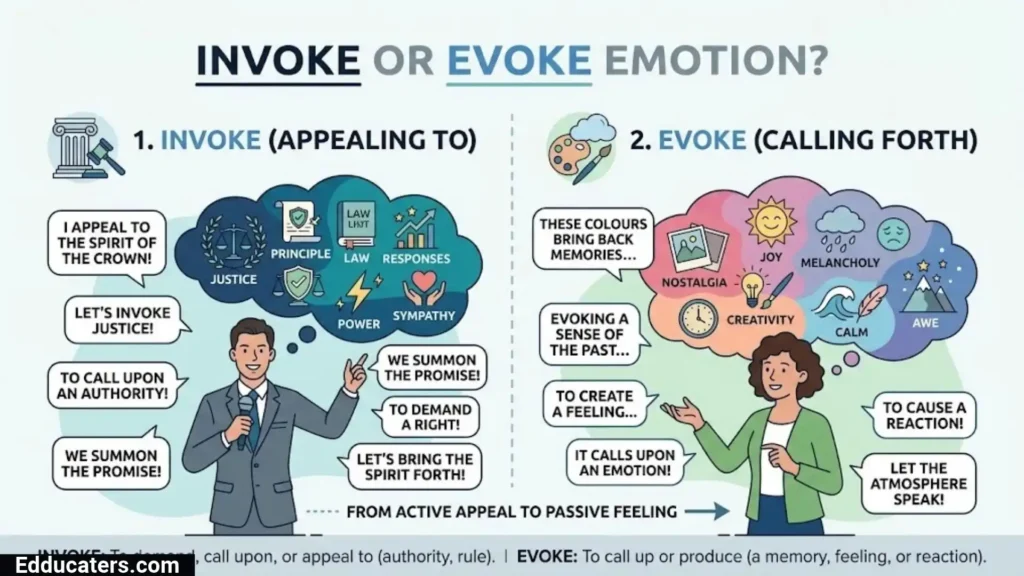
If you’re deciding between invoke emotion and evoke emotion, evoke emotion is usually the more natural expression when you mean that something causes people to feel an emotion.
For example:
- The film evoked strong emotions in the audience.
- The speech evoked sympathy for the victims.
- The song evoked feelings of nostalgia.
In each sentence, the subject produces an emotional response.
However, invoke emotion isn’t automatically wrong. It can work when someone deliberately calls upon an emotion as part of an appeal, argument, or rhetorical strategy. Still, alternatives such as appeal to emotion or evoke emotion may communicate the intended meaning more clearly.
Invoke Emotion or Evoke Emotion Examples
Compare these sentences:
Evoke emotion: The documentary evoked fear by showing the possible consequences of a natural disaster.
This sentence emphasizes the emotional effect of the documentary.
Invoke emotion: The speaker invoked the audience’s sense of duty to encourage them to volunteer.
Here, invoked means the speaker appealed to an existing feeling or principle to support a purpose. Depending on the intended meaning, appealed to the audience’s sense of duty may sound more natural.
The distinction isn’t simply about whether a feeling is positive or negative. Instead, ask whether the sentence describes a feeling arising or someone deliberately calling upon an emotion or principle.
Invoke or Evoke Feelings, Memories, and Responses?
Some of the most common word-choice questions involve feelings, memories, and responses. Both verbs can appear in discussions of human reactions, but they emphasize different things.
Invoke or Evoke Feelings?
Use evoke feelings when something brings about an emotional experience.
For example:
- The poem evoked feelings of loneliness.
- The familiar melody evoked happiness.
- The photograph evoked a sense of peace.
- The unsettling scene evoked feelings of unease.
These sentences describe emotions that arise in response to an experience.
By contrast, invoke may fit when a person deliberately appeals to an existing feeling or uses it to support an argument. For example, a campaign might invoke a sense of national pride to encourage participation.
If you simply want to say that a song makes someone feel happy, however, the song evokes happiness is the clearer choice.
Invoke or Evoke a Memory?
The natural expression is usually evoke a memory when something brings a past experience to mind.
Consider these examples:
- The old photograph evoked a memory of her first school.
- The smell of fresh grass evoked memories of childhood summers.
- The familiar street evoked memories of family holidays.
The photograph, smell, or street acts as a reminder. It brings an earlier experience into the person’s awareness.
You might also say that something triggers a memory, brings back a memory, or reminds someone of the past. These alternatives often sound more conversational.
Although invoke a memory can appear in specialized or figurative contexts, it’s not the usual choice for ordinary recollection. If your meaning is that something reminds a person of an earlier event, use evoke.
Invoke or Evoke a Response?
Both phrases can be grammatical, but they don’t always express the same idea.
Evoke a response usually means to prompt a reaction or answer.
For example:
The manager’s announcement evoked a strong response from the staff.
The announcement caused employees to react.
Invoke a response can work when the intended meaning involves calling upon or formally eliciting a response. However, elicit a response or prompt a response is often more natural when you mean that a question, message, or action causes someone to answer.
Compare these examples:
| Expression | Example | Meaning |
| Evoke a response | The speech evoked an emotional response. | Produced a reaction |
| Prompt a response | The email prompted a reply. | Encouraged an answer |
| Elicit a response | The question elicited an honest answer. | Drew out a response |
| Invoke a procedure | The manager invoked the formal response procedure. | Called upon an established process |
The last example illustrates a key distinction. The manager invokes the procedure, not necessarily the emotional response itself.
Invoke Change or Evoke Change?
Neither invoke change nor evoke change is usually the clearest choice when you mean to make something different.
Instead, choose a verb that expresses the specific action you have in mind:
- Bring about change: Cause a change to happen.
- Introduce change: Begin a new practice or system.
- Drive change: Actively push for progress or reform.
- Implement changes: Put planned changes into practice.
- Prompt change: Encourage a change to occur.
For example:
The organization implemented changes to improve its customer service.
This sentence clearly describes putting changes into practice.
However, invoke can be appropriate when a person activates a formal rule or procedure that leads to a change. Likewise, evoke can describe feelings or reactions associated with change.
For example:
- The board invoked its emergency powers to address the crisis.
- The documentary evoked strong feelings about social change.
The first sentence describes the use of authority. The second describes an emotional response.
Evoke or Invoke Examples: Side-by-Side Comparison
Sometimes the easiest way to understand a word is to compare it with another word in similar situations. The following examples show how context determines whether invoke or evoke fits best.
| Context | Correct Expression | Why It Fits |
| A lawyer relies on a legal protection | Invoke a right | The lawyer calls upon a legal entitlement. |
| A song brings back old memories | Evoke memories | The song brings past experiences to mind. |
| A company activates an established policy | Invoke a policy | The company puts a formal rule into use. |
| A painting creates a peaceful impression | Evoke a feeling of peace | The painting produces an emotional impression. |
| A programmer calls a function | Invoke a function | The program calls the function for execution. |
| A story makes readers feel sad | Evoke sadness | The story produces an emotional response. |
| A leader appeals to fairness | Invoke a principle | The leader refers to a guiding standard. |
| A photograph reminds someone of a vacation | Evoke a memory | The photograph prompts recollection. |
Notice that the correct word depends on the action being described, not simply on the noun that follows it.
For example, a speech can invoke a principle of fairness when the speaker appeals to that principle. The same speech can evoke sympathy when listeners feel concern for someone.
Both verbs can appear in discussions about speeches, but they communicate different ideas.
Are Invoke or Evoke Synonyms?
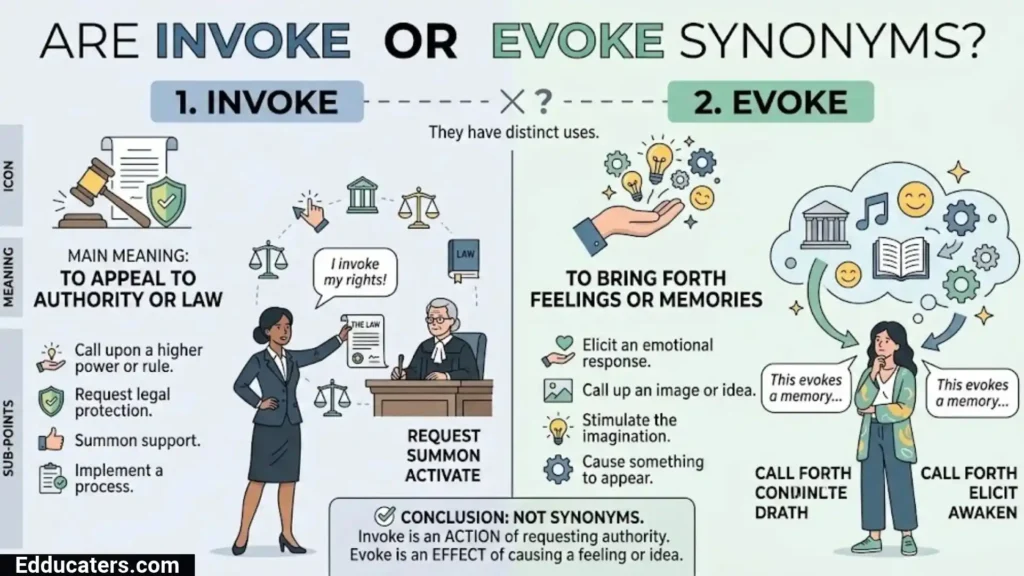
Invoke or evoke are related words, but they aren’t interchangeable synonyms. Both can describe bringing something into play or causing a response. However, they usually emphasize different actions.
Invoke commonly involves calling upon something, citing an authority, or activating a process. Evoke commonly involves bringing something to mind or eliciting a feeling or reaction. Standard dictionary definitions reflect this distinction.
For example:
- The attorney invoked the relevant law.
- The painting evoked memories of childhood.
Replacing invoked with evoked in the first sentence would change the intended meaning. Likewise, replacing evoked with invoked in the second sentence would sound unnatural if the goal is to describe ordinary memory recall.
Synonyms for Invoke
The best synonym depends on what you’re trying to express.
| Synonym | Meaning | Example |
| Call upon | Request help or assistance | The villagers called upon their leader for help. |
| Appeal to | Ask for support or refer to a principle | The lawyer appealed to a constitutional right. |
| Cite | Refer to a source or authority | The report cited the relevant regulation. |
| Activate | Make something operational | The team activated the emergency system. |
| Implement | Put a plan or rule into practice | The company implemented a new procedure. |
| Summon | Call someone or something to appear | The manager summoned the committee. |
| Call | Request the execution of a function in programming | The program called the function. |
These words overlap with invoke in certain situations, but none works in every context.
For example, cite a law and invoke a law can be similar when someone refers to legal authority. However, activate a function isn’t always the most natural alternative to invoke a function in technical writing.
Synonyms for Evoke
Choose an alternative based on whether you’re describing a memory, emotion, image, or reaction.
| Synonym | Meaning | Example |
| Bring to mind | Make someone remember or imagine something | The smell brought childhood summers to mind. |
| Elicit | Draw out a response or feeling | The question elicited an honest answer. |
| Arouse | Cause a feeling or reaction to arise | The story aroused curiosity. |
| Stir | Awaken or intensify a feeling | The song stirred deep emotions. |
| Trigger | Cause a response or memory to begin | The photograph triggered a memory. |
| Conjure up | Create a mental image or impression | The description conjured up an image of the coast. |
| Prompt | Encourage or cause a response | The announcement prompted questions. |
| Inspire | Encourage a feeling, idea, or action | Her story inspired hope. |
These alternatives can make your writing more precise. For instance, bring to mind often sounds conversational, while elicit may suit formal writing about a response.
Common Mistakes When Using Invoke or Evoke
Even experienced English speakers sometimes confuse these verbs. Their similar spelling makes them easy to mix up, especially when a sentence involves feelings or reactions.
Here are the mistakes worth avoiding.
Using Invoke for Ordinary Memory Recall
Incorrect for the intended meaning: The smell of fresh bread invoked memories of childhood.
Better: The smell of fresh bread evoked memories of childhood.
The second sentence clearly describes a smell bringing past experiences to mind. You could also say that the smell brought back childhood memories.
Using Evoke for a Formal Legal Right
Incorrect for the intended meaning: The defendant evoked the right to remain silent.
Better: The defendant invoked the right to remain silent.
The defendant is calling upon a legal protection rather than bringing a memory or image to mind.
Assuming Evoke Only Describes Positive Feelings
Evoke can describe pleasant, unpleasant, or mixed emotional reactions.
For example:
- The music evoked happiness.
- The abandoned building evoked fear.
- The news evoked sadness.
- The photograph evoked bittersweet memories.
The word describes the response, not whether that response feels good or bad.
Assuming Invoke Is Only Used in Legal Writing
Although invoke frequently appears in legal contexts, its meaning extends beyond the law.
You can invoke a religious power, invoke a principle, invoke a formal procedure, or invoke a programming function. The common idea is calling upon something or putting it into use.
Assuming Both Words Mean Exactly the Same Thing
The verbs may overlap in broad discussions of causes and reactions. However, their usual meanings remain distinct.
Compare:
- The speaker invoked the principle of fairness.
- The speaker’s story evoked sympathy.
The first sentence refers to an idea the speaker calls upon. The second describes the feeling the story produces.
Quick tip: Before choosing a verb, ask yourself whether someone is calling upon something or whether something is bringing a thought or feeling to mind.
How to Remember the Difference Between Invoke or Evoke
You don’t need to memorize a long definition to choose the right word. A short memory aid can help you make the distinction quickly.
Invoke = Call Upon
Think of laws, rights, rules, authority, religious protection, and programming functions.
Example: The lawyer invoked the client’s legal rights.
Evoke = Bring to Mind
Think of memories, emotions, mental images, nostalgia, and reactions.
Example: The photograph evoked memories of childhood.
You can also use a quick substitution test.
If call upon fits the sentence, invoke may be appropriate. If bring to mind or elicit fits better, evoke may be the right choice.
For example:
- The organization called upon its emergency powers. → Invoke
- The song brought to mind old memories. → Evoke
This test isn’t a strict grammar rule, but it works well for many everyday sentences.
Practice: Choose Invoke or Evoke
Test your understanding with these three examples.
1. The familiar melody ___ memories of summer vacations.
invoke
evoke
2. The attorney decided to ___ the client’s legal rights.
invoke
evoke
3. The painting ___ a feeling of calm and peace.
invoke
evoke
Try Again
The more you practice with complete sentences, the easier the distinction becomes. Pay attention to the action or effect that the sentence describes rather than relying on the words’ similar appearance.
Frequently Asked Questions
What Is the Difference Between Invoke or Evoke?
Invoke means to call upon, cite, or activate something, such as a law, right, rule, or function. Evoke means to bring something to mind or elicit a feeling, image, memory, or response.
For example, a lawyer invokes a right, while a song evokes a memory.
Is Invoke or Evoke Correct?
Both words are correct English verbs. The right choice depends on your intended meaning.
Use invoke when calling upon an authority, principle, or process. Use evoke when describing something that brings a memory, feeling, image, or reaction to mind.
Is It Invoke Emotion or Evoke Emotion?
Evoke emotion is generally the more natural expression when you mean that something causes an emotional response.
For example, The film evoked strong emotions in the audience.
Invoke emotion can also work in contexts where someone deliberately appeals to an emotion as part of an argument or rhetorical strategy.
Can You Invoke a Memory?
You can encounter invoke a memory in specialized or figurative writing, but it’s not the usual expression for ordinary recollection.
In most everyday contexts, use evoke a memory or bring back a memory.
For example, The old photograph evoked memories of her childhood.
What Does It Mean to Invoke a Law?
To invoke a law means to cite or rely on it as the basis for an action, argument, or claim.
For example, an attorney might invoke a relevant law to support a client’s position. The exact legal effect depends on the applicable law and circumstances.
What Does It Mean to Evoke a Response?
To evoke a response means to prompt a reaction or answer.
For example, The announcement evoked a strong response from employees.
Depending on the context, elicit a response or prompt a response may be more natural alternatives.
What Does It Mean to Invoke a Function?
In programming, to invoke a function means to call it so the program can execute its instructions.
For example, an application might invoke a function to validate a form or calculate a total.
Are Invoke or Evoke Interchangeable?
No. Although both words can appear in contexts involving reactions or effects, they usually express different meanings.
You invoke a legal right because you’re calling upon a protection. You evoke a memory because something brings an experience to mind.
Does Evoke Mean to Cause an Emotion?
Yes. One meaning of evoke is to cause someone to experience a feeling or emotion.
For example, a moving speech can evoke sympathy, while an unsettling scene can evoke fear. The word can describe positive, negative, or mixed emotional responses.
Conclusion: Evoke or Invoke?
The difference between evoke or invoke comes down to what you’re describing.
Invoke means to call upon something, cite an authority, or activate a process. You might invoke a law, invoke a principle, invoke religious protection, or invoke a function in a computer program.
Evoke means to bring something to mind or elicit a feeling, image, memory, or reaction. You might evoke nostalgia, evoke sympathy, evoke laughter, or evoke childhood memories.
When you’re unsure, remember this simple distinction: invoke means call upon; evoke means bring to mind.
Choose the word that matches your intended meaning, and your writing will sound clearer and more natural.

Hello, I’m Claire Holloway. I have always been passionate about the English language and enjoy turning complex grammar rules into simple, easy-to-follow lessons. I believe that every learner can become a confident English writer with the right guidance.
I create educational content focused on grammar, vocabulary, sentence structure, and writing improvement. Every article I publish is designed to help readers learn with confidence and accuracy.
Books
Grammar Without Confusion
Modern English Usage Guide
 Nathan Whitmore
 Julian Mercer