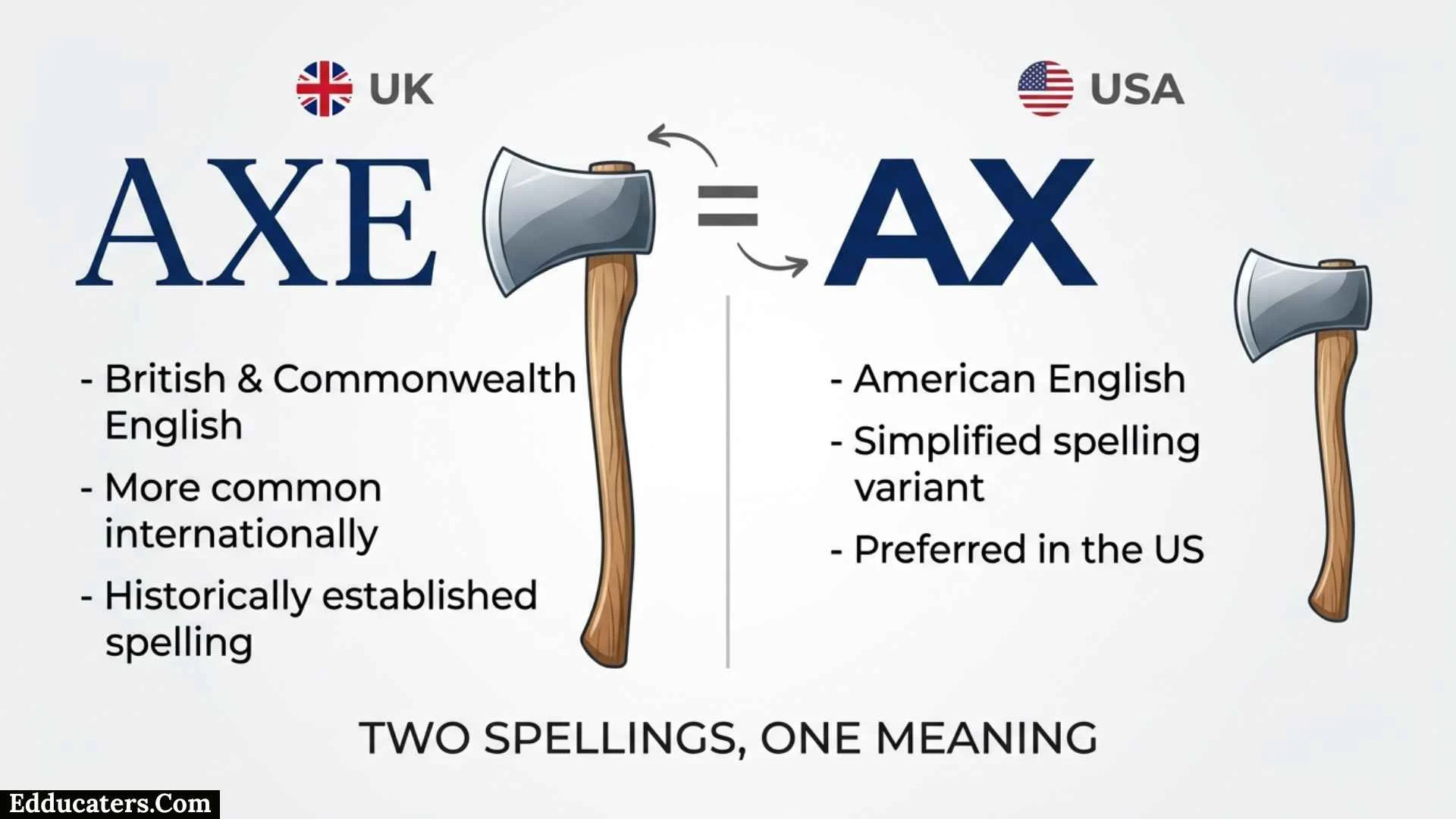
If you are unsure whether axe or ax is the correct spelling, the short answer is simple: both are correct. They describe the same cutting tool, have the same pronunciation, and can also be used as verbs.
The real difference is mostly a matter of spelling preference, regional usage, and style. Axe is the more common form overall, while ax is particularly familiar in American English. Oxford lists axe as the British English form and ax as the usual US English form. Merriam-Webster also confirms that both spellings are correct.
That can make the choice confusing, especially when you are writing for an international audience. This guide explains what each spelling means, where each form is commonly used, how the words work as nouns and verbs, which form you should choose in different situations, and why both spellings exist.
Quick Answer: Axe or Ax?
Axe and ax are both standard English spellings for the same tool.
| Point | Axe | Ax |
| Meaning | Cutting tool with a heavy blade | Same tool |
| Pronunciation | /æks/ | /æks/ |
| British English | Common | Less common |
| American English | Used | Common |
| Verb | Yes | Yes |
| Correct spelling | Yes | Yes |
| Meaning difference | None | None |
If you are following British English, axe is the natural choice. If you are following American English, ax is a common choice. However, American English also accepts axe, so neither form should automatically be treated as a mistake.
What Does Axe Mean?
Axe is a noun for a tool with a heavy metal blade attached to a handle. It is mainly used for cutting, chopping, or splitting wood and for cutting down trees.
For example:
The woodcutter carried an axe into the forest.
The word can describe different kinds of cutting tools, including a traditional chopping axe, a felling axe, a splitting axe, and specialized tools such as an ice axe. Oxford defines the noun as a tool with a wooden handle and a heavy metal blade used for cutting wood or trees.
Axe as a Noun
As a noun, axe names the physical tool.
Examples:
- The carpenter sharpened his axe before cutting the timber.
- There was an old axe hanging inside the shed.
- The logger carried a heavy axe through the woods.
- She bought an axe for splitting firewood.
The word can also appear in figurative expressions. One familiar example is have an axe to grind, which describes having a private reason or personal interest behind an argument or criticism.
Axe as a Verb
Axe can also function as a verb.
In its literal sense, it can mean to cut, chop, or sever something with an axe. In informal usage, it can also mean to remove, cancel, dismiss, or eliminate something.
For example:
The company axed the expensive project.
Here, axed does not mean that someone physically used a cutting tool. It means the company removed or cancelled the project.
Oxford records this figurative use in British English, especially in contexts involving services, projects, jobs, or spending.
What Does Ax Mean?
Ax has the same basic meaning as axe. It refers to the same type of cutting tool and can also be used as a verb.
Oxford’s American English dictionary lists ax as the main form and notes axe as an alternative.
For example:
He picked up an ax to split the logs.
The spelling may look different, but the pronunciation and meaning remain the same.
Ax as a Noun
When used as a noun, ax refers to the physical tool.
Examples include:
- The farmer kept an ax in the barn.
- He used an ax to split the firewood.
- The old ax had a worn wooden handle.
- The worker carried an ax into the forest.
Merriam-Webster defines ax as a variant spelling of axe and gives the same basic definition for the cutting tool.
Ax as a Verb
Ax can also be used as a verb.
In American English, it can describe cutting something with an ax or removing something abruptly.
For example:
The company decided to ax the unprofitable service.
Oxford’s American English entry specifically records ax as a verb meaning to get rid of a service or system, reduce spending significantly, or remove someone from a job.
What is the Difference Between Axe or Ax?
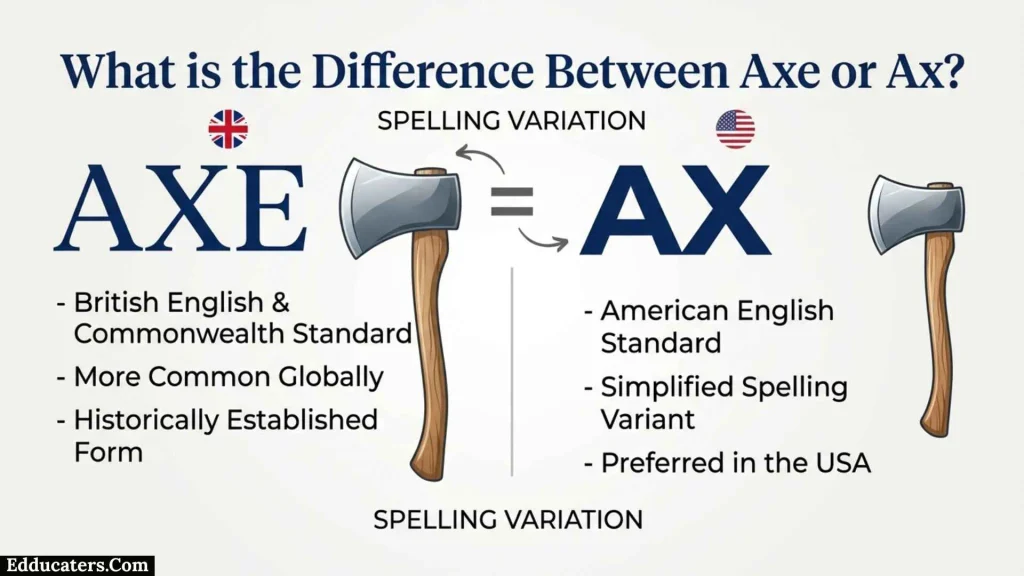
The important point is that there is no difference in basic meaning.
Both spellings refer to the same tool. Both can also have the same figurative meanings. The main difference is the spelling convention a writer chooses.
A useful way to think about the choice is:
British English → axe is the usual form
American English → ax is a common form
However, this is not an absolute divide. Merriam-Webster notes that axe is actually more common overall, including in the United States, despite the common assumption that American English always prefers ax.
That makes this spelling pair slightly different from familiar British-American pairs such as colour and color.
Is Axe More Common Than Ax?
Yes. According to Merriam-Webster, axe has been the dominant spelling overall, even though ax has had periods of stronger use, particularly in the United States.
This matters when you are writing for a broad audience. If you want a spelling that is immediately recognizable to readers across different varieties of English, axe is a strong choice.
That does not make ax incorrect. It simply means that the longer spelling has wider overall usage.
Are Axe and Ax Pronounced the Same?
Yes. Both forms are pronounced /æks/.
The final e in the axe does not create a different pronunciation. This is one reason the two spellings can seem interchangeable to learners.
The difference is visible in writing rather than audible in normal speech. Oxford gives the same pronunciation for its entries covering the two forms.
When Should You Use an Axe?
Use axe when your writing follows British English conventions or when you want the spelling that is broadly familiar internationally.
It is especially appropriate for:
- British websites
- UK educational content
- British newspapers
- International English content
- General writing where consistency matters
For example:
The gardener used an axe to remove the damaged branch.
If the rest of your article follows British spelling, using an axe helps keep the writing consistent.
Axe in British English
Oxford identifies axe as the British English spelling, while its American dictionary uses ax as the main US form. Cambridge likewise gives axe as the British form and notes ax for US English.
So a British reader is likely to encounter:
He bought a new axe.
rather than:
He bought a new ax.
The second version is understandable, but the first better matches ordinary British spelling conventions.
When Should You Use an Ax?
Use ax when you are deliberately following American English spelling or a particular publication’s style.
For example:
The lumberjack carried an ax into the forest.
This spelling is entirely legitimate. It is not a typo, abbreviation, or informal mistake.
Oxford’s American dictionary lists ax as the American form and gives axe as an alternative.
Ax in American English
American English has a long history of using ax. Noah Webster famously preferred the shorter spelling in his 1828 dictionary, while Samuel Johnson’s earlier dictionary included axe. Merriam-Webster explains that the shorter spelling had periods of increased use but that axe eventually remained more common overall.
This history explains why the shorter form is strongly established in American English without being the only acceptable choice.
Axe or Ax in Professional Writing
Professional writers should focus less on deciding which spelling is universally correct and more on maintaining a consistent style.
Suppose you are writing an American English article and choose ax. Continue using ax throughout the article.
Likewise, if you are writing British English content and choose axe, keep that spelling consistent.
Follow Your Existing Style Guide
If your company, publication, school, or client has a style guide, follow it.
A style guide may specify:
- American English
- British English
- Preferred dictionary
- Preferred spelling variants
- Editorial consistency rules
In professional writing, consistency is often more important than trying to prove that one variant is better than another.
Match the Audience
Consider who will read your content.
A UK gardening website may naturally prefer:
How to Choose the Right Axe for Cutting Wood
An American outdoor website may prefer:
How to Choose the Right Ax for Cutting Wood
Neither headline contains a spelling error. The preferred choice reflects the intended variety of English.
Common Mistakes With Axe or Ax
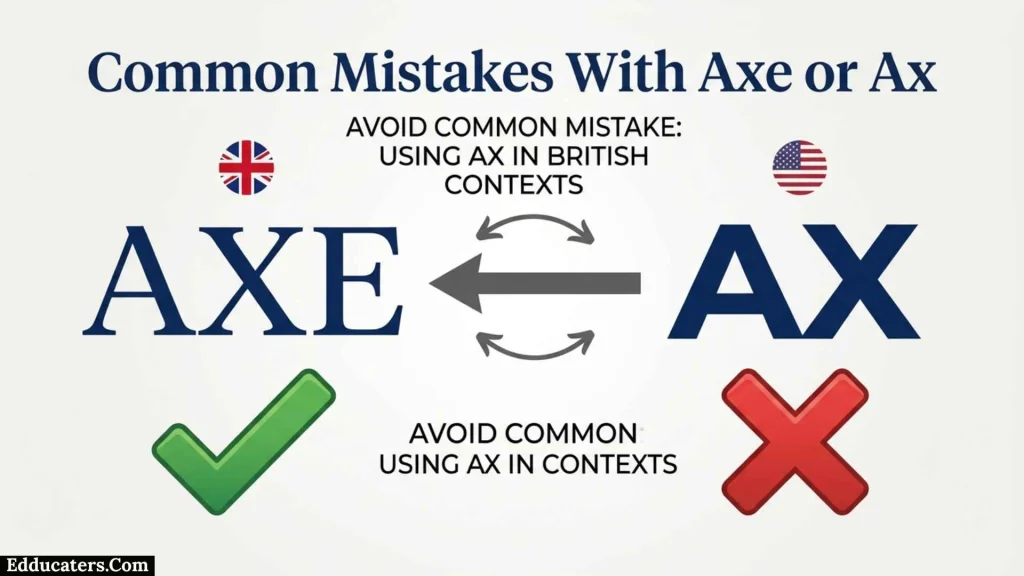
The biggest mistake is assuming that one spelling is always correct and the other is always wrong.
That is not supported by major dictionaries.
Mistake 1: Treating Ax as Incorrect
Some writers see ax and assume the writer forgot the final e. That is incorrect.
Merriam-Webster lists ax as a valid variant of axe, while Oxford lists it as the usual American form.
Mistake 2: Treating Axe as Wrong in American English
The reverse assumption is also incorrect.
Although ax is a common American spelling, axe is accepted in American English too. Merriam-Webster specifically notes that axe remains more common overall, including in the United States.
Mistake 3: Changing Spelling Throughout One Article
Switching randomly between axe and ax can make your writing look careless.
For example, this is inconsistent:
The worker picked up an ax. Later, he sharpened his axe. He stored the ax in the shed.
There is no grammatical error here, but a consistent editorial style would normally choose one form and stick with it.
Axe or Ax in Common Expressions
Both spellings can appear in familiar expressions.
One well-known expression is:
have an axe to grind
The phrase means that someone has a personal reason or private interest behind an argument or position.
The American form can also be written:
have an ax to grind
Oxford lists the expression with axe in its British entry and ax in its American entry.
Another figurative use involves the idea of something being removed or eliminated:
The television program got the axe.
American English can use:
The television program got the ax.
Both communicate the same idea.
Axe or Ax as a Verb
The spelling question becomes slightly more interesting when the word is used as a verb.
Both axe and ax can mean to remove, cancel, dismiss, or eliminate something.
For example:
The network axed the show after one season.
Or:
The network axed the show after one season.
The spelling of the base verb changes according to the writer’s preferred form, but axed is the normal past-tense spelling for both variants. Oxford records axed as the past form for its British and American entries.
What Does Axed Mean?
Axed can have several meanings depending on context.
Literally, it can mean cut with an axe or ax.
Figuratively, it can mean:
- cancelled
- removed
- dismissed
- eliminated
- discontinued
For example:
The company axed the planned expansion.
Here, the meaning is that the company cancelled the expansion.
Oxford gives examples involving cancelled services and people being removed from jobs.
Historical Background of Axe or Ax
The difference between these spellings has a much older history than modern American versus British English.
The word can be traced back to Old English forms such as æx. Merriam-Webster gives related forms from Old High German, Latin, and Greek. Oxford also identifies the word as Old English in origin.
The shorter spelling gained particular attention in American dictionary history because Noah Webster favored ax in his 1828 dictionary. He preferred spelling choices that often reflected pronunciation more directly.
Samuel Johnson’s 1755 dictionary, by contrast, included axe.
The interesting part is that the modern situation did not settle into a simple British axe versus American ax divide. Merriam-Webster’s usage discussion shows that axe has remained the dominant spelling overall.
A Simple Decision Guide for Axe or Ax
If you need to choose quickly, use this guide:
Are you following British English?
→ Choose an axe.
Are you following American English?
→ Ax is a natural choice, although axe is also correct.
Are you writing for an international audience?
→ Axe is a broadly recognizable choice.
Does your company have a style guide?
→ Follow the style guide.
Have you already chosen one spelling in the article?
→ Keep that spelling consistent.
This approach solves most real-world spelling questions without overthinking the difference.
Examples of Axe or Ax in Sentences
Seeing both forms in context makes the distinction easier to understand.
Examples With Axe
- The farmer used an axe to split the logs.
- The old axe was hanging beside the workshop door.
- She sharpened the axe before cutting the branches.
- The explorer carried an axe during the expedition.
- The company decided to axe the expensive program.
Examples With Ax
- The farmer used an ax to split the logs.
- The old ax was hanging beside the workshop door.
- He sharpened the ax before working in the yard.
- The ranger carried an ax during the trip.
- The company decided to ax the expensive program.
The sentences have the same basic meanings. The spelling changes, not the underlying idea.
Does Axe Mean Something Different From Ax?
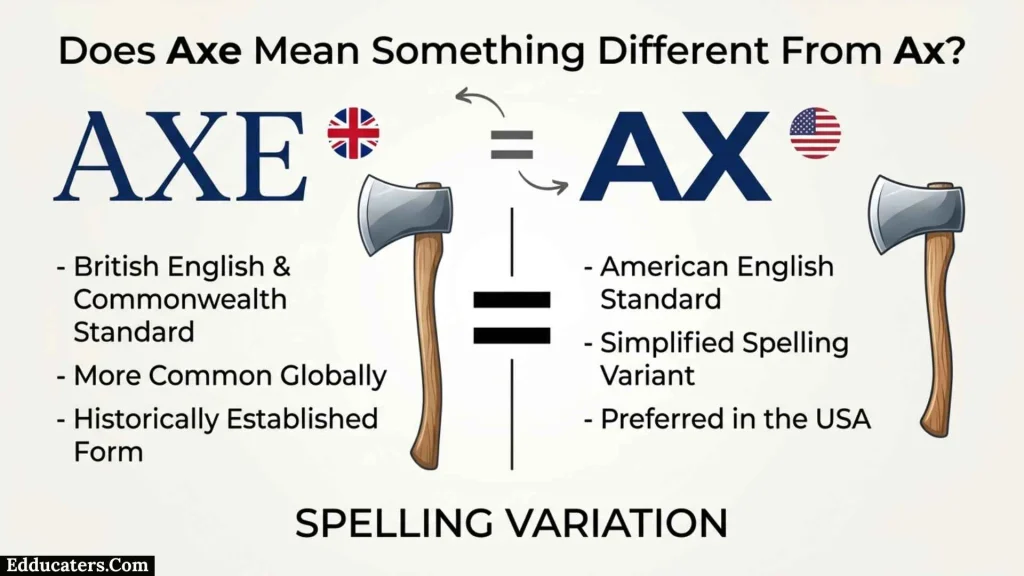
No. In ordinary English usage, axe and ax refer to the same tool and carry the same main meanings when used as verbs.
There can be differences in editorial preference, regional convention, or dictionary presentation, but there is no general meaning distinction that requires you to choose one based on what the tool does.
Merriam-Webster explicitly treats ax as a variant of axe, while Oxford presents the forms according to British and American usage.
Should You Use Both Spellings?
Yes, when the topic itself is a comparison of the two forms.
A page about axe or ax should naturally mention both spellings because readers searching for the phrase usually want to know whether they are different, whether one is wrong, and which one they should use.
The goal is not to repeat the phrase mechanically. Instead, answer the underlying questions a real reader would have.
Which Spelling Should You Choose?
There is no single spelling that every English writer must use.
Choose axe when:
- You write mainly in British English.
- Your audience expects British spelling.
- You want the more common overall spelling.
- Your existing style guide uses the longer form.
Choose ax when:
- You write mainly in American English.
- Your publication prefers the shorter form.
- Your style guide specifically recommends it.
- You want to follow a source’s established American spelling.
The most important rule is consistency. Once you choose a spelling for your article, use it consistently unless you are discussing the spelling variants themselves.
Frequently Asked Questions
Is Axe or Ax Correct?
Both are correct. Axe and ax are accepted spellings for the same cutting tool. The choice usually depends on regional or editorial preference.
Is Ax the American Spelling?
Ax is a common American spelling, and Oxford lists it as the usual US English form. However, axe is also accepted in American English and remains common overall.
Is Axe the British Spelling?
Yes. Axe is the standard British form listed by Oxford and Cambridge, while ax is recognized as the US variant.
Are Axe and Ax Pronounced Differently?
No. Both are normally pronounced /æks/. The spelling difference does not create a different standard pronunciation.
Can Axe Be Used as a Verb?
Yes. Axe can be a verb meaning to cut with an axe or, informally, to remove, cancel, or dismiss something.
Can Ax Be Used as a Verb?
Yes. Ax can also function as a verb, particularly in American English. It can describe cutting with an ax or removing something such as a service, project, or employee.
Which Form is More Common?
Axe is more common overall, according to Merriam-Webster. The shorter ax has been especially established in American English, but it has not replaced axe as the dominant spelling overall.
Is Axe Wrong in American English?
No. American English commonly uses ax, but axe is also a valid spelling. Treating axe as incorrect in all American writing would be too strict.
Is Ax Wrong in British English?
Not necessarily. British English strongly favors axe, but readers can understand ax, and the spelling is recognized as a valid variant. For formal British writing, however, axe is normally the better choice.
What is the Plural of Axe or Ax?
The plural is axes. The same written plural can also appear with ax, although pronunciation and context determine the meaning when discussing the separate word axis. Merriam-Webster lists axes as the plural of axe.
Conclusion
When choosing between axe or ax, you do not need to worry about picking a correct spelling versus an incorrect one. Both are correct.
The difference is mainly about regional usage and editorial preference. Axe is the usual British spelling and is also widely used internationally and in the United States. Ax is particularly common in American English and is fully accepted as a variant.
For most writers, the best approach is simple: identify your target audience, follow the appropriate English variety or style guide, then use your chosen spelling consistently.
If you are writing a British English article, axes are the natural choice. If you are writing American English content, ax is a perfectly valid option. Neither spelling changes the basic meaning of the word.

Hello, I’m Claire Holloway. I have always been passionate about the English language and enjoy turning complex grammar rules into simple, easy-to-follow lessons. I believe that every learner can become a confident English writer with the right guidance.
I create educational content focused on grammar, vocabulary, sentence structure, and writing improvement. Every article I publish is designed to help readers learn with confidence and accuracy.
Books
Grammar Without Confusion
Modern English Usage Guide
 Julian Mercer