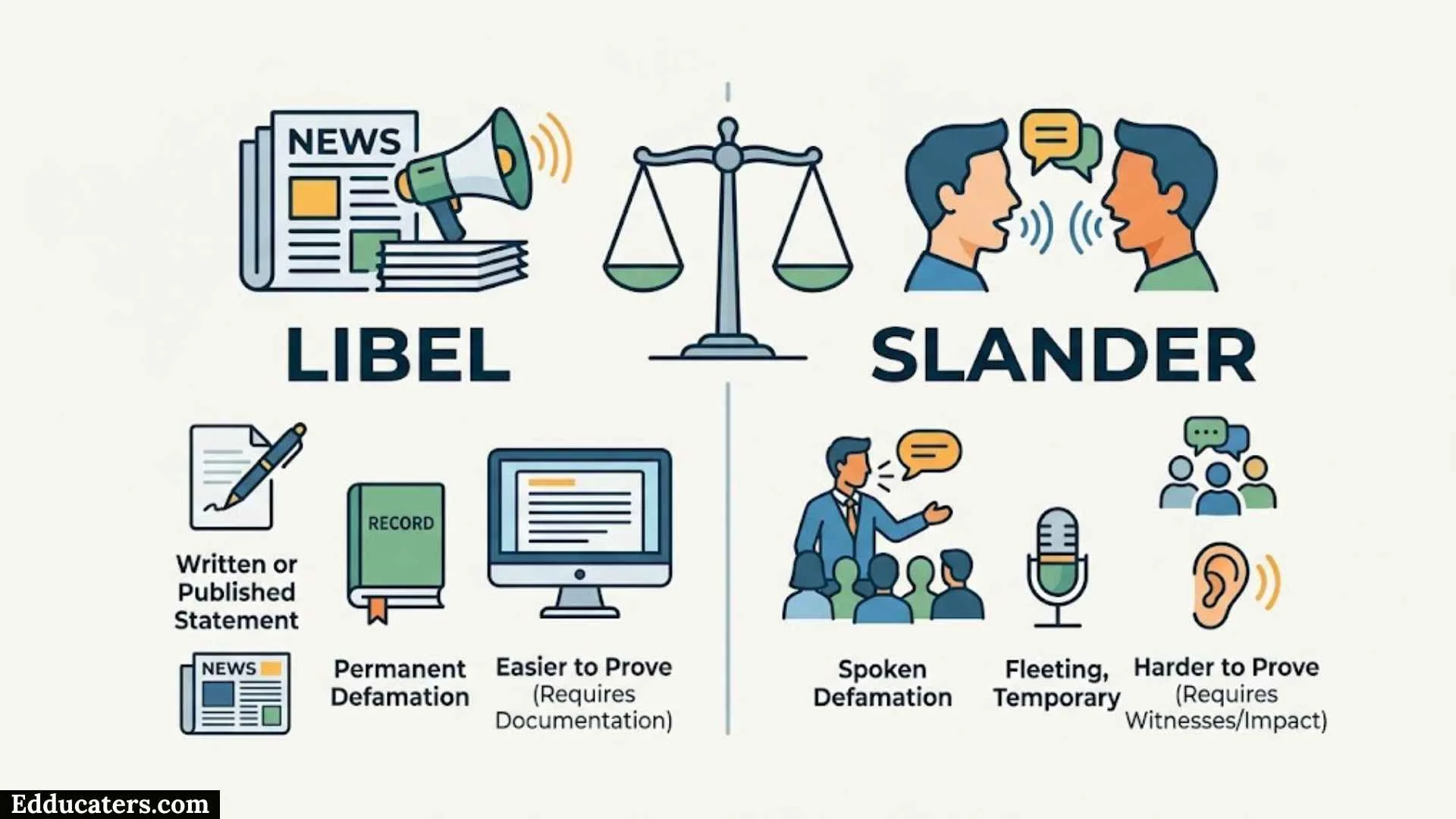
When someone makes a false statement that harms another person’s reputation, the legal issue may fall under defamation. Two terms commonly used within defamation law are libel or slander. The basic distinction is simple: libel generally involves defamatory statements that are written, printed, published, or otherwise recorded, while slander generally refers to defamatory statements that are spoken.
The difference becomes more important when you look at social media posts, online reviews, emails, podcasts, videos, workplace conversations, and public statements. A statement does not become legally actionable simply because it is insulting or upsetting. Defamation law generally focuses on whether a statement is a false assertion of fact, whether it was communicated to someone else, whether the required level of fault exists, and whether legally recognized harm resulted. The exact rules vary by jurisdiction.
This article explains what libel and slander mean, how they differ, how online communication fits into the distinction, why fact and opinion matter, what defenses may apply, and how U.S. defamation law treats public figures and private individuals.
Quick Answer: Libel or Slander?
The simple distinction
Libel generally refers to defamation expressed in a written, printed, pictured, published, or otherwise recorded form.
Slander generally refers to defamation expressed through spoken words.
Both can fall under the broader legal concept of defamation. The key issue is not simply whether someone said something negative. A typical defamation claim involves a false statement presented as fact, communication of that statement to a third party, the required level of fault, and legally recognized harm or damage. The precise elements differ among jurisdictions.
A quick example
Suppose a restaurant owner falsely tells a customer:
“That chef stole money from the restaurant.”
If the statement is spoken to another person, it could potentially be slander, assuming the other legal requirements are satisfied.
If the owner publishes the same false allegation in a written Facebook post, newspaper article, email, or other recorded communication, it could potentially be libel.
The format of the communication helps determine which term applies, but the complete legal analysis requires more than identifying whether the statement was spoken or written.
Key takeaways
- Defamation is the broader category.
- Libel generally involves written or recorded defamatory communication.
- Slander generally involves spoken defamatory communication.
- A false statement is not automatically defamation.
- Statements of pure opinion are generally protected, although calling something an “opinion” does not automatically make it legally protected.
- Truth is generally a complete defense to a defamation claim.
- Privileges can protect certain communications.
- Public officials and public figures generally face a higher constitutional burden because they must establish actual malice in applicable defamation cases.
- State law can substantially change the details, including damages, privileges, filing requirements, and the elements of a claim.
What Is Defamation?
Defamation is the larger legal category
Defamation is a legal concept involving statements that harm another person’s reputation. In U.S. law, the term generally encompasses both libel or slander.
Although the exact legal test varies, a typical defamation claim requires consideration of several questions:
- Was the statement presented as a fact?
- Was the statement false?
- Was it communicated to someone other than the person discussed?
- Did the speaker or publisher have the legally required level of fault?
- Did the statement cause legally recognizable harm or damage?
Not every jurisdiction uses exactly the same wording or applies these elements in exactly the same way. State statutes and common law can differ considerably.
Why the distinction matters
The words libel or slander are sometimes used casually to describe any harmful statement. Legally, however, the distinction can matter because different rules may apply to written and spoken communications, particularly regarding proof of damages.
For example, imagine an employee falsely tells several coworkers that another employee stole company property.
That could potentially raise a slander issue because the allegation was spoken.
Now imagine the same employee sends the allegation in an email to the entire department. The written communication may instead be analyzed as libel.
The underlying allegation is similar, but the method of communication is different.
What Is Libel?
Definition of libel
Libel generally involves a defamatory statement expressed through writing, print, pictures, signs, or another recorded or embodied form of communication. Traditional examples include newspaper articles, letters, printed publications, and written statements.
Modern communication has made the concept broader in practical terms. Written social media posts, online publications, digital reviews, emails, and other recorded communications can raise libel questions depending on the circumstances and applicable law.
The important point is that writing something does not automatically make it libel. The statement still needs to satisfy the applicable legal requirements for defamation.
Examples of potential libel
Consider these hypothetical situations:
Business review:
A customer knowingly posts, “This dentist stole money from patients,” when the customer has no factual basis for the accusation and the allegation is false.
Workplace email:
An employee sends an email to coworkers falsely claiming that a manager falsified financial records.
Social media post:
Someone publishes a false statement claiming that a local business owner committed a serious crime.
Online article:
A website publishes an allegedly factual accusation about an individual that is false and reputation-damaging.
These examples illustrate the type of communication that can raise libel questions. Whether any particular statement is actually actionable depends on the facts and the applicable law.
Libel does not mean every negative publication
A negative statement can be unpleasant without being defamatory.
For example:
“I would never eat at that restaurant again.”
That statement may communicate dissatisfaction or personal opinion.
Compare it with:
“The restaurant knowingly served contaminated food and falsified its health records.”
The second statement makes specific factual allegations that can potentially be tested as true or false.
That difference between opinion and factual assertion is an important part of defamation analysis.
What Is Slander?
Definition of slander
Slander generally refers to a false defamatory statement that is spoken rather than written or otherwise recorded.
For example, suppose a person tells several customers:
“That contractor takes deposits and never completes the work.”
If the statement is false, presented as fact, communicated to third parties, and satisfies the other applicable requirements, it could potentially form the basis of a slander claim.
Again, the statement does not become slander merely because it hurts someone’s feelings. The legal requirements still matter.
Spoken communication can take many forms
Traditional examples of slander include:
- A conversation between coworkers
- A statement made at a business meeting
- A false accusation made to customers
- A spoken allegation during a community gathering
- A verbal statement made to a potential employer
The line between spoken and recorded communication can become less obvious with modern technology. A live spoken conversation is different from a recorded podcast episode or uploaded video because the latter creates a lasting recorded communication that may be analyzed under rules applicable to libel or other forms of published defamation.
The precise classification can depend on the jurisdiction and circumstances.
Why damages can differ
A traditional distinction between libel and slander concerns damages. Cornell’s Legal Information Institute explains that damages for slander generally are not presumed and ordinarily must be proven, although recognized exceptions and jurisdiction-specific rules can change that result.
Some jurisdictions recognize forms of slander per se or similar categories in which certain especially serious statements may receive different treatment.
Because these rules differ by state, it is risky to assume that every spoken defamatory statement requires the same proof of financial loss.
Libel or Slander Compared
Side-by-side comparison
| Feature | Libel | Slander |
| General meaning | Defamatory communication in written, printed, pictured, or recorded form | Defamatory communication that is generally spoken |
| Broader category | Defamation | Defamation |
| Common examples | Articles, posts, emails, written reviews | Conversations, meetings, spoken accusations |
| Permanence | Often leaves a lasting record | May be temporary unless recorded |
| Online examples | Social media posts, websites, written reviews | Live verbal statements or conversations |
| Proof requirements | Vary by jurisdiction and circumstances | Vary by jurisdiction and circumstances |
| Damages | Rules vary; traditional libel rules differ from modern constitutional limits | Traditionally damages are generally not presumed, subject to exceptions |
| Main legal concern | False reputation-harming publication | False reputation-harming spoken statement |
The table gives the general distinction, not a universal legal test. U.S. defamation law is heavily dependent on state law and constitutional requirements.
An easy way to remember the difference
A simple memory aid is:
Libel = lasting or recorded communication
Slander = spoken communication
This is useful for remembering the basic vocabulary, but it should not be treated as a complete legal test.
A written statement can still be protected. A spoken statement can still be protected. And an apparently harmful statement may fail as a defamation claim because it is true, opinion-based, privileged, or missing another required element.
Fact and Opinion: Why the Difference Matters
Factual claims can be tested
Defamation law generally focuses on statements that can reasonably be understood as factual assertions.
For example:
“John was convicted of fraud last year.”
This is presented as a factual claim. It can be checked against records.
Now consider:
“John is the worst manager I have ever worked for.”
That statement may communicate an opinion or evaluation rather than a specific objectively verifiable fact.
The context matters. Courts look at how a reasonable person would understand the statement, rather than simply accepting the speaker’s preferred label for it.
Calling something an opinion does not automatically protect it
One common misconception is that adding phrases such as:
“In my opinion…”
automatically prevents a statement from being defamatory.
It does not necessarily work that way.
Suppose someone writes:
“In my opinion, Sarah secretly stole $50,000 from the company.”
The phrase “in my opinion” does not necessarily transform the underlying accusation into protected opinion. The statement may still communicate a specific factual allegation capable of being proven true or false.
The U.S. Supreme Court addressed this distinction in Milkovich v. Lorain Journal Co., explaining that there is not a blanket constitutional rule protecting every statement merely because it is characterized as an opinion.
Context changes how a statement is understood
Consider two restaurant comments:
“I think the service was terrible.”
This is naturally understood as a personal evaluation.
Now compare:
“The owner knowingly uses expired meat.”
The second statement asserts a specific factual claim.
A useful practical question is:
Could the statement reasonably be checked against evidence and shown to be true or false?
If yes, it deserves closer attention than a simple expression of taste, preference, or evaluation.
Online Communication and Defamation
Social media posts and comments
Social media has made written reputation-related disputes much more common in everyday communication.
A public post can reach thousands of people quickly. A false factual allegation can also be copied, reposted, screenshotted, or quoted elsewhere.
Examples include false claims about:
- Criminal conduct
- Professional misconduct
- Financial wrongdoing
- Business practices
- Academic misconduct
- Employment history
- Professional qualifications
But not every harsh social media comment is libel.
For example:
“This company has the worst customer service.”
This may be understood as an opinion.
A statement such as:
“This company falsifies customer invoices.”
makes a much more specific factual accusation.
Whether either statement is legally actionable depends on context and applicable law.
Online reviews
Online reviews create another important distinction between opinion and factual allegation.
Compare:
“The food was cold, and I thought the service was extremely slow.”
with:
“The restaurant secretly puts illegal substances in its food.”
The first contains subjective observations and opinions. The second alleges a specific factual practice.
Reviewers should therefore separate their personal experiences from factual accusations they cannot support.
Businesses, meanwhile, should not assume that every negative review is legally defamatory simply because it damages reputation.
Emails, podcasts, and videos
An email can create a written record of an allegedly defamatory statement.
A podcast or uploaded video can also create a recorded publication that is materially different from a private spoken conversation.
For anyone communicating publicly, a useful practice is to distinguish:
- What you personally observed
- What you can verify
- What another person told you
- What you believe
- What you are uncertain about
That distinction can reduce the risk of presenting an unverified allegation as an established fact.
Truth, Privilege, and Other Defenses
Truth is generally a complete defense
Truth is one of the most important concepts in defamation law.
A person generally cannot establish the falsity required for a defamation claim by proving that the challenged statement was true. Cornell’s Legal Information Institute identifies truth as a general complete defense to defamation.
This does not mean that every truthful statement is automatically harmless in every legal context. Other laws may govern privacy, confidentiality, trade secrets, or other forms of disclosure.
But for ordinary defamation analysis, falsity is a central requirement.
Absolute privilege
Some communications receive strong legal protection because society has an interest in allowing people to speak freely in particular settings.
An absolute privilege can provide complete immunity from a defamation claim when the legal requirements are satisfied.
Examples can include certain statements made during judicial proceedings and certain legislative proceedings. The scope depends on applicable law and the connection between the statement and the protected proceeding.
For example, a statement made by a participant during a judicial proceeding may receive a privilege that would not necessarily protect the same statement if repeated publicly outside that proceeding.
Qualified privilege
A qualified privilege can protect certain communications when there is a legitimate reason for the speaker to communicate the information and a corresponding interest in receiving it.
Employment-related communications can sometimes raise this issue. For example, a person with a legitimate workplace duty may communicate relevant information to someone who also has a legitimate interest in receiving it.
Qualified privilege is not unlimited. Its scope and the circumstances that can defeat it vary by jurisdiction.
Defamation per se
Some jurisdictions recognize categories of especially serious defamatory statements as defamation per se.
Traditionally recognized categories can include certain false accusations of serious crimes, certain serious claims about professional incompetence, and other particularly damaging allegations. The exact categories and consequences differ among jurisdictions.
This is one reason a general internet definition of libel or slander should not be treated as a substitute for state-specific legal analysis.
Actual Malice and Public Figures
What “actual malice” means
The legal term actual malice has a specific constitutional meaning in U.S. defamation law.
It does not simply mean that the speaker disliked the person or intended to hurt their feelings.
For public officials and public figures in applicable defamation cases, actual malice generally means that the defendant published a defamatory falsehood knowing it was false or with reckless disregard for whether it was false. The Supreme Court established the standard for public officials in New York Times Co. v. Sullivan and later applied it to public figures.
The distinction is important because ordinary negligence and constitutional actual malice are not the same legal concept.
Public figures and private individuals
U.S. constitutional law treats public figures differently from private individuals in defamation cases.
Public officials and public figures generally face the actual-malice requirement in applicable cases. Private plaintiffs generally do not have to satisfy that same constitutional standard, although the precise fault requirement can depend on state law and the nature of the speech.
This distinction reflects the constitutional importance of protecting discussion about public affairs while still allowing legal remedies for reputation-related harm.
A Practical Decision Guide
Follow this simple decision tree
When you encounter a potentially defamatory statement, work through these questions:
Was something said or published about a person or entity?
↓ No
There may be no defamation issue.
↓ Yes
Is the statement presented as a factual claim?
↓ No, it is clearly an opinion or subjective evaluation
It may receive constitutional protection, depending on context.
↓ Yes
Is the factual claim false?
↓ No
Truth generally defeats a defamation claim.
↓ Yes or uncertain
Was the statement communicated to someone other than the person discussed?
↓ No
The publication element may be missing under a typical defamation framework.
↓ Yes
Does the applicable law require a particular level of fault or proof of harm?
↓ Yes
Analyze the relevant state law, plaintiff status, subject matter, privileges, damages rules, and constitutional protections.
This decision guide is an educational framework, not a legal test that applies identically in every state.
A practical checklist before publishing a serious allegation
Before publishing or repeating a potentially damaging factual statement, ask:
- Do I know that the statement is true?
- What evidence supports it?
- Am I reporting a verified fact or repeating a rumor?
- Have I separated facts from my opinions?
- Could a reasonable reader interpret this as a factual accusation?
- Am I communicating it to someone who has a legitimate reason to receive it?
- Is there a privilege that may apply?
- Have I checked the relevant state law?
- Could the statement harm someone’s professional or personal reputation?
- Would a correction be appropriate if I discover an error?
This approach is especially useful for journalists, business owners, employers, reviewers, bloggers, community administrators, and people who regularly publish online.
Common Mistakes People Make
Mistake 1: Assuming every insult is defamation
Calling someone “rude,” “awful,” or “unprofessional” does not automatically create a defamation claim.
The legal question is more specific than whether the language is offensive.
Mistake 2: Thinking only newspapers can commit libel
Modern libel questions can involve websites, social media posts, emails, online reviews, and other recorded communications.
The medium has changed, but the legal questions about falsity, fact versus opinion, fault, publication, harm, and defenses remain important.
Mistake 3: Believing “in my opinion” solves everything
As discussed earlier, a statement can still imply a factual allegation even when introduced with opinion language.
Courts look at the substance and context of the communication, not simply the label attached to it.
Mistake 4: Assuming the person must have lost money
Financial loss can be important, but defamation law does not operate identically in every jurisdiction or for every category of statement.
Rules concerning presumed damages, actual damages, and defamation per se vary, and constitutional limitations can also affect available damages.
Mistake 5: Treating “actual malice” as ordinary bad intent
Actual malice has a specialized constitutional meaning.
For public officials and public figures, it generally concerns knowledge of falsity or reckless disregard for truth, not simply hostility or a desire to cause harm.
Frequently Asked Questions
Is libel written and slander spoken?
Generally, yes. Libel usually refers to defamatory statements expressed in written, printed, pictured, or otherwise recorded form, while slander generally refers to spoken defamatory statements. Both fall under the broader concept of defamation.
Is online defamation considered libel?
A written online statement can potentially be treated as libel because libel generally includes defamatory communications in recorded or written form. Social media posts, websites, and written online reviews can therefore raise libel questions.
However, being online does not automatically make a statement defamatory. The statement must still satisfy the applicable legal requirements.
Can an opinion be libel?
A genuine statement of opinion is generally protected when it cannot reasonably be understood as asserting an objectively verifiable fact.
However, simply adding “in my opinion” does not automatically protect a statement. An opinion may still create a legal issue if it implies undisclosed defamatory facts or asserts a factual allegation that can be proven true or false.
Can a truthful statement be libel?
Truth generally defeats a defamation claim because falsity is a central requirement. However, other areas of law may regulate certain truthful disclosures, such as confidential or legally protected information.
Is slander more serious than libel?
Neither term should automatically be described as more serious.
Libel or slander are different forms of defamation, and their legal consequences depend on the circumstances and applicable jurisdiction. Traditional rules have treated damages differently, but modern constitutional and state-law rules make the analysis more complicated than simply saying one is always worse.
Can a business be the subject of defamation?
Businesses can be involved in reputation-related defamation disputes, but the applicable legal rules depend on the jurisdiction, the nature of the statement, and the type of business interest affected.
A statement about a business should therefore be analyzed based on the applicable state law rather than assuming that the rules are identical to those involving an individual.
What happens if someone repeats a rumor?
Repeating an allegation does not automatically make it true or legally safe.
If someone repeats a false factual accusation to another person, the communication may raise defamation issues depending on the circumstances. Before repeating a serious allegation, it is safer to determine whether the underlying claim is supported by reliable evidence.
Does someone have to prove actual financial loss?
Not necessarily in every situation.
Damages rules vary by jurisdiction and by the type of defamation claim. Certain categories of defamatory statements may receive special treatment, while constitutional rules can limit presumed or punitive damages in particular circumstances.
What is the easiest way to remember libel or slander?
Remember:
Libel = generally written or recorded.
Slander = generally spoken.
Both are forms of defamation.
Conclusion
The simplest distinction between libel or slander is the form of communication. Libel generally involves defamatory statements that are written, printed, pictured, or otherwise recorded, while slander generally involves spoken defamatory statements.
But the legal analysis goes much further than that basic distinction. A potentially defamatory statement generally must involve a false factual assertion, communication to a third party, the required level of fault, and legally recognized harm or damage. Truth, opinion, privilege, plaintiff status, public concern, and state-specific rules can all affect the outcome.
The rise of social media, online reviews, email, podcasts, and video has made the distinction especially relevant in everyday communication. Before publishing or repeating a serious allegation, it is important to distinguish verified facts from opinions and rumors.
Most importantly, libel or slander are not simply different words for being rude or insulting. They are legal concepts governed by detailed rules that vary by jurisdiction. For an actual dispute, the specific statement, context, audience, evidence, and applicable state law should all be examined.
References
- Cornell Law School Legal Information Institute, Defamation.
- Cornell Law School Legal Information Institute, Libel.
- Cornell Law School Legal Information Institute, Slander.
- Cornell Law School Legal Information Institute, Public Figure.
- Cornell Law School Legal Information Institute, Absolute Privilege.
- Cornell Law School Legal Information Institute, Libel Per Se.
- Cornell Law School Legal Information Institute, New York Times Co. v. Sullivan (1964).
- Milkovich v. Lorain Journal Co., 497 U.S. 1 (1990), discussed in Cornell Law School’s defamation materials.
- Gertz v. Robert Welch, Inc., 418 U.S. 323 (1974), discussed in Cornell Law School’s defamation materials.

Hi, I’m Nathan Whitmore, and I enjoy making English grammar easy for learners of all ages. I believe grammar should be practical, not confusing. I write simple, well-researched guides that help readers improve their writing, speaking, and overall communication skills.
I spend a lot of time studying grammar patterns, sentence construction, punctuation, and modern English usage. My goal is to create lessons that anyone can understand, whether they are students, teachers, or professionals.
Books
Clear English Grammar
The Smart Writer’s Grammar Handbook
 Julian Mercer