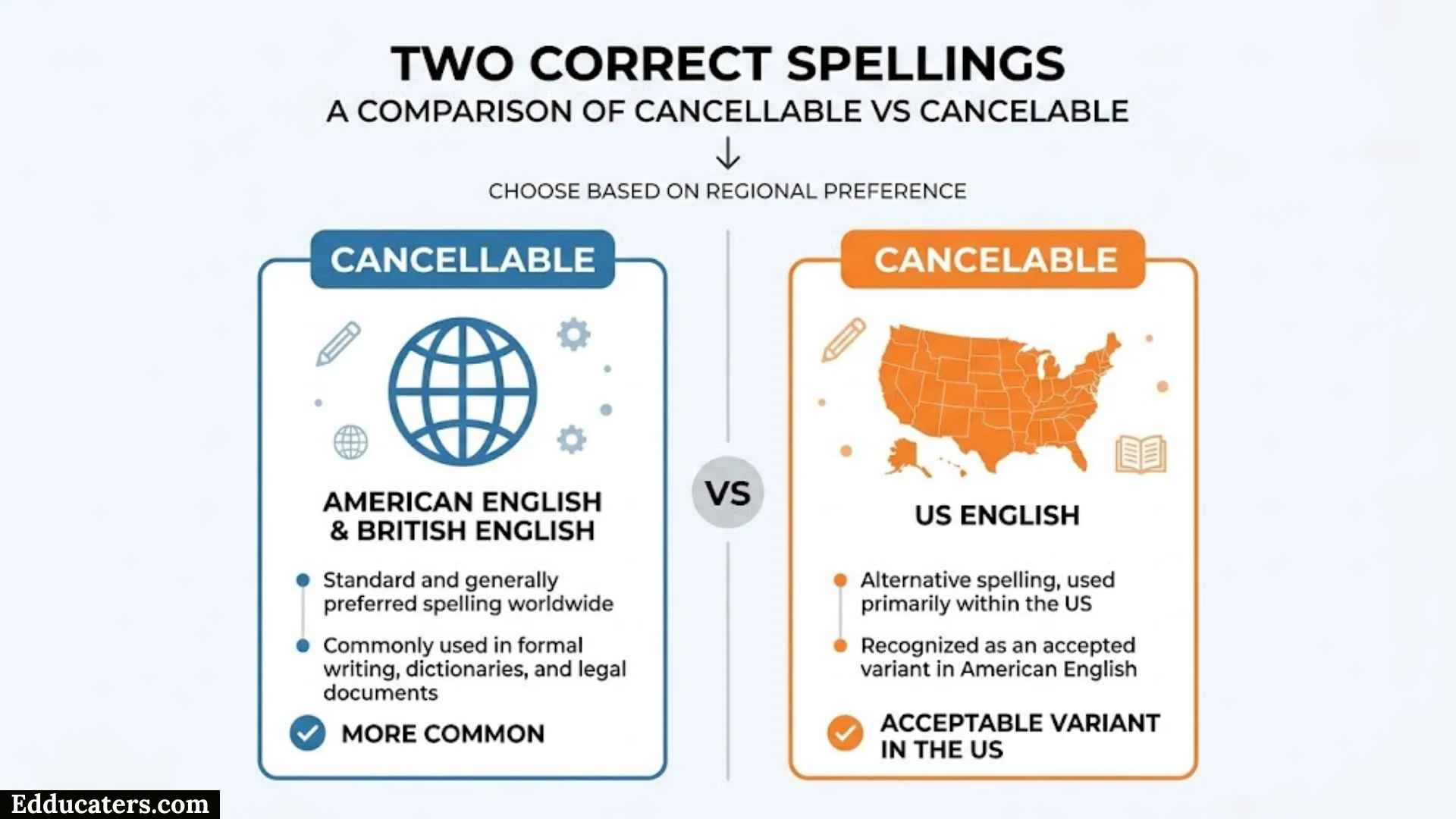
Cancellable or cancelable are both correct English spellings. They have the same basic meaning: able to be canceled. The main difference is regional spelling. Cancelable is generally used in American English, while cancellable is generally used in British English. Cambridge lists cancelable as the U.S. form and cancellable as the mainly U.K. form.
If you are writing for an American audience, cancelable is usually the natural choice. If you are following British English, cancellable is generally preferred.
The difference can be confusing because the verb is spelled cancel in both varieties, while related forms can change depending on the English variety: canceled/cancelled, canceling/cancelling, and cancelable/cancellable.
This guide explains the difference between the two spellings, what each word means, how to pronounce it, why the extra l appears, how the forms are used in real sentences, and which version you should choose in American and British English.
Quick Answer: Cancellable or Cancelable?
Both spellings are correct
The short answer is:
- Cancelable — generally American English
- Cancellable — generally British English
- Both mean able to be canceled
- Neither spelling changes the basic meaning
- The best choice depends on the English variety and style you are using
Cambridge defines cancelable as something that can be stopped or no longer used if you decide you do not want it. Its British-English entry gives cancellable as the corresponding form and notes that American English usually uses cancelable.
Which spelling should you use?
| If you are writing for… | Use |
| American English | cancelable |
| British English | cancellable |
| A U.S. business | cancelable |
| A British publication | cancellable |
| An international audience | Follow your chosen style consistently |
| A document with an established style guide | Follow that guide |
For example:
American English:
The reservation is cancelable up to 24 hours before arrival.
British English:
The reservation is cancellable up to 24 hours before arrival.
Both sentences mean the same thing.
What Does Cancellable or Cancelable Mean?
Definition and meaning
Cancellable or cancelable are adjectives. They describe something that can be canceled.
The word can apply to many things, including:
- Reservations
- Hotel bookings
- Flights
- Appointments
- Subscriptions
- Contracts
- Orders
- Insurance policies
- Memberships
- Services
- Tickets
- Agreements
For example:
The hotel offers a cancellable booking.
This means the booking can be canceled under the applicable conditions.
In American English, the same sentence would normally be written:
The hotel offers a cancelable booking.
The meaning does not change.
What does “able to be canceled” really mean?
The word describes possibility, not necessarily the conditions surrounding cancellation.
Consider:
The ticket is cancelable.
This tells you that cancellation is possible. It does not tell you whether:
- A cancellation fee applies
- A refund is available
- A deadline exists
- Written notice is required
- Only certain parts of the agreement can be canceled
- Cancellation is allowed during a particular period
For example:
The reservation is cancelable, but a $50 fee applies to cancellations made within 24 hours of arrival.
Here, the reservation is still cancelable. The additional information simply explains the conditions.
This distinction is important in business, travel, contracts, and customer-service writing.
Cancellable Or Cancelable Compared
The main difference is spelling, not meaning
There is no important difference in the basic definition of cancellable or cancelable.
| Feature | Cancellable | Cancelable |
| Part of speech | Adjective | Adjective |
| Meaning | Able to be canceled | Able to be canceled |
| Main regional association | British English | American English |
| Pronunciation | Essentially the same | Essentially the same |
| Spelling | Double l | Single l |
| Example | a cancellable booking | a cancelable booking |
| Opposite | noncancellable / non-cancellable | noncancelable / non-cancelable |
Cambridge specifically identifies cancellable as the U.K. form and cancelable as the usual U.S. form. It also records corresponding negative forms such as noncancellable and noncancelable.
An easy memory rule
You can remember the distinction this way:
American English → cancelable
British English → cancellable
The extra l is the easiest visual clue.
However, do not assume that every word related to cancel follows exactly the same spelling pattern. It is better to learn the common forms individually and then keep them consistent within your writing.
Why Does Cancellable Have Two “l”s?
The spelling comes from regional English conventions
The base verb is cancel.
When English adds endings to this word, American and British spelling conventions can produce different forms.
American English commonly uses:
- cancel
- canceled
- canceling
- cancelable
British English commonly uses:
- cancel
- cancelled
- cancelling
- cancellable
Oxford’s American English dictionary lists canceled as the American past tense and canceling as the American -ing form, while noting the British forms cancelled or cancelling.
Oxford’s broader English dictionary similarly gives cancelled or cancelling as standard forms while identifying the American alternatives canceled or canceling.
The spelling pattern is easier to see as a group
Compare the forms:
| American English | British English |
| cancel | cancel |
| canceled | cancelled |
| canceling | cancelling |
| cancelable | cancellable |
This is why someone accustomed to British English may naturally write cancellable, while an American English writer may automatically choose cancelable.
Neither choice changes the meaning.
Cancellable or Cancelable in American English
Use cancelable for a U.S. audience
If your content follows American English, cancelable is generally the preferred spelling.
Examples:
The subscription is cancelable at any time.
The hotel offers a cancelable reservation.
This contract is cancelable with 30 days’ notice.
The customer selected a cancelable ticket.
The order remains cancelable until it enters the shipping process.
These examples follow the American spelling pattern used in dictionary references such as Cambridge and Oxford.
American business writing
The word can be particularly useful in policies and customer-facing content.
For example:
Your membership is cancelable at any time after the first billing cycle.
This is clearer than simply saying:
You can cancel it.
The adjective can be useful when describing the type or status of a plan, contract, or reservation.
However, when writing terms and conditions, it is better to provide the actual cancellation rules as well.
For example:
The subscription is cancelable at any time. Cancellations made before the next billing date will prevent the following charge.
That gives the reader information they can act on.
Cancellable or Cancelable in British English
Use cancellable for a British English audience
In British English, cancellable is generally the preferred form.
Examples:
The booking is cancellable up to 48 hours before arrival.
The agreement is cancellable with written notice.
The policy is cancellable under certain conditions.
Customers can choose a cancellable fare.
Cambridge identifies cancellable as the U.K. form and provides examples involving contracts and hotel bookings.
Is cancelable wrong in British English?
Not necessarily.
English spelling is not always divided into absolute rules where a form is either universally correct or universally incorrect. Dictionaries can record regional variants, and individual organizations may follow particular style guides.
Still, if your goal is consistent British English, cancellable is the more natural choice.
Likewise, if your document is written in American English, cancelable will usually fit the surrounding spelling better.
How to Pronounce Cancellable Or Cancelable
Pronunciation
The two spellings are pronounced essentially the same.
A simple pronunciation guide is:
Cancellable: KAN-suh-luh-bul
Cancelable: KAN-suh-luh-bul
Cambridge provides essentially the same pronunciation for the two regional forms.
The extra l in cancellable does not create a major pronunciation difference. The distinction is mainly visible in writing.
Does the spelling affect pronunciation?
Generally, no.
A reader familiar with English will normally understand cancellable or cancelable as the same spoken word.
This is different from spelling pairs where changing letters creates a different pronunciation or meaning. Here, the main issue is regional written convention.
How to Use Cancellable or Cancelable in Sentences
Everyday examples
Here are natural examples using cancelable:
The appointment is cancelable if you give us enough notice.
I chose a cancelable hotel room because my travel plans may change.
The subscription is cancelable at any time.
This ticket is cancelable before departure.
The British versions can simply use cancellable:
The appointment is cancellable if you give us enough notice.
I chose a cancellable hotel room because my travel plans may change.
The subscription is cancellable at any time.
This ticket is cancellable before departure.
Workplace and professional examples
The word is also useful in professional writing.
The agreement is cancelable with 30 days’ written notice.
Customers may select a cancellable service plan.
The contract is cancellable if either party provides the required notice.
In British English:
The agreement is cancellable with 30 days’ written notice.
Customers may select a cancellable service plan.
The contract is cancellable if either party provides the required notice.
The regional spelling changes, but the underlying message remains identical.
Cancellable Does Not Mean Refundable
These words describe different things
One of the most important practical distinctions is between cancelable and refundable.
Cancelable means:
You are allowed to cancel something.
Refundable means:
Money can be returned under the applicable terms.
These are not the same.
For example:
The hotel booking is cancelable but non-refundable.
That may sound contradictory at first, but it is possible. The customer can cancel the booking, but the cancellation does not necessarily result in a refund.
Another example:
The ticket is cancelable with a 20% cancellation fee.
Again, cancellation is permitted, but a financial condition applies.
Why this distinction matters
This difference is especially important in:
- Travel bookings
- Airline tickets
- Hotel reservations
- Subscription services
- Insurance
- Contracts
- Event tickets
- Online purchases
If you are writing a policy, simply saying something is cancelable may not provide enough information.
A stronger sentence explains the actual terms:
The reservation is cancelable without charge until 6 p.m. the day before arrival.
That tells the reader what cancellation actually means in practice.
Related Forms of Cancel
Cancel, canceled, cancelled, canceling, and cancelling
The spelling of cancelable makes more sense when you understand the related forms.
The base verb is:
cancel
American English commonly uses:
canceled
British English commonly uses:
cancelled
For the -ing form:
canceling — American English
cancelling — British English
For the adjective:
cancelable — American English
cancellable — British English
Oxford confirms these regional patterns in its dictionary entries for cancel.
What about cancellation?
The noun is:
cancellation
For example:
We received a cancellation notice.
The airline announced the cancellation of the flight.
A cancellation fee may apply.
Oxford defines cancellation as the decision to stop something that has been arranged or the act of making an agreement no longer valid. It also records cancelation as a U.S. variant.
This is useful because writers sometimes assume that every word related to cancel must use exactly the same number of letters. English spelling does not always work that simply.
Common Mistakes With Cancellable or Cancelable
Mistake 1: Saying one spelling is always wrong
It is incorrect to assume that cancellable is simply a misspelling of cancelable, or vice versa.
Both are established forms.
The important question is which English variety you are following.
Mistake 2: Mixing American and British spelling without a reason
A document can look inconsistent if it moves between regional spelling systems.
For example:
The customer cancelled the order, and the subscription is cancelable.
This combines a commonly British form with a commonly American form.
A consistently American version would be:
The customer canceled the order, and the subscription is cancelable.
A consistently British version would be:
The customer cancelled the order, and the subscription is cancellable.
Consistency makes professional writing easier to read.
Mistake 3: Thinking the extra “l” changes the meaning
It does not.
The difference between cancellable or cancelable is not a difference in definition.
Both mean that something can be canceled.
Mistake 4: Confusing cancelable with noncancelable
These words have opposite meanings.
Cancelable / cancellable means something can be canceled.
Noncancelable / noncancellable means something cannot be canceled.
Cambridge records noncancelable as the U.S. form and noncancellable as the U.K. form, with both meaning unable to be canceled.
For example:
The ticket is cancelable.
means cancellation is allowed.
But:
The ticket is noncancelable.
means cancellation is not allowed under the stated terms.
Mistake 5: Assuming cancelable means cancellation is unlimited
A cancelable agreement may still have conditions.
For example:
The contract is cancellable with 60 days’ notice.
The contract can be canceled, but immediate cancellation may not be permitted.
Similarly:
The hotel room is cancelable until midnight.
The reservation can be canceled, but only before the stated deadline.
The adjective tells you that cancellation is possible. The surrounding policy tells you how.
A Simple Decision Guide
Choose the spelling based on your audience
Use this quick decision tree:
Who are you writing for?
↓
Primarily American English readers?
→ Use cancelable
Primarily British English readers?
→ Use cancellable
International audience?
→ Choose a consistent English style and use it throughout.
Following a company, academic, publishing, or legal style guide?
→ Follow that guide consistently.
This approach is more useful than trying to decide which spelling is universally “correct.”
A practical consistency checklist
Before publishing your document, check:
- Which English variety am I using?
- Have I chosen cancelable or cancellable?
- Does the rest of the document follow the same regional spelling?
- Am I also using canceled/cancelled consistently?
- Am I using canceling/cancelling consistently?
- Have I explained any cancellation deadline?
- Have I explained cancellation fees?
- Have I explained refund conditions?
- Is the item actually cancelable, or is it noncancelable?
For a customer-facing policy, these questions are often more important than the spelling itself.
Cancellable or Cancelable in Contracts and Policies
Why precise wording matters
In everyday conversation, either spelling is easy to understand.
In contracts and policies, however, the word should be accompanied by precise conditions.
For example:
The agreement is cancelable.
is relatively vague.
A clearer version is:
The agreement is cancelable by either party with 30 days’ written notice.
An even more detailed policy might state:
The agreement is cancelable by either party with 30 days’ written notice. Cancellation does not affect fees already due under the agreement.
The spelling question is therefore only one part of good professional writing.
Examples from travel and subscriptions
A travel company might write:
This fare is cancelable without a fee until 24 hours before departure.
A subscription service might write:
The monthly plan is cancelable at any time, but cancellation takes effect at the end of the current billing period.
These sentences make the actual policy clear instead of leaving the customer to interpret what cancelable means.
Frequently Asked Questions
Is cancelable a correct spelling?
Yes. Cancelable is a correct spelling and is generally associated with American English. Cambridge lists it as the U.S. form of cancellable.
Is cancellable a correct spelling?
Yes. Cancellable is a correct spelling and is generally associated with British English. Cambridge identifies it as the U.K. form.
Which is correct: cancellable or cancelable?
Both are correct. Use cancelable for American English and cancellable for British English as a general style choice.
Is cancelable American or British?
Cancelable is generally the American English spelling. Cambridge labels it US and identifies cancellable as the mainly U.K. form.
Is cancellable American or British?
Cancellable is generally the British English spelling. In American English, cancelable is usually preferred.
Does cancelable mean refundable?
No. Cancelable means that cancellation is possible. Refundable means that money can be returned under the applicable terms.
Something can be cancelable without being refundable.
Is noncancelable the opposite of cancelable?
Yes. Noncancelable means that something cannot be canceled. British English commonly uses noncancellable, while American English commonly uses noncancelable.
Is cancelable one word?
Yes. Cancelable is normally written as one word.
Likewise, cancellable is written as one word.
How do you pronounce cancelable?
It is commonly pronounced approximately KAN-suh-luh-bul. The British spelling cancellable has essentially the same pronunciation. Cambridge provides pronunciation information for both forms.
What is the difference between canceled or cancelled?
Canceled is generally the American English spelling, while cancelled is generally the British English spelling. Oxford documents both regional forms.
What is the difference between canceling or cancelling?
Canceling is generally the American English spelling, while cancelling is generally the British English spelling.
Is cancellation spelled with one or two “l”s?
Cancellation is normally spelled with two ls. Oxford and Cambridge both use this spelling, although Oxford notes cancelation as a U.S. variant.
Which spelling should I use on an American website?
Use cancelable if the website follows American English. Keep related spellings consistent, such as canceled or canceling.
Which spelling should I use on a British website?
Use cancellable if the website follows British English. Related forms would generally include cancelled or cancelling.
Conclusion
Cancellable or cancelable are both correct. The difference is primarily a matter of regional English spelling rather than meaning.
For American English, cancelable is generally the preferred form.
For British English, cancellable is generally preferred.
Both words mean able to be canceled, and both can describe reservations, subscriptions, contracts, appointments, tickets, services, orders, and other arrangements.
The easiest rule to remember is:
American English: cancelable
British English: cancellable
The same regional pattern appears in canceled/cancelled and canceling/cancelling. Choosing one spelling system and using it consistently will make your writing look more polished.
One final point matters beyond spelling: cancelable does not automatically mean free to cancel or refundable. A cancellation policy may include deadlines, fees, notice requirements, or refund restrictions. When the word appears in a contract, booking policy, subscription agreement, or customer notice, those conditions should be stated clearly.
References
- Cambridge Dictionary — “cancelable”: identifies cancelable as the U.S. form and defines it as something that can be stopped or no longer used.
- Cambridge Dictionary — “cancellable”: identifies cancellable as the U.K. form and gives examples involving contracts and hotel bookings.
- Cambridge Dictionary — “cancel”: provides pronunciation, meaning, and regional spelling information for related forms.
- Oxford Advanced Learner’s Dictionary — “cancel”: documents the American forms canceled and canceling alongside British cancelled and cancelling.
- Oxford Advanced Learner’s Dictionary — “cancellation”: provides definitions, examples, and the related American variant cancelation.
- Cambridge Dictionary — “noncancelable/noncancellable”: documents the corresponding negative forms and their regional spelling.

I’m Julian Mercer, an English language writer dedicated to helping people master grammar through practical examples and clear explanations. I enjoy teaching grammar in a way that is both engaging and easy to remember.
My work focuses on grammar rules, punctuation, word usage, and writing techniques that readers can apply in everyday life. I believe learning English should be simple, enjoyable, and useful.
Books
English Grammar in Practice
Writing with Precision
 Claire Holloway
 Nathan Whitmore