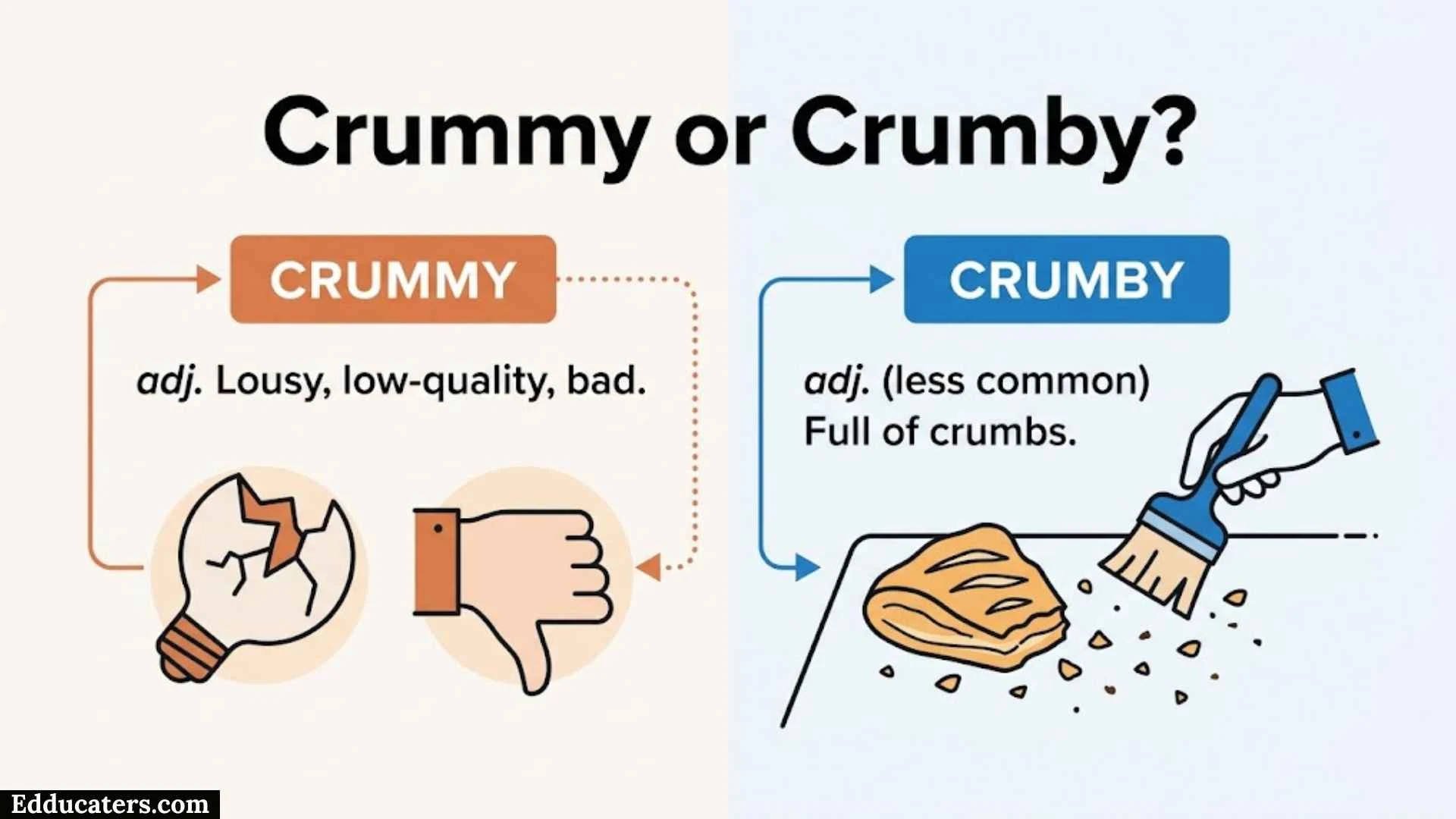
If you are wondering whether the correct spelling is crummy or crumby, the answer depends on what you mean. In modern everyday English, crummy is the usual spelling when you mean bad, unpleasant, inferior, or poor-quality. Crumby has a literal meaning connected with crumbs, such as something covered with or full of crumbs. However, dictionaries also recognize crumby as a variant spelling of crummy, so the two forms have a more complicated relationship than they first appear to have.
For most modern writing, the safest choice is straightforward: use crummy when you mean “bad” or “poor-quality.” Use crumby when you specifically mean something associated with crumbs, although phrases such as “covered in crumbs” or “full of crumbs” are often clearer.
This guide explains the difference between crummy or crumby, including their meanings, pronunciation, history, grammar, common mistakes, examples, and situations where one spelling is more appropriate than the other.
Crummy or Crumby: The Quick Answer
Crummy is the standard modern choice when the intended meaning is bad, unpleasant, inferior, or of very poor quality. Cambridge and Oxford both identify crummy as an informal adjective with this negative meaning.
Crumby has a literal crumb-related meaning: it can describe something that is full of or covered with crumbs. Collins also records crumby as a variant spelling of crummy, which means the spelling can occasionally appear with the negative sense as well.
| Word | Main modern use | Example |
| crummy | Bad, unpleasant, poor-quality | We stayed at a crummy hotel. |
| crumby | Full of or covered with crumbs | The table was crumby after breakfast. |
| crumby | Variant spelling of crummy in some dictionaries | They gave us a crumby deal. |
The easiest rule to remember
If you mean bad, choose crummy.
If you mean covered with crumbs, crumby can express that literal meaning.
For example:
We had a crummy experience at the hotel.
The experience was bad.
The kitchen table was crumby after breakfast.
The table had crumbs on it.
There is one important qualification: crumby is also documented as a variant of crummy, so it is not always an outright spelling error when used to mean “bad.” Nevertheless, crummy is the clearer and more widely recognized choice for that meaning in contemporary standard writing.
What Does Crummy Mean?
Crummy is an informal adjective used to describe something that is very bad, unpleasant, inferior, disappointing, or of poor quality.
Cambridge defines it as being of very bad quality and gives examples involving weather, jobs, movies, and other everyday situations. Oxford similarly defines it as “of very bad quality” and labels it informal.
The word can describe a physical object, service, experience, situation, place, or result.
Crummy Means Bad or Poor-Quality
Consider these examples:
This is a crummy laptop.
The speaker thinks the laptop is poor in quality.
We stayed in a crummy hotel.
The hotel was unpleasant or below expectations.
That was a crummy movie.
The speaker thought the movie was poor.
The company provided crummy service.
The service was unsatisfactory.
In each case, crummy communicates a negative judgment about quality or experience.
Crummy Can Describe an Unpleasant Situation
The word does not have to describe a physical object.
You can use it for an event or situation:
Missing the train was a crummy way to start the morning.
We had some crummy weather during our vacation.
It was a crummy day at work.
Here, crummy means unpleasant or disappointing rather than literally relating to crumbs.
This is one reason crummy is useful in conversational English: it can express general dissatisfaction without being especially formal.
Crummy Is an Informal Word
Register matters when choosing vocabulary.
Oxford and Cambridge both identify crummy as informal.
That means it works naturally in casual conversations, personal writing, informal reviews, messages, and everyday speech.
For example:
I had a crummy day.
sounds natural in conversation.
In a formal report, however, a more precise alternative may be better:
The service was unsatisfactory.
Depending on the context, other alternatives include:
- poor
- inferior
- disappointing
- unpleasant
- inadequate
- low-quality
- unsatisfactory
The best replacement depends on exactly what you are trying to criticize.
What Does Crumby Mean?
Crumby has a literal meaning connected to crumbs. Collins defines it as “full of or littered with crumbs” and also records meanings such as soft or like the inside of bread.
For example:
The table was crumby after breakfast.
The table had crumbs on it.
The children’s seats were crumby after the party.
The seats had been left with crumbs.
My hands were crumby after eating the cookies.
There were crumbs on the hands.
This literal sense is easy to connect with the noun crumb, which means a very small piece of bread, cake, biscuit, or similar food. Cambridge gives crumb the pronunciation /krʌm/ and defines it as a very small piece of bread, cake, or biscuit.
Crumby or Crumb Have a Clear Connection
The relationship is easy to see:
crumb → crumby
The adjective describes something associated with crumbs.
For example:
The floor was crumby.
means the floor had crumbs on it.
However, there is another adjective worth knowing:
crumbly
Crumbly means something that breaks easily into small pieces. Cambridge gives examples such as crumbly bread and crumbly dough.
That distinction matters:
- crumby = full of or covered with crumbs
- crumbly = easily breaking into small pieces
- crummy = bad, unpleasant, or poor-quality
These words look similar, but they do different jobs.
Crummy or Crumby Are Pronounced the Same
One reason these spellings cause confusion is that they are pronounced alike.
Cambridge gives crummy as /ˈkrʌm.i/ and crumby as /ˈkrʌm.i/ in both British and American pronunciation.
In simple terms, both sound approximately like:
KRUM-ee
That means you cannot normally determine the spelling from pronunciation alone.
For example, if someone says:
“That was a crummy hotel.”
you hear the sound, but you do not hear whether the writer would spell it crummy or crumby.
The meaning and context therefore become important when choosing the written form.
Crummy vs. Crumby: The Main Difference
The most useful way to understand the difference is to separate their modern common uses from the dictionary-recognized overlap.
Use Crummy for Bad or Unpleasant
When you want to describe something as bad, poor, inferior, or disappointing, crummy is the clearest choice.
Examples include:
a crummy job
a crummy hotel
a crummy movie
crummy weather
a crummy excuse
a crummy experience
Cambridge specifically gives examples such as “a crummy job,” “a crummy hotel,” and “a crummy movie.”
Use Crumby for a Literal Crumb-Related Meaning
When the intended meaning is connected to actual crumbs, crumby can be used.
For example:
The sofa became crumby after the children ate crackers.
The kitchen floor was crumby after breakfast.
I wiped the crumby counter before preparing dinner.
In these sentences, the word refers to physical crumbs rather than poor quality.
For maximum clarity, especially in formal or edited writing, you can also say:
The sofa was covered in crumbs.
The floor was full of crumbs.
The counter had crumbs all over it.
These alternatives remove any possible ambiguity.
Why the Difference Is More Complicated Than It Looks
It would be too simple to say that crummy is always correct or crumby is always wrong.
Historical and dictionary evidence shows that the two forms have overlapped. Oxford notes that crummy originally had literal senses involving being crumbly or like or covered with crumbs, and identifies it as a variant of crumby.
Collins likewise records crumby as both a literal crumb-related adjective and, in some usage, a variant spelling of crummy.
This means the relationship between the spellings is partly historical rather than simply a case of “one correct spelling and one misspelling.”
For a modern writer, however, clarity remains the practical priority. If your intended meaning is “bad,” crummy is the spelling most readers will recognize immediately.
The History Behind Crummy or Crumby
The spelling difference has an interesting history.
Oxford dates crummy to the mid-19th century in its modern negative sense, while noting that earlier uses involved literal meanings such as “crumbly” and “like or covered with crumbs.” Oxford describes it as a variant of crumby.
Collins gives crumby an origin based on crumb + -y and records the word from the 18th century. It also recognizes crumby as a variant spelling of crummy.
This history helps explain why dictionaries can treat the two spellings differently depending on the sense and variety of English.
The important point for present-day writing is that historical overlap does not mean every modern sentence should use the forms interchangeably. Modern readers generally expect crummy for the informal meaning “bad” or “poor-quality.”
Crummy, Crumby, and Crumbly: Do Not Confuse Them
A third word often enters the discussion: crumbly.
These three forms are related in appearance but have different typical uses.
| Word | Meaning | Example |
| crummy | Bad, unpleasant, poor-quality | It was a crummy hotel. |
| crumby | Full of or covered with crumbs; also a variant of crummy | The table was crumby. |
| crumbly | Breaking easily into small pieces | The cake has a crumbly texture. |
Crumbly Describes Texture
Suppose you are talking about a cookie that breaks apart easily.
You would normally write:
The cookie has a crumbly texture.
You are describing the physical texture of the cookie.
You would not normally use crumby for this idea if what you mean is “easily breaking into crumbs.”
Cambridge defines crumbly as “breaking easily into small pieces.”
That gives you a useful three-way distinction:
crummy → bad
crumby → crumbs
crumbly → breaks into crumbs
Common Mistakes With Crummy or Crumby
The most common mistake is choosing crumby simply because the word looks connected to crumb.
Mistake 1: Using Crumby for “Bad”
I had a crumby day.
If you mean that the day was unpleasant, crummy is the clearer modern choice:
I had a crummy day.
The spelling crumby can be found as a variant of crummy, but using crummy avoids unnecessary ambiguity.
Mistake 2: Using Crummy When You Mean Covered With Crumbs
The table is crummy.
This could be understood as saying the table is poor-quality or unpleasant.
If you specifically mean that crumbs are scattered across it, crumby is the more literal choice:
The table is crumby.
Or, for maximum clarity:
The table is covered in crumbs.
Mistake 3: Confusing Crumby With Crumbly
These are not automatically interchangeable.
The bread is crumbly.
means the bread breaks apart easily.
The table is crumby.
means the table has crumbs on it.
The first describes texture; the second describes the presence of crumbs.
How to Choose the Correct Word in Five Seconds
If you need to make the decision quickly, use this simple guide.
Step 1: Do You Mean “Bad”?
If yes, choose:
crummy
Example:
The customer service was crummy.
Step 2: Are You Talking About Actual Crumbs?
If yes, crumby can fit.
Example:
The kitchen counter was crumby after breakfast.
For clearer formal writing, you can say:
The kitchen counter was covered in crumbs.
Step 3: Do You Mean “Breaks Easily Into Small Pieces”?
Choose:
crumbly
Example:
The cheese has a crumbly texture.
Step 4: Is the Context Formal?
If you are writing a formal report, academic paper, business document, or professional communication, consider whether an exact alternative is better.
Instead of:
The product was crummy.
you might write:
The product was poor in quality.
Instead of:
The table was crumby.
you might write:
The table was covered in crumbs.
The more precise wording can be useful when the informal adjective might sound too casual or ambiguous.
Examples of Crummy in Different Contexts
Understanding real contexts makes the distinction easier to remember.
Everyday Conversation
“How was your weekend?”
“Pretty crummy. It rained the whole time.”
Here, crummy means unpleasant or disappointing.
Workplace Conversation
“How was the temporary office?”
“The room was crummy, and the internet barely worked.”
The speaker is criticizing the quality of the room.
Travel
We stayed at a crummy hotel near the station.
The hotel was poor or unpleasant.
Entertainment
The sound quality was crummy.
The sound quality was very poor.
Customer Service
They gave me a crummy response to my complaint.
The response was unsatisfactory.
These examples all use crummy because the intended idea is negative quality or experience.
Examples of Crumby in Literal Contexts
Now compare situations involving actual crumbs.
After Breakfast
The kitchen floor was crumby after everyone finished breakfast.
After Baking
The counter was crumby after we decorated the cookies.
With Children
The back seat became crumby after the children ate crackers.
At a Picnic
The blanket was crumby after lunch.
In each example, crumby refers to crumbs.
Still, because the word is relatively uncommon, a writer may choose a clearer phrase such as covered with crumbs depending on the audience and context.
Is Crumby a Misspelling of Crummy?
Not necessarily.
This is one of the most important points about the pair.
Crumby is a documented English word. Collins gives it a literal meaning related to crumbs and also records it as a variant spelling of crummy.
Oxford’s entry for crummy also explains the historical connection, describing the modern word as a variant of crumby.
Therefore, calling crumby simply a spelling mistake would be inaccurate.
The better practical advice is:
- If you mean bad or poor-quality, use crummy in ordinary modern writing.
- If you mean full of or covered with crumbs, crumby can express the literal sense.
- If clarity is especially important, say covered in crumbs instead.
Is Crummy More Common for the Meaning “Bad”?
For contemporary general writing, crummy is the clearer and more established choice for the informal meaning “bad” or “of very poor quality.” Cambridge and Oxford both present this meaning directly in their current dictionary entries.
This does not mean crumby never appears with that meaning. Some dictionaries recognize it as a variant. The distinction is therefore one of modern clarity and conventional usage, not a simple grammatical rule declaring one form universally valid and the other universally invalid.
What Are Better Alternatives to Crummy?
Because crummy is informal, you may want a different word in certain situations.
Depending on the context, alternatives include:
- poor
- bad
- inferior
- disappointing
- unpleasant
- inadequate
- unsatisfactory
- low-quality
- substandard
For example:
Informal:
The hotel was crummy.
More neutral:
The hotel was poor.
More formal:
The hotel was of poor quality.
The right choice depends on the tone you want rather than on grammar alone.
A Practical Editing Checklist
Before choosing between crummy, crumby, or crumbly, ask these questions:
- Do I mean bad or poor-quality? → crummy
- Do I mean full of or covered with crumbs? → crumby
- Do I mean easily breaking into small pieces? → crumbly
- Am I writing formally? → Consider a more precise alternative.
- Could the reader misunderstand crumby? → Use “covered in crumbs” or “full of crumbs.”
- Am I using crumby as a variant of crummy? → Be aware that this usage is dictionary-recognized but less clear for many modern readers.
This checklist is more reliable than trying to remember the spelling by appearance alone.
Frequently Asked Questions About Crummy or Crumby
Is “crummy” or “crumby” correct?
Both spellings are legitimate, but they have different common uses. Crummy is the usual modern choice for “bad,” “unpleasant,” or “poor-quality.” Crumby has a literal sense meaning full of or covered with crumbs and is also recognized by dictionaries as a variant of crummy.
How do you spell “crummy” when you mean bad?
The usual spelling is crummy, with two ms.
We had a crummy experience.
Oxford and Cambridge both use this spelling for the informal meaning “of very bad quality.”
Does crumby mean bad?
It can, because dictionaries such as Collins recognize crumby as a variant spelling of crummy. However, crummy is the clearer choice when you mean “bad” in modern everyday writing.
Does crumby mean covered in crumbs?
Yes. Crumby can mean full of or littered with crumbs.
For example:
The table was crumby after breakfast.
What is the difference between crummy or crumbly?
Crummy usually means bad, unpleasant, or poor-quality. Crumbly means something breaks easily into small pieces. Cambridge defines crumbly in terms of breaking into small pieces.
Are crummy or crumby pronounced the same?
Yes. Cambridge lists both crummy or crumby with the pronunciation /ˈkrʌm.i/.
Is “crummy” formal English?
No. Crummy is generally considered informal. Oxford and Cambridge both mark it as informal.
Can I use crummy in professional writing?
You can, but it may sound too casual in formal contexts. In professional writing, alternatives such as poor, unsatisfactory, inferior, or low-quality may communicate the idea more precisely.
Which is correct: “a crummy hotel” or “a crumby hotel”?
If you mean that the hotel was poor, unpleasant, or low-quality, a crummy hotel is the clearest choice.
We stayed in a crummy hotel.
Cambridge and Oxford both provide hotel-related examples for crummy.
Which is correct: “a crumby table” or “a crummy table”?
If you mean that the table has crumbs on it, a crumby table expresses the literal crumb-related idea.
If you mean the table is poor or unpleasant, a crummy table is appropriate.
If there is any possibility of confusion, simply write:
The table was covered in crumbs.
Conclusion: Crummy or Crumby?
The choice between crummy or crumby depends on meaning, context, and the level of clarity you want.
Crummy is the best default when you mean bad, unpleasant, disappointing, inferior, or poor-quality. It is an informal word, and both Cambridge and Oxford recognize this meaning.
Crumby has a literal connection with crumbs and can mean full of or covered with crumbs. At the same time, dictionaries also recognize crumby as a variant spelling of crummy, which explains why you may encounter the spelling with the meaning “bad.”
The simplest modern writing rule is:
Bad or poor-quality → crummy
Full of or covered with crumbs → crumby
Breaks easily into small pieces → crumbly
When precision matters, choose the spelling that makes your intended meaning immediately clear. In most everyday situations where you mean “bad,” crummy is the safest and most recognizable choice.

Hello, I’m Claire Holloway. I have always been passionate about the English language and enjoy turning complex grammar rules into simple, easy-to-follow lessons. I believe that every learner can become a confident English writer with the right guidance.
I create educational content focused on grammar, vocabulary, sentence structure, and writing improvement. Every article I publish is designed to help readers learn with confidence and accuracy.
Books
Grammar Without Confusion
Modern English Usage Guide
 Nathan Whitmore
 Julian Mercer