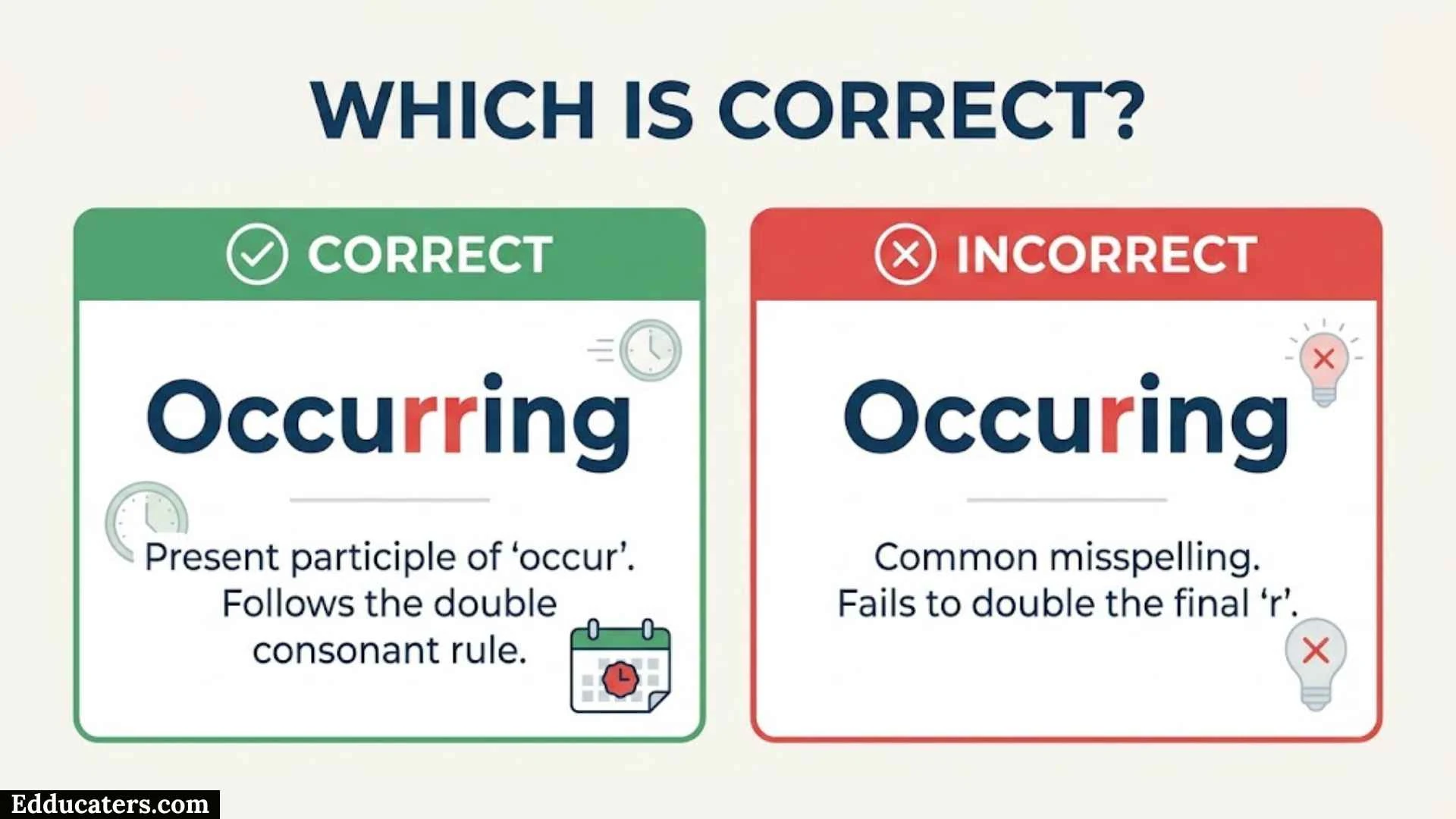
Occurring is the correct spelling. Occuring is a misspelling.
If you are writing a sentence such as “The problem is ___ again,” the correct word is occurring:
The problem is occurring again.
The confusion comes from the verb occur. When the -ing ending is added, the final r is doubled:
occur → occurring
Oxford lists occurred as the past tense and past participle and occurring as the -ing form of occur. Cambridge gives the same verb forms.
This spelling can be easy to get wrong because occuring looks as though it follows a simple “verb + ing” pattern. Understanding the word family and the spelling pattern makes the correct form much easier to remember.
Occurring or Occuring: The Quick Answer
The correct spelling is occurring, with two r’s before -ing.
| Spelling | Correct? | Example |
| occurring | Yes | A technical problem is occurring. |
| occuring | No | This is a misspelling. |
The base verb is occur, and its -ing form is occurring. Oxford also identifies occur as a formal verb meaning “to happen” and gives a second meaning related to something existing or being found somewhere.
So if you are choosing between the two spellings, there is no regional difference to consider:
Use “occurring.”
What Does “Occurring” Mean?
Occurring is the present participle of the verb occur.
The verb occur has two closely related uses. It can mean that something happens or takes place, or that something exists or is present in a particular place or situation. Both Oxford and Cambridge recognize these meanings.
Occurring as “Happening”
In the first sense, occurring describes an event, action, change, problem, or other situation that is taking place.
For example:
Several changes are occurring in the company.
An unexpected delay is occurring at the airport.
The chemical reaction is occurring naturally.
Similar problems are occurring across the system.
In these sentences, occurring is close in meaning to happening or taking place.
Occurring as “Existing or Being Present”
The word can also describe something that exists or is found in a particular place or context.
For example:
Naturally occurring minerals can be found in the Earth’s crust.
The species is occurring in several regions.
The substance contains naturally occurring compounds.
This meaning is especially common in scientific, technical, environmental, and academic writing. Oxford specifically gives examples involving naturally occurring chemicals and species found in particular locations.
That second meaning is easy to overlook when learning the word because many people first encounter occur as a synonym for “happen.”
Why Is It Spelled “Occurring” With Two Rs?
The easiest way to understand the spelling is to start with the base verb:
occur
The word already ends in r. When its -ing form is created, that final consonant is doubled:
occur + ing → occurring
The result is:
o-c-c-u-r-r-i-n-g
The spelling therefore contains two r’s immediately before -ing.
This is also confirmed directly by dictionary entries: Oxford lists the -ing form as occurring, while Cambridge lists occurring as the present participle.
Why “Occuring” Looks Reasonable
The incorrect spelling occuring is easy to produce because English has many verbs that simply take -ing without doubling a final consonant.
Compare:
- help → helping
- visit → visiting
- open → opening
- read → reading
Someone may therefore look at occur and automatically write:
occur + ing = occuring
But that is not the standard spelling of the word.
The correct form is:
occur → occurring
The extra r is not optional.
The Word Family: Occur, Occurs, Occurring, Occurred, Occurrence
One of the best ways to remember the spelling is to understand the entire word family.
| Word | Grammatical role | Example |
| occur | Base verb | Problems can occur unexpectedly. |
| occurs | Present-tense verb | The problem occurs frequently. |
| occurring | Present participle | The problem is occurring again. |
| occurred | Past tense/past participle | The problem occurred yesterday. |
| occurrence | Noun | The problem was a rare occurrence. |
Oxford lists occur, occurred, or occurring as forms of the same verb, while Cambridge identifies occurrence as the related noun for something that happens or exists.
Seeing these forms together makes the spelling pattern much easier to recognize.
Occur or Occurs
Use occur as the base form:
Accidents can occur without warning.
Use occurs with a third-person singular subject in the present tense:
The problem occurs frequently.
The spelling changes from occur to occurs, but the double c and final r remain.
Occurring
Use occurring when the action is in progress or when the -ing form is required.
The problem is occurring again.
Several changes are occurring simultaneously.
Occurred
Use occurred for the past tense and past participle.
The accident occurred yesterday.
The error had occurred before the update.
Cambridge explicitly identifies occurred as both the past simple and past participle of occur.
Occurrence
Occurrence is a noun rather than a verb.
The accident was an unusual occurrence.
Power outages are a common occurrence during severe storms.
Both Oxford and Cambridge define occurrence in relation to something that happens or exists.
Occurring or Occured or Occurred
There is another spelling mistake worth knowing because it involves the same verb.
The correct forms are:
- occur
- occurs
- occurring
- occurred
- occurrence
The incorrect forms include:
- occuring ❌
- occured ❌
Consider these sentences:
The problem is occurring now.
The problem occurred yesterday.
The first sentence describes something happening in the present.
The second describes something that happened in the past.
The doubled r appears in both occurring or occurred.
A Simple Comparison
Think of the forms this way:
Now or in progress:
→ occurring
Past:
→ occurred
A thing or event:
→ occurrence
This distinction is particularly useful when proofreading reports, academic writing, business documents, and technical material.
Occurring vs. Happening
In many sentences, occurring and happening can express a similar idea.
For example:
Something unusual is happening.
Something unusual is occurring.
Both sentences describe something taking place.
However, the words do not always sound equally natural in every context.
Happening is very common in everyday conversation. Occur or occurring are often more formal and are particularly common in academic, professional, scientific, and technical writing. Cambridge describes occur as a formal verb meaning to happen, while Oxford labels it “formal” as well.
Compare:
What is happening here?
This sounds natural in casual conversation.
What is occurring here?
This is grammatical but sounds more formal.
In a scientific report, however, occurring may fit naturally:
Researchers observed several reactions occurring during the experiment.
Occurring vs. Taking Place
Taking place can also be used in many contexts where occurring means “happening.”
For example:
The meeting is taking place at noon.
The meeting is occurring at noon.
The first sentence is more natural in ordinary English. Occurring is usually more useful when discussing events, processes, changes, incidents, or conditions in formal contexts.
The important point is that occurring is not simply a word to insert wherever happening appears. Natural word choice depends on the type of sentence and the intended tone.
How to Use “Occurring” Correctly
The word can appear in several grammatical structures.
Using “Is Occurring”
Use is occurring with a singular subject when describing something happening now or around the present period.
Examples:
A serious problem is occurring in the system.
A change is occurring in the local environment.
An unexpected delay is occurring at the station.
Using “Are Occurring”
Use are occurring with a plural subject.
Examples:
Several problems are occurring at once.
Major changes are occurring in the industry.
Multiple errors are occurring during the process.
The spelling of occurring does not change according to the subject.
Using “Was Occurring” or “Were Occurring”
The same form can be used with past forms of be.
A strange event was occurring when we arrived.
Several unusual events were occurring at the same time.
The choice between was or were depends on the subject, not on the word occurring.
Common Collocations With “Occurring”
Certain words naturally appear with occurring.
Common combinations include:
- currently occurring
- naturally occurring
- commonly occurring
- frequently occurring
- regularly occurring
- changes occurring
- events occurring
- problems occurring
- errors occurring
- incidents occurring
- reactions occurring
- symptoms occurring
For example:
The researchers studied naturally occurring compounds.
The software team investigated frequently occurring errors.
Several changes are currently occurring within the organization.
The report documents recurring incidents occurring in the region.
These combinations show why the word appears frequently in professional and technical contexts.
Occurring in Everyday, Academic, and Professional Writing
The correct spelling does not change according to the type of writing, but the contexts in which occurring is especially useful can vary.
Everyday Writing
In ordinary communication, happening is often the simpler choice.
What is happening?
But occurring is still correct:
What is occurring?
The second version simply has a more formal tone.
Academic Writing
Academic writers often discuss processes, changes, events, and patterns.
The study examines changes occurring in urban populations.
The researchers recorded several reactions occurring during the experiment.
Here, occurring works naturally because the writing describes processes or observed conditions.
Workplace and Business Writing
In professional communication, occurring can describe technical problems, delays, errors, or changes.
Several errors are occurring during the data transfer.
The issue is occurring only on older devices.
Unexpected delays are occurring because of the system update.
When the simpler happening would sound too conversational, occurring can be a suitable formal alternative.
Scientific and Technical Writing
The second meaning of occur—to exist or be present—is particularly important in technical contexts.
For example:
Naturally occurring minerals are found in many geological formations.
Here, occurring does not simply mean that the minerals are “happening.” It means they exist naturally rather than being artificially produced.
Oxford specifically includes this use of occur for things that exist or are found somewhere.
Common Mistakes With Occurring
Understanding the most common errors can help you avoid them during proofreading.
Mistake 1: Writing “Occuring”
Incorrect:
A problem is occuring during installation.
Correct:
A problem is occurring during installation.
The incorrect version is missing one r.
Mistake 2: Writing “Occured”
Incorrect:
The incident occured yesterday.
Correct:
The incident occurred yesterday.
The past form also contains the doubled r. Cambridge confirms occurred as the past form of occur.
Mistake 3: Confusing the Verb and Noun
Incorrect choice:
The event was a strange occurring.
Correct:
The event was a strange occurrence.
Occurrence is the noun.
Another example:
The event is occurring now.
Here, occurring is the verb form.
Mistake 4: Assuming “Happening” and “Occurring” Always Sound Identical
Although the meanings overlap, their style can differ.
What is happening?
is very natural in conversation.
What is occurring?
is more formal.
Knowing this difference helps you choose a word that fits your audience rather than simply choosing a grammatical word.
How to Remember the Correct Spelling
A practical memory trick is to start with the base verb:
OCCUR
Then add -ING while keeping the final r doubled:
OCCUR + ING → OCCURRING
You can also memorize the sequence:
occur → occurred → occurring → occurrence
All of these words belong to the same family, so recognizing the base occur can help you avoid dropping the second r.
Another useful visual check is to look at the middle of the word:
occuRRing
If you see only one r before -ing, stop and check the spelling.
A Quick Decision Guide
When proofreading, use this simple process:
Are you describing something happening now or in progress?
↓
Use occurring.
A problem is occurring.
Are you describing something that happened in the past?
↓
Use occurred.
A problem occurred yesterday.
Are you naming an event or the fact that something happens or exists?
↓
Use occurrence.
It was an unusual occurrence.
Are you wondering whether “occuring” is acceptable?
↓
No. Use occurring.
This gives you a quick way to choose the correct form without having to rethink the spelling each time.
Pronunciation of “Occurring”
The pronunciation of occurring follows the pronunciation of occur.
Oxford gives occur as approximately /əˈkɜːr/ in American English and /əˈkɜː(r)/ in British English, with occurring listed as approximately /əˈkɜːrɪŋ/.
A simple learner-friendly approximation is:
uh-KUR-ing
The main stress falls on the middle part of the word.
It is important to remember that pronunciation does not tell you exactly how many letters to write. The doubled r in occurring is a spelling feature, so hearing the word alone may not remind you to include both letters.
Is “Occurring” Formal English?
Yes. Occurring is a standard English word and is appropriate in formal writing.
The related verb occur is specifically marked as formal by Oxford and Cambridge.
This makes the word particularly common in:
- academic papers
- research writing
- technical documentation
- business reports
- professional correspondence
- scientific descriptions
- news and informational writing
That does not mean occurring is restricted to formal writing. It is perfectly grammatical in ordinary English. The difference is mainly one of natural style and context.
A Note on “Occur To”
There is another useful expression involving occur that learners sometimes confuse with the main meaning.
Occur to someone means that an idea or thought comes into someone’s mind.
For example:
It never occurred to me that the door was unlocked.
Did it occur to you that we could take the train?
Oxford treats occur to somebody as a phrasal verb meaning that an idea or thought comes into someone’s mind.
This construction is different from the ordinary use of occur meaning “happen.”
Compare:
The accident occurred at noon.
Here, occurred means happened.
It occurred to me that I had forgotten my keys.
Here, occurred to me means the thought came into my mind.
Knowing both meanings gives you a fuller understanding of the word rather than treating occur as simply another spelling question.
Frequently Asked Questions
Is occurring or occuring correct?
Occurring is correct. Occuring is a misspelling.
Does occurring have two Rs?
Yes. The correct spelling is occurring, with two r’s before the -ing ending.
Why is there a double r in occurring?
The base verb is occur, and its standard -ing form is occurring. The final r is doubled in the spelling. Oxford and Cambridge both list occurring as the correct present participle.
Is “occuring” an alternative spelling?
No. Occuring is not a standard alternative spelling of occurring. It is a misspelling.
What is the difference between occurring or occurred?
Occurring is the -ing form:
The problem is occurring now.
Occurred is the past form:
The problem occurred yesterday.
Cambridge identifies occurred as the past simple and past participle of occur.
What is the noun form of occurring?
The related noun is occurrence.
The incident was a rare occurrence.
Occurrence can refer to something that happens or to the fact that something exists or is present.
Is occurring the same as happening?
Often, yes. In many contexts occurring means happening or taking place. However, occur is generally more formal than happen, and it also has a separate meaning related to something existing or being present.
Can occurring be used in academic writing?
Yes. It is common in academic, scientific, technical, and professional writing, particularly when describing processes, events, changes, or conditions.
How do you spell occurring correctly?
Remember:
occur + ing = occurring
The correct word contains two r’s:
occurring
What is an example sentence with occurring?
Several technical problems are occurring during the installation process.
Another example is:
Naturally occurring minerals were found in the rock sample.
Is occurring a verb?
Occurring is the present participle and -ing form of the verb occur. It can function as part of a verb phrase and can also appear in participial or adjective-like constructions.
Does the spelling change in British and American English?
No. The spelling occurring is used in both British and American English. The pronunciation of occur can differ slightly between the varieties, but the spelling remains the same. Oxford provides British and American pronunciations while listing the same verb form, occurring.
Conclusion
If you are deciding between occurring or occuring, choose occurring every time in standard English.
The correct spelling is:
occurring ✅
The incorrect spelling is:
occuring ❌
The easiest way to remember it is to connect the word to its base form:
occur → occurring
The same word family includes occurs, occurred, and occurrence. Understanding these related forms is more useful than memorizing one spelling in isolation.
Use occurring when describing something that is happening or taking place:
The problem is occurring again.
Use it also when describing something that exists or is naturally present:
The substance contains naturally occurring compounds.
For past events, use occurred:
The incident occurred yesterday.
And when you need the noun, use occurrence:
It was an unusual occurrence.
The key spelling to remember is simple:
OCCURRING — with two Rs.
References
- Oxford Learner’s Dictionaries, “occur” — verb forms, definitions, pronunciation, usage, and examples.
- Oxford Learner’s Dictionaries, “occurrence” — noun forms, meanings, collocations, and examples.
- Cambridge Dictionary, “occur” — meanings, pronunciation, usage, and related forms.
- Cambridge Learner’s Dictionary, “occur” — present participle occurring and past form occurred.
- Cambridge Dictionary, “occurrence” — meanings and usage examples.

I’m Julian Mercer, an English language writer dedicated to helping people master grammar through practical examples and clear explanations. I enjoy teaching grammar in a way that is both engaging and easy to remember.
My work focuses on grammar rules, punctuation, word usage, and writing techniques that readers can apply in everyday life. I believe learning English should be simple, enjoyable, and useful.
Books
English Grammar in Practice
Writing with Precision
 Claire Holloway
 Nathan Whitmore