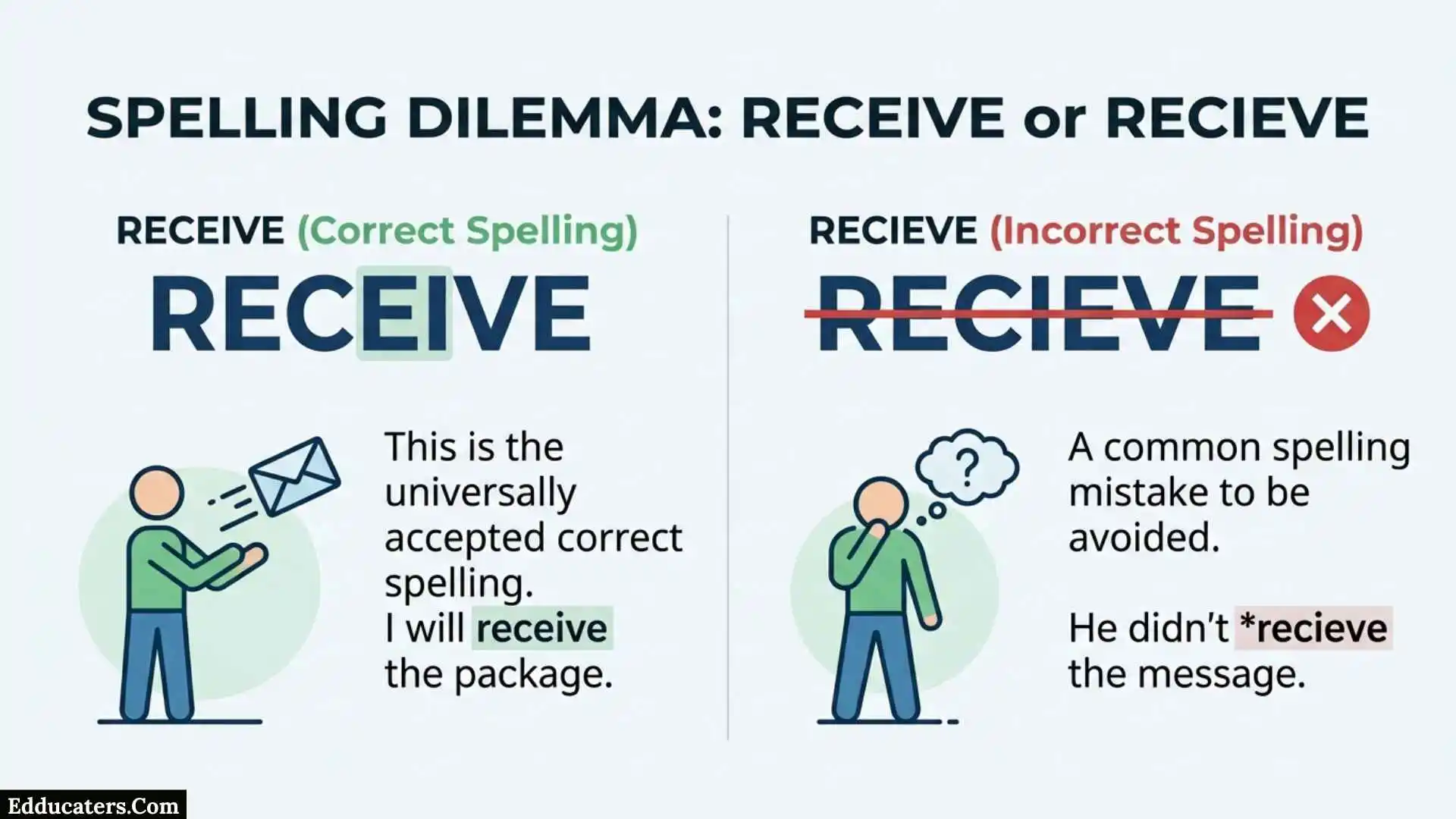
If you are searching for “recieve or receive,” you probably want to know which spelling is correct before using the word in an email, assignment, message, application, or other piece of writing.
The correct spelling is receive.
Recieve is a misspelling and is not the standard spelling of the English word.
The correct form is:
receive
The incorrect form is:
recieve
The word receive is a verb that commonly means “to get or be given something.” It can also mean to welcome someone, react to something in a particular way, or receive a signal, depending on the context. Cambridge Dictionary and Merriam-Webster both list receive as the standard word and provide several of these meanings.
This guide explains the difference between receive or recieve, why the mistake happens, how to remember the spelling, how to use the word correctly, and how to avoid related errors such as recieved and recieving.
Recieve or Receive: The Quick Answer
Receive is correct. Recieve is incorrect.
| Spelling | Correct? | Meaning |
| receive | Yes | To get, obtain, accept, welcome, or experience something, depending on context |
| recieve | No | Common misspelling of receive |
If you are writing the sentence:
I hope you receive my email.
the spelling receive is correct.
Writing:
I hope you recieve my email.
is incorrect.
The Correct Spelling
The word is spelled:
R-E-C-E-I-V-E
A useful way to see the spelling is:
RE-CEI-VE
The important sequence is CEI.
The Incorrect Spelling
The common error is:
R-E-C-I-E-V-E
This changes CEI into CIE.
That small letter reversal is the main reason people write recieve instead of receive.
Why Is Receive Correct?
English spelling can be difficult because letters do not always follow a single predictable pattern. In receive, the letters ei appear after c.
This is why the traditional spelling mnemonic “I before E, except after C” is often associated with the word.
However, this phrase should not be treated as an absolute rule for every English word. English has numerous spelling patterns and exceptions. For receive, the safest approach is to remember the actual spelling rather than rely entirely on a general rhyme.
Remember the “CEI” Pattern
The simplest spelling method is to focus on the middle of the word:
RE + CEI + VE
That gives you:
RECEIVE
Instead of trying to decide between ie and ei every time, remember the complete pattern CEI.
The “I Before E” Rule Is Only a Memory Aid
You may have learned:
I before E, except after C.
This helps explain why receive has ei after c.
But English spelling has enough exceptions that the phrase should not be used as a universal test.
For example, words such as weird, science, and foreign show why spelling cannot always be reduced to one simple rule.
For receive, however, the practical takeaway is easy:
After C, remember EI in receive.
What Does Receive Mean?
Receive is a verb. Its most common meaning is to get or be given something.
Cambridge Dictionary defines the common use as getting or being given something, while Merriam-Webster includes meanings such as coming into possession of something, welcoming someone, reacting to something in a specified way, and experiencing something.
Receive Means to Get Something
This is the most common everyday meaning.
Examples:
I received your letter yesterday.
Did you receive my email?
She will receive the package tomorrow.
We received your application this morning.
In each example, someone gets something that has been sent, given, or provided.
Receive Can Mean to Welcome Someone
The verb can also mean to formally welcome a visitor or guest.
For example:
The host stood at the entrance to receive the guests.
This use is more formal than simply saying welcome. Cambridge Dictionary specifically lists this sense of the word.
Receive Can Describe a Reaction
“Receive” is also used to describe how an idea, speech, proposal, performance, or decision is treated.
For example:
The proposal was well received by the committee.
Here, well received means that the committee reacted positively to the proposal.
You can also say:
The announcement was warmly received.
or:
The decision was poorly received by employees.
This is a common construction in professional and formal English.
Receive Can Refer to Signals
The word is also used in technology and communications.
For example:
The television receives signals from the satellite.
The radio cannot receive a clear signal in this area.
Cambridge Dictionary includes this technical sense of receive, particularly in relation to radio and television signals.
How Do You Pronounce Receive?
Receive is pronounced /rɪˈsiːv/.
For an approximate pronunciation, think:
ri-SEEV
The main stress falls on the second syllable.
Cambridge Dictionary gives the pronunciation /rɪˈsiːv/ for both British and American English.
Why Pronunciation Does Not Help Much With Spelling
The pronunciation of receive does not tell you whether the middle should be spelled ie or ei.
That is why someone can pronounce the word correctly while still writing:
recieve
The best solution is to memorize the written pattern:
RE-CEI-VE
Receive or Recieve in Sentences
Seeing the two forms side by side makes the difference easier to understand.
| Incorrect | Correct |
| Did you recieve my email? | Did you receive my email? |
| I recieved your message. | I received your message. |
| We are recieving applications. | We are receiving applications. |
| She will recieve the award. | She will receive the award. |
| Have you recieved the package? | Have you received the package? |
The key is not simply learning that “recieve” is wrong. You should also learn how the spelling changes when the verb is used in different grammatical forms.
Receive Word Forms
The main forms of the verb are receive, receives, received, and receiving.
Merriam-Webster lists received and receiving as the relevant forms of the verb.
Receive
Use receive as the base form.
I expect to receive a response tomorrow.
Customers will receive a confirmation email.
You may receive a notification shortly.
Receives
Use receives with a singular third-person subject in the present tense.
She receives hundreds of emails every week.
The company receives many applications.
The customer receives an automatic notification.
Received
Use received as the past tense and past participle.
I received your message yesterday.
We received the documents this morning.
Your payment has been received.
A very common spelling mistake is:
recieved
The correct form is:
received
Receiving
Use receiving as the present participle.
We are receiving new orders.
The company is receiving applications until Friday.
She is receiving regular updates.
A common mistake is:
recieving
The correct spelling is:
receiving
Notice the spelling change:
receive → receiving
The final e is removed before -ing, but the ei sequence remains.
Why Do People Write Recieve Instead of Receive?
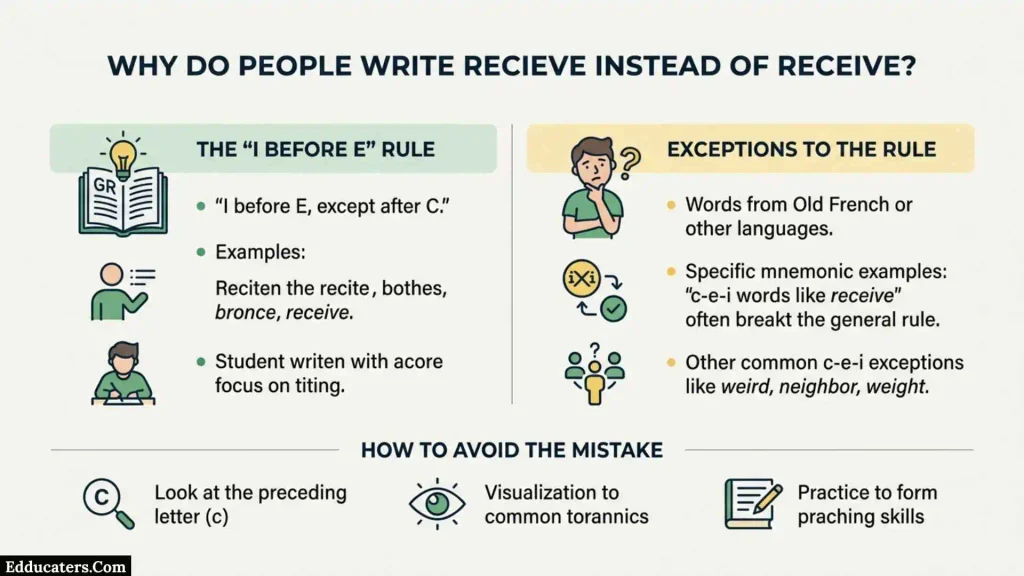
The mistake usually happens because the writer knows the word but is uncertain about the order of e and i.
Both ie and ei appear in English words, so people sometimes transfer a familiar pattern to the wrong word.
Similar Spelling Patterns Can Cause Confusion
Consider these words:
- believe
- piece
- friend
- achieve
- receive
- deceive
- perceive
Some use ie, while others use ei.
That variation makes it difficult to rely only on visual intuition.
Typing Makes the Mistake Easy
“Recieve” is also a common typing error because the two forms are almost identical.
A writer may know that the word is receive but accidentally type the letters in the wrong order.
This is particularly easy when writing quickly on a phone or keyboard.
A spell checker can catch many such mistakes, but knowing the correct spelling yourself is still valuable, especially in formal writing.
Receive vs. Get: What Is the Difference?
Receive and get can sometimes express the same basic idea, but they differ in tone and usage.
Compare:
I got your email.
with:
I received your email.
The first sentence sounds more conversational.
The second sounds more formal and neutral.
When Receive Is Better Than Get
Use receive when writing:
- Professional emails
- Business documents
- Formal letters
- Academic assignments
- Applications
- Customer-service messages
- Official notices
For example:
We have received your application and will contact you shortly.
This is more formal than:
We got your application.
Neither is necessarily wrong in the right context, but receive is often the better choice in formal communication.
Receive vs. Accept: What Is the Difference?
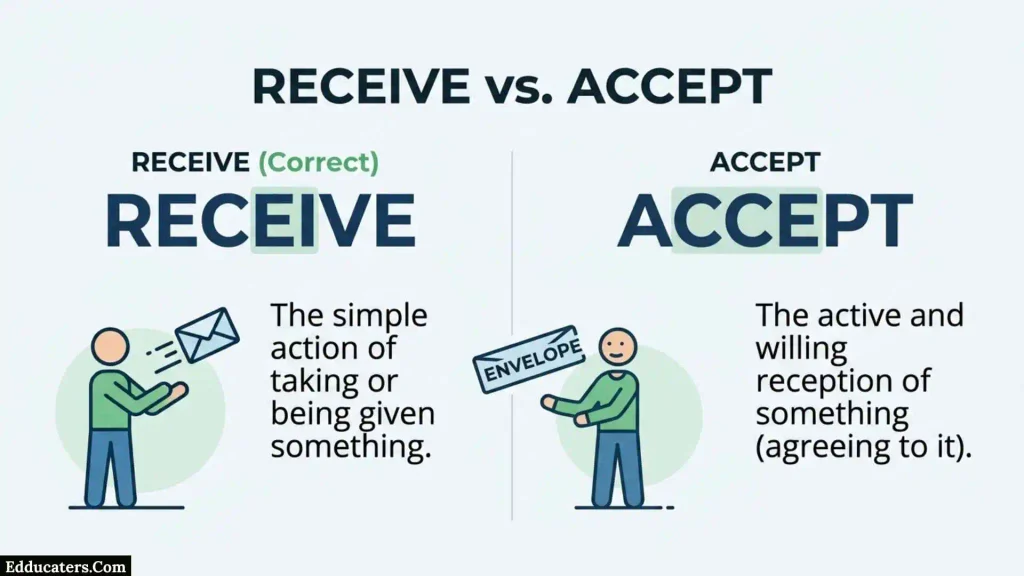
Receive and accept are sometimes confused because they can occur in similar situations.
However, they describe different actions.
Receive generally means that something comes to you or is given to you.
Accept generally means that you agree to take, approve, or welcome something.
For example:
I received the job offer.
This tells us that the offer was given or sent to the person.
I accepted the job offer.
This tells us that the person agreed to take it.
You can therefore receive something without accepting it.
For example:
She received the invitation but did not accept it.
Understanding this difference is useful when choosing the right verb in formal writing.
Common Mistakes With Receive
The most common errors involve changing the order of letters or applying the spelling pattern incorrectly.
Recieve
Incorrect:
I will recieve your message soon.
Correct:
I will receive your message soon.
Recieved
Incorrect:
We recieved your application.
Correct:
We received your application.
Recieving
Incorrect:
We are recieving new applications.
Correct:
We are receiving new applications.
Receve
Incorrect:
Did you receve the package?
Correct:
Did you receive the package?
The easiest solution is to remember the core sequence:
RE-CEI-VE
How to Remember Receive
A good memory technique is more useful than repeatedly correcting the same spelling mistake.
Use the “CEI” Memory Trick
Remember:
RE-CEI-VE
The middle three letters are:
CEI
When you see C, remember that EI follows it in this word.
Remember the “-ceive” Group
Several English words share the -ceive spelling pattern:
- receive
- deceive
- conceive
- perceive
Seeing these words together can reinforce the spelling pattern.
For example:
receive
deceive
conceive
perceive
The shared -ceive ending gives you a useful visual pattern to remember.
Practice the Three Most Important Forms
If you often make spelling mistakes, memorize these together:
receive → received → receiving
This is more practical than remembering only the base word because these are the forms you are likely to encounter in everyday writing.
Receive in Everyday Writing
“Receive” appears frequently in ordinary communication.
Emails
Did you receive my email?
I received your message this morning.
You will receive a confirmation email shortly.
Orders and Deliveries
When will I receive my order?
I received the package yesterday.
You will receive a tracking number after dispatch.
School and University
Students will receive their results next week.
She received an award for her academic work.
Successful applicants will receive an admission letter.
Business Communication
We have received your application.
Please confirm that you received the attached document.
Customers will receive an update when the order ships.
Payments
We have received your payment.
You should receive your refund soon.
The supplier received the payment yesterday.
These examples show why spelling receive correctly matters. The word is especially common in formal and professional communication.
Receive in Academic and Professional English
In academic and professional writing, receive often appears in standard phrases.
Examples include:
receive information
receive an award
receive funding
receive approval
receive permission
receive a response
receive an application
receive payment
receive treatment
receive support
Learning these common combinations can improve both spelling and vocabulary because you begin to recognize the word in context.
Receive and Its Related Words
Learning related vocabulary can help you recognize the spelling more easily.
Receipt
A receipt is commonly a written or electronic record showing that a payment or transaction has been made.
Example:
Please keep your receipt for your records.
Although receipt and receive are related words, their spellings are not identical.
Receiver
A receiver is someone or something that receives something.
Example:
The device contains a wireless receiver.
Reception
Reception can refer to the act or manner of receiving something, or to an event where guests are welcomed.
Example:
The proposal received a positive reception.
Receptive
Receptive means willing or ready to consider something.
Example:
The students were receptive to the new teaching method.
These words belong to a broader group of vocabulary connected with receiving and accepting.
Where Does the Word Receive Come From?
The history of receive goes back through Middle English and Anglo-French to Latin recipere, a verb associated with taking or receiving.
Merriam-Webster traces the word through Middle English and Anglo-French to Latin recipere, from re- and capere, meaning “to take.” It records the first known use of receive in the 14th century.
This historical background helps explain why receive is connected to other words dealing with receiving, accepting, taking, and welcoming.
You do not need to know the history to spell the word correctly, but it provides useful context for understanding why English contains a family of related words.
A Quick Decision Guide for Receive or Recieve
When you are unsure, use this simple process.
Are You Trying to Say “Get” or “Be Given”?
If yes, the word may be:
receive
Example:
I will receive the package tomorrow.
Are You Writing the Past Tense?
Use:
received
Example:
I received the package yesterday.
Are You Describing an Ongoing Action?
Use:
receiving
Example:
We are receiving applications now.
Does Your Draft Say “Recieve”?
Change it to:
receive
The same check applies to related errors:
recieved → received
recieving → receiving
This quick decision guide is useful when proofreading an email, assignment, application, or professional document.
How to Proofread Receive Correctly
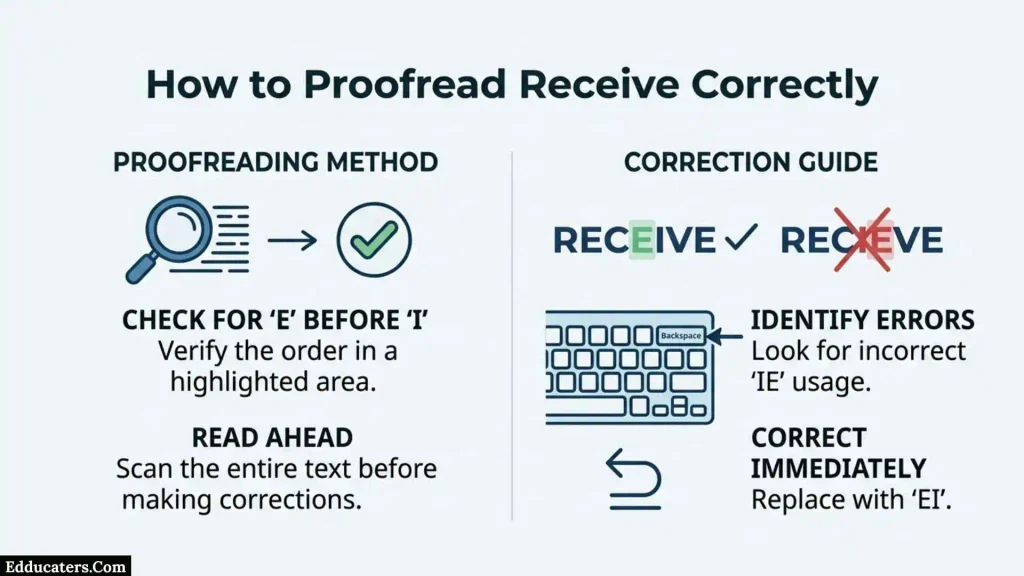
A final spelling check can prevent the most common errors.
Check the Middle Letters
Look at:
CEI
If you have written CIE, check the word again.
Check the Verb Ending
If the sentence is in the past tense, make sure you have:
received
not:
recieved
If the sentence uses the continuous form, check for:
receiving
not:
recieving
Read the Whole Sentence
Do not check spelling in isolation. Read the complete sentence and ask whether the meaning is about getting, being given, accepting, welcoming, or experiencing something.
For example:
We have received your request.
The meaning and grammar both confirm that received is the appropriate form.
Is “Recieve” Ever Correct?
In standard modern English, recieve is not the normal spelling of the verb meaning “to get” or “to be given.”
If you encounter recieve in an email, article, assignment, or message, it is generally a spelling error for receive.
For standard English writing, use:
receive
Frequently Asked Questions
Is it recieve or receive?
Receive is correct. Recieve is a misspelling.
How do you spell receive?
The correct spelling is R-E-C-E-I-V-E.
Why is recieve wrong?
“Recieve” places the i and e in the wrong order. The correct middle sequence is CEI.
Is recieved a correct spelling?
No. The correct past tense and past participle is received. Merriam-Webster lists received as the past form of receive.
Is recieving correct?
No. The correct spelling is receiving.
What does receive mean?
It commonly means to get or be given something. Depending on context, it can also mean to welcome someone, react to something in a particular way, or receive a signal.
How do you pronounce receive?
It is pronounced /rɪˈsiːv/, approximately “ri-SEEV.”
What is the past tense of receive?
The past tense is received.
Example:
I received your email yesterday.
What is the present participle of receive?
The present participle is receiving.
Example:
We are receiving new applications.
Is receive a verb?
Yes. Receive is a verb.
What is the difference between receive and accept?
Receive usually means to get or be given something, while accept means to agree to take, approve, or welcome something.
For example:
I received the offer but did not accept it.
What is the easiest way to remember receive?
Remember the middle sequence:
CEI
Then write the word as:
RE-CEI-VE
You can also remember related -ceive words such as deceive, conceive, and perceive.
Is the phrase “I before E except after C” enough to spell receive?
It can serve as a memory aid because receive uses ei after c, but it should not be treated as a universal rule for all English words.
Is receive formal or informal?
“Receive” works in both everyday and formal English. It is particularly common in professional, academic, official, and business writing.
Can receive mean welcome?
Yes. In formal contexts, receive can mean to formally welcome a visitor or guest.
Can receive be used for radio or television signals?
Yes. “Receive” can describe a radio, television, or similar device taking in a signal.
Key Takeaways
If you only remember a few points, remember these:
- Receive is the correct spelling.
- Recieve is a misspelling.
- The correct spelling is R-E-C-E-I-V-E.
- Remember the middle sequence CEI.
- The past form is received.
- The present participle is receiving.
- “Receive” commonly means to get or be given something.
- It can also mean to welcome someone, react to something, or receive a signal depending on context.
- “I before E except after C” can help as a memory aid, but it is not a universal English spelling rule.
- Receive is common in everyday, academic, business, and professional English.
Conclusion
When choosing between recieve or receive, the correct choice is receive.
Remember the spelling:
RE-CEI-VE
The most common related mistakes are recieve, recieved, and recieving. The correct forms are receive, received, and receiving.
The best way to remember the word is to focus on CEI and recognize the broader -ceive spelling pattern found in words such as deceive, conceive, and perceive.
If you are writing an email, school assignment, business document, application, or formal message, using receive will ensure that you are using the standard spelling.

Hello, I’m Claire Holloway. I have always been passionate about the English language and enjoy turning complex grammar rules into simple, easy-to-follow lessons. I believe that every learner can become a confident English writer with the right guidance.
I create educational content focused on grammar, vocabulary, sentence structure, and writing improvement. Every article I publish is designed to help readers learn with confidence and accuracy.
Books
Grammar Without Confusion
Modern English Usage Guide
 Julian Mercer