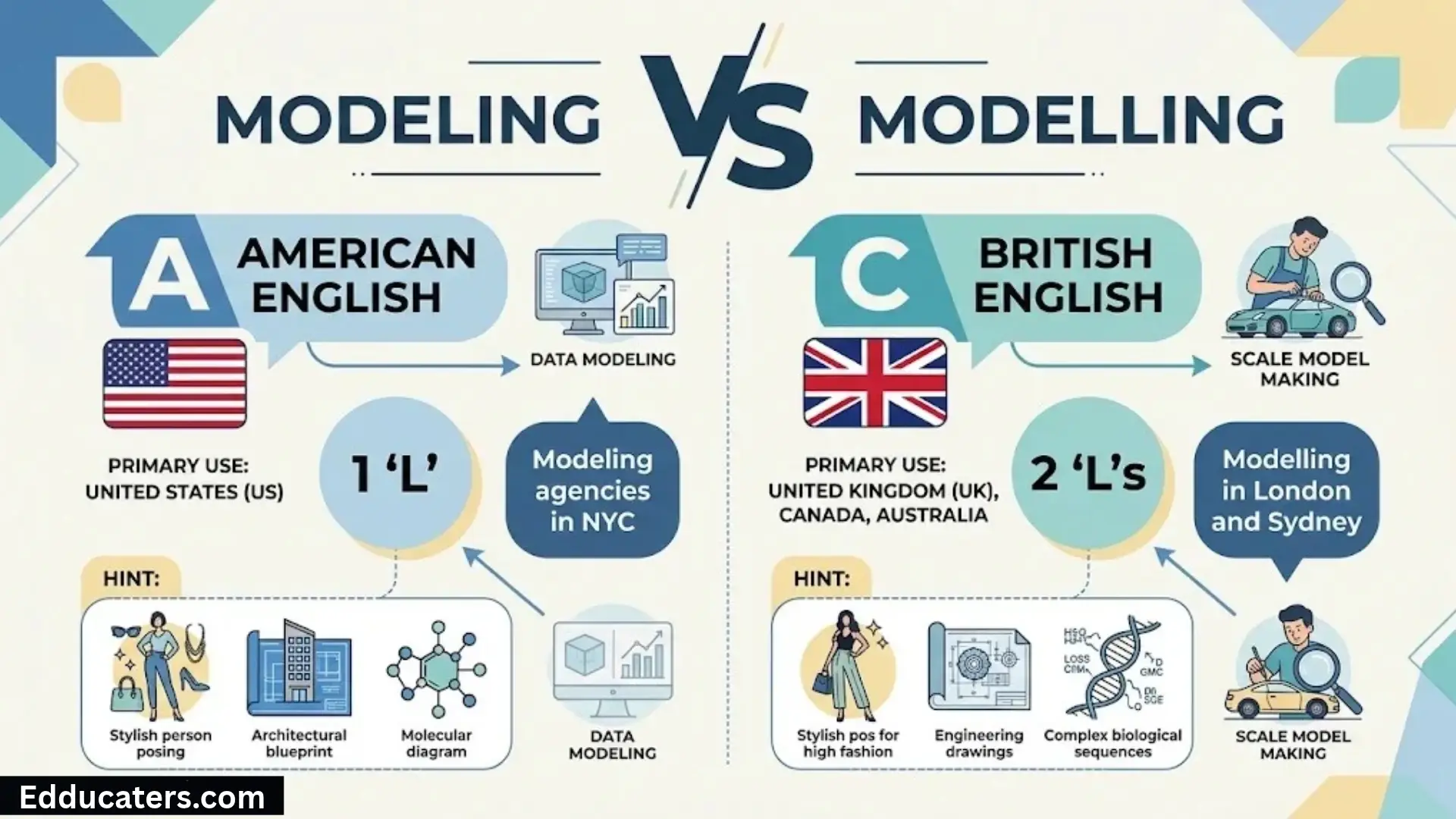
Have you ever wondered whether to write modeling or modelling? Both spellings look familiar, yet the extra letter L can make you second-guess your choice. The good news is that neither spelling is wrong. The difference comes down to regional English spelling conventions.
Modeling is the standard spelling in American English. Modelling is the preferred spelling in British English and several other varieties, including Australian and New Zealand English. Canadian English generally favors modelling as well, although Canadian spelling practices can vary by publication and style guide.
Both words have exactly the same meaning. They describe the process of creating, using, or representing a model. You might encounter them in fashion, mathematics, science, finance, architecture, or computer design.
The distinction also carries over to related words. Americans generally write modeled and modeler, while British writers prefer modelled and modeller.
Understanding this small spelling difference helps you write more clearly and maintain consistency. Whether you’re preparing an academic paper, publishing a blog post, or writing a professional report, the right choice depends on your intended audience.
Modeling or Modelling: What’s the Difference?
The main difference between modeling or modelling is the number of Ls. American English uses one L before the suffix -ing, while British English generally doubles the final L.
Consider these examples:
| American English | British English |
| Modeling | Modelling |
| Modeled | Modelled |
| Modeler | Modeller |
| Modeling career | Modelling career |
| 3D modeling | 3D modelling |
| Financial modeling | Financial modelling |
| Climate modeling | Climate modelling |
The two forms share the same definition, grammatical function, and pronunciation. Only their spelling changes.
For example, an American company might advertise a position for a 3D modeler. A British company could advertise the same position for a 3D modeller. Both descriptions refer to someone who creates three-dimensional digital models.
The same distinction applies to the activity itself. An American scientist might write about climate modeling, while a British scientist might use climate modelling.
Neither spelling makes the activity different.
Why Do the Spellings Differ?
The difference comes from the way American and British English handle certain words ending in a single consonant when adding suffixes.
British English commonly doubles the final L in words such as travel, cancel, and model. American English often keeps one L in comparable forms.
This distinction produces familiar pairs:
- Traveling or travelling
- Canceled or cancelled
- Labeled or labelled
- Modeling or modelling
These variations developed through different spelling conventions across English-speaking regions. They don’t indicate different meanings or pronunciation patterns.
One important point: American English doesn’t always avoid doubled consonants, and British English doesn’t double every final consonant. The applicable spelling pattern depends on the word, suffix, and regional convention.
Modeling or Modelling in American and British English
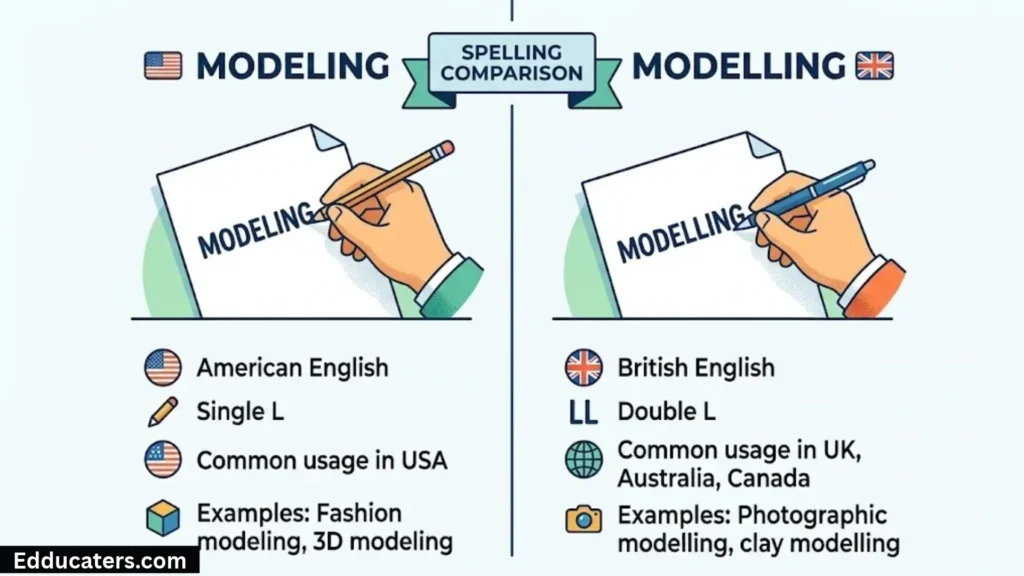
The spelling you choose usually depends on the English variety you’re following. American and British English have different conventions for several words ending in L.
The distinction isn’t limited to modeling. It also appears in words such as traveling, canceling, and labeling. Understanding these patterns makes it easier to recognize the correct form in different regions.
Modeling in American English
Modeling is the preferred spelling in the United States. American dictionaries recognize this form for the activity of creating models or working as a fashion model.
The same convention applies to its related forms:
- Modeling: Present participle or gerund.
- Modeled: Past tense and past participle.
- Modeler: A person who creates or works with models.
For example:
- She started a modeling career after graduating from college.
- The architect is modeling a new residential building.
- Researchers modeled the possible effects of rising temperatures.
- The company hired a skilled 3D modeler for its latest project.
You’ll also encounter this spelling in American technical and professional writing.
Common expressions include:
- Fashion modeling
- Commercial modeling
- Mathematical modeling
- Financial modeling
- Climate modeling
- Computer modeling
- 3D modeling
For American publications, using one L throughout these related forms helps maintain consistency.
Modelling in British English
Modelling is the standard British spelling. British writers generally double the final L when adding suffixes such as -ing and -ed to model.
Its related forms include:
- Modelling: Present participle or gerund.
- Modelled: Past tense and past participle.
- Modeller: A person who creates or works with models.
For example:
- She began a modelling career after completing her training.
- The architect is modelling a historic building.
- Scientists modelled several possible climate scenarios.
- The company employed an experienced 3D modeller.
The same spelling appears across British professional and academic contexts.
You’ll commonly see expressions such as:
- Fashion modelling
- Commercial modelling
- Mathematical modelling
- Financial modelling
- Climate modelling
- Computer modelling
- 3D modelling
An important distinction is that British English doesn’t make the doubled-L form mandatory in every context. Dictionaries may recognize alternative spellings. However, modelling remains the conventional British choice.
Modeling or Modelling in Canadian English
Canadian English can be confusing because it combines features of American and British spelling. It doesn’t follow either system completely.
For many words ending in L, Canadian usage favors the doubled-L form. For example, travelled, cancelled, and labelled are common Canadian spellings.
The same preference appears in some Canadian institutional style guides for modelling and modelled. The Canadian Institutes of Health Research, for example, lists these forms as its preferred spellings.
Canada.ca+1
However, Canadian spelling isn’t entirely uniform.
The Government of Canada’s language guidance explains that Canadian English has no single clearly established spelling standard for every variation. It recommends choosing a reliable Canadian dictionary and following it consistently.
Canada.ca
If you’re writing for a Canadian audience, consider these forms:
| Word | Common Canadian form |
| Modeling | Modelling |
| Modeled | Modelled |
| Modeler | Modeller |
| Traveling | Travelling |
| Canceled | Cancelled |
| Labeled | Labelled |
The exact preference can depend on your publisher, organization, or chosen dictionary.
Practical tip: If a Canadian publication has its own editorial style guide, follow that guide rather than automatically applying American or British rules.
Modeling or Modelling in Australian English
Australian English generally follows British-style spelling conventions for words ending in L.
Therefore, modelling, modelled, and modeller are familiar and preferred forms in Australian writing.
You’ll encounter them in several contexts:
- A student studying 3D modelling.
- A scientist researching climate modelling.
- A company developing financial modelling tools.
- A professional pursuing a fashion modelling career.
Australian organizations often use established Australian dictionaries to maintain consistent spelling. The Australian Government Style Manual recommends selecting an authoritative Australian dictionary and following its preferred entries. It specifically identifies the Australian Concise Oxford Dictionary and Macquarie Dictionary as useful references.
Style Manual
This guidance matters because Australian English has its own conventions. Following a British dictionary automatically isn’t always the best approach.
Modeling or Modelling in New Zealand English
New Zealand English also uses many British-derived spelling conventions.
Consequently, modelling is the usual spelling in New Zealand. The related forms modelled and modeller follow the same pattern.
For example:
- The university offers courses involving computer modelling.
- The researcher modelled population growth.
- The company hired a professional 3D modeller.
If you’re writing for a New Zealand institution, use its preferred dictionary or editorial guidelines.
Although New Zealand and British English share many spelling patterns, their vocabulary and usage aren’t identical. Regional preferences still matter.
Modeling or Modelling in Ireland
Irish English shares several spelling conventions with British English. As a result, modelling, modelled, and modeller are natural choices in many Irish publications.
However, Ireland doesn’t have one universal spelling rule that governs every publication.
Some organizations follow British dictionaries, while others establish their own editorial preferences. If you’re preparing professional or academic content for an Irish audience, check the relevant style guide.
Why Does Modeling Have One L in American English but Two in British English?
The extra L comes from a difference in spelling conventions.
English sometimes doubles a final consonant when adding a suffix. This process is called the consonant doubling rule.
For example, consider the verb run:
- Run becomes running.
- Run becomes runner.
The final consonant doubles before the suffix. However, the rule depends on the word’s structure and stress pattern.
The word model creates an interesting regional difference. Its pronunciation places the primary stress on the first syllable:
MOD-el
American English generally follows the convention that doesn’t double the final L in this word. British English commonly doubles it anyway.
That produces two accepted forms:
- American: model → modeling
- British: model → modelling
The same distinction applies when adding -ed or forming the agent noun with -er.
The Consonant-Doubling Rule Explained
The final consonant doubling rule helps determine whether a word needs an extra consonant before a suffix.
In many English words, you double the final consonant when adding a suffix beginning with a vowel if certain conditions apply.
A common pattern involves a single-syllable word ending in:
- One vowel.
- One consonant.
Consider these examples:
| Base word | With -ing | With -ed |
| Stop | Stopping | Stopped |
| Plan | Planning | Planned |
| Run | Running | Runned* |
| Sit | Sitting | Sitted* |
| Hop | Hopping | Hopped |
The last two columns illustrate the doubling pattern, not necessarily natural past-tense forms. The correct past forms are ran and sat.
A more useful comparison of regular forms is:
| Base word | Present participle | Past tense |
| Stop | Stopping | Stopped |
| Plan | Planning | Planned |
| Drop | Dropping | Dropped |
| Clap | Clapping | Clapped |
| Beg | Begging | Begged |
The doubling convention also applies to longer words when the final syllable carries the primary stress.
For example:
- Admit → admitting → admitted.
- Begin → beginning → beginner.
- Prefer → preferring → preferred.
Notice that the final syllable receives the main stress in these base words.
However, when the final syllable is unstressed, American English generally doesn’t double the consonant in comparable forms.
For example:
- Open → opening → opened.
- Visit → visiting → visited.
- Develop → developing → developed.
The word model has first-syllable stress. American English therefore writes modeling rather than modellling.
British English has a broader convention for doubling final L. It often retains the doubled consonant even when the final syllable isn’t stressed.
That’s why you see modelling rather than modeling in British writing.
Examples of American and British Consonant Doubling
Several familiar verbs demonstrate the same regional pattern.
| Base verb | American English | British English |
| Travel | Traveling | Travelling |
| Cancel | Canceling | Cancelling |
| Label | Labeling | Labelling |
| Model | Modeling | Modelling |
| Counsel | Counseling | Counselling |
Here are the differences in context:
Traveling or travelling
- American: We are traveling across the country.
- British: We are travelling across the country.
Canceling or cancelling
- American: The company is canceling the event.
- British: The company is cancelling the event.
Labeling or labelling
- American: The manufacturer is labeling each package.
- British: The manufacturer is labelling each package.
Modeling or modelling
- American: The engineer is modeling the new structure.
- British: The engineer is modelling the new structure.
Counseling or counselling
- American: She works in a counseling center.
- British: She works in a counselling center.
These examples demonstrate why regional spelling matters. The difference isn’t limited to one particular word.
Meaning and Grammar of Modeling or Modelling
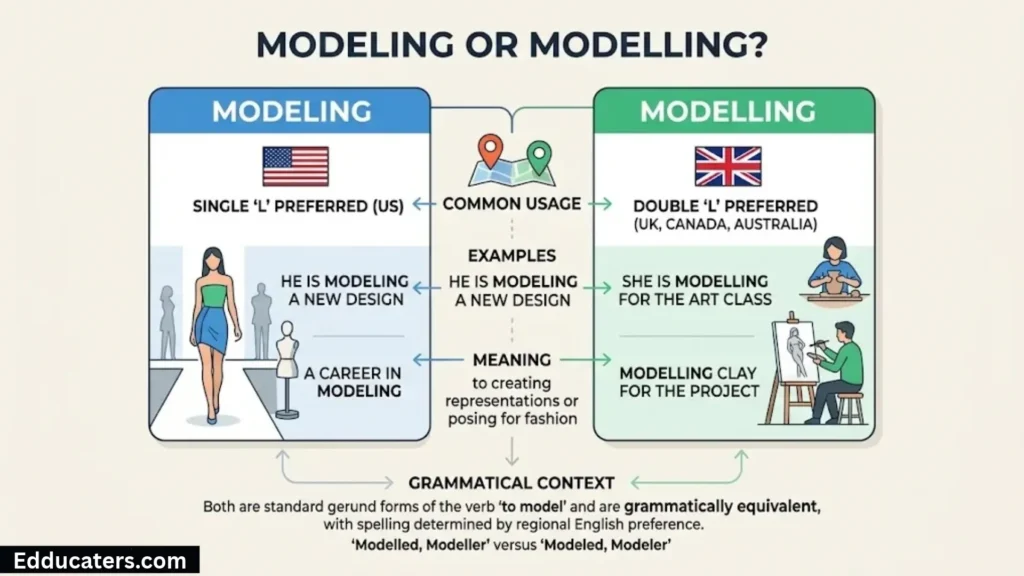
Although modeling and modelling have different spellings, they share the same grammatical functions.
Both forms come from the base verb model. Depending on the sentence, the word can function as a verb, gerund, present participle, or noun.
Understanding these roles helps you use the word correctly rather than simply choosing the right number of Ls.
Modeling or Modelling as a Gerund
A gerund is a verb form ending in -ing that functions as a noun.
Both modeling and modelling can describe an activity or process. They answer questions such as “What activity?” or “What does someone enjoy doing?”
For example:
- Modeling requires patience and attention to detail.
- She enjoys modelling for independent fashion designers.
- Mathematical modeling helps researchers understand complicated systems.
- Computer modelling plays an important role in product development.
In these examples, the words identify activities rather than describe ongoing actions.
Modeling or Modelling as a Present Participle
A present participle is a verb form ending in -ing. It commonly appears in continuous tenses or describes an ongoing action.
For example:
- She is modeling a new collection for the designer.
- The research team is modelling future climate conditions.
- The architect is modeling a commercial building.
- Scientists are modelling the spread of an infectious disease.
The grammatical function remains the same in both regional varieties.
The spelling changes, but the tense and meaning don’t.
Modeling or Modelling as a Noun
The word also functions as a noun when it describes a professional activity, technical process, or creative practice.
For example:
- Fashion modeling attracts people interested in advertising and photography.
- Financial modelling helps analysts evaluate business decisions.
- Three-dimensional modeling allows designers to create digital objects.
- Clay modelling involves shaping a material into a particular form.
The context determines the specific meaning.
In fashion, modeling usually refers to presenting clothing, products, or designs. In mathematics, it describes representing real-world situations through mathematical relationships.
In technology, it often means creating digital representations of physical objects or systems.
Modeled or Modelled: Which Spelling Is Correct?
Both modeled and modelled are correct past-tense and past-participle forms of the verb model.
The difference follows the same regional spelling convention as modeling and modelling.
- Modeled: Standard American English spelling.
- Modelled: Standard British English spelling.
Consider these examples:
| American English | British English |
| The artist modeled the sculpture. | The artist modelled the sculpture. |
| The architect modeled the building. | The architect modelled the building. |
| Scientists modeled the disease outbreak. | Scientists modelled the disease outbreak. |
| She modeled for a fashion company. | She modelled for a fashion company. |
Both versions describe completed actions.
The word can also appear as a past participle after auxiliary verbs.
For example:
- American: The building has been modeled using advanced software.
- British: The building has been modelled using advanced software.
If you’re writing in American English, choose modeled. For British English, choose modelled.
Modeler or Modeller: Which Form Should You Use?
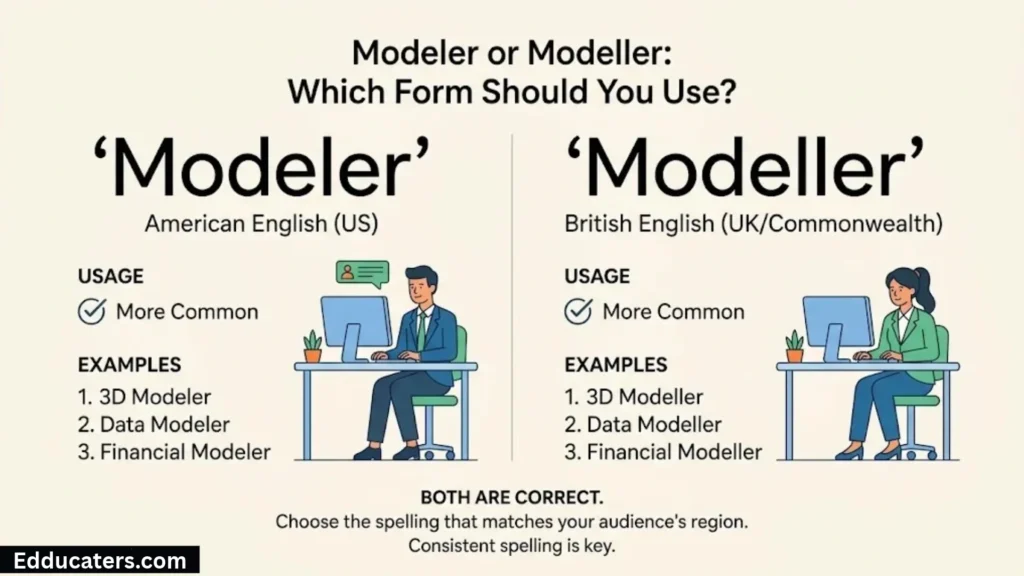
The words modeler and modeller refer to someone who creates, develops, or works with models.
The spelling depends on regional preferences.
- Modeler: American English.
- Modeller: British English and commonly used in other British-influenced varieties.
The word can describe professionals working in several industries. A modeler might create miniature vehicles, architectural structures, mathematical representations, or digital characters.
For example:
- The American company hired a talented 3D modeler.
- The British studio hired an experienced 3D modeller.
- A mathematical modeler studies relationships between different variables.
- A climate modeller uses computer simulations to examine environmental changes.
The distinction is purely orthographic. Both forms describe the same occupation or activity.
How to Use Modeling or Modelling in a Sentence
Seeing both spellings in complete sentences makes the distinction easier to remember.
The following examples demonstrate how each form works in different situations.
Examples of Modeling in American English
Use these sentences when following American spelling conventions:
- Her modeling career began with a local advertising campaign.
- The company hired a professional modeling agency.
- Scientists use climate modeling to examine possible environmental changes.
- The engineer is modeling a new bridge design.
- Financial modeling helps investors evaluate potential risks.
- The architect modeled the building before construction began.
- The studio hired an experienced 3D modeler.
- Role modeling can influence children’s behavior and development.
- The university offers courses in mathematical modeling.
- The designer uses specialized software for digital modeling.
Examples of Modelling in British English
These examples follow British spelling conventions:
- Her modelling career began with a local advertising campaign.
- The company hired a professional modelling agency.
- Scientists use climate modelling to examine possible environmental changes.
- The engineer is modelling a new bridge design.
- Financial modelling helps investors evaluate potential risks.
- The architect modelled the building before construction began.
- The studio hired an experienced 3D modeller.
- Role modelling can influence children’s behavior and development.
- The university offers courses in mathematical modelling.
- The designer uses specialized software for digital modelling.
Notice that the sentence structures and meanings remain identical. Only the spelling changes.
Common Uses of Modeling or Modelling Across Different Fields
The word modeling appears in many industries. Its meaning changes slightly depending on the subject, but the spelling convention stays the same.
Whether you’re discussing fashion, scientific research, or digital design, the regional distinction remains consistent.
Fashion and Commercial Modeling
Fashion modeling involves presenting clothing, accessories, and other products through photographs, runway appearances, or promotional campaigns.
Professional models work with designers, photographers, advertising agencies, and fashion brands.
Common activities include:
- Walking in fashion shows.
- Appearing in print campaigns.
- Promoting clothing and accessories.
- Participating in television advertisements.
- Creating content for digital campaigns.
- Working with professional modeling agencies.
For example, an American fashion magazine might publish an article about a successful modeling career. A British publication would generally use modelling career.
Both expressions describe the same profession.
Mathematical and Scientific Modeling
Mathematical modeling involves representing real-world situations through mathematical equations, relationships, and assumptions.
Researchers use these representations to understand complicated systems and explore possible outcomes.
For example, scientists can create models to study:
- Population growth.
- Infectious disease transmission.
- Environmental changes.
- Weather patterns.
- Traffic movement.
- Resource consumption.
Climate modeling is another important application. Researchers use computer simulations and scientific data to examine how the climate system may respond to different conditions.
A model doesn’t reproduce every detail of reality. Instead, it simplifies a complicated system so researchers can investigate particular relationships.
American researchers generally write mathematical modeling. British researchers usually write mathematical modelling.
Financial Modeling
Financial modeling involves building numerical representations of a company’s financial performance.
Businesses and financial professionals use these models to estimate future results and evaluate investment decisions.
A financial model may include:
- Revenue forecasts.
- Operating expenses.
- Cash flow projections.
- Profit estimates.
- Debt calculations.
- Investment assumptions.
For example, an investment analyst might develop a financial model to estimate how a company’s revenue could change over the next five years.
The American spelling is financial modeling. British English generally uses financial modelling.
3D Modeling and Digital Design
3D modeling is the process of creating a three-dimensional digital representation of an object, character, environment, or structure.
Designers use specialized software to build objects with specific shapes, dimensions, and surface details.
Common applications include:
- Video game character design.
- Architectural visualization.
- Product development.
- Animation and visual effects.
- Engineering simulations.
- Manufacturing prototypes.
For example, an architect might create a 3D model of a proposed building before construction begins.
This representation allows clients and engineers to examine the design from different angles.
American software documentation commonly uses 3D modeling. British documentation often uses 3D modelling.
Role Modeling
Role modeling refers to demonstrating behavior that other people may observe and imitate.
Parents, teachers, coaches, and community leaders can act as role models.
For example, a teacher who treats students fairly demonstrates positive behavior. Children may observe that example and adopt similar habits.
Role modeling can involve:
- Demonstrating honesty.
- Showing respect for others.
- Practicing responsibility.
- Handling disagreements calmly.
- Encouraging cooperation.
- Developing healthy habits.
The spelling difference remains regional:
- American English: Role modeling
- British English: Role modelling
Both expressions describe the same concept.
Modeling or Modelling: Common Spelling Mistakes to Avoid
Even though both spellings are correct, writers sometimes mix regional conventions or misunderstand how related word forms work.
A few simple habits can help you avoid these mistakes.
Mixing American and British Spelling
One common mistake is using American and British forms interchangeably in the same document.
For example:
- The company is modeling a new product.
- The architect modelled the building.
- She hired a professional modeler.
Each word is recognizable. However, the combination creates inconsistent spelling because the first and third forms follow American conventions while the second follows British conventions.
Choose one regional standard and maintain it throughout your document.
Assuming the Extra L Changes the Meaning
Another mistake is assuming that modeling and modelling describe different activities.
They don’t.
Both words can refer to creating a representation, demonstrating something, or working as a fashion model.
The extra L doesn’t change the definition or grammatical function.
Applying the Consonant-Doubling Rule Incorrectly
The consonant doubling rule doesn’t mean every word ending in L automatically receives another L.
The spelling depends on the word and the regional convention.
For example:
- American: traveling
- British: travelling
- American: modeling
- British: modelling
Remember that British English commonly doubles the final L in these forms even when the final syllable isn’t stressed.
Forgetting Related Word Forms
Writers sometimes remember the spelling of modeling but forget its other forms.
For example, someone following American English might correctly write modeling but accidentally use modelled elsewhere.
Remember these complete word families:
| American English | British English |
| Model | Model |
| Modeling | Modelling |
| Modeled | Modelled |
| Modeler | Modeller |
Learning the complete pattern makes consistent writing much easier.
How to Choose Between Modeling or Modelling
Choosing between modeling or modelling becomes simple once you identify your audience.
You don’t need to memorize complicated spelling rules for every situation. Start with the regional English standard required by your publication or readers.
Here are some practical guidelines.
- Choose modeling when writing for American readers.
- Choose modelling when following British English conventions.
- Check a Canadian dictionary when writing for a Canadian audience.
- Follow an Australian dictionary when preparing Australian content.
- Use the publisher’s style guide when writing academic papers, reports, or professional documents.
- Maintain spelling consistency throughout your article or manuscript.
Which Spelling Should You Use for an International Audience?
International writing requires a little more attention because readers may follow different English conventions.
For example, a website might attract visitors from the United States, United Kingdom, Canada, Australia, and New Zealand.
In this situation, choosing one consistent spelling system is usually the best approach.
Consider these recommendations:
| Target audience | Recommended spelling |
| United States | Modeling |
| United Kingdom | Modelling |
| Canada | Modelling is common; check the chosen Canadian standard |
| Australia | Modelling |
| New Zealand | Modelling |
| Ireland | Modelling is commonly preferred |
If your publication follows American English, use modeling consistently even when international readers visit your website.
If it follows British English, use modelling throughout.
Consistency matters more than trying to accommodate every regional preference within one article.
Modeling or Modelling: Frequently Asked Questions
Is modeling or modelling correct?
Both modeling and modelling are correct spellings of the same word.
Modeling is standard in American English, while modelling is preferred in British English. Both forms have the same meaning and pronunciation.
Is modeling American or British English?
Modeling is the standard American English spelling.
American writers use one L in related forms such as modeled and modeler. British English generally uses modelling, modelled, and modeller.
Is modelling acceptable in American English?
Yes, readers can understand modelling, but it isn’t the standard American spelling.
If you’re writing for an American audience, use modeling. American dictionaries and publications generally prefer the single-L form.
Do Canadians use modeling or modelling?
Canadians commonly use modelling, following a British-style spelling convention.
However, Canadian English combines British and American influences. Spelling preferences can vary between dictionaries, publishers, and organizations.
For professional Canadian writing, consult an established Canadian dictionary or the publication’s style guide.
Do Australians and New Zealanders spell it modelling?
Yes. Modelling is the usual spelling in both Australian and New Zealand English.
These varieties generally follow British-derived conventions for words such as modelled, travelling, and cancelled.
What is the difference between modeled and modelled?
Both words are past-tense and past-participle forms of model.
Modeled is the American spelling, while modelled is the British spelling.
For example:
- American: The engineer modeled the new structure.
- British: The engineer modelled the new structure.
Both sentences communicate exactly the same idea.
What is the difference between modeler and modeller?
The difference is regional spelling.
Modeler is the preferred American form, while modeller is the usual British form.
Both words describe someone who creates, develops, or works with models.
Why does modelling have two Ls?
British English commonly doubles the final L when adding suffixes such as -ing and -ed to certain words.
American English generally doesn’t double the final L in modeling or modeled because the first syllable carries the primary stress.
This convention produces the different spellings.
Does modeling or modelling have a different pronunciation?
No. The spelling difference doesn’t normally change pronunciation.
Both forms represent the same word and have the same pronunciation within a given English accent.
The additional L is a written regional variation rather than a different spoken sound.
Can you use modeling and modelling in the same document?
You can, but it’s generally better to avoid mixing them.
Using both forms without a clear reason makes your writing inconsistent. Choose American or British English and apply that convention throughout the document.
However, preserve official names, direct quotations, and titles exactly as their original publishers write them.
Which spelling should you use for an international audience?
Choose the spelling system that best suits your primary audience.
Use modeling if your publication follows American English. Choose modelling if it follows British English conventions.
The important thing is to maintain consistency across your content.
What other verbs follow the same spelling pattern?
Several English verbs demonstrate the same regional difference.
Here are some common examples:
| American English | British English |
| Traveling | Travelling |
| Traveled | Travelled |
| Canceling | Cancelling |
| Canceled | Cancelled |
| Labeling | Labelling |
| Labeled | Labelled |
| Counseling | Counselling |
| Counseled | Counselled |
These examples help illustrate the broader difference between American and British spelling conventions.
Conclusion: Modeling or Modelling?
The choice between modeling or modelling depends on which English spelling convention you’re following.
Both forms are correct, and neither changes the word’s meaning or pronunciation.
Remember these simple distinctions:
- Modeling is standard in American English.
- Modelling is standard in British English.
- Canadian English commonly favors modelling, although preferences vary.
- Australian and New Zealand English generally use modelling.
- Modeled and modeler are American forms.
- Modelled and modeller are British-style forms.
The next time you write about fashion, mathematics, financial analysis, or 3D design, consider your intended audience before choosing a spelling.
One extra L might seem insignificant, but consistent spelling makes your writing look more polished and professional.

Hi, I’m Nathan Whitmore, and I enjoy making English grammar easy for learners of all ages. I believe grammar should be practical, not confusing. I write simple, well-researched guides that help readers improve their writing, speaking, and overall communication skills.
I spend a lot of time studying grammar patterns, sentence construction, punctuation, and modern English usage. My goal is to create lessons that anyone can understand, whether they are students, teachers, or professionals.
Books
Clear English Grammar
The Smart Writer’s Grammar Handbook
 Julian Mercer
 Claire Holloway