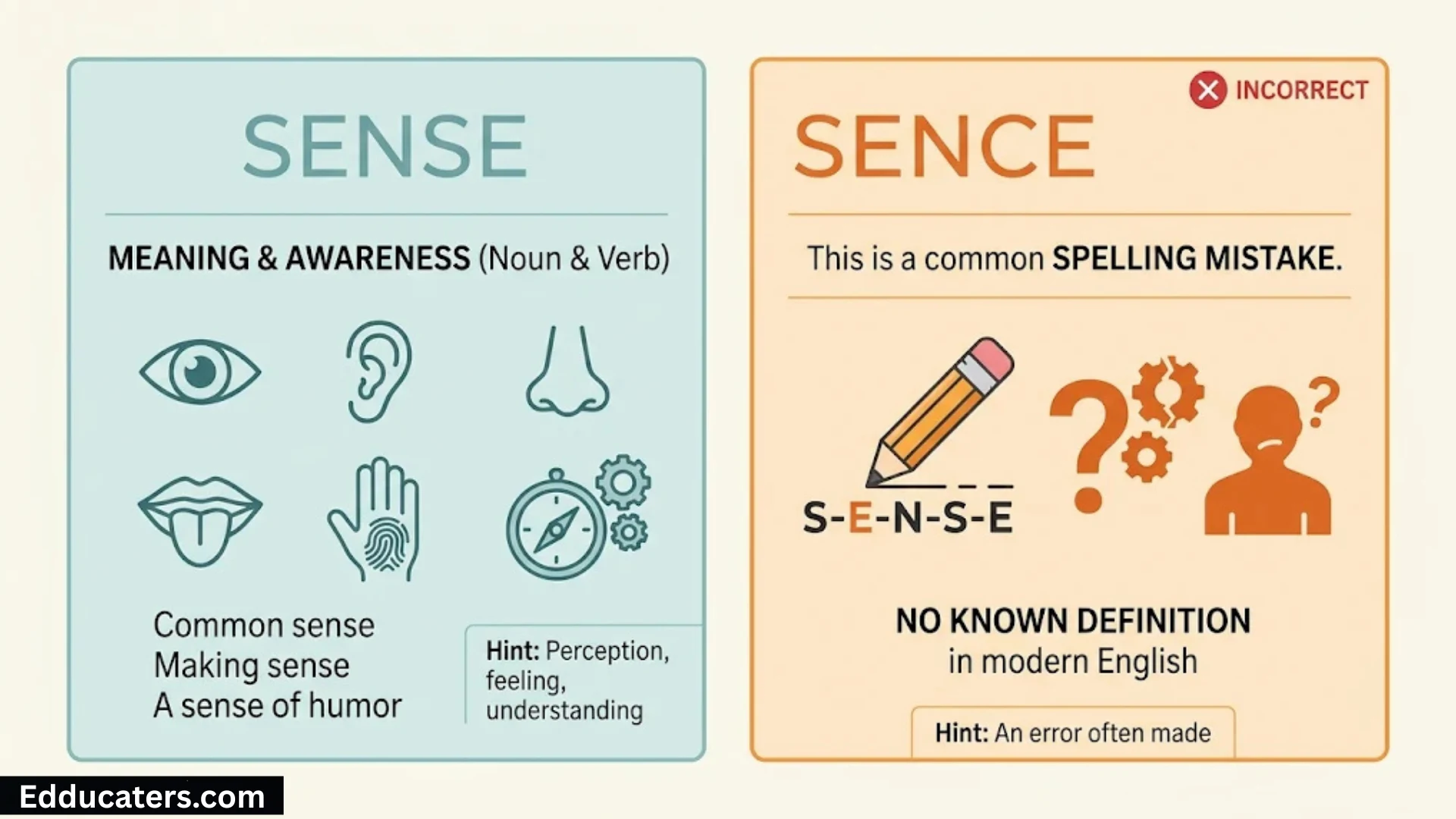
Have you ever stopped while writing because you couldn’t decide between sence or sense? You’re not alone. These two spellings look almost identical and sound the same in ordinary English pronunciation. However, only one is the standard spelling in modern English.
Sense is the correct spelling. It refers to perception, understanding, awareness, judgment, or the meaning of something. You can use it when discussing the five human senses, describing someone’s common sense, or explaining whether an idea makes sense.
On the other hand, sence is generally an incorrect spelling in contemporary English. Although historical sources record it as an older spelling, modern writers should use sense in everyday, academic, and professional communication.
Let’s explore their meanings, grammatical functions, differences, and practical examples so you can remember the correct spelling.
Sence or Sense: Which One Is Correct?
The correct spelling is sense, with an S rather than a C in the middle. It follows the standard English spelling used in both American and British English.
The word works as both a noun and a verb. As a noun, it describes a person’s ability to perceive things, understand information, or make reasonable decisions. As a verb, it means to detect, notice, or become aware of something.
Consider these examples:
- She has a good sense of direction.
- That explanation doesn’t make sense.
- You should use your common sense before making a decision.
- I could sense that something was wrong.
In each sentence, sense communicates a meaningful idea related to perception, understanding, or awareness.
Is Sence a Word?
The spelling sence has appeared in historical English usage. Some older texts used it as an alternative spelling of sense. However, it isn’t the accepted spelling in contemporary standard English.
You might occasionally encounter sence in historical documents, old literature, informal writing, or online messages. Its appearance doesn’t make it an appropriate substitute for sense in modern communication.
For example:
- Incorrect in modern standard English: I have no sence of direction.
- Correct: I have no sense of direction.
The difference matters because readers expect the established spelling. Using sence in an essay, email, application, or business document can make your writing appear careless.
Therefore, remember this simple rule: Use sense whenever you mean perception, understanding, judgment, or meaning.
Sence or Sense: Quick Comparison
| Feature | Sense | Sence |
| Modern standard spelling | Correct | Incorrect |
| Historical usage | Yes | Yes, as an older spelling |
| Part of speech | Noun and verb | Not a standard modern form |
| Meaning | Perception, awareness, judgment, or meaning | Usually intended to mean sense |
| Pronunciation | /sens/ | Usually intended to sound like sense |
| Modern writing | Recommended | Avoid |
The important distinction is that sense remains the accepted modern spelling. Sence belongs to historical spelling records or modern spelling mistakes.
What Does Sense Mean?
The word sense has several meanings depending on the situation. It can describe your physical ability to experience the world, your understanding of an idea, or your ability to make sensible decisions.
It can also refer to the meaning of a word, statement, or action.
Let’s examine its most common meanings.
Sense as a Noun
A noun names a person, place, thing, feeling, or idea. The word sense functions as a noun when it describes a particular ability, understanding, judgment, or interpretation.
Here are its main meanings.
Physical perception
One common meaning of sense is the ability to recognize or experience things through your body. People traditionally identify five major senses: sight, hearing, smell, taste, and touch.
Each sense provides information about the surrounding environment.
For example:
- My sense of smell is particularly strong.
- Loud music can affect your sense of hearing.
- Dogs have an excellent sense of smell.
- Her sense of touch helped her recognize the fabric.
These examples describe how people and animals receive information through their sensory systems.
Understanding or comprehension
Sense can also describe someone’s ability to understand information, situations, or ideas.
When you understand what someone means, you grasp the sense of their statement. Similarly, a person with good sense can recognize reasonable ideas and understand situations.
For example:
- I finally understand the sense of his explanation.
- She has a clear sense of what needs to happen.
- His words made perfect sense after I explained the situation.
Here, the word refers to comprehension rather than physical perception.
Good judgment or practical wisdom
Another important meaning involves the ability to make sensible decisions. People often use sense when discussing practical judgment, reasoning, and everyday choices.
This meaning appears frequently in the expression common sense.
For example:
- Use your sense before spending all your savings.
- He showed good sense by checking the information first.
- Sometimes, common sense matters more than complicated instructions.
In these sentences, sense describes the ability to recognize what is reasonable or appropriate.
Meaning or interpretation
Sense can also refer to what a word, sentence, statement, or action communicates.
For example:
- What is the sense of this sentence?
- The final paragraph gives the story a different sense.
- Her statement has a deeper sense than I initially realized.
This meaning frequently appears in reading, writing, literature, and everyday conversations.
Awareness or feeling
Sometimes, sense describes a person’s awareness of something or an internal feeling about a situation.
For example:
- I had a strange sense that someone was watching us.
- She felt a sense of relief after finishing the examination.
- He developed a strong sense of responsibility.
These examples describe emotional awareness, impressions, and personal feelings.
Sense as a Verb
Although many people recognize sense as a noun, it also works as a verb.
As a verb, sense means to detect, perceive, notice, or become aware of something. You might sense danger before seeing it or notice that someone feels uncomfortable without hearing an explanation.
For example:
- I can sense something unusual in this room.
- She sensed that her friend was upset.
- The dog sensed danger and started barking.
- He could sense a change in the atmosphere.
The verb often describes an intuitive feeling or an awareness that develops through observation.
Its common grammatical forms include:
| Verb Form | Example |
| Base form | Sense |
| Third-person singular | Senses |
| Past tense | Sensed |
| Present participle | Sensing |
For example, you might write, “She senses danger,” “He sensed trouble,” or “They are sensing a change.”
Understanding both grammatical functions helps you use the word naturally in different situations.
How to Use Sense in a Sentence
The easiest way to understand a word is to see how people use it in everyday communication. Sense appears in conversations, books, workplace messages, academic writing, and ordinary descriptions.
Here are examples showing its different meanings.
| Meaning | Example Sentence |
| Physical perception | My sense of hearing is very sensitive. |
| Understanding | I understand the sense of your argument. |
| Good judgment | You should use some common sense. |
| Meaning | This sentence has a completely different sense. |
| Awareness | She had a sense that something was wrong. |
| Direction | My brother has an excellent sense of direction. |
| Humor | My father has a wonderful sense of humor. |
| Responsibility | Every employee needs a sense of responsibility. |
| Verb: detection | I can sense that you’re worried. |
| Verb: awareness | The animal sensed danger nearby. |
Notice how the same spelling communicates several related ideas. Context helps readers understand which meaning the writer intends.
For example, “I have a sense of smell” describes a physical ability. However, “I have a sense that something will happen” describes an impression or feeling.
Both sentences use the same word correctly.
Common Expressions and Idioms With Sense
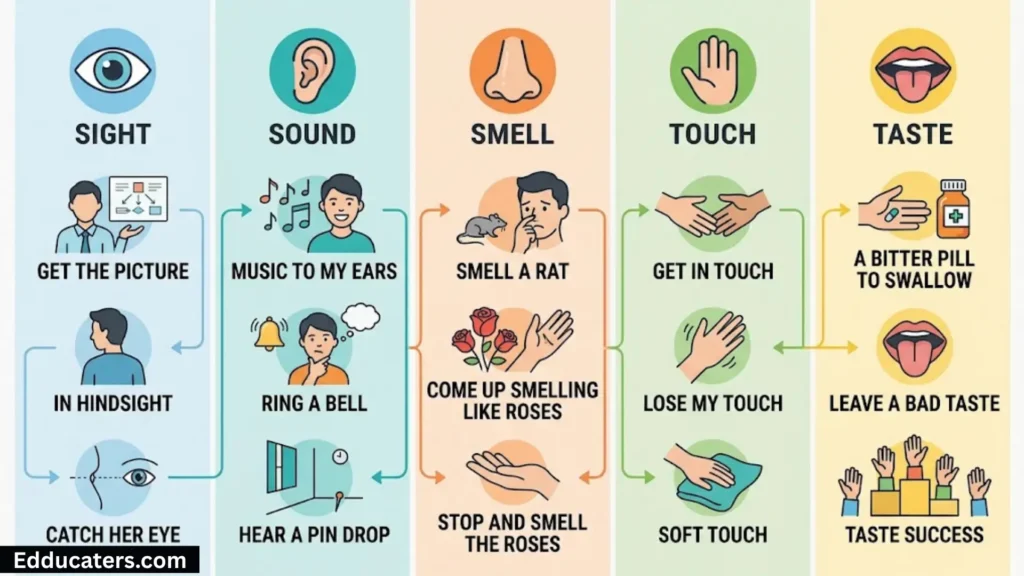
English speakers use sense in many familiar expressions. Learning these phrases can help you understand conversations and improve your vocabulary.
Make Sense
The expression make sense means that something is logical, understandable, or reasonable.
People commonly use it when discussing explanations, decisions, instructions, or ideas.
Examples:
- Your explanation makes sense now.
- This sentence doesn’t make sense.
- Does the new schedule make sense to everyone?
You can also use make sense when describing a practical decision.
For example, “Buying a reliable used car makes sense when you have a limited budget.”
Common Sense
Common sense refers to practical judgment that helps someone make reasonable everyday decisions.
It doesn’t necessarily require advanced education or specialized knowledge. Instead, it involves recognizing what is sensible in ordinary situations.
Examples:
- Use common sense when crossing a busy road.
- Common sense tells you to check the weather before traveling.
- It takes common sense to recognize a suspicious offer.
Sense of Humor
A sense of humor describes someone’s ability to recognize, appreciate, or create humor.
People with a good sense of humor often enjoy jokes, funny situations, and amusing conversations.
Examples:
- My teacher has a great sense of humor.
- She appreciates people with a good sense of humor.
- His sense of humor makes every gathering enjoyable.
Sense of Direction
A sense of direction refers to someone’s ability to recognize locations, understand routes, and navigate unfamiliar places.
Examples:
- My sister has an excellent sense of direction.
- I have a terrible sense of direction and often get lost.
- GPS devices help people who struggle with their sense of direction.
Sense of Urgency
A sense of urgency means understanding that something requires quick attention or immediate action.
Examples:
- The approaching deadline created a sense of urgency.
- Employees need a sense of urgency when handling emergencies.
- The manager communicated a strong sense of urgency.
Other Common Expressions With Sense
Several other expressions appear frequently in spoken and written English.
| Expression | Meaning | Example |
| In a sense | From a particular point of view | In a sense, both answers are correct. |
| Sixth sense | An intuitive feeling about something | She had a sixth sense that something was wrong. |
| Come to your senses | Start thinking reasonably again | He eventually came to his senses. |
| Sense of responsibility | Awareness of your duties | Parents develop a strong sense of responsibility. |
| Sense of achievement | Feeling of satisfaction after success | Completing the project gave me a sense of achievement. |
| Make no sense | Be completely illogical or unclear | His explanation makes no sense. |
These expressions demonstrate how widely sense appears in everyday English.
Sense, Sence, Cents, or Since: What’s the Difference?
Although sense and sence look similar, other English words can create additional spelling confusion.
In particular, cents and since have different meanings and grammatical functions. Understanding these distinctions can prevent mistakes in everyday writing.
Sense
Sense refers to perception, understanding, judgment, or meaning. It can function as a noun or verb.
Examples:
- She has a good sense of humor.
- I can sense that something is wrong.
Sence
Sence is generally a misspelling of sense in modern standard English. It also appears as an archaic spelling in historical records.
Example:
- Incorrect: Your explanation makes sence.
- Correct: Your explanation makes sense.
Cents
Cents is the plural form of cent. It refers to a monetary unit equal to one-hundredth of certain currencies, including the US dollar.
Examples:
- This pen costs fifty cents.
- I found a few cents in my pocket.
- The price increased by twenty cents.
Remember that cents relates to money rather than perception or understanding.
Since
Since can function as a preposition, conjunction, or adverb. It commonly refers to a period beginning at a particular time or explains a reason.
Examples:
- I haven’t seen her since Monday.
- Since it was raining, we stayed indoors.
- He moved here several years ago and has lived here since.
Unlike sense, since doesn’t describe the five senses, practical judgment, or meaning.
Comparison Table
| Word | Meaning | Example |
| Sense | Perception or understanding | I have a good sense of direction. |
| Sence | Archaic spelling or modern misspelling | Use sense in modern writing. |
| Cents | Monetary units | The candy costs 75 cents. |
| Since | Time or reason | I haven’t visited since June. |
The best way to remember these words is to connect each spelling with its meaning. Sense relates to understanding, cents relates to money, and since relates to time or reason.
Why Do People Confuse Sence With Sense?
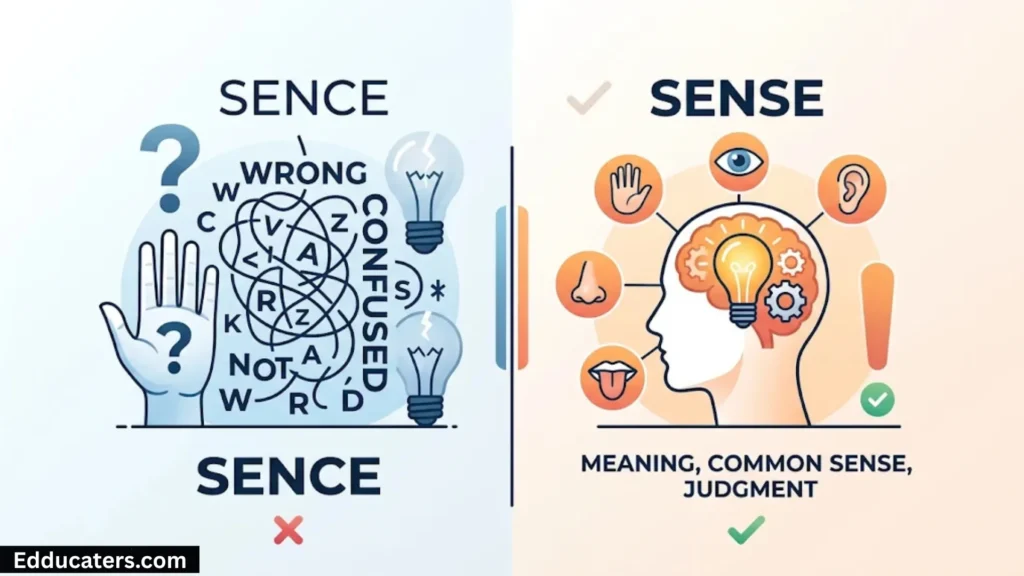
English spelling doesn’t always follow pronunciation in an obvious way. That’s one reason writers sometimes choose an incorrect spelling even when they know how a word sounds.
The confusion between sence and sense usually comes from a few common factors.
Similar Pronunciation and Spelling Patterns
The letters C and S can sometimes represent the same sound in English.
For example, the C in words such as city, cent, and center produces an /s/ sound.
Because of this pattern, someone unfamiliar with the correct spelling might assume that sence is acceptable.
However, English spelling depends on established word forms rather than pronunciation alone.
The correct spelling is sense, even though sence might appear reasonable to someone hearing the word.
Typing and Autocorrect Mistakes
Fast typing can create spelling mistakes, especially when you’re writing on a small mobile keyboard.
You might accidentally type sence instead of sense without noticing the difference.
Autocorrect and spellcheck features can help identify some mistakes. However, they don’t always recognize the intended meaning of a sentence.
For example, a spelling checker might identify an unfamiliar word but fail to explain why sense belongs in a particular context.
That’s why proofreading remains important.
Confusion Among English Learners
People learning English sometimes struggle with words that have similar sounds but different spellings.
English includes many spelling patterns that don’t always match pronunciation.
For example, cent and scent sound alike, while sense and cents have different vowel sounds in standard pronunciation.
Learning common word patterns and practicing complete sentences can make these distinctions easier to remember.
Is Sense Spelled Differently in British and American English?
No. Sense has the same spelling in both American and British English.
Some English words have different regional spellings. For example, American English generally uses color, while British English commonly uses colour.
However, sense doesn’t follow this pattern.
| English Variety | Correct Spelling |
| American English | Sense |
| British English | Sense |
| Canadian English | Sense |
| Australian English | Sense |
Writers in these English varieties use sense when referring to perception, understanding, or judgment.
Neither American nor British standard English uses sence as the normal modern spelling.
Therefore, you don’t need to worry about regional spelling preferences when choosing between these two forms.
What Is the Origin of the Word Sense?
The word sense has an interesting history that connects language with human perception and understanding.
It entered English through historical language development and has roots in older French and Latin forms.
The English word sense appeared in the late fourteenth century. Historical records connect it with Old French sens and Latin sensus.
The Latin word sensus referred to perception, feeling, and understanding. It came from the verb sentire, meaning to perceive, feel, or recognize.
Over time, the English word developed several related meanings.
Initially, sense referred to meaning, interpretation, and the ability to perceive. Later, its usage expanded to include physical sensations, practical judgment, and personal awareness.
Today, people use it in many different contexts.
For example:
- The sense of a sentence refers to its meaning.
- A sense of smell refers to physical perception.
- Common sense refers to practical judgment.
- A sense of responsibility refers to personal awareness of obligations.
This historical development explains why one relatively short word can communicate so many related ideas.
The older spelling sence also appears in historical records. However, modern English spelling has settled on sense as the standard form.
How to Remember the Correct Spelling of Sense
Remembering the correct spelling becomes easier when you connect it with familiar words and expressions.
You don’t need to memorize complicated spelling rules. A few simple techniques can help you recognize the correct form whenever you write.
Remember the Five Senses
One useful memory trick is to connect sense with the five traditional human senses.
These include:
- Sight: The ability to see objects, colors, and movement.
- Hearing: The ability to recognize sounds.
- Smell: The ability to detect different odors.
- Taste: The ability to recognize flavors.
- Touch: The ability to feel pressure, texture, and temperature.
All five are called the human senses.
Remembering this familiar phrase helps reinforce the correct spelling: S-E-N-S-E.
Remember the S-E-N-S-E Pattern
Break the word into its individual letters:
S – E – N – S – E
Notice that the word contains an S in the middle rather than a C.
Whenever you feel tempted to write sence, remember the familiar expression common sense.
For example:
- Use common sense.
- That makes sense.
- I have a good sense of direction.
Repeated exposure to these expressions can strengthen your spelling memory.
Learn Related Words
Several English words share the same spelling root or closely related forms.
Learning them can help reinforce the correct spelling.
| Related Word | Meaning | Example |
| Sensible | Showing good judgment | That was a sensible decision. |
| Sensibly | In a reasonable way | She handled the situation sensibly. |
| Senseless | Lacking meaning or reason | It was a senseless argument. |
| Sensitive | Easily affected by something | He has sensitive skin. |
| Sensory | Related to the senses | The activity provides sensory stimulation. |
| Sensation | A physical feeling or experience | The cold created a strange sensation. |
| Sensitivity | The quality of being sensitive | Light sensitivity can affect vision. |
These related words make it easier to recognize the S-E-N-S spelling pattern.
Practice With Complete Sentences
Another effective technique is to practice the word in familiar sentences rather than memorizing individual letters.
Try writing these examples:
- That doesn’t make sense.
- Use your common sense.
- She has a wonderful sense of humor.
- I can sense something unusual.
- He has a strong sense of responsibility.
The more often you encounter the correct spelling in context, the easier it becomes to recognize.
Frequently Asked Questions
What Is the Correct Spelling: Sence or Sense?
Sense is the correct spelling in modern standard English. It refers to perception, understanding, awareness, judgment, or meaning. Sence is generally considered a misspelling today, although historical sources record it as an older spelling.
Is Sence a Real English Word?
Sence appears in historical English usage as an archaic spelling of sense. However, it isn’t the accepted spelling in contemporary standard English. Use sense in modern writing, including emails, essays, and professional documents.
What Does Sense Mean?
Sense has several meanings. It can describe the five physical senses, a person’s understanding, practical judgment, or the meaning of a statement. It can also refer to an intuitive feeling or awareness of something.
Is Sense a Noun or a Verb?
Sense functions as both a noun and a verb.
As a noun, it describes perception, understanding, judgment, or meaning.
Example: She has a good sense of direction.
As a verb, it means to detect, perceive, or become aware of something.
Example: I can sense that something is wrong.
Why Do People Spell Sense as Sence?
People sometimes write sence because the letters C and S can produce similar sounds in English. Fast typing, unfamiliar spelling patterns, and pronunciation-based spelling habits can also contribute to this mistake. However, sense is the established modern spelling.
Is Sense Spelled the Same in American and British English?
Yes. Both American and British English use sense. There is no regional spelling difference between these varieties. The spelling sence isn’t the standard form in either one.
What Are the Five Human Senses?
The five traditional human senses are sight, hearing, smell, taste, and touch. They allow people to receive information about their surroundings. Scientists also recognize additional sensory systems, including balance and body-position awareness.
How Do You Use Sense in a Sentence?
You can use sense in several ways:
- She has a strong sense of responsibility.
- Your explanation makes perfect sense.
- He has a good sense of humor.
- I can sense that you’re upset.
The intended meaning depends on the surrounding words and context.
What Is the Difference Between Sense, Cents, and Since?
Sense refers to perception, understanding, or judgment. Cents refers to monetary units, while since indicates time or introduces a reason.
For example, “I have good sense,” “It costs 50 cents,” and “I haven’t seen her since Monday.”
How Can I Remember How to Spell Sense?
Connect sense with the five traditional human senses: sight, hearing, smell, taste, and touch. You can also remember the letter pattern S-E-N-S-E and practice familiar expressions such as common sense and make sense.
Conclusion
When choosing between sence or sense, always use sense in modern standard English. It is the accepted spelling in both American and British English.
The word has several meanings, including physical perception, understanding, practical judgment, and awareness. It also functions as both a noun and a verb.
Although sence appears in historical spelling records, it isn’t the standard modern form. Using the correct spelling keeps your writing clear, accurate, and professional.
Remember the five senses and the S-E-N-S-E spelling pattern. The next time you write common sense or make sense, you’ll know exactly which spelling to choose.

Hi, I’m Nathan Whitmore, and I enjoy making English grammar easy for learners of all ages. I believe grammar should be practical, not confusing. I write simple, well-researched guides that help readers improve their writing, speaking, and overall communication skills.
I spend a lot of time studying grammar patterns, sentence construction, punctuation, and modern English usage. My goal is to create lessons that anyone can understand, whether they are students, teachers, or professionals.
Books
Clear English Grammar
The Smart Writer’s Grammar Handbook
 Julian Mercer