
Have you ever paused while writing adviser or advisor and wondered which spelling is correct? You’re not alone. Both forms appear in professional job titles, dictionaries, business documents, and everyday English. That makes choosing between them a little confusing, especially when you’re writing for a British audience.
Here’s the simple answer: both adviser and advisor are correct English spellings. They have the same meaning and refer to someone who gives advice, guidance, or recommendations. However, adviser is the preferred spelling in many British English style guides, including the GOV.UK style guide.
That preference doesn’t make advisor grammatically wrong in the UK. You may still see it in company names, professional titles, academic departments, and other established names. The important thing is to understand the difference between a generally accepted spelling and a spelling preferred by a particular organization.
This guide explains the meaning of adviser and advisor, their spelling differences, British and American usage, professional titles, and the situations in which you should use each form.
Adviser or Advisor: The Quick Answer
Both adviser and advisor are correct nouns. They describe a person who provides advice, guidance, recommendations, or professional assistance.
The main difference is spelling preference rather than meaning.
| Spelling | General Usage | Meaning |
| Adviser | Preferred by many British English style guides | A person who gives advice |
| Advisor | Common in some American contexts and established professional titles | A person who gives advice |
If you’re writing for a UK government department or following a British editorial style guide, adviser is usually the safer choice.
For American English, advisor is widely used, particularly in certain professional and academic titles. However, adviser is also a recognized spelling in American English.
Keep these points in mind:
- Both spellings are accepted English words.
- Both have the same basic meaning.
- Adviser is preferred by GOV.UK.
- Advisor isn’t automatically incorrect in British English.
- The spelling may depend on an organization’s official name or job title.
- Consistency matters more than switching between the two forms.
In other words, choose the spelling that suits your audience and follow it throughout your writing.
What Does Adviser Mean?
Adviser is a noun that describes someone who gives advice, guidance, suggestions, or recommendations to another person or organization.
An adviser may offer professional knowledge in a particular area. For example, a financial adviser helps people understand financial choices, while a careers adviser helps individuals explore employment and education opportunities.
The word can describe someone who provides advice as part of a formal job. It can also refer to a person who offers guidance in a less formal setting.
Examples:
- The financial adviser explained the available investment options.
- She spoke with a careers adviser before choosing a university course.
- The company hired an experienced business adviser.
- Our legal adviser reviewed the agreement.
- The government appointed a special adviser to support the minister.
In each sentence, adviser refers to a person who provides guidance or recommendations.
Adviser as a Professional Title
You may encounter adviser in many professional settings. The word often appears in job descriptions, employment advertisements, government documents, and organizational structures.
Common examples include:
- Financial adviser: Someone who provides financial guidance.
- Careers adviser: Someone who helps people make education and career decisions.
- Legal adviser: Someone who provides legal guidance.
- Business adviser: Someone who helps organizations make business decisions.
- Mortgage adviser: Someone who helps clients understand mortgage options.
- Immigration adviser: Someone who provides guidance on immigration matters.
- Special adviser: Someone appointed to provide specialized advice to a government minister or other official.
- Customer service adviser: Someone who helps customers with questions, problems, or services.
- Investment adviser: Someone who provides guidance about investments.
These titles describe different areas of work. The word adviser remains a noun in each example.
What Does Advisor Mean?
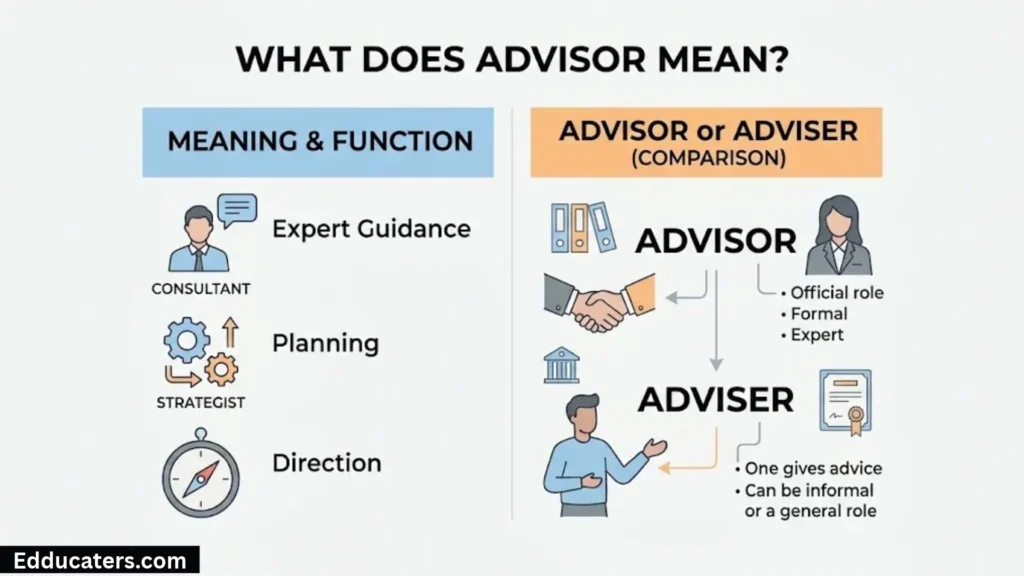
Advisor is another accepted spelling of the same noun. It describes a person who gives advice, offers recommendations, or provides guidance.
Its meaning doesn’t change simply because it ends in -or instead of -er.
For example, a person called a financial advisor performs the same general type of role as someone called a financial adviser. The spelling alone doesn’t establish a different qualification, responsibility, or level of expertise.
Examples:
- The financial advisor helped the couple review their retirement plans.
- My academic advisor recommended several courses.
- The company appointed a senior advisor to guide its management team.
- She contacted an investment advisor before making a decision.
- The student met with an advisor to discuss university applications.
These sentences use advisor correctly.
Advisor in Professional and Academic Titles
Advisor appears in several established professional and academic titles. Its use can depend on an institution’s naming conventions rather than a universal spelling rule.
Common examples include:
- Academic advisor: A person who guides students through academic decisions.
- Financial advisor: A professional who provides financial guidance.
- Investment advisor: A person or firm that provides investment-related advice.
- Senior advisor: Someone who provides guidance to senior managers or decision-makers.
- Policy advisor: Someone who advises on government or organizational policies.
- College advisor: Someone who helps students understand academic requirements and opportunities.
- Technical advisor: Someone who offers specialized technical knowledge.
- Strategic advisor: Someone who helps organizations consider long-term plans.
If an institution officially uses advisor in a job title, retain that spelling when referring to its position.
For example, if a university calls a particular role an Academic Advisor, don’t automatically change its official title to Academic Adviser.
Adviser or Advisor in British English
When writing in British English, adviser is generally the preferred spelling in several prominent institutional style guides.
For example, the GOV.UK style guide recommends adviser, not advisor. The NHS inform style guide also uses adviser as its preferred form. The Welsh Government style guide follows the same preference.
These recommendations are particularly useful when preparing:
- Government publications
- Public-sector documents
- Official reports
- British business communications
- Professional guidance
- Website content for UK readers
- Formal correspondence
If you’re writing a general article for a British audience, adviser is a sensible default.
However, it’s important to understand what this recommendation means. A style guide establishes a preferred editorial choice. It doesn’t necessarily declare every alternative spelling incorrect.
Does British English Prefer Adviser?
Yes. Adviser is preferred in many British institutional writing standards.
The GOV.UK style guide specifically recommends adviser rather than advisor. This makes adviser the appropriate choice when following that guide.
For example:
- The government appointed a special adviser.
- Contact your financial adviser for further guidance.
- The careers adviser discussed employment opportunities.
- The organization is looking for an experienced business adviser.
These examples follow the preferred British spelling.
Is Advisor Wrong in British English?
No. Advisor isn’t automatically wrong in British English.
Although adviser is preferred by several UK style guides, advisor remains a recognized English spelling. You may encounter it in established job titles, business names, academic positions, and professional organizations.
For instance, a British university might use the official title Academic Advisor. A company may also have a registered name that includes Advisor.
You shouldn’t change an official name just to match a general spelling preference.
The distinction is simple:
- Use adviser when following a British style guide that recommends it.
- Retain advisor when it forms part of an official name or established title.
- Don’t describe advisor as a spelling mistake in every British English context.
What Does GOV.UK Recommend?
The GOV.UK style guide recommends adviser rather than advisor.
This recommendation applies to government writing and helps maintain consistency across official publications.
For example, the guide uses the spelling in terms such as special adviser.
If you’re preparing content for a UK government department or writing according to GOV.UK standards, follow that recommendation.
It’s also worth remembering that the same style guide may recommend other British English conventions. You should follow the complete editorial standard rather than selecting spellings randomly.
Adviser or Advisor in American English
Both adviser and advisor are recognized in American English. However, advisor is common in several American professional and academic contexts.
You may see it in titles such as:
- Academic advisor
- Financial advisor
- Investment advisor
- College advisor
- Senior advisor
- Policy advisor
Adviser is also correct in American English. It appears in dictionaries, professional writing, and publications.
Therefore, it’s inaccurate to claim that adviser belongs exclusively to British English or that advisor belongs exclusively to American English.
The distinction is better understood as a difference in usage preference and institutional style.
Which Spelling Should Americans Use?
If you’re writing for a US audience, either spelling may work. However, you should consider the organization, publication, or profession you’re writing about.
For example, if a university officially calls its student-support position an Academic Advisor, use that title.
If an American publication consistently uses adviser, follow its editorial style.
For general American writing, advisor is a familiar choice in many professional contexts. Still, consistency is the most important rule.
Adviser or Advisor: Do They Have the Same Meaning?
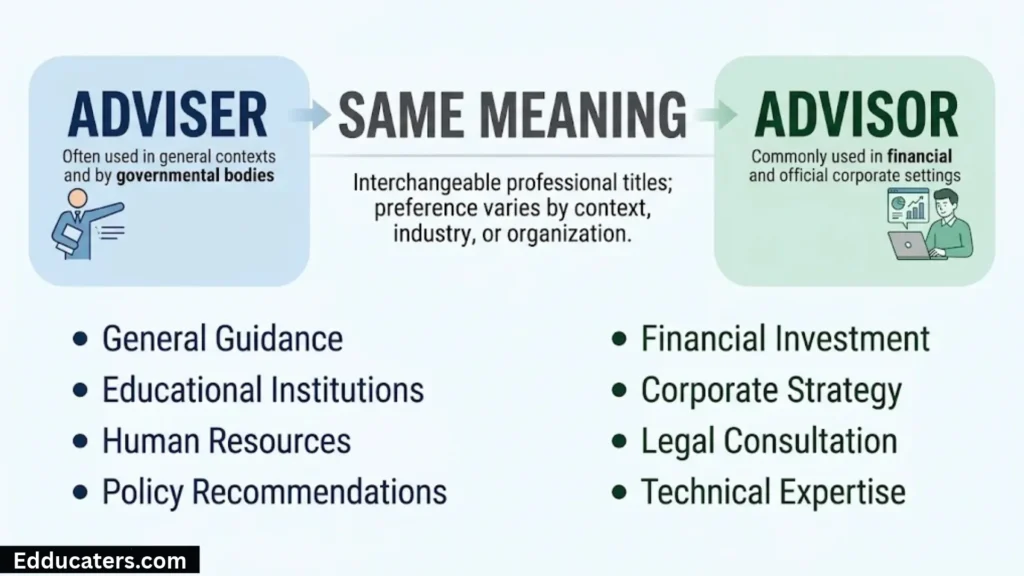
Yes. Adviser and advisor generally have the same meaning.
Both words describe a person who provides advice, guidance, suggestions, or recommendations.
There isn’t a universal rule that gives adviser one meaning and advisor another.
For example, consider these sentences:
- The adviser helped the business develop a new strategy.
- The advisor helped the business develop a new strategy.
Both sentences communicate the same basic idea.
The spelling doesn’t tell you whether someone is more experienced, more qualified, or more senior. Those details depend on the person’s actual role, qualifications, and responsibilities.
Is There a Difference in Formality?
Not as a general rule.
Some organizations may prefer one spelling for official documents, while others use the alternative. That doesn’t establish a universal difference in formality.
Both forms can appear in professional writing.
For example:
- A government department may use special adviser.
- A university may use academic advisor.
- A financial company may use financial adviser.
- Another firm may use financial advisor.
The appropriate choice depends on the established title or editorial standard.
Adviser or Advisor in Professional Job Titles
One reason people search for adviser or advisor is that both spellings appear in professional job titles.
You might find one form in a job advertisement and the other on a company’s website. This can make the words look like different positions.
In most cases, the spelling doesn’t change the basic meaning. The professional responsibilities come from the actual job description.
Financial Adviser or Financial Advisor
Both financial adviser and financial advisor describe someone who provides financial guidance.
A financial professional may help clients understand investments, savings, pensions, retirement planning, insurance, or other financial decisions.
However, spelling doesn’t establish whether a person is authorized to provide regulated financial advice.
In the UK, consumers should check the relevant regulatory status and qualifications rather than relying on a job title alone. The Financial Conduct Authority (FCA) sets professional standards for relevant regulated advisers.
Examples:
- The financial adviser explained the available pension options.
- The financial advisor helped the client review an investment plan.
- You should check a professional’s qualifications before accepting financial advice.
Both spellings are understandable. Follow the spelling used by the professional or organization you’re discussing.
Careers Adviser or Careers Advisor
A careers adviser or careers advisor helps people explore education, training, and employment opportunities.
This professional may help someone identify suitable careers, prepare for interviews, understand qualifications, or plan a career change.
Examples:
- The careers adviser helped me improve my resume.
- A careers advisor explained the training requirements.
- Students can speak with a careers adviser about future opportunities.
The spelling doesn’t change the general purpose of the role.
Legal Adviser or Legal Advisor
Both legal adviser and legal advisor can describe someone who provides legal guidance.
However, don’t assume that every person using this title is a qualified solicitor or barrister. Professional status and legal authorization depend on the person’s qualifications, role, and applicable rules.
Examples:
- The company consulted its legal adviser before signing the agreement.
- A legal advisor reviewed the contract.
- We asked our adviser to explain the legal requirements.
Use the official spelling when referring to a named position or organization.
Mortgage Adviser or Mortgage Advisor
A mortgage adviser or mortgage advisor helps people understand mortgage products and financing options.
The role may involve explaining interest rates, repayment terms, eligibility, and available mortgage deals.
Examples:
- The mortgage adviser explained the repayment options.
- We contacted a mortgage advisor before applying for a home loan.
- A qualified adviser helped the buyer compare mortgage products.
In the UK, the spelling used in an official job profile or company title should be retained when referring to that specific role.
Academic Adviser or Academic Advisor
Academic adviser and academic advisor both describe someone who helps students make educational decisions.
An academic adviser may explain course requirements, degree progress, registration, and academic opportunities.
Examples:
- My academic advisor helped me select the right courses.
- The academic adviser explained the university’s graduation requirements.
- Students should contact their advisor if they need academic guidance.
American universities commonly use academic advisor in their official terminology. However, the exact title depends on the institution.
Advice, Advise, Adviser, Advisor, or Advisory: What’s the Difference?
These words look similar, but they don’t all perform the same grammatical job.
The easiest way to remember them is to identify whether you’re talking about a thing, an action, a person, or a description.
| Word | Part of Speech | Meaning | Example |
| Advice | Noun | Guidance or recommendations | Her advice was helpful. |
| Advise | Verb | To give guidance or recommendations | I advise you to check the details. |
| Adviser | Noun | A person who gives advice | The adviser reviewed the proposal. |
| Advisor | Noun | An alternative spelling of adviser | The advisor answered our questions. |
| Advisory | Adjective or noun | Related to advice or guidance | The company formed an advisory committee. |
Understanding these differences can help you avoid common spelling and grammar mistakes.
Advice: A Noun
Advice refers to guidance, suggestions, or recommendations.
It’s an uncountable noun in standard English. You generally don’t use a or an directly before it.
Correct:
- She gave me useful advice.
- I need some advice about my career.
- His advice helped us make a decision.
Incorrect:
- She gave me an advice.
- I received several advices.
If you need to count individual recommendations, use phrases such as a piece of advice or two pieces of advice.
Advise: A Verb
Advise means to recommend something or give someone guidance.
It describes an action rather than a person or a piece of guidance.
Correct:
- I advise you to read the agreement.
- The doctor advised him to rest.
- Our manager advised us to review the plan.
Remember that advise is a verb, while advice is a noun.
Adviser or Advisor: A Person
Both adviser and advisor describe someone who gives advice.
Correct:
- The adviser explained the policy.
- The advisor discussed the available options.
The spelling difference doesn’t change the grammatical function.
Advisory: A Descriptive Word
Advisory is commonly used as an adjective to describe something connected with advice or guidance.
Examples include:
- Advisory committee
- Advisory board
- Advisory service
- Advisory role
- Advisory report
For example:
The organization created an advisory board to review its long-term strategy.
Here, advisory describes the type of board.
Why Do Adviser and Advisor Have Different Spellings?
English has several words that use different endings despite having similar meanings or grammatical functions.
The endings -er and -or often appear in nouns describing people who perform an action or hold a particular role.
For example:
- Teacher
- Writer
- Employer
- Director
- Instructor
- Advisor
However, English spelling doesn’t follow one simple rule that determines when every word must end in -er or -or.
Both adviser and advisor developed as accepted spelling forms. Their continued use reflects the flexibility of English spelling rather than a difference in meaning.
The -er and -or Suffixes
The suffixes -er and -or frequently appear in nouns that identify people or things associated with an action.
For example:
- A teacher teaches.
- A writer writes.
- A director directs.
- An instructor instructs.
- An adviser advises.
These examples show a general pattern. They don’t create a universal spelling formula.
You can’t always decide the correct ending by looking at the base verb. English contains many established forms that you’ll need to learn individually.
Does the -or Ending Make Advisor More Formal?
No. The -or ending doesn’t automatically make a word more formal or professional.
Advisor isn’t inherently more formal than adviser. The choice usually reflects editorial preference, established terminology, or an organization’s official spelling.
Both forms can appear in formal documents.
When Should You Use Adviser or Advisor?
Choosing between adviser and advisor becomes easier when you consider your audience and the document’s purpose.
You don’t need to memorize complicated spelling rules. Instead, follow a few practical guidelines.
Use Adviser for British Government Writing
If you’re preparing a document according to GOV.UK guidance, use adviser.
The same choice is appropriate when following other British style guides that recommend this spelling.
For example:
- The department appointed a special adviser.
- Contact your financial adviser for more information.
- The careers adviser provided employment guidance.
Use the Official Spelling of a Job Title
Some organizations use advisor in their official job titles.
If you’re referring to a specific position, department, or institution, retain its established spelling.
For example, don’t rewrite Academic Advisor as Academic Adviser if the university officially uses the first form.
This principle applies to company names, registered business names, professional services, and organizational departments.
Follow the Publication’s Style Guide
If you’re writing for a newspaper, website, company, or academic institution, check its spelling preferences.
A style guide helps writers maintain consistency across different articles and documents.
For example, one publication may use adviser throughout its content, while another may prefer advisor.
Neither choice automatically changes the word’s meaning.
Stay Consistent Throughout Your Writing
Avoid switching between adviser and advisor without a clear reason.
For example, don’t use financial adviser in one paragraph and financial advisor in the next simply because you forgot which spelling you selected.
Choose one form for general references and maintain it throughout the document.
However, retain different spellings when they’re part of official names or titles.
Adviser or Advisor: Example Sentences
Examples make the difference easier to understand. The following sentences show how both spellings work in everyday and professional writing.
Examples Using Adviser
- The adviser explained the new company policy.
- She contacted a financial adviser before investing her savings.
- Our legal adviser reviewed the contract.
- The government appointed a special adviser.
- A careers adviser helped him explore different professions.
- The mortgage adviser explained the repayment schedule.
- The business adviser recommended a change in strategy.
- I asked my academic adviser for guidance.
- The immigration adviser explained the application process.
- The customer service adviser resolved the complaint.
Examples Using Advisor
- The advisor helped the students choose their courses.
- I spoke with a financial advisor about retirement planning.
- The company hired a senior advisor.
- The academic advisor explained the degree requirements.
- Our investment advisor reviewed the portfolio.
- The policy advisor prepared recommendations for the department.
- She contacted a technical advisor for assistance.
- The college advisor discussed scholarship opportunities.
- A strategic advisor helped the organization review its plans.
- The advisor provided guidance throughout the process.
Examples Showing Both Spellings
The following pairs demonstrate that the two spellings can communicate the same idea.
| Adviser | Advisor |
| The adviser helped me choose a course. | The advisor helped me choose a course. |
| She contacted a financial adviser. | She contacted a financial advisor. |
| The company hired a senior adviser. | The company hired a senior advisor. |
| I spoke with my careers adviser. | I spoke with my careers advisor. |
| The adviser reviewed the proposal. | The advisor reviewed the proposal. |
The meaning remains essentially unchanged in each pair.
Common Mistakes When Using Adviser or Advisor
Although both spellings are correct, writers sometimes misunderstand their relationship or use them inconsistently.
Here are some mistakes worth avoiding.
Treating Advisor as Always Incorrect in British English
One common misconception is that advisor is an American spelling that British writers must never use.
That’s too restrictive.
Adviser is preferred by several British style guides, but advisor remains a recognized alternative. It may also appear in official names and professional titles.
Better approach: Use adviser when following a British style guide that recommends it. Retain advisor in established names and titles.
Assuming Adviser Is Only British English
Another mistake is treating adviser as a spelling that belongs exclusively to the UK.
Adviser is also used and accepted in American English.
The difference is not as strict as some British-versus-American spelling pairs.
Better approach: Check the publication’s preferred spelling rather than assuming that only one country can use adviser.
Believing the Two Words Have Different Meanings
Some writers assume adviser and advisor refer to different professional responsibilities.
There is no general spelling rule that supports this distinction.
A financial adviser and a financial advisor can describe the same type of role. The actual responsibilities depend on the job, organization, and relevant professional requirements.
Better approach: Look at the job description and qualifications rather than relying on the final letter of the title.
Switching Between the Spellings
Using both forms randomly can make an article or report look inconsistent.
For example, a document might use adviser in its introduction and advisor in later sections without referring to an official title.
Better approach: Choose one spelling for general use and apply it consistently.
Changing an Official Name
A company, university, or department may use advisor in its official title.
Changing that spelling to adviser could make the name inaccurate.
Better approach: Preserve the exact spelling of official names, titles, and registered organizations.
Confusing Adviser With Advice
Adviser and advice are related, but they aren’t interchangeable.
Adviser refers to a person. Advice refers to guidance or recommendations.
Correct:
- The adviser gave me useful advice.
Incorrect:
- The advice gave me useful adviser.
Better approach: Ask yourself whether you’re describing a person or the guidance that person provides.
Is Adviser More Correct Than Advisor?
Not universally. Both spellings are accepted, but adviser may be more appropriate when following a British editorial standard that specifically recommends it.
For example, GOV.UK recommends adviser in its style guide. This makes it the preferred choice for writers following that guidance.
However, advisor remains valid in English and may be the correct spelling of a particular professional title or organization.
The phrase more correct can therefore be misleading. A spelling may be preferred by a style guide without making every alternative incorrect.
A better way to think about the choice is:
- Preferred spelling: The form recommended by a particular style guide.
- Accepted spelling: A recognized form used in English.
- Official spelling: The form used by a specific organization or in a formal title.
These categories aren’t always identical.
Is Adviser or Advisor Better for Formal Writing?
Both forms can be used in formal writing.
The better choice depends on the audience, publication, and relevant style requirements.
If you’re writing a UK government report, adviser is the safer choice under GOV.UK guidance.
If you’re writing an American university document and the institution uses academic advisor, follow its official terminology.
For a general business article, choose one form and use it consistently.
Formal writing isn’t determined by the -er or -or ending. Accuracy, clarity, consistency, and appropriate terminology matter much more.
How to Remember Adviser or Advisor
If you regularly confuse these spellings, a few simple reminders can help.
Remember the British style preference: Adviser is recommended by GOV.UK. If you’re following that guide, choose adviser.
Remember that both forms are accepted: Advisor isn’t automatically a mistake. It is an alternative spelling with the same general meaning.
Think about the official title: If a university, company, or department uses advisor in its name, preserve that spelling.
Check your audience: British government writing may call for adviser, while an American institution may use advisor in its official terminology.
Stay consistent: Once you’ve selected a spelling for general use, don’t switch randomly.
These simple habits can prevent unnecessary editing mistakes.
Frequently Asked Questions About Adviser or Advisor
Is adviser or advisor correct?
Both adviser and advisor are correct English spellings. They have the same general meaning and refer to someone who gives advice or guidance. Adviser is preferred by several British style guides, including GOV.UK.
Which spelling is preferred in UK English?
Adviser is preferred in many British institutional style guides. GOV.UK, NHS inform, and the Welsh Government style guide recommend this spelling. However, advisor remains a recognized alternative.
Is advisor wrong in British English?
No. Advisor isn’t automatically wrong in British English. It may appear in official job titles, business names, academic positions, and professional terminology. Use adviser when following a style guide that specifically recommends it.
Is adviser an American or British spelling?
Adviser is used in both British and American English. It isn’t exclusive to the UK. American writers also use advisor, particularly in certain professional and academic contexts.
Is advisor an American spelling?
Advisor is widely used in American English, but it isn’t exclusive to the United States. British organizations may also use it in official titles and names.
Do adviser and advisor mean the same thing?
Yes. Both words generally describe a person who gives advice, recommendations, or guidance. The spelling doesn’t create a universal difference in meaning or professional responsibilities.
Which is correct: financial adviser or financial advisor?
Both forms are correct. Financial adviser is common in British institutional writing, while financial advisor is familiar in many American professional contexts. Follow the spelling used by the organization or publication you’re referring to.
Should I write academic adviser or academic advisor?
Both forms are acceptable. However, many American universities use academic advisor as an official title. If you’re referring to a particular university position, use the institution’s exact spelling.
Is special adviser or special advisor correct?
Both forms can be understood, but special adviser is the form recommended in the GOV.UK style guide and used in the official UK government title, Special Adviser. Use that spelling when following British government conventions.
Can I use advisor in a formal document?
Yes. Advisor can appear in formal writing. However, you should follow the relevant style guide and preserve official names and job titles. If a British style guide recommends adviser, use that form for consistency.
Does advisor mean someone with more experience than an adviser?
No. The spelling doesn’t establish someone’s experience, seniority, or qualifications. Those details depend on the person’s professional role and background.
Is adviser a noun or a verb?
Adviser is a noun. It describes a person who gives advice. The related verb is advise, while advice is the noun referring to guidance or recommendations.
What is the plural of adviser?
The plural of adviser is advisers.
Example: The advisers attended the meeting.
What is the plural of advisor?
The plural of advisor is advisors.
Example: The advisors discussed the new policy.
Is advisory related to adviser and advisor?
Yes. Advisory is a related word that commonly functions as an adjective. It describes something connected with advice or guidance, as in advisory board, advisory service, or advisory committee.
Should I use adviser or advisor in a resume?
Use the spelling that matches your actual job title, employer, or professional experience. If the official position was Financial Advisor, don’t change it to Financial Adviser just to follow a general British spelling preference. Keep the wording accurate.
Can I use both adviser and advisor in the same article?
You can use both when referring to official titles or names that use different spellings. However, for general references, choose one form and use it consistently throughout the article.
Conclusion: Adviser or Advisor?
The choice between adviser or advisor is simpler than it first appears. Both are correct English nouns, and both describe someone who gives advice, guidance, or recommendations. Their basic meaning doesn’t change with the spelling.
The main difference comes down to editorial preference and established usage. Adviser is preferred by several British style guides, including GOV.UK, while advisor is common in many American professional and academic titles. Neither spelling is automatically wrong in every context.
If you’re writing for a UK audience, adviser is a reliable default, particularly in formal or government-related content. If you’re referring to an organization or professional title that officially uses advisor, keep its original spelling.
Most importantly, choose the form that fits your audience, follow the relevant style guide, and stay consistent. Once you understand that simple rule, you’ll know exactly when to use adviser or advisor.

Hi, I’m Nathan Whitmore, and I enjoy making English grammar easy for learners of all ages. I believe grammar should be practical, not confusing. I write simple, well-researched guides that help readers improve their writing, speaking, and overall communication skills.
I spend a lot of time studying grammar patterns, sentence construction, punctuation, and modern English usage. My goal is to create lessons that anyone can understand, whether they are students, teachers, or professionals.
Books
Clear English Grammar
The Smart Writer’s Grammar Handbook
 Julian Mercer
 Claire Holloway