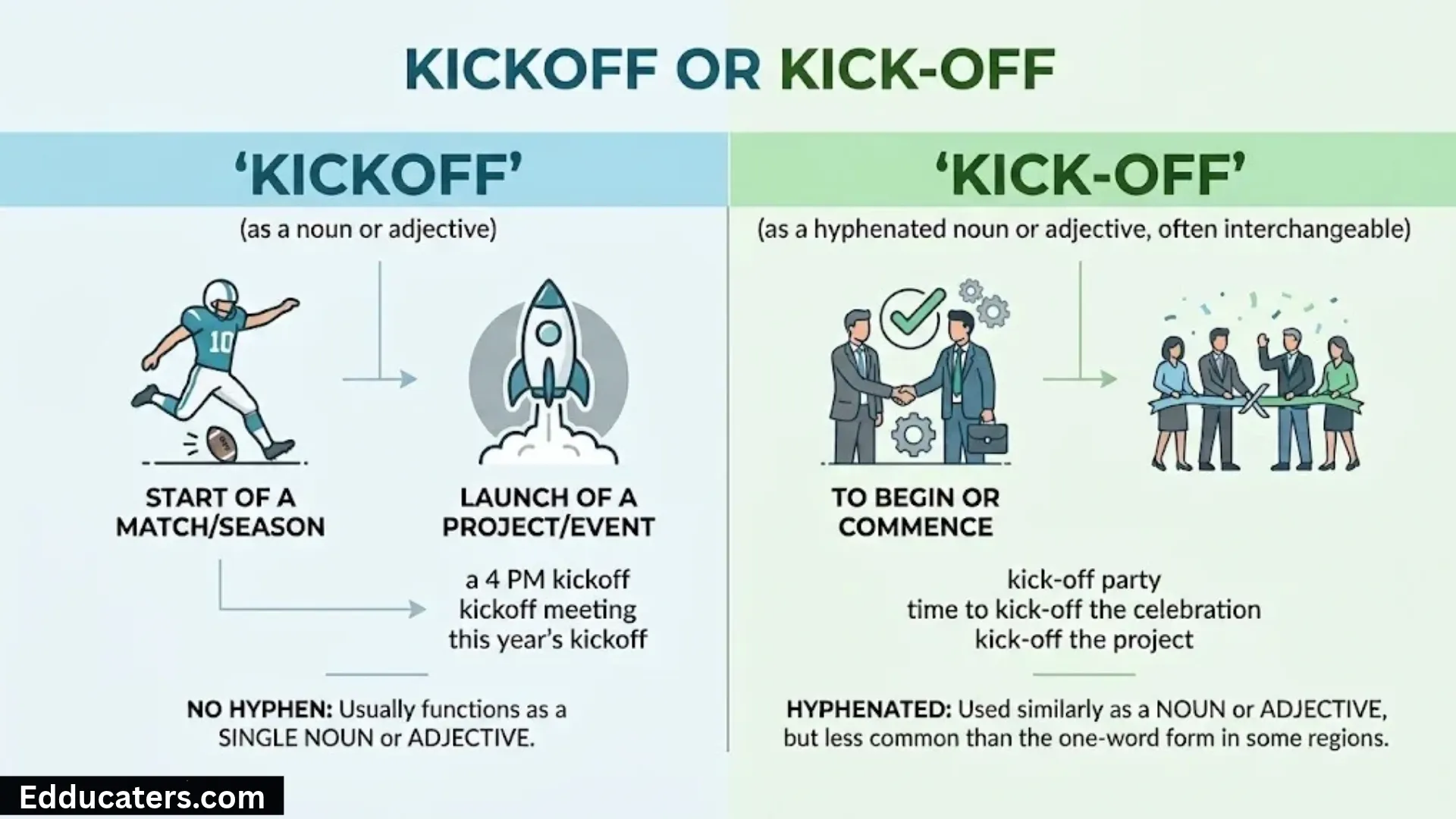
Have you ever wondered whether to write kickoff or kick-off? Both spellings are correct, but the best choice depends on your writing style and regional preference. There’s also a third form, kick off, which follows a different grammatical rule.
The distinction is easier than it looks. Use kickoff or kick-off as a noun when referring to the beginning of an event, project, game, or activity. Use kick off as a verb phrase when describing the action of starting something.
For example:
- Kickoff: The company scheduled its annual kickoff for Monday.
- Kick-off: The match kick-off is scheduled for 3 p.m.
- Kick off: We will kick off the new project next week.
Although these expressions share a meaning related to beginnings, you can’t always substitute one for another. Understanding their grammatical roles will help you choose the right spelling every time.
Let’s look at their meanings, spelling conventions, regional differences, and practical examples.
Kickoff or Kick-Off: What’s the Difference?
The main difference between kickoff, kick-off, or kick off comes down to grammar. The first two forms work as nouns and noun modifiers, while the third functions as a verb phrase.
Both kickoff and kick-off describe the beginning of something. However, dictionaries and regional writing conventions may favor one spelling over the other.
Here’s a quick comparison:
| Word form | Part of speech | Meaning | Example |
| Kickoff | Noun | The beginning of something | The kickoff is tomorrow. |
| Kick-off | Noun | The beginning of something | The kick-off is tomorrow. |
| Kickoff | Noun modifier | Related to the beginning | We have a kickoff meeting. |
| Kick-off | Noun modifier | Related to the beginning | We have a kick-off meeting. |
| Kick off | Phrasal verb | To begin something | Let’s kick off the meeting. |
Notice how the verb phrase uses two separate words. You shouldn’t write kickoff the meeting when you mean to describe the action of starting it.
For example:
- Correct: The conference will kick off at 10 a.m.
- Incorrect: The conference will kickoff at 10 a.m.
However, you can write:
– Correct: The conference kickoff is scheduled for 10 a.m.
The sentence structure determines which form you need.
What Does Kickoff Mean?
Kickoff is a noun that means the beginning or starting point of an event, activity, process, or organized undertaking. People commonly use it in sports, business, education, entertainment, and everyday conversations.
The word originally connects to the action of kicking a ball to start a game. Over time, its meaning expanded to include the beginning of almost any planned activity.
For example, a company might organize a kickoff meeting before starting a new project. A school might hold a kickoff event before its annual sports competition.
In both situations, the word describes the beginning rather than the action of beginning something.
According to Collins Dictionary, the noun kickoff can describe the beginning of an event or activity. It also has a specific meaning in American football and soccer.
Kickoff as a Noun
The most common grammatical use of kickoff is as a noun.
A noun identifies a person, place, thing, idea, or event. In this case, kickoff identifies the starting point of an activity.
You can use it when discussing:
- The beginning of a business project.
- The first meeting of a new team.
- The opening of a campaign.
- The start of a sports competition.
- The beginning of a conference.
- The first stage of a new initiative.
Examples:
- Our project kickoff is scheduled for Tuesday.
- The kickoff attracted hundreds of visitors.
- Everyone arrived early for the campaign kickoff.
- The football kickoff took place shortly after noon.
- We discussed the budget during the project kickoff.
In each example, kickoff names an event or starting point. It doesn’t describe someone performing the action of starting something.
You can also make the noun plural by adding an s:
- The company organized three separate kickoffs this year.
- Several project kickoffs are scheduled for next month.
- The tournament’s opening kickoffs attracted large crowds.
The closed spelling remains intact in the plural form.
Kickoff as a Noun Modifier
Although dictionaries commonly classify kickoff as a noun, it can also appear before another noun to describe its purpose or relationship to a beginning.
This use is called an attributive noun or noun modifier.
For example:
- Kickoff meeting: A meeting that officially starts a project.
- Kickoff event: An event that marks the beginning of an activity.
- Kickoff party: A celebration held to launch something.
- Kickoff date: The scheduled date when an activity begins.
- Kickoff time: The time when an event or game starts.
In these expressions, kickoff helps explain the type of meeting, event, party, date, or time.
Consider this sentence:
“The marketing team organized a kickoff meeting for its new campaign.”
Here, meeting is the main noun. Kickoff modifies it by explaining the meeting’s purpose.
You don’t need to treat this use as an entirely separate verb or grammatical category.
Kickoff in Sports
Sports provide the original and one of the clearest contexts for understanding the word.
In American football, a kickoff is the kick that puts the ball into play at the beginning of a half or after certain scoring plays. It marks the start or resumption of play.
Soccer also uses the term for the action that begins a match or restarts play after a goal. British English commonly uses kick-off for this noun.
Examples include:
- The opening kickoff went out of bounds.
- Fans arrived early for the football kickoff.
- The referee prepared for the match kick-off.
- The game kickoff was delayed because of heavy rain.
The exact sporting rules differ between football codes. However, the general connection remains the same: a kickoff marks the start of play.
What Does Kick-Off Mean?
Kick-off is the hyphenated form of kickoff. It generally carries the same meaning and grammatical function when used as a noun or noun modifier.
The difference is primarily spelling rather than meaning.
British English commonly favors the hyphenated spelling in noun expressions. For example, Cambridge Dictionary identifies kick-off as a British noun and notes kickoff as the usual American equivalent in its Business English entry.
However, the hyphenated version isn’t limited to British writers. American dictionaries also recognize it as a spelling variant.
You might encounter kick-off in:
- British sports reporting.
- Newspaper headlines.
- Business announcements.
- Event schedules.
- Meeting invitations.
- General writing that follows a hyphenated style.
For example:
“The official kick-off ceremony will take place on Saturday.”
The sentence uses kick-off as a noun modifier. It describes the ceremony that marks the beginning of an event.
Kick-Off as a Noun
When you use kick-off as a noun, it refers to the start of an event, match, or organized activity.
This spelling appears frequently in British sports writing. It also occurs in general expressions about starting events and projects.
Consider these examples:
- The match kick-off is scheduled for 2 p.m.
- The kick-off of the conference attracted several guests.
- We attended the official kick-off ceremony.
- The campaign’s kick-off generated considerable interest.
- Everyone gathered before the tournament’s kick-off.
You can also use the word when discussing the scheduled starting time.
For instance:
“The kick-off is at 3:30 p.m.”
Here, the word identifies the time when the match begins.
In British English, you may also see kick-off time in sports schedules and news reports.
Kick-Off as a Noun Modifier
The hyphenated form can also modify another noun.
Examples include:
- Kick-off meeting
- Kick-off event
- Kick-off ceremony
- Kick-off party
- Kick-off date
- Kick-off session
These expressions identify activities associated with an official beginning.
For example:
“The organization arranged a kick-off meeting before launching its new initiative.”
The word kick-off describes the type of meeting. It tells readers that the meeting marks the beginning of the initiative.
Writers should follow a consistent spelling convention throughout the same document. If you choose kick-off for your British English article, avoid switching randomly between kick-off and kickoff.
What Does Kick Off Mean?
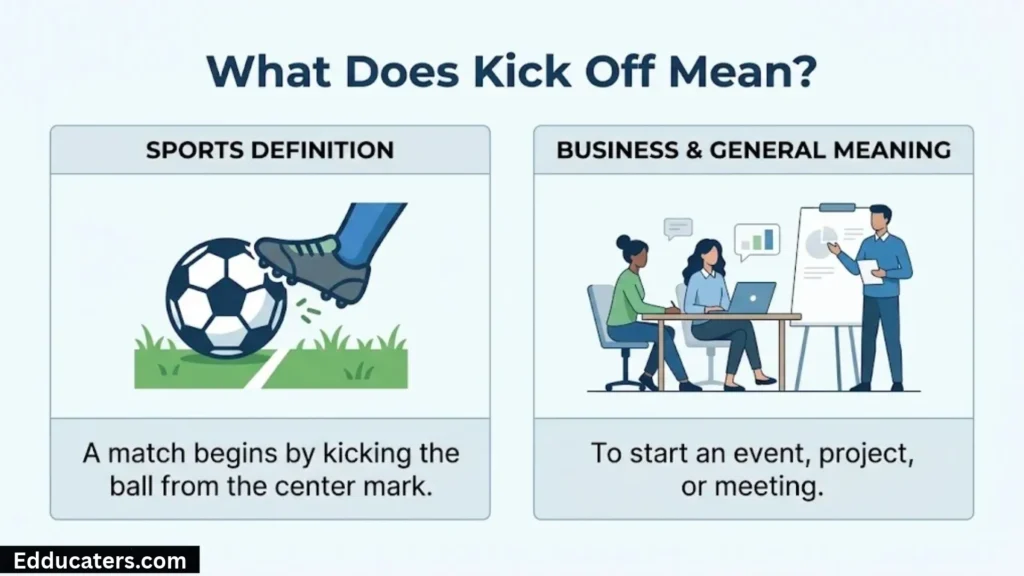
Unlike kickoff and kick-off, kick off is a two-word phrasal verb.
It means to begin an event, activity, discussion, project, or process. You can use it when someone starts something or when an event begins on its own.
For example:
- We will kick off the meeting with a short presentation.
- The festival will kick off tomorrow.
- The company plans to kick off its advertising campaign next month.
In these sentences, kick off describes an action or occurrence. That’s why you need the separate verb and particle rather than the one-word noun.
Cambridge Dictionary identifies kick off as a phrasal verb and provides examples of both intransitive and transitive use.
Kick Off as a Phrasal Verb
A phrasal verb combines a main verb with a particle or preposition to create a particular meaning.
In this expression:
- Kick is the main verb.
- Off is the particle.
- Kick off means to begin or start something.
The meaning isn’t always literal. You’re not necessarily kicking an object away from you.
For example:
“The manager will kick off the discussion with a brief introduction.”
The manager isn’t physically kicking anything. The phrase simply means that the manager will begin the discussion.
You can use kick off in several situations:
Business and workplace
- Let’s kick off the meeting with the latest updates.
- The director will kick off the new project.
- Our team kicked off the planning process yesterday.
Education
- The teacher kicked off the lesson with a short quiz.
- The new semester will kick off next Monday.
- Students kicked off the discussion with several questions.
Events and entertainment
- The concert will kick off with a live performance.
- The festival kicks off with a colorful parade.
- Organizers kicked off the celebration with fireworks.
Sports
- The referee blew the whistle to kick off the match.
- The home team will kick off after halftime.
- The game kicks off at 7 p.m.
In every example, the two-word expression functions as a verb.
Kick Off as a Transitive and Intransitive Verb
Another important grammar point involves transitive and intransitive usage.
A transitive verb takes a direct object. An intransitive verb doesn’t require one.
The phrasal verb kick off can work in both ways.
Transitive use
Use kick off transitively when someone starts a particular activity or event.
Examples:
- The manager kicked off the meeting.
- The company will kick off its new campaign.
- The teacher kicked off the class with a question.
- Organizers kicked off the festival with a parade.
In these sentences, the meeting, its new campaign, the class, and the festival are direct objects.
They identify what someone starts.
Intransitive use
Use kick off intransitively when the event itself begins.
Examples:
- The conference kicks off tomorrow.
- The match will kick off at noon.
- The ceremony kicked off with a welcome speech.
- The tournament kicks off next weekend.
These sentences don’t require a direct object after the verb phrase.
The event or activity itself acts as the subject.
Kick Off in Different Verb Tenses
The phrasal verb also changes according to the tense of the sentence.
| Tense | Verb form | Example |
| Present simple | Kick off / kicks off | The conference kicks off today. |
| Present continuous | Am/is/are kicking off | The team is kicking off the campaign. |
| Past simple | Kicked off | We kicked off the project yesterday. |
| Present perfect | Has/have kicked off | The event has kicked off already. |
| Past perfect | Had kicked off | The match had kicked off before we arrived. |
| Future simple | Will kick off | The meeting will kick off tomorrow. |
Notice that the past-tense form is kicked off, not kickoffed.
The main verb kick receives the regular past-tense ending -ed. The particle off stays unchanged.
This rule applies whether you use the phrase literally or figuratively.
For example:
- The players kicked off the match.
- The manager kicked off the discussion.
- The organizers kicked off the event.
All three sentences follow the same basic grammatical pattern.
Is Kickoff One Word or Two?
The answer depends on how you use the expression.
Kickoff is one word when you use it as a noun or noun modifier. Kick off contains two words when you use it as a phrasal verb.
The hyphenated form kick-off is another accepted noun spelling.
This distinction matters because the three forms don’t serve exactly the same grammatical purpose.
| Form | Number of written units | Typical grammatical function |
| Kickoff | One | Noun or noun modifier |
| Kick-off | One hyphenated compound | Noun or noun modifier |
| Kick off | Two separate words | Phrasal verb |
When to Use Kickoff
Choose kickoff when you need a noun referring to the beginning of something.
It works naturally in professional writing, sports reporting, announcements, and everyday communication.
Examples:
- The kickoff is scheduled for Friday.
- Our annual kickoff attracted new employees.
- The project kickoff went better than expected.
- We need to confirm the kickoff date.
- The campaign kickoff marks the start of our advertising efforts.
You can also place it before another noun:
- Kickoff meeting
- Kickoff event
- Kickoff celebration
- Kickoff schedule
If you’re writing in American English, the closed spelling is generally the safest choice.
When to Use Kick Off
Choose kick off when the sentence describes an action.
You can use it when someone begins an activity or when something starts.
Examples:
- We will kick off the project tomorrow.
- The conference will kick off with a keynote speech.
- Let’s kick off the meeting now.
- The new season kicks off next month.
- The organizers kicked off the campaign last week.
A simple test can help you choose the right spelling.
Ask yourself: Does the sentence describe the beginning or the act of beginning?
- The kickoff was successful. (The beginning)
- We kicked off successfully. (The action)
This small distinction prevents most spelling mistakes.
Is Kick-Off Also Correct?
Yes. Kick-off is an established spelling, particularly in British English.
You can use it as a noun when referring to the beginning of an event or the starting moment of a sports match.
Examples:
- The kick-off is scheduled for 4 p.m.
- The team prepared for the opening kick-off.
- We attended the kick-off meeting.
- The kick-off ceremony attracted local officials.
However, don’t assume that every use of kickoff requires a hyphen. The closed form is standard in American English and is also recognized in dictionaries as a spelling variant.
The best approach is to follow the dictionary or editorial style guide used by your publication.
Kickoff or Kick-Off in American and British English
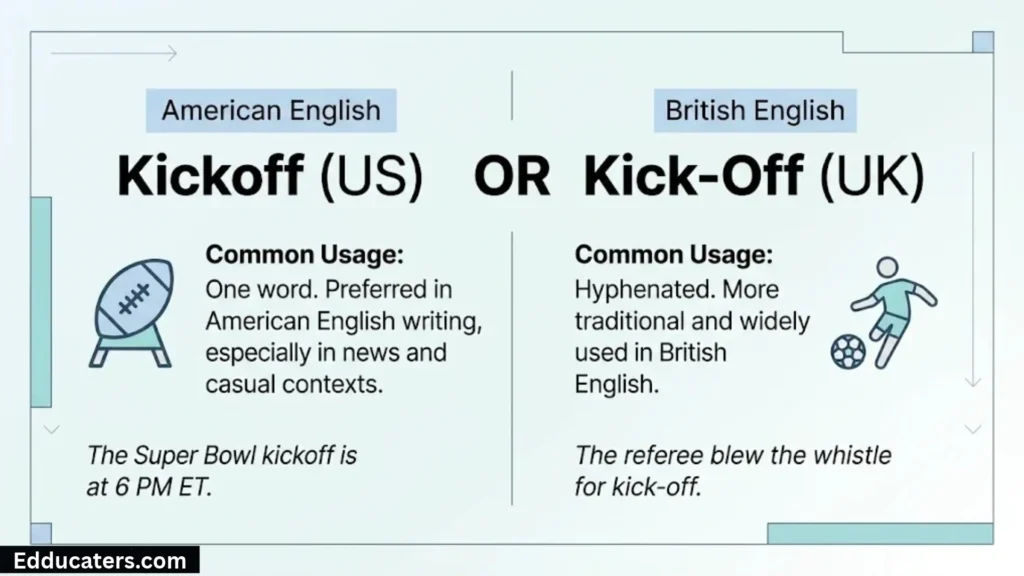
English spelling sometimes changes across regions. Words such as color and colour demonstrate this difference clearly. The spelling of kickoff or kick-off also reflects regional preferences.
Both American and British writers use the expression. However, their preferred noun spellings aren’t always the same.
Kickoff in American English
American English generally favors kickoff as one word when using the expression as a noun.
You’ll commonly see this spelling in:
- American football coverage.
- Business meetings.
- Corporate announcements.
- Marketing campaigns.
- School events.
- Sports schedules.
- Project planning documents.
For example:
- The football kickoff starts at 8 p.m.
- Our annual company kickoff is next week.
- The marketing team scheduled a kickoff meeting.
- The summer festival kickoff attracted thousands of visitors.
American English also uses the two-word verb phrase kick off.
For example:
- The game will kick off at 7 p.m.
- We’ll kick off the campaign on Monday.
- The conference kicks off with a keynote presentation.
The spelling distinction doesn’t disappear simply because you’re writing in American English. You still need to separate the words when using the verb phrase.
Kick-Off in British English
British English commonly uses kick-off as a noun, especially when discussing football (soccer) and rugby.
You might encounter expressions such as:
- Match kick-off
- Kick-off time
- Opening kick-off
- Kick-off meeting
- Tournament kick-off
- Kick-off ceremony
Examples:
- The match kick-off is scheduled for 3 p.m.
- We arrived early for the tournament kick-off.
- The kick-off meeting takes place tomorrow.
- The club announced a new kick-off time.
British writers also use kick off as a verb phrase.
For example:
- The match will kick off at 3 p.m.
- The festival kicks off with a live performance.
- The manager will kick off the discussion.
The noun and verb distinction remains the same.
Does the Meaning Change Between American and British English?
Generally, no. The basic meaning remains the beginning of an activity or the action of starting something.
The main difference involves spelling preference and certain sports-related meanings.
For example, American football uses kickoff for a specific play that starts a half or follows certain scores. In British football, kick-off commonly refers to the opening or restarting of a soccer match.
Here’s a useful regional comparison:
| Context | American English | British English |
| Beginning of a project | Project kickoff | Project kick-off |
| Initial business meeting | Kickoff meeting | Kick-off meeting |
| Starting time of a match | Game kickoff | Match kick-off |
| Beginning an event | Event kickoff | Event kick-off |
| Action of beginning | Kick off | Kick off |
These are common preferences rather than rigid rules. Individual publications may adopt different conventions.
If you’re writing for an American audience, choose kickoff as your default noun spelling. For British readers, kick-off is a familiar traditional choice.
Kickoff Meeting or Kick-Off Meeting: Which Is Correct?
Both kickoff meeting and kick-off meeting are correct.
The choice depends mainly on your preferred English variety and editorial style.
American business writing generally favors kickoff meeting. British business writing commonly uses kick-off meeting.
Both expressions describe an initial meeting that marks the beginning of a project, campaign, or organized initiative.
For example:
“The marketing department arranged a kickoff meeting to discuss the new advertising campaign.”
The meeting provides an opportunity for everyone involved to understand the project’s purpose and expectations.
What Happens at a Project Kickoff Meeting?
A project kickoff meeting brings the people involved in a project together before the main work begins.
It helps establish a shared understanding of the objectives, responsibilities, schedule, and expected results.
Although the agenda depends on the project, most kickoff meetings cover several important topics.
Common discussion points include:
- Project objectives: Explain what the team wants to accomplish.
- Team introductions: Introduce the people responsible for different tasks.
- Roles and responsibilities: Clarify who handles each part of the work.
- Project timeline: Review important deadlines and milestones.
- Communication methods: Decide how team members will share updates.
- Available resources: Discuss the budget, tools, and support required.
- Potential challenges: Identify risks that could affect progress.
- Immediate next steps: Assign the first tasks and establish priorities.
For example, a website redesign project might begin with a kickoff meeting involving designers, developers, content writers, and project managers.
Everyone discusses the website’s goals and agrees on a realistic timeline. The team also identifies who will approve designs and review the finished content.
The meeting doesn’t complete the project. It gives everyone a clear starting point.
Project Kickoff or Project Kick Off
These expressions look similar, but their grammatical functions differ.
Project kickoff uses kickoff as a noun. It refers to the initial stage or event associated with a project.
Kick off the project uses the phrasal verb. It describes the action of starting the work.
Compare these examples:
| Project kickoff | Kick off the project |
| The project kickoff is tomorrow. | We will kick off the project tomorrow. |
| Our project kickoff went smoothly. | We kicked off the project successfully. |
| The project kickoff needs better planning. | Let’s kick off the project with a team meeting. |
You can use either expression in professional writing. Just make sure the sentence structure supports your choice.
Kickoff or Kick-Off Sentence Examples
Sentence examples make the spelling rules easier to understand. The following examples show how each form works in natural English.
Kickoff in Sentences
Use kickoff as a noun or noun modifier.
- The company scheduled its annual kickoff for Monday.
- Our project kickoff went smoothly despite a few delays.
- The football kickoff starts at 7 p.m.
- Everyone attended the campaign kickoff.
- The kickoff meeting helped the team understand its responsibilities.
- The organizers announced the official kickoff date.
- We discussed the budget during the project kickoff.
- The summer kickoff event attracted many families.
- The tournament kickoff was delayed because of bad weather.
- Our department is preparing for its annual kickoff celebration.
Kick-Off in Sentences
Use kick-off when following a style that prefers the hyphenated noun spelling.
- The match kick-off is scheduled for 3 p.m.
- We attended the official kick-off ceremony.
- The kick-off marked the beginning of the new season.
- The campaign’s kick-off attracted several supporters.
- Everyone arrived early for the tournament kick-off.
- The company arranged a kick-off meeting for its new employees.
- The event’s kick-off included a welcome speech.
- The organizers confirmed the kick-off time.
- Our annual kick-off takes place in September.
- The charity’s kick-off event raised awareness about the cause.
Kick Off in Sentences
Use kick off when describing the action of starting something.
- We will kick off the project next Monday.
- The conference will kick off with a welcome speech.
- Let’s kick off the meeting with a quick introduction.
- The tournament kicks off tomorrow.
- The team kicked off its new campaign last week.
- The teacher will kick off the lesson with a short quiz.
- Organizers plan to kick off the festival with live music.
- The company hopes to kick off production in January.
- Our manager kicked off the discussion with an important announcement.
- The new season will kick off with an exciting match.
Kickoff vs. Kick Off: Side-by-Side Examples
Sometimes, changing only the grammatical structure changes the spelling.
| Noun form | Verb form |
| The kickoff begins at noon. | The event will kick off at noon. |
| Our project kickoff was successful. | We will kick off our project tomorrow. |
| The kickoff meeting starts soon. | Let’s kick off the meeting now. |
| The campaign kickoff attracted visitors. | The company will kick off the campaign. |
| The tournament kickoff is scheduled for Sunday. | The tournament will kick off on Sunday. |
Pay attention to the role of each expression.
The noun identifies a beginning, while the verb phrase describes the action that starts something. Once you recognize this pattern, choosing the correct spelling becomes much easier.
Common Kickoff or Kick-Off Grammar Mistakes
Even experienced writers sometimes confuse these forms. The problem usually occurs when someone focuses on spelling without considering the sentence’s grammatical structure.
Here are the most common mistakes and ways to avoid them.
Using Kickoff as a Verb
One frequent mistake involves writing kickoff when the sentence requires kick off.
Incorrect: We will kickoff the conference tomorrow.
Correct: We will kick off the conference tomorrow.
Why? The sentence describes an action. Therefore, you need the phrasal verb rather than the noun.
Writing Kick Off Meeting
Another common mistake involves using the verb phrase before a noun when the writer intends to describe a kickoff meeting.
Incorrect: We scheduled a kick off meeting for Friday.
Correct: We scheduled a kickoff meeting for Friday.
You can also write kick-off meeting when following a hyphenated spelling convention.
Adding an Unnecessary Hyphen to the Verb Phrase
Some writers assume that the expression always needs a hyphen because they frequently see kick-off in British publications.
Incorrect: The festival will kick-off tomorrow.
Correct: The festival will kick off tomorrow.
The verb phrase contains two separate words. The hyphenated spelling belongs to the noun form.
Confusing Nouns With Verbs
Consider these sentences:
- The kickoff starts at 9 a.m.
- We will kick off at 9 a.m.
Both sentences are correct.
However, they use different grammatical structures. The first identifies the scheduled beginning. The second describes when the action of beginning occurs.
Assuming Kickoff and Kick-Off Are Different Words
Another misconception is that the two noun spellings have different meanings.
In ordinary contexts, they generally mean the same thing.
The difference comes from spelling conventions rather than a separate definition.
Mixing Spelling Conventions
Switching between kickoff and kick-off without a reason can make an article look inconsistent.
For example:
“The project kickoff is scheduled for Monday. Everyone should attend the kick-off meeting.”
This isn’t necessarily grammatically wrong, but the inconsistent style may distract readers.
Choose a spelling convention and use it consistently.
Confusing Kickoff With Launch
The words kickoff and launch sometimes appear in similar contexts. However, they aren’t perfect synonyms.
A kickoff generally refers to the beginning of an event, activity, or process. A launch often emphasizes formally introducing or putting something into operation.
For example:
- The project kickoff brought the team together.
- The product launch introduced the new software to customers.
A project can have a kickoff meeting before the product itself launches.
Understanding this distinction helps you select more accurate vocabulary.
How to Remember the Difference Between Kickoff, Kick-Off, and Kick Off
You don’t need to memorize complicated grammar terminology to distinguish these forms. A simple rule will help you choose the right spelling.
Remember: The noun names the beginning, while the verb describes starting something.
Here’s an easy way to apply that rule:
- Kickoff: Use the one-word form as a noun in American English.
- Kick-off: Use the hyphenated noun form when following British or another hyphenated style.
- Kick off: Use the two-word form as a phrasal verb.
Consider these three sentences:
- The kickoff starts at noon.
- The kick-off starts at noon.
- The team will kick off at noon.
The first two sentences identify the beginning of an event. The third describes the action of beginning.
A Quick Grammar Test
When you’re unsure, examine the words around the expression.
Ask yourself these questions:
Does the sentence need a noun?
Use kickoff or kick-off.
Example: “The kickoff was exciting.”
Does the sentence need a verb?
Use kick off.
Example: “The players will kick off soon.”
Does the expression describe another noun?
Use kickoff or kick-off as a noun modifier.
Example: “We organized a kickoff meeting.”
This quick test works in everyday writing, professional documents, school assignments, and online articles.
Conclusion: Kickoff or Kick-Off?
So, should you write kickoff or kick-off? Both spellings are correct when used as nouns or noun modifiers. The difference mainly comes from regional spelling preferences and editorial conventions.
American English generally favors kickoff, while British English commonly uses kick-off. However, both forms appear in dictionaries and modern writing.
The two-word expression kick off follows a different grammatical rule. Use it as a phrasal verb when describing the action of beginning something.
Keep these three rules in mind:
- Kickoff: The one-word noun, commonly preferred in American English.
- Kick-off: The hyphenated noun, commonly preferred in British English.
- Kick off: The two-word phrasal verb used to describe starting something.
For example, you can write, “The project kickoff is Monday” or “We’ll kick off the project on Monday.”
Once you understand the difference between the noun and verb forms, you’ll have no trouble choosing the correct spelling.
Frequently Asked Questions
Is It Kickoff or Kick-Off?
Both kickoff and kick-off are correct spellings when used as nouns. American English generally favors the one-word form, while British English commonly uses the hyphenated version.
For example, Americans might write “The kickoff starts at noon,” while British writers might prefer “The kick-off starts at noon.”
Is Kickoff One Word or Two?
Kickoff is one word when used as a noun or noun modifier. However, kick off consists of two separate words when used as a phrasal verb.
For example:
- The kickoff starts tomorrow.
- We will kick off the event tomorrow.
The hyphenated spelling kick-off is also accepted as a noun.
Is Kickoff a Noun or a Verb?
Kickoff is primarily a noun that describes the beginning of an event, activity, or process.
Its corresponding verb form is kick off. You shouldn’t use the closed spelling when the sentence requires the phrasal verb.
For example, “The kickoff was successful” uses a noun, while “We kicked off the project” uses a verb phrase.
Can You Write Kick-Off Without a Hyphen?
Yes. Kickoff is an accepted spelling without a hyphen. It’s especially common in American English.
You can write kickoff meeting, kickoff event, and project kickoff without adding a hyphen.
However, British English commonly retains the hyphenated form kick-off in noun expressions.
Is Kickoff Meeting or Kick-Off Meeting Correct?
Both expressions are grammatically acceptable.
American English generally prefers kickoff meeting, while British English commonly uses kick-off meeting.
Both describe an initial meeting that introduces a project, campaign, or organized activity.
The important thing is to follow your chosen spelling convention consistently.
What Is the Past Tense of Kick Off?
The past tense of kick off is kicked off.
The verb kick takes the regular -ed ending, while off remains unchanged.
Examples:
- The company kicked off its campaign yesterday.
- We kicked off the meeting with introductions.
- The tournament kicked off last Saturday.
Never write kickoffed as the past tense.
Is Kickoff the Same as Launch?
Not exactly. Both words can describe the beginning of something, but they have slightly different uses.
A kickoff usually refers to the start of an event, activity, or process. A launch often emphasizes introducing a product, service, campaign, or initiative.
For example, a company might organize a project kickoff meeting before launching its new product.
What Is Another Word for Kickoff?
Several words can replace kickoff, depending on the context.
Common alternatives include:
- Beginning: The point where something starts.
- Start: The initial point of an activity.
- Opening: The beginning of an event or occasion.
- Launch: The introduction of a product, service, or initiative.
- Commencement: The formal beginning of an activity.
- Initiation: The process of starting something.
- Inception: The point when something first begins.
Choose a synonym that matches the sentence rather than replacing kickoff automatically.
Is Kick Off a Phrasal Verb?
Yes. Kick off is a phrasal verb formed from the verb kick and the particle off.
It commonly means to begin an event, activity, discussion, or process.
For example:
“The manager will kick off the meeting with a short presentation.”
It can also describe the beginning of an event without a direct object: “The conference kicks off tomorrow.”
Is Kickoff American or British English?
Both American and British English use the expression, but their preferred noun spellings often differ.
American English generally favors kickoff. British English commonly prefers kick-off, particularly in sports-related writing.
Both varieties use kick off as a two-word verb phrase.
When Should You Use Kickoff or Kick Off?
Use kickoff when referring to the beginning of something. Use kick off when describing the action of starting something.
For example:
- The kickoff is scheduled for Monday.
- We will kick off the project on Monday.
The grammatical role determines the correct spelling.

I’m Julian Mercer, an English language writer dedicated to helping people master grammar through practical examples and clear explanations. I enjoy teaching grammar in a way that is both engaging and easy to remember.
My work focuses on grammar rules, punctuation, word usage, and writing techniques that readers can apply in everyday life. I believe learning English should be simple, enjoyable, and useful.
Books
English Grammar in Practice
Writing with Precision
 Nathan Whitmore
 Claire Holloway