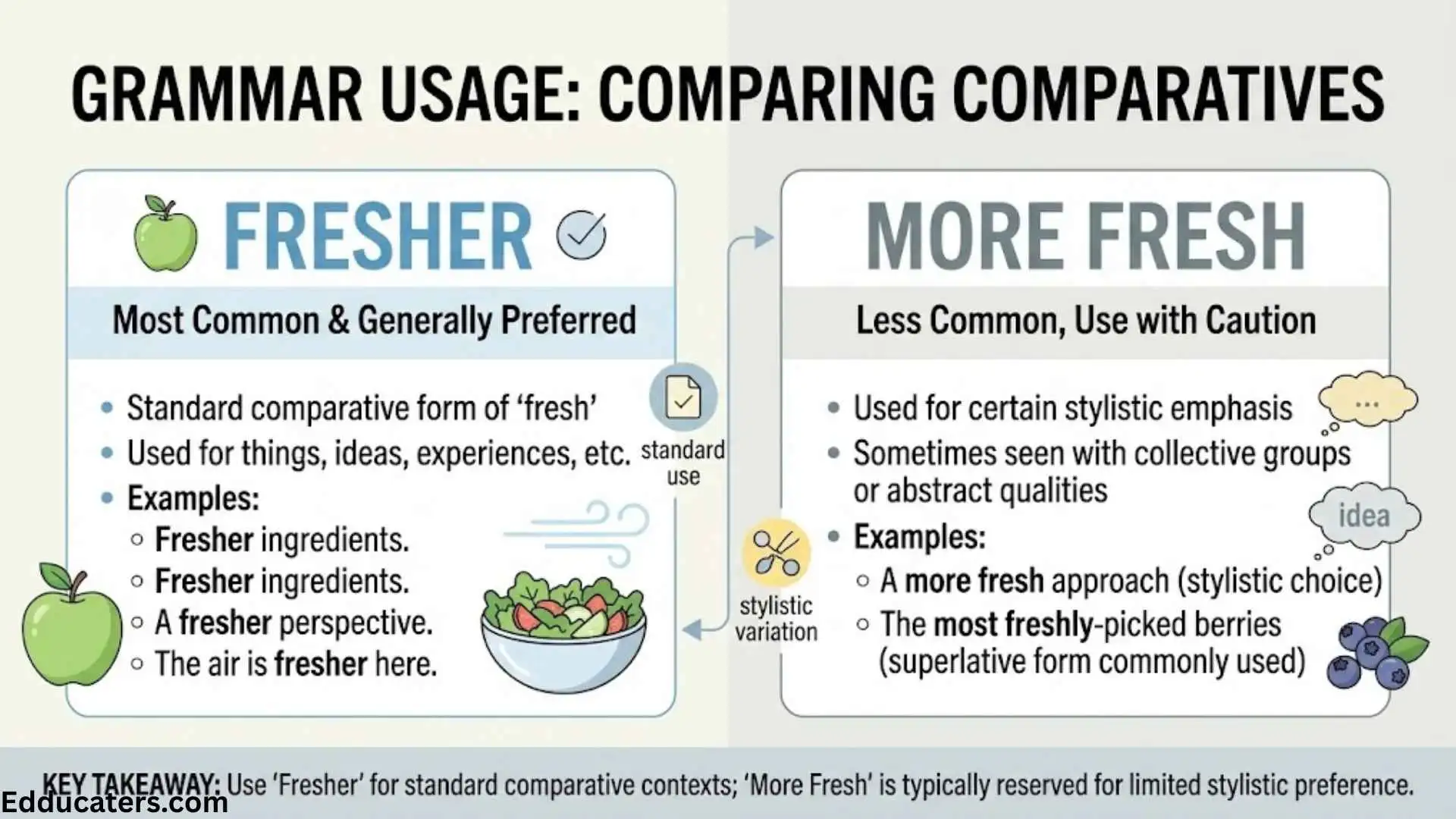
If you are unsure whether to use “fresher” or “more fresh,” you are not alone. The two forms can appear similar, but they are not equally common in standard everyday English. When fresh is used as an adjective and you need its comparative form, fresher is normally the natural choice.
For example, you would usually say, “This bread is fresher than yesterday’s bread.” The standard comparative pattern is fresh → fresher → freshest. More fresh can occasionally appear in English, particularly when the writer is emphasizing the quality described by fresh, but it is much less common than fresher in an ordinary comparison.
So, if you are asking, “Is it fresher or more fresh?”, the practical answer is simple: use fresher for a normal comparison. It is the regular comparative form of fresh, and it works naturally in both American English and British English.
Fresher or More Fresh: Which Is Correct?
Fresher is the normal and preferred comparative form of fresh.
Use fresher when comparing the freshness, newness, condition, or quality of two things:
- This milk is fresher than the milk in the other bottle.
- The vegetables look fresher today.
- The air feels fresher after the rain.
- I need fresher ingredients for this recipe.
- Her ideas are fresher than the ones we discussed earlier.
More fresh is possible in some contexts, but it is not normally the first choice for a straightforward comparison. Grammar references generally identify fresher as the regular comparative form of fresh.
| Form | Grammatical Role | Example |
| Fresh | Positive adjective | The bread is fresh. |
| Fresher | Comparative adjective | This bread is fresher. |
| Freshest | Superlative adjective | This is the freshest bread. |
| More fresh | Alternative comparative construction | Possible in limited contexts, but less natural in ordinary comparisons. |
| Most fresh | Alternative superlative construction | Possible in limited contexts, but usually replaced by freshest. |
For normal English writing, the easiest rule is:
Fresh → Fresher → Freshest
What Does Fresher Mean?
Fresher is the comparative form of fresh. It describes something that has a greater degree of freshness than something else.
The meaning of fresh changes slightly depending on context, so fresher can also have several related meanings.
Fresher Meaning: Recently Made or Produced
When talking about food or other products, fresher can mean more recently produced, prepared, bought, or harvested.
This bread is fresher than the loaf I bought yesterday.
Fresher Meaning: Cleaner or More Refreshing
When talking about air, water, or an environment, fresher can mean cleaner, cooler, or more refreshing.
The air feels fresher after the storm.
Fresher Meaning: Newer or More Original
When talking about ideas, approaches, designs, or perspectives, fresher can mean newer, more original, or less familiar.
We need a fresher approach to the problem.
Fresher Meaning: More Rested
When describing a person, fresher can sometimes mean more rested or refreshed.
I feel fresher after getting a full night’s sleep.
Because fresh has several meanings, the exact meaning of fresher depends on the sentence.
What Is the Comparative Form of Fresh?
The standard comparative form of fresh is fresher.
The three basic forms are:
- Positive: fresh
- Comparative: fresher
- Superlative: freshest
For example:
The fruit is fresh.
The fruit from the local market is fresher.
These are the freshest fruits in the store.
The adjective fresh is a one-syllable adjective, and it follows the common English pattern of forming its comparative with -er and its superlative with -est.
Other examples include:
- cold → colder → coldest
- fast → faster → fastest
- clean → cleaner → cleanest
- young → younger → youngest
- fresh → fresher → freshest
This is why fresher is the form most speakers naturally choose.
Why Do We Say Fresher Instead of More Fresh?
English uses different methods to form comparative adjectives. Short adjectives commonly take -er, while many longer adjectives use more.
For example:
- tall → taller
- small → smaller
- quick → quicker
- expensive → more expensive
- beautiful → more beautiful
Because fresh is a short, one-syllable adjective, fresher follows the regular pattern.
So:
This apple is fresher than that apple. ✅
is the normal construction.
This apple is more fresh than that apple.
can be understood, but it is less idiomatic in ordinary usage.
A grammar reference specifically addressing this question notes that fresher is the expected comparative form, while also acknowledging that more fresh can occur in some contexts.
Is More Fresh Ever Correct?
It is better not to describe more fresh as absolutely impossible. English usage can be flexible, and the phrase does occur.
However, there is an important distinction between grammatically possible and natural everyday usage.
If you simply want to compare two things, fresher is normally the better choice:
This bread is fresher than that bread.
Rather than:
This bread is more fresh than that bread.
There are contexts in which a writer may deliberately use more fresh to emphasize fresh as a descriptive quality. In other cases, the writer may be comparing a compound or a broader phrase rather than simply forming the ordinary comparative of fresh.
For learners, however, there is no need to make the choice complicated. When you mean “more fresh,” the normal comparative form is fresher.
Fresher or More Fresh in a Sentence
Here are natural examples showing how fresher works:
- This fruit is fresher than the fruit we bought yesterday.
- The vegetables look fresher after being refrigerated.
- The morning air feels fresher than the afternoon air.
- These flowers are fresher than the ones on the table.
- The bakery sells fresher bread in the morning.
- I prefer the fresher ingredients.
- The new design gives the website a fresher appearance.
- She came back from vacation looking fresher and more energetic.
- The local market usually has fresher produce.
- We need a fresher idea for the campaign.
Notice that fresher does not always refer to food. It can describe air, ideas, appearances, approaches, experiences, and other things.
Fresher or Freshest: What Is the Difference?
Fresher or freshest are both forms of fresh, but they serve different grammatical purposes.
Fresher
Use fresher when making a comparison.
This apple is fresher than that one.
The comparison may involve two individual things or two groups.
The vegetables at the farmers’ market are fresher than the vegetables at the supermarket.
Freshest
Use freshest when identifying the highest degree of freshness within a group.
These are the freshest vegetables in the market.
The pattern is:
Fresh → Fresher → Freshest
This distinction is important because fresher is comparative, while freshest is superlative.
Most Fresh or Freshest: Which Is Correct?
If you are wondering whether to say “most fresh or freshest,” the usual answer is freshest.
For example:
This is the freshest bread in the bakery.
This is more natural than:
This is the most fresh bread in the bakery.
The same pattern applies to other short adjectives:
- fast → fastest
- clean → cleanest
- young → youngest
- fresh → freshest
Therefore, the normal progression is:
Fresh → Fresher → Freshest
not:
Fresh → More Fresh → Most Fresh
Although more fresh or most fresh can occasionally be found in real usage, they are not the forms learners normally need for ordinary comparative or superlative sentences.
How to Use Fresher With Than
A comparative adjective commonly works with than when the thing being compared is stated explicitly.
The basic structure is:
Subject + be + fresher + than + comparison
Examples:
This milk is fresher than that milk.
The air here is fresher than the air in the city.
These apples are fresher than the ones I bought yesterday.
You can also use fresher without than when the comparison is understood from context:
The vegetables look much fresher today.
Here, the listener can understand that today’s vegetables are being compared with their previous condition or appearance.
Fresher or More Fresh Synonyms
The best synonym depends on what fresh means in the sentence.
When Fresh Means Recently Produced
Possible alternatives include:
- newer
- recently made
- recently prepared
- recently harvested
- newly produced
For example:
We need fresher ingredients.
could become:
We need newer ingredients.
However, newer does not always have exactly the same meaning as fresher. Food can be new to you without necessarily being fresher, so context matters.
When Fresh Means Crisp
For food, especially fruits and vegetables, crisper can sometimes express a related idea.
These apples are crisper than the others.
But crisper focuses more specifically on texture, while fresher focuses on freshness.
When Fresh Means New or Original
Possible alternatives include:
- newer
- more original
- more innovative
- more recent
- less familiar
For example:
We need a fresher perspective.
could mean:
We need a newer or more original perspective.
So, fresher does not have one universal synonym. The appropriate alternative depends on the meaning of fresh in context.
Fresher Pronunciation
Fresher is pronounced approximately:
FRESH-er
Its IPA pronunciation is commonly represented as:
/ˈfreʃər/
It has two syllables:
FRESH-er
The main stress falls on the first syllable.
The base adjective fresh is pronounced:
/freʃ/
Adding -er gives:
fresh → fresher
The spelling is straightforward, and the pronunciation does not require a major change to the original word.
Is Fresher a Noun Too?
Yes. Fresher can also function as a noun in some varieties of English, especially British English.
In British educational contexts, fresher can refer informally to a first-year university student.
For example:
The freshers attended an orientation event.
This meaning is separate from the comparative adjective fresher.
Compare:
This bread is fresher than yesterday’s bread.
Here, fresher is a comparative adjective.
The freshers attended their first university event.
Here, freshers is a noun referring to students.
The surrounding sentence makes the intended meaning clear.
Common Mistakes With Fresher or More Fresh
Mistake 1: Using More Fresh in a Normal Comparison
Less natural:
This fruit is more fresh than that fruit.
More natural:
This fruit is fresher than that fruit.
For a straightforward comparison, fresher is the normal choice.
Mistake 2: Using Freshest for Two Things
Incorrect for a simple two-way comparison:
This apple is the freshest than that one.
Correct:
This apple is fresher than that one.
Use fresher for the comparison and freshest when identifying the highest degree within a group.
Mistake 3: Saying Most Fresh Instead of Freshest
Less natural:
This is the most fresh bread here.
Natural:
This is the freshest bread here.
Mistake 4: Confusing Fresher With Freshly
Fresher is an adjective:
The bread is fresher.
Freshly is an adverb:
The bread was freshly baked.
They perform different grammatical roles and should not be used interchangeably.
Fresher or More Fresh in American English
In American English, fresher is the normal comparative form of fresh.
For example:
The vegetables at this store are fresher.
There is no major American spelling difference between fresher and British English fresher. The same comparative form is used in both varieties.
Therefore, this is not a case like color or colour or tire or tyre, where regional spelling determines which form you should choose.
Fresher or More Fresh in British English
British English also commonly uses fresher as the comparative form.
For example:
The bread from the local bakery is fresher.
British English also uses fresher as a noun in the university context mentioned earlier, but that is a separate meaning from the comparative adjective.
So, for the adjective comparison, both American English and British English normally use:
fresh → fresher → freshest
Fresher or More Fresh Quiz
Test your understanding by choosing the more natural form.
Question 1
This milk is ___ than the milk I bought yesterday.
- A. more fresh
- B. fresher
Answer: B. fresher
Question 2
These are the ___ vegetables in the store.
- A. freshest
- B. fresher
Answer: A. freshest
Question 3
The air feels ___ after the rain.
- A. fresher
- B. freshest
Answer: A. fresher
Question 4
Which is the usual comparative form of fresh?
- A. more fresh
- B. fresher
Answer: B. fresher
Question 5
Which sentence is most natural?
- A. This bread is fresher than that bread.
- B. This bread is freshest than that bread.
Answer: A. This bread is fresher than that bread.
Quick Rule to Remember
If you only remember one thing, remember this:
Fresh → Fresher → Freshest
Use fresh when simply describing something:
The bread is fresh.
Use fresher when comparing:
This bread is fresher than that bread.
Use freshest when identifying the highest degree:
This is the freshest bread in the bakery.
This simple pattern will cover the vast majority of situations in which you need to compare freshness.
FAQs
Is it fresher or more fresh?
Fresher is the normal comparative form of fresh and is usually the more natural choice in everyday English.
Is fresher grammatically correct?
Yes. Fresher is the standard comparative form of fresh.
What is the comparative form of fresh?
The comparative form of fresh is fresher.
What is the superlative form of fresh?
The superlative form of fresh is freshest.
Is more fresh grammatically wrong?
Not absolutely. More fresh can occur in some contexts, but fresher is normally preferred for a straightforward comparison.
Should I say fresher than?
Yes. Fresher than is a normal comparative construction.
Is it most fresh or freshest?
Freshest is the normal superlative form of fresh.
Is fresher used in American English?
Yes. Fresher is standard in American English.
Is fresher used in British English?
Yes. British English also commonly uses fresher as the comparative form of fresh.
What are the three forms of fresh?
The three basic forms are fresh, fresher, or freshest.
Conclusion
If you are deciding between fresher or more fresh, choose fresher for a normal comparative sentence. It is the regular comparative form of the one-syllable adjective fresh, and it is natural in both American English and British English.
The easiest pattern to remember is:
Fresh → Fresher → Freshest
Use fresher when comparing two things:
This fruit is fresher than that fruit.
Use freshest when describing the highest degree of freshness within a group:
These are the freshest fruits in the store.
Although more fresh can occur in particular contexts, it is generally less natural than fresher for an ordinary comparison. If your goal is clear, natural English, fresher is the form you will normally want.

I’m Julian Mercer, an English language writer dedicated to helping people master grammar through practical examples and clear explanations. I enjoy teaching grammar in a way that is both engaging and easy to remember.
My work focuses on grammar rules, punctuation, word usage, and writing techniques that readers can apply in everyday life. I believe learning English should be simple, enjoyable, and useful.
Books
English Grammar in Practice
Writing with Precision
 Nathan Whitmore
 Claire Holloway