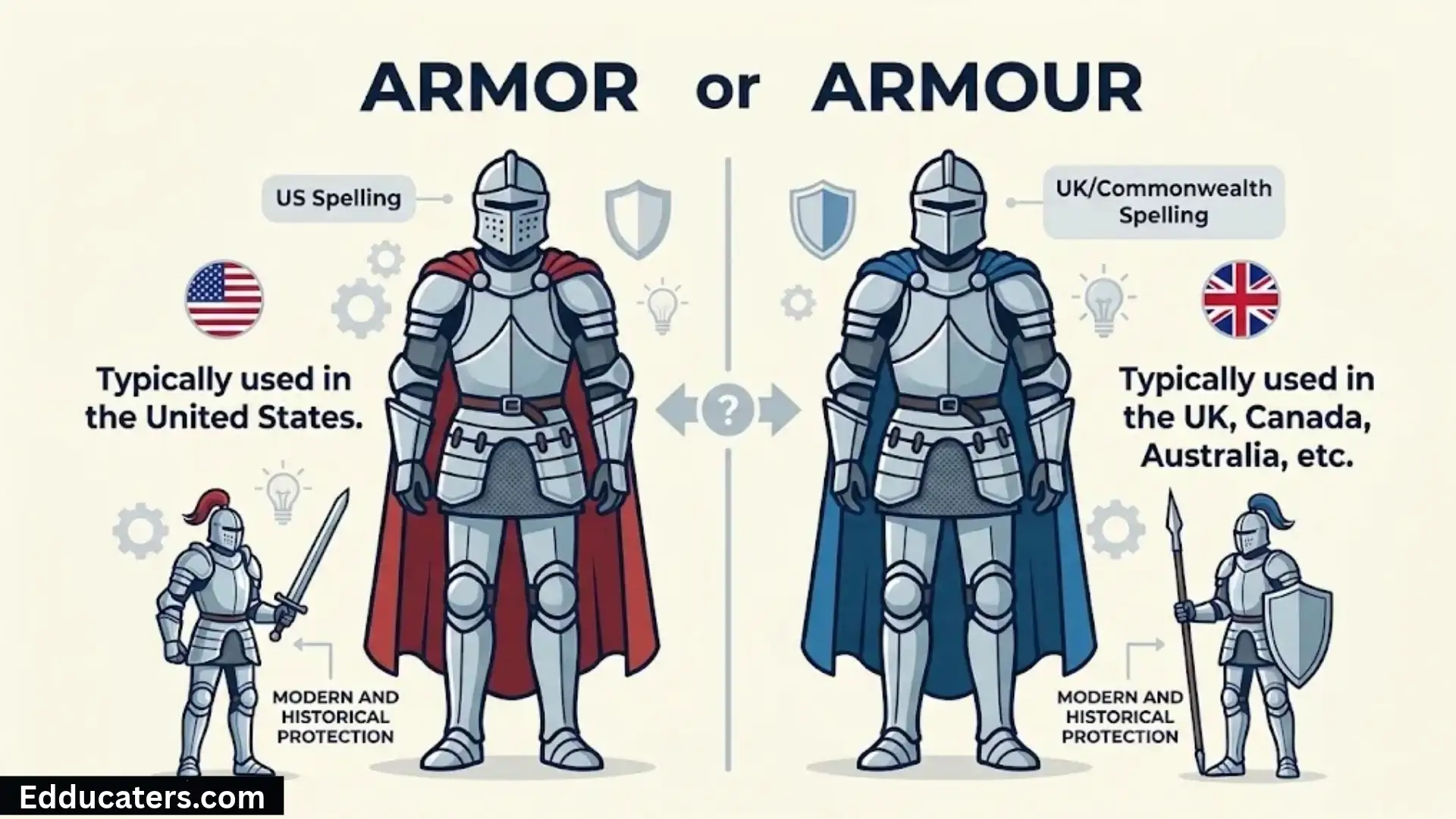
Have you ever wondered whether to write armor or armour? Both spellings look right, yet choosing the wrong one for your audience can make your writing seem inconsistent. The good news is that neither spelling is incorrect. The difference comes down to regional English conventions.
Armor is the standard spelling in American English, while armour is the preferred spelling in British English. Both words have the same meaning, grammatical function, and basic pronunciation. They describe protective covering used by soldiers, vehicles, animals, and other objects.
This spelling difference also appears in related words. Americans write armored and armoring, while British writers generally use armoured and armouring. Canadian, Australian, and New Zealand English generally favor the traditional -our spelling, although individual dictionaries and editorial standards can influence usage.
Understanding these differences helps you choose the right spelling for school assignments, professional documents, articles, and everyday communication. Let’s explore their meanings, origins, regional preferences, and practical uses.
Armor or Armour: Which Spelling Is Correct?
Both armor and armour are correct English spellings. Neither represents a grammatical mistake or a different word. The distinction comes from the regional spelling conventions used in different English-speaking countries.
American English generally drops the letter u from words that traditionally end in -our. British English usually retains it.
Here is the simplest way to remember the difference:
- Armor: Correct American English spelling.
- Armour: Correct British English spelling.
- Armor: Commonly preferred in American publications, books, and professional writing.
- Armour: Commonly preferred in British publications, books, and professional writing.
For example:
- The medieval knight wore heavy armor during battle. (American English)
- The medieval knight wore heavy armour during battle. (British English)
Both sentences communicate exactly the same information. Only the regional spelling changes.
You don’t need to worry about choosing one universally correct version. Instead, consider your readers and follow their expected spelling conventions.
Armor or Armour: What’s the Difference?
The main difference between armor and armour is one letter. The American spelling leaves out the u, while the British spelling keeps it.
However, their similarities go much further than appearance. Both words have the same definition and perform the same grammatical functions.
Consider this comparison:
| Feature | Armor | Armour |
| Spelling | American English | British English |
| Meaning | Protective covering | Protective covering |
| Pronunciation | Regional American pronunciation | Regional British pronunciation |
| Part of speech | Noun and verb | Noun and verb |
| Grammatical function | Identical | Identical |
| Common derivative | Armored | Armoured |
| Present participle | Armoring | Armouring |
| Primary usage | United States | United Kingdom |
The spelling difference doesn’t change the word’s meaning. Both versions describe something that protects a person, vehicle, animal, or object against damage.
For instance, a soldier’s protective vest is body armor in American English and body armour in British English.
Similarly, a military vehicle can be described as an armored vehicle or an armoured vehicle. Both expressions refer to a vehicle equipped with protective covering.
The same principle applies to figurative expressions. Someone might describe emotional protection as armor or armour, depending on the regional writing standard.
Remember: The letter u distinguishes the spellings, not their definitions.
What Does Armor or Armour Mean?
Armor or armour means a protective covering designed to protect someone or something against physical harm, weapons, or damaging forces.
Traditionally, the word referred to protective equipment worn by soldiers during combat. Medieval knights, for example, wore metal suits to protect their bodies from swords, arrows, and other weapons.
Today, the meaning extends beyond historical military equipment. Modern usage includes protective clothing, vehicle coverings, military equipment, and figurative forms of defense.
Armor or Armour as a Noun
As a noun, armor describes protective material or equipment. It can refer to anything from a medieval metal suit to reinforced military vehicles.
The word generally functions as an uncountable noun when describing protective material or equipment.
Examples include:
- The soldier wore heavy armor before entering the battlefield.
- The museum displayed a medieval suit of armour.
- The military vehicle has reinforced armor.
- Police officers wore protective armour during the operation.
- The tank’s armor protected its crew from incoming fire.
The noun also has a military meaning beyond physical coverings. In military contexts, armor or armour can refer collectively to armored fighting vehicles and their units.
For example:
“The infantry advanced alongside the armour.”
Here, armour refers to military vehicles or armored forces rather than individual protective suits.
Armor or Armour as a Verb
Both spellings can also function as verbs. To armor something means to cover, equip, or strengthen it with protective material.
The verb can describe physical reinforcement or figurative protection.
Examples:
- Engineers will armor the vehicle before its next deployment.
- Workers armoured the structure against external damage.
- The manufacturer plans to armor the equipment with reinforced panels.
- She tried to armour herself emotionally against criticism.
The exact verb forms follow the regional spelling conventions:
- American: armor, armors, armored, armoring.
- British: armour, armours, armoured, armouring.
Physical and Figurative Meanings
Armor doesn’t always refer to metal protection or military equipment. English speakers also use it figuratively to describe emotional strength or psychological defense.
For example, someone who has experienced repeated disappointment might develop emotional armor. This expression suggests that the person protects their feelings to avoid further hurt.
Another familiar expression is a chink in someone’s armor. It describes a weakness that others might exploit.
Consider these examples:
- Confidence became his emotional armor against criticism.
- Her calm attitude provided a layer of armour during difficult conversations.
- The investigation revealed a serious chink in the company’s armor.
These expressions carry the same meaning in American and British English. Only the spelling changes.
Armor or Armour in American English
If you’re writing for readers in the United States, armor is the correct standard spelling.
American English generally removes the u from many traditional British words ending in -our. This convention appears in several familiar spelling pairs.
| American English | British English |
| Armor | Armour |
| Color | Colour |
| Honor | Honour |
| Favor | Favour |
| Labor | Labour |
| Neighbor | Neighbour |
| Behavior | Behaviour |
| Humor | Humour |
The American spelling armor appears in dictionaries, newspapers, academic publications, military documents, and everyday writing.
It also appears in common expressions such as:
- Body armor
- Bulletproof armor
- Medieval armor
- Armor plating
- Armor-piercing ammunition
- Armor protection
- Suit of armor
- Emotional armor
American English Examples
Here are some sentences demonstrating the correct American spelling:
- The museum recently acquired a complete suit of medieval armor.
- Modern soldiers wear lightweight body armor for additional protection.
- The manufacturer developed stronger armor plating for military vehicles.
- The historical exhibition features weapons and protective armor from several periods.
- The vehicle’s reinforced armor can withstand certain ballistic threats.
- He built emotional armor after years of difficult experiences.
Notice that each example uses the American spelling consistently.
Why Do Americans Spell Armor Without a U?
The missing letter comes from the broader development of American English spelling conventions.
During the eighteenth and nineteenth centuries, American spelling reformers encouraged simpler and more standardized spellings. Noah Webster played an important role in this movement.
His dictionaries and spelling books helped establish forms such as color, honor, favor, and armor in American writing.
Consequently, modern American English generally prefers -or endings over the traditional British -our forms.
If you’re preparing content for an American audience, use armor throughout the document. American readers will recognize armour, but the shorter version matches their standard spelling expectations.
Armour or Armor in British English
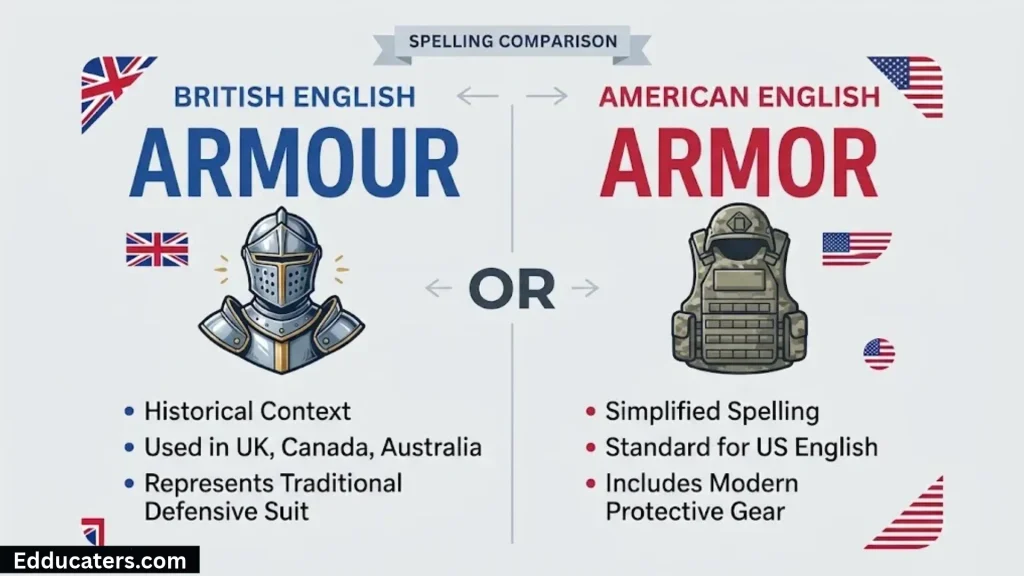
In British English, armour is the preferred spelling. The letter u remains part of the traditional British spelling pattern.
British dictionaries recognize armour as the standard form. You’ll find it in historical books, newspapers, educational materials, military publications, and everyday communication.
Common British expressions include:
- Body armour
- Medieval armour
- Suit of armour
- Armour plating
- Armoured vehicle
- Armour-piercing ammunition
- Protective armour
- Emotional armour
The meaning remains identical to the American version. British writers simply retain the traditional spelling.
British English Examples
Here are several examples using armour correctly:
- The medieval knight wore a heavy suit of armour during battle.
- Police officers received additional body armour for protection.
- The museum displays several examples of medieval armour.
- The military upgraded its vehicles with reinforced armour plating.
- The soldiers moved forward alongside several armoured vehicles.
- She developed emotional armour to protect herself from disappointment.
Each sentence follows standard British spelling conventions.
Why Does British English Keep the U?
British English retained the traditional -our spelling in words such as armour, colour, honour, and favour.
American spelling reform gradually established shorter forms without the additional letter.
This difference doesn’t mean British English uses an extra letter incorrectly. It reflects the historical development of two regional spelling systems.
If your readers are primarily from the United Kingdom, use armour and its related forms. This keeps your writing consistent with their familiar spelling conventions.
Armor or Armour in Canadian, Australian, and New Zealand English
American and British English aren’t the only varieties worth considering. Canadian, Australian, and New Zealand English also have established spelling preferences.
These varieties share many conventions with British English, but they don’t follow identical rules in every situation.
Armor or Armour in Canadian English
Canadian English combines features of American and British spelling. This happens partly because Canada has historical connections with Britain and shares a border with the United States.
For words ending in -our, Canadian English generally favors the traditional spelling. Therefore, armour is usually the preferred Canadian form.
Examples include:
- The museum displays historical suits of armour.
- Police officers received new body armour.
- The military vehicle uses reinforced armour plating.
However, Canadian spelling doesn’t follow every British convention. For example, Canadians commonly use organize rather than organise.
The Canadian government’s Language Portal explains that Canadian spelling has historically drawn from both British and American usage. It recommends consulting a reliable Canadian dictionary and maintaining consistency.
The Canadian Oxford Dictionary is one recognized spelling authority. The Oxford American Dictionary also identifies armour as the usual Canadian English form.
Therefore, if you’re writing for a Canadian audience, armour is the safer default. Check your organization’s preferred dictionary when a specific house style applies.
Armor or Armour in Australian English
Australian English generally follows British spelling conventions. This means armour is the preferred spelling in most Australian writing.
The Australian Government Style Manual recommends using an established Australian dictionary, such as the Australian Concise Oxford Dictionary or Macquarie Dictionary.
Examples include:
- The historical collection contains several examples of medieval armour.
- Soldiers wear protective body armour during military operations.
- The vehicle received additional armour plating.
- The museum restored an old suit of armour.
Australian English also commonly retains the u in words such as colour, honour, and behaviour.
However, Australian English has its own regional conventions. Don’t assume that every British spelling rule automatically applies to Australian writing.
For professional documents, follow the preferred Australian dictionary or organizational style guide.
Armor or Armour in New Zealand English
New Zealand English generally follows British-style spelling conventions. Therefore, armour is the usual spelling.
The New Zealand Ministry for the Environment’s spelling guidance recommends retaining the -our ending in words such as colour, honour, and labour.
Examples include:
- The exhibition features traditional suits of armour.
- The police department purchased additional body armour.
- The vehicle requires stronger armour plating.
New Zealand universities also commonly recommend British-style spelling in academic writing.
If you’re writing for New Zealand readers, choose armour unless your publication follows a different established style.
What About Other Commonwealth Countries?
Commonwealth countries don’t share one universal English spelling system.
Many follow British-style spelling conventions, but local usage can vary. Educational standards, government publications, national dictionaries, and organizational preferences all influence spelling.
For example, English publications in India, South Africa, and other Commonwealth countries may follow British-style conventions. However, individual organizations can adopt different standards.
The safest approach is to identify your audience’s preferred English variety before choosing a spelling.
Armor or Armour: Meaning, Pronunciation, and Grammar
Although the two spellings look different, they represent the same English word. Understanding their pronunciation and grammatical functions makes the distinction even clearer.
Do Armor and Armour Have the Same Meaning?
Yes. Armor and armour have identical core meanings.
Both describe protective coverings or equipment that defend people, vehicles, and objects against damage.
Their meanings include:
- Protective clothing worn by soldiers.
- Metal coverings on military vehicles.
- Reinforced protective layers on ships and equipment.
- Military forces equipped with armored vehicles.
- Figurative protection against emotional or personal harm.
For example, body armor and body armour refer to the same kind of protective equipment.
Likewise, a suit of armor and a suit of armour describe the same historical clothing.
You won’t change the meaning by choosing one spelling over the other.
Are Armor and Armour Pronounced the Same?
The spelling difference doesn’t create a different pronunciation. However, American and British accents pronounce the word differently.
Cambridge Dictionary gives these broad pronunciation patterns:
| English variety | IPA pronunciation |
| American English | /ˈɑːr.mɚ/ |
| British English | /ˈɑː.mə(r)/ |
The American pronunciation is generally rhotic. This means speakers pronounce the r sound after the vowel.
In many standard British accents, that final r isn’t pronounced unless a vowel follows.
The important distinction is that these pronunciation differences come from regional accents, not from the spelling.
An American speaker can pronounce armour using an American accent. A British speaker can pronounce armor using a British accent.
Both spellings represent the same underlying word.
Are Armor and Armour Nouns or Verbs?
Both words can function as nouns and verbs.
As nouns, they usually refer to protective equipment or material.
For example:
- The soldier’s armor was damaged.
- The knight wore heavy armour.
As verbs, they describe the action of providing protection.
For example:
- Engineers will armor the vehicle.
- Workers will armour the structure.
When the word functions as a noun, dictionaries generally classify it as uncountable when referring to protective equipment as a substance or general category.
It can also describe military vehicles collectively in military contexts.
As a verb, its spelling changes according to tense and regional conventions. These differences become especially important when you write longer sentences or technical descriptions.
Armored or Armoured: Which Spelling Is Correct?
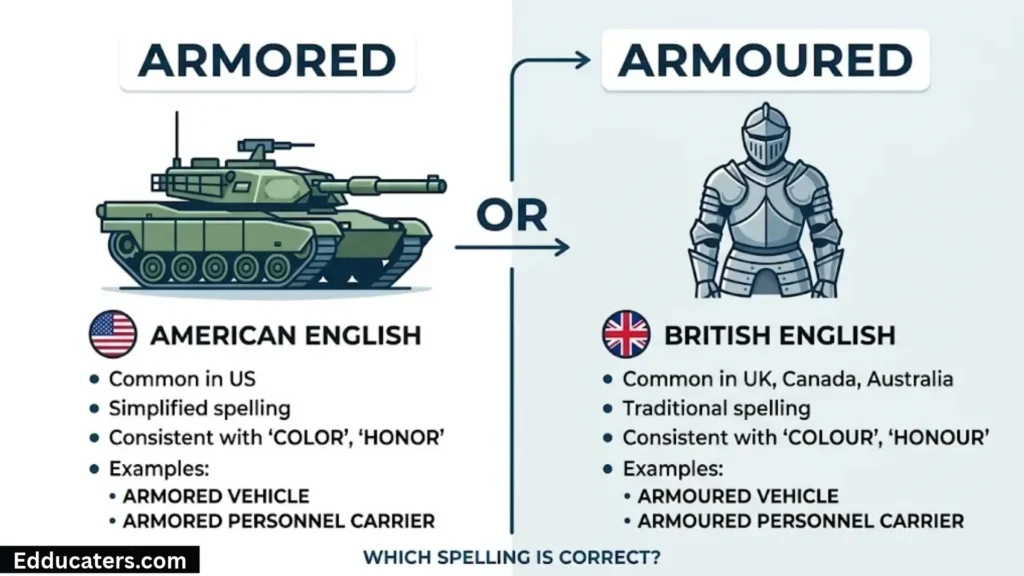
The same regional spelling rule applies to the related adjective armored or armoured.
Both forms are correct. The choice depends on your preferred English variety.
- Armored: Standard American English.
- Armoured: Standard British English.
The adjective describes something protected or reinforced with armor.
For example:
- The army deployed several armored vehicles. (American English)
- The army deployed several armoured vehicles. (British English)
Other related forms follow the same pattern.
| American English | British English |
| Armor | Armour |
| Armored | Armoured |
| Armoring | Armouring |
| Unarmored | Unarmoured |
| Armor-piercing | Armour-piercing |
| Armor-plated | Armour-plated |
When Should You Use Armored?
Use armored when writing for an American audience.
Examples:
- The company manufactures armored trucks.
- Police officers entered the building in an armored vehicle.
- The military ordered additional armored personnel carriers.
When Should You Use Armoured?
Use armoured when following British English conventions.
Examples:
- The military deployed several armoured vehicles.
- The company specializes in armoured trucks.
- The museum displays an old armoured fighting vehicle.
What About Armoring or Armouring?
These are the present participle forms of the verb.
American English uses armoring, while British English generally uses armouring.
For example:
- Workers are armoring the vehicle with protective steel panels.
- Engineers are armouring the vehicle before its next deployment.
The spelling pattern remains consistent across the word family. Once you choose a regional form, use its related forms throughout your writing.
History and Etymology of Armor or Armour
The spelling difference between armor and armour becomes easier to understand when you explore the word’s history.
Both forms developed from the same historical word. Their different modern spellings reflect changes in English spelling conventions rather than separate origins.
Where Did the Word Armor Come From?
The word armor entered English during the Middle English period, around the early fourteenth century.
Its history traces through Old French armure to Latin armatura.
The Latin word referred to arms or equipment. It came from armare, meaning to arm or equip, which connects to arma, meaning weapons.
The word originally described protective equipment associated with warfare.
Over time, its meaning expanded to include other forms of protection.
For example, armor could refer to:
- Metal clothing worn by soldiers.
- Protective coverings on military equipment.
- Defensive structures and coverings.
- Figurative protection against emotional harm.
The word also developed a modern military meaning associated with armored vehicles and mechanized forces.
Why Does Armour Have an Extra U?
The additional u comes from the historical spelling pattern used in British English.
Words such as armour, colour, honour, and favour traditionally retained the -our ending.
American English gradually adopted shorter forms that removed the letter u.
This produced familiar differences:
| Traditional British form | American form |
| Armour | Armor |
| Colour | Color |
| Honour | Honor |
| Favour | Favor |
| Labour | Labor |
| Neighbour | Neighbor |
| Behaviour | Behavior |
| Humour | Humor |
The difference doesn’t reflect a change in pronunciation or meaning. It simply represents separate spelling conventions.
How Did Noah Webster Influence American Spelling?
Noah Webster was an influential American lexicographer, educator, and spelling reformer.
He believed American English should develop a more standardized spelling system. His work encouraged simpler forms that differed from traditional British conventions.
His early spelling publications included The American Spelling Book, first published in 1783. Later, his dictionaries helped establish American spelling preferences.
Webster supported changes such as:
- Honour becoming honor.
- Colour becoming color.
- Favour becoming favor.
- Armour becoming armor.
- Centre becoming center.
His influence helped standardize these forms in American education and publishing.
However, it’s important not to credit him with inventing every spelling difference. English spelling had already developed through centuries of regional variation, and other writers, printers, and dictionaries also influenced standard usage.
The result was a clearer distinction between many American and British spellings.
Armor or Armour in Different Contexts
Both spellings appear in several fields. Their meanings remain the same, but regional preferences determine which version writers should choose.
Military and Defense
Military writing frequently uses armor or armour to describe equipment that protects soldiers and vehicles.
Common terms include:
- Body armor or body armour
- Tank armor or tank armour
- Armor plating or armour plating
- Armored vehicles or armoured vehicles
- Armor-piercing ammunition or armour-piercing ammunition
For example, an American military publication would generally use armored vehicle. A British publication would normally use armoured vehicle.
The same distinction applies to military reports, technical descriptions, and defense publications.
Historical Writing
Historical writing often discusses medieval armor, knights, swords, shields, and protective clothing.
A British history book might describe a knight wearing a suit of armour. An American history book would generally use a suit of armor.
Both descriptions refer to the same historical equipment.
Common expressions include:
- Medieval armor
- Plate armor
- Chain mail armor
- Knight’s armor
- Suit of armor
- Medieval armour
- Plate armour
- Chain mail armour
- Knight’s armour
- Suit of armour
When writing about a historical museum or exhibition, follow the spelling used by the institution if you’re reproducing its official descriptions.
Everyday and Figurative Usage
People also use armor or armour in everyday language to describe emotional protection.
For example, someone might say they developed emotional armor after experiencing repeated criticism.
Another person might describe confidence as a protective layer against outside pressure.
Common figurative expressions include:
- Emotional armor
- Emotional armour
- A chink in someone’s armor
- A chink in someone’s armour
- A knight in shining armor
- A knight in shining armour
These expressions don’t describe physical military equipment. They use the idea of protection to explain personal strength, weaknesses, or emotional defenses.
Gaming and Digital Content
Video games often feature armor as protective equipment for characters. Players may collect armor sets, upgrade protective gear, and compare armor statistics.
American game releases generally use armor, while British-localized versions may use armour.
For example, a game’s American interface might display:
- Heavy Armor
- Armor Sets
- Armor Rating
- Armor Customization
A British version might use:
- Heavy Armour
- Armour Sets
- Armour Rating
- Armour Customisation
The exact wording depends on the game’s localization choices. Not every developer changes every term between regional releases.
The same principle applies to software, digital products, and other localized content. Follow the language settings and regional terminology selected for the intended users.
Which Spelling Should You Use: Armor or Armour?
Choosing between armor and armour is simple once you identify your target audience.
You don’t need to memorize complicated spelling rules. Just follow the standard conventions of the English variety you’re using.
When to Use Armor
Choose armor when writing in American English.
It’s the preferred spelling for:
- American blog posts and articles.
- School assignments in the United States.
- American academic publications.
- Business documents for US readers.
- American military and technical writing.
- US-focused websites and digital content.
For example:
“The museum recently opened an exhibition featuring medieval armor.”
This sentence follows American spelling conventions.
When to Use Armour
Choose armour when writing in British English.
It’s the preferred spelling for:
- British newspapers and magazines.
- Academic assignments in the United Kingdom.
- British business correspondence.
- Historical books and publications using British English.
- UK-focused websites.
- British military and technical documents.
For example:
“The museum recently opened an exhibition featuring medieval armour.”
This sentence follows British spelling conventions.
Which Spelling Works Best for an International Audience?
If your content targets readers across several countries, consistency matters more than trying to satisfy every regional preference.
Start by identifying your largest or most important audience.
Then choose one spelling standard and apply it throughout the document.
For example:
| Target audience | Recommended spelling |
| United States | Armor |
| United Kingdom | Armour |
| Canada | Armour |
| Australia | Armour |
| New Zealand | Armour |
| International audience | Follow one chosen style consistently |
For a publication serving multiple countries, a documented house style can prevent unnecessary confusion.
You can also use language localization to provide different regional spellings where the audience needs them.
The goal isn’t to make every reader prefer your spelling. It’s to make your writing consistent and appropriate for its intended audience.
Common Mistakes When Using Armor or Armour
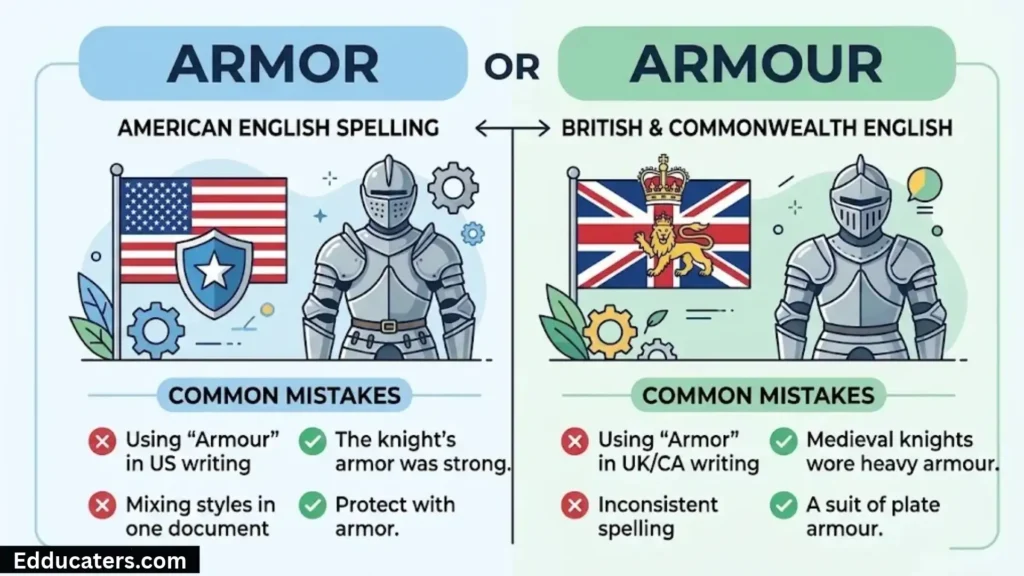
Although the difference looks simple, writers sometimes make mistakes when switching between American and British English.
Here are some common problems and how to avoid them.
Treating one spelling as universally correct
Some writers assume armor is always correct because their spellchecker accepts it. Others believe armour is the only proper spelling.
Both assumptions are incorrect. Each form belongs to a recognized regional spelling system.
Mixing American and British spellings
Using armor in one paragraph and armoured in another can make your writing inconsistent.
Choose a standard and apply it to related words.
Assuming the words have different meanings
Armor and armour don’t describe different types of protective equipment. Their meanings remain the same.
Using the wrong regional derivative
Remember that American English uses armored, while British English uses armoured.
Changing only the main noun isn’t enough. Related forms should follow the same spelling convention.
Assuming all Commonwealth countries use identical spelling
Canadian, Australian, and New Zealand English share many British-style conventions. However, each variety has its own spelling standards and exceptions.
Ignoring spellcheck language settings
A spellchecker might flag a correct regional spelling if you select the wrong English dictionary.
For example, American English settings may identify armour as a regional alternative.
Set your language preference correctly before proofreading. Microsoft Word and other word processors provide regional English settings that help identify spelling inconsistencies.
Frequently Asked Questions About Armor or Armour
Is Armor or Armour the Correct Spelling?
Both spellings are correct. Armor is the standard American English form, while armour is the preferred British English form. Choose the version that matches your audience and maintain consistency throughout your writing.
Is Armor American or British?
Armor is the standard American English spelling. American dictionaries, publications, and educational materials generally use this shorter form without the letter u.
Is Armour British or American?
Armour is the standard British English spelling. British writers retain the traditional -our ending, just as they do in words such as colour, honour, and favour.
Do Canadians Use Armor or Armour?
Canadian English generally favors armour. Canadian spelling combines British and American influences, so checking a reliable Canadian dictionary is the best way to confirm regional preferences.
Do Australians Spell It Armor or Armour?
Australians generally use armour. Australian English follows many British spelling conventions, including the traditional -our ending.
Do New Zealanders Use Armor or Armour?
New Zealand English generally uses armour. The country’s spelling conventions closely resemble British English, although local dictionaries and publication styles determine preferred forms.
Do Armor and Armour Have the Same Meaning?
Yes. Both words describe protective coverings or equipment used to defend people, vehicles, animals, and objects against damage. They can also describe figurative or emotional protection.
Are Armor and Armour Pronounced Differently?
The spelling difference doesn’t create a separate pronunciation. However, American and British accents produce different sounds. American English generally pronounces the final r, while many British accents don’t.
Is It Armored or Armoured?
Both forms are correct. American English uses armored, while British English uses armoured. The same regional distinction applies to armoring and armouring.
Why Does Armour Have a U?
British English retained the traditional -our spelling, while American spelling reform established shorter -or forms. Noah Webster helped popularize these changes through his influential spelling books and dictionaries.
Can You Use Armour in American English?
Yes. American readers can understand armour, and it isn’t an inherently incorrect spelling. However, armor is the standard American form and is generally the better choice for US-focused writing.
Can You Use Armor in British English?
Yes. British readers understand armor, but armour is the preferred British spelling. Use the traditional form when following British dictionaries or publication guidelines.
Which Spelling Should You Use for International Writing?
Choose one established English variety based on your main audience. If your publication targets several countries, create a consistent spelling policy and follow it throughout your content.
Conclusion: Armor or Armour?
The choice between armor or armour comes down to regional spelling conventions. Both forms are correct, share the same meaning, and perform the same grammatical functions.
American English prefers armor, while British English generally uses armour. Canadian, Australian, and New Zealand English also tend to favor armour, although their local spelling authorities and editorial standards deserve consideration.
Remember these simple guidelines:
- Use armor for American English.
- Use armour for British English.
- Generally use armour for Canadian, Australian, and New Zealand English.
- Use armored and armoring in American writing.
- Use armoured and armouring in British-style writing.
- Maintain consistent spelling throughout your documents.
Ultimately, neither spelling is better or more correct than the other. Choose the version that suits your readers, follow the appropriate regional conventions, and keep your writing consistent.

Hello, I’m Claire Holloway. I have always been passionate about the English language and enjoy turning complex grammar rules into simple, easy-to-follow lessons. I believe that every learner can become a confident English writer with the right guidance.
I create educational content focused on grammar, vocabulary, sentence structure, and writing improvement. Every article I publish is designed to help readers learn with confidence and accuracy.
Books
Grammar Without Confusion
Modern English Usage Guide
 Nathan Whitmore
 Julian Mercer