
The English language often trips us up with words that sound identical but serve different purposes. When it comes to expressing agreement, you have likely found yourself staring at a text message or a draft, wondering whether to type “yea” or “yeah.” While they sound similar to the untrained ear, they occupy distinct spaces in our vocabulary one steeped in history and formal procedure, the other a staple of casual, modern communication.
Understanding the nuances between these two terms will not only polish your writing but also help you navigate various social and professional contexts with ease. In this guide, we will break down the history, proper usage, and grammatical distinctions between “yea” and “yeah” so you can communicate with total confidence.
Quick Answer: Yea or Yeah
“Yeah” is the informal, colloquial version of “yes,” used primarily in casual conversation and texting. “Yea” (pronounced “yay”) is an archaic or formal term representing a vote of approval, historically used in parliamentary or legislative settings. In modern English, use “yeah” for everyday agreement and “yea” only when participating in a formal voice vote.
Comparison at a Glance
| Feature | Yea | Yeah |
| Meaning | An affirmative vote | An informal “yes” |
| Part of Speech | Noun / Adverb | Interjection / Adverb |
| Formality | Formal / Archaic | Informal / Colloquial |
| Pronunciation | /yeɪ/ (like “yay”) | /jæ/ or /jɛə/ |
| Common Use | Legislative voting | Casual conversation |
| Memory Tip | Think “Yea-s” (Vote) | Think “Yeah” = “Yes” |
Understanding “Yea”
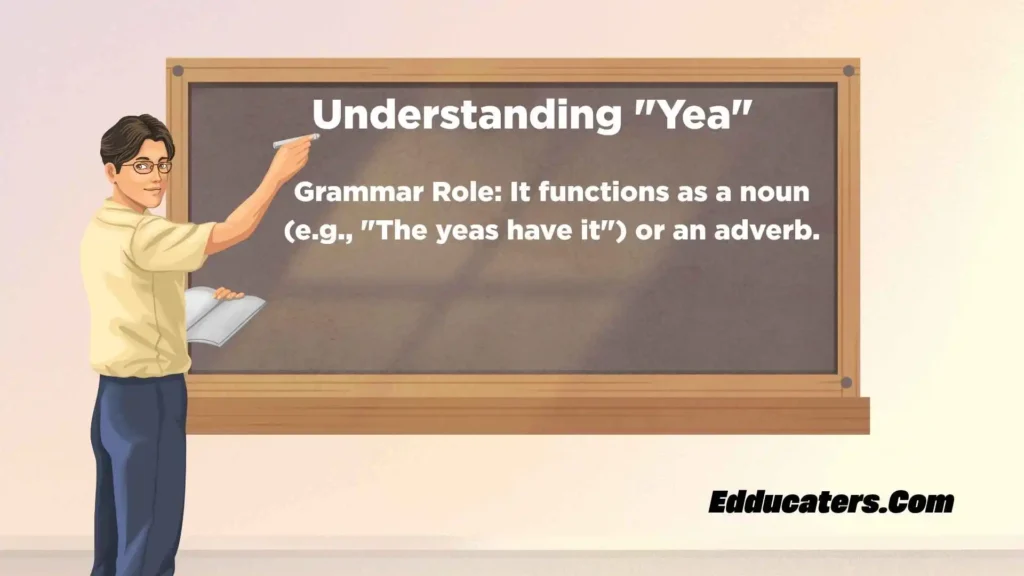
“Yea” is a specialized term that has largely faded from daily conversation. Historically, it served as an affirmative, but today it is almost exclusively reserved for formal voting procedures. When you hear a politician say “yea” or “nay,” they are participating in a structured decision-making process.
- Grammar Role: It functions as a noun (e.g., “The yeas have it”) or an adverb.
- Usage Context: Legislative chambers, board meetings following Robert’s Rules of Order, and historical literary contexts.
- Examples:
- The chairman asked for a show of hands: “All those in favor, say yea.”
- The final count showed twenty yeas and fifteen nays.
Understanding “Yeah”
“Yeah” is the undisputed champion of informal agreement. It is the phonetic spelling of how many English speakers pronounce “yes” in rapid or casual speech. It lacks the stiffness of “yes” and the technicality of “yea.”
- Grammar Role: An interjection used to express assent, enthusiasm, or acknowledgment.
- Usage Context: Texting, social media, casual conversation, and informal emails.
- Examples:
- “Yeah, I think that sounds like a great plan for Saturday.”
- “Are you coming to the party?” “Yeah, I’ll be there around eight.”
Key Differences at a Glance
- Contextual Boundary: The most significant difference is the setting. If you are in a courtroom or a legislative assembly, “yea” is the technical choice. If you are ordering coffee or chatting with a friend, “yeah” is the natural choice.
- Pronunciation: While they may sound similar to non-native speakers, “yea” rhymes with “day,” while “yeah” typically rhymes with “meh” or “pah.”
- Frequency: “Yeah” appears in literature and media thousands of times more often than “yea,” which is now restricted to specific formal domains.
Grammar Rules and Usage
There is no complex rulebook for these words, but there is a clear social contract. “Yea” is essentially a fossilized term. Using “yea” in a text message to a friend will likely cause confusion, as the recipient will assume you are trying to cast a vote or are using an archaic affectation. Conversely, using “yeah” in a formal board meeting transcript would be considered unprofessional and grammatically incorrect for the record.
When to use each:
- Academic Writing: Avoid both. Use “yes” or “affirmative.”
- Professional/Business: Use “yes” in emails. Use “yea” only if you are literally recording a vote.
- Informal/Social: “Yeah” is perfectly acceptable and expected.
Common Mistakes
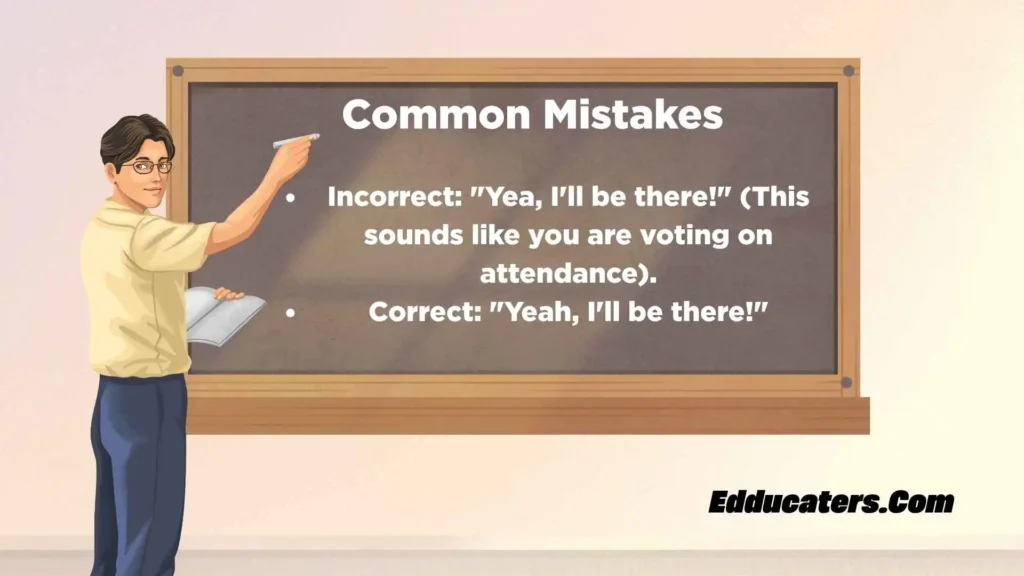
The most frequent mistake is using “yea” when you mean “yeah.” People often assume “yea” is just a fancy or alternative spelling of “yeah,” but they are etymologically and functionally different.
- Incorrect: “Yea, I’ll be there!” (This sounds like you are voting on attendance).
- Correct: “Yeah, I’ll be there!”
- Incorrect: “The yeahs outnumbered the nays.” (This is a misspelling of the noun).
- Correct: “The yeas outnumbered the nays.”
Original Examples
- Workplace: “Yeah, I can have that report finished by five o’clock.”
- Conversation: “Do you want to grab lunch?” “Yeah, let’s go.”
- News: “The city council voted: twenty-two yeas, twelve nays.”
- Social Media: “Yeah! That new movie was absolutely incredible.”
- Books: The protagonist whispered a soft “yea” to the magistrate’s question, sealing his fate.
- School: “Class, please vote yea if you want to extend the project deadline.”
- Everyday English: “Yeah, I think I remember seeing him there last night.”
- Business: “Yeah, the meeting is still scheduled for tomorrow morning.”
- Conversation: “Can you help me move this desk?” “Yeah, I’ve got you.”
- Legislative: The clerk recorded the years as the motion passed unanimously.
- Texting: “Are we still on for the hike?” “Yeah, see you then!”
- Professional: “Yea or nay?” the moderator asked, prompting the final vote.
- Casual: “Yeah, that seems like the most logical solution.”
- Historical: The knights shouted “yea” in response to the king’s declaration.
- Daily Life: “Did you enjoy the concert?” “Yeah, it was life-changing.”
Memory Trick
To never confuse them again, remember the letter V:
- Yea is for a Vote. (It has the “ea” vowel sound, but it is reserved for the formal Vote).
- Yeah is for Yes. (It is the informal, fun, conversational version of Yes).
Mini Quiz
- Which word is used in formal voting?
a) Yeah
b) Yea
c) Yes
d) Both a and c - How should you respond to a friend asking if you are hungry?
a) “Yea”
b) “Yeah”
c) “Affirmative”
d) “The yeas have it” - Which of the following is correct?
a) The motion passed with many yeahs.
b) The motion passed with many yeas.
c) The motion passed with many yeses.
d) Both a and b. - What is the primary difference between yea and yeah?
a) Spelling
b) Pronunciation
c) Level of formality
d) All of the above - In which setting would you most likely use “yea”?
a) Texting
b) Legislative meeting
c) Social media
d) Casual chat
Answers: 1:b, 2:b, 3:b, 4:d, 5:b
FAQs
Is “yea” just a shorter way to write “yeah”?
No, they are distinct words. “Yeah” is an informal variation of “yes,” while “yea” is a formal term used specifically for voting. Using them interchangeably is considered a mistake in both professional and casual writing, as the meanings and contexts do not overlap.
Can I use “yea” in a formal business email?
Only if you are documenting a vote or a resolution within a formal meeting. In standard business correspondence, you should use “yes” or “agreed.” “Yea” sounds archaic or confusing when used in place of a simple “yes” in modern professional communication.
What is the correct pronunciation of “yea”?
“Yea” is pronounced like the word “yay” (/yeɪ/). It does not sound like “yeah” (/jæ/). Because of this, using it in casual conversation can lead to confusion, as listeners may think you are cheering rather than agreeing.
Is it ever okay to use “yeah” in professional writing?
While “yeah” is common in internal, quick-fire instant messaging (like Slack or Teams), it is generally avoided in formal reports, emails to clients, or official documents. In these cases, “yes” or “certainly” maintains a higher standard of professionalism.
Why do some people spell “yes” as “yeah”?
“Yeah” is a phonetic spelling that reflects the casual, relaxed pronunciation of “yes.” It serves to lighten the tone of a sentence, making it sound more conversational and friendly compared to the somewhat authoritative or clipped tone of “yes.”
Are “yea” and “nay” always paired?
Yes, in the context of voting, they are almost always paired as “yea and nay.” This pairing is traditional in parliamentary and legislative procedures to clearly categorize votes for and against a specific motion or proposal.
Key Takeaways
- Context matters: Use “yeah” for casual, everyday life; use “yea” for formal, legislative voting.
- Formal or Informal: “Yea” is an archaic, formal noun/adverb; “yeah” is a modern, informal interjection.
- Avoid in professional settings: When in doubt, default to “yes” to remain safe and professional.
- Understand the pronunciation: “Yea” rhymes with “day,” while “yeah” rhymes with “meh.”
- Don’t force it: Use “yea” only when the situation explicitly calls for a formal vote.
Conclusion
Navigating the subtle waters of English grammar becomes significantly easier when you understand the history and context behind word choices. While “yea” and “yeah” may seem interchangeable at first glance, their roles are firmly established.
Keep “yeah” for your texts, emails, and conversations, and save “yea” for the ballot box. By mastering this distinction, you ensure your writing remains clear, professional, and socially appropriate, regardless of the situation.

Hi, I’m Nathan Whitmore, and I enjoy making English grammar easy for learners of all ages. I believe grammar should be practical, not confusing. I write simple, well-researched guides that help readers improve their writing, speaking, and overall communication skills.
I spend a lot of time studying grammar patterns, sentence construction, punctuation, and modern English usage. My goal is to create lessons that anyone can understand, whether they are students, teachers, or professionals.
Books
Clear English Grammar
The Smart Writer’s Grammar Handbook
 Claire Holloway
 Julian Mercer