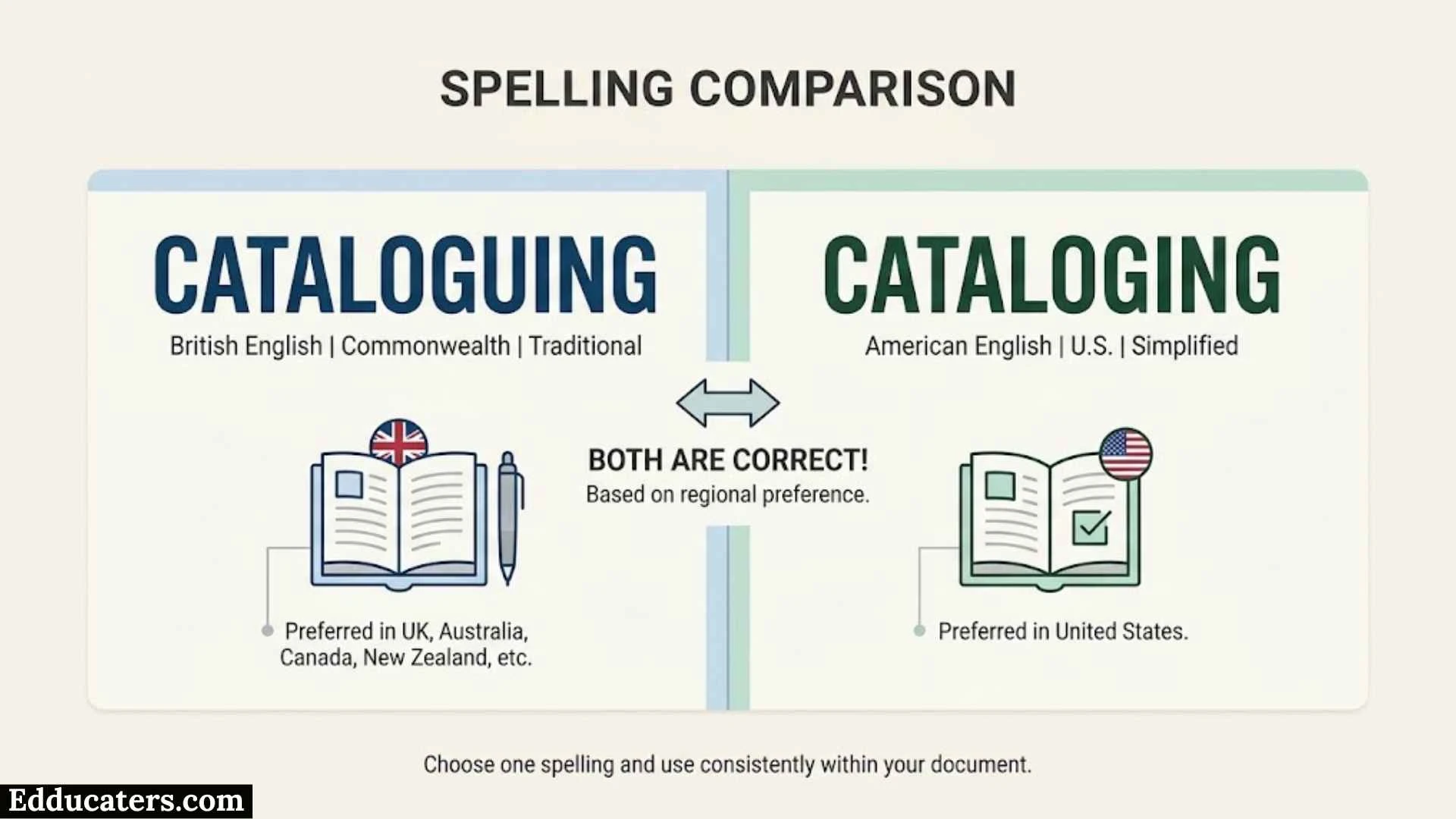
If you are writing about libraries, books, archives, databases, or organized collections, you may wonder whether cataloguing or cataloging is the correct spelling. The answer is that both forms are correct. The main difference is regional spelling: cataloguing is the standard British English form, while cataloging is the standard American English form.
The two forms have the same basic meaning. Both refer to the process of recording, describing, organizing, and providing access to information about resources. In a library, cataloging can involve much more than making a simple list. It may include bibliographic description, subject analysis, classification, authority control, metadata, and the creation or maintenance of structured records.
If you are writing in American English, cataloging is generally the form to choose. If you are following British English, cataloguing is appropriate. The important thing is to match the spelling to your chosen variety of English and use it consistently.
This guide explains the spelling difference, the meaning of cataloguing or cataloging, how the process works in libraries, common types, professional tools, the relationship with classification, examples, common mistakes, pronunciation, and practical guidance for choosing the right form.
Quick Answer: Cataloguing or Cataloging?
Both cataloguing or cataloging are correct. The difference is primarily regional.
| Form | English variety | Meaning |
| Cataloguing | British English | The process of creating or maintaining a catalog |
| Cataloging | American English | The process of creating or maintaining a catalog |
For example:
- British English: The librarian is cataloguing the new books.
- American English: The librarian is cataloging the new books.
Neither spelling should automatically be treated as a mistake. If your audience uses British English, cataloguing will look natural. If your audience uses American English, cataloging is the usual choice.
Cambridge Dictionary defines cataloguing as the present participle of catalogue and gives the meaning of recording something, especially in a list.
The Simple Rule
Remember this pattern:
- British English: catalogue → cataloguing
- American English: catalog → cataloging
The difference is in the spelling of the base word as well as the spelling of its -ing form.
What Does Cataloguing or Cataloging Mean?
Cataloguing or cataloging means creating an organized record of resources so that they can be identified, described, organized, and found.
In a simple setting, cataloging might mean making a list of books in a personal collection. In a professional library, however, the process is much more structured.
A catalog record can contain information such as:
- Author
- Title
- Edition
- Publisher
- Publication date
- Physical description
- Subjects
- Notes
- Identifiers
- Classification information
- Access points
The Library of Congress explains that MARC 21 bibliographic records can contain titles, names, subjects, notes, publication information, and physical descriptions for many types of materials.
The purpose is not simply to store information. A well-constructed catalog record helps people discover and identify resources.
A Simple Definition
You can think of cataloging as:
Creating structured information about a resource so people can identify it and find it efficiently.
For a small collection, this could be a spreadsheet. For a large library, it can involve professional standards, controlled vocabularies, classification systems, authority records, metadata structures, and library-management systems.
Cataloguing in British English
Cataloguing is the spelling traditionally associated with British English.
It is formed from catalogue:
catalogue → cataloguing
Examples include:
- The librarian is cataloguing new books.
- The museum is cataloguing its historical objects.
- The archive is cataloguing thousands of documents.
- The university is cataloguing its digital resources.
- Students are learning about cataloguing in library school.
The spelling is also visible in established library terminology. For example, the historical title Anglo-American Cataloguing Rules uses cataloguing.
This historical terminology should not be interpreted as evidence that cataloging is incorrect. The two spellings belong to different spelling conventions.
Cataloging in American English
Cataloging is the standard American English form.
It is formed from catalog:
catalog → cataloging
Examples include:
- The librarian is cataloging new books.
- The museum is cataloging its collection.
- The archive is cataloging historical photographs.
- The university is cataloging electronic resources.
- The department is responsible for cataloging new materials.
The Library of Congress uses cataloging extensively in its current U.S. professional documentation and provides extensive resources for cataloging practice.
Why Are Cataloguing or Cataloging Different?
The spelling difference comes from the two common forms of the base noun or verb:
- catalogue is traditionally associated with British English.
- catalog is standard in American English.
When the -ing ending is added, the corresponding forms become:
- catalogue → cataloguing
- catalog → cataloging
This is a spelling distinction rather than a difference in meaning.
The same basic idea applies when you see these forms in professional writing. A British publication may use cataloguing throughout, while an American institution may use cataloging.
Does the Extra “U” Change the Meaning?
No.
The u in cataloguing does not give the word a different definition. It reflects the spelling of catalogue in British English.
So these sentences communicate the same basic idea:
The library is cataloguing its new collection.
The library is cataloging its new collection.
The appropriate choice depends on the English variety being used.
Which Spelling Should You Use?
The easiest way to choose is to identify your audience and style guide.
Choose Cataloging When:
- You are writing in American English.
- Your readers are primarily in the United States.
- Your organization follows American spelling.
- Your publication uses catalog rather than catalogue.
- Your institutional documentation uses American English.
Choose Cataloguing When:
- You are writing in British English.
- Your publication follows British spelling.
- Your organization uses catalogue.
- Your intended audience expects British English.
- Your institutional terminology specifically uses that form.
What If You Write for an International Audience?
If your readers come from several English-speaking countries, either form can work. The best approach is usually to select one spelling convention for the document and apply it consistently.
For example, if your article generally uses British spellings such as organise, centre, and colour, cataloguing will normally fit that style.
If your article uses American spellings such as organize, center, and color, cataloging will normally fit better.
The goal is consistency rather than treating one regional form as universally correct.
Cataloguing or Cataloging in a Library
In library science, cataloguing or cataloging refers to a specialized process of creating and maintaining information about library resources.
A catalog record may help users answer questions such as:
- What is this resource?
- Who created it?
- What is its title?
- When was it published?
- What subject does it cover?
- Which edition is it?
- Where can I find it?
- Are there related resources?
- Which version of a work am I looking at?
Professional cataloging can apply to many kinds of materials, including:
- Books
- Journals
- Maps
- Music
- Films
- Sound recordings
- Manuscripts
- Photographs
- Electronic resources
- Digital collections
The Library of Congress’s MARC documentation describes bibliographic records for printed materials, manuscripts, computer files, maps, music, continuing resources, visual materials, and mixed materials.
This is why library cataloging is more than simply entering a book title into a database.
What Is the Process of Cataloging?
The exact workflow varies according to the institution, resource, cataloging standard, and level of description. A simplified professional workflow can be understood in several stages.
1. Identify the Resource
The cataloger first determines what resource is being described.
For a book, the cataloger may examine the title page, verso, cover, contents, publication information, and other relevant parts of the item.
2. Record Descriptive Information
Important bibliographic details are recorded.
These can include the title, creators, edition, publisher, date, extent, and other characteristics.
3. Establish Access Points
The record can include names, titles, subjects, and other information that helps users search for the resource.
Authority control can be important here because it helps maintain consistent forms of names or subjects across records.
4. Analyze the Subject
The cataloger determines what the resource is about and selects appropriate subject information according to the system or policy being used.
5. Apply Classification
Where the library uses a classification scheme, the resource can receive an appropriate classification notation.
This helps organize materials by subject and supports physical or virtual arrangement.
6. Encode the Information
The catalog record may be represented in a structured machine-readable format such as MARC 21.
The Library of Congress explains that MARC 21 provides codes and conventions for identifying data elements in bibliographic records.
7. Review the Record
The finished record may be checked for accuracy, consistency, completeness, and compliance with relevant standards or local policies.
The actual workflow can be more complex, particularly for special collections, serials, rare materials, digital resources, or cooperative cataloging environments.
Types of Cataloging
There is no single list of cataloging types that applies identically to every library. Institutions may use different terminology depending on their standards and workflows.
The Library of Congress’s MARC documentation identifies several encoding levels, including full, core, abbreviated, partial, minimal, and prepublication levels.
Commonly discussed approaches include the following.
Full Cataloging
Full cataloging provides a relatively comprehensive record based on the applicable cataloging standards.
A full record may contain detailed descriptive information, access points, subject information, notes, classification, and other relevant elements.
Minimal Cataloging
Minimal cataloging provides the information necessary to make a resource identifiable and accessible without producing the most extensive possible record.
It can be useful when an institution needs to make materials discoverable efficiently.
Abbreviated Cataloging
Abbreviated cataloging creates a shorter record with fewer descriptive elements than a full record.
The exact requirements depend on the institution or cataloging environment.
Collection-Level Cataloging
Collection-level cataloging describes a collection as a whole rather than producing a separate detailed record for every individual item.
This approach can be useful for certain archival or special-collection materials.
Prepublication Cataloging
Prepublication records can be created before a resource is formally published or widely distributed. The Library of Congress’s MARC documentation includes a specific prepublication encoding level.
These approaches demonstrate why “cataloging” is not one single activity with one universal workflow.
Cataloguing Tools Used in Libraries
Professional cataloging depends on standards, rules, controlled vocabularies, classification systems, metadata formats, and software.
Important resources include:
- RDA — Resource Description and Access
- MARC 21
- Library of Congress Subject Headings (LCSH)
- Library of Congress Classification (LCC)
- Dewey Decimal Classification (DDC)
- Authority records
- Cataloging manuals
- Bibliographic databases
- Integrated library systems
- Metadata tools
The American Library Association identifies RDA as a standard for bibliographic description used by catalogers and other metadata specialists in libraries and cultural institutions. ALA also notes that RDA has superseded AACR2 as the preferred standard for bibliographic description, although older records and practices may still involve AACR2.
RDA
Resource Description and Access, commonly called RDA, is a standard used for bibliographic description.
It provides a framework for describing resources and recording information about them in a way that supports discovery and exchange.
The current RDA environment has also developed in connection with the IFLA Library Reference Model (LRM). The Library of Congress notes that official RDA introduced updated terminology, entities, elements, cataloging practices, and MARC 21 encodings following the RDA Toolkit restructuring and redesign project.
MARC 21
MARC 21 is a family of machine-readable formats used to represent and exchange bibliographic and related information.
A MARC record uses fields, indicators, subfields, and codes to structure information.
The Library of Congress explains that MARC 21 formats support the representation and exchange of bibliographic, authority, holdings, classification, and community information in machine-readable form.
Library of Congress Subject Headings
Library of Congress Subject Headings (LCSH) provides controlled subject vocabulary that can help libraries provide consistent subject access.
Library of Congress Classification
Library of Congress Classification (LCC) organizes library materials according to subject-based classes and subclasses.
Dewey Decimal Classification
Dewey Decimal Classification (DDC) is another widely used classification system. It organizes knowledge into numbered subject categories and is particularly common in public and school-library environments.
These resources have different purposes. RDA provides cataloging guidance, MARC 21 provides a structured encoding format, subject headings support subject access, and classification systems help organize materials.
Cataloguing or Classification: What Is the Difference?
Cataloguing or classification are closely related activities, but they perform different functions.
Cataloguing or cataloging primarily involves describing a resource and providing information that helps users identify and discover it.
Classification assigns the resource to a place within a classification scheme.
For example, suppose a library receives a new book about marine biology.
Cataloging might record:
- The book’s title
- Author
- Publisher
- Publication date
- Edition
- Subject information
- Physical description
- Other bibliographic details
Classification can then assign a notation that places the book within the library’s classification structure.
The two activities can work together, but they should not be treated as identical.
Cataloging Examples
Here are natural examples of cataloging in American English:
- The librarian is cataloging the new books.
- The archive is cataloging historical photographs.
- The university has started cataloging its digital resources.
- The museum is cataloging recently acquired objects.
- The library completed cataloging the new journals.
- The department is responsible for cataloging electronic resources.
- The team spent several months cataloging the collection.
- The archivist is cataloging documents from the nineteenth century.
- The library hired additional staff to help with cataloging.
- The project involves cataloging thousands of records.
For British English, the same verb can be written as cataloguing:
- The librarian is cataloguing the new books.
- The archive is cataloguing historical photographs.
- The university has started cataloguing its digital resources.
- The museum is cataloguing recently acquired objects.
- The library completed cataloguing the new journals.
The meaning does not change because of the spelling.
Cataloguing or Cataloging in a Sentence
The following examples show how the two regional forms work in context.
American English
The library is cataloging a large collection of reference books.
The archivist spent the morning cataloging historical documents.
The university is cataloging its digital archive.
British English
The library is cataloguing a large collection of reference books.
The archivist spent the morning cataloguing historical documents.
The university is cataloguing its digital archive.
If you are editing a longer document, check the spelling of related words too. Consistency across the entire document is usually more professional than switching between regional conventions.
Common Mistakes With These Spellings
Mistake 1: Calling Cataloguing a Misspelling
Incorrect assumption: Cataloguing is simply a misspelling of cataloging.
Correct: Cataloguing is a standard British English form.
The spelling difference reflects regional English conventions.
Mistake 2: Calling Cataloging Incorrect
Incorrect assumption: Cataloging is missing a letter and should always be cataloguing.
Correct: Cataloging is the standard American English form.
It is not an error merely because British English uses cataloguing.
Mistake 3: Writing “Catalogueing”
A common spelling error is adding -ing directly to catalogue without removing the final e.
Incorrect: catalogueing
Correct: cataloguing
The same spelling principle appears in the related British forms:
catalogue → cataloguing
Mistake 4: Mixing Regional Styles
A document might use cataloging in one paragraph and cataloguing in another without a reason.
This does not necessarily make the document grammatically incorrect, but it can make the spelling style inconsistent.
Better approach: Decide whether your document follows American or British English and apply that choice consistently.
Mistake 5: Thinking Cataloging Means Only Making a List
Professional cataloging can involve description, access points, subject analysis, classification, authority control, and machine-readable data.
The Library of Congress specifically describes MARC records as structured carriers for bibliographic information and notes that their content can depend on cataloging rules, subject vocabularies, and classification schedules.
Cataloguing or Cataloging: Pronunciation
The two forms are generally pronounced very similarly. The spelling difference does not create a major pronunciation difference between the British and American forms.
A simple pronunciation guide is:
cataloguing: KAT-uh-log-ing
cataloging: KAT-uh-log-ing
The exact vowel sounds can vary according to accent.
Cambridge gives pronunciation information for catalogue in both British and American English, illustrating that the base word itself can have accent-related differences.
For learners, the most useful point is that the u in British cataloguing is primarily a spelling feature. You should not assume that it represents a separate syllable.
A Simple Decision Guide
Use this quick decision process before choosing the spelling:
Are you writing in American English?
→ Yes: Use cataloging.
→ No: Continue.
Are you writing in British English?
→ Yes: Use cataloguing.
→ No: Check your organization’s style guide or the spelling convention already used in your document.
Quick Checklist
- 🇺🇸 American English → cataloging
- 🇬🇧 British English → cataloguing
- Same basic meaning → Yes
- Different grammatical function → No
- Different pronunciation because of spelling → Generally no
- One form universally wrong → No
- Best practice → Match your regional style and stay consistent
How Cataloging Works in Modern Library Systems
Modern cataloging is increasingly connected to digital metadata, linked data, interoperability, and automated library systems.
A catalog record is not simply a piece of text stored in isolation. Structured bibliographic data can be exchanged between systems and reused in different discovery environments.
MARC 21 remains an important machine-readable format in library environments, while RDA provides a modern framework for bibliographic description. The Library of Congress continues to publish RDA-related implementation information, including updates to its official RDA environment.
This matters because library users often interact with catalog data without seeing the underlying cataloging work. When someone searches an online library catalog by author, title, subject, or other information, the quality and structure of the underlying records affect what can be discovered.
Cataloging Best Practices
Whether you call the process cataloging or cataloguing, several practical principles are useful.
Follow the Applicable Standard
Professional cataloging should follow the standards and policies appropriate to the institution and material.
RDA is currently recognized by ALA as a standard for bibliographic description used by catalogers and metadata specialists.
Keep Records Consistent
Consistent descriptions, access points, subject terms, and other metadata elements make records easier to manage and retrieve.
Use Authority Control Where Appropriate
Authority records help maintain consistent forms of names and subjects across bibliographic records. The Library of Congress describes MARC authority records as a way to represent authorized forms and references for names, subjects, and subject subdivisions.
Match the Workflow to the Resource
A simple book, a rare manuscript, a continuing resource, and a digital collection may require very different cataloging decisions.
There is no single workflow that should be applied mechanically to every type of material.
Check Local Policies
Even when an institution follows a recognized standard, local policies can affect how records are created, maintained, or displayed.
Frequently Asked Questions
Is cataloguing or cataloging correct?
Both are correct. Cataloguing is the standard British English spelling, while cataloging is the standard American English spelling.
Is cataloguing British or American?
Cataloguing is associated with British English. American English generally uses cataloging.
Is cataloging the American spelling?
Yes. Cataloging is the standard American English form.
What does cataloguing mean in a library?
It means creating and maintaining organized information about library resources so users can identify, discover, and access them. Professional cataloguing can include bibliographic description, subject analysis, classification, access points, authority control, and metadata.
What is the process of cataloging?
A simplified process involves identifying the resource, recording descriptive information, establishing access points, analyzing subjects, applying classification where appropriate, encoding the data, and reviewing the record.
What are the types of cataloging?
Different institutions use different classifications, but professional environments can include full, core, minimal, abbreviated, partial, and prepublication levels. The Library of Congress documents several encoding levels for MARC records.
What tools are used for cataloging?
Common professional resources include RDA, MARC 21, Library of Congress Subject Headings, Library of Congress Classification, Dewey Decimal Classification, authority resources, cataloging manuals, bibliographic databases, and library-management systems.
Is cataloging the same as classification?
No. Cataloging primarily creates descriptive and access information about a resource, while classification assigns the resource to a position within a classification scheme.
How do you spell cataloguing?
The British English spelling is cataloguing.
How do you spell cataloging?
The American English spelling is cataloging.
Is “catalogueing” correct?
No. The standard British form is cataloguing, with the final e of catalogue removed before -ing.
Should I use cataloging or cataloguing in an academic paper?
Follow the spelling convention required by your university, publisher, journal, or style guide. If no specific rule is given, use the variety of English you normally follow and remain consistent throughout the paper.
Does cataloguing have a different meaning from cataloging?
No. The two forms have the same basic meaning. The main distinction is regional spelling.
Conclusion
Cataloguing or cataloging are both correct. The choice depends mainly on the variety of English you are using.
Use cataloguing in British English and cataloging in American English. Neither form should be labeled universally incorrect simply because the other spelling is more familiar to a particular audience.
In library science, the term refers to a specialized process that can involve bibliographic description, subject analysis, classification, authority control, metadata, and structured records. Modern cataloging also relies on professional standards and formats such as RDA and MARC 21.
If you are writing for an American audience, cataloging is the natural choice. If you are following British English, choose cataloguing. When in doubt, check the relevant style guide and keep the spelling consistent throughout your document.
References
- American Library Association — Standards and Guidelines: Information on RDA and cataloging standards.
- Library of Congress — RDA: Resource Description and Access: Current RDA information, implementation documentation, and updates.
- Library of Congress — MARC 21 Format for Bibliographic Data: Official documentation explaining bibliographic records and their data elements.
- Library of Congress — MARC 21 Format for Classification Data: Information about machine-readable classification data.
- Library of Congress — MARC 21 Leader: Documentation describing different record encoding levels, including full, core, abbreviated, minimal, and prepublication levels.
- Library of Congress — MARC 21 Authority Data: Information about authority records and authorized forms of names and subjects.
- Cambridge Dictionary — Cataloguing: Definition and pronunciation information for cataloguing.

Hello, I’m Claire Holloway. I have always been passionate about the English language and enjoy turning complex grammar rules into simple, easy-to-follow lessons. I believe that every learner can become a confident English writer with the right guidance.
I create educational content focused on grammar, vocabulary, sentence structure, and writing improvement. Every article I publish is designed to help readers learn with confidence and accuracy.
Books
Grammar Without Confusion
Modern English Usage Guide
 Nathan Whitmore
 Julian Mercer