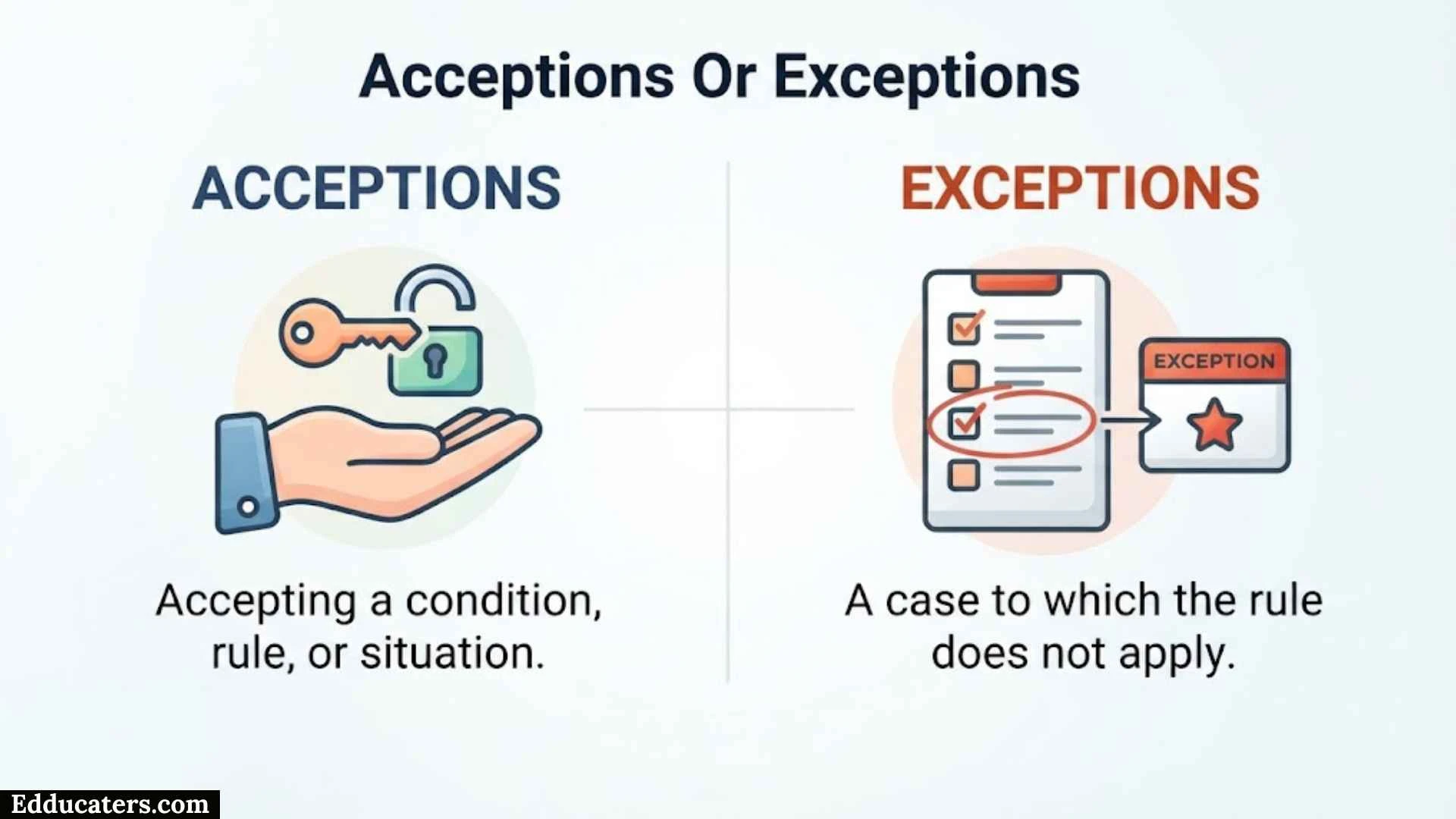
If you are unsure whether to write “acceptions” or “exceptions,” the correct choice depends on what you mean. These words look similar, but they do not have the same meaning.
Exceptions is the normal word when you mean people, things, or situations that do not follow a general rule. For example, “There are a few exceptions to this rule.” Oxford and Cambridge both define exception in this sense.
The more specialized word related to meanings of words is actually acceptation, not usually acception. Oxford defines acceptation as the meaning a word or expression is generally accepted as having, and Cambridge likewise uses it for an accepted meaning of a word.
That distinction matters because someone searching for “acceptions or exceptions” may actually be dealing with a spelling or word-choice confusion involving exception, acceptance, or acceptation.
Quick Answer: Acceptions Or Exceptions?
For ordinary English, exceptions is the word you almost certainly need when you mean cases that do not follow a rule.
| Word | Meaning | Typical Use |
| Exceptions | Cases that do not follow a rule, pattern, group, or expectation | “There are exceptions to this rule.” |
| Acceptation | An accepted meaning or sense of a word | “In its usual acceptation, the term means…” |
| Acceptance | The act of accepting something | “We received her acceptance.” |
| Acceptions | An uncommon or nonstandard-looking form that may be encountered, but is not the usual modern choice for the “meaning of a word” sense | Usually avoid unless a specific historical or specialized source uses it |
Best choice in most everyday sentences: exceptions.
Cambridge gives examples such as “There are exceptions to every rule,” while Oxford defines exception as something or someone not included in a general statement or something that does not follow a rule.
What Does Exceptions Mean?
Exceptions is the plural form of exception.
An exception is something that does not fit a general rule, statement, group, pattern, or expectation. It can also refer to a special case in which someone or something is treated differently from the usual rule.
Examples Of Exceptions
Here are some natural examples:
- There are several exceptions to this grammar rule.
- Most students completed the assignment, with two exceptions.
- The store is open every day, with the exception of Sunday.
- Most birds can fly, but there are some exceptions.
- The company normally does not offer refunds, but it made an exception in this case.
In each sentence, the word refers to something outside the normal rule or situation.
Exceptions In Grammar And Spelling
The word exception is especially common when discussing English rules.
For example:
Most English verbs follow this pattern, but there are some exceptions.
Here, exceptions means words that do not behave according to the general pattern.
This is why you will frequently see phrases such as:
- exceptions to the rule
- grammatical exceptions
- spelling exceptions
- common exceptions
- unusual exceptions
- notable exceptions
The meaning remains the same: something does not follow what would normally be expected.
What Does Acceptation Mean?
If your intended meaning is “a particular or accepted meaning of a word,” the word you are more likely looking for is acceptation.
Oxford classifies acceptation as a linguistics term and defines it as the meaning that a word or expression is generally accepted as having. Oxford also notes that the word has an older history, with its current sense dating from the early seventeenth century.
Cambridge similarly defines acceptation as the accepted meaning of a word and gives examples involving different senses of terms.
Examples Of Acceptation
The word is formal and uncommon in everyday conversation:
The term has several acceptations in historical writing.
The word was used in a different acceptation in older texts.
The expression has a specific legal acceptation in this context.
For most modern readers, however, phrases such as meaning, sense, or interpretation will usually be clearer.
Why Acceptation Can Cause Confusion
The spelling acceptation sits close to several other words:
- accept
- acceptance
- acceptation
- exception
These words share parts of their spelling and historical connections, but their meanings have developed differently.
This makes them particularly easy to confuse when writing about language.
Acceptions Or Acceptations: Is There A Difference?
This is an important distinction that a simple “acceptions or exceptions” explanation can miss.
If you are trying to express the idea of different meanings or senses of a word, acceptations is the established dictionary form used in the modern sources consulted here. Cambridge explicitly gives the plural example “The term has several acceptations,” while Oxford treats acceptation as a linguistics term.
So, in a modern language article, these are the safer choices:
The word has several acceptations.
or, more simply:
The word has several meanings.
By contrast:
There are several exceptions to the rule.
means something entirely different.
Acceptions, Acceptation, Acceptance, And Exception Compared
These four forms are worth separating because they can easily become confused.
| Word | Meaning | Example |
| Exception | Something outside a general rule | This is an exception to the rule. |
| Exceptions | More than one exception | There are several exceptions. |
| Acceptation | An accepted meaning or sense of a word | The term has a specialized acceptation. |
| Acceptations | More than one accepted meaning or sense | The word has several acceptations. |
| Acceptance | The act of accepting something | We received her acceptance. |
Oxford defines acceptance as the act of accepting a gift, invitation, offer, or similar thing.
This means acceptance should not be substituted for exception.
For example:
There are three exceptions to the rule. ✅
Not:
There are three acceptances to the rule. ❌
The second sentence changes the meaning completely.
When Should You Use Exceptions?
Use exceptions when something falls outside a general rule, category, statement, or expectation.
Everyday Situations
Everyone was invited, with a few exceptions.
The restaurant is open daily, with the exception of Monday.
Academic Writing
The theory works in most cases, although several exceptions have been identified.
Business Writing
The policy applies to all employees, with certain exceptions.
Grammar And Spelling
English contains many spelling exceptions.
This broad usefulness is one reason exceptions is the appropriate choice for most readers.
When Should You Use Acceptation?
Use acceptation when you are discussing the accepted meaning or sense of a word, particularly in formal or linguistic writing.
For example:
The term has a different acceptation in legal writing.
The historical acceptation of the word differs from its modern meaning.
However, this is a specialized word. If your audience is general, meaning or sense will often communicate the idea more clearly.
That is an important practical writing principle: a technically valid word is not necessarily the clearest word for every audience.
Common Expressions With Exception
Learning the common phrases surrounding exception makes the word much easier to use correctly.
Exception To The Rule
This is one of the most common expressions.
There are always exceptions to the rule.
It means that a general rule has particular cases where it does not apply. Cambridge specifically lists “exception to” and gives examples of rules with exceptions.
Make An Exception
Make an exception means to allow someone or something to be treated differently from the usual rule.
We normally do not accept late applications, but we will make an exception this time.
Cambridge defines this expression as not treating someone or something according to the usual rules.
With The Exception Of
This means except for or not including.
Everyone attended, with the exception of Maria.
Oxford gives “with the exception of” as an expression meaning “except” or “not including.”
Without Exception
This means that nobody or nothing is excluded.
All employees, without exception, must complete the training.
Oxford describes this phrase as emphasizing that everyone or everything is included.
Take Exception To
This has a different meaning. To take exception to something means to object strongly to it or become offended by it.
For example:
She took exception to the manager’s comment.
This does not mean that she found a rule-breaking case. It means she objected to what was said.
Why Do People Confuse These Words?
The confusion mainly comes from their similar spelling.
Compare:
acceptions
acceptations
acceptance
exceptions
They share several letters and similar sounds, especially around the middle of the word. Someone who has seen one form but not the others may easily select the wrong spelling.
There is also a meaning problem. A writer may know they want a word connected with accepting, meaning, or something outside a rule, but may not remember which noun belongs to that idea.
The best solution is to identify the meaning before choosing the spelling.
A Simple Decision Guide
Use this quick decision process:
Are you talking about something that does not follow a rule?
→ Yes → exception / exceptions
Are you talking about the accepted meaning or sense of a word?
→ Yes → acceptation / acceptations
Are you talking about accepting an offer, invitation, gift, or decision?
→ Yes → acceptance
Are you simply talking about the meaning of a word for a general audience?
→ Usually choose meaning or sense rather than the specialized term acceptation.
This distinction is more useful than simply memorizing similar spellings.
Common Mistakes With Acceptions And Exceptions
Mistake 1: Using Acceptions For Rule-Breaking Cases
Incorrect:
There are several acceptions to this grammar rule.
If you mean cases that do not follow the rule, write:
There are several exceptions to this grammar rule.
Mistake 2: Using Acceptance For Exception
Incorrect:
This word is an acceptance to the rule.
Correct:
This word is an exception to the rule.
Acceptance concerns accepting something; exception concerns something being outside a rule or general statement.
Mistake 3: Assuming Similar Spelling Means Similar Meaning
Words can look similar without being interchangeable.
For example:
The company made an exception.
means the company allowed something outside its normal rule.
The company confirmed its acceptance.
means the company accepted something.
The difference is small in spelling but large in meaning.
Mistake 4: Using A Rare Word When A Simple Word Is Better
Even when acceptation is technically appropriate, it may not be the best choice for general readers.
Compare:
The term has several acceptations.
with:
The term has several meanings.
The second sentence is more direct for most audiences.
Acceptions Or Exceptions In Real Sentences
Here are several examples that show the difference clearly.
Rule-Based Example
There are a few exceptions to the school’s attendance policy.
This refers to cases where the policy does not apply in the normal way.
Spelling Example
English spelling has many exceptions that learners need to memorize.
The word refers to words that do not follow an expected spelling pattern.
Business Example
The company normally requires payment in advance, but management made an exception for a long-term client.
The client received special treatment.
Linguistic Example
The term has several historical acceptations.
Here, the writer is discussing different accepted meanings of the term.
Formal Writing Example
The phrase acquired a different acceptation during the eighteenth century.
This concerns the meaning of the expression, not an exception to a rule.
Acception Vs Acceptation: Why The Extra “T” Matters
If you encountered acception while looking for a word meaning “meaning” or “sense,” check whether acceptation is what you actually need.
The established dictionary entries from Oxford and Cambridge use acceptation for the specialized meaning of an accepted sense or meaning.
This is an especially useful correction because a search for “acceptions or exceptions” can reflect a spelling question rather than a genuine choice between two equally common words.
For careful modern writing, do not automatically treat acceptions and acceptations as interchangeable.
The Historical Background Of Acceptation
The history of acceptation also explains why it looks related to accept and acceptance.
Oxford traces acceptation to Late Middle English. Its earlier sense involved favorable reception or approval, while the current sense connected with the meaning of a word dates from the early seventeenth century.
This historical development is different from simply treating acception as a modern alternative spelling of exception.
The words may look related on the page, but their modern functions are distinct.
How To Choose The Right Word Quickly
When proofreading, do not focus on the spelling first. Ask what the sentence means.
If You Mean “A Case Outside The Rule”
Choose:
exception
Plural:
exceptions
Example:
There are several exceptions to the rule.
If You Mean “The Accepted Meaning Of A Word”
Choose:
acceptation
Plural:
acceptations
Example:
The term has several acceptations.
If You Mean “The Act Of Accepting”
Choose:
acceptance
Example:
We received her acceptance of the offer.
This meaning-first method is much more reliable than trying to remember which spelling looks familiar.
Frequently Asked Questions
Is “Acceptions” A Correct Word?
Acceptions is not the form you should normally choose when you mean “different meanings of a word.” Modern authoritative dictionary sources use acceptation, with the plural acceptations, for that specialized sense.
If you mean cases that do not follow a rule, use exceptions.
Is “Exceptions” The Correct Word?
Yes, when you mean cases that are outside a general rule, statement, group, or expectation.
For example:
There are several exceptions to this rule.
Oxford and Cambridge both support this meaning.
What Is The Difference Between Exceptions And Acceptations?
Exceptions are cases that do not follow a general rule.
Acceptations are accepted meanings or senses of a word.
For example:
There are exceptions to the rule.
versus:
The word has several acceptations.
Is Acceptation The Same As Acceptance?
No.
Acceptance means the act of accepting something, such as an offer, invitation, or proposal. Acceptation is a formal linguistic term referring to an accepted meaning or sense of a word.
What Is The Plural Of Exception?
The plural of exception is exceptions.
Example:
There are several exceptions to this rule.
What Is The Plural Of Acceptation?
The plural of acceptation is acceptations.
Example:
The term has several acceptations in different contexts.
Cambridge explicitly uses the plural acceptations in its definition examples.
Which Word Should I Use In A Grammar Article?
If you are talking about cases that do not follow a grammar rule, use exceptions.
For example:
English has several exceptions to this grammatical pattern.
If you are discussing the different meanings of a grammatical term, acceptation may be appropriate, although meaning or sense will often be clearer.
Does “Exception” Mean Something Negative?
Not necessarily.
An exception simply describes something that differs from a general rule or expectation. It can be positive, negative, or neutral.
For example:
She was an exception to the general trend.
The word itself does not indicate whether the difference is good or bad.
What Does “Make An Exception” Mean?
Make an exception means to allow someone or something to avoid the normal rule in a particular situation.
For example:
The library normally charges a late fee, but the manager made an exception.
Cambridge gives the same core meaning for this expression.
What Does “Take Exception To” Mean?
Take exception to something means to object strongly to it or feel offended by it.
For example:
He took exception to the accusation.
This is a separate expression from make an exception.
Key Takeaways
- Exceptions is the correct word for cases that do not follow a general rule.
- Acceptation is a specialized word meaning an accepted meaning or sense of a word.
- The plural of acceptation is acceptations.
- Acceptance means the act of accepting something.
- Acceptions should not automatically be treated as the modern equivalent of acceptations.
- For general readers, meaning or sense is often clearer than the specialized word acceptation.
- If you are talking about grammar or spelling rules that have unusual cases, exceptions is the word you want.
Conclusion
When choosing between acceptions or exceptions, start with the meaning rather than the spelling.
If you mean cases that do not follow a rule, use exceptions. It is the normal and widely used word in everyday, academic, professional, and grammatical writing.
If you mean an accepted meaning or sense of a word, the established specialized term is acceptation, with the plural acceptations. Oxford and Cambridge both document this usage.
And if you mean the act of accepting something, use acceptance.
The easiest memory aid is:
Exceptions = cases outside a rule.
Acceptations = accepted meanings.
Acceptance = the act of accepting.
That distinction will help you choose the right word without relying on their similar-looking spellings.

I’m Julian Mercer, an English language writer dedicated to helping people master grammar through practical examples and clear explanations. I enjoy teaching grammar in a way that is both engaging and easy to remember.
My work focuses on grammar rules, punctuation, word usage, and writing techniques that readers can apply in everyday life. I believe learning English should be simple, enjoyable, and useful.
Books
English Grammar in Practice
Writing with Precision
 Claire Holloway