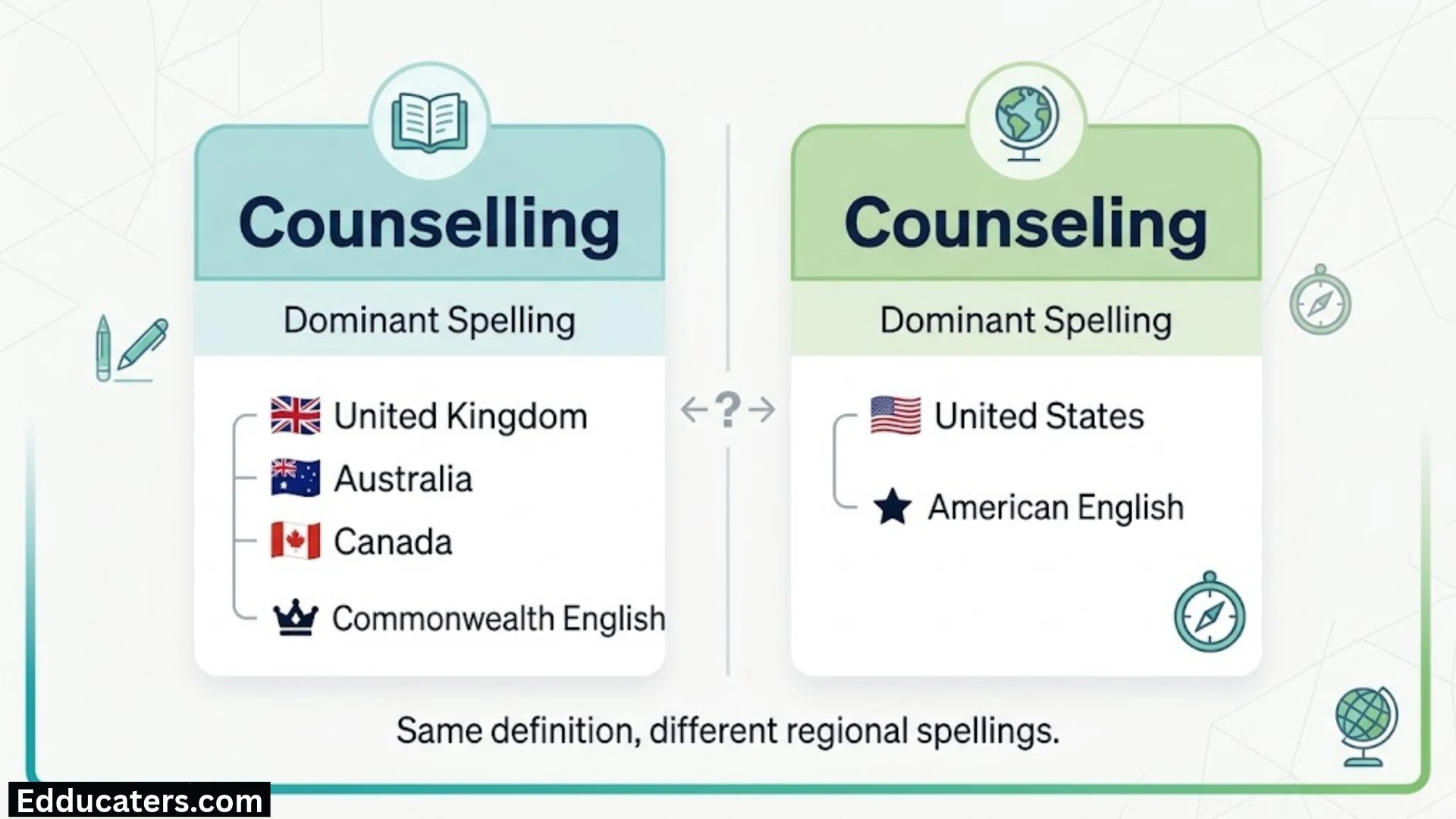
Have you ever written counselling and wondered whether it should have one L or two? You may have also noticed that American websites often use counseling while British publications prefer counselling.
Both spellings are correct. The difference comes down to regional English conventions. Counselling is the standard British English spelling, while counseling is the standard American English spelling.
Both words have the same meaning. They describe the process of giving or receiving professional advice, guidance, and emotional support to help someone deal with personal, educational, relationship, or other life challenges.
The same spelling difference appears in related words, including counsellor or counselor, as well as counselled or counseled.
Let’s explore the meanings, spelling rules, pronunciation, examples, and common mistakes so you can confidently choose the right form.
Which Spelling Is Correct: Counselling or Counseling?
Both counselling or counseling are correct English spellings. Your choice depends on the variety of English you’re using.
- Counselling: The preferred spelling in British English, Australian English, and several other varieties that follow British spelling conventions.
- Counseling: The preferred spelling in American English.
Neither spelling is more correct than the other. They represent the same word with a regional spelling difference.
For example:
- British English: She started counselling to manage her anxiety.
- American English: She started counseling to manage her anxiety.
Both sentences are grammatically correct. The only difference is the spelling of the word.
If you’re writing for an American audience, use counseling. If you’re writing for a British audience, use counselling.
What Is the Difference Between Counselling or Counseling?
The main difference between counselling or counseling is the number of letters L.
| Feature | Counselling | Counseling |
| Spelling | Double L | Single L |
| English variety | British English | American English |
| Meaning | Professional advice and support | Professional advice and support |
| Pronunciation | Same | Same |
| Grammatical role | Noun or verb form | Noun or verb form |
| Example | She needs counselling. | She needs counseling. |
The two spellings have the same definition and pronunciation. Neither spelling describes a different type of therapy or professional service.
The difference follows regional spelling conventions. British English generally retains the double L in this word, while American English uses one L.
Why Does Counselling Have Two Ls?
The spelling counselling follows the British English convention of doubling the final L when adding certain suffixes to counsel.
When you add -ing to counsel, British English writes:
- Counsel → Counselling
- Counsel → Counselled
- Counsel → Counsellor
American English generally keeps one L in these forms:
- Counsel → Counseling
- Counsel → Counseled
- Counsel → Counselor
This difference is a spelling convention rather than a difference in meaning.
Is Counselling or Counseling More Common?
The answer depends on the country and audience.
Counseling is more common in the United States because American English uses the single-L spelling. You’ll see it in American schools, universities, healthcare organizations, and professional publications.
Counselling is more common in the United Kingdom and other regions that follow British spelling conventions.
Neither spelling is universally preferred. The best choice is the one that matches your intended audience.
Counselling or Counseling Meaning and Definition
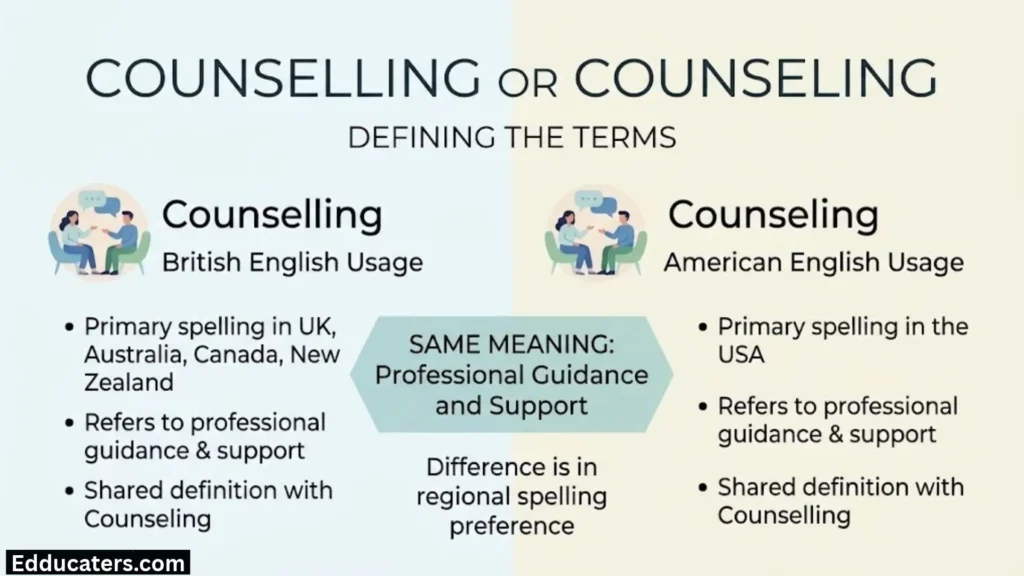
Both counselling or counseling refer to the process of receiving professional guidance or support to understand and manage problems.
A trained professional may help someone explore their feelings, recognize challenges, consider possible solutions, and make informed decisions.
Counselling can address several areas of life, including:
- Emotional difficulties
- Stress and anxiety
- Relationship problems
- Family conflicts
- Educational challenges
- Career decisions
- Grief and loss
- Personal development
- Behavioral concerns
- Major life changes
For example, someone experiencing workplace stress might speak with a counselor to understand the causes of their stress and develop healthier ways to manage it.
Similarly, a student struggling with academic pressure might receive counseling to improve their confidence, motivation, and study habits.
What Does Counselling Mean in Simple Words?
In simple words, counselling means talking with a trained professional who helps you understand a problem and explore ways to handle it.
It provides a supportive environment where people can discuss their concerns without feeling judged.
For example:
- A person dealing with grief may seek counselling after losing a loved one.
- A couple experiencing relationship difficulties may attend marriage counselling.
- A student unsure about a career path may receive career counselling.
The exact purpose depends on the person’s needs and the type of support they receive.
Is Counselling the Same as Therapy?
Counselling and therapy are closely related terms, and people sometimes use them interchangeably. However, their meanings can vary depending on the professional setting and the type of service.
Counselling often focuses on helping people address specific concerns, make decisions, and manage challenging situations.
Therapy can involve a broader or more in-depth process of understanding emotional, behavioral, and psychological patterns.
The distinction isn’t absolute. Some professionals use both approaches, and the terminology varies across countries and professional organizations.
Is Counselling a Noun or a Verb?
Counselling can function as a noun or as the present participle of the verb counsel.
Its grammatical role depends on how you use it in a sentence.
Counselling as a Noun
As a noun, counselling refers to the process or service of providing professional advice and support.
Examples:
- Counselling helped her understand her emotions.
- The school offers free counselling to students.
- He decided to try marriage counselling.
- Professional counselling can help people manage difficult situations.
In these examples, the word names an activity or service.
Counselling as a Verb Form
Counselling is also the present participle of the verb counsel.
Examples:
- The psychologist is counselling a young patient.
- She is counselling students about their career options.
- They have been counselling families for several years.
Here, counselling describes an ongoing action.
Is Counselling Countable or Uncountable?
When counselling refers to the general activity or professional service, it is normally an uncountable noun.
You wouldn’t usually say:
- I need a counselling.
- She received three counsellings.
Instead, use expressions such as:
- I need some counselling.
- She received professional counselling.
- He attended three counselling sessions.
- They offer several types of counselling services.
The word session makes it possible to count individual appointments.
For example, you can say, “I attended three counselling sessions last month.”
Counselling or Counseling in a Sentence: Examples
Seeing both spellings in context makes the difference easier to understand.
The following examples show how each spelling works in everyday writing.
Counselling in British English
- She decided to seek counselling after a difficult period in her life.
- The school provides free counselling for students.
- Marriage counselling helped the couple improve their communication.
- He is receiving counselling for work-related stress.
- The university offers career counselling to graduates.
- Professional counselling can provide emotional support.
- My doctor recommended counselling to help me manage anxiety.
- The organization provides family counselling services.
- She completed a course in professional counselling.
- The center offers confidential counselling appointments.
Counseling in American English
- She decided to seek counseling after a difficult period in her life.
- The school provides free counseling for students.
- Marriage counseling helped the couple improve their communication.
- He is receiving counseling for work-related stress.
- The university offers career counseling to graduates.
- Professional counseling can provide emotional support.
- My doctor recommended counseling to help me manage anxiety.
- The organization provides family counseling services.
- She completed a course in professional counseling.
- The center offers confidential counseling appointments.
Notice that the meaning and sentence structure remain the same. Only the regional spelling changes.
Counsellor or Counselor: Which Spelling Is Correct?
The same regional difference appears in the word counsellor or counselor.
Both spellings refer to a person who provides advice, guidance, or professional support.
- Counsellor: British English spelling.
- Counselor: American English spelling.
For example:
- British English: The school hired a new counsellor.
- American English: The school hired a new counselor.
A counsellor or counselor may work in different settings, including schools, healthcare facilities, private practices, universities, and community organizations.
The person’s exact responsibilities depend on their training, qualifications, and professional role.
Counsellor or Counselor in a Sentence
British English examples:
- The school counsellor helped the student choose suitable subjects.
- She spoke with a professional counsellor about her concerns.
- The marriage counsellor encouraged the couple to communicate openly.
American English examples:
- The school counselor helped the student choose suitable subjects.
- She spoke with a professional counselor about her concerns.
- The marriage counselor encouraged the couple to communicate openly.
Both sets of examples are correct in their respective varieties of English.
Counselling or Counseling: British English or American English?
The difference between counselling or counseling is part of a wider pattern of British and American spelling differences.
British English often retains a double L in words such as counselling, while American English generally uses a single L in the corresponding form.
Here are some related examples:
| British English | American English |
| Counselling | Counseling |
| Counsellor | Counselor |
| Counselled | Counseled |
| Travelling | Traveling |
| Cancelled | Canceled |
| Modelling | Modeling |
| Labelled | Labeled |
These examples demonstrate a common spelling pattern, but English spelling rules have exceptions. You shouldn’t assume that every word ending in L follows exactly the same pattern.
Is Counselling British or American?
Counselling is primarily the British English spelling.
It is also used in other English-speaking regions that follow British spelling conventions, including Australia.
American English normally uses counseling.
Is Counseling British or American?
Counseling is the standard American English spelling.
American dictionaries, educational institutions, and professional organizations generally use this form.
However, readers in the United Kingdom and other countries can still understand it.
Common Mistakes When Using Counselling or Counseling
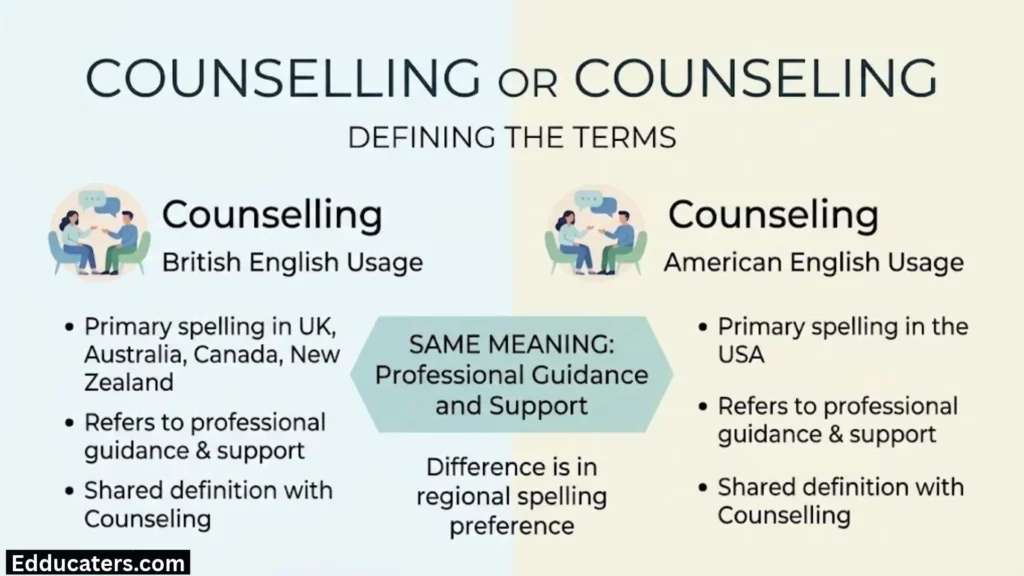
Although the spelling difference is straightforward, writers sometimes make mistakes when choosing between the two forms.
Here are some common problems to avoid.
Mixing British and American Spellings
One common mistake is using both spellings in the same piece of writing without a clear reason.
For example:
“The school offers counselling services, and students can speak with an American counselor.”
This sentence isn’t necessarily grammatically incorrect. However, it mixes British and American spelling conventions.
For consistent American English, write:
“The school offers counseling services, and students can speak with an American counselor.”
For consistent British English, write:
“The school offers counselling services, and students can speak with a British counsellor.”
Using Counselling as a Countable Noun
Because counselling usually functions as an uncountable noun, you shouldn’t normally place a directly before it when referring to the general service.
Incorrect: She needs a counselling.
Correct: She needs counselling.
You can use a with a countable expression:
Correct: She needs a counselling session.
Confusing Counsel With Council
The words counsel and council look and sound similar, but they have different meanings.
- Counsel: Advice or guidance; it can also mean to give advice.
- Council: A group of people appointed or elected to make decisions.
Examples:
- The lawyer offered legal counsel.
- The city council approved the new plan.
Remember that counselling comes from counsel, not council.
Assuming Counselling and Counseling Have Different Meanings
Some writers assume that the double-L spelling refers to one type of service while the single-L spelling refers to another.
That isn’t correct.
Both spellings describe the same activity. The difference is regional rather than semantic.
Types of Counselling Services
Counselling covers several areas of personal, professional, and educational life.
Different services address different concerns. The right approach depends on a person’s situation and the professional’s qualifications.
Here are some common types of counselling.
Individual Counselling
Individual counselling involves one person working with a trained professional.
People may seek this service to discuss personal concerns, emotional difficulties, stress, grief, or major life changes.
The professional provides a private setting where the person can explore their experiences and consider possible ways forward.
Marriage Counselling
Marriage counselling helps married couples address relationship difficulties.
Common topics include:
- Communication problems
- Trust issues
- Financial disagreements
- Parenting challenges
- Emotional distance
- Conflict resolution
A marriage counselor may help partners understand each other’s perspectives and develop healthier communication habits.
Family Counselling
Family counselling focuses on relationships and communication between family members.
Families may seek support during major changes, disagreements, parenting difficulties, or periods of conflict.
The goal is to help family members understand one another and work toward healthier relationships.
Career Counselling
Career counselling helps people make informed decisions about their professional lives.
Students, graduates, and working professionals may use this service to explore career options, identify strengths, and consider educational or employment opportunities.
For example, a student who feels uncertain about choosing a university major may benefit from career guidance.
School Counselling
School counselling supports students with academic, social, emotional, and personal challenges.
School counselors may help students with:
- Study habits
- Academic pressure
- Peer relationships
- Personal development
- Educational planning
- School-related concerns
The services available depend on the school and the counselor’s professional role.
Grief Counselling
Grief counselling supports people who are dealing with the loss of someone important.
Losing a loved one can affect emotions, relationships, routines, and everyday responsibilities.
A trained professional can provide a supportive environment where someone can talk about their loss and explore ways to cope.
Substance Use Counselling
Substance use counselling helps people address difficulties involving alcohol or other substances.
Depending on the person’s needs, support may focus on understanding behavior, identifying triggers, developing coping strategies, and connecting with appropriate treatment services.
Some people may require additional medical or specialist care.
Counselling Centre or Counseling Center: Which Is Correct?
Both counselling centre and counseling center are correct. The appropriate form depends on the English variety you’re using.
- Counselling centre: British English spelling.
- Counseling center: American English spelling.
The words centre and center also follow a British-American spelling difference.
Examples:
- British English: She visited a local counselling centre.
- American English: She visited a local counseling center.
A counselling centre or counseling center is a place where people can access professional guidance and support.
These facilities may provide individual counselling, family support, career guidance, or other services.
If you’re writing for an American audience, use counseling center. If you’re writing for a British audience, use counselling centre.
How to Pronounce Counselling or Counseling
Both counselling or counseling have the same pronunciation.
The spelling difference doesn’t change how you say the word.
The word is commonly pronounced:
KOWN-suh-ling
Its pronunciation can be represented approximately as:
/ˈkaʊn.səl.ɪŋ/
The first syllable receives the main stress.
You can break the word into three parts:
- KOWN
- suh
- ling
The pronunciation remains the same in both British and American English, although individual accents may produce slight variations.
Easy Ways to Remember Counselling or Counseling
If you frequently confuse these spellings, a simple memory trick can help.
Remember the Double L for British English
Think of the double L in counselling as the British spelling.
- British: Counselling
- American: Counseling
The same pattern applies to counsellor and counselor.
Match the Spelling to Your Audience
Before choosing a spelling, consider who will read your writing.
If your readers are primarily American, use counseling.
If your readers are primarily British, use counselling.
Consistency matters more than choosing one spelling for every English-speaking audience.
Learn the Related Word Forms Together
Remembering the related forms can make the difference easier to recognize.
| British English | American English |
| Counselling | Counseling |
| Counsellor | Counselor |
| Counselled | Counseled |
Learning these forms together can help you avoid switching between regional conventions.
Frequently Asked Questions
Is It Counselling or Counseling?
Both spellings are correct. Counselling is the standard British English spelling, while counseling is the standard American English spelling. Both have the same meaning and pronunciation.
Is Counselling Spelled With One L or Two?
In British English, counselling is spelled with two Ls. American English uses counseling with one L.
Is Counseling Spelled With One L or Two?
The American English spelling counseling uses one L. The British English spelling counselling uses two Ls.
Is Counseling American or British?
Counseling is the standard American English spelling. British English generally uses counselling.
Is Counselling British or American?
Counselling is primarily the British English spelling. It is also used in other English-speaking regions that follow British spelling conventions.
What Is the Difference Between Counselling and Counseling?
The difference is regional spelling. Counselling is used in British English, while counseling is used in American English. Both words refer to the same process of providing professional guidance and support.
What Is the Difference Between Counselling and Therapy?
Counselling often focuses on specific concerns, decisions, and challenging situations. Therapy may involve a broader or more in-depth exploration of emotional and behavioral patterns. However, the terms can overlap, and their use varies between professional settings.
What Does Counselling Mean in Simple Words?
Counselling means talking with a trained professional who helps you understand personal difficulties and explore ways to handle them. It can provide guidance and emotional support during challenging situations.
Is Counselling a Noun or a Verb?
Counselling can be a noun or the present participle of the verb counsel. As a noun, it describes a professional service. As a verb form, it describes the action of providing guidance.
Is Counselling a Countable or Uncountable Noun?
Counselling is generally an uncountable noun when it refers to the overall service or activity. However, you can count individual appointments by using the word session.
What Is the Plural of Counselling?
When counselling refers to the general service, it normally doesn’t have a plural form. You can use expressions such as counselling sessions or counselling services when referring to multiple appointments or types of support.
Is Counsellor or Counselor Correct?
Both spellings are correct. Counsellor is the British English spelling, while counselor is the American English spelling. Both refer to a person who provides advice or professional support.
Is It Counselling Center or Counseling Center?
Counseling center is the standard American English spelling. Counselling centre is the British English spelling. Both refer to a place that provides guidance or support services.
How Do You Pronounce Counselling?
Counselling is commonly pronounced KOWN-suh-ling. The American spelling counseling has the same pronunciation.
Is Counselling the Same as Advice?
Not exactly. Advice is a suggestion or recommendation about what someone should do. Counselling is a professional process that may involve discussion, guidance, emotional support, and exploring possible solutions.
What Are the Main Types of Counselling?
Common types include individual counselling, marriage counselling, family counselling, career counselling, school counselling, grief counselling, and substance use counselling. Each type addresses different needs and concerns.
Can I Use Counselling in American English?
Readers in the United States will generally understand counselling, but counseling is the standard American spelling. Use the American form when writing for a US audience.
Conclusion
Both counselling or counseling are correct spellings. The difference comes from British and American English conventions, not from their meaning or pronunciation.
Use counselling when writing in British English. Choose counseling when writing in American English.
The same regional pattern applies to counsellor or counselor, as well as counselled or counseled.
Most importantly, stay consistent throughout your writing. Once you know which audience you’re addressing, choosing the correct spelling becomes easy.

I’m Julian Mercer, an English language writer dedicated to helping people master grammar through practical examples and clear explanations. I enjoy teaching grammar in a way that is both engaging and easy to remember.
My work focuses on grammar rules, punctuation, word usage, and writing techniques that readers can apply in everyday life. I believe learning English should be simple, enjoyable, and useful.
Books
English Grammar in Practice
Writing with Precision
 Nathan Whitmore