
We have all been there: you are typing a high-stakes email or polishing a final draft, and you pause over a common phrase. You need to describe a change or a new rule, but you suddenly second-guess yourself. Should you write “take effect” or “take effect”? This tiny confusion trips up even the most experienced writers, often because the two words sound nearly identical and share a root.
However, using the wrong one can shift the meaning of your entire sentence. In this guide, we will clear up this linguistic hurdle once and for all. By the end, you will understand exactly when to use each term, the grammar rules governing them, and a simple trick to ensure you never confuse them again.
Quick Answer: Which One Is Correct?
The correct phrase is take effect. “Take effect” means to become operative or to begin to produce a result. “Take affect” is almost always grammatically incorrect because “affect” is typically used as a verb meaning “to influence,” not as a noun to be “taken.” Always use “take effect” when referring to laws, rules, or changes starting.
Comparison: Take Effect vs. Take Affect
| Feature | Correct Phrase | Common Error |
| Primary Term | Take effect | Take affect |
| Grammatical Role | Verb + Noun | Verb + Verb (incorrect) |
| Definition | To become operative/active | None (invalid phrase) |
| Part of Speech | Noun (Effect) | Verb (Affect) |
| Main Use | Laws, policies, medicine | N/A |
| Memory Tip | Effect starts with E (End result) | Avoid “affect” here |
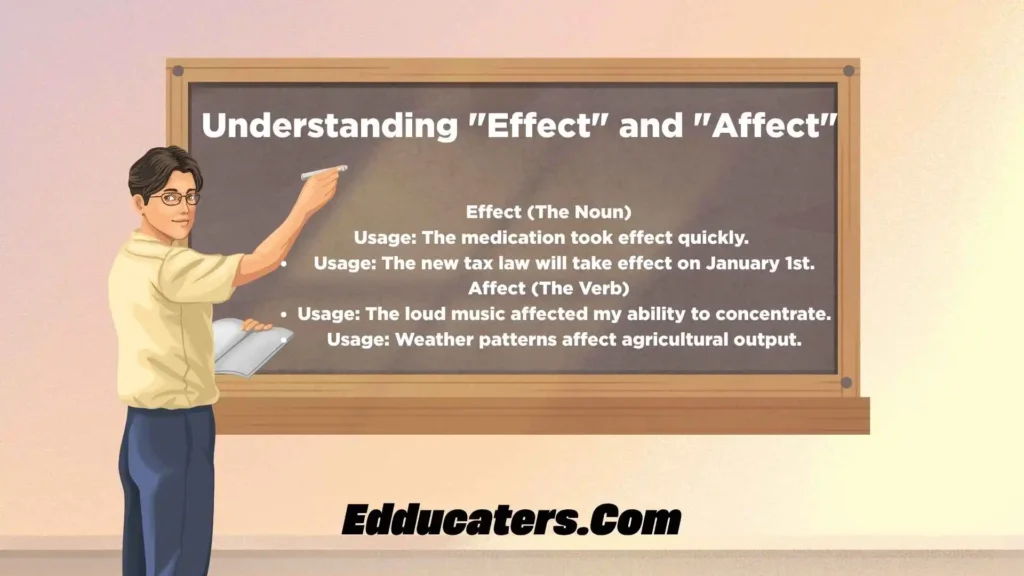
Understanding “Effect” and “Affect”
To master these phrases, you must first distinguish between the two base words.
Effect (The Noun) Most of the time, effect is a noun. It refers to the result or consequence of an action. When you use the phrase “take effect,” you are using effect as a noun—the thing that is being “taken” or activated.
- Usage: The medication took effect quickly.
- Usage: The new tax law will take effect on January 1st.
Affect (The Verb) Affect is almost always a verb. It means to influence or produce a change in something. Because it is a verb, it cannot serve as the direct object of the verb “take.” You cannot “take” an influence; you can only “take” a result (an effect).
- Usage: The loud music affected my ability to concentrate.
- Usage: Weather patterns affect agricultural output.
Key Differences at a Glance
- Grammar Structure: “Take” is a verb that requires a noun to follow it. Since effect is a noun (the result), it fits perfectly. Affect is a verb (the action of influencing), so putting it after “take” creates a grammatical clash.
- Meaning: “Take effect” describes the start of a state of being (the result). “Affect” describes the process of change.
- Context: You use “take effect” when something (like a rule) moves from inactive to active. You use “affect” when one thing acts upon another.
The Grammar Rules
In standard English, the rule is straightforward: Affect is the action; Effect is the result.
The phrase “take effect” is an idiom. It functions as a single unit meaning “to start working” or “to become law.” Because effect is a noun, it follows the rules of direct objects. You can “take” a seat, “take” a breath, or “take” an effect (in the sense of letting the result begin).
There is only one rare exception where affect functions as a noun: in psychological contexts, it refers to an observable expression of emotion. However, even in psychology, one would never say “take effect” to mean “show emotion.” Therefore, for 99.9% of professional, academic, and daily writing, “take effect” is simply an error.
When to Use Each Phrase
Professional and Business Writing In contracts, policy updates, and corporate announcements, precision is paramount. Use “take effect” to signal when a policy starts.
- Example: “The new remote work policy will take effect next Monday.”
Academic Writing Academic papers require formal language. Avoid “affect” as a noun entirely and ensure “take effect” is used correctly when discussing experimental outcomes or legal precedents.
- Example: “The pharmaceutical compound began to take effect within thirty minutes of administration.”
Emails and Daily Conversation While you might be more casual, using “take effect” keeps your message clear. If you use “take affect,” readers may perceive it as a typo, which can distract from your intended message.
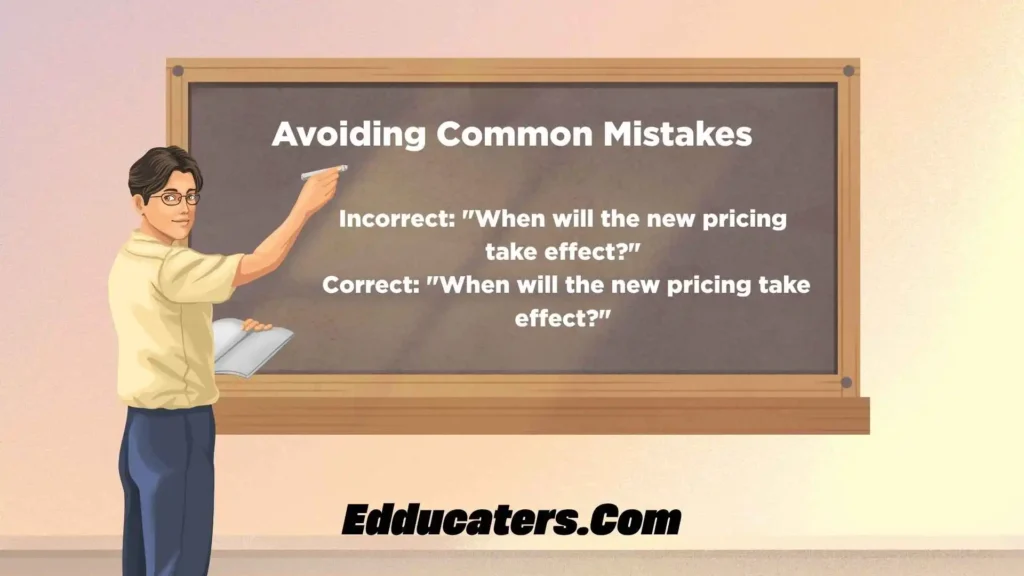
Avoiding Common Mistakes
The confusion stems from the fact that affect and effect are near-homophones—they sound almost exactly the same in rapid speech. Because of this, many people guess based on phonetic memory rather than grammatical function.
Incorrect: “When will the new pricing take effect?” Correct: “When will the new pricing take effect?”
Why it happens: People hear “take” followed by an “uh” sound and assume the word is affected. To avoid this, remember that you are waiting for the result (the effect) to start.
Original Examples of Correct Usage
- The anesthesia began to take effect before the surgeon made the first incision.
- Our new safety protocols will take effect starting at the beginning of the next quarter.
- The proposed zoning changes will not take effect until the city council votes next month.
- She waited patiently for the caffeine to take effect so she could finish her report.
- Changes to the software license will take effect automatically upon the next update.
- The treaty will take effect once all three nations sign the document.
- His calm demeanor started to take effect on the agitated crowd.
- The dietary changes did not take effect for several weeks.
- The emergency measures must take effect immediately to prevent further damage.
- The discount code will take effect once you reach the checkout screen.
- Environmental regulations often take years to take effect in developing industrial sectors.
- The lawyer argued that the contract did not take effect because it lacked a signature.
- The training sessions started to take effect as team productivity surged.
- The new ban on single-use plastics will take effect citywide next year.
- He realized the medication would take effect soon and decided to lie down.
The RAVEN Memory Trick
To keep affect and effect straight, use the RAVEN acronym:
Remember: Affect = Verb Effect = Noun
If you are using the word after “take,” you are looking for a noun (the result). Therefore, you must use the word starting with E. If you are describing an action or an influence, use the word starting with A.
Mini Quiz
- Which is correct? a) The law will take effect today. b) The law will take effect today.
- “Affect” is primarily which part of speech? a) Noun b) Verb
- “Effect” is primarily which part of speech? a) Noun b) Verb
- Choose the correct sentence: a) I hope the speech will take effect on the audience. b) I hope the speech will affect the audience.
- In the phrase “take effect,” what does “effect” represent? a) The action of influencing. b) The end result or state.
Answers: 1-b, 2-b, 3-a, 4-b, 5-b.
Frequently Asked Questions
Is “take effect” ever correct?
No. In standard English, “take affect” is considered a grammatical error. “Affect” is a verb meaning to influence, and it does not fit the structure of the phrase. You should always use “take effect,” where “effect” functions as a noun representing the result or the start of an operative state.
Why do so many people say “take effect”?
People often confuse the two because affect and effect have nearly identical pronunciations. Because speakers cannot hear the difference, they often misspell the words in writing. It is a common phonetic error rather than a misunderstanding of the definitions, but it remains incorrect in formal and professional writing.
Can I use “effect” as a verb?
Yes, but in a very specific context. “To effect” means to bring about or cause something to happen (e.g., “to effect change”). This is different from the phrase “take effect.” When you want to discuss something starting to work, stick to the noun form: “take effect.”
How can I remember the difference during a meeting?
Think of the phrase “take effect” as a single unit meaning “to start.” If you are writing or speaking, replace it with the word “start.” If “start” makes sense, “take effect” is the correct choice. You would never say “take start,” but you would say “the rule will start,” which aligns with “the rule will take effect.”
Is there a difference between US and UK English here?
No. In both American and British English, “take effect” is the standard, correct phrase. There is no variation in the usage of these terms between the two major dialects. Both regions treat “affect” as a verb and “effect” as a noun in this context.
Does “take effect” only apply to laws?
No, it applies to anything that becomes operative or noticeable. You can use it for medicine, policies, rules, plans, or even subtle changes in mood or environment. As long as you are referring to a result beginning to manifest or a system becoming active, “take effect” is the correct terminology to use.
Key Takeaways
- Always use “take effect”: This is the only grammatically correct version of the phrase.
- “Affect” is a verb: It means to influence and is rarely used as a noun.
- “Effect” is a noun: It refers to a result, which makes it the correct word to pair with “take.”
- Use the “Start” test: If you can replace the phrase with “start,” use “take effect.”
- Precision matters: Using the correct terminology boosts your professional credibility and ensures your message is clearly understood.
Conclusion
Mastering the difference between “take effect” and “take affect” is a simple but powerful way to sharpen your writing. By remembering that effect is the noun you “take” when something begins to work, you can avoid the most common pitfalls of English grammar.
If you are drafting a legal document, sending an email to your team, or writing a creative piece, using the correct phrase ensures your communication remains professional and clear. The next time you find yourself pausing to choose between the two, remember the RAVEN rule and choose the noun—take effect.

I’m Julian Mercer, an English language writer dedicated to helping people master grammar through practical examples and clear explanations. I enjoy teaching grammar in a way that is both engaging and easy to remember.
My work focuses on grammar rules, punctuation, word usage, and writing techniques that readers can apply in everyday life. I believe learning English should be simple, enjoyable, and useful.
Books
English Grammar in Practice
Writing with Precision
 Nathan Whitmore
 Claire Holloway