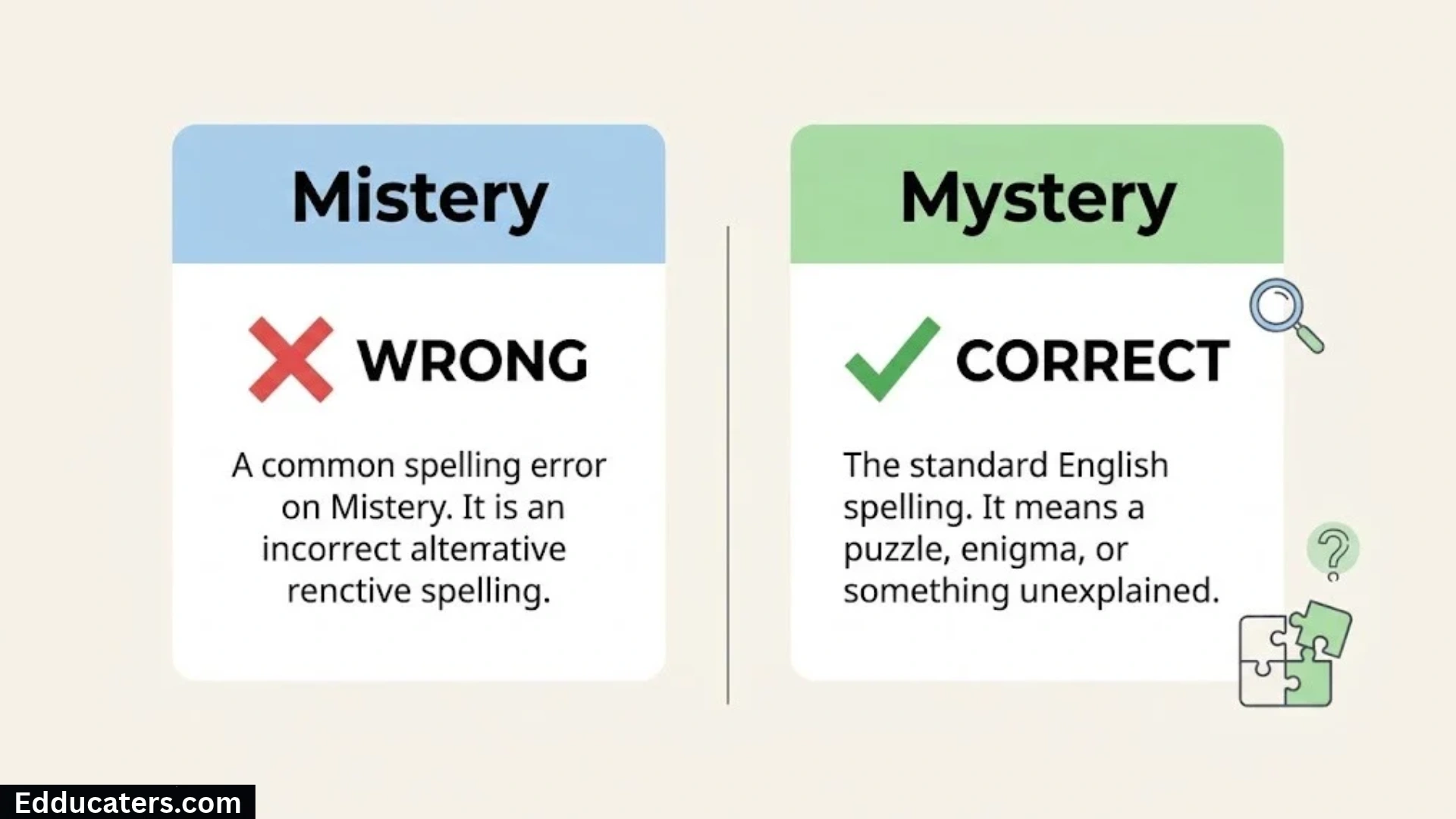
Have you ever wondered whether to write mistery or mystery? You’re not alone. These two spellings look similar, and it’s easy to leave out a letter when typing quickly. However, only one is the standard spelling in English.
Mystery is the correct spelling. Mistery is a common spelling mistake, not an accepted British or American spelling variation. The word mystery describes something unknown, unexplained, or difficult to understand. It can also refer to a book, movie, or story that revolves around solving a puzzle or uncovering a secret.
Once you learn the correct spelling, a few related forms become easier to remember. These include mysteries, mysterious, and mysteriously. This guide explains their meanings, pronunciation, grammar, origins, and everyday uses so you can write them confidently.
Mistery or Mystery: What Is the Correct Spelling?
The correct spelling is mystery. The spelling mistery is incorrect when you intend to use the standard English noun meaning something unknown or unexplained.
Although the two forms look almost identical, that small difference matters in school assignments, emails, articles, and professional documents.
| Word | Status | Example |
| Mystery | Correct standard English spelling | The missing necklace remains a mystery. |
| Mistery | Common misspelling | The missing necklace remains a mistery. |
| Mysteries | Correct plural form | The detective solved two separate mysteries. |
| Mysterious | Correct adjective | A mysterious visitor arrived late. |
| Mysteriously | Correct adverb | The lights mysteriously switched off. |
The important point is simple: write mystery, with a y after the initial m. Don’t replace that letter with an i.
For example:
- Correct: Nobody knows the mystery behind the abandoned house.
- Incorrect: Nobody knows the mistery behind the abandoned house.
The incorrect version might still communicate your intended meaning, but it doesn’t follow standard English spelling.
Is Mistery a Word?
In ordinary English writing, mistery is a misspelling of mystery. It isn’t a recognized alternative spelling of the standard noun.
You might encounter the incorrect form in online comments, search queries, usernames, or informal messages. Its appearance in those places doesn’t make it correct.
If you use a spelling checker, the software may flag mistery and suggest mystery. However, a spell-checker isn’t a substitute for understanding the word. Some tools may overlook errors when an incorrect form resembles a name or another recognized string of letters.
Remember: If you’re writing about an unexplained event, a hidden truth, or a detective story, use mystery.
What Does Mystery Mean?
The word mystery is a noun that describes something unknown, unexplained, secret, or difficult to understand. It can refer to a puzzling event, an unanswered question, or a situation whose explanation remains unclear.
According to the Cambridge Dictionary’s definition of mystery, the word covers both unexplained things and stories in which strange events or crimes are eventually explained.
For example:
- The cause of the strange noise remains a mystery.
- Her sudden departure was a complete mystery to her friends.
- Scientists continue to investigate several mysteries of the natural world.
- I enjoy reading a mystery before going to sleep.
In each sentence, the word describes something that invites curiosity or requires an explanation.
Mystery as Something Unknown or Unexplained
One common meaning of mystery involves a situation that people cannot fully explain.
Imagine that you leave your keys on the kitchen table. A few minutes later, they’re gone. Nobody remembers moving them, and you can’t find them anywhere. Their disappearance becomes a mystery until you discover what happened.
The word works similarly in more serious situations. Researchers may investigate an unexplained natural event, while detectives may examine evidence to understand a crime.
A mystery doesn’t necessarily involve anything supernatural. Sometimes, it simply means that people haven’t discovered the answer yet.
Consider these examples:
- The origin of the unusual sound remains a mystery.
- Nobody could explain why the machine stopped working.
- The reason for the sudden change was a mystery to everyone.
- The missing documents created a mystery for the investigators.
In these sentences, mystery describes an unexplained event, an unknown reason, or a question without a clear answer.
Mystery in Books, Movies, and Stories
Mystery also describes a genre of entertainment. A mystery novel, movie, or television episode often introduces a puzzling event and invites the audience to work out what happened.
The story may contain clues, suspects, misleading information, and unexpected discoveries. As the plot develops, the reader or viewer tries to connect the evidence.
For example, a detective might investigate a theft involving several possible suspects. Each character offers a different explanation, but only one fits the available evidence.
A well-written mystery gradually reveals information without giving away the entire solution too early.
Common expressions include:
- Mystery novel: A book centered on an unexplained event, investigation, or puzzle.
- Murder mystery: A story focused on investigating a killing and identifying the person responsible.
- Mystery movie: A film built around secrets, unanswered questions, or an investigation.
- Mystery story: A narrative that challenges readers to uncover an explanation.
Mystery stories often create suspense, but the words mystery and suspense don’t mean exactly the same thing. A mystery focuses on what remains unknown, while suspense concerns the tension or anticipation surrounding what might happen.
Mystery in Everyday Expressions
You don’t need to be discussing a crime or reading a detective novel to use mystery. The word appears in ordinary conversations whenever something is difficult to explain.
Here are several common expressions:
- A mystery to me: Something you don’t understand.
- Solve the mystery: Discover the explanation for something unknown.
- Remain a mystery: Continue to be unexplained.
- Shrouded in mystery: Surrounded by secrecy or uncertainty.
- An air of mystery: A quality that makes someone or something seem intriguing or difficult to understand.
For example, you might say, “Why the printer stopped working is a mystery to me.” This simply means you don’t know the reason.
Similarly, “Her past is shrouded in mystery” suggests that little information is available about her history.
These expressions make mystery useful in both casual conversation and formal writing.
How Do You Pronounce Mystery?
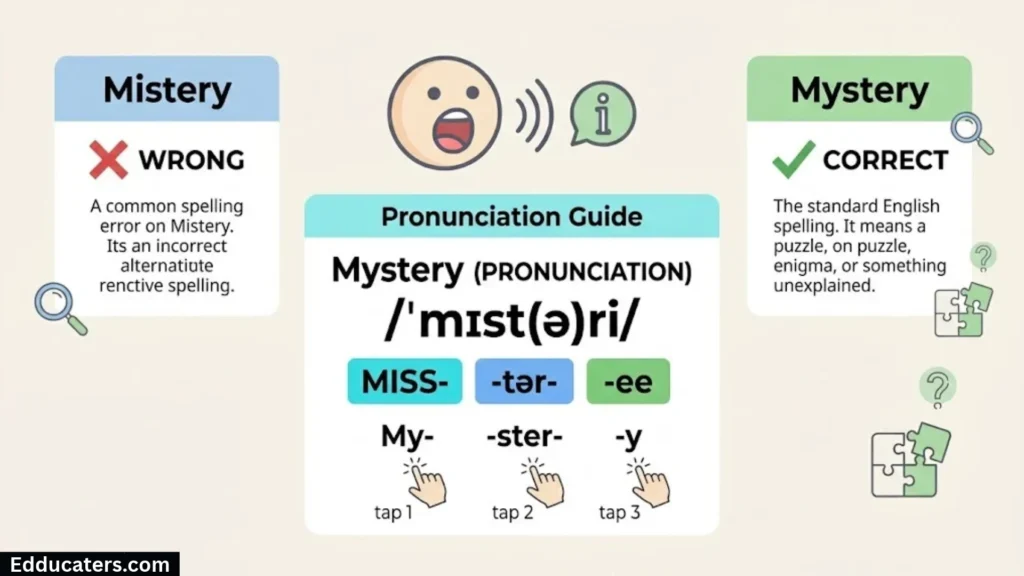
The word mystery has three syllables in its common American English pronunciation. You can break it into a simple pronunciation guide: MIS-tuh-ree.
The first syllable carries the main stress. The remaining syllables follow more lightly in ordinary speech.
The Cambridge Dictionary provides British and American pronunciations, along with audio examples, on its mystery pronunciation page.
A few tips can help you say the word naturally:
- Start with the sound of mis.
- Keep the middle syllable short and unstressed.
- Finish with the sound of ree.
- Give the first syllable the strongest emphasis.
Pronunciation can vary slightly among English speakers. Some speakers also compress the final part of the word in rapid conversation. These differences don’t change the standard spelling.
Why Do People Spell Mystery as Mistery?
The pronunciation may contribute to spelling confusion, especially for people learning English. However, the sound of a word doesn’t always tell you exactly which letters to write.
Writers may also make the mistake because they type quickly, rely on memory, or confuse the word with other familiar spellings.
The best solution is to learn the written form alongside its meaning and pronunciation. Reading the word in context and using it in your own sentences can reinforce that connection.
Mystery in a Sentence: Examples of Correct Usage
Seeing a word in context helps you understand how it works. The following mystery example sentences cover everyday situations, investigations, literature, and common expressions.
Everyday Examples of Mystery
- The sudden disappearance of my wallet remains a mystery.
- It’s a mystery why the computer keeps restarting.
- The children wondered about the mystery behind the locked door.
- Her decision to leave without saying goodbye was a mystery to everyone.
- Scientists are studying the mystery of how certain animals navigate long distances.
- The old building has an air of mystery about it.
- The source of the unusual smell was no longer a mystery after we found the leak.
- How the package reached our doorstep without a delivery notice remains a mystery.
Each sentence uses mystery as a noun. The word names something that people don’t understand or haven’t explained.
Mystery in Stories and Entertainment
- I borrowed a mystery novel from the library.
- The detective solved the mystery by examining a forgotten clue.
- We watched a murder mystery during the weekend.
- The movie kept its central mystery hidden until the final scene.
- Her favorite mystery stories feature clever detectives and unexpected endings.
- The author introduced three suspects to make the mystery more challenging.
These examples show how mystery can describe a type of story or the central puzzle within it.
Common Expressions With Mystery
| Expression | Meaning | Example |
| Solve the mystery | Discover the answer | The detective solved the mystery before sunrise. |
| Remain a mystery | Stay unexplained | The letter’s author remains a mystery. |
| A mystery to someone | Something someone doesn’t understand | Mathematics was a mystery to him. |
| Shrouded in mystery | Surrounded by secrecy | The agreement was shrouded in mystery. |
| An air of mystery | An intriguing or secretive quality | The empty mansion had an air of mystery. |
When you write your own sentences, consider whether mystery refers to the unknown thing itself or to a story about uncovering it. That distinction will help you choose the word naturally.
What Is the Plural of Mystery?
The plural of mystery is mysteries. The correct spelling changes the final y to ies.
For example:
- One mystery; two mysteries.
- A strange mystery; several strange mysteries.
- An unsolved mystery; multiple unsolved mysteries.
The forms mysterys, misteries, or misterys are incorrect plurals of the standard noun.
Why Does Mystery Become Mysteries?
English uses a common spelling pattern for many nouns that end in a consonant followed by y. To form the plural, you usually change the y to ies.
The pattern looks like this:
Consonant + y → consonant + ies
Examples include:
| Singular | Plural |
| Mystery | Mysteries |
| Story | Stories |
| City | Cities |
| Family | Families |
| Country | Countries |
| Party | Parties |
The letter before the final y matters. When a noun ends in a vowel followed by y, you generally add s instead.
For example:
| Singular | Plural |
| Boy | Boys |
| Toy | Toys |
| Key | Keys |
| Day | Days |
This distinction explains why mystery becomes mysteries, while key becomes keys.
The plural rule doesn’t make mistery correct. You must begin with the correctly spelled singular form and then apply the plural pattern.
Correct: mystery → mysteries
Incorrect: mistery → misteries
Learning the singular and plural forms together is a practical way to avoid both errors.
Mystery, Mysterious, or Mysteriously: What’s the Difference?
Mystery, mysterious, or mysteriously share a related meaning, but they perform different grammatical jobs.
The easiest way to distinguish them is to identify the part of speech. Mystery is a noun, mysterious is an adjective, and mysteriously is an adverb.
| Word | Part of speech | Main function | Example |
| Mystery | Noun | Names an unknown thing or puzzling situation | The mystery remains unsolved. |
| Mysterious | Adjective | Describes something strange or difficult to explain | A mysterious visitor arrived. |
| Mysteriously | Adverb | Describes an action or situation as strange or unexplained | The lights mysteriously went out. |
Mystery: The Noun
Use mystery when you’re naming something unexplained or referring to the quality of being difficult to understand.
Examples:
- The mystery attracted the attention of local reporters.
- Her identity remains a mystery.
- The story contains several mysteries.
In each sentence, the word identifies a thing, situation, or concept.
Mysterious: The Adjective
Use mysterious to describe a person, object, event, or situation that seems strange, secretive, or difficult to understand.
Examples:
- A mysterious sound came from the basement.
- The stranger left a mysterious note.
- They discovered a mysterious symbol on the wall.
Notice that mysterious modifies a noun. It tells you something about the sound, stranger, or symbol.
Mysteriously: The Adverb
Use mysteriously when you want to describe an action or event as unexplained or strange.
Examples:
- The door mysteriously opened during the night.
- My missing file mysteriously reappeared.
- The lights mysteriously switched off.
Here, the adverb adds information about how an event occurred or how it appeared to happen.
A Simple Way to Remember the Difference
Compare these three sentences:
- Noun: The disappearance was a mystery.
- Adjective: The disappearance was mysterious.
- Adverb: The documents mysteriously disappeared.
All three sentences describe related ideas, but their grammar differs.
You can use this pattern with other words in English, too. Learning a word family helps you build sentences more accurately instead of treating every related form as interchangeable.
Why Do People Spell Mystery as Mistery?
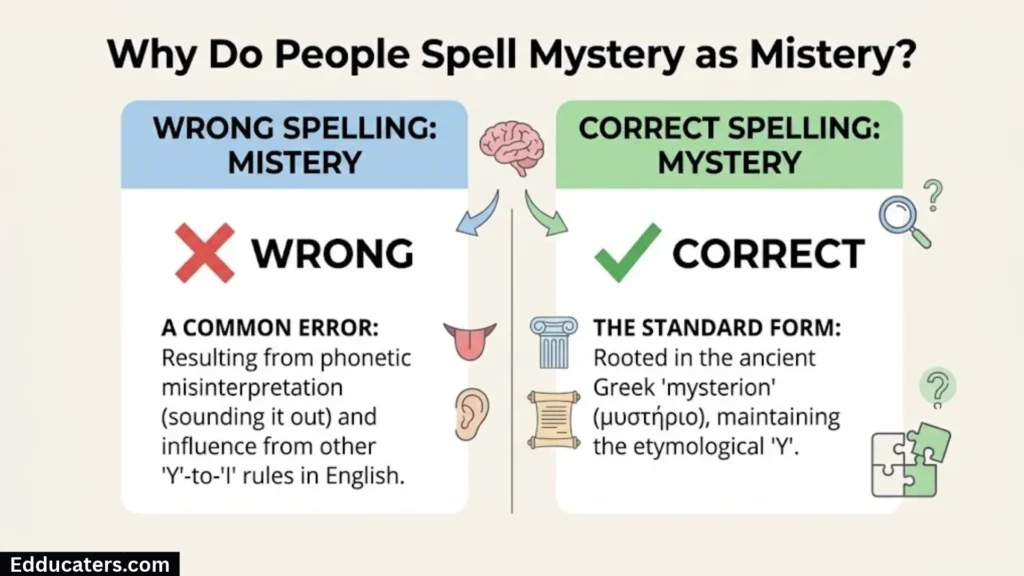
The spelling error usually happens when writers remember the general sound of a word but not its exact letter sequence. A missing letter can be easy to overlook, especially during fast typing or when writing an unfamiliar word.
Several factors can contribute to the mistake:
- Uncertain spelling memory: A writer remembers the word’s sound but forgets its exact spelling.
- Typing errors: Someone accidentally enters an i instead of a y.
- Limited reading exposure: A learner may not have encountered mystery often enough to remember its written form.
- Overreliance on pronunciation: English spelling doesn’t always follow predictable sound-to-letter patterns.
None of these reasons makes mistery an accepted alternative. They simply explain how the error can happen.
How to Remember the Correct Spelling of Mystery
A useful spelling mnemonic should help you recall the correct word without making the process complicated.
Try these practical methods:
- Memorize the complete word: Practice writing mystery rather than relying on how it sounds.
- Learn the plural alongside it: Write mystery → mysteries to reinforce the correct spelling.
- Use a meaningful sentence: Try, “The mystery remains unsolved.”
- Read the word regularly: Seeing it in books and articles helps strengthen your spelling memory.
- Check unfamiliar words: Use a reliable dictionary when you aren’t certain.
You can also remember that the correct word begins with mys-, not mis-.
A short practice exercise can help:
- Write mystery three times.
- Write a sentence containing the word.
- Change the noun to its plural form.
- Check both spellings against a dictionary.
The goal isn’t to memorize a complicated rule. It’s to become familiar enough with the correct form that you recognize an error quickly.
Can a Spell Checker Correct Mistery?
Most modern spelling tools can flag mistery when the surrounding context makes the intended word clear. They may suggest mystery as a replacement.
However, spell checkers aren’t perfect. A tool may overlook a mistake or offer several suggestions without understanding the meaning you intend.
For reliable proofreading, combine automated tools with a dictionary and a careful review. This approach is especially useful for published writing, school assignments, and professional documents.
Is Mistery a Word in British or American English?
No. Mystery is the standard spelling in American, British, Canadian, and Australian English. The form mistery isn’t an accepted regional spelling variant of this noun.
Some English words have different regional spellings. For example, American English uses color, while British English commonly uses colour. Those differences are recognized spelling variations.
Mystery doesn’t follow that pattern. You should use the same spelling regardless of which major English variety you’re writing.
| English variety | Correct spelling | Incorrect form |
| American English | Mystery | Mistery |
| British English | Mystery | Mistery |
| Canadian English | Mystery | Mistery |
| Australian English | Mystery | Mistery |
The plural is also consistent across these varieties: mysteries.
What About Mistry?
Mistry can appear as a surname. A surname is a person’s family name, so it should be treated according to the person’s actual spelling.
For example, if someone’s name is Mistry, you shouldn’t automatically change it to Mystery. Names and ordinary dictionary words serve different purposes.
However, if you’re describing an unexplained event or a puzzling situation, the standard noun is mystery.
What Is the Origin of the Word Mystery?
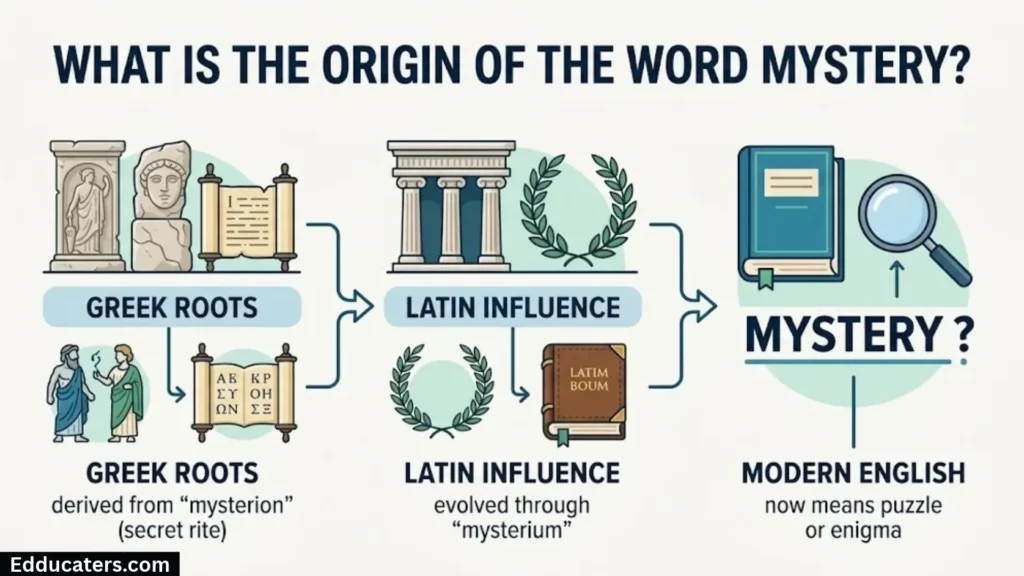
The word mystery has a long history that connects modern English with older European languages and Ancient Greek.
According to the Dictionary.com entry for mystery, the word developed through Middle English forms and traces back through Latin mystērium to Ancient Greek mystḗrion, a word associated with a secret rite or doctrine.
Its history helps explain why the modern word refers to things that remain hidden, unknown, or difficult to understand.
From Ancient Greek to Modern English
The word’s historical path can be summarized as follows:
- Ancient Greek: mystḗrion referred to a secret or secret religious rite.
- Latin: mystērium carried related meanings.
- Older French forms: The word passed through forms such as Old French mistere.
- Middle English: Forms such as misterie appeared in English.
- Modern English: Mystery became the standard spelling for the familiar noun.
The spelling and meaning changed over time as the word moved between languages. Historical spellings don’t determine which form you should use in modern writing.
It’s also worth noting that older English used forms resembling mistery. That historical fact doesn’t make mistery an acceptable modern alternative spelling of mystery. The present-day standard is clear.
How Has the Meaning of Mystery Developed?
The word’s earlier associations with secret rites and hidden knowledge helped shape its modern sense of something unknown or difficult to understand.
Today, mystery can describe an unexplained event, a secret, a philosophical question, or a fictional investigation.
For example, people discuss the mysteries of nature, the mystery of life, and the mystery surrounding a historical disappearance. In literature, the word also names a genre built around discovering answers.
The central idea remains similar: something invites curiosity because its explanation isn’t fully known.
What Are Synonyms for Mystery?
The best mystery synonym depends on what you want to express. Words such as enigma, puzzle, riddle, and conundrum overlap with mystery, but each carries a slightly different emphasis.
| Synonym | Meaning | Example |
| Enigma | Something puzzling or difficult to understand | His motives remained an enigma. |
| Puzzle | A problem that requires thought or a solution | The missing evidence presented a puzzle. |
| Riddle | A question or statement that challenges someone to find an answer | The old inscription was a riddle. |
| Secret | Information kept hidden from others | She guarded the secret carefully. |
| Conundrum | A confusing or difficult problem | Choosing between the two offers was a conundrum. |
| Unknown | Something not yet known or identified | The source of the signal remained unknown. |
| Question | Something that needs an answer or explanation | The sudden change raised a question. |
| Uncertainty | A state of not knowing what will happen or what is true | Uncertainty surrounded the decision. |
These words aren’t interchangeable in every sentence.
For example, secret emphasizes concealed information, while puzzle emphasizes a problem that needs solving. Enigma often suggests something particularly difficult to interpret.
Consider the sentence, “The disappearance remains a mystery.” You could replace mystery with puzzle if you want to emphasize the challenge of finding an explanation.
However, “The mystery of life” has a broader philosophical tone. Replacing it with riddle might make the expression sound more like a question with a specific answer.
Choose the synonym that matches the meaning and tone you want.
Common Mystery Spelling Mistakes to Avoid
The most common error is writing mistery instead of mystery. Other mistakes occur when writers form the plural incorrectly or confuse the noun with its related adjective and adverb.
Use this table as a quick reference:
| Incorrect spelling or usage | Correct form | Explanation |
| Mistery | Mystery | The standard noun requires the correct letter sequence. |
| Mysterys | Mysteries | Nouns ending in consonant + y commonly change y to ies in the plural. |
| Misteries | Mysteries | Correct the singular spelling before forming the plural. |
| Misterys | Mysteries | Both the singular spelling and plural formation are incorrect. |
| The event was a mysteriously | The event was mysterious | An adjective describes the event. |
| The lights turned mysterious | The lights turned mysteriously | An adverb can describe how the lights changed. |
Not every sentence requires the same word form. Before correcting a spelling, check the role the word plays in the sentence.
For example, “The case is a mystery” is correct because mystery is a noun. “The case is mysterious” is also correct because mysterious describes the case.
The choice depends on your intended meaning and sentence structure, not just the letters.
Frequently Asked Questions
Is Mistery a Correct English Word?
No. Mistery is a common misspelling of mystery when referring to something unknown or unexplained. Use mystery in standard English writing.
What Is the Correct Spelling of Mystery?
The correct spelling is mystery. Remember the opening letters mys- rather than mis-.
What Is the Meaning of Mystery in One Word?
Enigma is a useful one-word synonym for something puzzling or difficult to understand. Depending on the context, puzzle or secret may also fit.
Why Is Mystery Spelled With a Y?
The spelling reflects the word’s historical development through older languages. Modern English spelling doesn’t always match the way a word sounds, so learning the standard form is important.
What Is the Plural of Mystery?
The plural is mysteries. Because mystery ends in a consonant followed by y, the plural usually changes y to ies.
Is Mistry Another Spelling of Mystery?
No. Mistry can be a surname, but it isn’t the standard spelling of the noun mystery. Use the correct form for the meaning you intend.
What Is a Mystery Box?
A mystery box is a package whose contents aren’t revealed until the buyer opens it. The term often describes surprise products, gifts, toys, collectibles, or other merchandise.
What Is a Mystery Shopper?
A mystery shopper poses as an ordinary customer to evaluate a business. The shopper may assess customer service, product availability, store cleanliness, or the overall shopping experience.
What Does Mystery Mean in Literature?
In literature, mystery can describe a genre in which characters or readers try to uncover the explanation for a crime, strange event, or hidden secret. Clues and revelations often guide the story toward a solution.
What Does the Mystery of Life Mean?
The phrase mystery of life refers to questions about existence that people find difficult to answer completely. Depending on the context, it may involve consciousness, human existence, nature, or philosophical and religious beliefs.
Conclusion: Mystery Is the Correct Spelling
When choosing mistery or mystery, always use mystery for the standard English noun. Mistery is a spelling mistake, not an accepted British or American variant.
Remember the related forms, too: mysteries is the plural, mysterious is the adjective, and mysteriously is the adverb. Each form has a different grammatical role.
If you’re writing about an unexplained event, a detective novel, or the mystery of life, the correct spelling makes your meaning clearer. When in doubt, check a reliable dictionary and remember the simple pattern: mystery → mysteries.

I’m Julian Mercer, an English language writer dedicated to helping people master grammar through practical examples and clear explanations. I enjoy teaching grammar in a way that is both engaging and easy to remember.
My work focuses on grammar rules, punctuation, word usage, and writing techniques that readers can apply in everyday life. I believe learning English should be simple, enjoyable, and useful.
Books
English Grammar in Practice
Writing with Precision
 Claire Holloway
 Nathan Whitmore