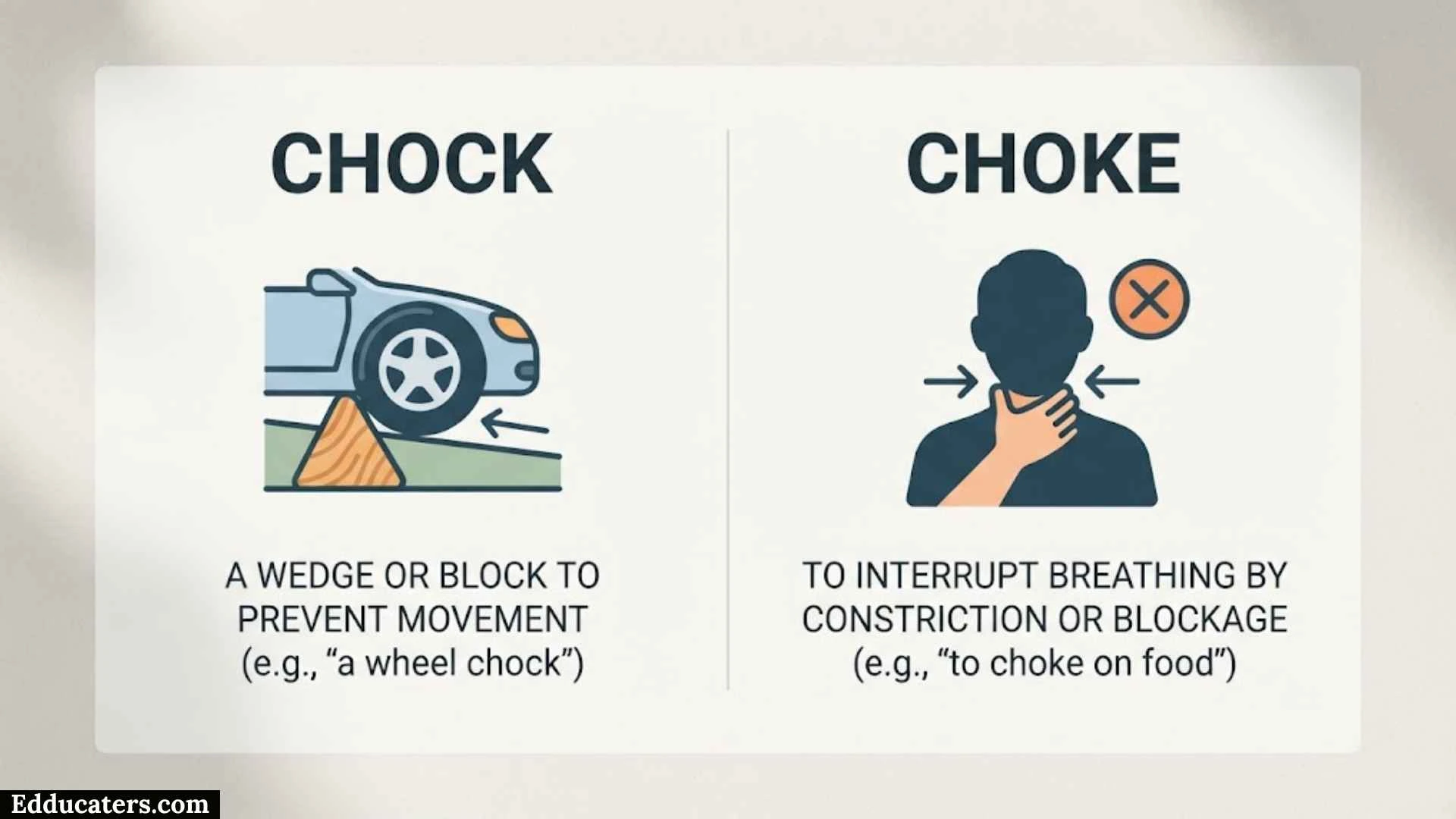
Chock or choke are both correct English words, but they have different meanings and are used in very different situations. They are easy to confuse because they look similar and begin with the same ch- sound, but you cannot normally substitute one for the other.
Chock is commonly used for a block or wedge that prevents something from moving. It also appears in expressions such as chock-full and chock-a-block, and it can be used as a verb meaning to secure something with a chock.
Choke, on the other hand, is mainly a verb associated with difficulty breathing, blocking or restricting movement, or failing under pressure. It can also be a noun, including the name of a device used in some engines.
So, if you are trying to decide between chock or choke, the correct choice depends on what you mean. This guide explains the difference, pronunciation, grammar, common expressions, examples, and the mistakes that often cause confusion.
Chock or Choke: The Quick Answer
Both chock or choke are standard English words. Neither is simply a misspelling of the other.
The key difference is meaning:
- Chock usually refers to a block or wedge used to stop something from moving. It also means tightly or completely in expressions such as chock-full.
- Choke usually means to have difficulty breathing because something blocks the throat, or to cause someone to have difficulty breathing. It can also mean to block or restrict something, or to fail because of pressure or nervousness.
Cambridge defines chock as a block placed under a wheel or heavy object to prevent movement. It defines choke as a verb that can describe stopping breathing because something blocks the throat, filling or blocking something, or failing under pressure, particularly in sports.
| Feature | Chock | Choke |
| Main meaning | A block or wedge that prevents movement | To have difficulty breathing or block something |
| Common grammar | Noun, verb, adverb in certain expressions | Verb, noun |
| Common expression | chock-full | choke on, choke up, choke back |
| Example | Put a chock behind the wheel. | The child began to choke on the food. |
| Related meaning | Filled completely | Blocked or restricted |
| Pronunciation | /tʃɒk/ UK, /tʃɑːk/ US | /tʃəʊk/ UK, /tʃoʊk/ US |
The easiest way to remember the distinction is:
Chock stops something from moving.
Choke blocks breathing, movement, or expression.
What Does Chock Mean?
The most concrete meaning of chock is a block or wedge placed against a wheel or another heavy object to keep it from moving.
For example:
Put a chock behind the truck’s wheel before you start working underneath it.
A chock can be made from wood, metal, rubber, or another suitable material. Its purpose is to hold an object securely in place.
Cambridge specifically defines a chock as a block of wood that can be placed under a wheel or heavy object to prevent it from moving.
Chock as a Noun
The noun chock refers to the physical object.
Examples include:
The mechanic placed a chock behind the tire.
The aircraft’s wheels were secured with chocks.
Use a wheel chock before working on the vehicle.
The plural form is chocks.
In transportation, maintenance, construction, and marine settings, the word can have more specialized meanings. For example, nautical uses include fittings or supports associated with ropes, boats, and other equipment. Collins also records specialized nautical and mountaineering meanings.
Chock as a Verb
Chock can also be used as a verb meaning to secure something with a chock.
For example:
The workers chocked the wheels before unloading the trailer.
Make sure the vehicle is properly chocked before starting the inspection.
The common verb forms are:
- chock
- chocks
- chocked
- chocking
This usage is particularly relevant in mechanical, industrial, aviation, transportation, and workplace-safety contexts.
What Does Choke Mean?
Choke has several related meanings, but its most familiar meaning involves breathing.
If someone chokes, something is blocking the throat or interfering with normal breathing.
For example:
She began to choke on a piece of food.
The child was choking on a small object.
Cambridge defines choke as stopping breathing because something is blocking the throat. It also lists meanings involving blocking or filling something and failing under pressure.
Choke as a Verb
The verb choke can describe several different situations.
A person can choke because something is stuck in the throat:
He choked on a piece of bread.
Something can also choke or block another thing:
The weeds choked the young plants.
Heavy traffic choked the main road.
And a person can choke figuratively by failing under pressure:
She was performing well until she choked during the final round.
This last meaning is especially common in sports and competitive situations. Cambridge identifies it as an informal usage for failing at an important moment because of a sudden loss of confidence.
Choke as a Noun
Choke can also be a noun.
One technical meaning is a device in a motor vehicle that changes the amount of air entering the engine so that more fuel enters relative to air, helping the engine start.
The noun also appears in other technical contexts.
For example:
The mechanic checked the choke before starting the older engine.
This meaning is very different from the ordinary verb choke, which is why context matters.
Chock and Choke Have Different Meanings
The most important point is that chock and choke are not alternative spellings of the same word.
They are separate words.
Consider these sentences:
The driver placed a chock behind the wheel.
The chock is a physical object used to prevent movement.
Now compare:
The driver began to choke on his food.
Here, choke describes a problem with breathing caused by an obstruction.
Changing one word to the other changes the meaning completely.
| Sentence | Correct Word | Why |
| Put a ___ behind the wheel. | chock | A chock prevents the wheel from moving. |
| The child began to ___ on a grape. | choke | Choke relates to blocked breathing. |
| The room was ___-full of people. | chock | The expression is chock-full. |
| The weeds began to ___ the flowers. | choke | Choke can mean to obstruct or crowd out. |
| The athlete ___ during the final. | choked | Choke can mean to fail under pressure. |
How Do You Pronounce Chock and Choke?
The two words are pronounced differently because their vowel sounds are different.
Cambridge gives chock as /tʃɒk/ in UK English and /tʃɑːk/ in US English.
Choke is pronounced /tʃəʊk/ in UK English and /tʃoʊk/ in US English.
A simple comparison is:
chock → sounds like “chok” with a short vowel
choke → has a longer vowel sound, similar to the vowel in go
The final k sound is present in both words, so the vowel is the main pronunciation difference.
Why Pronunciation Can Cause Confusion
Both words begin with the same ch- sound and end with -k. The middle vowel is what separates them.
This means that a reader who has only heard one of the words in conversation may occasionally choose the wrong spelling.
Learning the meaning alongside the spelling is more reliable than trying to remember only the sound.
Chock-Full: A Common Expression
One of the most common uses of chock is in chock-full.
Chock-full means completely full or containing a large amount of something.
For example:
The report is chock-full of useful information.
The suitcase was chock-full of clothes.
The website is chock-full of helpful examples.
Cambridge’s dictionary examples include chock-full for something containing a great deal of something.
The spelling is:
chock-full
not:
❌ choke-full
Why Chock-Full Uses Chock
The expression has a long history and is an established form in English. It should be learned as a fixed expression rather than changed according to the modern meaning of chock.
So when you want to say that something is completely full, write:
chock-full
For example:
The library was chock-full of students during exam week.
Chock-a-Block: Another Common Expression
Another expression containing chock is chock-a-block.
It means extremely full, crowded, or packed tightly together.
For example:
The streets were chock-a-block with traffic.
The parking lot was chock-a-block with cars.
The market was chock-a-block with shoppers.
Cambridge records chock-a-block among the established expressions associated with chock.
This expression is especially associated with British English, although readers elsewhere may recognize it.
Do not spell it choke-a-block when you mean the established expression.
Choke On, Choke Up, and Choke Back
Choke also appears in several common expressions.
Choke On
Choke on is used when something enters or blocks the throat and causes difficulty breathing.
The child choked on a piece of food.
He started to choke on the drink.
The preposition on is important in this construction.
Choke Up
Choke up has more than one use.
It can describe becoming unable to speak clearly because of strong emotion:
She choked up when she talked about her family.
It can also relate to blocking or restricting something in other contexts. Cambridge lists choke up among the phrasal verbs associated with choke.
Choke Back
Choke back usually means to suppress an emotional reaction, especially tears.
He choked back his tears during the speech.
The expression is figurative rather than a reference to food blocking someone’s throat.
Chock or Choke in Real-World Contexts
Context is often the fastest way to choose the correct word.
Vehicles and Maintenance
Use chock when you are talking about securing a vehicle or heavy object.
The technician placed chocks behind the wheels.
Use choke when discussing breathing or, in some older or specialized vehicles, an engine control.
The engine’s choke was adjusted before starting.
Food and Eating
Use choke, not chock, when food blocks someone’s throat.
The child began to choke on the food.
A chock has no connection with this meaning.
Crowds and Blockages
Use choke when something blocks or restricts movement.
Traffic choked the narrow road.
Use chock-full when you mean completely full.
The hall was chock-full of people.
These two ideas can look similar because both involve something being crowded or blocked, but their grammatical patterns are different.
Sports and Competition
Use choke when someone fails at an important moment because of pressure or nervousness.
The player choked in the final seconds.
Do not use chocked for this meaning.
Common Mistakes With These Words
Because chock and choke are visually similar, several mistakes are common.
Mistake 1: Writing Choke-Full
Incorrect:
The article is choke-full of examples.
Correct:
The article is chock-full of examples.
The established expression is chock-full.
Mistake 2: Using Chock for a Breathing Problem
Incorrect:
The child began to chock on the food.
Correct:
The child began to choke on the food.
The verb associated with blocked breathing is choke.
Mistake 3: Using Choke for a Wheel Block
Incorrect:
Put a choke behind the wheel.
Correct:
Put a chock behind the wheel.
A wheel chock is the object used to prevent movement.
Mistake 4: Confusing Chocked and Choked
Both chocked and choked are legitimate words, but they come from different verbs.
Chocked comes from chock:
The workers chocked the wheels.
Choked comes from choke:
The runner choked under pressure.
This is one of the most important spelling distinctions to remember.
Chocked or Choked: How Do You Choose?
When the past-tense form causes confusion, look at the meaning.
If the action involves securing something with a physical block:
chocked
Example:
The crew chocked the aircraft wheels.
If the action involves breathing, blocking, or failing under pressure:
choked
Examples:
He choked on a piece of food.
She choked during the final round.
A quick memory aid is:
Chocked = chock used
Choked = choke happened
This is not a grammar rule; it is simply a useful way to connect each spelling with its meaning.
Chock or Choke: Which One Should You Use?
Use chock when you mean a block, wedge, or support that keeps something from moving, or when you are using an expression such as chock-full or chock-a-block.
Use choke when you mean difficulty breathing, blocking or restricting something, becoming unable to speak because of emotion, or failing under pressure.
A simple decision guide can help:
Are you talking about a physical block placed under or against something?
→ Use chock.
Are you talking about difficulty breathing or something blocking the throat?
→ Use choke.
Are you saying something is completely full?
→ Use chock-full.
Are you describing someone failing under pressure?
→ Use choke.
Are you talking about securing wheels or another heavy object?
→ Use chock.
The History Behind the Two Words
The two words have different histories, which helps explain why they are separate words despite their similar appearance.
Chock, in its noun sense of a block, dates from the seventeenth century. The Online Etymology Dictionary traces it to a word meaning a block or piece of wood and discusses possible French and earlier origins.
Choke is much older. The American Heritage Dictionary traces the verb through Middle English to Old English, while Dictionary.com gives a Middle English and Old English history associated with suffocating or restricting the throat.
Their different origins reflect the fact that these are genuinely separate words rather than two spellings that developed from the same modern meaning.
Frequently Asked Questions
Is Chock a Real Word?
Yes. Chock is a standard English word. It can refer to a block or wedge used to prevent movement, and it appears in expressions such as chock-full and chock-a-block.
Is Choke a Real Word?
Yes. Choke is also a standard English word. It can describe difficulty breathing, blocking something, suppressing emotion, or failing under pressure. It also has noun and technical uses.
Are Chock and Choke Homophones?
No. They are not normally pronounced the same. Their vowel sounds differ, although their initial and final consonant sounds are similar. Cambridge gives different pronunciations for both words.
Is It Chock-Full or Choke-Full?
The established expression is chock-full.
For example:
The guide is chock-full of useful information.
Choke-full is not the standard spelling of this expression.
Is It Chock-a-Block or Choke-a-Block?
The established expression is chock-a-block.
It means extremely full or crowded.
The street was chock-a-block with traffic.
Is It Chocked or Choked?
Both forms are correct, but they come from different verbs.
Chocked is the past tense of chock:
The workers chocked the wheels.
Choked is the past tense of choke:
The player choked under pressure.
What Is a Wheel Chock?
A wheel chock is a block or wedge placed against a wheel to help prevent a vehicle or other wheeled equipment from moving. Cambridge gives this as the core noun meaning of chock.
What Does Choke Mean in Sports?
In informal sports usage, choke means to fail at an important moment, often because of pressure or a sudden loss of confidence.
For example:
The player choked in the final seconds.
Cambridge specifically records this sports-related meaning.
Can Chock Be a Verb?
Yes. Chock can be used as a verb meaning to secure something with a chock.
For example:
The mechanic chocked the vehicle before beginning work.
Can Choke Be a Noun?
Yes. Choke can be a noun. One technical meaning is a device used in some vehicle engines to alter the air-fuel mixture during starting.
Final Takeaway
Chock or choke are both correct words, but they are not interchangeable.
Use chock for a block or wedge that prevents movement, and remember expressions such as chock-full and chock-a-block.
Use choke for difficulty breathing, blocking or restricting something, becoming unable to speak because of emotion, or failing under pressure.
The most useful distinction is:
Chock = secure or fill completely
Choke = obstruct, suffocate, or fail under pressure
Once you connect each spelling with its meaning, chock or choke becomes much easier to distinguish.
References
- Cambridge Dictionary, Chock.
- Cambridge Dictionary, Choke.
- Cambridge Dictionary, Pronunciation of Chock.
- American Heritage Dictionary, Choke.
- Dictionary.com, Chock.
- Online Etymology Dictionary, Chock.

Hi, I’m Nathan Whitmore, and I enjoy making English grammar easy for learners of all ages. I believe grammar should be practical, not confusing. I write simple, well-researched guides that help readers improve their writing, speaking, and overall communication skills.
I spend a lot of time studying grammar patterns, sentence construction, punctuation, and modern English usage. My goal is to create lessons that anyone can understand, whether they are students, teachers, or professionals.
Books
Clear English Grammar
The Smart Writer’s Grammar Handbook
 Claire Holloway
 Julian Mercer