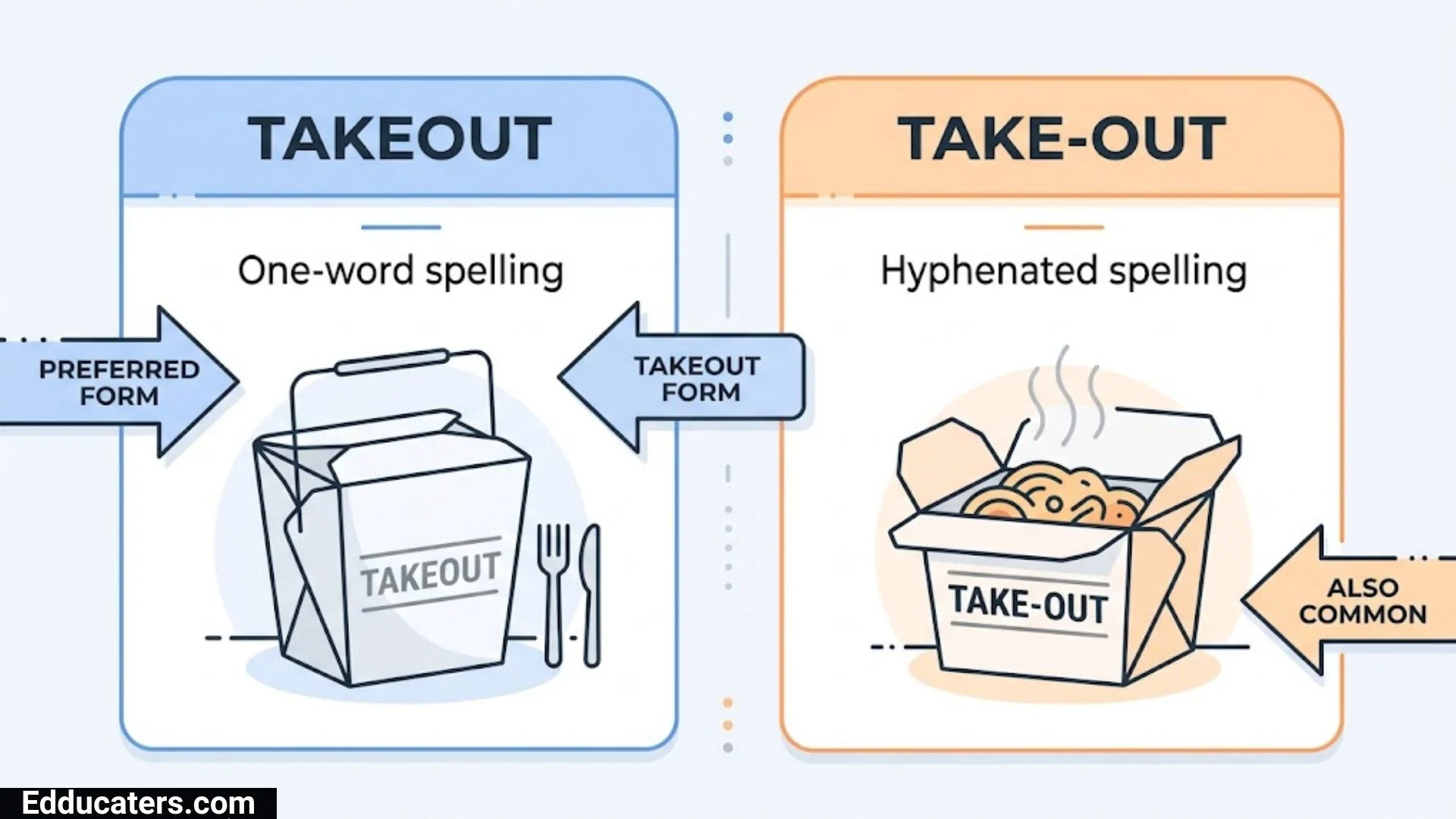
The spelling takeout or take-out can be confusing because English often uses both one-word and hyphenated forms of the same expression. You might see takeout on a restaurant menu, take-out food in an article, or take out in a sentence such as “I need to take out the trash.” Although these forms look similar, they don’t always serve the same grammatical purpose.
Both “takeout” or “take-out” are accepted spellings when referring to food prepared by a restaurant for customers to eat elsewhere. “Takeout” is the more common modern spelling in American English, while “take-out” remains an accepted hyphenated variant. However, “take out” without a hyphen is generally a phrasal verb with a different grammatical role and meaning.
Understanding the difference will help you choose the right form for restaurant orders, everyday conversation, and formal writing.
Takeout or Take-Out: Which Is Correct?
Both takeout or take-out can refer to prepared food that customers collect from a restaurant and eat somewhere else. The main difference is spelling rather than meaning.
In contemporary American English, takeout is generally the preferred spelling, especially when the word functions as a noun or adjective. The hyphenated form take-out is also used, although it is less common in many modern contexts.
Compare these examples:
- Takeout: We ordered takeout because nobody wanted to cook.
- Take-out: The restaurant offers take-out meals for busy customers.
- Take out: I’ll take out the food before it gets cold.
The first example uses takeout as a noun. The second uses take-out as an adjective describing meals. The third uses take out as a verb phrase meaning to remove or collect something.
Here is a quick comparison:
| Form | Typical grammatical role | Example |
| Takeout | Noun or adjective | We ordered takeout. |
| Take-out | Hyphenated noun or adjective variant | They offer take-out service. |
| Take out | Phrasal verb | Please take out the recycling. |
The key is to consider how the expression functions in your sentence. If you’re writing about restaurant food, takeout is usually the simplest choice in American English. If you’re describing an action, take out is generally the correct form.
Takeout or Take-Out Food: Meaning and Usage
Takeout food is food prepared by a restaurant or food business for customers to take away and eat somewhere else. Customers might eat it at home, at work, in a hotel room, or outdoors.
The expression describes how the food is obtained and consumed, not necessarily the type of food being served. Pizza, burgers, noodles, sandwiches, salads, and many other dishes can be takeout.
Examples include:
- We ordered Chinese takeout for dinner.
- The restaurant prepares takeout food throughout the day.
- Would you like to order takeout or cook at home?
- She picked up takeout on her way back from work.
- The café has a separate counter for takeout orders.
In these examples, takeout works naturally as a noun or adjective.
Is Takeout One Word or Two?
When referring to restaurant food, takeout is usually written as one word in modern American English. The hyphenated form take-out is also accepted, while the two-word form take out generally serves as a verb.
For example:
- Correct: We bought takeout for lunch.
- Also accepted: We bought take-out for lunch.
- Different meaning: We need to take out some cash.
The last sentence uses a phrasal verb because take out describes an action. It doesn’t name a type of food.
If you’re writing a restaurant menu, a food review, or an everyday message in American English, takeout is a practical default. Consistency matters, too: avoid switching between takeout or take-out unnecessarily within the same piece of writing.
Takeout in American English
In American English, takeout is a widely used noun and adjective.
For example:
- Let’s get takeout tonight.
- The restaurant has a large takeout menu.
- Our takeout order arrived early.
- Do you offer takeout or delivery?
American restaurants may also use expressions such as takeout order, takeout menu, and takeout service.
The word is not limited to a particular cuisine. You can order Italian takeout, Thai takeout, Indian takeout, or almost any other kind of restaurant food.
Takeout or Take Out: Understanding the Phrasal Verb
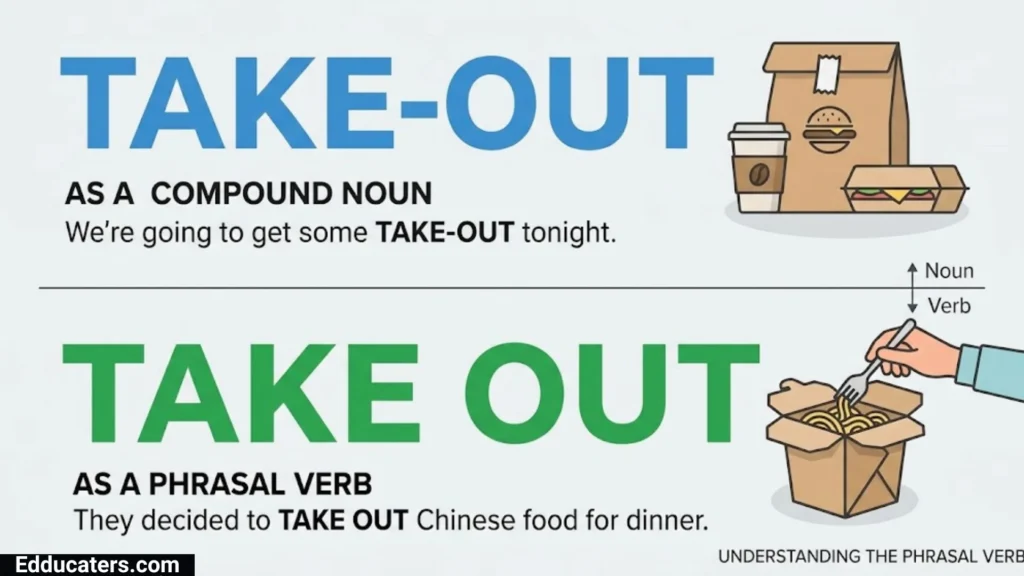
Although takeout or take out look almost identical, their grammatical roles differ.
Takeout is commonly a noun or adjective. Take out is a phrasal verb consisting of the verb take and the particle out. Its meaning depends on the context.
The phrasal verb can mean to remove something, obtain something, invite someone somewhere, eliminate a person or object, or arrange certain services.
Common Meanings of Take Out
1. To remove something
This is one of the most common meanings of take out.
- Please take out the rubbish.
- He took out his phone to check the time.
- I need to take the clothes out of the dryer.
2. To obtain money or a document
The expression can refer to withdrawing money or obtaining something officially.
- She stopped at the ATM to take out some cash.
- They decided to take out a loan.
- He took out an insurance policy for his new car.
3. To invite someone somewhere
Take someone out can mean inviting them to a restaurant, cinema, or another place for entertainment.
- He took his parents out for dinner.
- I’m taking my sister out to celebrate her graduation.
- She asked whether he wanted to take her out sometime.
4. To eliminate or defeat something or someone
In informal speech, take out can mean to eliminate a competitor or target.
- The team took out its strongest rival.
- The character took out the final opponent in the game.
The exact meaning depends on the sentence. For this reason, you shouldn’t replace every occurrence of take out with takeout.
Takeout vs. Take Out in Sentences
Compare these examples to see how the spelling changes with the grammatical role.
| Sentence | Meaning |
| We ordered takeout. | Restaurant food prepared to eat elsewhere |
| The takeout menu is on the counter. | A menu for food customers take away |
| Please take out the trash. | Remove the trash |
| She took out her notebook. | Removed a notebook from somewhere |
| He took his family out for dinner. | Took his family somewhere to eat |
| We need to take out a loan. | Obtain a loan |
A simple way to remember the distinction is to ask yourself whether you’re naming something or describing an action. If you’re naming the food, takeout is usually appropriate. If you’re describing the act of removing, obtaining, or taking someone somewhere, use take out.
Take Out Meaning and Sentence Examples
The phrase take out has several meanings, so context is essential. It doesn’t refer exclusively to restaurant food.
Here are ten natural sentences showing how the expression works in everyday English.
- Remove an object: Please take out your notebook and begin writing.
- Remove rubbish: I forgot to take out the garbage last night.
- Withdraw money: She went to the bank to take out some cash.
- Obtain a loan: They plan to take out a mortgage next year.
- Arrange insurance: You should take out travel insurance before your trip.
- Invite someone to dinner: He wants to take his partner out for their anniversary.
- Purchase restaurant food: Let’s take out some food for the journey.
- Eliminate an opponent: The underdogs managed to take out the defending champions.
- Extract a part: The mechanic had to take out the damaged component.
- Get food to eat elsewhere: We decided to take out dinner rather than eat at the restaurant.
Notice that the seventh and tenth examples use take out as a verb. Depending on the region and context, people may also use expressions such as get takeout, order takeout, or pick up takeout when talking about restaurant food.
The expression can also form part of other phrases, such as take out a loan, take out insurance, and take someone out. These expressions have established meanings that readers understand from context.
Dine In or Take Out: What’s the Difference?
Dine in and take out describe two different ways of getting restaurant food.
Dine in means eating at the restaurant where the food is prepared. Take out means obtaining food from the restaurant to eat somewhere else.
For example:
- Dine in: We decided to dine in because the restaurant had comfortable seating.
- Take out: We ordered takeout and ate at home.
- Dine in: Would you like to dine in tonight?
- Take out: Can I order food to take out?
Restaurants often use dine-in as an adjective, as in dine-in customers or dine-in service. The expression dine in is written as two words when used as a verb phrase.
Similarly, take out is a verb phrase, while takeout is commonly used as a noun or adjective.
| Expression | Meaning | Example |
| Dine in | Eat at the restaurant | We usually dine in on Fridays. |
| Dine-in | Describes eating at the restaurant | The café offers dine-in service. |
| Take out | Collect food to eat elsewhere | I’ll take out the order. |
| Takeout | Food collected to eat elsewhere | We ordered takeout for dinner. |
| Take-out | Hyphenated variant | The shop has a take-out counter. |
Is Takeout the Same as Delivery?
Not exactly. Takeout and delivery both allow you to eat restaurant food away from the restaurant, but the method of receiving the food differs.
With takeout, you usually collect the food yourself. With delivery, the restaurant or a delivery service brings it to your location.
For example:
- We picked up takeout on the way home.
- We ordered delivery because we didn’t want to leave the house.
Some people use takeout broadly when discussing restaurant food eaten elsewhere, but the distinction between collection and delivery remains useful in restaurant ordering.
Frequently Asked Questions
Is It Takeout or Take-Out?
Both spellings are accepted when referring to restaurant food. Takeout is generally more common in modern American English, while take-out is an established hyphenated variant. Use takeout unless your preferred style guide or publication specifies otherwise.
Is Takeout One Word or Two?
For the food-related noun, takeout is usually written as one word in American English. Take-out is also used. The two-word expression take out is generally a phrasal verb, as in “Please take out the trash.”
Is Takeout a Noun or a Verb?
Takeout is primarily a noun or adjective. For example, “We ordered takeout” uses it as a noun, while “takeout menu” uses it as an adjective. The verb phrase is take out, as in “I’ll take out the order.”
Is Takeout Food Correct English?
Yes. Takeout food is a correct and widely understood expression, especially in American English. It refers to food prepared for customers to collect and eat somewhere else.
Should I Write Takeout Order or Take-Out Order?
Both are understandable and accepted. Takeout order is a common modern American English form. Take-out order is a valid hyphenated alternative. Choose one form and use it consistently.
What Does Take Out Mean in a Sentence?
Take out usually means to remove something, obtain something, or take someone somewhere. For example, “Please take out the rubbish” means to remove it, while “He took her out for dinner” means he invited or accompanied her to dinner.
Is Takeout the Same as Dine In?
No. Takeout refers to food collected to eat elsewhere, while dine in means eating at the restaurant. For example, you might order takeout for home or choose to dine in at the restaurant.
Is Takeout the Same as Delivery?
Not usually. Takeout generally involves collecting the food yourself, whereas delivery means the food is brought to you. Both options allow you to eat restaurant food away from the restaurant.
What Does Takeout Mean on Reddit?
On Reddit, takeout usually refers to restaurant food ordered for collection or eaten away from the restaurant. However, the meaning can vary by discussion. In a conversation about restaurants, it generally refers to food; in another context, the phrase may refer to something being removed or extracted.
Is Takeout Formal or Informal English?
Takeout is standard English, not slang. It’s suitable for everyday conversation, restaurant menus, and many forms of general writing. In formal writing, follow the relevant publication’s style guide if it specifies takeout, take-out, or another preferred expression.
Conclusion
Both takeout or take-out are correct when referring to restaurant food prepared to eat elsewhere. In modern American English, takeout is generally the simplest and most common choice.
Use take out as a verb phrase when you mean to remove something, obtain something, or take someone somewhere. Remember the distinction between dine in and take out, too: dining in means eating at the restaurant, while takeout means collecting food to eat elsewhere.

I’m Julian Mercer, an English language writer dedicated to helping people master grammar through practical examples and clear explanations. I enjoy teaching grammar in a way that is both engaging and easy to remember.
My work focuses on grammar rules, punctuation, word usage, and writing techniques that readers can apply in everyday life. I believe learning English should be simple, enjoyable, and useful.
Books
English Grammar in Practice
Writing with Precision
 Nathan Whitmore
 Claire Holloway