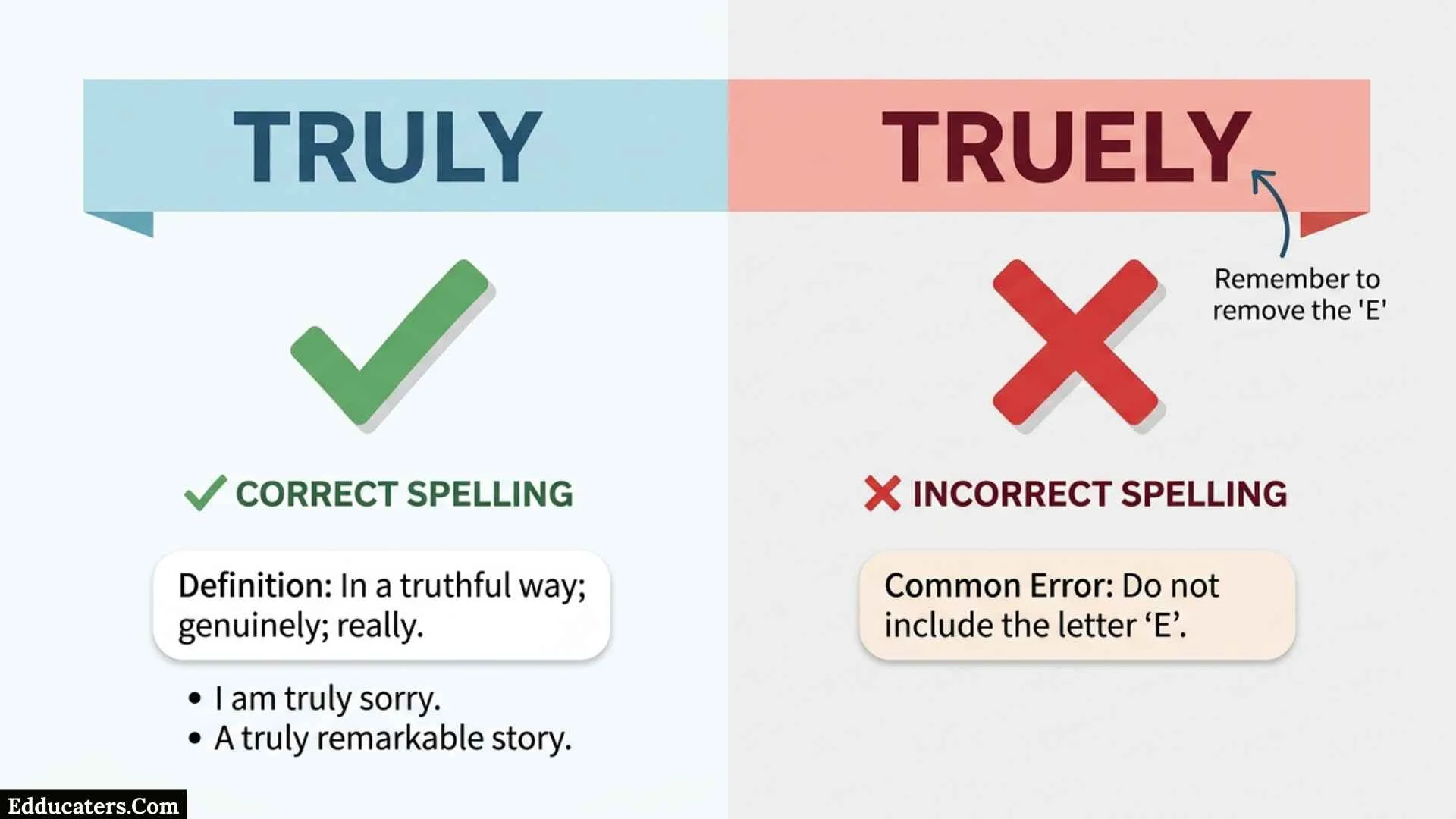
If you are wondering whether the correct spelling is truly or truely, the answer is simple: truly is correct.
Truely is a common misspelling of truly. Although truely may look logical because the base word is true, standard English uses truly.
For example:
- Correct: I truly appreciate your help.
- Incorrect: I truely appreciate your help.
The correct spelling is:
T-R-U-L-Y
There is no e between the u and l.
However, spelling is only one part of the question. If you are writing an email, essay, website article, business message, school assignment, or professional document, you may also want to know what it truly means, why the spelling causes confusion, when to use it, and how it differs from true, truthful, truthfully, and really.
This guide answers those questions with clear explanations, realistic examples, common mistakes, a decision guide, pronunciation, word history, and practical proofreading advice.
Truly or Truely: The Quick Answer
Truly is the standard and correct spelling. Truely is a common misspelling.
| Word | Correct? | Part of speech | Main use |
| truly | Yes | Adverb | Sincerely, genuinely, really, accurately, or in truth |
| truely | No | — | Common misspelling of truly |
| true | Yes | Adjective | Real, correct, factual, or genuine |
| truthful | Yes | Adjective | Honest or sincere |
| truthfully | Yes | Adverb | In an honest or truthful way |
| really | Yes | Adverb | Actually, genuinely, or to add emphasis |
Which spelling should you use?
Use truly in standard English writing.
For example:
We truly appreciate your support.
She truly understands the problem.
It was a truly remarkable experience.
Avoid:
We truely appreciate your support.
She truely understands the problem.
It was a truely remarkable experience.
If you are proofreading your own writing, searching for truely is an easy way to catch this particular spelling mistake.
The easiest memory trick
Remember:
true → truly
You can also think of it as:
TRUE − E + LY = TRULY
This is a useful memory aid for this specific word. It should not be treated as a universal rule for every English word ending in e, because English spelling has many different patterns.
The important form to memorize is simply:
true → truly
Why Is Truly Correct and Truely Incorrect?
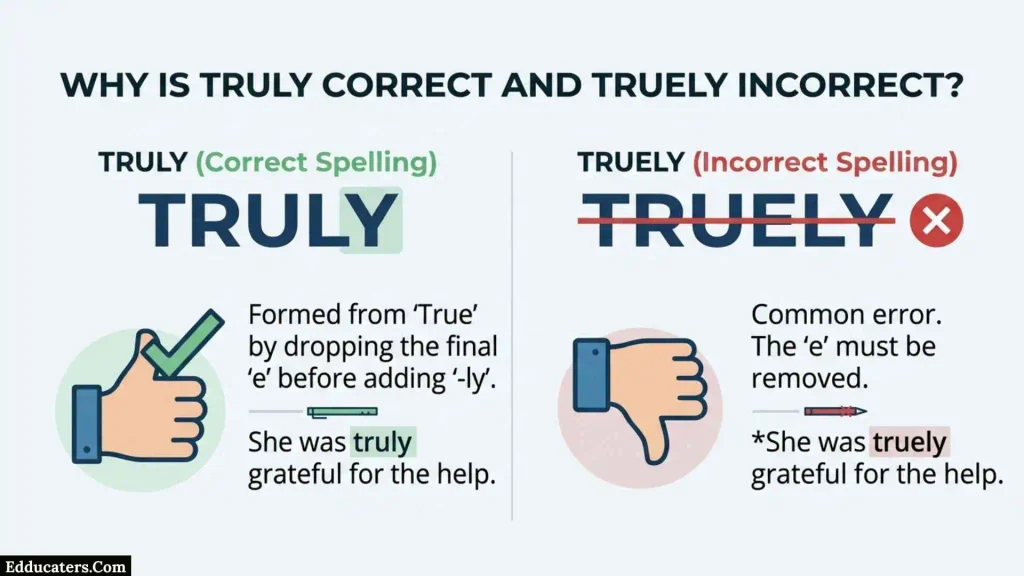
The confusion comes from the relationship between true and truly.
Many English adverbs are formed by adding -ly to an adjective:
- quick → quickly
- careful → carefully
- honest → honestly
- slow → slowly
- clear → clearly
Because true ends in e, it is tempting to write:
true + ly = truely
That spelling looks reasonable at first glance. However, the standard English form is truly.
The spelling is word-specific
It is tempting to turn this into a simple rule such as “remove the final e before adding -ly.” That explanation is too broad.
Consider:
- nice → nicely
- safe → safely
- fine → finely
These words retain the e.
So the safest explanation is not that every adjective ending in e behaves the same way. Instead, learn the established form:
true → truly
This is especially useful for English learners because trying to apply one spelling rule to every word can create more errors.
Why does truely look so natural?
The spelling truely follows a pattern that many writers expect.
A person who knows:
true + ly
may naturally construct:
truely
The problem is that English spelling is not always perfectly predictable from the modern spelling of the base word.
This is why dictionaries and established usage are useful when a spelling feels uncertain.
When in doubt, remember:
The adjective is true. The adverb is truly.
What Does Truly Mean?
Truly is an adverb.
Its exact meaning depends on the context. It can express sincerity, genuineness, truth, accuracy, certainty, or emphasis.
Merriam-Webster, Cambridge Dictionary, and Oxford Advanced Learner’s Dictionary all recognize several related uses of the word.
Truly can mean sincerely
One of the most common meanings of truly is sincerely or genuinely.
Examples:
I truly appreciate your kindness.
She truly cares about her students.
I am truly sorry for the mistake.
We truly value your feedback.
In these examples, it truly emphasizes that the feeling is genuine.
Compare:
I appreciate your help.
with:
I truly appreciate your help.
Both sentences are correct. The second places greater emphasis on sincerity.
Truly can mean genuinely
Truly can also show that something genuinely possesses a particular quality.
Examples:
She is a truly talented artist.
It was a truly memorable experience.
This is a truly unusual situation.
The company has become a truly global organization.
Here, it truly strengthens the description by suggesting that the quality is real or genuine.
Truly can mean really or indeed
In some contexts, truly is close to really or indeed.
For example:
That was truly surprising.
The situation is truly difficult.
This is truly important.
The exact nuance depends on the sentence, but truly often gives the statement a stronger sense of genuine truth or emphasis.
Truly can emphasize accuracy
Another important use occurs when a writer wants to question or emphasize whether something is actually accurate.
For example:
Is this information truly accurate?
The sample does not truly represent the wider population.
The two methods are not truly identical.
Here, it truly focuses on whether something is accurate, genuine, or correct in a meaningful sense.
Truly as an Adverb
Understanding the grammar of truly makes the word easier to use correctly.
Truly is an adverb.
An adverb can modify a verb, adjective, or sometimes an entire statement.
Truly can modify a verb
Examples:
I truly appreciate your help.
She truly understands the problem.
They truly believe in the project.
In these sentences, it truly adds emphasis to the action or state expressed by the verb.
Truly can modify an adjective
A common pattern is:
truly + adjective
Examples:
- truly beautiful
- truly remarkable
- truly important
- truly unusual
- truly impressive
- truly memorable
For example:
It was a truly remarkable achievement.
Here, truly emphasizes the adjective remarkable.
Truly can emphasize a whole statement
Truly can also appear at the beginning of a sentence.
For example:
Truly, I did not expect that result.
Truly, this was an extraordinary experience.
In this position, truly can emphasize the speaker’s sincerity or certainty about the statement.
Truly or Truely: Examples in Real Sentences
Seeing the correct spelling in different contexts makes the distinction easier to remember.
| Context | Correct sentence |
| Appreciation | I truly appreciate your help. |
| Apology | I am truly sorry. |
| Business | We truly value our customers. |
| Education | She truly understands the subject. |
| Personal | I truly hope everything goes well. |
| Description | It was a truly beautiful place. |
| Professional | The results are truly significant. |
| Everyday conversation | That was truly unexpected. |
| Formal writing | Truly, this is an important matter. |
| Correspondence | Yours truly, |
In every example, truly is spelled without the extra e.
Truly or Truely in Everyday Conversation
Although many people encounter this word in writing rather than speech, truly is completely natural in everyday English.
You might hear:
I truly don’t know what happened.
I truly enjoyed the movie.
She truly wants to help.
I truly hope you get the job.
The word is not limited to academic or formal writing.
Does truly sound formal?
Sometimes truly can sound more deliberate or emphatic than really, but it is not exclusively formal.
For example:
I really like this song.
sounds very conversational.
I truly love this song.
can sound more heartfelt or emphatic.
Both are possible. The difference is largely about meaning, emphasis, and tone.
Truly or Truely in Professional Writing
Truly is common in business communication, customer service, workplace messages, and professional correspondence.
Examples include:
We truly appreciate your patience.
Our team truly values your feedback.
We are truly grateful for your continued support.
She truly understands the needs of our customers.
These sentences are grammatically correct and natural.
A professional writing tip
Do not use truly simply to make business writing sound more impressive.
For example:
We truly provide a truly exceptional and truly outstanding service.
This sounds repetitive because the same intensifier is doing too much work.
A more useful sentence might be:
Our support team responds to customer requests promptly and provides clear solutions.
The second version gives the reader specific information.
A strong writer uses truly when sincerity or emphasis matters, not as a substitute for evidence or useful detail.
Truly or Truely in Academic Writing
Truly can be used in academic writing, but context matters.
For example:
The evidence does not truly support the original hypothesis.
This can be appropriate when the writer is questioning whether the evidence genuinely supports the claim.
Another example is:
The sample may not truly represent the wider population.
Here, truly helps express concern about accurate representation.
However, academic writing usually benefits from precise evidence instead of unnecessary emphasis.
Instead of:
This is a truly amazing discovery.
a research paper might use:
The findings provide significant evidence for the proposed explanation.
The second sentence communicates the point more objectively.
The lesson is not that truly is inappropriate in academic writing. Rather, it should have a clear purpose.
Truly or Truely in Personal Messages
Personal messages often use truly to express genuine feelings.
Examples:
I truly appreciate everything you’ve done for me.
I am truly sorry about what happened.
Your kindness truly means a lot to me.
I truly hope you achieve your goals.
You have truly been a great friend.
In this context, truly works especially well because sincerity is part of the message.
Truly or Really: Which Word Should You Use?
Truly and really overlap in meaning, but they are not identical in every situation.
Really is extremely common in everyday English. Depending on the context, it can mean actually, genuinely, or very, and it is frequently used for emphasis.
Truly can also express emphasis, but it often carries a stronger sense of sincerity, genuineness, or actual truth.
Compare the meaning
I really appreciate your help.
This sounds natural and conversational.
I truly appreciate your help.
This can sound more deliberate and heartfelt.
Another example:
She really cares about her students.
She truly cares about her students.
Both are correct. The second puts more emphasis on the genuineness of her concern.
When truly is a better choice
Use truly when the important idea is:
- genuine feeling
- sincerity
- actual truth
- authenticity
- accuracy
- strong emphasis on a real quality
For example:
He truly believes that the plan will work.
The word emphasizes that his belief is genuine.
When really is a better choice
Really is often the better choice for casual conversation and ordinary emphasis.
For example:
That movie was really good.
Do you really want to leave?
What really happened?
These are highly natural everyday constructions.
The best choice depends on the meaning and tone you want.
Truly or Truthfully: What Is the Difference?
This is one of the most useful distinctions for careful writers.
Truly can mean genuinely, sincerely, really, accurately, or in accordance with truth.
Truthfully has a more specific meaning: honestly or in a way that tells the truth.
Compare:
I truly care about this project.
This means the speaker genuinely cares.
Now:
I answered the question truthfully.
This means the speaker answered honestly.
A practical test
Ask yourself:
Am I emphasizing genuine feeling or reality?
Use truly.
She truly cares about her work.
Am I describing honest speech or behavior?
Use truthfully.
She answered the question truthfully.
This simple distinction prevents many awkward sentences.
Truly or Truthful: What Is the Difference?
Truly and truthful are related but serve different grammatical functions.
Truthful is an adjective.
Truly is an adverb.
For example:
He is truthful.
Here, truthful describes the person.
Now:
He truly understands the problem.
Here, truly emphasizes the genuineness of his understanding.
Another example:
She is a truthful witness.
compared with:
She answered truthfully.
The first describes the person or witness. The second describes how she answered.
True or Truly: Which Form Is Correct?
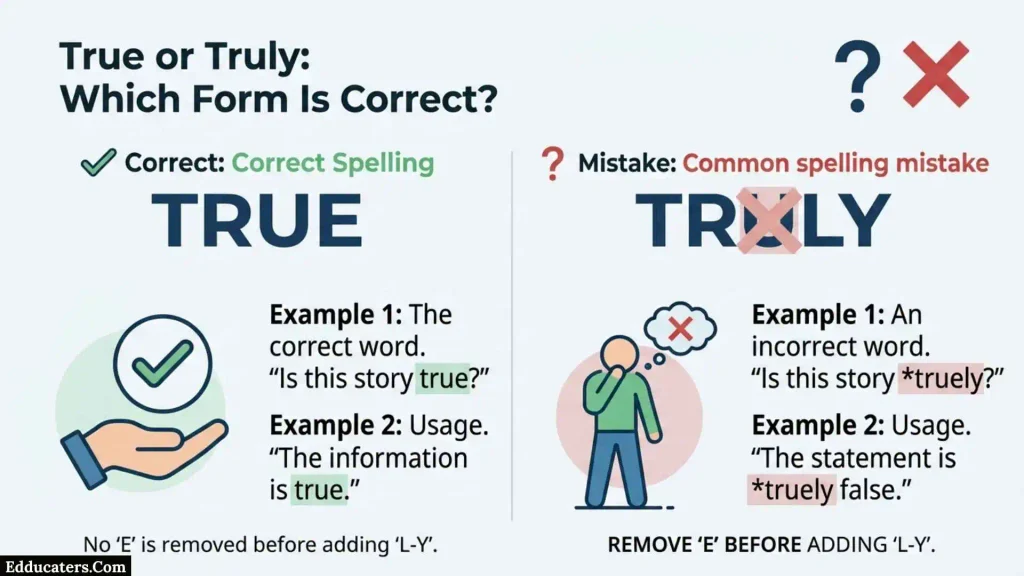
True and truly are both correct words, but they are used differently.
Use true as an adjective
Examples:
The statement is true.
That is a true story.
Is this information true?
He is a true professional.
In these sentences, true describes a noun or subject.
Use truly as an adverb
Examples:
I truly believe you.
She truly understands the situation.
That was truly impressive.
The results are truly surprising.
Here, truly modifies or emphasizes a verb, adjective, or statement.
A useful grammar test
Ask:
Am I describing something as real, correct, or genuine?
You may need true.
The story is true.
Ask:
Am I emphasizing how genuinely or sincerely something happens or feels?
You may need truly.
She truly believes the story.
The Word Family: True, Truth, Truthful, Truthfully, Truly
Learning the related words together can make both spelling and grammar easier.
| Word | Part of speech | Example |
| true | Adjective | The statement is true. |
| truth | Noun | She told the truth. |
| truthful | Adjective | He is a truthful person. |
| truthfully | Adverb | She answered truthfully. |
| truly | Adverb | I truly believe you. |
Oxford lists these words as part of the same word family.
The important point is that related words can have different grammatical roles and meanings.
Knowing the word family helps you avoid replacing one word with another simply because they look similar.
Is Truly a Formal Word?
No. Truly can be used in both formal and informal English.
Its tone depends on the sentence.
Informal example
I truly have no idea what happened.
Professional example
We truly appreciate your continued support.
Academic example
The evidence does not truly establish causation.
Formal or literary example
Truly, this was an extraordinary moment.
So you should not avoid truly simply because it sometimes sounds formal or emphatic.
What Does “Yours Truly” Mean?
Yours truly is a traditional expression used as a closing in correspondence.
For example:
Yours truly,
James
It is especially associated with formal letters in American English, although its use and tone can vary.
The important spelling point is:
Yours truly
not:
Yours truely
Can “yours truly” refer to yourself?
Yes.
It can also be used informally or humorously to refer to the speaker.
For example:
And yours truly was the last person to arrive.
This use is more playful than the traditional letter closing.
How Do You Pronounce Truly?
Truly is pronounced approximately:
TROO-lee
Cambridge gives the pronunciation as:
/ˈtruː.li/
The British and American pronunciations are essentially the same.
The spelling truely does not represent a different standard pronunciation. It is simply a common spelling mistake.
Why pronunciation can cause spelling confusion
When people hear truly, they may focus on the sound and assume that the word contains the spelling true plus -ly.
That can lead to:
truely
But the written form is:
truly
Connecting the pronunciation directly with the correct spelling can help:
truly = TROO-lee
Is Truly the Same in British and American English?
Yes.
The standard spelling is truly in both major varieties of English.
You should write:
truly
whether you are writing for:
- a British audience
- an American audience
- an international audience
- a school
- a university
- a workplace
- a website
There is no standard British spelling that replaces truly.
Common Spelling Mistakes Related to Truly
The main error is truely, but other variations can appear.
Truely
Incorrect:
I truely understand your concern.
Correct:
I truly understand your concern.
Trully
Incorrect:
She trully believes him.
Correct:
She truly believes him.
Truelly
Incorrect:
It was truelly remarkable.
Correct:
It was truly remarkable.
These errors usually come from trying to construct the spelling from the pronunciation or from the base word true.
The safest approach is to remember the complete word:
truly
Common Grammar Mistakes With Truly
Spelling is not the only issue.
Using true when truly is needed
Incorrect:
I truly appreciate your help.
Correct:
I truly appreciate your help.
The first sentence uses an adjective where an adverb is required.
Using truthfully when truly is intended
Consider:
I truthfully care about this project.
If you mean that your concern is genuine, truly is usually the clearer choice:
I truly care about this project.
If you mean that you are answering honestly, then truthfully is appropriate:
I answered truthfully.
Using truly in every sentence
Too much emphasis can make writing sound unnatural.
For example:
We truly believe our truly excellent product provides a truly outstanding experience.
The repetition weakens the sentence.
A better approach is to reserve truly for places where it contributes meaning.
The History of Truly
Truly has a long history in English.
Oxford traces the word to Old English trēowlīce, meaning “faithfully.” Merriam-Webster records the first known use of truly in the 13th century.
This history is useful because it shows why modern spelling should not always be treated as a simple mathematical combination of a modern base word and a suffix.
English spelling has developed over centuries, and many forms have become established through historical usage.
For modern writers, however, the practical lesson is straightforward:
true → truly
You do not need to know the Old English form to spell the modern word correctly.
Why “Truly” Is More Than a Spelling Question
Someone searching for truly or truely may initially want only one answer: which spelling is correct?
That answer is important, but a genuinely useful language resource should solve the next questions too.
A reader may also want to know:
- What does truly mean?
- Is it truly an adverb?
- Why does true become truly?
- Is truely ever acceptable?
- How do I use truly in a sentence?
- Is it truly formal?
- Is it truly used in British English?
- Is it truly used in American English?
- What is the difference between truly and really?
- What is the difference between truly and truthfully?
- What is the difference between true and truly?
- How is it truly pronounced?
- What does “yours truly” mean?
Answering these related questions makes the resource more useful than a page that simply says “truly is correct.”
A Simple Decision Guide for Choosing the Right Word
When you are unsure which related word to use, follow this quick process.
Do you mean “real, correct, or factual”?
Choose true.
The statement is true.
Do you mean “honest or not lying”?
Choose truthfulness.
She is a truthful person.
Do you mean “in an honest way”?
Choose truthfully.
He answered truthfully.
Do you mean “genuinely, sincerely, really, or accurately”?
Choose truly.
I truly appreciate your help.
Do you simply want everyday emphasis?
Consider really.
I really enjoyed the movie.
This decision process is more reliable than choosing a word only because it looks similar to another word.
A Quick Decision Tree
Use this simple guide when proofreading:
What are you trying to say?
↓
Real or correct?
→ true
Honest person or statement?
→ truthful
In an honest way?
→ truthfully
Genuine, sincere, real, or strongly emphasized?
→ truly
Everyday emphasis or “actually”?
→ really, when appropriate
This distinction is especially helpful for English learners because these words belong to the same semantic family but do not perform the same grammatical job.
How to Proofread Truly in Your Writing
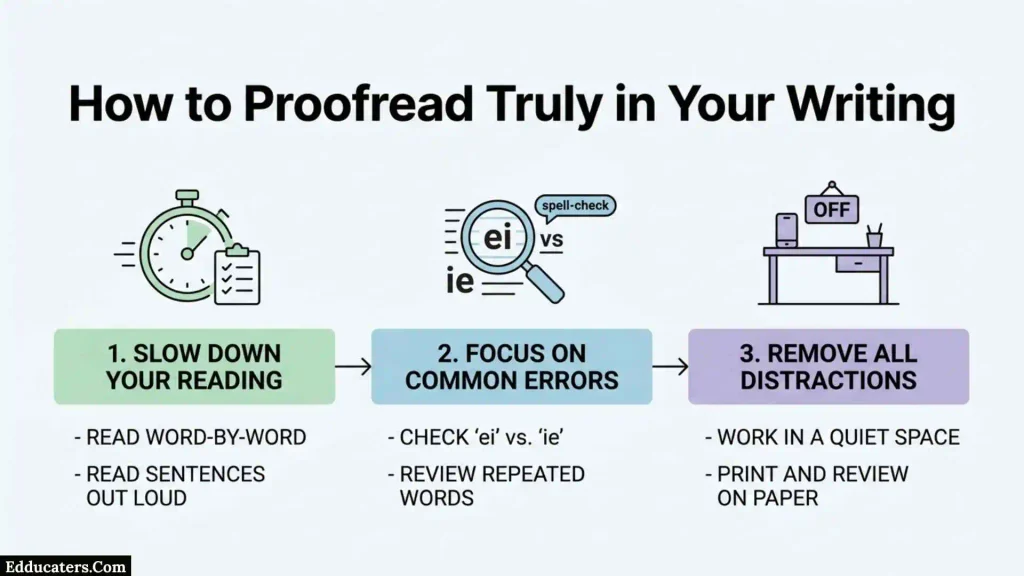
If truly or truely is a recurring spelling problem, you can build a simple proofreading routine.
Search for “truely”
Before publishing, use your document’s search function.
Search for:
truely
If you find it, replace it with:
truly
Check for “trully” and “truelly”
If spelling mistakes are common in your writing, also search for:
- trully
- truelly
These are not the standard spelling.
Check the meaning
Do not stop after correcting the spelling.
Ask whether truly is actually the word you need.
For example:
She answered truly.
If you mean that she answered honestly, truthfully may communicate the idea more clearly:
She answered truthfully.
But:
She truly cares about the issue.
is natural because it truly emphasizes genuine feeling.
This two-step check improves both spelling and word choice.
Best Practices for Using Truly
Good usage is not only about knowing what is correct. It is also about knowing when the word adds value.
Use truly when sincerity matters
I truly appreciate your support.
This is especially useful in thank-you messages and personal communication.
Use truly when genuineness matters
She truly understands the challenges involved.
This emphasizes genuine understanding.
Use truly to emphasize a strong quality
It was a truly remarkable performance.
This gives emphasis to the adjective.
Use truly when questioning accuracy
Does the result truly reflect the situation?
Here, the word focuses attention on whether the description is accurate.
Avoid unnecessary repetition
If every paragraph contains truly, the word loses some of its effect.
Use it where it contributes meaning.
Frequently Asked Questions About Truly or Truely
Is it truly or truely correct?
Truly is correct. Truely is a common misspelling. The standard spelling is truly.
How do you spell truly?
The correct spelling is:
T-R-U-L-Y
It does not contain an e after the u.
Why do people write truely?
The mistake usually happens because the base word is true. Writers may assume that adding -ly creates truely. Standard English uses truly instead.
Is truely an alternative spelling?
No. Truely is not the standard spelling of the adverb. In normal modern English writing, use truly.
Is it truly a real word?
Yes. Truly is a standard English word and an adverb.
What does truly mean?
Depending on context, truly can mean sincerely, genuinely, really, in truth, accurately, or exactly.
Is it truly an adverb?
Yes. Truly is an adverb.
For example:
I truly appreciate your help.
What is the adjective related to truly?
The related adjective is true.
The statement is true.
She truly believes the statement.
What is the difference between true and truly?
True is generally an adjective, while truly is an adverb.
The story is true.
She truly believes the story.
What is the difference between truly and truthfully?
Truly has a wider range of meanings, including genuinely and sincerely. Truthfully specifically emphasizes honesty or telling the truth.
I truly care about the project.
I answered truthfully.
What is the difference between truly and really?
Both can add emphasis, but truly often emphasizes sincerity, genuineness, or actual truth, while really is more common in everyday conversation and has several uses.
Is it truly a formal word?
No. Truly can be used in both formal and informal English.
Is this truly correct in British English?
Yes. Truly is the standard spelling in British English.
Is this truly correct in American English?
Yes. Truly is also the standard spelling in American English.
How do you pronounce it truly?
Truly is pronounced approximately TROO-lee, represented in dictionaries such as Cambridge by /ˈtruː.li/.
Can I truly start a sentence?
Yes.
Truly, I did not expect that result.
This use can emphasize sincerity or certainty.
Can truly be used before an adjective?
Yes.
It was a truly remarkable achievement.
Can truly be used before a verb?
Yes.
I truly appreciate your help.
Does it truly mean very?
Sometimes truly can intensify an adjective, but it is not simply interchangeable with very. It can also express sincerity, genuineness, or truth.
Is “Yours truly” correct?
Yes. Yours truly is a traditional correspondence closing and can also be used informally or humorously to refer to oneself.
Is “Yours truely” correct?
No. The correct expression is:
Yours truly
Is trully correct?
No. The standard spelling is truly.
Is truelly correct?
No. The standard spelling is truly.
Can it truly be used in academic writing?
Yes, when it contributes a clear meaning. Academic writers should avoid unnecessary emphasis and choose precise wording.
Can truly be used in professional emails?
Yes. It is common in expressions such as:
We truly appreciate your support.
What is the easiest way to truly remember?
Remember:
true → truly
You can also use:
TRUE − E + LY = TRULY
as a memory aid specifically for this word.
Key Takeaways
Here are the most important points to remember:
- Truly is the correct spelling.
- Truely is a common misspelling.
- The correct spelling is T-R-U-L-Y.
- Truly is an adverb.
- True is generally an adjective.
- Truthful is an adjective related to honesty.
- Truthfully is an adverb meaning in an honest or truthful way.
- Truly can mean sincerely, genuinely, really, accurately, or in truth, depending on context.
- Truly can be used in both formal and informal English.
- The spelling is truly in both British and American English.
- Yours truly is the correct traditional expression.
- Common mistakes include truely, trully, and truelly.
- Do not assume that every word ending in e follows the same spelling pattern when forming an adverb.
- The easiest spelling connection to remember is true → truly.
- Use truly because it fits the meaning, not simply because it makes a sentence sound stronger.
Conclusion
When deciding between truly or truely, choose truly.
The spelling truely looks understandable because the base word is true, but standard English uses truly as the adverb. The correct form is T-R-U-L-Y, without an e between the u and l.
The word itself has several useful meanings. Truly can express sincerity, genuine feeling, truth, accuracy, or strong emphasis. It can be used in everyday conversation, personal messages, professional communication, academic writing, and traditional expressions such as “Yours truly.”
It is also important to distinguish truly from related words. Use true as an adjective, truthful when describing honesty, and truthfully when describing an honest way of speaking or acting. Really can overlap with truly, but it is often more conversational and does not carry exactly the same emphasis in every sentence.
If you often hesitate over the spelling, keep one simple connection in mind:
true → truly
Once you remember that form, you can confidently choose truly whenever the choice is truly or truely.

Hello, I’m Claire Holloway. I have always been passionate about the English language and enjoy turning complex grammar rules into simple, easy-to-follow lessons. I believe that every learner can become a confident English writer with the right guidance.
I create educational content focused on grammar, vocabulary, sentence structure, and writing improvement. Every article I publish is designed to help readers learn with confidence and accuracy.
Books
Grammar Without Confusion
Modern English Usage Guide
 Julian Mercer