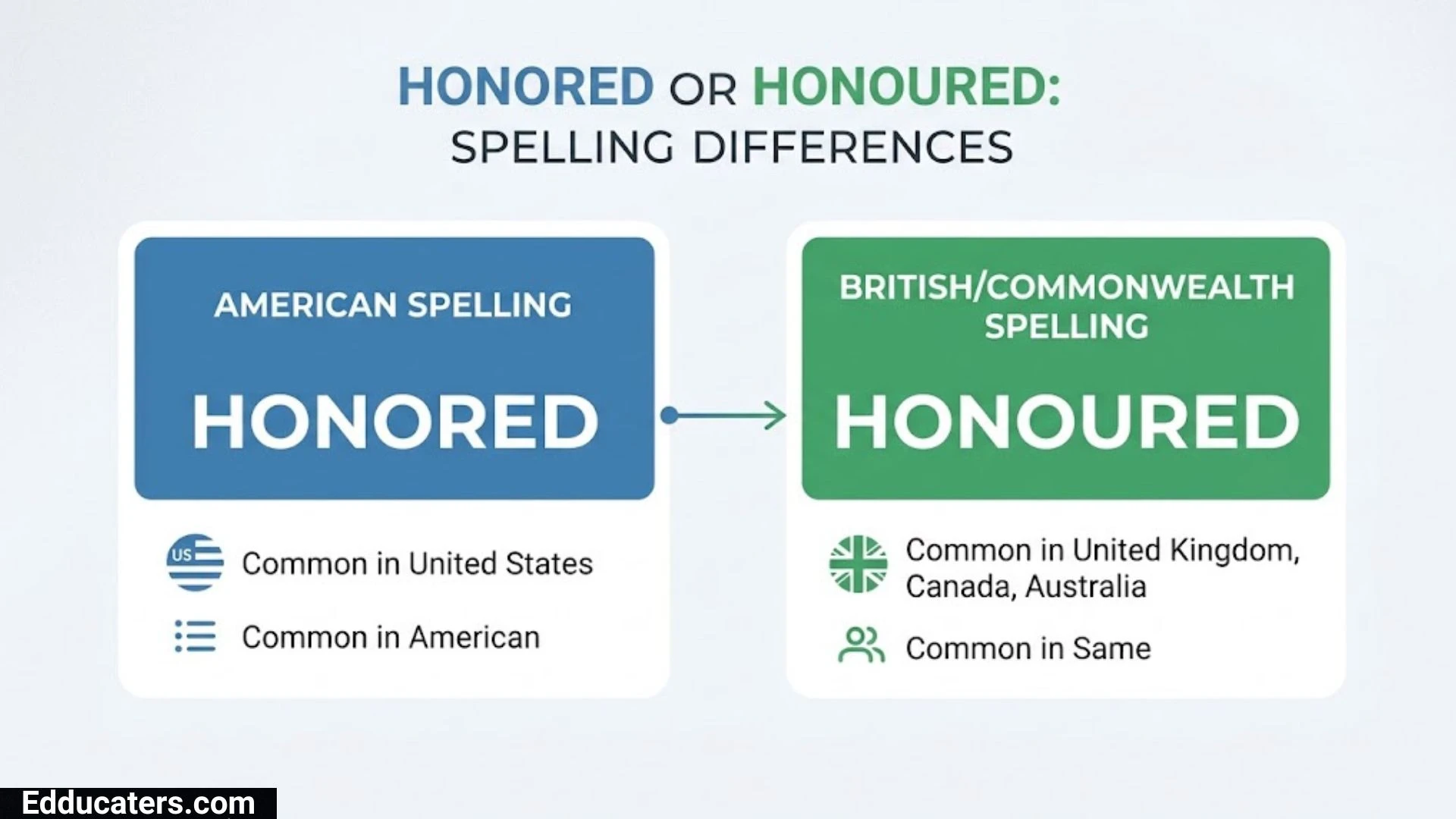
Have you ever wondered whether to write honored or honoured? Both spellings are correct, but the right choice depends on which variety of English you’re using. American English drops the letter u, while British English generally keeps it.
The difference is easy to remember once you understand the pattern. Americans write honor, honored, or honoring. British writers usually prefer honour, honoured, or honouring. Neither spelling changes the word’s meaning or grammatical function.
For example, an American might write, “I am honored to receive this award,” while a British writer might say, “I am honoured to receive this award.” Both sentences express gratitude and a sense of privilege.
This guide explains the honored or honoured meaning, spelling differences, pronunciation, grammar, verb forms, regional preferences, and common expressions. You’ll also find practical examples to help you choose the right spelling in everyday conversations, professional emails, academic writing, and formal announcements.
Honored or Honoured: Which Spelling Is Correct?
Both honored or honoured are correct spellings of the past tense and past participle of the verb honor or honour. The main difference comes from regional English spelling conventions.
| Feature | American English | British English |
| Base word | Honor | Honour |
| Past tense | Honored | Honoured |
| Past participle | Honored | Honoured |
| Present participle | Honoring | Honouring |
| Related adjective | Honorable | Honourable |
| Example | I feel honored. | I feel honoured. |
The American form is standard in the United States. The British form is standard in the United Kingdom and is also common in countries such as Australia.
Neither spelling is more correct, intelligent, or formal than the other. Your choice should match your audience and the regional spelling conventions you follow.
Quick rule: If you’re writing for an American audience, choose honored. If you’re following British English conventions, choose honoured.
Honored or Honoured Meaning and Difference
The words honored or honoured have the same meaning. Both can describe someone who feels privileged, receives recognition, or treats a commitment as something important.
The spelling doesn’t change the idea you’re expressing. It simply reflects a difference between American and British orthography, the system of conventions used to write words.
What Does Honored or Honoured Mean?
The word can express several related ideas depending on the context.
- Respect and esteem: Someone receives respect because of their character, position, or actions.
- Recognition: Someone receives acknowledgment for an achievement or contribution.
- Privilege and gratitude: Someone feels fortunate to have an opportunity or experience.
- Fulfillment of an obligation: A person or organization keeps a promise, agreement, or commitment.
- Tribute: Someone recognizes another person’s service, sacrifice, or accomplishments.
Consider these examples:
- “I feel honored to meet the author.” The speaker feels privileged.
- “The school honored its graduates.” The school recognized their achievements.
- “The company honored its agreement.” The company fulfilled its commitment.
- “The community honoured the volunteers.” The community showed appreciation for their service.
Notice how the meaning changes with the situation. In the first sentence, honored describes a personal feeling. In the second, it describes an act of recognition. In the third, it means fulfilling an obligation.
Does the Letter U Change the Meaning?
No. The extra u in honoured doesn’t create a new meaning or change the pronunciation in any systematic way.
Both spellings can appear in sentences about awards, ceremonies, professional accomplishments, personal relationships, and promises.
For example:
- American English: “We are honored to welcome you.”
- British English: “We are honoured to welcome you.”
Both sentences communicate the same respect and appreciation. The only difference is the spelling convention.
Honored or Honoured in American, British, Canadian, and Australian English
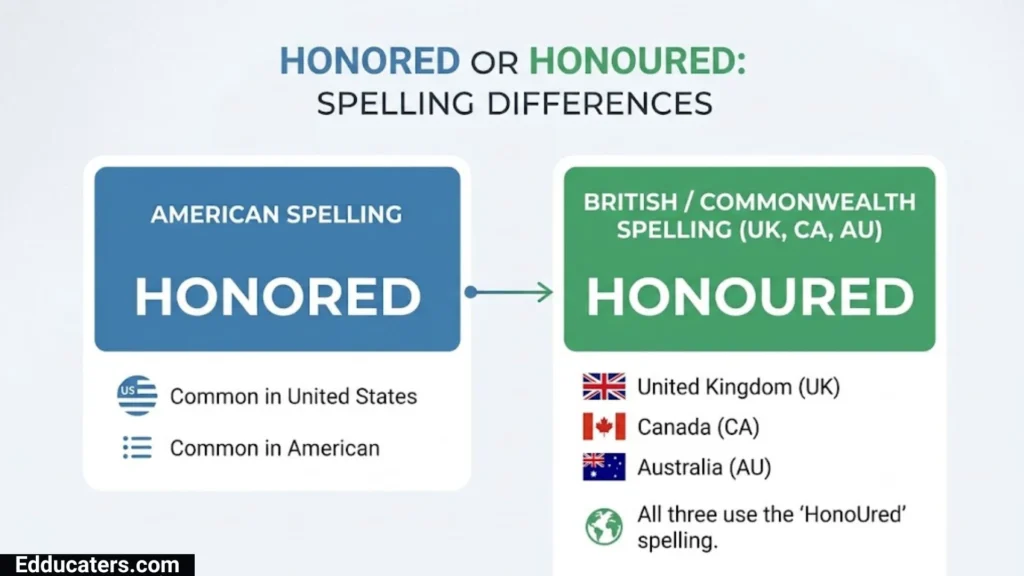
Although English speakers share much of the same vocabulary, regional spelling conventions can differ. The honor/honour family is a clear example of how one letter can separate two accepted forms.
Honored or Honoured in American English
In the United States, honored is the standard spelling. American English generally omits the u in several word families that retain it in British English.
Common American forms include:
- Honor: “It was an honor to represent my school.”
- Honored: “The mayor honored the volunteers.”
- Honoring: “The university is honoring its graduates.”
- Honorable: “She received an honorable mention.”
You’ll see these forms in American newspapers, company announcements, university publications, award ceremonies, and professional emails.
For example, an American employee might write:
I am honored to accept this award and grateful for the support of my colleagues.
The spelling is appropriate for US readers. Changing honored to honoured isn’t necessary unless a publication or organization specifically requires that form.
Honored or Honoured in British English
British English generally uses honoured. The same spelling pattern applies to related words, including honour, honouring, and honourable.
Examples include:
- “We are honoured to welcome our distinguished guests.”
- “The council honoured her for years of public service.”
- “He is honouring a promise he made to his family.”
- “It was an honour to attend the ceremony.”
These spellings are standard in British publications and formal communications that follow UK conventions.
The British form also appears in established expressions such as honourable mention and in honour of someone. When writing for a British audience, using the appropriate spelling helps your text fit local expectations.
Honored or Honoured in Canada
Canadian English generally prefers honour or honoured. Canada’s federal Language Portal specifically identifies honour as the preferred spelling for the noun and verb. Language Portal of Canada provides guidance on these conventions in its honor and honour spelling guide.
Canadian English doesn’t simply copy every British spelling rule. It combines several conventions, so some words follow British patterns while others commonly use American-style forms.
For instance:
- Canadian English: “We are honoured to receive this recognition.”
- American English: “We are honored to receive this recognition.”
Both are understandable, but honoured is generally the better choice when you’re following standard Canadian spelling.
If you write for a Canadian employer, university, or government organization, check its preferred dictionary or editorial style guide.
Honored or Honoured in Australia
Australian English generally follows the honour spelling pattern. Therefore, honoured is the usual choice in Australian writing.
Examples include:
- “The organization honoured its founding members.”
- “We are honoured to receive this recognition.”
- “She was honoured for her contribution to the community.”
The Australian Government’s Style Manual recommends choosing an established Australian dictionary and applying its spellings consistently. Different organizations may follow different approved references, so consistency matters more than assuming every publication follows exactly the same rules.
Regional Spelling Comparison Table
| Region | Preferred spelling | Example |
| United States | Honored | We feel honored. |
| United Kingdom | Honoured | We feel honoured. |
| Canada | Honoured | We feel honoured. |
| Australia | Honoured | We feel honoured. |
These are general preferences rather than rules that make the alternative spelling impossible in every setting.
Remember: Choose the spelling that fits your audience, then apply the same convention throughout your article, report, or letter.
Honored or Honoured Pronunciation
One useful fact about honored or honoured is that the spellings generally have the same pronunciation. The extra u doesn’t create another syllable.
Cambridge Dictionary gives the British pronunciation of honour as /ˈɒn.ə/ and its American pronunciation as /ˈɑː.nɚ/. Actual vowel sounds vary by accent. You can hear the dictionary recordings on its honour entry.
English meaning – Cambridge Dictionary
For a simple pronunciation guide:
- Honored: usually two syllables.
- Honoured: usually two syllables.
- Stress: the first syllable receives the main stress.
The exact vowel quality differs between American and British accents. However, speakers don’t normally pronounce the written u as a separate sound.
If you’re learning English, focus on saying the word naturally rather than trying to make the spelling difference audible. You can use either spelling in writing without changing the intended pronunciation.
Honored or Honoured as a Verb or Adjective
The word honored or honoured can function as a verb form or an adjective. Its role depends on how you use it in a sentence.
Understanding the difference helps you construct sentences accurately and choose the right prepositions.
Honored or Honoured as a Verb
As a verb, honored or honoured is the simple past tense and past participle of the corresponding base verb.
When it describes an action someone completed, it usually functions as the simple past tense.
Examples:
- “The committee honored the retiring teacher.”
- “The community honoured its emergency responders.”
- “The company honored its agreement with the supplier.”
- “The school honoured the students who earned scholarships.”
Each sentence describes an action. Someone recognized a person, showed respect, or fulfilled a commitment.
The past participle also appears in passive constructions:
- “The teacher was honored at the ceremony.”
- “The volunteers were honoured for their dedication.”
In these examples, the people received recognition rather than giving it.
Honored or Honoured as an Adjective
The past participle can also describe a person’s status or the recognition they have received.
For example:
- “She was an honored guest at the conference.”
- “He is an honoured member of the organization.”
- “The honored visitors took their seats near the stage.”
Here, the word describes the people rather than presenting the act of recognition as the main focus.
A useful way to tell the difference is to look at the sentence’s purpose. If the sentence emphasizes what someone did, the form functions as a verb. If it describes a person or their status, it may function adjectivally.
Honored or Honoured Verb Forms
Both honor or honour are regular verbs. They form their past tense and past participle by adding -ed. Their present participles use -ing.
The main difference lies in the spelling of the base word and the way that spelling carries into related forms.
| Verb Form | American English | British English |
| Base form | Honor | Honour |
| Third-person singular | Honors | Honours |
| Simple past | Honored | Honoured |
| Past participle | Honored | Honoured |
| Present participle | Honoring | Honouring |
Related adjectives also follow the same regional pattern: honorable in American English and honourable in British English.
Past Tense and Past Participle
The past tense of honor is honored. The past tense of honour is honoured.
Examples:
- “The president honored the winning team.”
- “The president honoured the winning team.”
Both forms are correct in their respective spelling systems.
The past participle is identical to the simple past form. For example, “The winning team has been honored” uses honored as a past participle. The British equivalent is “The winning team has been honoured.”
Present Participle: Honoring or Honouring
The present participle describes an ongoing action or appears in certain noun-like constructions.
Examples:
- “We are honoring the finalists tonight.”
- “We are honouring the finalists tonight.”
The difference follows the same regional convention. American English removes the u, while British English retains it.
Honorable or Honourable
The related adjective follows the same pattern:
- American English: honorable
- British English: honourable
Both mean worthy of respect or characterized by honesty and integrity.
For example, “She made an honorable decision” and “She made an honourable decision” express the same idea.
One important distinction: honorary is the standard spelling for the adjective meaning awarded as an honor, as in honorary degree. Don’t change it to honourary just because you’re using British spelling. The Canadian government’s spelling guidance also identifies honorary as the preferred form.
How to Use Honored or Honoured in a Sentence
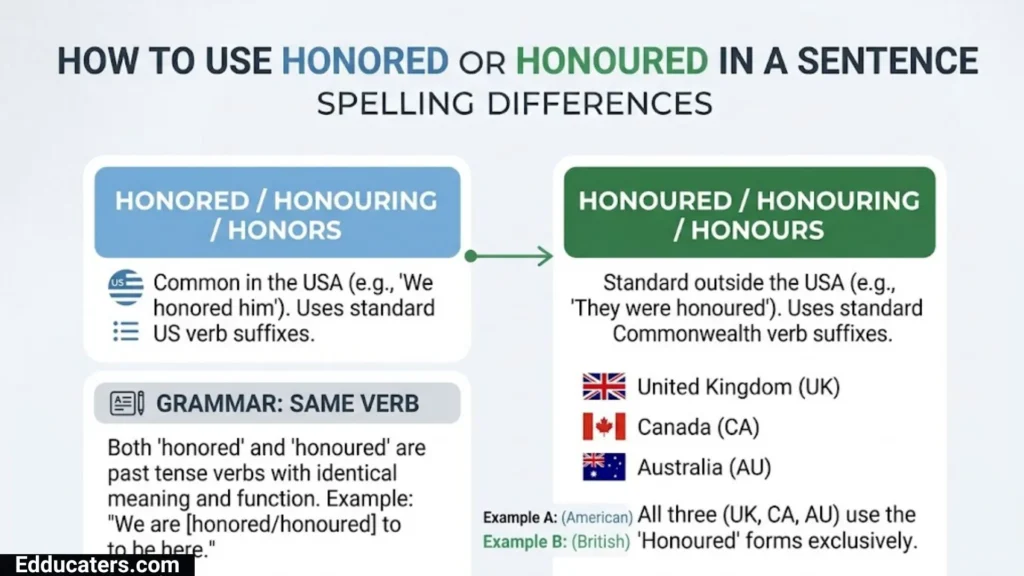
The word appears in many everyday expressions. It can communicate gratitude, respect, appreciation, or the importance of keeping a promise.
The most common patterns include honored to, honored for, honored with, and honored by. Each has a slightly different purpose.
Honored or Honoured to Receive an Award
Use honored to receive when someone expresses gratitude or a sense of privilege about receiving an award, opportunity, or recognition.
Examples:
- “I am honored to receive this award.”
- “We are honoured to receive this recognition.”
- “She felt honored to be selected for the scholarship.”
- “He was honoured to accept the lifetime achievement award.”
This expression works well in award speeches, acceptance letters, public announcements, and professional messages.
You can also use it when someone receives an opportunity rather than a physical award. For instance, “I would be honored to represent our organization at the conference” expresses appreciation for being selected.
Honored or Honoured to Meet Someone
The phrase honored to meet you expresses respect or appreciation when meeting someone you admire.
Examples:
- “I’m honored to meet you.”
- “We are honoured to welcome the visiting professor.”
- “It was an honor to meet the author.”
- “I would be honoured to meet the ambassador.”
The phrase is polite and often carries a formal tone. However, you don’t need to reserve it for famous people or senior officials. It can also express sincere appreciation for meeting a respected teacher, mentor, colleague, or community leader.
For casual introductions, pleased to meet you may sound more natural. Use honored to meet you when you want to emphasize the importance of the meeting.
Honored or Honoured With an Award
Use honored with when someone receives a particular award, title, or form of recognition.
Examples:
- “The scientist was honored with a national award.”
- “She was honoured with an honorary degree.”
- “The volunteers were honored with certificates.”
- “He was honoured with a prestigious service medal.”
The phrase identifies the recognition received. It often appears in news reports, biographies, award announcements, and formal speeches.
Honored or Honoured for an Achievement
Use honored for when you want to explain why someone received recognition.
Examples:
- “She was honored for her outstanding research.”
- “The firefighter was honoured for his bravery.”
- “The organization was honored for its community service.”
- “They were honoured for their commitment to education.”
The difference between with and for is straightforward:
| Expression | Purpose | Example |
| Honored with | Identifies the award or recognition | She was honored with a medal. |
| Honored for | Identifies the reason | She was honored for her bravery. |
| Honored by | Identifies who gave the recognition | She was honored by the university. |
| Honored to | Expresses a feeling or privilege | She was honored to attend. |
These patterns aren’t limited to awards. They also work in professional settings, public service, education, and community events.
Honored or Honoured by an Organization
Use honored by when the sentence identifies the person, group, or institution giving recognition.
Examples:
- “He was honored by the university.”
- “She was honoured by her colleagues.”
- “The volunteers were honored by the city council.”
- “The researcher felt honored by the invitation.”
This construction is particularly useful when writing biographies, institutional announcements, and reports about professional achievements.
Other Common Expressions With Honored or Honoured
The following expressions are useful in everyday and formal communication.
| Expression | Meaning | Example |
| I would be honored | A polite expression of willingness or appreciation | I would be honored to speak at your event. |
| Deeply honored | Feeling strong respect or gratitude | We are deeply honored by your support. |
| Honored to serve | Feeling privileged to perform a role | I am honored to serve this community. |
| Honored to attend | Appreciating an invitation | She was honored to attend the ceremony. |
| Honored to host | Feeling privileged to welcome guests | We are honored to host the conference. |
| Honored to represent | Appreciating the responsibility of representing others | He was honored to represent his country. |
| Honored to accept | Appreciating an offer or award | I am honored to accept this position. |
In British English, use the corresponding honoured forms. Choose the version that matches the rest of your writing.
Honor or Honour: Understanding the Base Word
The distinction between honor or honour explains why the past forms differ.
Both words can function as nouns and verbs. As a noun, the word can refer to respect, integrity, reputation, or an award. As a verb, it can mean showing respect, recognizing someone’s achievements, or fulfilling a promise.
Honor or Honour as a Noun
The noun appears in expressions involving reputation, respect, and distinction.
Examples:
- “It was an honor to represent my country.”
- “It was an honour to represent my country.”
- “The award is a great honor.”
- “The award is a great honour.”
The noun also appears in the phrase in honor of or in honour of, which means doing something to show respect for a person or commemorate an event.
For example:
- “The school organized a ceremony in honor of its founder.”
- “The school organized a ceremony in honour of its founder.”
Both sentences describe a ceremony held to recognize someone important.
Honor or Honour as a Verb
As a verb, the word has several meanings. It can describe recognizing a person, respecting someone’s wishes, or keeping an agreement.
Examples:
- “We honor our teachers.”
- “We honour our teachers.”
- “The business honored its contract.”
- “The business honoured its contract.”
The verb also appears in financial and legal contexts. A bank may honor a check, for example, or an organization may honor a claim when it accepts and fulfills the relevant obligation.
These uses share a central idea: treating a person, agreement, or obligation with the respect or recognition it deserves.
Is Honored or Honoured More Formal?
Neither spelling is inherently more formal than the other. Both work in formal letters, academic writing, award announcements, speeches, and professional communication.
The level of formality comes from the sentence, the audience, and the context—not from whether the word contains a u.
For example, these sentences are equally appropriate for a formal acceptance speech:
- “I am honored to accept this award.”
- “I am honoured to accept this award.”
The first follows American spelling. The second follows British spelling.
When choosing between them, consider the following:
- Audience: Use the spelling readers expect in their region.
- Publication standards: Follow the organization’s chosen dictionary or style guide.
- Consistency: Don’t switch between American and British spellings without a clear reason.
- Document type: Maintain the same conventions throughout a report, application, article, or speech.
A British university may expect honoured in its official communications. An American company will generally use honored. Neither choice makes the writing more professional on its own.
Common Mistakes When Using Honored or Honoured
Although the spelling difference is simple, a few common mistakes can make your writing inconsistent or unclear.
Assuming One Spelling Is Always Wrong
The most common mistake is treating one form as incorrect everywhere.
Honored is standard American English, while honoured is standard British English. Both are legitimate forms, so don’t mark one as universally incorrect simply because you prefer the other.
Mixing American and British Spelling
Using honored in one paragraph and honouring in the next can make a document look inconsistent.
Compare these examples:
- Inconsistent: “We honored the volunteers for their service and are now honouring their dedication.”
- Consistent American English: “We honored the volunteers for their service and are now honoring their dedication.”
- Consistent British English: “We honoured the volunteers for their service and are now honouring their dedication.”
The consistent versions are easier to read and follow a clear spelling convention.
Confusing Honored With Rewarded
The words honored and rewarded are related, but they aren’t exact synonyms.
Someone may be honored through a public tribute, an award, or a statement of appreciation. Someone who is rewarded typically receives something in recognition of an action or achievement.
For example, a teacher might be honored at a ceremony without receiving money. An employee might receive a financial reward for meeting a target.
Choose the word that expresses the intended meaning rather than treating every form of recognition as a reward.
Using the Wrong Preposition
The preposition can change the focus of your sentence.
- Honored for: “She was honored for her research.”
- Honored with: “She was honored with a medal.”
- Honored by: “She was honored by the university.”
- Honored to: “She was honored to accept the invitation.”
These expressions follow common English usage patterns. Choosing the appropriate preposition makes your meaning more precise.
Confusing Honorable With Honorary
Honorable or honourable means worthy of respect or associated with integrity. Honorary describes a title, position, or award granted as an honor rather than through the usual duties or requirements of that position.
For example:
- “She made an honorable decision.”
- “He received an honorary degree.”
These words belong to the same word family, but their meanings differ. Remember that honorary retains its standard spelling in both American and British English.
Frequently Asked Questions
Which Is Correct, Honored or Honoured?
Both are correct. Honored is the standard American English spelling, while honoured is the standard British English spelling. The words have the same meaning and grammatical uses.
Is Honored the American Spelling?
Yes. American English uses honor, honored, honoring, and honorable. These forms follow the US convention of dropping the u found in several British spellings.
Is Honoured the British Spelling?
Yes. British English generally uses honour, honoured, honouring, and honourable. The spelling with u is also common in Canadian and Australian English.
Do Honored and Honoured Have the Same Meaning?
Yes. Both can describe feeling privileged, receiving recognition, showing respect, or fulfilling a promise. The spelling changes according to regional convention, not meaning.
Do Honored and Honoured Have the Same Pronunciation?
Generally, yes. Both forms usually have two syllables, and the written u doesn’t create an extra syllable. However, vowel sounds can vary between American and British accents.
Is Honoured Correct in American English?
Honoured is recognizable in American writing, but honored is the standard US spelling. If you’re writing for an American publication or audience, use honored unless a specific style requirement says otherwise.
Is Honored Correct in British English?
British readers will generally understand honored, but honoured is the standard British form. Use the British spelling when following UK editorial conventions.
Which Spelling Is Used in Canada and Australia?
Both countries generally prefer honoured. Canadian English combines British and American spelling conventions, while Australian English generally follows British-style forms for this word. Follow the relevant local dictionary or style guide when precision matters.
What Is the Past Tense of Honor or Honour?
The past tense of honor is honored. The past tense of honour is honoured. Both are regular verb forms.
What Is the Difference Between Honoring or Honouring?
The difference is regional spelling. American English uses honoring, while British English uses honouring. Both forms describe showing respect, recognizing someone, or fulfilling an obligation.
What Does “I Would Be Honored” Mean?
It means that someone would feel privileged, pleased, or grateful to accept an opportunity or invitation. For example, “I would be honored to speak at your graduation” expresses appreciation for the invitation.
What Does “Honored With an Award” Mean?
It means that someone received an award or another form of recognition. For example, “She was honored with a medal” tells readers what recognition she received.
Can Honored Be Used as an Adjective?
Yes. Honored can describe someone who has received respect or recognition, as in “She was an honored guest.” The British equivalent is honoured.
Is Honored More Formal Than Honoured?
No. Neither form is inherently more formal. Both suit professional writing, official correspondence, speeches, and award announcements when used according to the appropriate regional spelling conventions.
Conclusion: Honored or Honoured?
The choice between honored or honoured comes down to regional spelling conventions. American English uses honored, while British English generally uses honoured. Canadian and Australian English also commonly prefer the form with u.
Both spellings share the same meaning, pronunciation, and grammatical function. You can use either form to express respect, gratitude, recognition, or the fulfillment of a promise.
Before publishing your writing, remember three simple rules:
- Use honored for standard American English.
- Use honoured for standard British English and generally for Canadian and Australian English.
- Keep your spelling consistent throughout the document.
Once you know your audience, the choice becomes easy. The letter u may change the spelling, but it doesn’t change the honor behind the word.

Hello, I’m Claire Holloway. I have always been passionate about the English language and enjoy turning complex grammar rules into simple, easy-to-follow lessons. I believe that every learner can become a confident English writer with the right guidance.
I create educational content focused on grammar, vocabulary, sentence structure, and writing improvement. Every article I publish is designed to help readers learn with confidence and accuracy.
Books
Grammar Without Confusion
Modern English Usage Guide
 Nathan Whitmore
 Julian Mercer