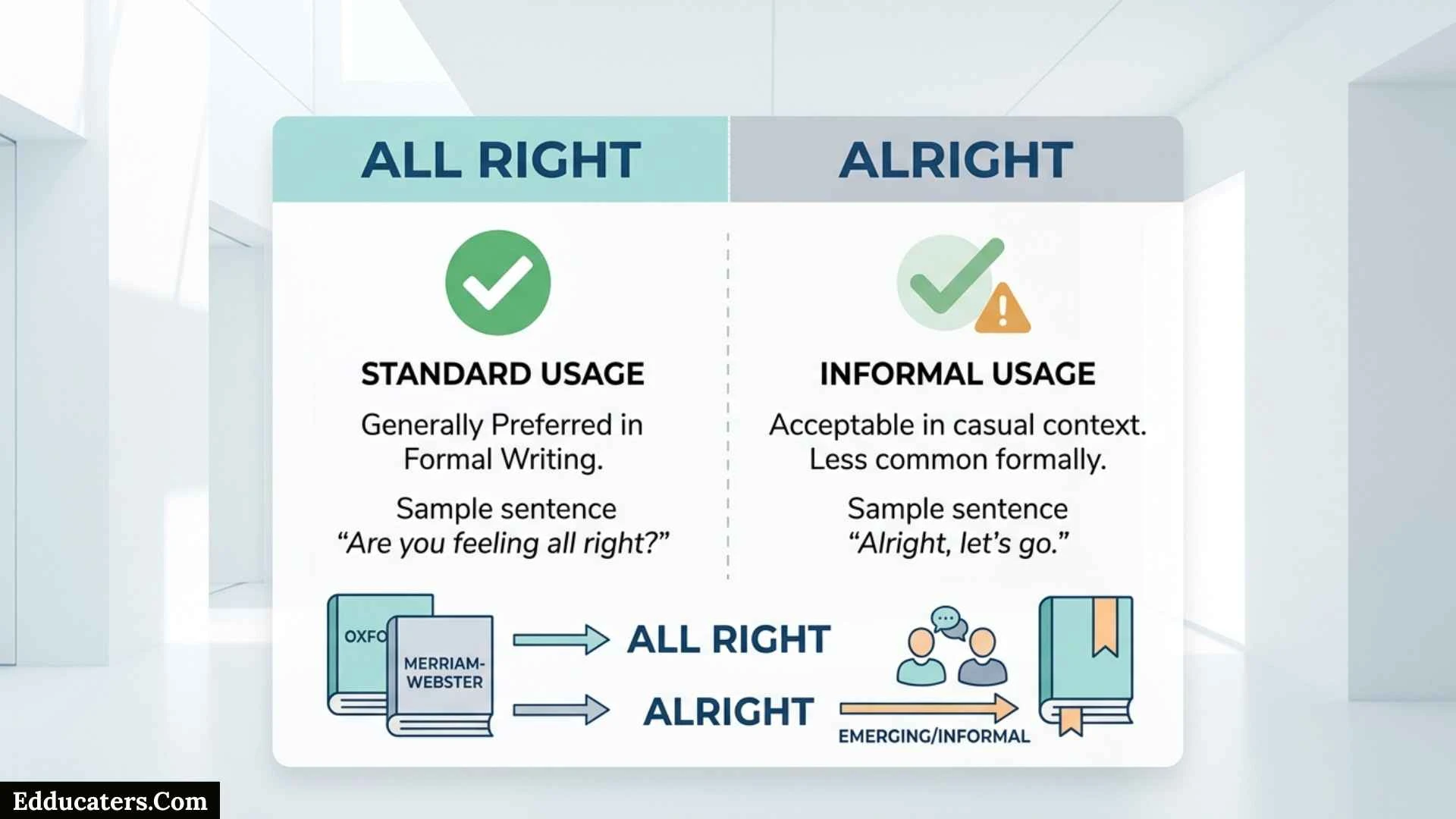
If you are searching for alright or all right, the safest answer is all right. It is the established standard form for formal writing. Alright is widely recognized in modern English, especially in informal communication, yet major dictionaries still mark it as nonstandard or informal. Cambridge identifies alright as a nonstandard form of all right, while Oxford describes it as non-standard or informal.
The two forms usually carry the same basic meaning: okay, satisfactory, safe, well, acceptable, or agreed. The important difference is not usually the meaning. It is usage, style, formality, plus editorial preference.
For school assignments, academic papers, business communication, professional websites, formal documents, plus carefully edited articles, all right is the safer choice.
For text messages, casual dialogue, informal posts, relaxed conversation, plus some creative writing, alright can be appropriate when an informal tone is intended.
This guide explains the difference between the two forms, their meanings, grammar, pronunciation, history, formal usage, informal usage, common mistakes, editing decisions, plus practical examples.
Alright Or All Right: Quick Answer
Which Spelling Is Standard?
All right is the safest standard spelling.
Examples:
- Is everything all right?
- I am all right now.
- Your answer is all right.
- All right, let’s begin.
- Did you get home all right?
Cambridge lists all right as the established form, while noting that alright is also encountered. Its grammar guidance says all right is more common.
Is Alright Wrong?
Calling alright simply “wrong” is too absolute.
The form is widely used in modern English. Cambridge includes it in its dictionary, but labels it a nonstandard form of all right. Oxford labels it non-standard or informal, with specific guidance that it should not normally be used in formal writing.
A more accurate rule is:
Formal writing → all right
Informal writing → alright can be acceptable
When uncertain → all right
What Is The Safest Choice?
If you are writing for a teacher, employer, client, publisher, professional website, academic audience, or official organization, choose all right.
That choice follows the conservative editorial standard recognized by Cambridge plus Oxford.
What Does All Right Mean?
All Right Means Okay Or Acceptable
All right can mean that something is acceptable, satisfactory, or reasonably good.
Examples:
- The food was all right.
- Your answer is all right.
- The movie was all right, but it was not memorable.
- The plan seems all right to me.
Cambridge defines all right in this sense as satisfactory or reasonably good. It also records the expression for something that is only just good enough.
All Right Means Safe Or Well
The expression can describe a person’s condition.
Examples:
- Are you all right?
- She is all right now.
- I hope everyone is all right.
- Did the passengers get home all right?
Cambridge records all right as meaning safe, well, or not harmed. Oxford gives the same general sense.
All Right Can Show Agreement
The expression can also show acceptance or agreement.
Examples:
- All right, I understand.
- All right, we can leave now.
- All right, I will finish it today.
- Is this arrangement all right with you?
Cambridge describes this use as a way to show acceptance or agreement. Oxford also lists all right as an expression used to agree, accept something, or check understanding.
All Right Can Introduce A New Action
At the beginning of a sentence, all right can act as a discourse marker.
Example:
All right, let’s start the meeting.
Here, the expression does not describe something as satisfactory. Instead, it signals that the speaker is ready to begin.
This distinction matters because the same spelling can perform different grammatical functions depending on context. Cambridge specifically identifies this discourse-marker use.
What Does Alright Mean?

Alright Has Similar Meanings
Alright generally carries the same basic meanings as all right.
It can express:
- Acceptance
- Agreement
- Safety
- Well-being
- Satisfaction
- Permission
- Adequacy
Examples:
- Are you alright?
- Everything will be alright.
- The meal was alright.
- Is it alright if I leave early?
- Alright, let’s go.
Cambridge identifies alright as a nonstandard form of all right. Oxford lists similar meanings, while marking the form as non-standard or informal.
Why Is Alright Common?
English frequently develops shorter or combined forms through everyday usage. Alright has become familiar in conversation, fiction, digital communication, popular culture, plus informal writing.
Its familiarity explains why many readers consider it natural.
However, familiarity does not automatically make a form the preferred choice for every writing situation. That is why dictionary labels plus editorial context matter.
Alright Can Sound More Conversational
Compare:
All right, let’s begin.
with:
Alright, let’s begin.
Both are easily understood. The second can feel more relaxed or conversational.
A writer may deliberately choose alright to reproduce natural speech or create an informal voice.
Alright Or All Right: Main Difference
Comparison Table
| Feature | All Right | Alright |
| Spelling | Two words | One word |
| Basic meaning | Okay, satisfactory, safe, agreed | Usually the same |
| Formal writing | Safest choice | Usually avoid |
| Informal writing | Fully acceptable | Commonly used |
| Academic writing | Preferred | Better avoided |
| Business writing | Preferred | Usually avoid |
| Dialogue | Natural | Very natural in casual speech |
| Dictionary status | Standard form | Often marked nonstandard or informal |
Cambridge states that all right is more common. Oxford specifically advises against alright in formal writing.
The Difference Is Mainly Editorial
The two forms rarely create a major difference in meaning.
The important issue is register.
Register means the level of formality appropriate for a particular situation.
For example:
- A university essay requires careful standard usage.
- A text message allows relaxed language.
- A novel may use either form depending on voice.
- A business report usually benefits from conventional spelling.
- Dialogue may intentionally reflect everyday speech.
Therefore, the best spelling depends partly on the writing situation.
When To Use All Right
Use All Right In Academic Writing
For essays, research assignments, reports, dissertations, applications, plus academic articles, all right is the safer form.
Example:
The experimental conditions were all right for the second stage.
However, academic writing often benefits from more precise vocabulary.
Instead of:
The results were all right.
you could write:
The results were satisfactory.
The second sentence gives the reader a clearer description.
Use All Right In Business Writing
Professional communication usually favors conventional standard forms.
Examples:
- Please confirm whether the proposed date is all right.
- Let me know if this arrangement is all right.
- I hope everything is all right.
- Is the revised schedule all right with you?
Using all right removes any possible editorial concern about the closed form.
Use All Right In Formal Articles
If you are writing an informational article, reference page, educational guide, business page, or professional report, all right is normally the better choice.
This is especially useful when the article itself discusses grammar or spelling.
A language article should model the standard form clearly.
Use All Right In Official Communication
Official documents should generally favor the conventional form.
Examples include:
- Legal correspondence
- Government communication
- School notices
- Corporate reports
- Professional instructions
- Formal applications
The exact style guide for the organization should always take priority when one exists.
When To Use Alright
Use Alright In Casual Messages
Informal messages often use alright naturally.
Example:
Alright, I will call you later.
A casual message does not necessarily require the conservative spelling used in formal prose.
Use Alright In Dialogue
Writers sometimes use alright to make dialogue feel natural.
Example:
“Alright, let’s go,” Maya said.
This can represent everyday speech more closely than formal prose.
The decision is stylistic rather than a question of basic comprehension.
Use Alright When A Style Guide Allows It
Some publications may permit alright.
If a publication, brand, client, or editorial team has an established style guide, follow that guidance consistently.
The key principle is consistency.
Do not alternate randomly between all right plus alright in the same type of content.
All Right As Different Parts Of Speech
All Right As An Adjective
All right can function as an adjective after linking verbs such as be, feel, seem, or look.
Examples:
- I am all right.
- She feels all right.
- Everything looks all right.
- The patient seems all right.
Cambridge specifically identifies this adjective use.
All Right As An Adverb
It can also function as an adverb.
Examples:
- She is doing all right.
- Did you sleep all right?
- The project is going all right.
- He handled the situation all right.
Here, the expression describes how something happens or progresses.
Cambridge records this adverbial use with meanings such as well, satisfactorily, or okay.
All Right As An Exclamation
It can also appear as an exclamation.
Examples:
- All right! We won!
- All right, everyone, listen carefully.
- All right, I understand your point.
Oxford identifies this exclamatory function, including agreement, acceptance, attention-getting, plus checking understanding.
Alright Or All Right In Different Situations

In Text Messages
Either form can appear in casual texting.
Examples:
Alright, see you tomorrow.
All right, see you tomorrow.
The first feels more relaxed. The second follows the traditional standard spelling.
In Professional Emails
Choose all right.
Example:
Please let me know if this time is all right for you.
This is a simple way to keep professional communication conventional.
In School Assignments
Choose all right.
Students should normally follow standard edited English unless their instructor gives different instructions.
In Fiction
Either form may work.
Narration may favor all right. Dialogue may use alright when the writer wants an informal voice.
The important factor is consistency with character voice plus the publication’s style.
In Social Media Posts
Informal social media writing gives writers more flexibility.
Alright may sound natural in a conversational post.
Example:
Alright, here is what happened today.
A professional company account may still prefer all right for brand consistency.
Common Mistakes With Alright Or All Right
Mistake 1: Saying Alright Is Never Used
This is inaccurate.
Major dictionaries recognize the form, although Cambridge marks it as nonstandard while Oxford labels it non-standard or informal.
The better explanation is that alright is widely used but all right is the safer standard form.
Mistake 2: Assuming Both Forms Have Completely Different Meanings
Usually, they do not.
In most everyday sentences, alright functions as a closed spelling of all right.
The bigger distinction concerns standardness, formality, plus editorial preference.
Mistake 3: Using Alright In Formal Writing Without Checking Style
A professional writer should consider the audience before choosing the closed form.
Oxford specifically states that alright should not be used in formal writing.
Mistake 4: Changing Every Alright Automatically
Automatic replacement is not always appropriate.
If alright appears in dialogue, a quotation, a creative work, or content following a specific style guide, changing it may remove an intentional stylistic feature.
Editors should examine context first.
Mistake 5: Confusing Meaning With Grammar
A sentence can be understandable while still using a less preferred form.
For example:
Is everything alright?
Most readers understand the meaning immediately.
For formal edited prose, however:
Is everything all right?
is the safer choice.
Understanding this distinction produces better editing decisions.
How To Choose The Correct Form
Step 1: Identify The Audience
Ask who will read the content.
Is it:
- A teacher?
- A client?
- A manager?
- A general reader?
- A friend?
- A social media audience?
- A fiction reader?
Audience strongly influences formality.
Step 2: Identify The Writing Type
Next, identify the content type.
Academic → All right
Professional → All right
Formal → All right
Casual → Either may work
Dialogue → Either may work
Informal message → Either may work
Step 3: Check The Style Guide
If you are writing for an organization, publisher, school, newspaper, website, or brand, check its style guide.
A specific editorial rule can override a general preference.
Step 4: Choose Consistently
Once you select a form, use it consistently unless context requires a deliberate change.
A document filled with random switches between alright plus all right can look poorly edited.
A Simple Decision Guide
Is The Writing Formal?
Yes → Use All Right
This is the safest standard choice.
Is The Writing Academic?
Yes → Use All Right
Standard edited English is usually expected.
Is The Writing Professional?
Yes → Use All Right
It avoids unnecessary style questions.
Is The Writing Casual?
Yes → Alright Can Work
The closed form is common in informal communication.
Is It Character Dialogue?
Yes → Choose According To Voice
Use alright if the character’s speech is deliberately informal.
Is A Style Guide Available?
Yes → Follow The Style Guide
A publication-specific rule takes priority.
Real-World Editing Examples
Example 1: University Essay
Original:
The results were alright.
Recommended:
The results were all right.
Even better, if the intended meaning is “satisfactory”:
The results were satisfactory.
The final version may be more precise.
Example 2: Business Email
Original:
Is Thursday alright for the meeting?
Recommended:
Is Thursday all right for the meeting?
The second version is the safer professional choice.
Example 3: Casual Text
Original:
Alright, I’ll see you at six.
This is natural informal communication.
There is no strong need to make a casual message sound formal.
Example 4: Fiction Dialogue
“Alright, I understand,” Daniel said.
The spelling can help maintain a relaxed conversational voice.
An author may instead choose:
“All right, I understand,” Daniel said.
Both are understandable; the editorial preference depends on the desired style.
Example 5: Formal Website Content
Original:
If everything is alright, click continue.
Recommended:
If everything is all right, click continue.
For carefully edited website copy, the second version is the safer standard choice.
Better Alternatives To All Right
Use Okay For Casual Writing
Okay is a common alternative.
Example:
Is everything okay?
This is natural in everyday conversation.
Use Acceptable For Formal Writing
When all right means “acceptable,” the word acceptable may be more precise.
Example:
The proposed arrangement is acceptable.
Use Satisfactory For Evaluation
When discussing quality, satisfactory can provide a more exact meaning.
Example:
The final result was satisfactory.
This is stronger than the vague phrase all right.
Use Safe Or Well For Health Or Safety
If the intended meaning is physical condition, a more precise term may work better.
Example:
Everyone is safe.
Or:
She is feeling well.
The best word depends on the exact meaning.
Why All Right Remains The Safer Standard
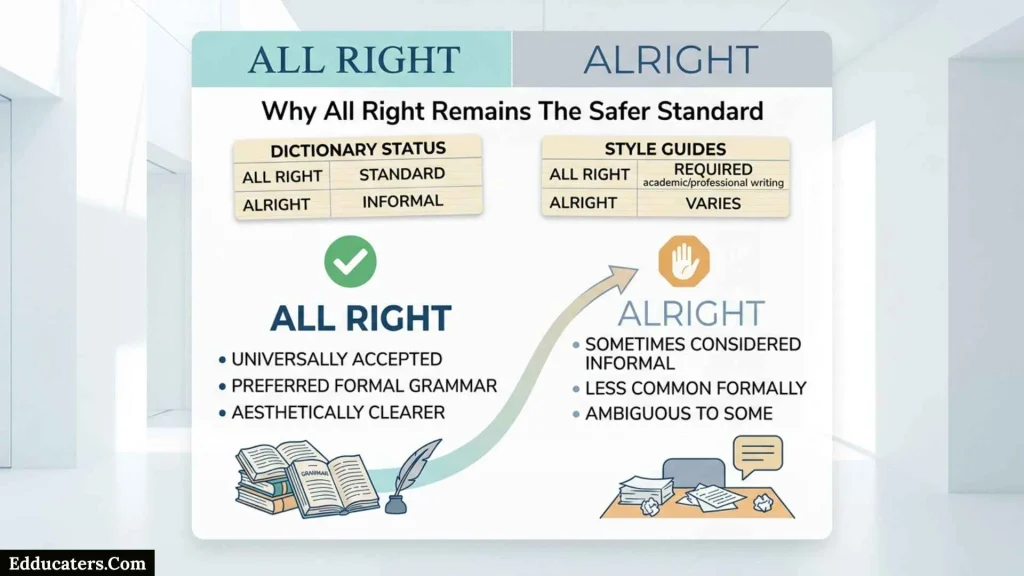
Dictionary Guidance Matters
Cambridge states that all right is more common, while its dictionary identifies alright as a nonstandard form.
Oxford similarly presents all right as the main form while labeling alright non-standard or informal. Its American English entry explicitly says the informal form should not be used in formal writing.
This does not mean alright is invisible or meaningless. It means writers should understand the difference between common usage plus preferred formal usage.
Standard English Is Not The Same As Everyday English
Language changes through ordinary use.
A form can become familiar long before editorial standards fully accept it in every context.
That is exactly why alright deserves a nuanced explanation rather than a simple “wrong” label.
For careful writing, however, all right remains the low-risk choice.
Frequently Asked Questions About Alright Or All Right
Is All Right The Correct Spelling?
Yes. All right is the safest standard spelling, especially in formal writing. Cambridge identifies it as the established form.
Is Alright A Real Word?
Yes. Alright is widely used plus appears in major dictionaries. Cambridge identifies it as a nonstandard form of all right, while Oxford labels it non-standard or informal.
Is Alright Grammatically Correct?
It can function naturally in English, but its acceptability depends on context. For formal writing, all right is the safer choice.
Is Alright One Word?
Yes. Alright is written as one word.
Are All the Right Two Words?
Yes. The standard spelling is all right, written as two words.
Should I Use Alright In An Essay?
It is better to use all right in an academic essay unless a specific style guide says otherwise.
Can I Use Alright In A Text Message?
Yes. Text messaging is usually informal, so alright is common in that setting.
Which Is Better For Professional Writing?
All right is the better choice for professional writing because it follows the safer standard form.
Does Alright Mean The Same Thing As All Right?
Usually, yes. Both can express ideas such as okay, satisfactory, safe, well, acceptable, plus agreement.
Why Do People Write Alright?
The one-word form is common in everyday speech-based writing, informal communication, fiction, digital content, plus popular media. Its widespread use has made it familiar to many readers.
Can Alright Be Used In Dialogue?
Yes. Writers may use alright in dialogue when they want to reflect casual speech.
Should Editors Always Change Alright To All Right?
No. Editors should consider context, quotation rules, dialogue, house style, audience, plus intended tone before making a change.
Is All Right More Formal Than Alright?
Generally, yes. All right is the safer conventional form for formal edited English. Oxford specifically recommends all right for formal writing.
Can All Right Mean Only Okay?
No. It can also mean satisfactory, safe, well, acceptable, agreed, or certainly, depending on context.
What Is The Easiest Way To Remember The Difference?
Use this rule:
Formal → All Right
Casual → Alright Can Work
Unsure → All Right
That rule handles most everyday writing situations.
Conclusion
When deciding between alright or all right, the safest standard choice is all right.
Use all right for academic writing, professional communication, formal documents, business content, educational material, plus carefully edited articles.
Use alright when a deliberately informal tone is appropriate, especially in casual messages, conversational writing, plus some fictional dialogue.
The important point is that alright is not simply meaningless or incomprehensible. It is a widely recognized form that major dictionaries document, while also marking it as nonstandard or informal.
The simplest rule remains:
Formal → All Right
Casual → Alright Can Work
When In Doubt → All Right

I’m Julian Mercer, an English language writer dedicated to helping people master grammar through practical examples and clear explanations. I enjoy teaching grammar in a way that is both engaging and easy to remember.
My work focuses on grammar rules, punctuation, word usage, and writing techniques that readers can apply in everyday life. I believe learning English should be simple, enjoyable, and useful.
Books
English Grammar in Practice
Writing with Precision
 Claire Holloway