Have you ever paused mid-sentence while typing an email or drafting a report, wondering if you should spell it “speach” or “speech”? You are certainly not alone. This is one of the most common spelling dilemmas in the English language. Because the word sounds exactly like it should be spelled with an “a”—following the phonetic patterns of words like “teach” or “reach”—the confusion is entirely understandable.
However, English orthography often favors tradition over simple phonetics. In this guide, we will clear up the confusion once and for all, ensuring you never have to double-check this spelling again. You will learn the exact rule, see how to use the word in context, and master a simple trick to lock this knowledge into your memory forever.
Quick Answer: The Correct Spelling
The correct spelling is speech. “Speach” is an incorrect spelling and is considered a misspelling in all forms of English. The word refers to the faculty or act of expressing thoughts through articulated sounds. Always use the “ee” spelling, as “speech” is derived from the Old English word spǣc.
Comparison: Speech or Speach
| Feature | Speech | Speach |
| Correctness | Correct | Incorrect |
| Definition | The expression of thoughts in spoken words. | None (Misspelling) |
| Part of Speech | Noun | N/A |
| Grammar Rule | Standard English orthography | N/A |
| Usage | Used in all formal/informal writing | Never used |
| Pronunciation | /spiːtʃ/ | N/A |
| Common Mistake | N/A | Phonetic misspelling |
| Memory Tip | Think: “I see the speech.” | N/A |
| Example | Her speech was inspiring. | Incorrect spelling. |
Understanding the Meaning of Speech
Speech is a noun that describes the power of expressing or communicating thoughts and feelings by articulate sounds. It functions as the primary vehicle for human interaction, debate, and oratory.
- As a physical act: It refers to the physiological capability to speak.
- Example: The therapy helped him regain his natural speech after the accident.
- As a formal address: It refers to a formal discourse or address delivered to an audience.
- Example: The CEO delivered a powerful speech about the future of the company.
- As a language system: It refers to a specific dialect or manner of speaking.
- Example: The professor analyzed the unique speech patterns found in the coastal region.
Key Differences and Common Pitfalls
The primary difference is simple: Speech is a recognized English word, while speach does not exist.
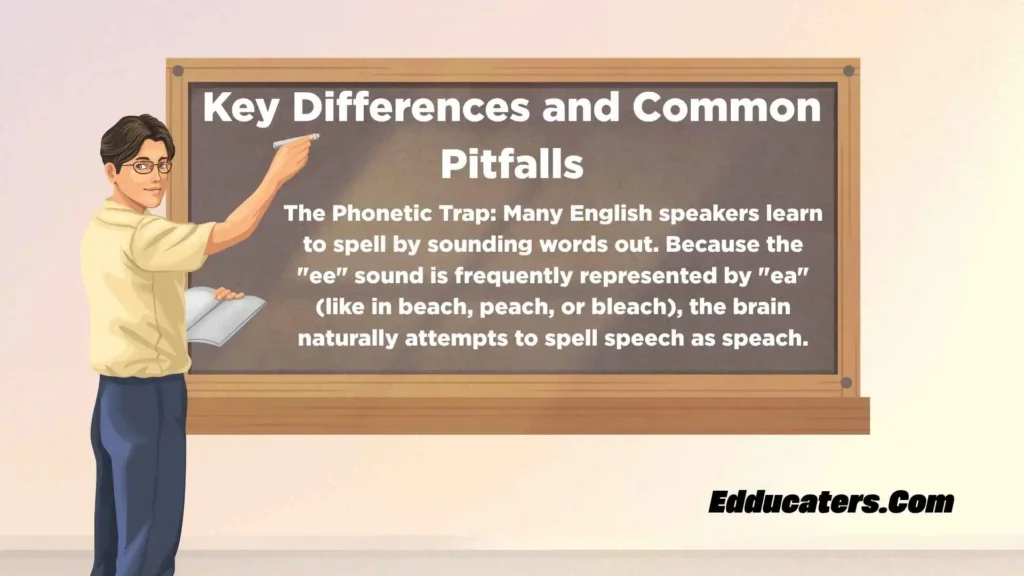
- The Phonetic Trap: Many English speakers learn to spell by sounding words out. Because the “ee” sound is frequently represented by “ea” (like in beach, peach, or bleach), the brain naturally attempts to spell speech as speach.
- The Etymological Reality: The word evolved from the Old English sprǣc and Middle English speche. While the spelling of English words shifted over centuries, “speech” settled into its modern form, remaining distinct from the “ea” vowel team pattern.
Essential Grammar Rules
In English grammar, speech is a countable or uncountable noun depending on the context.
- As an uncountable noun: It refers to the general ability to talk.
- Example: Freedom of speech is a fundamental right.
- As a countable noun: It refers to a specific presentation or address.
- Example: She gave three speeches during the conference.
There are no exceptions to the spelling. Regardless of whether you are using the word in a formal academic paper or a casual text message, it must always be spelled with the “ee” combination.
Usage Across Different Contexts
- Academic Writing: In scholarly essays or research papers, always use “speech” when discussing linguistics, rhetoric, or public oratory.
- Professional/Business Writing: Use “speech” when referring to corporate presentations, keynote addresses, or internal communications.
- Emails: Whether you are writing to a colleague or a client, use the correct “speech” spelling to maintain professional credibility.
- Daily Conversation/Social Media: While texting often allows for loose grammar, using the correct spelling of “speech” ensures your digital presence remains polished.
Why People Get It Wrong
The confusion stems from the inconsistency of English vowels. We have words like reach, teach, and preach—all of which use “ea”—and then we have speech. It is a classic “exception to the pattern.” When we learn the “ea” rule as children, our brains default to it for almost any word with that long “e” sound. Spelling speech with an “a” is a result of over-applying a spelling rule that doesn’t actually apply here.
20 Original Examples of Usage
- The graduation speech moved the entire audience to tears.
- She has been practicing her public speech for the upcoming gala.
- Freedom of speech is protected under the constitution.
- His speech was filled with complex technical jargon.
- After the ceremony, the guest of honor gave a short speech.
- The politician’s speech focused on economic reform.
- She captured the attention of the room with her passionate speech.
- I am nervous about giving a speech in front of the board members.
- The playwright wrote a moving speech for the protagonist.
- Rapid speech is a common symptom of high anxiety.
- He was asked to give a keynote speech at the industry summit.
- The historical speech changed the course of the revolution.
- Improving your speech delivery can boost your confidence.
- The CEO’s closing speech emphasized unity and growth.
- She accidentally slurred her speech due to extreme exhaustion.
- The wedding speech was lighthearted and funny.
- Clear speech is essential for effective communication.
- The coach gave an inspiring speech to the team at halftime.
- We analyzed the rhetoric used in the president’s latest speech.
- Every great leader is known for the quality of their speech.
The “See” Memory Trick
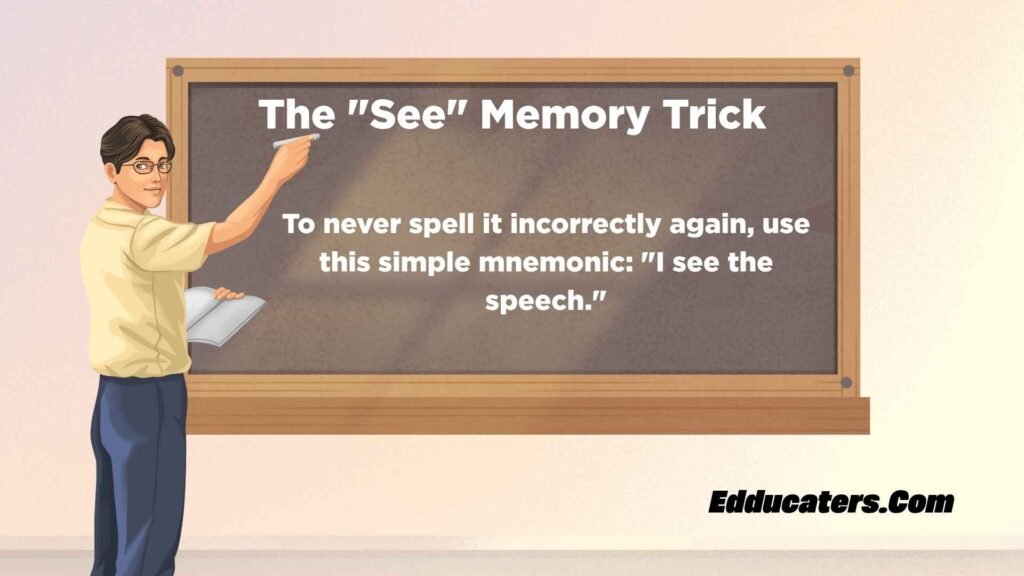
To never spell it incorrectly again, use this simple mnemonic: “I see the speech.”
Because both “see” and “speech” share the double “ee,” associating them together helps reinforce the correct spelling. Whenever you are about to type the word, imagine yourself saying, “I see the speech,” and you will automatically type the double “e.”
Mini Quiz
- What is the correct spelling?
a) Speach
b) Speech
c) Speechs
d) Speache
Answer: b - Which sentence is grammatically correct?
a) He gave a long speach at the wedding.
b) He gave a long speech at the wedding.
Answer: b - Why do people often misspell the word?
a) Because they don’t know English.
b) Because of the long “e” sound and the “ea” rule.
c) Because it is a new word.
Answer: b - Is “speech” a noun, verb, or adjective?
a) Verb
b) Adjective
c) Noun
Answer: c - Which phrase is correct?
a) Freedom of speach
b) Freedom of speech
Answer: b
Frequently Asked Questions
Is “speach” ever considered an alternative spelling?
No, “speach” is not an accepted alternative spelling in any dialect of English, including American, British, or Australian English. It is strictly considered a misspelling. Always use the standard “speech” spelling to ensure your writing remains professional and correct.
How do I pronounce the word correctly?
The word “speech” is pronounced /spiːtʃ/. The “ee” makes the long “e” sound, followed by the “ch” digraph. There is no “a” sound in the pronunciation, which is a helpful reminder to avoid adding the “a” when writing it down.
Does British English spell it differently?
No, the spelling remains “speech” in both American and British English. While there are many differences between these two versions of English regarding words like “colour” or “centre,” the spelling of “speech” is universally consistent across all English-speaking regions.
Can “speech” be used as a verb?
No, “speech” is exclusively a noun. If you want to describe the action of speaking, use the verb “speak.” For example: “She will speak at the conference” (verb) versus “She will give a speech at the conference” (noun).
What is the plural form of speech?
The plural form of “speech” is “speeches.” Note that when you add the “es” suffix, the spelling remains consistent with the root word. There is no change to the base “speech” spelling, ensuring you maintain the correct form in all contexts.
Are there any common synonyms for speech?
Yes, common synonyms include “address,” “discourse,” “lecture,” “oration,” “talk,” and “presentation.” Depending on the context, you might choose one of these if you want to avoid repeating the word, but none of these synonyms can replace the noun “speech” in its general sense.
Key Takeaways
- The word is always spelled speech.
- Speach is a common but incorrect misspelling.
- The word is a noun referring to the ability to speak or a formal address.
- It is not a verb; use the verb speak instead.
- Use the “I see the speech” mnemonic to remember the double “e.”
- Consistency is key: use “speech” in all professional, academic, and casual writing.
Conclusion
Mastering the nuances of English spelling is a journey, and conquering “speech” is a significant step toward clearer communication. By moving past the “ea” phonetic trap and internalizing the “ee” spelling, you enhance the professionalism of every document, email, and conversation you engage in.
Remember that language is a tool; keeping it sharp by using accurate spelling ensures your message is never lost or misunderstood. Whether you are delivering a formal address or writing a simple note, always rely on the standard “speech” spelling to express your thoughts with precision and confidence.

Hi, I’m Nathan Whitmore, and I enjoy making English grammar easy for learners of all ages. I believe grammar should be practical, not confusing. I write simple, well-researched guides that help readers improve their writing, speaking, and overall communication skills.
I spend a lot of time studying grammar patterns, sentence construction, punctuation, and modern English usage. My goal is to create lessons that anyone can understand, whether they are students, teachers, or professionals.
Books
Clear English Grammar
The Smart Writer’s Grammar Handbook
 Claire Holloway
 Julian Mercer