Have you ever stopped while writing because you couldn’t decide whether to use whos or whose? You’re not alone. These words often confuse English learners and native speakers because they sound exactly alike but serve different grammatical purposes.
The confusion becomes even greater when you consider who’s, which adds an apostrophe and carries another meaning. Although these three forms look similar, only two are standard spellings in ordinary English writing: who’s and whose.
The good news? You don’t need to memorize complicated grammar rules to distinguish them. Once you understand what each word means, choosing the correct spelling becomes much easier.
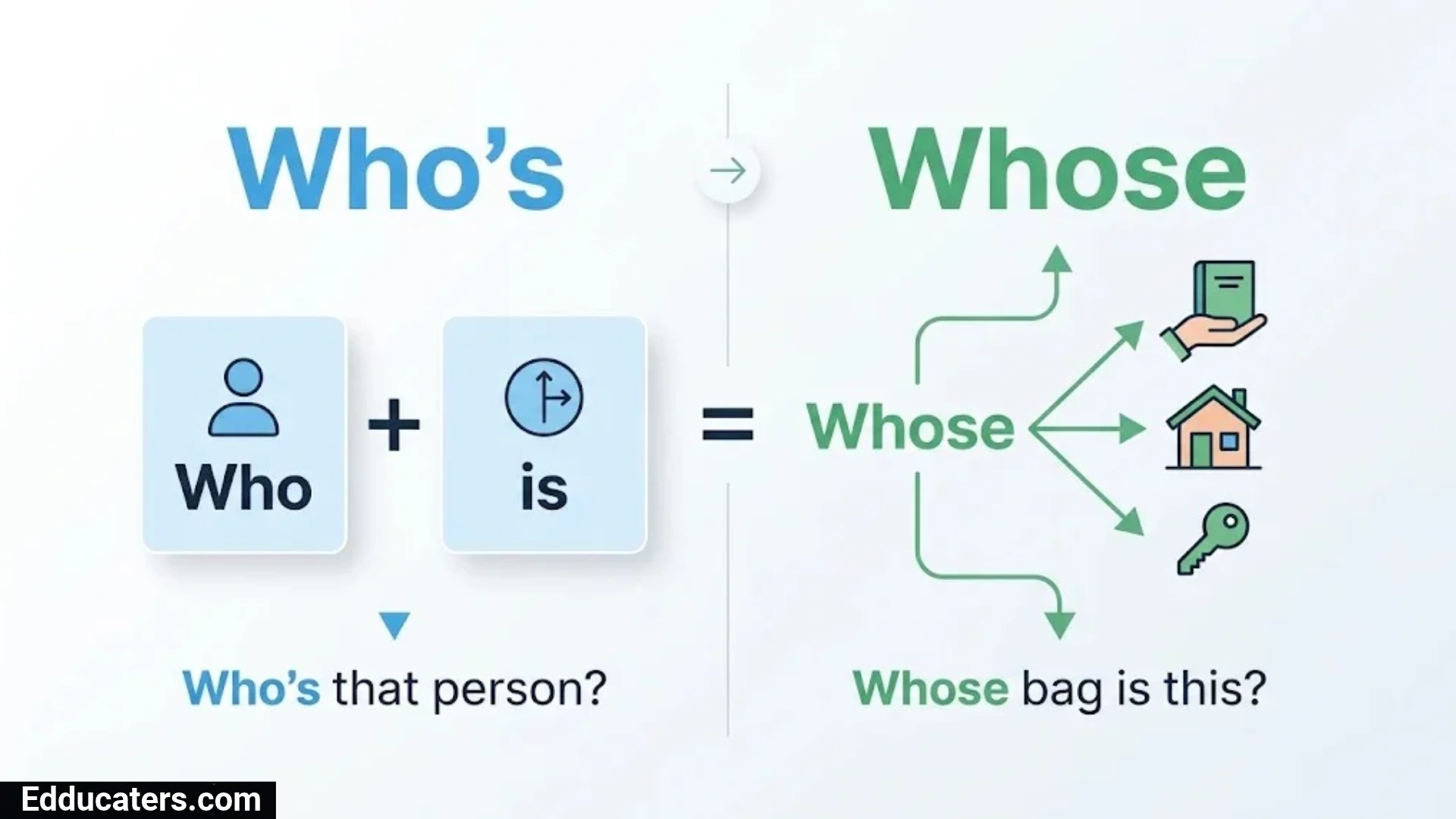
Who’s is a contraction of who is or who has. Whose is a possessive word that expresses ownership, association, or relationships. Meanwhile, whos without an apostrophe isn’t the standard spelling of either word.
For example:
- Who’s coming to dinner? (Who is coming to dinner?)
- Whose jacket is hanging by the door? (Who owns the jacket?)
- Whos coming to dinner? (Incorrect spelling in standard English.)
In this guide, you’ll learn the meanings of who’s and whose, their grammatical functions, apostrophe rules, and common mistakes. You’ll also discover simple memory tricks and practical sentence examples that make the difference easy to remember.
Who’s or Whose: What’s the Difference?
The main difference between who’s and whose comes down to contraction versus possession. Although both words share the same pronunciation, they perform different jobs in a sentence.
Who’s combines the pronoun who with either is or has. Writers use it to shorten expressions and make sentences sound more natural.
Whose, on the other hand, indicates ownership or a relationship between someone and something associated with them. It can also introduce a relative clause that provides additional information about a person, animal, or thing.
Consider these examples:
- Who’s responsible for organizing the meeting?
- Whose responsibility is it to organize the meeting?
The first sentence asks who is responsible. The second asks about ownership or responsibility associated with someone.
Here’s a quick comparison:
| Feature | Who’s | Whose |
| Meaning | Who is or who has | Belonging to whom |
| Grammatical function | Contraction | Possessive pronoun or determiner |
| Apostrophe | Yes | No |
| Primary purpose | Shortens two words | Expresses possession or association |
| Common usage | Questions and statements | Questions and relative clauses |
| Example | Who’s calling me? | Whose phone is ringing? |
One important detail deserves attention: an apostrophe doesn’t automatically indicate ownership. In who’s, it represents omitted letters from a contraction. In whose, possession comes from the word’s grammatical function rather than punctuation.
Remember this simple distinction:
- Who’s = who is or who has.
- Whose = possession or relationship.
- Whos = nonstandard spelling in ordinary English prose.
What Does Who’s Mean?
Who’s is a contraction formed by combining the interrogative or relative pronoun who with either the auxiliary verb is or has.
A contraction shortens two words into one. An apostrophe marks the letters removed during that process.
For example:
- Who is becomes who’s.
- Who has becomes who’s.
Both expansions are grammatically correct. However, the intended meaning depends on the surrounding words.
You can use who’s in questions, statements, and relative clauses. It appears frequently in everyday conversations, emails, articles, and informal writing.
Who’s as a Contraction of Who Is
The most common meaning of who’s is who is. It helps writers ask questions or describe someone’s identity, condition, role, or activity.
When you see who’s, try replacing it with who is. If the sentence still makes sense, you’ve probably found the correct form.
For example:
- Who’s at the front door? (Who is at the front door?)
- Who’s your favorite singer? (Who is your favorite singer?)
- Who’s responsible for this decision? (Who is responsible for this decision?)
- Who’s going to help us tomorrow? (Who is going to help us tomorrow?)
- Who’s ready for lunch? (Who is ready for lunch?)
Notice that each sentence asks about a person or group of people.
However, who’s doesn’t appear only in direct questions. You can also use it in statements and indirect questions.
Consider these examples:
- I know who’s coming to the party.
- Nobody knows who’s responsible for the missing documents.
- She’s the teacher who’s organizing the school event.
- Can you tell me who’s waiting outside?
- He wants to know who’s available this afternoon.
In each example, who’s means who is.
Important grammar point: Who’s can introduce a clause that identifies someone or describes their condition. The contraction doesn’t change the basic meaning of the sentence.
Who’s as a Contraction of Who Has
The second meaning of who’s is who has. This form appears when has functions as an auxiliary verb, particularly in present perfect constructions.
The present perfect connects a past action or experience with the present. It commonly follows the structure has + past participle.
For example:
- Who’s finished the assignment? (Who has finished the assignment?)
- Who’s been to California? (Who has been to California?)
- Who’s taken my notebook? (Who has taken my notebook?)
- Who’s already eaten breakfast? (Who has already eaten breakfast?)
- Who’s left the lights on? (Who has left the lights on?)
Here, who’s doesn’t mean who is. Instead, it replaces who has.
You can identify this meaning by examining the verb that follows the contraction.
For instance, consider the sentence:
“Who’s been working here since January?”
The word been is the past participle of be. Therefore, who’s expands naturally into who has.
Compare these two examples:
- Who’s working here? (Who is working here?)
- Who’s worked here before? (Who has worked here before?)
The first sentence describes an ongoing activity. The second asks about previous experience.
Sometimes the surrounding context determines which expansion makes sense. Don’t rely on the contraction alone. Examine the complete sentence.
Why Does Who’s Have an Apostrophe?
The apostrophe in who’s represents letters omitted when two words combine.
English uses contractions to make speech and writing shorter. Instead of writing every word separately, speakers combine certain words and replace missing letters with an apostrophe.
Here are several familiar examples:
| Full form | Contraction |
| Who is | Who’s |
| Who has | Who’s |
| She is | She’s |
| He is | He’s |
| It is | It’s |
| They are | They’re |
| You are | You’re |
| We have | We’ve |
The apostrophe doesn’t mean that someone owns something. It simply identifies a contraction.
This distinction matters because many writers assume every word ending in apostrophe-s must show possession.
That’s not how contractions work.
For example, it’s means it is or it has. Meanwhile, its expresses possession. The same general distinction helps explain who’s and whose.
What Does Whose Mean?
Whose is the possessive form of the pronoun who. It indicates ownership, association, or a relationship between a person and something connected to them.
You can use whose when asking who owns something or identifying the person associated with a particular object, characteristic, or relationship.
For example:
- Whose phone is ringing?
- Whose car is parked outside?
- Whose idea was this?
- I met a woman whose daughter studies medicine.
In the first three examples, whose asks about ownership or responsibility. In the final example, it introduces information about a relationship.
Unlike who’s, whose never needs an apostrophe. Its possessive meaning is already built into the word.
Whose has two important grammatical functions. It can work as a possessive determiner before a noun or as a possessive pronoun without a following noun.
Whose as a Possessive Determiner
A possessive determiner appears before a noun to identify ownership or association.
In this construction, whose helps identify the person or thing connected to the noun that follows.
For example:
- Whose book is lying on the table?
- Whose car did you borrow?
- Whose phone keeps ringing?
- Whose brother works at the hospital?
- Whose idea changed the entire project?
Notice the grammatical pattern:
Whose + noun
The noun identifies the object, person, or relationship being discussed.
Consider another example:
“Whose keys did you find near the entrance?”
Here, whose modifies the noun keys. The question asks who owns those keys.
You can also use whose in indirect questions.
For example:
- I wonder whose bag this is.
- She asked whose appointment was scheduled first.
- Nobody knew whose responsibility it was.
- Can you tell me whose office we’re visiting?
Indirect questions don’t always use question-word order. However, the meaning of whose remains unchanged.
Whose as a Possessive Pronoun
Whose can also function as a possessive pronoun when the noun it refers to is already understood.
In this construction, whose doesn’t need another noun immediately afterward.
For example:
- Whose is this?
- Whose are these?
- I found a wallet. Whose is it?
- Several jackets are here. Whose are they?
Compare these two sentences:
- Whose jacket is this?
- Whose is this?
The first sentence includes the noun jacket. The second leaves it out because the object is already clear from the conversation.
This is similar to how other possessive forms work.
| Possessive determiner | Possessive pronoun |
| My book | Mine |
| Your bag | Yours |
| Her phone | Hers |
| Their house | Theirs |
| Whose book? | Whose? |
The exact grammatical classification of whose can vary slightly across grammar frameworks. However, the practical distinction is straightforward: it can appear before a noun or stand alone when the meaning is clear.
Whose in Relative Clauses
Another important use of whose involves relative clauses.
A relative clause provides additional information about a noun. It often identifies someone or something by describing an associated person, object, quality, or relationship.
Whose introduces this information by expressing possession or association.
For example:
- She’s the woman whose son won the national competition.
- I met a writer whose books are popular worldwide.
- That’s the student whose project received first prize.
- We visited a house whose roof needed repairs.
- He works for a company whose products are sold internationally.
In these sentences, whose connects the person or thing mentioned earlier with another noun.
Consider this example:
“That’s the teacher whose students won the science competition.”
The main sentence identifies a teacher. The relative clause explains which teacher by mentioning the students’ achievement.
Without whose, the relationship becomes harder to express naturally.
You might write “the students of the teacher,” but that construction sounds less direct in this context.
Whose makes the relationship clear without adding unnecessary words.
Can Whose Refer to Things or Animals?
Yes. A common misconception suggests that whose can only refer to people. However, standard English also allows it to refer to animals, organizations, places, and inanimate objects.
Although some writers prefer alternatives in formal contexts, whose is an established grammatical choice for nonhuman references.
Consider these examples:
For animals:
- The dog whose owner lives nearby often visits our garden.
- We adopted a cat whose fur has unusual markings.
- The horse whose leg was injured is recovering.
For organizations:
- We contacted a company whose services cover several countries.
- She joined an organization whose mission focuses on education.
- The university whose graduates work worldwide recently expanded its campus.
For places and objects:
- We visited a town whose history dates back centuries.
- That’s the building whose windows were damaged.
- I bought a laptop whose battery lasts all day.
- This is the house whose garden attracts butterflies.
The choice becomes particularly useful when you want to avoid awkward phrases such as “the building of which the windows were damaged.”
A sentence with whose often sounds more natural and conversational.
Is Whos a Word? Understanding the Incorrect Spelling
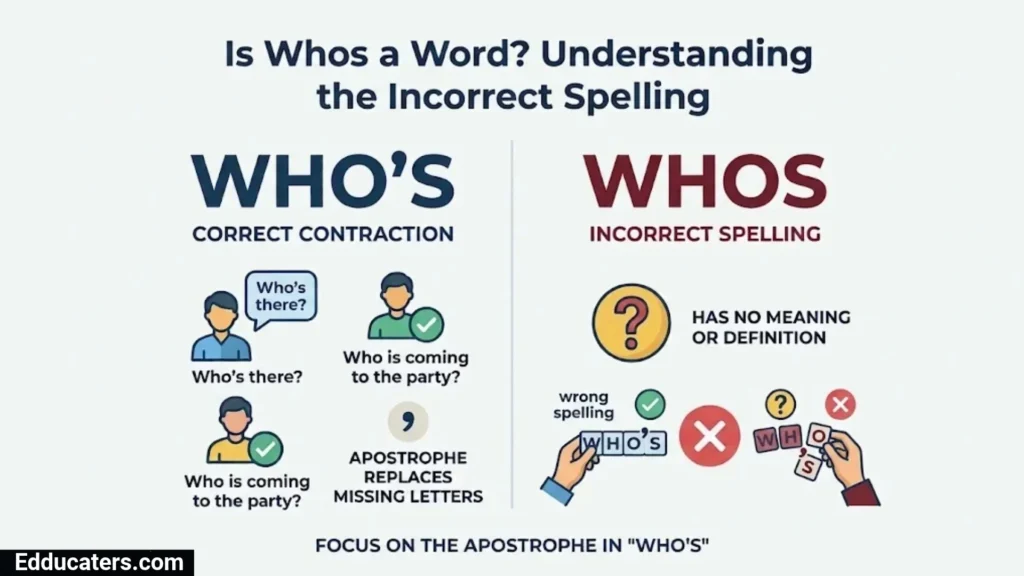
The spelling whos without an apostrophe is not the standard form of either who’s or whose in ordinary English writing.
Writers usually produce this mistake because they forget the apostrophe in who’s or mistakenly remove it from whose.
However, the distinction matters.
If you want to write who is or who has, you need who’s.
If you want to express ownership or association, you need whose.
The unpunctuated spelling doesn’t communicate either standard grammatical meaning.
Compare the three forms:
| Word | Correct? | Meaning |
| Who’s | Yes | Who is or who has |
| Whose | Yes | Possession or association |
| Whos | No, in ordinary standard prose | Nonstandard spelling or typo |
For example:
- Incorrect: Whos going to the meeting?
- Correct: Who’s going to the meeting?
- Incorrect: Whos jacket is on the chair?
- Correct: Whose jacket is on the chair?
Why Do People Write Whos Instead of Who’s?
Several factors contribute to this spelling mistake.
1. Forgetting the apostrophe
People sometimes leave out apostrophes when typing quickly. This happens frequently in text messages, social media posts, and informal online conversations.
2. Confusing contractions with possessive words
English contains several similar-looking forms, including it’s and its, you’re and your, and they’re and their.
Because these words follow different patterns, writers sometimes apply the wrong apostrophe rule.
3. Relying on pronunciation
Who’s and whose sound identical in standard American English. Therefore, listening to a sentence doesn’t reveal which spelling belongs there.
4. Typing without proofreading
Autocorrect and spell-checking tools don’t always identify contextual grammar mistakes. A sentence can contain correctly spelled words but still communicate the wrong meaning.
The easiest solution is to check the grammatical function before choosing a spelling.
How to Choose Between Who’s or Whose
You don’t need to memorize dozens of examples to master who’s or whose. A few simple grammar checks can help you identify the correct word in almost any ordinary sentence.
Use the Who Is Replacement Test
The first method involves replacing who’s with who is.
If the expanded sentence makes sense without changing the intended meaning, who’s is probably correct.
For example:
- Original: Who’s coming to the wedding?
- Replacement: Who is coming to the wedding?
- Correct choice: Who’s.
Another example:
- Original: Do you know who’s responsible?
- Replacement: Do you know who is responsible?
- Correct choice: Who’s.
Try another:
- Original: Whose coming to dinner?
- Replacement: Who is coming to dinner?
- Correct choice: Who’s.
The replacement reveals the error immediately.
However, don’t replace words mechanically. Make sure the expanded sentence preserves the intended meaning.
Use the Who Has Replacement Test
Sometimes who’s means who has rather than who is.
The same substitution method works here.
For example:
- Original: Who’s finished the report?
- Replacement: Who has finished the report?
- Correct choice: Who’s.
More examples:
- Who’s taken my umbrella? (Who has taken my umbrella?)
- Who’s been waiting outside? (Who has been waiting outside?)
- Who’s already completed the application? (Who has already completed the application?)
One useful clue is the verb that follows the contraction.
When who’s introduces a present perfect construction, the next verb often appears as a past participle.
Examples include:
- Who’s gone?
- Who’s written this?
- Who’s broken the window?
- Who’s seen the latest episode?
Remember that who’s can also mean who is before a participle. For example, “Who’s working?” means “Who is working?” Context and sentence structure determine the intended expansion.
Check Whether the Sentence Shows Possession
If replacing who’s with who is or who has produces an incorrect or unintended sentence, examine whether the sentence expresses ownership or association.
If it does, whose is usually the correct choice.
For example:
- Whose phone is ringing?
- Whose shoes are these?
- Whose idea was accepted?
- She’s the woman whose brother works here.
Try replacing whose with a phrase such as belonging to whom when asking a question.
For example:
“Whose car is parked outside?”
The sentence asks, “The car belongs to whom?”
That relationship confirms the correct spelling.
Remember the Simple Grammar Rule
When you’re unsure, remember these three points:
- Use who’s when you mean who is.
- Use who’s when you mean who has.
- Use whose when expressing possession or association.
Don’t add an apostrophe to whose.
This quick rule solves most spelling problems involving these words.
Who’s or Whose: Common Mistakes to Avoid
Even experienced writers occasionally confuse who’s and whose. The mistake often happens because both words sound identical and appear in similar sentence structures.
Understanding common errors can help you recognize the correct form more quickly.
Here’s a comparison of frequent mistakes and their corrections.
| Incorrect sentence | Correct sentence | Explanation |
| Whose coming home? | Who’s coming home? | Means who is coming home. |
| Who’s book is this? | Whose book is this? | Asks about ownership. |
| Whose responsible? | Who’s responsible? | Means who is responsible. |
| Who’s shoes are these? | Whose shoes are these? | Shows possession. |
| Whose been here? | Who’s been here? | Means who has been here. |
| I know who’s car it is. | I know whose car it is. | Indicates ownership. |
| Whos at the door? | Who’s at the door? | Means who is at the door. |
| Do you know who’s bag this is? | Do you know whose bag this is? | Identifies the bag’s owner. |
Confusing Apostrophes With Possession
One of the biggest mistakes involves assuming that apostrophe-s always expresses ownership.
In reality, apostrophes have several grammatical functions.
They can indicate possession in nouns:
- Sarah’s notebook.
- The dog’s collar.
- My brother’s bicycle.
They can also indicate missing letters in contractions:
- She’s ready.
- He’s working.
- Who’s calling?
Whose is different because it already functions as a possessive word.
For example:
- Correct: Whose laptop is this?
- Incorrect: Who’s laptop is this?
The second sentence incorrectly uses a contraction where a possessive determiner belongs.
Choosing Based on Pronunciation Instead of Meaning
Another common problem occurs when writers rely on sound instead of context.
In standard American English, who’s and whose share the same pronunciation: /huːz/.
This makes them homophones, meaning words that sound alike but have different spellings and meanings.
Other familiar examples include:
- To, too, and two.
- There, their, and they’re.
- Your and you’re.
- Its and it’s.
Because pronunciation cannot distinguish who’s from whose, you must examine the sentence.
For example:
- Who’s calling? (Who is calling?)
- Whose calling card is this? (Who owns the calling card?)
The surrounding words reveal the correct grammatical function.
Who’s or Whose in Sentence Examples
Examples make grammar rules easier to understand because they show how words behave in real situations.
The following sentences demonstrate how to use who’s and whose in different contexts.
Examples of Who’s in Questions
Use who’s when asking about someone’s identity, condition, responsibility, or actions.
- Who’s your favorite author?
- Who’s going to the football game?
- Who’s waiting outside the office?
- Who’s responsible for this mistake?
- Who’s calling me so late?
- Who’s ready to start the meeting?
- Who’s helping you with the assignment?
- Who’s at the front desk?
- Who’s organizing the birthday celebration?
- Who’s coming with us tomorrow?
All these examples use who’s as a contraction of who is.
Examples of Who’s in Statements
Who’s also appears naturally in statements and indirect questions.
- I know who’s coming to the party.
- Nobody knows who’s responsible for the missing file.
- She’s the person who’s managing the project.
- He wants to know who’s available tomorrow.
- We haven’t decided who’s leading the discussion.
- I wonder who’s using my computer.
- They’re asking who’s attending the conference.
- She’s someone who’s always willing to help.
- The manager knows who’s working tonight.
- Nobody remembers who’s supposed to bring the documents.
Examples of Who’s Meaning Who Has
These examples demonstrate the second meaning of who’s.
- Who’s finished the assignment?
- Who’s been to London?
- Who’s taken my keys?
- Who’s already eaten lunch?
- Who’s written this message?
- Who’s left the door open?
- Who’s seen my glasses?
- Who’s completed the training?
- Who’s broken the window?
- Who’s been waiting for an hour?
In each sentence, who’s replaces who has.
Examples of Whose in Questions
Use whose when asking who owns something or identifying a relationship.
- Whose keys are these?
- Whose house are we visiting?
- Whose phone is ringing?
- Whose idea was this?
- Whose jacket did you borrow?
- Whose car is parked outside?
- Whose brother works at the hospital?
- Whose responsibility is it?
- Whose notebook did you find?
- Whose birthday are we celebrating?
Examples of Whose in Statements
Whose can also introduce information about ownership or relationships within statements.
- I met a teacher whose students love reading.
- That’s the man whose car was stolen.
- She adopted a dog whose owner had moved away.
- We visited a museum whose collection impressed everyone.
- He’s the writer whose books became international bestsellers.
- I know a family whose children attend this school.
- This is the company whose products we use.
- They purchased a house whose garden overlooks the lake.
- She’s the scientist whose research changed the field.
- We visited a village whose history goes back hundreds of years.
How to Remember the Difference Between Who’s or Whose
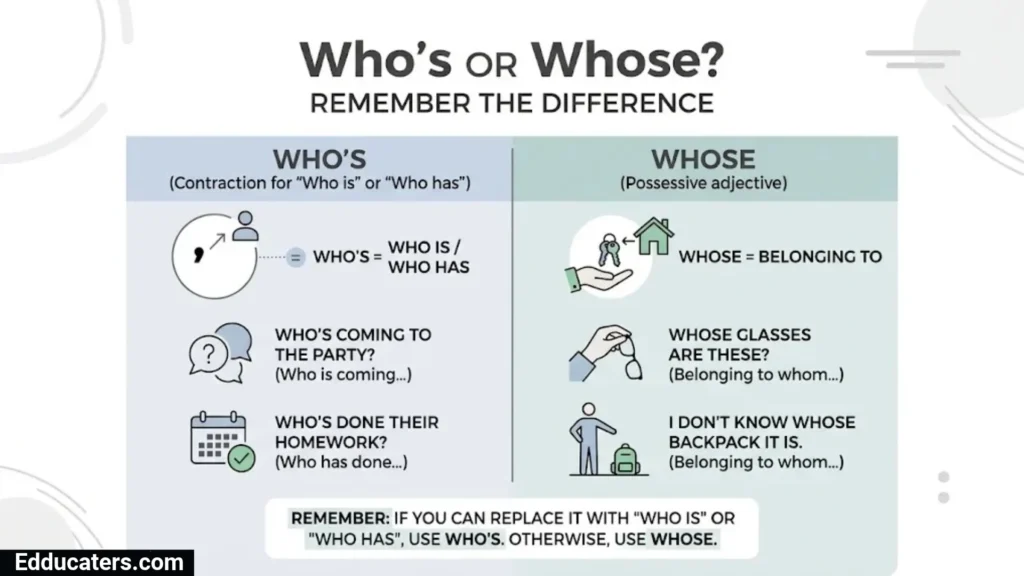
If you regularly confuse these words, a few simple memory tricks can make the correct spelling easier to recall.
The Expansion Trick
Whenever you see who’s, expand it into who is or who has.
If one of those expressions fits the sentence, who’s is correct.
For example:
- Who’s your teacher? → Who is your teacher?
- Who’s finished? → Who has finished?
If neither expansion works, consider whose when the sentence expresses possession or association.
The Ownership Trick
Associate whose with ownership.
Whenever a sentence asks who owns something or identifies a relationship, whose is generally the correct choice.
For example:
- Whose phone is this?
- Whose sister is visiting?
- Whose office are we entering?
Remember that whose doesn’t need an apostrophe.
The Apostrophe Trick
Think of the apostrophe in who’s as a replacement for missing letters.
The word combines who with is or has. The apostrophe marks that contraction.
Meanwhile, whose is already a complete possessive form.
This distinction is similar to the difference between it’s and its:
- It’s = it is or it has.
- Its = possessive form of it.
The same reasoning helps you remember who’s and whose.
Practice Exercise: Who’s or Whose?
Now that you’ve learned the rules, try applying them yourself.
Choose the correct word to complete each sentence. Pay attention to whether the sentence expresses an action, identity, ownership, or relationship.
Fill in the blanks with who’s or whose.
- _____ coming to the birthday party?
- _____ shoes are lying near the door?
- Do you know _____ responsible for this mistake?
- _____ been using my computer?
- _____ idea was it to organize the event?
- She’s the woman _____ brother works here.
- _____ going to drive us home?
- I wonder _____ phone this is.
- _____ finished reading the book?
- _____ dog keeps barking outside?
- Nobody knows _____ managing the new project.
- That’s the student _____ essay won first prize.
- _____ waiting for us at the airport?
- Can you tell me _____ keys these are?
- _____ been invited to the conference?
Answers and Explanations
| No. | Correct answer | Explanation |
| 1 | Who’s | Who is coming? |
| 2 | Whose | Asks about ownership. |
| 3 | Who’s | Who is responsible? |
| 4 | Who’s | Who has been using it? |
| 5 | Whose | Asks about ownership or association. |
| 6 | Whose | Shows a family relationship. |
| 7 | Who’s | Who is going to drive? |
| 8 | Whose | Identifies the phone’s owner. |
| 9 | Who’s | Who has finished? |
| 10 | Whose | Identifies the dog’s owner. |
| 11 | Who’s | Who is managing? |
| 12 | Whose | Connects the student with the essay. |
| 13 | Who’s | Who is waiting? |
| 14 | Whose | Asks who owns the keys. |
| 15 | Who’s | Who has been invited? |
If you answered all 15 correctly, you’ve understood the central difference.
If you missed a few, revisit the substitution test. It provides a reliable way to check your choices.
Frequently Asked Questions About Who’s or Whose
Here are answers to common questions about whos or whose, including spelling, meaning, apostrophes, pronunciation, and grammatical usage.
Which Is Correct, Who’s or Whose?
Both who’s and whose are correct English words, but they have different meanings.
Who’s is a contraction of who is or who has. Whose expresses possession or association.
For example, write “Who’s coming?” when asking who is coming. Use “Whose bag is this?” when asking who owns the bag.
The correct choice depends on your sentence.
Is Whos Correct Without an Apostrophe?
No. Whos isn’t the standard spelling of who’s or whose in ordinary English writing.
If you mean who is or who has, write who’s. If you mean ownership, write whose.
For example:
- Incorrect: Whos your teacher?
- Correct: Who’s your teacher?
- Incorrect: Whos book is this?
- Correct: Whose book is this?
Does Who’s Mean Who Is or Who Has?
Yes. Who’s can represent both expressions.
It means who is in sentences such as “Who’s coming to dinner?” It means who has in sentences such as “Who’s finished the assignment?”
The surrounding grammar helps identify the intended expansion.
Does Whose Need an Apostrophe?
No. Whose never needs an apostrophe to express possession.
It already functions as the possessive form of who.
For example:
- Whose car is parked outside?
- Whose idea was accepted?
- I know someone whose brother lives here.
Adding an apostrophe would create the incorrect form who’s.
Can Whose Be Used for Objects?
Yes. Whose can refer to objects, animals, organizations, and places as well as people.
For example:
- This is the building whose entrance was damaged.
- I bought a phone whose battery lasts all day.
- We visited a town whose history fascinated us.
This usage is especially helpful in relative clauses when expressing possession or association.
Can Whose Start a Sentence?
Yes. Whose commonly begins direct questions.
For example:
- Whose book is this?
- Whose car are we using?
- Whose responsibility is it?
- Whose birthday is tomorrow?
It can also begin an indirect question after another clause, as in “I wonder whose this is.”
Is Who’s Grammatically Correct in Formal Writing?
Yes. Who’s is grammatically correct in both formal and informal English.
However, some formal documents, academic assignments, and professional publications prefer expanded forms to maintain a more formal tone.
For example:
- Conversational: Who’s responsible for the decision?
- More formal: Who is responsible for the decision?
The expanded form is a stylistic choice rather than a grammatical requirement.
Are Who’s and Whose Pronounced the Same?
Yes. In standard American English, who’s and whose are homophones.
Both have the pronunciation /huːz/.
Their identical pronunciation explains why writers often confuse them. However, their spellings and grammatical functions remain different.
You must use sentence meaning and context to choose the correct form.
What Is the Possessive Form of Who?
Whose is the possessive form of who.
It indicates ownership, association, or a relationship.
For example:
- Whose jacket is this?
- She’s the woman whose son won the award.
- I know a student whose father teaches mathematics.
What’s the Difference Between Who Is and Whose?
Who is asks about someone’s identity, condition, or actions. Whose asks about ownership or relationships.
For example:
- Who is responsible for this project?
- Whose responsibility is this project?
The first question asks for a person’s identity. The second asks who the responsibility belongs to.
Is Whose a Possessive Pronoun or a Possessive Determiner?
Whose can function as both.
It acts as a possessive determiner when it appears before a noun, as in “Whose book is this?”
It can function as a possessive pronoun when it stands alone, as in “Whose is this?”
It also introduces relative clauses, as in “the author whose books I enjoy.”
Conclusion: Who’s or Whose – Remember the Difference
The difference between who’s or whose becomes simple once you understand their grammatical functions.
Who’s is a contraction of who is or who has. It helps shorten questions and statements without changing their intended meaning.
Whose expresses possession, ownership, or relationships. It can function as a possessive determiner, possessive pronoun, or relative form.
Meanwhile, whos without an apostrophe isn’t the standard spelling in ordinary English prose.
Whenever you’re uncertain, try the replacement test:
- If who is works, use who’s.
- If who has works, use who’s.
- If the sentence expresses ownership or association, use whose.
You don’t need complicated grammar terminology to make the right choice. Just understand what your sentence means and select the form that expresses it correctly.
With a little practice, you’ll stop confusing who’s and whose and write with greater confidence.

Hi, I’m Nathan Whitmore, and I enjoy making English grammar easy for learners of all ages. I believe grammar should be practical, not confusing. I write simple, well-researched guides that help readers improve their writing, speaking, and overall communication skills.
I spend a lot of time studying grammar patterns, sentence construction, punctuation, and modern English usage. My goal is to create lessons that anyone can understand, whether they are students, teachers, or professionals.
Books
Clear English Grammar
The Smart Writer’s Grammar Handbook
 Claire Holloway
 Julian Mercer