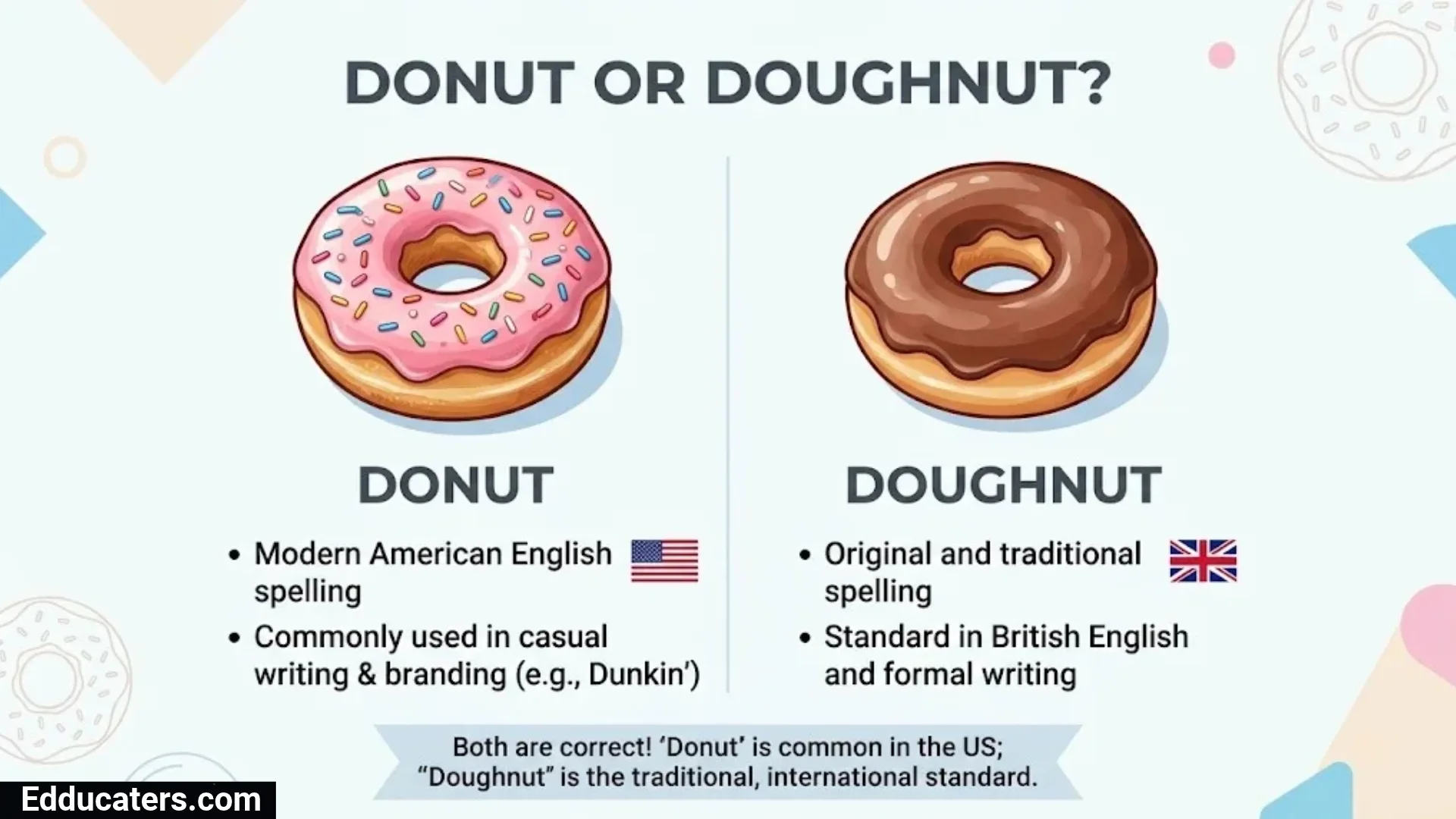
Have you ever paused while writing a recipe, ordering breakfast, or editing an article because you couldn’t decide between donut or doughnut? You’re not alone. These two spellings often confuse English speakers because they look different but describe exactly the same delicious treat.
Here’s the good news: Both donut or doughnut are correct English spellings. Neither represents a spelling mistake. The main difference comes down to regional preference and spelling convention. Doughnut is the traditional form, while donut is a shorter variant that has become especially popular in American English.
You’ll encounter both versions in dictionaries, cookbooks, restaurant menus, advertisements, and everyday conversations. However, your choice may depend on where your readers live and which variety of English you follow.
For example, an American bakery might advertise freshly made chocolate donuts, while a British bakery might promote its homemade chocolate doughnuts. Both descriptions are perfectly understandable.
So, which spelling should you choose? Let’s explore their meanings, history, pronunciation, grammatical forms, and regional differences to help you make the right decision.
Donut or Doughnut: Which Spelling Is Correct?
Both donut and doughnut are accepted spellings of the same English noun. They describe a small, sweet cake made from dough and usually cooked in hot oil or fat.
The difference doesn’t involve meaning, pronunciation, or grammatical function. Instead, it reflects two established ways of spelling the same word.
Here’s how the two forms compare:
- Doughnut: The traditional and longer spelling.
- Donut: The shorter spelling, particularly popular in the United States.
The longer version has a more established historical presence. Nevertheless, the shorter spelling has gained widespread recognition through American popular culture, commercial naming, and everyday writing.
Major dictionaries recognize the relationship between these forms. Cambridge Dictionary identifies donut as a mainly American spelling and lists it as another form of doughnut. It also recognizes doughnut in American English.
definition in the Cambridge English Dictionary+1
This distinction matters when you’re writing for a particular audience.
For example:
- If you’re following conventional British English, doughnut is a sensible choice.
- If you’re writing for American readers, donut is a familiar and widely used option.
- If you’re publishing internationally, either spelling works as long as you remain consistent.
Neither spelling is inherently more grammatical than the other. Choose the version that suits your audience and follow that choice throughout your writing.
Donut vs. Doughnut: Key Differences at a Glance
Although the two words look different, their definitions and grammatical functions remain identical. Understanding their basic characteristics makes the spelling choice much easier.
Here’s a comparison of donut vs. doughnut:
| Feature | Donut | Doughnut |
| Spelling type | Shortened variant | Traditional spelling |
| Meaning | Sweet fried dough food | Sweet fried dough food |
| Part of speech | Noun | Noun |
| Pronunciation | /ˈdoʊ.nʌt/ | /ˈdoʊ.nʌt/ |
| American English | Very common | Also accepted |
| British English | Recognized, less traditional | Conventional preference |
| Singular form | Donut | Doughnut |
| Plural form | Donuts | Doughnuts |
| Possessive form | Donut’s | Doughnut’s |
| Grammatical correctness | Correct | Correct |
Several important points stand out from this comparison.
First, neither spelling changes the food’s ingredients or preparation. A glazed donut and a glazed doughnut describe the same product.
Second, both forms follow ordinary English noun rules. You can make either word plural by adding s or show possession by adding an apostrophe and s.
Finally, pronunciation doesn’t distinguish them. Most English speakers pronounce both forms identically within their regional accent.
The simplest distinction is this: doughnut is the traditional spelling, while donut is its established shorter variant.
What Does Donut or Doughnut Mean?
Before exploring the spelling history, it helps to understand what these words actually describe.
Both forms refer to a sweet food made from dough. Bakers typically prepare it by mixing flour, sugar, yeast or another raising agent, and other ingredients before frying the dough in hot oil.
The finished product can have a ring shape or a round shape with a filling inside.
Depending on the recipe, a donut or doughnut may contain:
- Flour and sugar
- Milk or water
- Eggs
- Butter or shortening
- Yeast or baking powder
- Salt
- Flavorings such as vanilla or cinnamon
Bakers may also add icing, chocolate, powdered sugar, fruit fillings, or other toppings.
Donut Meaning and Definition
Donut is a noun that refers to a small, sweet cake made from dough and usually fried in hot fat.
The word commonly describes both ring-shaped and filled varieties. Its meaning doesn’t depend on whether the product has a hole in the middle.
For example, a traditional glazed ring donut and a jelly-filled donut both fall under this definition.
Here are some common examples:
- Glazed donut: A fried dough cake covered with a thin sugar glaze.
- Chocolate donut: A donut topped with chocolate icing or made with chocolate-flavored dough.
- Strawberry donut: A sweet donut finished with strawberry-flavored icing or filling.
- Donut hole: A small, round piece of fried dough, traditionally associated with the center cut from a ring-shaped donut.
- Cream-filled donut: A soft fried cake containing sweet cream or custard.
The shorter spelling appears frequently in American food businesses, product descriptions, advertisements, and casual writing.
For example:
- I bought a glazed donut with my morning coffee.
- The bakery sells fresh chocolate donuts every weekend.
- She prepared homemade donuts for the family.
- Would you like a strawberry donut or a cinnamon roll?
In each sentence, donut functions as a common countable noun.
Doughnut Meaning and Definition
Doughnut has exactly the same basic meaning as donut. It describes a small cake made from sweetened dough and cooked in hot fat.
The traditional spelling appears in British English and remains common in American publications, cookbooks, and dictionaries.
A doughnut doesn’t always have a hole. Some varieties contain jam, custard, or cream instead.
Consider these popular examples:
- Ring doughnut: A circular fried cake with a hole in the center.
- Jam-filled doughnut: A soft doughnut filled with fruit jam.
- Glazed doughnut: A fried cake covered with a sweet glaze.
- Chocolate doughnut: A doughnut topped with chocolate icing or coating.
- Custard-filled doughnut: A soft fried cake containing smooth custard.
Here are a few examples in sentences:
- The bakery makes fresh doughnuts every morning.
- I ordered a chocolate doughnut with my tea.
- She filled the homemade doughnuts with raspberry jam.
- The children decorated their doughnuts with colorful sprinkles.
Notice that the spelling changes, but the meaning stays the same.
Are Donut and Doughnut the Same Thing?
Yes. Donut and doughnut refer to the same type of food. Neither spelling identifies a separate recipe, ingredient, or preparation method.
You can use either word when describing a ring-shaped fried cake or a filled sweet pastry.
For example, these expressions communicate the same meaning:
- Glazed donut = glazed doughnut
- Chocolate donut = chocolate doughnut
- Jam-filled donut = jam-filled doughnut
- Strawberry donut = strawberry doughnut
However, individual bakeries and food brands may prefer one spelling for their product names.
That’s a matter of commercial naming rather than a difference in the English language.
Also, the word doughnut has meanings beyond food in certain contexts. For example, it can describe an object with a circular shape and a hole in the middle. Cambridge also records related uses involving hair accessories and circular driving maneuvers.
These additional meanings don’t create a difference between the two spellings.
Why Are There Two Spellings of Doughnut?
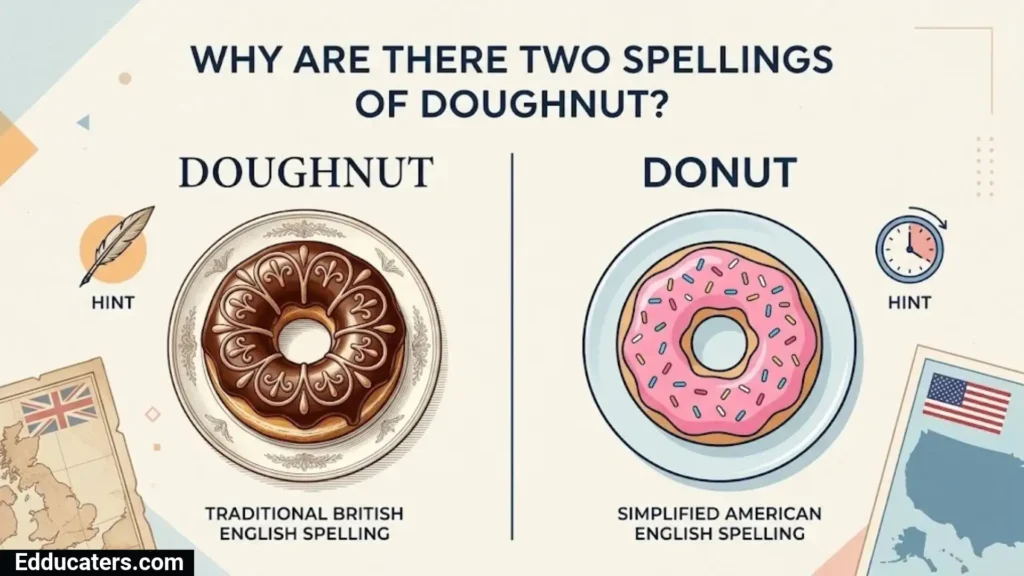
The existence of donut and doughnut reflects a familiar feature of English: words sometimes develop shorter or alternative spellings while retaining their original meanings.
The traditional spelling combines two recognizable English elements: dough and nut.
The word dough refers to a mixture of flour and liquid used to prepare bread, cakes, and similar foods. The word nut historically had broader uses, including references to small rounded objects or cakes.
Together, these elements formed the word doughnut.
The food originally appeared in forms that didn’t always resemble the familiar ring-shaped pastries sold today. Early doughnuts often consisted of small balls of sweetened dough fried in fat.
The shorter spelling, donut, emerged as an alternative in American English.
According to Etymonline, the shorter form appeared in the United States by 1870 and became common in bakery names around 1920.
This development helps explain why both spellings exist today.
A Brief History of the Word Doughnut
The history of the word is more interesting than its spelling might suggest.
Here are some important historical details:
| Period | Historical development |
| Late 18th century | Early recorded references to the word appear. |
| Early 19th century | Doughnut appears in published American writing. |
| 19th century | The shorter spelling donut emerges as an alternative. |
| Around 1920 | Donut becomes increasingly common in American bakery names. |
| 20th century | Both spellings gain wider recognition. |
| Modern English | Both forms remain accepted and widely understood. |
One historical detail deserves special attention.
The Oxford English Dictionary’s early record is commonly associated with 1782. Other historical accounts cite Washington Irving’s 1809 description in A History of New York. These dates refer to different historical records, so they shouldn’t be treated as interchangeable claims about the same publication.
Irving described the food as sweetened dough fried in fat and called it a doughnut or olykoek.
Interestingly, the familiar ring shape wasn’t always the defining feature. Earlier versions could be solid balls of dough.
The hole became associated with the food later in its development.
Why Did Donut Become Popular?
Several factors helped the shorter spelling gain recognition.
1. Simpler spelling
The word donut removes the letters ough, making it shorter and easier to write.
This kind of spelling variation isn’t unusual in English. Over time, some shorter forms become established alongside their longer counterparts.
2. American commercial usage
American bakeries and food businesses helped popularize the shorter spelling.
Business names, signs, advertisements, and product labels made donut familiar to generations of customers.
3. Popular culture
American newspapers, television, restaurants, and everyday conversations helped spread the shorter form.
As a result, many readers now recognize donut immediately, even when they usually write doughnut.
4. Established dictionary recognition
Modern dictionaries recognize the shorter spelling as a legitimate variant.
That recognition separates donut from an accidental typo or an invented abbreviation.
The important point is that donut didn’t replace doughnut completely. Both forms developed and continued to coexist.
Donut or Doughnut in American English
American English accepts both donut and doughnut. However, the shorter spelling has become especially familiar in everyday American communication.
You’ll often see donut on bakery signs, restaurant menus, product packaging, and commercial advertisements.
For example, American businesses frequently use expressions such as:
- Donut shop
- Donut holes
- Glazed donuts
- Chocolate donuts
- Donut delivery
- Donut flavors
The shorter spelling also appears in ordinary writing. Someone might say, “I picked up a dozen donuts on my way home,” without giving the spelling a second thought.
However, American English hasn’t abandoned the traditional form.
You can still find doughnut in cookbooks, newspapers, dictionaries, educational materials, and formal publications. Both versions communicate the same meaning.
Is Doughnut Correct in American English?
Absolutely. Doughnut is completely acceptable in American English.
Although donut is a familiar American spelling, the longer version isn’t outdated or incorrect.
For example, an American food writer might publish a recipe titled “Homemade Glazed Doughnuts.” Another writer might call the same recipe “Easy Homemade Glazed Donuts.”
Neither title contains a spelling error.
The choice often depends on personal preference, publication style, and the intended presentation.
Which Spelling Should American Writers Use?
American writers can choose either spelling. However, they should consider their audience and maintain consistency.
Here are some practical recommendations:
- Use donut for casual American content when it suits your preferred style.
- Use doughnut when following a publication that prefers the traditional spelling.
- Follow the spelling used by a specific brand when discussing its products.
- Avoid switching between the two forms without a clear reason.
For example, if your article begins with “The best chocolate donuts,” continue using donuts throughout the article.
Consistency makes your writing easier to follow and gives it a more polished appearance.
Donut or Doughnut in British English
In British English, doughnut is the conventional spelling.
British dictionaries and publications commonly use the longer form when referring to the sweet fried food. You’ll also encounter it in supermarket descriptions, bakery menus, recipes, and everyday conversations.
For example:
- I bought two jam doughnuts from the bakery.
- These homemade doughnuts taste delicious.
- Would you like a chocolate doughnut with your tea?
- The shop sells freshly prepared ring doughnuts.
The traditional spelling fits naturally into British English writing.
However, that doesn’t mean British speakers cannot use donut.
Cambridge’s Essential British English Dictionary identifies donut as another spelling of doughnut. This confirms that the shorter version is recognized rather than an invented or meaningless form.
Is Donut Correct in British English?
Yes. Donut is a recognized spelling in British English, although doughnut remains the more conventional choice.
You might encounter donut in American product names, international advertising, restaurant branding, and casual online content.
For example, a British customer might visit a shop displaying the words “Fresh Donuts” without finding anything unusual about the spelling.
Nevertheless, if you’re writing an academic assignment, educational article, or formal British publication, doughnut is generally the safer option.
Which Spelling Should British Writers Use?
British writers should normally choose doughnut when following conventional British spelling.
This recommendation is particularly useful when writing:
- School assignments
- British English learning materials
- Newspaper articles
- Educational publications
- Formal reports
- Recipes intended for British readers
However, brand names should retain their official spelling.
If a company calls its product a Donut, changing the name to Doughnut would misrepresent its branding.
The same principle applies to quotations and published titles. Preserve the original spelling when reproducing someone else’s wording.
Donut or Doughnut Pronunciation
One reason people confuse these spellings is that they sound the same.
Both donut and doughnut have the same standard pronunciation within a given English accent.
The difference appears in writing, not in the spoken word.
American English IPA
/ˈdoʊ.nʌt/
British English IPA
/ˈdəʊ.nʌt/
The first syllable receives the main stress in both pronunciations.
The American and British versions differ slightly in their vowel sounds, as you’d expect from their broader accent differences. However, the spelling choice doesn’t create a separate pronunciation.
For example, an American speaker generally pronounces both forms with the same American vowel sounds. A British speaker does the same with their regional pronunciation.
Do Donut and Doughnut Sound Different?
No. Donut and doughnut are homophones in standard usage.
Homophones are words that share the same pronunciation but have different spellings or meanings.
In this case, the two spellings also share the same meaning.
Consider these examples:
- I bought a donut.
- I bought a doughnut.
Both sentences sound identical when spoken by the same person.
The additional letters in doughnut don’t represent extra syllables or separate sounds.
This makes the difference relatively easy to remember: you only need to consider spelling conventions rather than learning two pronunciations.
Donut or Doughnut: Singular and Plural Forms
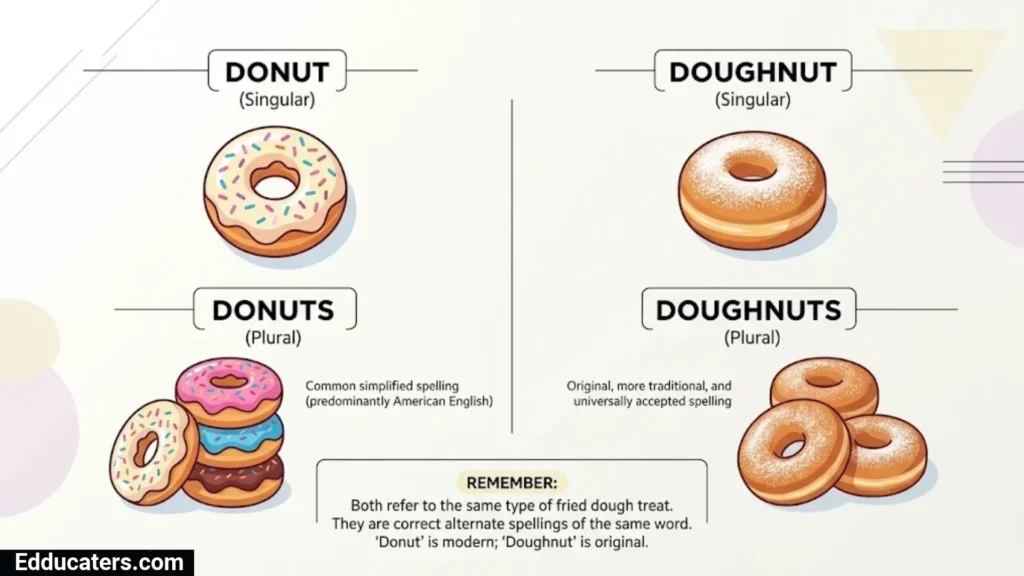
Both words function as countable nouns. You can use them to describe one item or several items.
Fortunately, their grammatical rules are straightforward.
The main difference appears in their spelling, not their pluralization.
Singular Forms: Donut or Doughnut
Use donut or doughnut when referring to one item.
Examples:
- I ate a chocolate donut after lunch.
- She bought a fresh doughnut from the bakery.
- He ordered one glazed donut with his coffee.
- My favorite doughnut contains raspberry jam.
Both singular forms take the article a because they begin with a consonant sound.
You can also use them after numbers or descriptive words when the context calls for a singular noun.
For example:
- One donut
- A delicious doughnut
- This chocolate donut
- That homemade doughnut
Plural Forms: Donuts or Doughnuts
To form the plural, simply add -s to either spelling.
| Singular | Plural |
| Donut | Donuts |
| Doughnut | Doughnuts |
Both plural forms are grammatically correct.
Examples:
- The bakery sells fresh donuts every morning.
- We bought six doughnuts for breakfast.
- These chocolate donuts taste amazing.
- The children decorated their homemade doughnuts.
You don’t need to change any other letters when forming these plurals.
The same rule applies whether you’re writing in American or British English.
Donut’s or Donuts: Where Does the Apostrophe Go?
A common grammar mistake involves using an apostrophe when forming ordinary plurals.
Remember that donuts and doughnuts don’t need apostrophes when you’re simply talking about more than one item.
However, apostrophes become necessary when you show possession or ownership.
Let’s examine the difference.
Donuts: Ordinary plural
Use donuts when referring to multiple donuts.
Example:
– The bakery prepared twenty donuts for the customers.
Donut’s: Singular possessive
Use donut’s when something belongs to or relates to one donut.
Example:
– The donut’s chocolate coating started melting.
Here, the coating belongs to one particular donut.
Donuts’: Plural possessive
Use donuts’ when something belongs to multiple donuts.
Example:
– The donuts’ colorful decorations attracted everyone’s attention.
The same rules apply to doughnut.
| Form | Grammatical function | Example |
| Donut | Singular | I bought a donut. |
| Donuts | Plural | I bought three donuts. |
| Donut’s | Singular possessive | The donut’s filling was sweet. |
| Donuts’ | Plural possessive | The donuts’ toppings looked beautiful. |
| Doughnut | Singular | She ate a doughnut. |
| Doughnuts | Plural | She bought two doughnuts. |
| Doughnut’s | Singular possessive | The doughnut’s glaze was sticky. |
| Doughnuts’ | Plural possessive | The doughnuts’ fillings were delicious. |
The distinction is simple: use s for an ordinary plural and an apostrophe when showing possession.
Donut or Doughnut in Everyday Writing
Knowing that both spellings are correct is useful. However, understanding how they work in actual sentences makes the distinction easier to apply.
You can use either form in recipes, menus, conversations, advertisements, and general writing.
The important thing is to choose a spelling that suits your audience.
Using Donut in a Sentence
The shorter form appears naturally in American English and casual communication.
Here are some examples showing different contexts:
- Everyday conversation: I picked up a dozen donuts before heading to work.
- Food description: The chocolate donut had a soft center and a sweet glaze.
- Bakery advertisement: Fresh donuts are available every morning.
- Recipe writing: Mix the ingredients until you form a smooth donut dough.
- Shopping: She bought six glazed donuts for the office.
- Breakfast: He enjoys eating a cinnamon donut with his coffee.
- Food preference: My favorite donut has a strawberry filling.
Notice how donut works naturally as a noun in each sentence.
It can also appear before another noun as a modifier.
For example:
- Donut shop
- Donut recipe
- Donut box
- Donut maker
- Donut filling
These combinations describe something associated with donuts.
Using Doughnut in a Sentence
The longer spelling works in exactly the same grammatical situations.
It’s particularly familiar in British English and traditional food writing.
Consider these examples:
- Everyday conversation: I bought a fresh doughnut from the bakery.
- Food description: The doughnut was covered in powdered sugar.
- Bakery advertisement: Our homemade doughnuts contain fresh ingredients.
- Recipe writing: Allow the doughnuts to cool before adding the glaze.
- Shopping: She purchased four jam-filled doughnuts.
- Breakfast: He ate a warm doughnut with his morning tea.
- Food preference: My favorite doughnut contains chocolate custard.
You can also use doughnut as a modifier:
- Doughnut shop
- Doughnut recipe
- Doughnut filling
- Doughnut maker
- Doughnut box
Neither form changes its grammatical role.
Can You Use Donut in Formal Writing?
Yes. Donut is an accepted English spelling, so using it in formal writing isn’t automatically incorrect.
However, formal writing often follows a particular style guide or dictionary preference.
For example, a British educational publication might consistently use doughnut, while an American magazine might prefer donut.
Both choices are acceptable when they follow the publication’s established conventions.
Before choosing a spelling, consider these questions:
- Who will read your writing?
- Are you following American or British English?
- Does your publisher require a particular dictionary?
- Are you discussing a brand with an established spelling?
- Have you used the same form throughout your document?
These small decisions help maintain a consistent writing style.
A spelling doesn’t become incorrect simply because another version looks more traditional.
Common Donut or Doughnut Spelling Mistakes
Although both spellings are correct, writers sometimes misunderstand how they work. Most mistakes happen because people confuse regional preferences with actual grammar rules.
Here are some common errors worth avoiding.
Assuming Donut Is Always Incorrect
Some writers believe donut is an informal abbreviation that shouldn’t appear in standard English.
That’s incorrect.
Modern dictionaries recognize donut as an established spelling variant. You can use it in ordinary writing without treating it as a typo.
Assuming Doughnut Is Exclusively British
Another common misconception is that Americans should always write donut.
However, American English accepts both forms. The traditional spelling remains common in American dictionaries, publications, and recipes.
Treating Donut and Doughnut as Different Foods
The two spellings don’t identify different recipes or products.
A glazed donut and a glazed doughnut are the same type of food. The same applies to chocolate, strawberry, and jam-filled varieties.
Mixing Both Spellings Unnecessarily
Switching between donut and doughnut in the same article can make your writing look inconsistent.
For example:
Inconsistent usage
“The bakery sells fresh donuts every morning. Its chocolate doughnuts are especially popular.”
Consistent usage
“The bakery sells fresh donuts every morning. Its chocolate donuts are especially popular.”
The second example follows one spelling convention throughout.
You can use both forms when discussing spelling differences, quoting original text, or reproducing official product names. Otherwise, choose one and stick with it.
Using an Apostrophe to Create an Ordinary Plural
Remember that donuts and doughnuts don’t require apostrophes.
- Incorrect: Three donut’s
- Correct: Three donuts
- Incorrect: Five doughnut’s
- Correct: Five doughnuts
An apostrophe indicates possession or certain contractions. It doesn’t normally create plural nouns.
Changing a Brand’s Official Spelling
Businesses sometimes choose unusual or shortened spellings for their names.
When discussing a specific company, preserve its official branding.
For example, if a bakery uses Donut House as its business name, don’t automatically change it to Doughnut House.
Brand names follow their owners’ chosen spellings rather than general spelling preferences.
Donut or Doughnut: Which Spelling Should You Use?
Now that you understand their meanings, history, and grammatical forms, choosing between the two becomes much easier.
Your decision should depend on your audience, publication requirements, and regional spelling conventions.
Here’s a practical guide.
| Writing situation | Recommended spelling | Reason |
| American English | Donut or doughnut | Both are accepted |
| British English | Doughnut | Traditional British preference |
| Academic writing | Follow the required style | Maintains consistency |
| Educational writing in the UK | Doughnut | Follows conventional British usage |
| American food advertising | Donut | Familiar commercial spelling |
| International content | Either | Both are widely recognizable |
| Brand names | Official spelling | Preserves brand identity |
| Direct quotations | Original spelling | Maintains accuracy |
For American English
If you’re writing for American readers, either spelling works.
However, donut is a familiar choice for everyday communication, menus, advertisements, and casual publications.
For example:
- Fresh donuts available today!
- Homemade chocolate donuts
- Best donut shops in town
You can also use doughnut when following a publication’s preferred style.
For British English
If you’re writing for a British audience, choose doughnut.
This form follows conventional British spelling and appears frequently in British publications, educational materials, and everyday writing.
For example:
- Freshly baked doughnuts
- Traditional jam doughnuts
- Homemade chocolate doughnuts
Although British readers understand donut, the longer version generally fits traditional British usage better.
For Academic or Educational Writing
Academic writing should follow the spelling conventions required by the institution, teacher, publisher, or style guide.
If your assignment requires British English, use doughnut.
If you’re following an American English style guide, either form may be acceptable. However, check the publication’s dictionary preference before deciding.
The goal isn’t to make one spelling look superior. It’s to maintain a consistent standard throughout your work.
For Business and Marketing Content
Businesses should consider their customers and existing brand identity.
An American bakery might prefer donuts because the spelling feels familiar to its customers.
A British bakery might choose doughnuts because it matches local conventions.
Neither approach creates a grammatical problem.
If you’re creating product descriptions, advertisements, or menus, consistency helps customers recognize the product and understand your message.
For International Content
If your writing targets readers from several English-speaking countries, either spelling can work.
However, consistency becomes especially important.
For example, you might choose doughnut throughout an international educational article because it’s the traditional form. Alternatively, you might use donut if your publication follows American English.
Don’t alternate between spellings simply to include more variations.
The best spelling is the one that fits your audience and remains consistent throughout your writing.
Frequently Asked Questions About Donut or Doughnut
Here are straightforward answers to common questions about the spelling, meaning, pronunciation, and grammatical use of these words.
Is Donut or Doughnut Correct?
Both donut and doughnut are correct English spellings.
Doughnut is the traditional form, while donut is a shorter, established variant. Both describe the same sweet fried food and have the same pronunciation.
Is Donut a Real Word?
Yes. Donut is a real English word recognized by major dictionaries.
Although some people consider it less traditional than doughnut, it has an established place in American English and everyday communication.
You can use it in sentences, recipes, advertisements, and general writing.
Is Doughnut the Original Spelling?
Yes. Doughnut is the traditional spelling and has an earlier documented history than the shorter form donut.
Historical records associate the word with the late eighteenth and early nineteenth centuries. The shorter spelling appeared as an American variant during the nineteenth century.
Is Donut American or British English?
Donut is particularly associated with American English.
However, British English also recognizes the spelling. British writers generally prefer doughnut because it follows conventional British usage.
Why Do Americans Spell Doughnut as Donut?
Americans use donut as a shorter spelling of doughnut.
The shortened form appeared in American English during the nineteenth century and became increasingly common through bakery names, commercial usage, and popular culture.
It offers a simpler written form without changing the word’s meaning or pronunciation.
Are Donut and Doughnut Pronounced the Same?
Yes. Both spellings have the same standard pronunciation.
American and British speakers may pronounce the vowel sounds differently because of their accents. However, the difference between donut and doughnut doesn’t create a pronunciation distinction.
What Is the Plural of Doughnut?
The plural of doughnut is doughnuts.
Simply add the letter s to the singular form.
For example:
- One doughnut
- Two doughnuts
- Six doughnuts
- A dozen doughnuts
What Is the Plural of Donut?
The plural of donut is donuts.
Add s to make the word plural.
For example:
- One donut
- Two donuts
- Five donuts
- Twelve donuts
Both plural forms follow the regular English pluralization rule.
Can I Use Doughnut in American English?
Yes. Doughnut is perfectly acceptable in American English.
Although Americans frequently use donut, the traditional spelling remains recognized in American dictionaries, recipes, books, and publications.
You can choose either form without changing the meaning.
Can I Use Donut in British English?
Yes. British dictionaries recognize donut as a spelling variant of doughnut.
However, doughnut remains the conventional choice in British English, particularly in formal and educational writing.
If you’re following traditional British spelling conventions, the longer form is generally preferable.
Is Doughnut More Formal Than Donut?
Not necessarily.
Both forms are accepted English spellings. However, doughnut may look more traditional in certain publications, particularly those following British English conventions.
The appropriate choice depends on the publication’s preferred spelling rather than an absolute distinction between formal and informal language.
Does Doughnut Always Have a Hole in the Middle?
No. A doughnut doesn’t need a hole.
Ring-shaped doughnuts have a central opening, but many varieties come filled with jam, custard, or cream.
The word describes the general food rather than one specific shape.
Is Donut an Abbreviation of Doughnut?
Not exactly. Donut is better described as a shortened spelling variant.
It removes the letters ough from the traditional spelling but retains the same meaning and pronunciation.
It’s an established alternative rather than an ordinary abbreviation.
Conclusion: Donut or Doughnut?
So, donut or doughnut: which spelling should you use? The answer is simple: Both are correct.
Doughnut is the traditional spelling, while donut is a shorter variant that became especially popular in American English. Neither changes the word’s meaning, pronunciation, or grammatical function.
If you’re writing for a British audience, doughnut is generally the better choice. For American readers, donut is a familiar option, although doughnut remains equally acceptable.
Remember these three points:
- Doughnut: Traditional spelling and conventional British preference.
- Donut: Shorter spelling widely used in American English.
- Both: Correct spellings with identical meanings and pronunciations.
Ultimately, your audience and writing conventions should guide your decision. Choose one spelling, use it consistently, and enjoy your favorite sweet treat without worrying about the spelling!

Hello, I’m Claire Holloway. I have always been passionate about the English language and enjoy turning complex grammar rules into simple, easy-to-follow lessons. I believe that every learner can become a confident English writer with the right guidance.
I create educational content focused on grammar, vocabulary, sentence structure, and writing improvement. Every article I publish is designed to help readers learn with confidence and accuracy.
Books
Grammar Without Confusion
Modern English Usage Guide
 Nathan Whitmore
 Julian Mercer