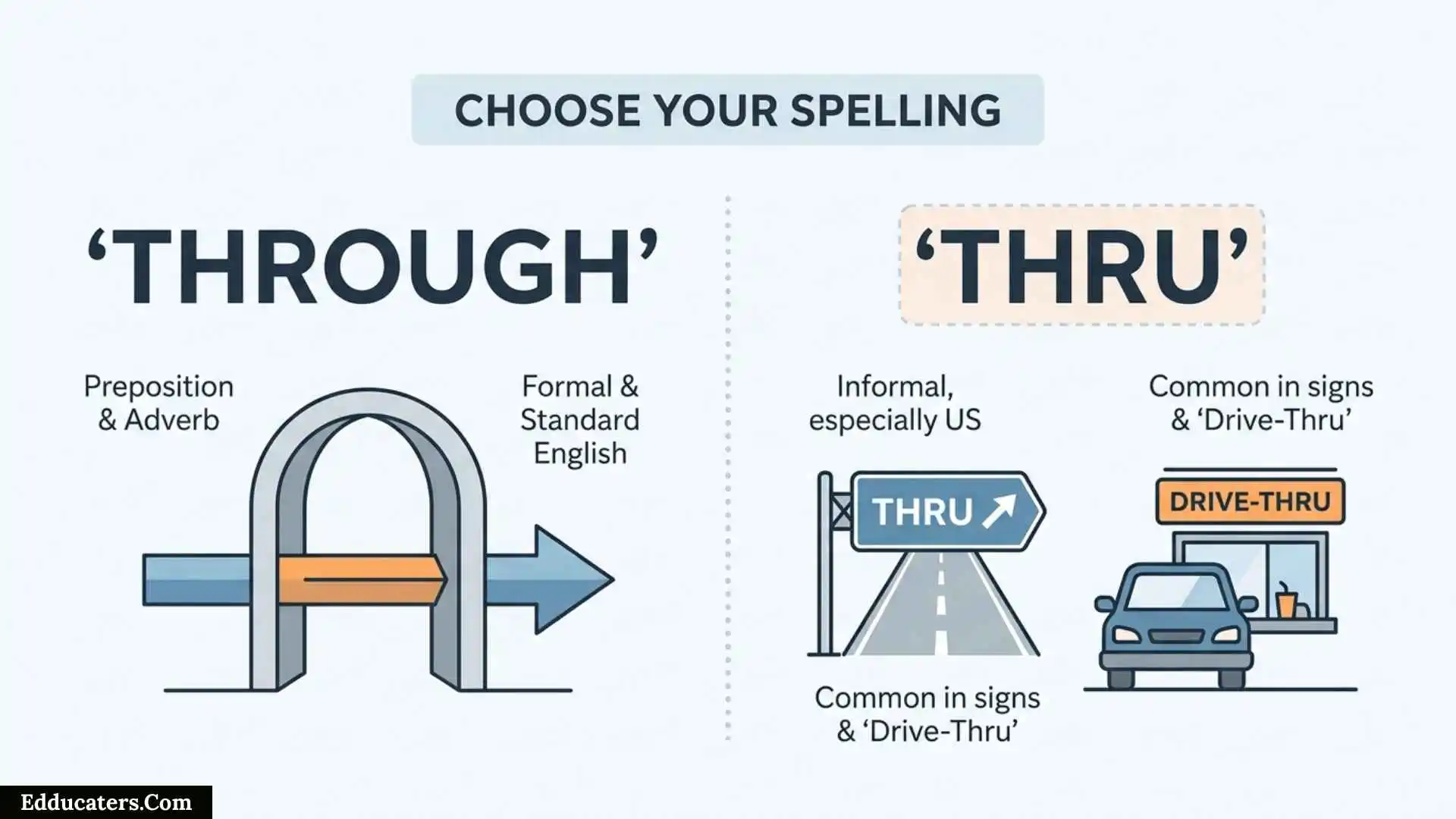
If you are searching for through or thru, you probably want to know one thing first: Which spelling should you use?
The standard answer is through. It is the normal spelling used in essays, business writing, articles, academic work, reports, emails, plus other edited English.
Thru is also a recognized form, but it has a much narrower role. It is mainly an informal North American spelling that appears in signs, advertisements, casual writing, plus expressions such as drive-thru. Cambridge describes thru as another spelling of through used in signs and advertisements, while Oxford labels it North American and informal.
So, if you are writing a sentence such as “She walked ___ the door,” choose through.
If you are looking at a restaurant sign saying drive-thru, the shorter spelling is perfectly familiar.
This guide explains the difference in detail, including meaning, grammar, formal usage, American English, British English, pronunciation, common expressions, the confusion with threw, real-world examples, common mistakes, plus a simple decision framework.
Through or Thru: Quick Answer
Through is the standard spelling for normal English writing.
Thru is an informal spelling used mainly in North American English, particularly on signs, in advertisements, in casual communication, plus in certain established expressions.
| Form | Main use | Formal writing? | Example |
| through | Standard English | Yes | We walked through the park. |
| thru | Informal or commercial usage | Usually no | The restaurant has a drive-thru. |
| threw | Past tense of throw | Yes, when grammatically appropriate | She threw the ball. |
The safest rule
If you are unsure, use through.
It is the standard form and works in virtually every ordinary writing situation.
Use thru only when the informal spelling suits the context, such as a sign, advertisement, established expression, brand name, or casual message.
What Does Through Mean?
Through is a versatile English word. It can function as a preposition, adverb, or adjective, depending on the sentence.
Cambridge gives several meanings related to movement, time, completion, results, methods, plus other contexts.
Through means from one side to another
This is one of its most common meanings.
Examples:
- We walked through the forest.
- The train passed through the tunnel.
- Sunlight came through the window.
- She pushed her way through the crowd.
- The river flows through the city.
Here, through describes movement within or across a space.
Oxford gives similar examples involving roads, windows, crowds, rivers, tunnels, plus other physical routes.
Through can describe a period of time
The word can also describe something that continues from one point in time to another.
Examples:
- He worked through the night.
- The store is open Monday through Friday.
- She stayed there through the summer.
- We talked through the afternoon.
In North American English, Monday through Friday normally includes both Monday plus Friday. Oxford specifically identifies this use of through as an informal alternative to thru in North American English.
Through can describe completion
You can use through when talking about finishing something or reaching the end of an experience.
Examples:
- I need to get through this assignment.
- She read through the report.
- We worked through the problem.
- He made it through a difficult year.
Cambridge records uses involving getting through a day, training period, difficult experience, or another period of time.
Through can describe a method
It can also mean by means of or using something.
Examples:
- She found the job through a friend.
- We communicate through email.
- The company sells its products through local retailers.
- He learned about the event through social media.
This use is especially common in professional writing.
What Does Thru Mean?
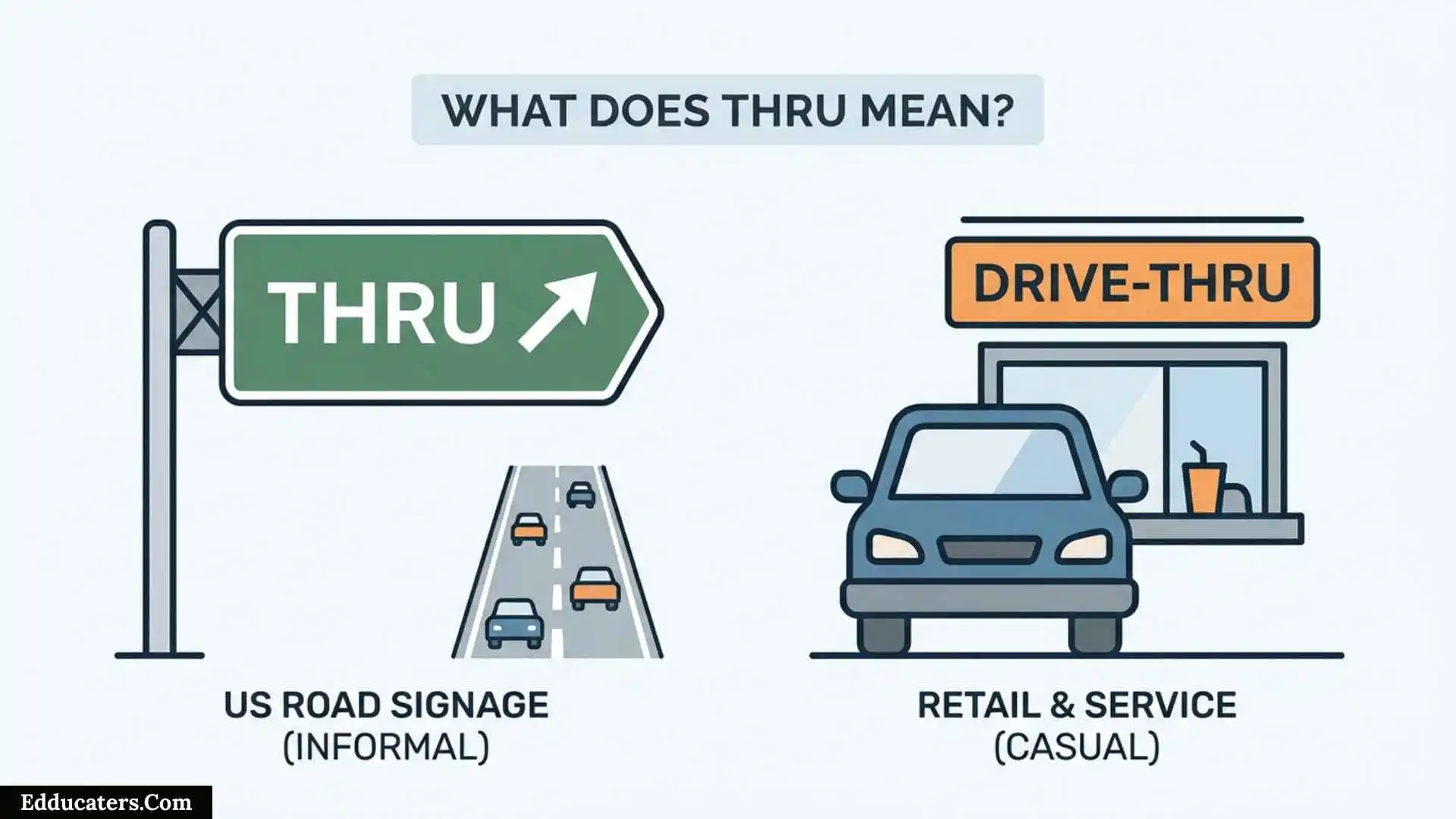
Thru represents the same basic word as through, but it belongs to a different style of English.
Cambridge Learner’s Dictionary labels it mainly US informal and says it is another spelling of through used in signs and advertisements.
Oxford similarly labels thru as North American English, informal.
For example:
We drove through the city.
This is standard written English.
We drove thru the city.
This is understandable, but it looks informal.
The meaning has not changed. The spelling has changed to create a shorter, more casual form.
Why does the shorter form exist?
The main practical advantage is brevity.
Signs have limited space. Advertisements often need short wording. Commercial expressions also tend to favor compact language.
That helps explain forms such as:
- drive-thru
- walk-thru
- no thru traffic
- thru lane
Not every shortened expression is appropriate in formal prose, but some have become familiar enough to appear regularly in public language.
Is Thru a Correct Word?
This question needs a careful answer.
Thru is a recognized English form, but it is not the standard spelling for ordinary formal writing.
Cambridge has a dictionary entry for thru, while Oxford lists it as an informal North American form.
Therefore, two common claims are both misleading:
“Thru is always wrong.”
Too broad.
“Thru is the normal spelling of through.”
Also incorrect.
A better explanation is:
Through is the standard spelling. Thru is an informal variant with specific common uses.
That distinction is important for students, professionals, bloggers, editors, plus anyone learning English.
When Should You Use Through?
Use through when writing standard English.
This includes:
- School assignments
- College essays
- Academic papers
- Business emails
- Reports
- Professional websites
- News articles
- Resumes
- Cover letters
- Legal or official documents
- Instructions
- Books
- Formal correspondence
For example:
Please read through the agreement before signing it.
The full spelling is appropriate because this is normal professional prose.
Another example:
The application must be submitted through the online portal.
Again, through is the natural choice.
Why is through better for formal writing?
Formal writing benefits from standard spelling.
Using thru in a report or academic paper may make the sentence look like casual texting or advertising copy. The reader can still understand it, but the style becomes less polished.
When there is no reason to shorten the word, through is the safer editorial choice.
When Is Thru Appropriate?
There are several situations where thru is natural or established.
Signs and road language
You may encounter:
- No thru traffic
- Thru lane
- Thru road
- Thru street
These forms save space, which is useful on signs.
However, standard edited prose would normally use through.
Restaurant terminology
Drive-thru is one of the most familiar examples.
You may see:
- drive-thru window
- drive-thru service
- drive-thru pickup
- drive-thru restaurant
- drive-thru coffee
Merriam-Webster discusses drive-thru as an established spelling in American usage, while Cambridge lists drive-thru as a related expression under thru.
Casual messages
A person might text:
I will be there thru Friday.
The meaning is clear.
However, if that same sentence appears in a professional email, through would normally be preferable.
Branding
Some businesses intentionally use shortened spellings in names, slogans, product labels, or marketing language.
If a company officially spells something thru, preserve that spelling when referring to the brand.
A brand name is a proper name, so normal spelling preferences do not necessarily apply.
Through or Thru in American English
The distinction is especially noticeable in American English.
Through remains the standard spelling in ordinary prose.
Thru appears more often in commercial language, signs, advertising, plus informal communication.
Cambridge identifies thru as a mainly US informal spelling.
Oxford also describes it as a North American informal form.
One interesting feature of North American English is the expression:
Monday through Friday
This means the period includes Monday, Tuesday, Wednesday, Thursday, plus Friday.
Oxford notes that North American English uses through in this inclusive time expression, while British English can use to or inclusive depending on context.
Through or Thru in British English
British English generally favors through in standard writing.
British readers understand thru, especially when it appears in American commercial language, signs, digital communication, or familiar expressions.
For an international website, however, through is usually the better default.
It is recognizable, standard, plus less likely to look like an abbreviation.
Is Through Pronounced the Same as Thru?
Yes.
Both are pronounced approximately /θruː/.
Oxford gives the pronunciation of through as /θruː/, while Cambridge gives the same pronunciation for thru.
This is one reason spelling confusion happens so easily.
When spoken aloud, the listener normally cannot tell whether the speaker intends the standard spelling or the informal spelling.
The difference becomes visible when the word is written.
Through or Thru: Meaning, Style, and Context
The easiest way to understand the relationship is to separate meaning from style.
| Feature | Through | Thru |
| Basic meaning | Passage, duration, completion, method, plus related uses | Generally the same |
| Standard spelling | Yes | No |
| Formal writing | Recommended | Usually avoided |
| Casual writing | Appropriate | Appropriate |
| Signs | Common | Common in some US contexts |
| Advertising | Common | Common |
| Academic writing | Recommended | Usually avoided |
| American English | Standard | Informal |
| International writing | Safest choice | More context-dependent |
| Drive-thru | Less common in this fixed expression | Very common |
The key point is simple: the difference is mainly one of spelling style and context, not basic meaning.
Through or Thru or Threw?
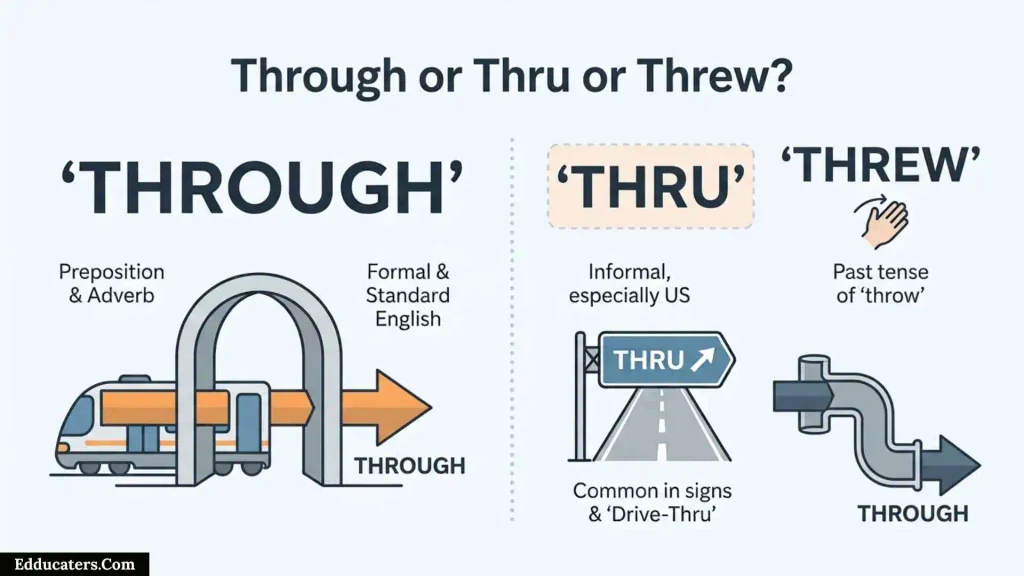
A much more important spelling distinction involves threw.
Although these words sound alike, they do not mean the same thing.
Through
Through refers to passage, movement, time, completion, or a related concept.
We walked through the door.
Thru
Thru is an informal spelling of through.
The sign says no thru traffic.
Threw
Threw is the past tense of throw.
She threw the ball across the field.
These words are homophones: they can sound alike while having different spellings plus meanings.
Oxford explicitly lists threw as a homophone of through.
A sentence containing both forms
She threw the ball through the open window.
Here:
- threw = past action involving throwing
- through = movement from one side to another
That distinction is worth remembering because spell-check tools may not catch every mistake involving homophones.
Common Expressions With Through
Understanding common phrases helps you recognize when through is required.
Go through
I need to go through these documents.
This can mean examine, experience, or move through something.
Get through
We will get through this difficult period.
This can mean survive, complete, or reach the end of something.
Look through
She looked through the photographs.
This means examining a collection of items.
Work through
The team worked through the problem.
This means handling a problem step by step.
Read through
Please read through the instructions.
This means reading something carefully, often from beginning to end.
Through and through
This expression means completely or in every way.
He is a New Yorker through and through.
Cambridge defines through and through as meaning completely.
These expressions normally use through in standard writing.
Common Mistakes With Through and Thru
Mistake 1: Thinking Thru Is Always Wrong
This is too absolute.
Thru is recognized by major dictionaries as an informal spelling.
The better lesson is to understand where it belongs.
Mistake 2: Using Thru in Formal Writing
Writing:
Please send the document thru email.
may be understood, but:
Please send the document through email.
is more appropriate for professional writing.
Mistake 3: Assuming Drive-Thru Makes Thru Formal
The popularity of drive-thru does not mean that thru should replace through everywhere.
Fixed expressions can follow different spelling conventions from ordinary prose.
Mistake 4: Confusing Through With Threw
Remember:
throw → threw
passage → through
Example:
He threw the package through the window.
Mistake 5: Treating Every Short Form as Poor English
Informal language has its own conventions.
The important skill is knowing when an informal form fits the situation.
A Practical Decision Tree
Use this quick guide whenever you are unsure.
Are you writing an essay, report, article, email, application, or other formal text?
→ Use through.
Are you writing a normal sentence for a website or blog?
→ Use through.
Are you creating a sign where space is limited?
→ Thru may be appropriate, depending on the style.
Are you referring to a restaurant service?
→ Drive-thru is a standard familiar expression.
Are you writing a casual text message?
→ Either can work, but through remains the standard spelling.
Is the spelling part of a brand name?
→ Follow the brand’s official spelling.
Are you talking about the past tense of throw?
→ Use threw.
This decision tree solves most real-world cases without requiring complicated grammar rules.
Real-World Examples
The best way to understand the difference is to see how it works in different settings.
Academic example
The study examined how information travels through social networks.
Use through because academic writing requires standard spelling.
Business example
Customers can submit their applications through the company’s online portal.
Again, through is the natural professional choice.
Everyday conversation
We walked through the shopping center before going home.
Standard spelling remains perfectly natural in casual conversation.
Road sign
NO THRU TRAFFIC
A shortened form may be used because signs benefit from compact wording.
Restaurant
Please enter the drive-thru lane.
Here, drive-thru is an established commercial expression.
Casual text
I will be working thru Friday.
This is understandable in an informal message, although through would still be the standard written form.
How Writers Should Choose Between Through and Thru
For most content creators, the best strategy is surprisingly simple.
Use the standard form by default
If there is no specific reason to shorten the word, write through.
This works across audiences, countries, writing styles, plus publishing formats.
Match the spelling to the source
If you are quoting a sign, brand, advertisement, product name, or official label, preserve its original spelling when accuracy matters.
Do not force informal language
Using thru repeatedly just because it is shorter can make an article look less polished.
Informal spelling should have a purpose.
Consider your audience
A US-focused casual advertisement may comfortably use thru.
An international educational article should generally favor through.
That small distinction improves clarity without making the writing complicated.
Does Google Prefer Through or Thru?
There is no useful reason to write thru simply because you think it will improve rankings.
For an SEO article, the priority should be accurate language, helpful information, natural terminology, plus satisfying search intent.
If the search topic is “through or thru,” it is useful to mention both forms because the reader is explicitly asking about both spellings.
But repeating the exact keyword in every paragraph would not improve the article.
A stronger SEO approach is to naturally cover related terms such as:
- standard spelling
- informal spelling
- American English
- British English
- formal writing
- casual writing
- drive-thru
- Monday through Friday
- threw
- homophones
- grammar
- spelling
- signs
- advertisements
- professional writing
This creates broader topical coverage while keeping the article readable.
Key Takeaways
Here are the most important points to remember:
- Through is the standard spelling.
- Thru is an informal spelling used mainly in North American English.
- Thru commonly appears in signs, advertisements, plus casual contexts.
- Drive-thru is a familiar established expression.
- Through is the better choice for academic, professional, plus formal writing.
- Threw is a completely different word: it is the past tense of throw.
- In North American English, Monday through Friday includes both endpoints.
- When you are unsure, choose through.
Frequently Asked Questions
Is through or thru correct?
Both forms exist, but through is the standard spelling. Thru is an informal variant, especially common in North American signs, advertisements, plus casual usage.
Is thru a real English word?
Yes. Major dictionaries recognize thru as a spelling of through, while labeling it informal or nonstandard for ordinary formal prose.
Should I use through in an essay?
Yes. Through is the appropriate choice for school essays, college papers, academic work, plus most edited writing.
Is “Monday thru Friday” correct?
It can appear in informal North American usage, but Monday through Friday is the standard written form.
Is “drive-thru” correct?
Yes. Drive-thru is a widely recognized expression in American English. Cambridge lists it as a related form, while Merriam-Webster discusses its established usage.
Is through a preposition?
Yes. Through can function as a preposition. It can also function as an adverb or adjective depending on the sentence.
Is thru formal English?
Generally, no. It is mainly an informal spelling. Standard formal writing should normally use through.
Is thru used in British English?
British readers understand thru, but through is the safer standard form for British English plus international writing.
Are through and threw homophones?
Yes. They have the same pronunciation but different spellings plus meanings. Oxford identifies threw as a homophone of through.
What is the easiest way to remember the difference?
Use through for normal writing.
Use thru when an informal, commercial, signage, or established expression specifically calls for it.
Use threw when you mean the past tense of throw.
Conclusion
When choosing through or thru, the main difference is not basic meaning. Both forms can represent the same word. The real distinction is standard spelling, formality, audience, plus context.
Through is the reliable choice for essays, professional writing, websites, reports, academic work, plus everyday standard English.
Thru has a legitimate but narrower role. It is especially familiar in North American signs, advertising, casual communication, plus expressions such as drive-thru.
If you are writing for a broad audience or simply want the safest spelling, choose through.
If you see thru on a sign or in a commercial expression, do not automatically assume it is a spelling mistake. In the right context, it is an established informal form.
The most useful rule is simple:
When in doubt, write “through.

Hello, I’m Claire Holloway. I have always been passionate about the English language and enjoy turning complex grammar rules into simple, easy-to-follow lessons. I believe that every learner can become a confident English writer with the right guidance.
I create educational content focused on grammar, vocabulary, sentence structure, and writing improvement. Every article I publish is designed to help readers learn with confidence and accuracy.
Books
Grammar Without Confusion
Modern English Usage Guide
 Julian Mercer