Few grammar hurdles in the English language cause as much frustration as the difference between “lying” or “laying.” Even highly educated writers and professionals stumble over these terms, often because they sound similar and share overlapping meanings in casual speech.
However, in formal writing, they follow strict rules governed by whether the verb requires an object. Understanding the distinction once and for all will sharpen your writing and boost your professional credibility.
Quick Answer: Lying or Laying
The difference depends on whether the verb needs an object. Lying means to recline or rest; it does not take a direct object (you are lying on the bed). Laying means to place or put something down; it requires a direct object (you are laying the book on the table).
At a Glance: Lying or Laying Comparison
| Feature | Lying | Laying |
| Meaning | Reclining or resting | Placing or putting down |
| Direct Object | No (Intransitive) | Yes (Transitive) |
| Part of Speech | Present participle of lie | Present participle of lay |
| Pronunciation | LY-ing | LAY-ing |
| Common Mistake | Using it when moving an object | Using it when referring to oneself |
| Memory Tip | “I lie down to rest” | “I lay the item down” |
| Example | He is lying on the couch. | She is laying the tiles now. |
Also Check This Post: Flyers or Fliers: Simple Rules That Make the Choice Easy
Understanding “Lying”
“Lying” is the present participle of the intransitive verb to lie. An intransitive verb does not transfer action to an object. When you use “lying,” you are describing a state of being or a position rather than an action performed upon an external item.
Usage and Grammar Role
You use “lying” when a person, animal, or thing is in a horizontal position. Because it is intransitive, nothing comes after it to receive the action. You simply exist in that position.
- Example 1: The exhausted hiker is lying under the oak tree.
- Example 2: A pile of old letters was lying on the desk for months.
- Example 3: Stop lying on the floor and help me move this sofa.
Understanding “Laying”
“Laying” is the present participle of the transitive verb to lay. A transitive verb requires a direct object—an item that receives the action. You cannot simply be “laying”; you must be laying something.
Usage and Grammar Role
You use “laying” when you are placing an object into a specific spot. If you can replace the word “laying” with “placing,” you are using the word correctly.
- Example 1: The construction crew is laying the foundation for the new office.
- Example 2: She is carefully laying the tablecloth across the dining table.
- Example 3: Please stop laying your heavy bags on the antique chair.
Key Differences to Remember
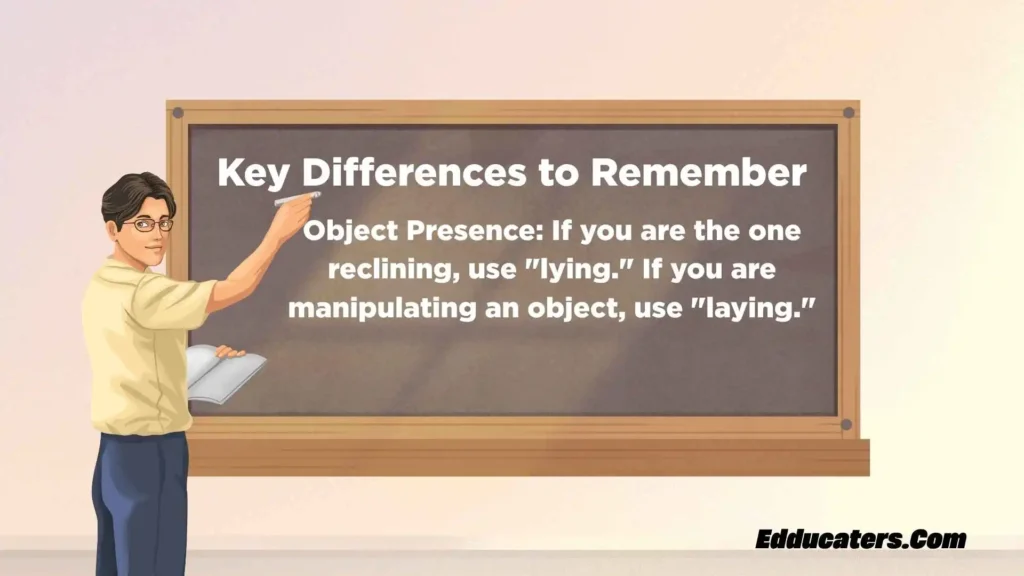
To master these verbs, focus on the presence of an object. Use these bulleted distinctions to simplify your decision-making process:
- Object Presence: If you are the one reclining, use “lying.” If you are manipulating an object, use “laying.”
- The “Place” Test: Mentally replace your word with “placing.” If the sentence still makes sense, use “laying.” If it does not, use “lying.”
- Physical Movement: “Laying” involves an active transfer of an object from one location to another. “Lying” describes the state of something already at rest.
Core Grammar Rules
The confusion often stems from the fact that the past tense of “lie” is “lay.” This creates an overlap that trips up even native speakers.
- Lie (Intransitive):
- Present: Lie
- Past: Lay
- Past Participle: Lain
- Example: I will lie down today. I lay down yesterday. I have lain down often.
- Lay (Transitive):
- Present: Lay
- Past: Laid
- Past Participle: Laid
- Example: I will lay the pen down. I laid the pen down yesterday. I have laid the pen down.
Note: Always remember that “lying” never takes an object, while “laying” must have one.
Professional and Daily Usage
Your choice of words dictates the perceived quality of your communication.
- Academic and Professional Writing: Use precise terminology. In a formal report, saying “the data was laying on the table” is technically incorrect; it should be “the data was lying on the table.”
- Business Emails: Precision prevents misunderstanding. “I am laying out the strategy” is correct because the strategy is the object.
- Daily Conversation: While casual speech often ignores the distinction, mastering the rule builds authority in your professional interactions.
Also Check This Post: In Route or En Route: A Practical Guide to Proper Usage
Common Mistakes Explained
The most frequent error is using “laying” when referring to human rest. People often say, “I am laying in bed,” which is grammatically incorrect because a person cannot “lay” themselves down—they “lie” down.
- Incorrect: The cat is laying in the sun.
- Correct: The cat is lying in the sun.
- Incorrect: He was laying on the sofa when I arrived.
- Correct: He was lying on the sofa when I arrived.
Pro Tip: If you feel the urge to say “laying,” check if there is an object. If there is no object, swap it for “lying.”
20 Original Examples of Proper Usage
- The students are lying on the grass during their lunch break.
- She is laying the bricks with precision to ensure a level wall.
- The heavy antique rug is lying flat in the hallway.
- Please stop laying your coat across the back of my chair.
- Many important documents were lying in the storage room for years.
- The mother is laying the baby in the crib for a nap.
- The landscape architect is laying out the garden path design.
- I am lying here listening to the rain against the window.
- He is laying the groundwork for a successful merger.
- Several stray pens were lying beneath the office desk.
- The technician is laying the new fiber optic cables through the floor.
- A thick layer of dust is lying on the unused bookshelf.
- You should be laying the groundwork for your presentation now.
- The injured bird is lying quietly in a box until the rescue arrives.
- She is laying the final pieces of the puzzle on the table.
- Shadows were lying long across the late afternoon fields.
- The employee is laying out the expectations for the new project.
- I am lying on the beach trying to relax after a long week.
- They are laying a new carpet in the conference room.
- The culprit was lying low to avoid being spotted by authorities.
The “Object” Memory Trick

To never confuse these again, use the Object-Oriented Rule:
Laying needs a Loan (something you give).
Lying needs Leisure (you are resting).
If you are putting something down, you are laying it. If you are just existing in a horizontal position, you are lying there. Think of “laying” as needing a “thing” to work, while “lying” needs only yourself.
Mini Quiz
- Which sentence is correct?
A) I am laying on the bed.
B) I am lying on the bed.
Answer: B - Which sentence is correct?
A) Please start laying the folders on my desk.
B) Please start lying the folders on my desk.
Answer: A - Which verb requires a direct object?
A) Lie
B) Lay
Answer: B - Choose the correct word for: “The dog is ____ in the grass.”
A) Laying
B) Lying
Answer: B - Choose the correct word for: “She is ____ the table for dinner.”
A) Laying
B) Lying
Answer: A
Frequently Asked Questions (FAQs)
Why is it so hard to distinguish between lying and laying?
The confusion stems from the past tense of “lie” being “lay.” This creates a linguistic trap where speakers mistakenly carry that past tense form into the present, leading to frequent misuse. The best way to overcome this is to analyze whether an object is receiving the action in your sentence.
Can I ever use “laying” for a person?
No, a person cannot “lay” themselves down in standard English. You “lie” down. The only exception is if you are placing an object (like a child or an object) into a position. For example, “I am laying the child down” is correct, but “I am laying down” is grammatically incorrect.
What is the “place” test?
The “place” test is a simple way to identify the correct verb. If you can swap the word with “placing” and the sentence remains grammatically correct, you should use “laying.” If “placing” does not fit the context, you likely need the intransitive verb “lying.”
Does this rule apply to American and British English?
Yes, the distinction between the transitive “lay” and the intransitive “lie” is consistent across standard American and British English. While some dialects may use these terms interchangeably, standard formal grammar in both regions requires maintaining the distinction between reclining (lying) and placing an object (laying).
What if I am “laying” low?
Actually, the common idiom is “lying low,” meaning to stay out of sight or avoid attention. Because “low” is not a physical object you are placing somewhere, it is an intransitive state. Therefore, the correct form is “lying low,” not “laying low.”
How can I practice this to improve my writing?
Review your recent emails or essays. Look for every instance of “laying” or “lying.” Check each one to see if an object follows the verb. If you find “laying” without an object, replace it with “lying.” Consistent practice will make this distinction feel intuitive after just a few attempts.
Key Takeaways
- Lying is intransitive and means to recline.
- Laying is transitive and means to place an object.
- “Laying” requires a direct object; “lying” does not.
- The “place” test is the most reliable way to check your work.
- Correct usage boosts professional credibility and ensures clear communication.
Conclusion
Mastering the difference between “lying” or “laying” is a hallmark of strong writing skills. By remembering that “laying” requires an object, a “thing” being placed while “lying” describes the act of reclining, you eliminate the guesswork.
Apply these rules consistently, and you will find that your writing becomes more precise and authoritative. Next time you hesitate, simply ask yourself: “Am I placing an object, or am I resting?” If you are resting, you are definitely lying down.
Also Check This Post: Suppose to or Supposed to: Common Mistakes to Avoid

Hello, I’m Claire Holloway. I have always been passionate about the English language and enjoy turning complex grammar rules into simple, easy-to-follow lessons. I believe that every learner can become a confident English writer with the right guidance.
I create educational content focused on grammar, vocabulary, sentence structure, and writing improvement. Every article I publish is designed to help readers learn with confidence and accuracy.
Books
Grammar Without Confusion
Modern English Usage Guide
 Nathan Whitmore
 Julian Mercer