Have you ever paused mid-sentence, wondering whether you should write “towards” or “toward”? If you find yourself frequently hitting the backspace key to toggle between these two words, you are not alone. This subtle linguistic dilemma trips up even the most experienced writers. While both terms essentially mean the same thing, the choice often depends on where you live and the tone you wish to convey.
Understanding the nuance between these two prepositions will help you polish your writing and communicate with greater precision. In this guide, we will break down the history, regional preferences, and grammatical rules surrounding these two words so you can choose the right one with absolute confidence.
Quick Answer: Towards or Toward
Both toward and towards are grammatically correct and interchangeable. The primary difference is regional: toward is the standard form in American English, while towards is more common in British English. Regardless of geography, both function as prepositions indicating movement or direction in relation to a specific point.
Comparison at a Glance
| Feature | Toward | Towards |
| Primary Region | United States / Canada | United Kingdom / Australia |
| Meaning | In the direction of | In the direction of |
| Part of Speech | Preposition | Preposition |
| Grammar Rule | Standard in North America | Standard in Commonwealth English |
| Formality | Neutral / Formal | Neutral / Formal |
| Pronunciation | /tɔːrd/ or /təˈwɔːrd/ | /təˈwɔːrdz/ |
| Common Mistake | Using it as an adjective | Using it as an adjective |
| Memory Tip | “No ‘s’ for U.S.” | “S for States abroad” |
Defining the Terms
What is Toward?
Toward is a preposition used to indicate movement in the direction of something or someone. It implies a sense of orientation. In North American English, this is the preferred spelling for almost all professional and academic writing. It carries a clean, concise aesthetic that aligns with the general preference for brevity in American style guides.
What is Towards?
Towards holds the exact same definition as its counterpart. It serves the same function—identifying a physical or abstract trajectory. The “s” at the end is a relic of older English forms, and while it is often criticized by some American editors as being “extra,” it remains perfectly standard and acceptable in international contexts, particularly throughout the United Kingdom and Commonwealth nations.
Key Differences Explained
The distinction between these two words is entirely stylistic and geographical rather than functional.
- Geographic Preference: You will rarely encounter the “s” version in a formal American publication, such as a major US newspaper. Conversely, removing the “s” in British English might strike some readers as an Americanism.
- Physical vs. Abstract: Both words work equally well when describing physical movement (“We walked toward the park”) or abstract goals (“We are making progress toward our target”).
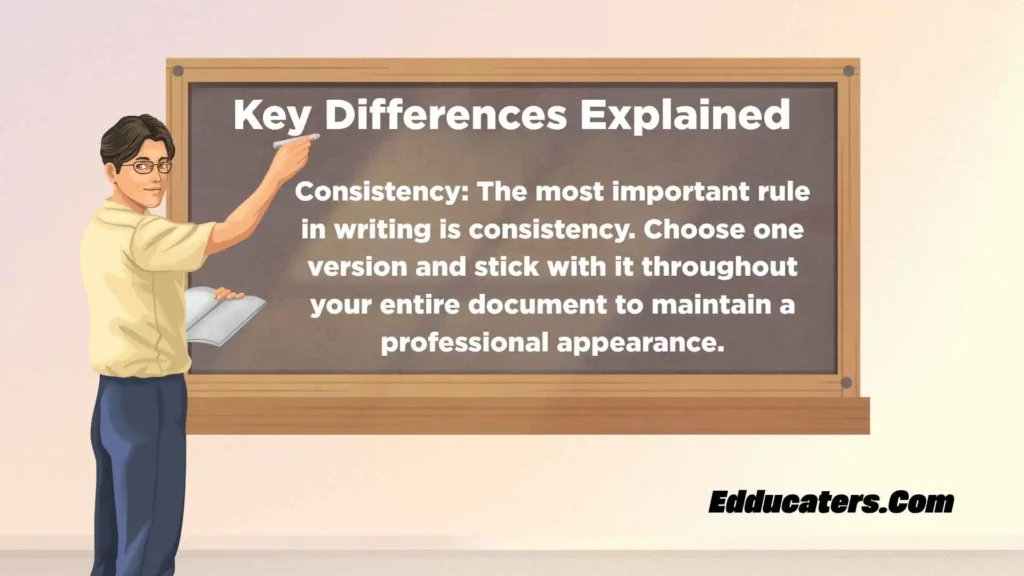
- Consistency: The most important rule in writing is consistency. Choose one version and stick with it throughout your entire document to maintain a professional appearance.
Grammar Rules and Exceptions
There are no complex grammatical laws dictating when to use one over the other. The rule is simple: use the version that matches your target audience.
However, keep in mind that neither word should be used as an adjective. You cannot have a “toward path.” Furthermore, both words should only be used as prepositions. If you are expressing a desire for something to happen, you would use the verb “to want” or “to aim for,” not “toward.”
Contextual Usage Guidelines
Academic and Professional Writing
In academic papers, your choice should align with the style guide you are following. If you are submitting a manuscript to an American university, use toward. If you are writing for a British journal, use towards. Always check the publication’s specific style manual (e.g., APA, MLA, or Chicago), as they often explicitly state a preference.
Business and Emails
In international business, both are accepted. If your recipient is in London, towards feels natural. If your email is heading to a New York office, toward is the safer, more localized choice. In daily office communication, the discrepancy rarely causes confusion, but consistency remains the hallmark of a polished professional.
Common Mistakes to Avoid
The most common mistake is believing that one form is “wrong.” Many writers worry they are committing a grave grammatical error by adding or omitting the “s.”
- The “Adjective” Trap: People sometimes mistakenly use these words to describe a state of being.
- Incorrect: “The toward result was expected.”
- Correct: “The result toward which we worked was expected.”
- Regional Inconsistency: Mixing them within the same paragraph can make your writing look unedited. Choose one and commit to it.
Original Examples for Every Situation
- Workplace: We are working toward a more inclusive company culture.
- School: The students walked towards the library after the bell rang.
- Conversation: Could you move a little toward the light so I can see you?
- Business: Our investment strategy is geared toward long-term growth.
- Books: She felt an intense pull towards the mysterious door at the end of the hall.
- News: The committee is making strides toward a new policy.
- Social Media: We are inching towards our goal of ten thousand followers!
- Everyday English: Please push the chair toward the table.
- Professional: The organization remains committed toward environmental sustainability.
- Academic: This study contributes toward a better understanding of cellular biology.
- Casual: Are you heading toward the exit yet?
- Formal: The diplomat signaled a shift towards a more cooperative stance.
- Instructional: Tilt the screen toward the viewer for a better angle.
- Creative: He looked towards the horizon, searching for a sign of home.
- Technical: The sensor adjusts toward the heat source automatically.
Memory Trick: The “U.S.” Method
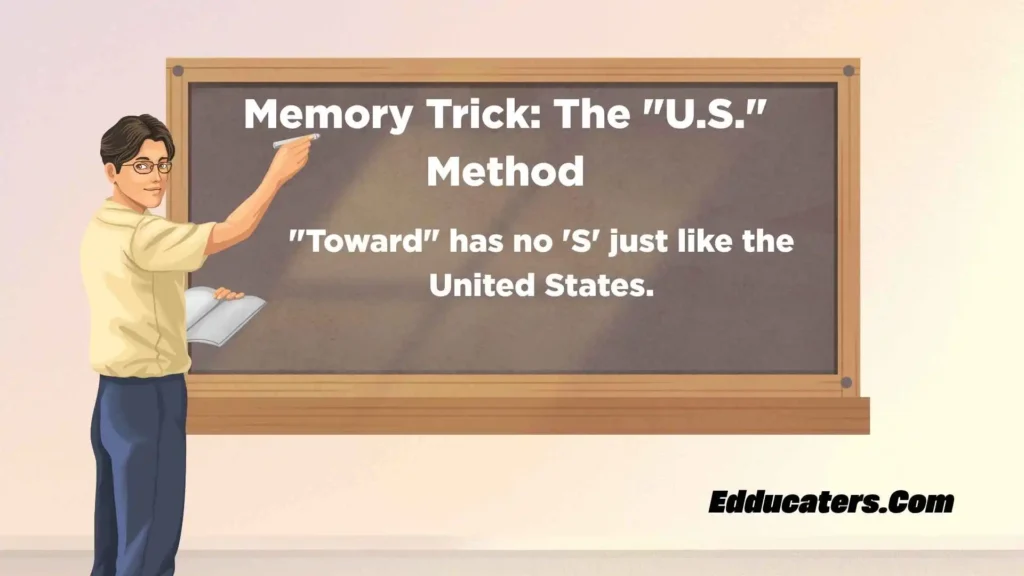
If you ever find yourself struggling to remember which to use, follow this simple mnemonic:
“Toward” has no ‘S’ just like the United States.
If you are writing for an American audience, keep the “s” away. If you are writing for anywhere else, feel free to use the “s.”
Mini Quiz: Test Your Knowledge
- Which is the preferred spelling in the United States?
a) Towards
b) Toward
c) Both are equally preferred
d) Neither
Answer: b - Which is more common in British English?
a) Toward
b) Towards
c) Neither
d) Only “to”
Answer: b - Can you use these words as adjectives?
a) Yes
b) Only in casual speech
c) No
d) Only in formal writing
Answer: c - What is the best way to maintain consistency?
a) Alternate every other sentence
b) Use both within the same paragraph
c) Choose one and use it throughout the document
d) Use the one that sounds better to you at the moment
Answer: c - Are these words interchangeable in meaning?
a) Yes
b) No
c) Only in formal writing
d) Only in academic writing
Answer: a
Frequently Asked Questions (FAQs)
Is one word more formal than the other?
No, both “toward” and “towards” are considered equally formal. The distinction is strictly geographical rather than a matter of register. Neither word is inherently more professional or more casual, so you can use your preferred spelling in any professional context without concern for your perceived level of formality.
Does changing from “toward” to “towards” change the meaning?
No, the meaning remains identical. Whether you include the “s” or not, the preposition signifies movement or orientation in the direction of a target. You are describing the same physical or metaphorical trajectory regardless of the spelling you choose. The difference is purely a matter of regional convention.
Should I use “toward” or “towards” in a resume?
On a resume, you should use the spelling that matches the location of the company you are applying to. Use “toward” for companies based in the United States or Canada. Use “towards” if you are applying for roles in the United Kingdom, Australia, or other Commonwealth countries to align with local expectations.
Are there any style guides that forbid one or the other?
Yes, specific style guides have firm preferences. For example, the Associated Press Stylebook, which governs most American journalism, explicitly mandates “toward.” Always consult the style guide required by your employer or publication to ensure you are compliant with their specific editorial standards and formatting preferences.
Can I use both in the same document?
It is highly recommended that you do not. Mixing spellings can make your writing appear inconsistent or poorly proofread. Even though both are correct, pick one version at the start of your writing process and maintain that choice throughout the entire text to demonstrate attention to detail and professional control.
Why does the “s” exist in “towards”?
The “s” is a historical artifact. Historically, English speakers frequently added the “s” to prepositions and adverbs to signify direction or movement. While most of these have fallen out of use, “towards” survived as a standard variant in British English, while American English tended to drop the “s” in favor of a shorter, more simplified form.
Key Takeaways
- Interchangeability: “Toward” and “towards” are synonyms and are both grammatically correct.
- Geography Rules: Use “toward” in American/Canadian English; use “towards” in British/Commonwealth English.
- Consistency: Always maintain one spelling throughout your entire document.
- No Adjective Use: Avoid using either word to describe a noun; they are prepositions.
- Style Guides: Always defer to the specific style guide (APA, Chicago, AP) required by your project or publisher.
Conclusion
Deciding between toward or towards is one of the easiest stylistic choices you will make as a writer, provided you know your audience. By opting for “toward” when addressing an American audience and “towards” for international or British readers, you demonstrate a keen awareness of language conventions.
Remember, consistency is the ultimate key to professional writing. Choose the version that fits your context, apply it uniformly, and focus your energy on the content of your message.

I’m Julian Mercer, an English language writer dedicated to helping people master grammar through practical examples and clear explanations. I enjoy teaching grammar in a way that is both engaging and easy to remember.
My work focuses on grammar rules, punctuation, word usage, and writing techniques that readers can apply in everyday life. I believe learning English should be simple, enjoyable, and useful.
Books
English Grammar in Practice
Writing with Precision
 Nathan Whitmore
 Claire Holloway