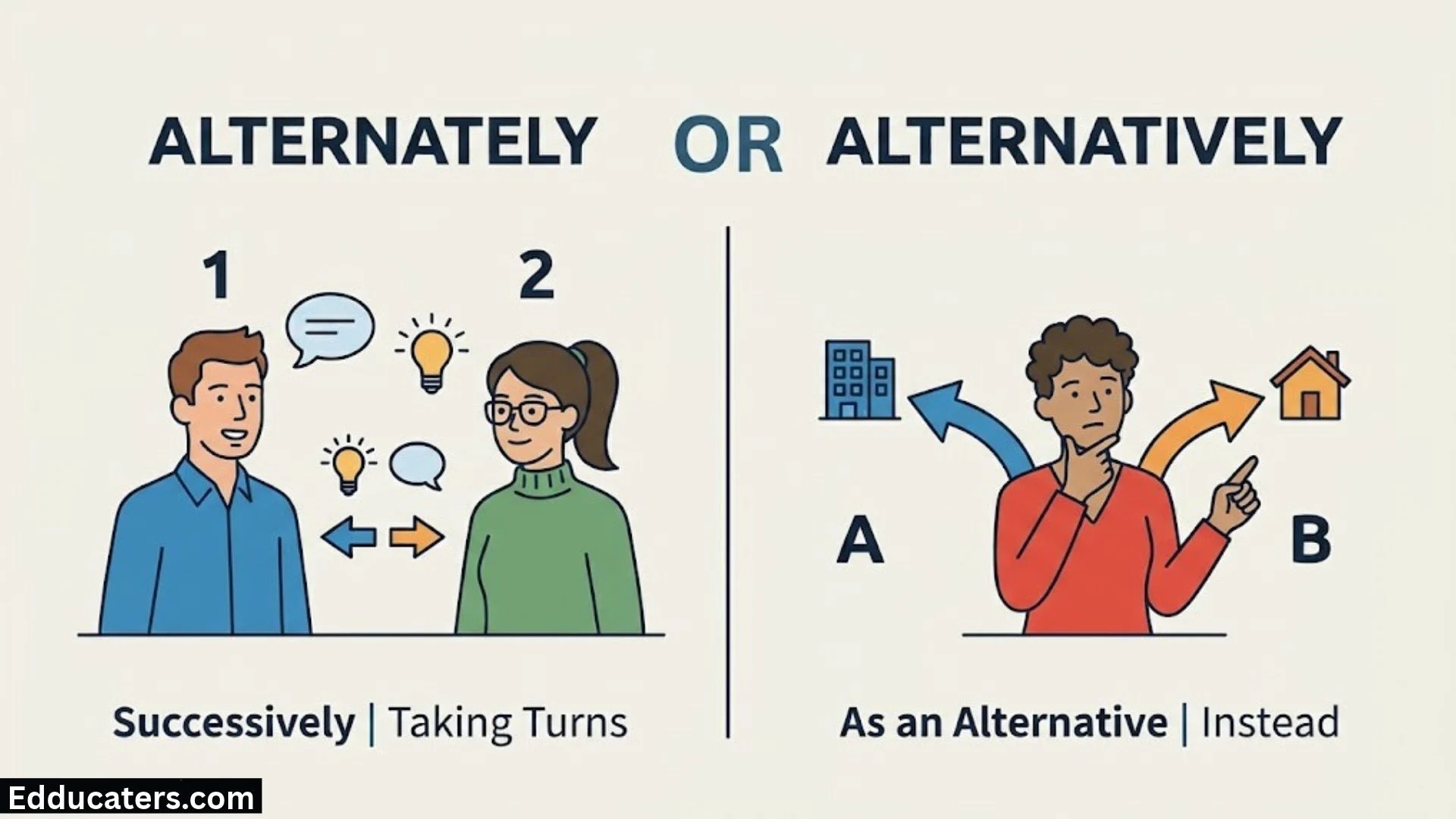
Have you ever stopped while writing because you couldn’t decide between alternately or alternatively? These two words look similar and belong to the same word family. However, they usually express different ideas. Choosing the right one can make your writing clearer and prevent confusion.
Alternately means taking turns or happening in a changing sequence. Alternatively means presenting another option, possibility, or course of action.
For example, you might write, “The lights flashed red and blue alternately.” The lights change in sequence. Now consider this sentence: “We could drive to the beach. Alternatively, we could take the train.” Here, the second sentence introduces another way to travel.
Both words are correct in standard English. The difference lies in their meanings and how you use them in a sentence.
This guide explains the difference between alternately or alternatively, their definitions, grammatical roles, common mistakes, synonyms, and practical examples. By the end, you’ll know which word fits your sentence and why.
Alternately or Alternatively: What’s the Difference?
The main difference between alternately or alternatively is the relationship each word expresses.
Alternately describes actions, events, or conditions that occur by turns or follow one another in a changing sequence. Alternatively introduces another choice, method, or possible course of action.
Here’s a quick way to remember the distinction:
- Alternately: Taking turns or changing in sequence.
- Alternatively: Another option or possibility.
Consider these examples:
- Alternately: The two musicians played the piano and guitar alternately throughout the performance.
- Alternatively: We could attend the concert in person. Alternatively, we could watch the live stream at home.
In the first sentence, the musicians switch between instruments. In the second, the writer presents two possible ways to enjoy the performance.
Both sentences mention different possibilities, but only the second uses the word to introduce a choice.
Quick Comparison Table
| Feature | Alternately | Alternatively |
| Main meaning | By turns or in a changing sequence | As another option or possibility |
| Part of speech | Adverb | Adverb |
| Main purpose | Describes how something happens | Introduces another possible action |
| Common contexts | Repeated actions, changing conditions, alternating patterns | Decisions, suggestions, solutions, and plans |
| Example | The lights flashed red and blue alternately. | Alternatively, we could use green lights. |
| Memory clue | Taking turns | Another choice |
The easiest way to choose between these words is to focus on the intended meaning. If things take turns, alternately is usually appropriate. If you’re offering another option, alternatively is generally the better choice.
What Does Alternately Mean?
Alternately is an adverb that describes something happening by turns or in a sequence where one thing follows another. It often refers to two actions, people, objects, or conditions that switch places or change repeatedly.
For example:
“The two drivers operated the vehicle alternately during the long journey.”
This sentence means that the drivers took turns driving. One drove for a period before the other took over.
The word can also describe changing feelings, weather conditions, colors, sounds, and repeated processes. For instance, someone might feel alternately excited and nervous, while a warning light might flash red and blue alternately.
The important point is that alternately describes a pattern or sequence rather than simply introducing a choice.
Alternately Definition and Part of Speech
The word alternately functions as an adverb. It comes from alternate, a word associated with taking turns, switching between things, or following a recurring sequence.
Understanding this word family can make the difference easier to remember.
- Alternate: To take turns or switch between things; it can also describe something that occurs by turns.
- Alternation: A process or pattern in which things change between states or positions.
- Alternating: Changing between two or more things in a sequence.
- Alternately: In a manner that involves taking turns or alternating.
Here are examples of each form:
- We alternate between morning and evening shifts.
- The schedule follows an alternating pattern.
- The alternation between warm and cold weather continued for days.
- The employees covered the shifts alternately.
Each word has a different grammatical role, but all relate to the general idea of alternating.
The word alternate can also refer to a substitute or replacement, particularly in American English. This additional meaning sometimes causes confusion between alternate and alternative. However, the usual distinction between alternately or alternatively remains useful.
When to Use Alternately
Use alternately when you want to describe actions, events, or conditions that take turns or occur in a changing sequence.
Several common situations call for this word.
When people take turns
- The two students answered the teacher’s questions alternately.
- The siblings read chapters aloud alternately.
- The players served alternately during practice.
These examples describe people sharing an activity by taking turns.
When lights, colors, or signals change
- The warning lights flashed red and blue alternately.
- The display showed bright and dark patterns alternately.
- The indicator switched between green and amber lights alternately.
Here, the word describes a changing sequence rather than a choice between colors.
When conditions change repeatedly
- The weather was alternately sunny and cloudy.
- She felt alternately hopeful and anxious before the interview.
- The temperature rose and fell alternately throughout the afternoon.
These examples show that alternately can describe changing states, emotions, and physical conditions.
When tasks or processes follow a sequence
- The machine heated and cooled the samples alternately.
- The chef added flour and milk alternately to the mixture.
- The two teams worked on the project alternately.
In each case, the word describes how the actions occur.
Alternately in a Sentence: Practical Examples
The following examples show how to use alternately in a sentence.
| Example sentence | Meaning |
| The two drivers operated the vehicle alternately. | They took turns driving. |
| The lights flashed red and blue alternately. | The colors appeared in a changing sequence. |
| The movie was alternately funny and heartbreaking. | Its tone shifted between two qualities. |
| The children answered the teacher alternately. | They took turns answering. |
| The temperature alternately rose and fell throughout the day. | The temperature repeatedly changed. |
| The musicians performed alternately on the piano and guitar. | The instruments took turns being used. |
| She felt alternately hopeful and anxious. | Her feelings changed between two states. |
| The machine heated and cooled the material alternately. | The two processes occurred in turn. |
Notice that alternately doesn’t always require two people or objects. It can describe feelings, qualities, temperatures, and stages of a process.
The word often suggests a recurring pattern, although the sequence doesn’t have to occur at perfectly equal intervals. The surrounding sentence determines how the reader understands the pattern.
What Does Alternatively Mean?
Alternatively is an adverb that introduces another possibility, choice, method, or course of action. It tells the reader that a different option is available.
For example:
“You can submit the application online. Alternatively, you can deliver it to the office.”
The second sentence offers another way to submit the application. It doesn’t mean that online submission and office delivery must take turns.
In everyday English, alternatively often appears at the beginning of a sentence. It can also appear elsewhere when the writer wants to introduce another possibility without starting a new sentence.
The word is especially useful when explaining plans, presenting solutions, comparing methods, or discussing different ways to achieve a goal.
Alternatively Definition and Part of Speech
The word alternatively functions as an adverb. It comes from alternative, which commonly refers to another available choice or a different option.
The related words include:
- Alternative: A different choice or option.
- Alternatively: As another possibility or in place of another option.
- Alternatives: Two or more available choices.
- Alternative method: A different way to achieve something.
Consider these examples:
- We need an alternative to the current plan.
- An alternative method might save time.
- Alternatively, we could change the plan entirely.
The first sentence identifies a need for another choice. The second describes a different method. The third introduces another possible action.
These words frequently appear in business proposals, academic discussions, travel plans, and everyday conversations because people regularly compare possible courses of action.
When to Use Alternatively
Use alternatively when you want to introduce another option rather than describe actions taking turns.
When suggesting another method
- You can contact customer support by phone. Alternatively, you can send an email.
- We could repair the computer. Alternatively, we could replace it.
The second sentence in each example offers another way to handle the situation.
When presenting a backup plan
- If the train is delayed, we can take a taxi. Alternatively, we can wait for the next service.
- If the venue becomes unavailable, we can book a nearby hotel. Alternatively, we can move the event online.
Here, the writer provides another possible response to a problem.
When explaining choices in professional writing
- Employees may submit their forms electronically. Alternatively, they may deliver printed copies.
- The company could extend the deadline. Alternatively, it could reduce the project’s scope.
The word helps organize options without requiring a lengthy explanation.
When offering a different solution
- You can use a spreadsheet to track expenses. Alternatively, a budgeting app may work better.
- Students can complete the assignment individually. Alternatively, they can work in small groups.
In each case, the word signals a different approach to the same general goal.
Alternatively in a Sentence: Practical Examples
These examples demonstrate how to use alternatively in a sentence.
| Example sentence | Meaning |
| You can call the office. Alternatively, you can send an email. | Another communication method |
| We could drive to the beach. Alternatively, we could take the train. | Another way to travel |
| Submit the form online. Alternatively, deliver it in person. | Another submission method |
| We can postpone the meeting. Alternatively, we can hold it virtually. | Another scheduling option |
| You could cook dinner at home. Alternatively, you could order takeout. | Another meal plan |
| Students may complete an online survey. Alternatively, they may submit a paper form. | Another way to participate |
| The company could repair the equipment. Alternatively, it could replace it. | Another solution |
| You can save the file locally. Alternatively, you can store it in the cloud. | Another storage option |
You can use alternatively in formal and informal writing. In casual conversations, or or instead may sound more natural. In a formal explanation, alternatively can make the relationship between choices clearer.
Where Should Alternatively Appear in a Sentence?
You can place alternatively in different positions depending on your sentence structure.
At the beginning of a sentence
“Alternatively, you can request a refund.”
This position clearly introduces another possibility.
After the subject
“You could alternatively request a refund.”
This version integrates the adverb into the sentence rather than using it as a transition between sentences.
After presenting an initial option
“You can request a replacement or alternatively ask for a refund.”
This construction is possible, although the sentence may sound cleaner as “You can request a replacement or ask for a refund.” When or already makes the choice clear, adding alternatively may be unnecessary.
For clear, natural writing, use the word when it adds meaning or helps readers follow your ideas.
Alternately or Alternatively: How to Choose the Correct Word
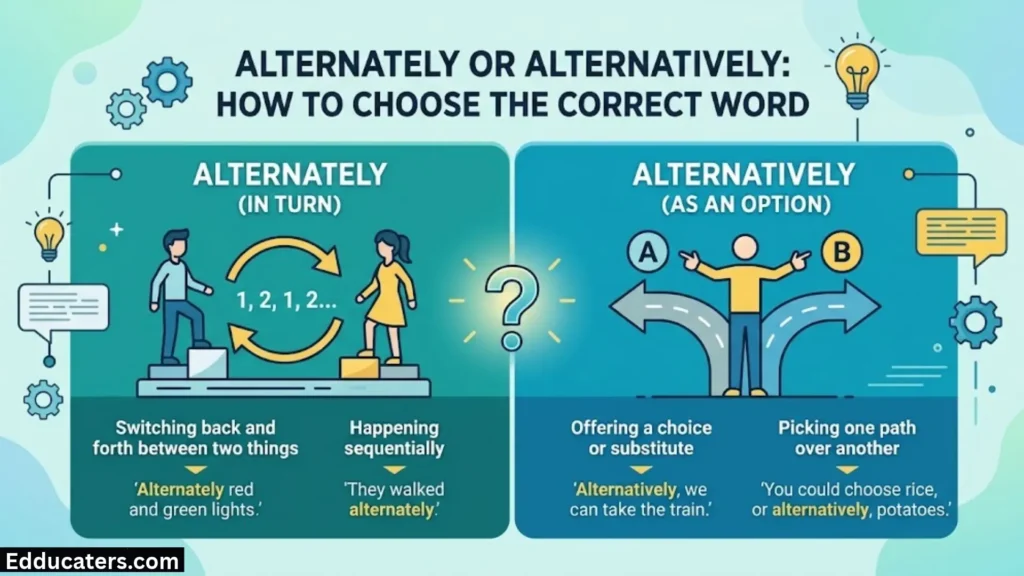
When you’re unsure which word to use, don’t focus on how similar they look. Focus on the relationship between the ideas in your sentence.
Ask yourself one question: Am I describing a sequence, or am I offering a choice?
If you’re describing actions that take turns or conditions that keep changing, alternately will usually fit. If you’re presenting another possible action, alternatively is generally the better choice.
Use Alternately for Taking Turns
The word alternately works when the sentence describes one thing followed by another in a recurring sequence.
For example:
- The two teachers led the discussion alternately.
- The lights flashed red and green alternately.
- The weather was alternately warm and cold.
Each sentence describes a pattern. The teachers take turns, the lights change in sequence, and the weather shifts between conditions.
Remember that alternately doesn’t necessarily mean that two actions happen at exactly equal intervals. The important point is that they alternate.
Use Alternatively for Another Option
Choose alternatively when you’re introducing a different possibility.
For example:
- You can walk to the station. Alternatively, you can take the bus.
- We could revise the proposal. Alternatively, we could prepare a new one.
- You can pay by credit card. Alternatively, you can use a bank transfer.
Each sentence presents another course of action. The reader can choose between the available options.
A Simple Memory Trick
Here’s an easy way to remember the difference:
- Alternately = alternating turns.
- Alternatively = an alternative choice.
The related words provide a helpful clue. Alternate commonly relates to taking turns, while alternative commonly refers to another option.
However, don’t rely on the word endings alone. Always check the sentence’s intended meaning.
Try this quick test:
| Sentence | Correct choice | Reason |
| The two players served ___ during practice. | Alternately | They took turns serving. |
| We can take the bus. ___, we can walk. | Alternatively | Walking is another option. |
| The temperature was ___ hot and cold. | Alternately | The conditions changed. |
| You can call the office. ___, send an email. | Alternatively | Email is another possible method. |
This approach works in most everyday situations and helps you avoid common mistakes.
Alternately or Alternatively Examples Compared
Sometimes definitions aren’t enough. Comparing similar sentences makes the difference easier to recognize because you can see exactly how the intended meaning changes.
Alternating Actions or Alternative Choices
Consider these two sentences:
Sentence A: Maya and Liam read the paragraphs alternately.
Sentence B: Maya can read the paragraph. Alternatively, Liam can read it.
In Sentence A, Maya and Liam take turns reading. In Sentence B, the writer presents two possible choices about who will read.
The same distinction appears in many everyday situations.
| Context | Using alternately | Using alternatively |
| Driving | The two drivers operated the car alternately. | We could drive ourselves. Alternatively, we could hire a driver. |
| Cooking | The chef added flour and milk alternately. | We could bake a cake. Alternatively, we could make cookies. |
| Work | The employees covered the shifts alternately. | We could extend the shifts. Alternatively, we could hire temporary staff. |
| Studying | The students took turns reading and summarizing. | You could study alone. Alternatively, you could join a study group. |
| Transportation | The two buses operated alternately on the route. | We could take the bus. Alternatively, we could use the subway. |
The transportation example in the first column describes a recurring arrangement. The second column presents separate possibilities.
Everyday Situations
Imagine you’re planning a weekend trip.
You might write:
“The two friends drove alternately throughout the journey.”
This means they shared the driving by taking turns.
Now consider a different sentence:
“The friends could drive to the mountains. Alternatively, they could take a train.”
This sentence presents two ways to reach the destination.
The same rule applies to communication, meals, meetings, and household tasks. If you describe a pattern of changing activities, consider alternately. If you offer another method, consider alternatively.
Describing Changing Conditions
These words can also affect descriptions of feelings, weather, and other changing conditions.
- Alternately: The sky was alternately bright and overcast.
- Alternatively: We could wait for the weather to improve. Alternatively, we could move the event indoors.
The first sentence describes changing weather. The second offers another plan.
Notice that the distinction isn’t about the subject itself. Both sentences discuss weather-related circumstances, yet they perform different functions.
Common Mistakes With Alternately or Alternatively
The most common errors occur when writers use one word to express the meaning of the other. Fortunately, a few simple adjustments can make your writing clearer.
Using Alternately When You Mean Instead
Suppose you write:
“We can drive to the beach. Alternately, we can take the train.”
Your intended meaning is clear enough, but alternatively is the more direct choice because the second sentence introduces another option.
A clearer version is:
“We can drive to the beach. Alternatively, we can take the train.”
The distinction matters because alternately generally describes a sequence or arrangement involving turns. It doesn’t ordinarily serve as the best transition when you simply want to propose a different plan.
Using Alternatively to Describe Repeated Actions
Consider this sentence:
“The warning lights flashed red and blue alternatively.”
If the lights repeatedly switched between red and blue, alternately expresses that pattern more directly.
Write:
“The warning lights flashed red and blue alternately.”
The sentence now emphasizes the changing sequence rather than suggesting a choice between two possibilities.
Confusing Alternatively With Instead
The words alternatively and instead often overlap, but their usual functions differ slightly.
Alternatively introduces another available possibility. Instead often emphasizes replacing one action or choice with another.
Compare these examples:
- “You can call the office. Alternatively, you can send an email.”
- “You can send an email instead of calling the office.”
Both sentences describe similar options. However, the first presents email as another possibility, while the second emphasizes choosing email in place of a phone call.
You can often replace alternatively with instead if you adjust the sentence structure.
For example:
- “Alternatively, we could postpone the meeting.”
- “We could postpone the meeting instead.”
Both are possible, although the second sentence needs an earlier context to clarify what the postponement replaces.
Assuming the Two Words Are Always Interchangeable
Similar spelling doesn’t guarantee identical meaning. That’s true of many commonly confused English words, including affect and effect or compliment and complement.
With alternately or alternatively, the intended relationship between ideas determines the better choice.
Use this editing checklist:
- Does the sentence describe people or actions taking turns?
- Does it describe a recurring sequence or changing condition?
- Does it introduce another option or solution?
- Would by turns clarify the meaning?
- Would as another option clarify the meaning?
If by turns fits, alternately is often appropriate. If as another option fits, alternatively is usually the better choice.
Can You Use Alternatively Instead of Instead?
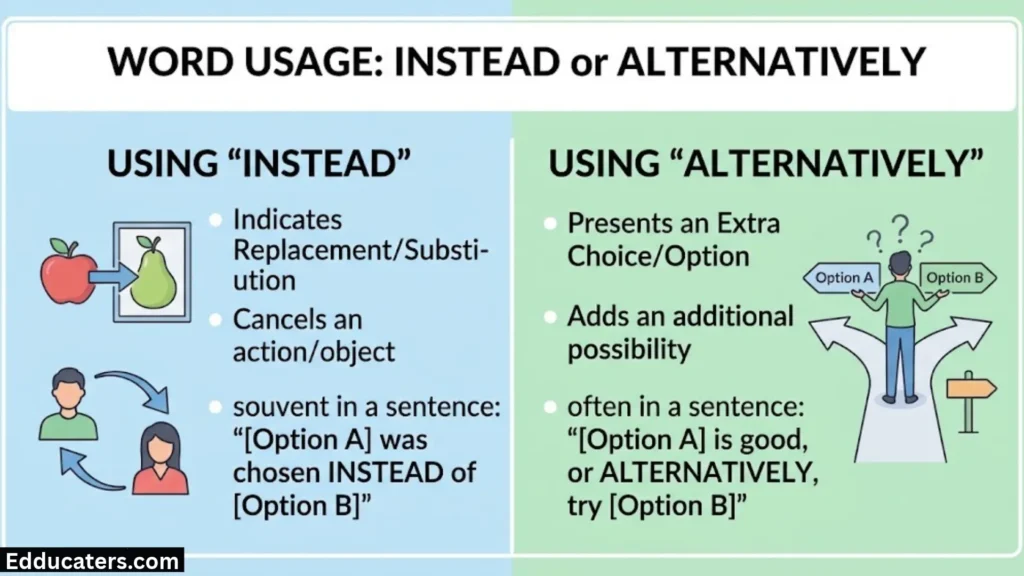
Yes, you can often use alternatively instead of instead, especially when presenting a different possible action. However, the sentence structure and intended meaning still matter.
Consider these examples:
- “You can email the document. Alternatively, you can upload it.”
- “You can upload the document instead of emailing it.”
The first sentence presents two possible methods. The second emphasizes replacing email with an upload.
Here’s another example:
- “Alternatively, we could meet on Friday.”
- “We could meet on Friday instead.”
Both can work when the context already establishes another proposed date. The first introduces Friday as another possibility. The second suggests Friday in place of the earlier arrangement.
When you’re editing, consider the emphasis you want to create:
| Expression | Main emphasis | Example |
| Alternatively | Another possibility | Alternatively, we could meet online. |
| Instead | Replacement or substitution | We could meet online instead. |
| As another option | An additional choice | As another option, we could meet online. |
| Otherwise | A different outcome or an alternative in suitable contexts | We should leave now; otherwise, we’ll miss the train. |
These expressions can overlap, but they aren’t identical in every context. In particular, otherwise can describe the consequence of failing to do something, as the final example shows.
Is “Alternatively Cheaper” Correct?
The phrase “alternatively cheaper” is generally awkward when you simply want to say that another product costs less.
The problem isn’t that the adverb alternatively is inherently ungrammatical near an adjective. Rather, alternatively doesn’t ordinarily mean more cheaply or at a lower price.
Consider these examples:
Awkward for the intended meaning:
“This model is alternatively cheaper.”
Clearer alternatives:
- “This model is cheaper.”
- “A cheaper alternative is available.”
- “Alternatively, you could choose the less expensive model.”
- “This model offers a more affordable option.”
Each improved sentence communicates the intended price comparison more naturally.
The difference becomes clearer when you separate the adverb from the related noun and adjective.
- Alternatively: Introduces another possibility.
- Alternative: Refers to another available choice.
- Cheaper: Compares the prices of two or more things.
For example, “Alternatively, you could buy the cheaper model” works because the adverb introduces another possible action. The adjective cheaper describes the model’s price.
When discussing prices, use cheaper, less expensive, or more affordable to express the comparison directly.
What Is the Difference Between Alternate or Alternative?
Understanding alternate or alternative helps explain why alternately or alternatively have different meanings.
Although the words belong to the same family, alternate or alternative don’t always perform the same grammatical role.
Alternate Meaning and Examples
Alternate can function as a verb, adjective, or noun, depending on the sentence.
As a verb, it means to take turns or switch between things.
- “We alternate between morning and evening shifts.”
- “The instructor alternates lectures with practical exercises.”
- “Her mood alternates between excitement and frustration.”
As an adjective, alternate can describe something occurring by turns or every other time.
- “The clinic opens on alternate Saturdays.”
- “The team follows an alternate-week schedule.”
In American English, alternate can also mean a substitute or replacement.
- “The organizer selected an alternate speaker.”
- “We chose an alternate route because of road construction.”
This last meaning overlaps with alternative. That’s an important exception to remember: alternate or alternative can sometimes serve similar purposes, particularly when describing substitutes or options.
Alternative Meaning and Examples
Alternative commonly functions as a noun or adjective.
As a noun, it means another available choice.
- “We need an alternative to the current schedule.”
- “Taking the train is a practical alternative to driving.”
As an adjective, it describes another possible choice or approach.
- “The team developed an alternative plan.”
- “We considered an alternative route.”
The adverb alternatively introduces another possibility:
- “We could follow the original route. Alternatively, we could take the highway.”
The key distinction remains useful:
| Word | Typical meaning | Example |
| Alternate (verb) | To take turns or switch | We alternate between shifts. |
| Alternate (adjective) | Occurring by turns or serving as a substitute | We selected an alternate route. |
| Alternative (noun) | Another available choice | We need an alternative. |
| Alternative (adjective) | Providing another choice | We considered an alternative plan. |
| Alternately (adverb) | By turns or in a changing sequence | The lights flashed alternately. |
| Alternatively (adverb) | As another possibility | Alternatively, we could leave earlier. |
The distinction isn’t an absolute rule for every use of alternate or alternative. Usage can overlap, particularly in American English. Still, the traditional distinction provides a reliable starting point for choosing the right word.
Alternately or Alternatively in American and British English
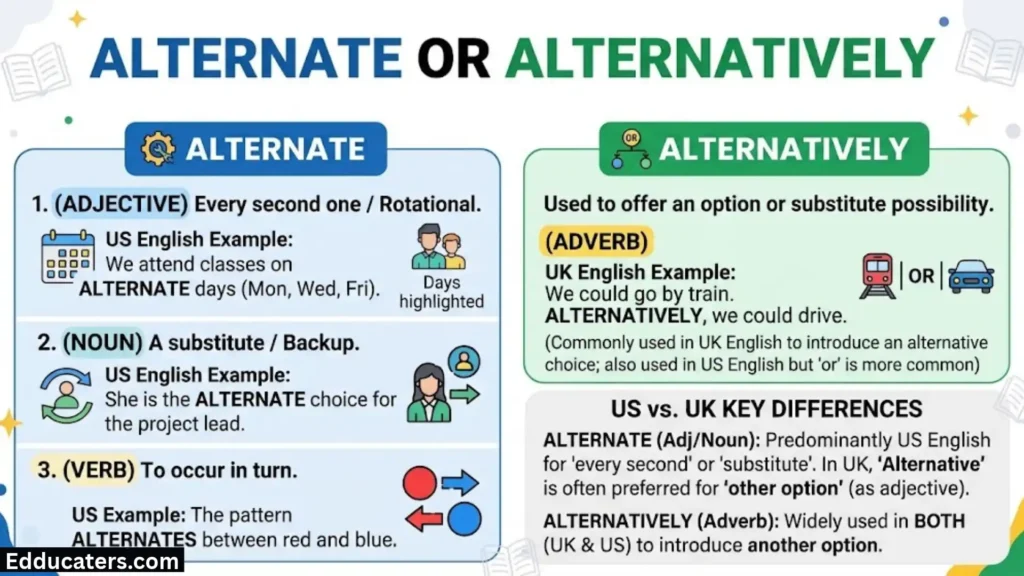
Writers sometimes wonder whether alternately or alternatively follow different rules in American English and British English. The short answer is no: both words are standard in both varieties, and their central meanings remain broadly consistent.
You don’t need to change alternately to alternatively when switching between American and British English. Instead, choose the word that matches your intended meaning.
For example:
- American English: The lights flashed red and blue alternately.
- British English: The lights flashed red and blue alternately.
- American English: Alternatively, we could take the bus.
- British English: Alternatively, we could take the bus.
The same distinction applies to Canadian and Australian English in ordinary usage.
The confusion comes from meaning, not regional spelling. Both words have established spellings, and neither is an incorrect regional variant of the other.
Synonyms for Alternately or Alternatively
Synonyms can make your writing more varied, but not every related expression fits every sentence. Choose a replacement based on the meaning you want to preserve.
Synonyms for Alternately
The following expressions can communicate the idea of taking turns or following a changing sequence.
| Synonym or expression | Example |
| By turns | The speakers answered the questions by turns. |
| In turns | The children took turns reading aloud. |
| In rotation | The employees worked in rotation. |
| Back and forth | The pendulum swung back and forth. |
| In an alternating sequence | The colors appeared in an alternating sequence. |
| One after another | The performers entered one after another. |
These expressions aren’t interchangeable in every context. For example, one after another can describe a series of events without suggesting that they repeatedly switch between two things.
Similarly, back and forth emphasizes movement or repeated switching, while in rotation often describes an organized arrangement.
The expression alternatingly also exists, but it can sound less natural than alternately in many everyday sentences. Prefer the more familiar wording when it communicates your meaning clearly.
Synonyms for Alternatively
These expressions can introduce another possibility, depending on the sentence.
| Synonym or expression | Example |
| Instead | We could walk instead. |
| As another option | As another option, we could take the train. |
| As an alternative | As an alternative, consider a different route. |
| Another possibility | Another possibility is to postpone the meeting. |
| As another approach | As another approach, try simplifying the process. |
| Otherwise | We should leave now; otherwise, we’ll miss the train. |
Notice that otherwise doesn’t always mean the same thing as alternatively. It can introduce a consequence or explain what happens if a condition isn’t met.
For example, “You should wear a coat; otherwise, you’ll feel cold” describes a possible consequence. It doesn’t simply introduce another option.
When choosing a synonym for alternatively, check the sentence’s purpose rather than replacing the word automatically.
Frequently Asked Questions About Alternately or Alternatively
Is alternately the same as alternatively?
No, not in their usual meanings. Alternately describes actions or conditions that take turns or follow one another in a changing sequence. Alternatively introduces another choice or possibility. Although their meanings can overlap in some contexts, they aren’t generally interchangeable.
Can alternately mean alternatively?
Sometimes readers may understand the intended meaning from context, but alternately isn’t usually the best substitute for alternatively when presenting a choice. Use alternately for a sequence and alternatively for another possible course of action.
Can I use alternatively instead of instead?
Yes, often. Both words can introduce a different action or possibility. However, instead frequently emphasizes replacement, while alternatively presents another option. Choose the expression that fits your sentence structure and intended emphasis.
Which word is more common?
Neither word is universally preferable in every context. Their frequency depends on the type of writing and what the writer wants to express. A sentence describing alternating conditions naturally favors alternately, while a sentence presenting another solution naturally favors alternatively.
Is alternatively cheaper correct?
The phrase is generally awkward if you mean that another item costs less. Write “This model is cheaper” or “A cheaper alternative is available.” You can also write, “Alternatively, you could choose the less expensive model.”
When should you use alternately?
Use alternately when two or more actions, events, or conditions take turns or occur in a changing sequence. For example, “The lights flashed red and blue alternately” describes a recurring pattern.
When should you use alternatively?
Use alternatively when introducing another option, method, or possible course of action. For example, “You can call the office. Alternatively, you can send an email” presents two ways to communicate.
Is there a British or American difference?
No major difference affects the central meanings of these words. Both alternately or alternatively are standard in American and British English. Choose the word according to its meaning, not the regional variety you’re writing in.
What is the difference between alternate or alternative?
Alternate can describe taking turns or something serving as a substitute. Alternative commonly means another choice or option. For example, “We alternate shifts” describes a recurring pattern, while “We need an alternative” identifies another possible choice.
How can I remember the difference?
Use this simple memory aid: alternately means taking turns, while alternatively means another option. If the sentence describes a changing sequence, consider alternately. If it presents a different possibility, choose alternatively.
Conclusion: Alternately or Alternatively?
The difference between alternately or alternatively becomes simple once you focus on the sentence’s meaning.
Use alternately when people, actions, or conditions take turns or change in a recurring sequence. Use alternatively when you introduce another choice, method, or possible course of action.
Remember these examples:
- “The lights flashed red and blue alternately.” The colors changed in sequence.
- “We could drive to the beach. Alternatively, we could take the train.” The second sentence offers another option.
Before choosing a word, ask yourself whether you’re describing a pattern or presenting a choice. That small check can prevent a common writing mistake and make your meaning clearer.

I’m Julian Mercer, an English language writer dedicated to helping people master grammar through practical examples and clear explanations. I enjoy teaching grammar in a way that is both engaging and easy to remember.
My work focuses on grammar rules, punctuation, word usage, and writing techniques that readers can apply in everyday life. I believe learning English should be simple, enjoyable, and useful.
Books
English Grammar in Practice
Writing with Precision
 Nathan Whitmore