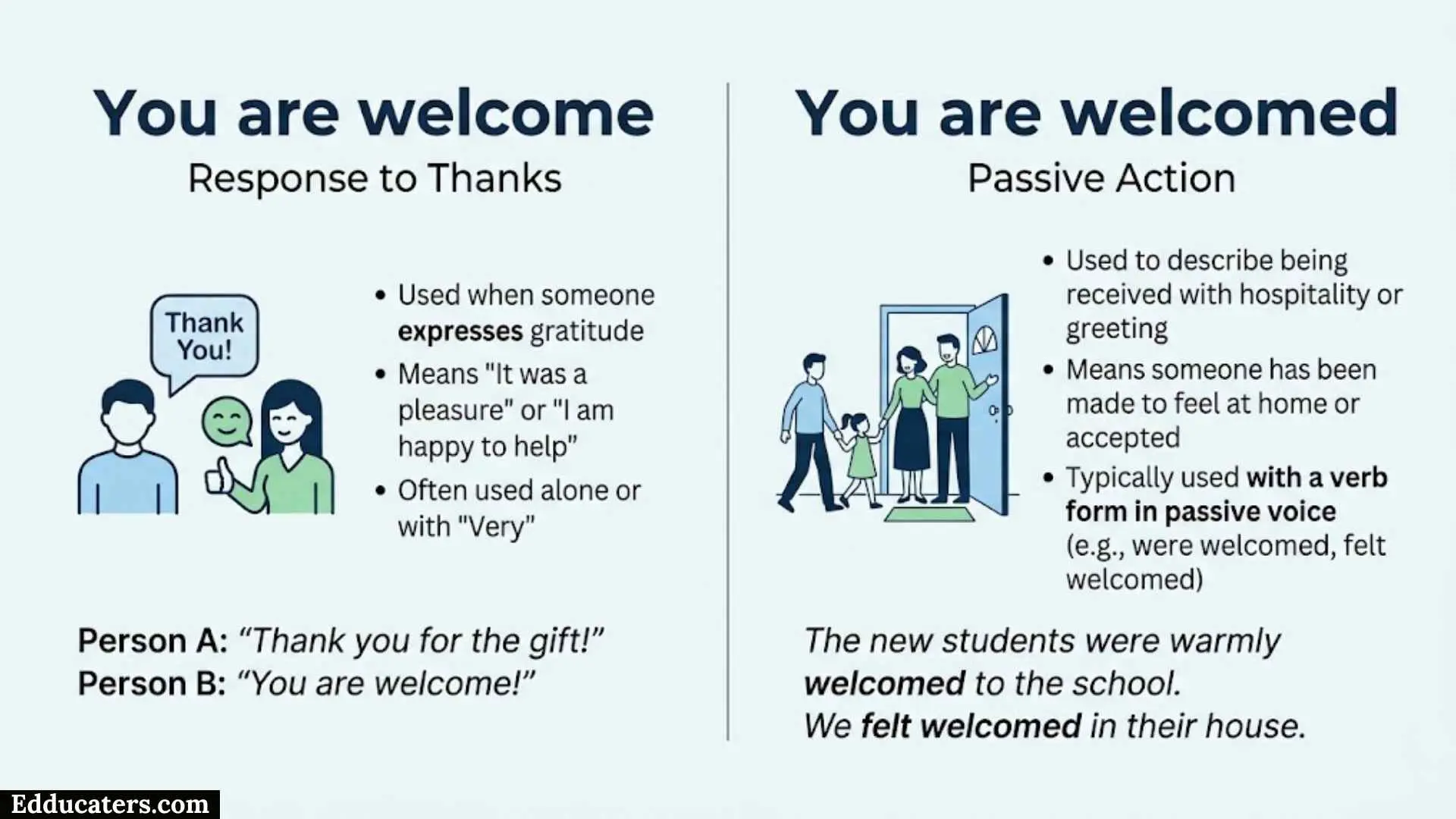
If someone says “Thank you,” the standard response is “You are welcome” or the more common contraction “You’re welcome.” This is the established English expression used to respond politely when someone thanks you.
“You are welcomed” is also grammatically possible, but it has a different structure and meaning. It uses welcomed as the past participle of the verb welcome, usually in a passive construction. It is not the normal phrase to use after someone says “thank you.”
The difference becomes much easier to understand once you look at how welcome or welcomed function in a sentence. Welcome can be an adjective, verb, noun, and part of a fixed expression, while welcomed is the past tense and past participle of the verb welcome.
You Are Welcome or You Are Welcomed: The Main Difference
The choice depends on what you are trying to say.
You are welcome is the correct and natural expression when responding to someone’s thanks:
“Thank you for helping me.”
“You are welcome.”
More commonly in everyday conversation:
“Thank you for helping me.”
“You’re welcome.”
Cambridge Dictionary identifies you’re welcome as an idiom used as a polite answer when someone thanks you. Oxford Learner’s Dictionaries gives the same usage and provides the example “Thanks for your help.” “You’re welcome.”
You are welcomed, on the other hand, normally describes someone being received, accepted, or greeted in a particular way:
“You are welcomed by the staff when you arrive.”
Here, welcomed is the past participle of the verb welcome. The sentence is passive: someone welcomes you, so you are welcomed.
When to Use “You Are Welcome”
Use you are welcome when you want to:
- respond to “thank you”
- tell someone they are accepted or wanted somewhere
- give permission in the expression “you are welcome to…”
- describe something as acceptable or gladly received
For example:
“Thank you for your help.”
“You are welcome.”
Or:
“You are welcome here anytime.”
Or:
“You are welcome to join us.”
In these examples, welcome is not functioning as the past form of a verb. It is part of the adjective construction be welcome, or you’re welcome is also a fixed polite expression. Cambridge and Oxford both recognize these uses.
When to Use “You Are Welcomed”
Use you are welcomed when the sentence describes an action performed toward someone.
For example:
“You are welcomed by the host when you arrive.”
This means that the host welcomes you.
Other examples include:
“Guests are welcomed by friendly staff.”
“New members are welcomed into the organization.”
“Visitors are warmly welcomed at the entrance.”
In each sentence, welcomed describes what someone does to the guests, members, or visitors.
The form welcomed is the past simple and past participle of the verb welcome. Cambridge Dictionary explicitly lists welcomed as the past simple and past participle form of welcome.
Why “You’re Welcome” Is the Normal Reply to “Thank You”
The phrase you’re welcome has a special conversational function in English. It is not simply a random combination of you, are, and welcome. It is an established expression used to acknowledge someone’s thanks.
Consider this conversation:
“Thank you for carrying my bags.”
“You’re welcome.”
The speaker is not saying that the other person has been welcomed into a place. Instead, the speaker is politely responding to the person’s gratitude.
Cambridge defines you’re welcome specifically as a polite answer when someone thanks you for doing something.
This is why you’re welcomed sounds incorrect in that situation:
“Thank you for helping me.”
“You’re welcomed.”
The problem is not that welcomed is an invalid English word. It is a perfectly valid word. The problem is that it does not belong in this particular fixed expression.
The natural response is:
“You’re welcome.”
Not:
“You’re welcomed.”
“You’re” Does Not Mean “Your”
Another common source of confusion is the difference between you’re and your.
You’re is a contraction of you are.
You’re welcome.
You are welcome.
Your is a possessive determiner.
Your welcome was very warm.
These are different grammatical structures.
For example:
“Thank you for helping me.”
“You’re welcome.”
Here, you’re means you are.
But:
“Your welcome made the new employees feel comfortable.”
Here, your indicates possession. It refers to the welcome that you gave.
A simple test is to replace you’re with you are. If the sentence still works, you’re is probably correct.
You’re welcome.
You are welcome.
Both work.
But:
Your welcome.
Changing your to you are would produce:
You are welcome.
That is a different grammatical construction and potentially a different meaning.
Welcome or Welcomed Have Different Grammatical Roles
Understanding the word welcome itself makes the difference much clearer.
Welcome as an Adjective
Welcome can function as an adjective meaning accepted, wanted, gladly received, or pleasing.
For example:
“You are welcome here.”
“Everyone is welcome at the event.”
“Your suggestions are welcome.”
“The extra help was welcome.”
Oxford defines welcome as an adjective for people who are accepted or wanted somewhere and also uses the adjective for things that someone is pleased to receive or have.
This adjective use is central to the expression you are welcome.
Welcome as a Verb
Welcome can also be a verb.
It can describe greeting someone in a friendly way:
“The host welcomed the guests.”
It can also mean accepting, supporting, or being pleased about something:
“The committee welcomed the opportunity.”
“The community welcomed the new facility.”
Cambridge lists these verb meanings, including meeting someone in a friendly way and being pleased about or supporting something.
The verb produces forms such as:
- welcome
- welcomes
- welcomed
- welcoming
For example:
“They welcome visitors.”
“She welcomed the guests.”
“They are welcoming new members.”
Welcomed as the Past Form of Welcome
Welcomed is the past simple and past participle of welcome.
Compare:
Present: The host welcomes every guest.
Past: The host welcomed every guest.
Passive: Every guest was welcomed by the host.
Because welcomed is a verb form, it can appear in passive constructions:
“The visitors were welcomed by the director.”
“The new students were welcomed by their classmates.”
“The proposal was welcomed by the committee.”
Cambridge gives examples of welcomed being used for both people and ideas or decisions.
Examples of “You Are Welcome” in Different Situations
The expression you are welcome has more than one useful application.
Responding to Thanks
This is the most common situation:
“Thank you for explaining that.”
“You’re welcome.”
“Thank you for waiting.”
“You’re welcome.”
“Thanks for sending me the information.”
“You’re welcome.”
In everyday conversation, you’re welcome is usually more natural than the fully expanded you are welcome.
Telling Someone They Are Accepted
You can also use you are welcome to tell someone that they are wanted or accepted in a particular place.
“You are welcome in our home anytime.”
“You are always welcome here.”
“Everyone is welcome at the meeting.”
This use is different from the response to “thank you,” although the wording is identical.
Oxford gives examples such as “Children are always welcome at the hotel” and “New members are welcome at the club.”
Giving Permission
The construction you are welcome to + verb means that someone is free or invited to do something.
“You are welcome to stay for dinner.”
“You are welcome to use my computer.”
“You are welcome to contact us if you have questions.”
Cambridge and Oxford both document be welcome to do something as a way of telling someone that they can certainly do something if they want to.
This is an important distinction because welcome does not always relate to gratitude.
Examples of “You Are Welcomed” in Context
Although you are welcomed is not the standard response to “thank you,” it can be correct when the sentence describes someone being welcomed.
Passive Reception of a Person
“You are welcomed by the staff as soon as you enter.”
This means the staff welcome you.
A more natural version in many everyday situations might be:
“The staff welcome you as soon as you enter.”
Or:
“You are warmly welcomed by the staff.”
The passive construction is grammatically valid, but whether it sounds natural depends on the context.
Guests and Visitors
“Visitors are welcomed with refreshments.”
“Guests are welcomed at the front desk.”
“New employees are welcomed by their colleagues.”
Here, welcomed describes an action directed toward another person.
Ideas, Decisions, and Changes
Welcome can also mean to support or be pleased about something. As a result, welcomed can describe a positive reaction to an idea, decision, change, or opportunity.
“The announcement was welcomed by local residents.”
“The new policy was welcomed by many employees.”
“The opportunity was welcomed by the students.”
This use is different from physically greeting someone. Cambridge gives examples such as a decision being welcomed by everybody and an appointment being widely welcomed.
“You Are Welcome” or “You Are Welcomed” in Formal Writing
Both expressions can occur in formal English, but they serve different purposes.
If you are writing a formal email responding to someone’s thanks, use:
“You are welcome.”
For example:
“Thank you for providing the requested information.”
“You are welcome. Please let me know if you need anything else.”
However, if you are describing how visitors are received, welcomed may be appropriate:
“All visitors are welcomed by a member of the reception team.”
You might also see:
“New participants are warmly welcomed.”
The choice is therefore determined by meaning rather than by whether the sentence is formal or informal.
Common Mistakes With Welcome or Welcomed
Several mistakes occur because welcome, welcomed, you’re, and your look or sound similar in certain contexts.
Mistake: “Thank You.” “You’re Welcomed.”
Incorrect as the conventional response:
“Thank you.”
“You’re welcomed.”
Correct:
“Thank you.”
“You’re welcome.”
The word welcomed is not wrong in itself. It is simply the wrong form for this fixed expression.
Mistake: “Your Welcome” as a Reply to Thanks
Another common error is:
“Your welcome.”
When replying to “thank you,” write:
“You’re welcome.”
Remember:
you’re = you are
your = possessive
So:
“You’re welcome.”
means:
“You are welcome.”
Mistake: Thinking “Welcomed” Is Always Wrong
It would also be incorrect to conclude that welcomed should never be used.
These sentences are correct:
“The guests were welcomed warmly.”
“The proposal was welcomed by the team.”
“New students were welcomed at the orientation.”
The word is completely legitimate when it is the past or past participle form of the verb welcome.
The issue is simply choosing the form that fits the sentence.
You’re Welcome, You Are Welcome, and Other Responses to Thanks
There are several ways to respond when someone thanks you.
You’re Welcome
This is the standard, widely recognized expression:
“Thanks for your help.”
“You’re welcome.”
Cambridge and Oxford both identify it as a polite response to thanks.
You Are Welcome
The full form is also correct:
“Thank you for your assistance.”
“You are welcome.”
In ordinary conversation, the contraction you’re welcome is generally more natural.
My Pleasure
“Thank you for helping me.”
“My pleasure.”
This emphasizes that the speaker was happy to help.
No Problem
“Thanks for picking me up.”
“No problem.”
This is more conversational and can be appropriate in casual situations.
Of Course
“Thank you for taking care of that.”
“Of course.”
This can sound warm and reassuring when the speaker considers the help natural or expected.
The best response depends on the situation, relationship, and tone. But none of these alternatives changes the central distinction: the conventional phrase is you’re welcome, not you’re welcomed.
Pronunciation of Welcome or Welcomed
Welcome is pronounced approximately:
/ˈwel.kəm/
The first syllable sounds like wel, while the second is a reduced kuhm sound. Cambridge lists this pronunciation for both British and American English.
Welcomed adds the -d ending:
welcome → welcomed
The pronunciation difference is small but important in connected speech.
You’re welcome is commonly pronounced as a smooth phrase rather than as three strongly separated words.
For spelling purposes, remember that welcomed contains the complete word welcome followed by -d:
welcome + d = welcomed
The spelling does not change the final e.
A Simple Decision Guide
If you are unsure which form to use, ask what your sentence means.
Are you responding to “thank you”?
Use:
You’re welcome.
Are you saying that someone is accepted or wanted somewhere?
Use:
You are welcome here.
Are you giving someone permission to do something?
Use:
You are welcome to join us.
Are you describing someone being greeted or received?
Use:
You are welcomed by the host.
Are you describing a positive reaction to an idea, decision, or change?
Use:
The decision was welcomed by the public.
This distinction eliminates most confusion between you are welcome and you are welcomed.
Frequently Asked Questions
Is “you are welcome” correct?
Yes. You are welcome is correct English. It is commonly used as a polite response to thanks, and it can also mean that someone is accepted, wanted, or free to do something.
Is “you are welcomed” grammatically correct?
Yes, it can be grammatically correct, but it has a different function. Welcomed is the past participle of the verb welcome and can be used in passive constructions, such as “You are welcomed by the staff.”
Should I say “you’re welcome” or “you’re welcomed”?
Say you’re welcome when responding to “thank you.” You’re welcomed is not the standard expression for responding to thanks.
Why is “you’re welcome” correct after “thank you”?
You’re welcome is an established English idiom used as a polite response when someone thanks you. Both Cambridge and Oxford dictionaries document this specific use.
Is “your welcome” correct?
Your welcome can be grammatically possible when your is a possessive determiner and welcome is a noun, but it is not the correct response to “thank you.” The normal response is you’re welcome.
Can “welcomed” be used for things as well as people?
Yes. Welcome as a verb can describe a positive response to an idea, decision, opportunity, or change.
For example:
“The decision was welcomed by employees.”
Cambridge documents this use of welcome or welcomed.
What is the difference between “welcome” or “welcomed”?
Welcome can be an adjective or the base form of the verb. Welcomed is the past simple and past participle form of the verb welcome.
Compare:
“You are welcome here.”
“The guests were welcomed by the host.”
Is “you are welcome to” correct?
Yes. You are welcome to + verb is a standard construction used to give permission or indicate that someone is free to do something.
“You are welcome to ask questions.”
“You are welcome to stay.”
Both Cambridge and Oxford document this construction.
Is “you are welcomed here” correct?
It can be grammatically correct, but you are welcome here is usually the more natural way to tell someone that they are accepted or wanted in a place.
You are welcomed here emphasizes the action of someone welcoming the person and is more likely to occur in a passive construction with an agent or context.
What is the correct reply to “Thank you”?
The standard reply is:
You’re welcome.
You can also say you are welcome, my pleasure, no problem, or another suitable response depending on the context and tone.
Conclusion
The correct choice between you are welcome or you are welcomed depends on the meaning of the sentence.
When someone says “Thank you,” the standard response is “You’re welcome” or “You are welcome.” This is an established polite expression, not “You’re welcomed.”
Welcomed is nevertheless a correct English word. It is the past simple and past participle of the verb welcome and is used when someone or something is greeted, received, accepted, or positively supported.
Compare these two sentences:
“Thank you for helping me.” — “You’re welcome.”
“The guests were welcomed by the host.”
The first uses welcome in the conventional response to thanks. The second uses welcomed as a verb form describing an action.
A useful rule to remember is simple: respond to “thank you” with “you’re welcome,” but use “welcomed” when you are describing someone or something being welcomed.

Hello, I’m Claire Holloway. I have always been passionate about the English language and enjoy turning complex grammar rules into simple, easy-to-follow lessons. I believe that every learner can become a confident English writer with the right guidance.
I create educational content focused on grammar, vocabulary, sentence structure, and writing improvement. Every article I publish is designed to help readers learn with confidence and accuracy.
Books
Grammar Without Confusion
Modern English Usage Guide
 Julian Mercer
 Nathan Whitmore