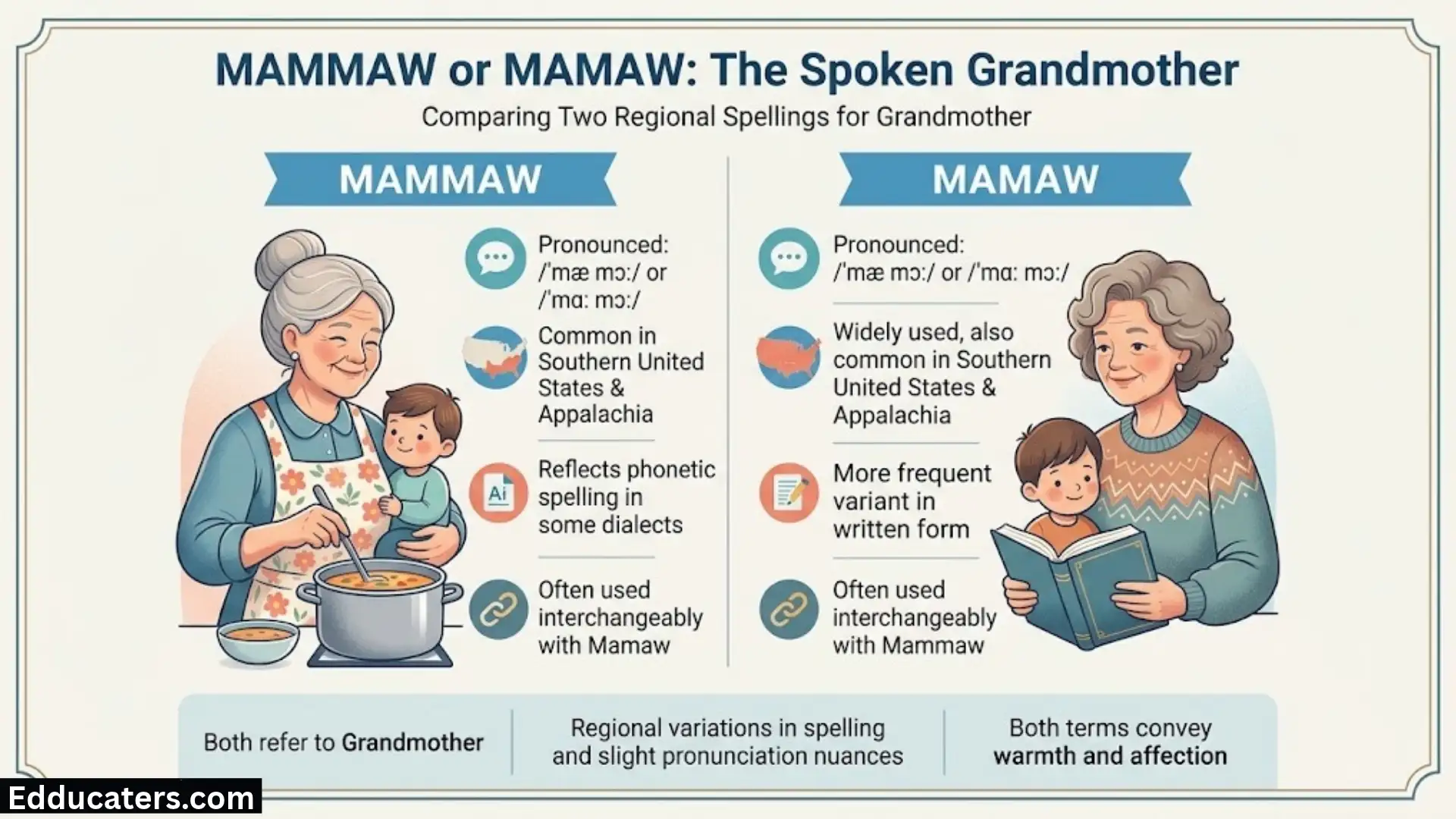
Have you ever wondered whether to write Mammaw or Mamaw when talking about your grandmother? Both spellings appear in informal English, especially in family vocabulary associated with the Southern United States and Appalachia. However, the extra m can make the choice confusing if you’re unsure which version to use.
The good news is that both forms can refer to a grandmother. Mamaw is a documented regional form, while Mammaw is used as an alternative spelling in some families and communities. Neither spelling has to replace the other in every situation.
The best choice depends on your family’s tradition, regional usage, and the spelling your grandmother prefers. Understanding their meanings, pronunciation, and background can help you choose the right form for your writing.
Mammaw or Mamaw: Which Spelling Is Correct?
Both Mamaw or Mammaw can be correct when used as informal names for a grandmother. The main difference is their spelling, not necessarily their meaning.
Mamaw is a regional American English term associated particularly with the Southern United States and Appalachia. Mammaw is an alternative form that some families use for the same relationship. You may also encounter spellings such as Mawmaw or Meemaw, although these forms have their own patterns of use.
Unlike words with a single established spelling in standard written English, affectionate family names can vary from one household to another. A grandmother might use Mamaw on family cards, while her grandchildren might write Mammaw because that’s how their parents taught them to spell it.
Here is a quick comparison:
| Feature | Mamaw | Mammaw |
| Meaning | An affectionate name for a grandmother | An affectionate name for a grandmother |
| Spelling | One m in the middle | Two m letters in the middle |
| Word type | Informal family name or regional noun | Informal family name or regional noun |
| Regional association | Southern American English and Appalachia | Regional and family-specific usage |
| Formality | Informal | Informal |
| Preferred spelling | Depends on family preference | Depends on family preference |
Both forms can communicate the same relationship. However, you shouldn’t assume that every family uses them interchangeably.
The simplest rule: Use the spelling your family recognizes or the one your grandmother prefers. If you’re describing the relationship to a general audience, grandmother is the clearest standard term.
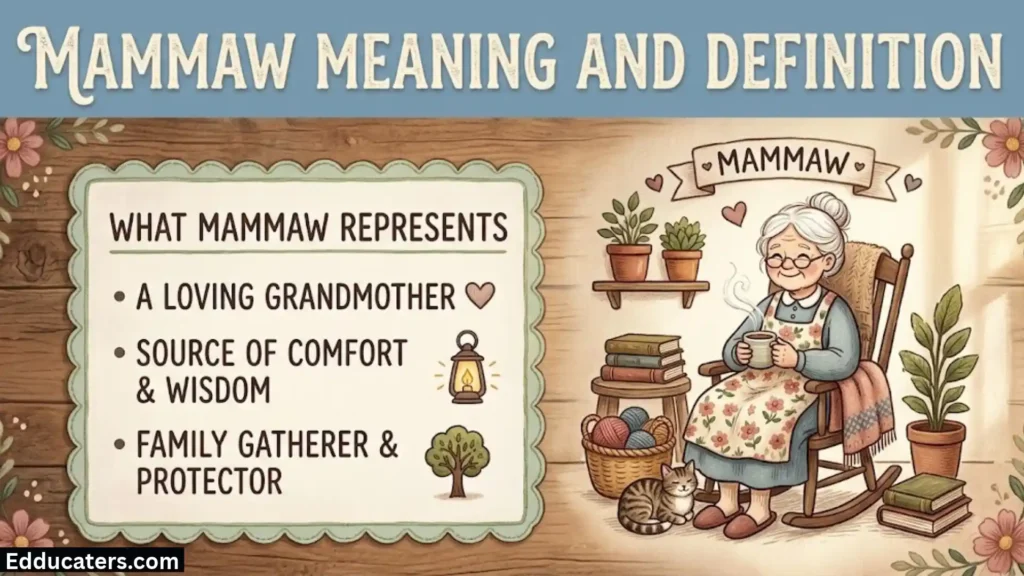
Mamaw Meaning and Definition
Mamaw is an informal name for a grandmother, particularly in parts of the Southern United States and Appalachia. It functions as a term of affection rather than a formal description of a family relationship.
For many families, the word feels warmer and more personal than grandmother. Children may use it when speaking directly to their grandmother, referring to her in conversation, or writing about family gatherings.
For example:
- “I’m spending Sunday afternoon with my Mamaw.”
- “Mamaw makes the best homemade biscuits.”
- “We visited Mamaw during the holidays.”
- “My Mamaw taught me how to bake bread.”
In these examples, Mamaw identifies a grandmother while also reflecting a familiar family tradition.
The word doesn’t automatically identify which side of the family the grandmother belongs to. Some definitions associate it especially with a maternal grandmother, but families may use it for either a mother’s mother or a father’s mother.
Is Mamaw Another Word for Grandma?
Yes. In the relevant regional and family contexts, Mamaw is another word for Grandma.
Both terms can refer to the mother of someone’s parent. The difference lies mainly in family preference and regional vocabulary.
Consider these examples:
- “My Grandma lives in Kentucky.”
- “My Mamaw lives in Kentucky.”
Both sentences describe a grandmother. The second uses a more regionally marked or family-specific name.
Other familiar names include:
- Grandma: A widely understood informal name for a grandmother.
- Granny: An affectionate term used in many English-speaking communities.
- Nana: A common family name for a grandmother.
- Meemaw: Another informal grandparent name, particularly associated with some Southern families.
- Mawmaw: A spelling variant used by some families.
These names can overlap in meaning, but they aren’t always interchangeable within a particular family. Someone who has always called her grandmother Mamaw may consider that name an important part of their relationship.
Does Mamaw Mean Maternal Grandmother?
Mamaw can mean a maternal grandmother, but it doesn’t always refer exclusively to one.
A maternal grandmother is your mother’s mother. A paternal grandmother is your father’s mother. The distinction describes the family relationship rather than the nickname itself.
For example:
- “My maternal grandmother is called Mamaw.”
- “My paternal grandmother also goes by Mamaw.”
A family may use Mamaw for both grandmothers or reserve it for just one. Other families distinguish between their grandmothers with names such as Mamaw Jean and Mamaw Rose.
The important point is that the word alone doesn’t tell you whether the grandmother is related through the mother’s or father’s side. You need the family context to know.
Mammaw Meaning and Definition
Mammaw is an alternative spelling used as an informal name for a grandmother in some families and regional contexts. Its meaning commonly overlaps with Mamaw.
The additional m doesn’t automatically give the word a different definition. Instead, it reflects a spelling choice that may have developed through family tradition, local usage, or an attempt to represent the way a name sounds.
For example:
- “We’re visiting Mammaw this weekend.”
- “Mammaw gave me a family recipe.”
- “I called Mammaw to wish her a happy birthday.”
- “My Mammaw used to tell wonderful stories.”
Each sentence uses Mammaw as a familiar name for a grandmother.
Because affectionate names often pass from one generation to the next through speech, families don’t always learn their spelling from a dictionary. A child may hear a name for years before needing to write it. By that point, the family’s preferred spelling may already feel natural.
Is Mammaw a Real Word?
Yes, Mammaw is used as an informal family name, particularly as an alternative spelling of Mamaw. However, dictionary coverage and recognition can differ among reference works.
This distinction matters because people often assume that a word must appear in every major dictionary to count as a real word. That isn’t how language works.
A term can have a clear meaning within a community even when some dictionaries omit it. Regional vocabulary, family nicknames, and informal expressions don’t always receive the same coverage as common words used throughout standard written English.
For example, a family might call its grandmother Mammaw for several generations. The term has a consistent meaning in that household even if a particular dictionary doesn’t list that exact spelling.
Still, dictionary inclusion matters when you’re deciding how to write for a broad audience. If you’re writing a formal document or an article for readers unfamiliar with the term, explain the meaning at its first use.
Does Mammaw Mean Maternal Grandmother?
Mammaw can refer to a maternal grandmother, but the spelling doesn’t establish that relationship by itself.
The word usually functions as a familiar family name. Whether it refers to your mother’s mother or your father’s mother depends on how your family uses it.
For example, “Mammaw lives near my parents” tells readers what the family calls her. It doesn’t establish which parent she is related to.
If that distinction matters, be specific:
- “My maternal grandmother, Mammaw, lives nearby.”
- “My paternal grandmother goes by Mammaw.”
- “Both of my grandmothers use the name Mammaw.”
These examples make the relationship clear without changing the nickname.
What Is the Difference Between Mamaw or Mammaw?
The main difference between Mamaw or Mammaw is spelling. Both can serve as affectionate names for a grandmother, and the extra m doesn’t necessarily change the pronunciation or meaning.
However, a few details deserve attention.
| Comparison | Mamaw | Mammaw |
| Basic meaning | Grandmother in regional American usage | Commonly the same meaning |
| Spelling pattern | Shorter middle-letter sequence | Doubled middle m |
| Pronunciation | Depends on the speaker and region | May be pronounced the same way |
| Usage | Regional and informal | Regional and family-specific |
| Formal writing | Usually better explained on first use | Usually better explained on first use |
| Best spelling for a particular family | The family’s established form | The family’s established form |
The comparison doesn’t establish that one form is universally superior. Instead, it shows why you should consider the context before choosing a spelling.
For example, if your grandmother writes Mamaw on birthday cards and introduces herself by that name, copying her spelling is a sensible choice. If your family has always used Mammaw, changing it without a reason may create unnecessary confusion.
Do Mamaw or Mammaw Sound the Same?
They may sound the same or nearly the same, depending on the speaker’s accent and family pronunciation.
English spelling doesn’t always provide a reliable guide to how a regional or informal name will sound. Family names can also develop distinctive pronunciations over time.
If your family pronounces Mamaw or Mammaw identically, adding another m to the written form won’t necessarily change how anyone says it.
The best approach is to follow the pronunciation used by the person whose name you’re writing. Don’t invent a pronunciation difference simply because the spellings look different.
Is One Spelling More Correct Than the Other?
Not in every family or context.
When a regional family name has multiple established spellings, correctness depends partly on the community’s conventions. A form can be appropriate for one family even if another family prefers a different version.
However, context still matters. If a dictionary, historical source, or publication uses a particular spelling, preserve that spelling when quoting or referring to the source.
For ordinary family writing, use the name the person actually uses. For general explanatory writing, introduce the term clearly and explain that alternative spellings exist.
Mamaw or Mammaw in Southern American English
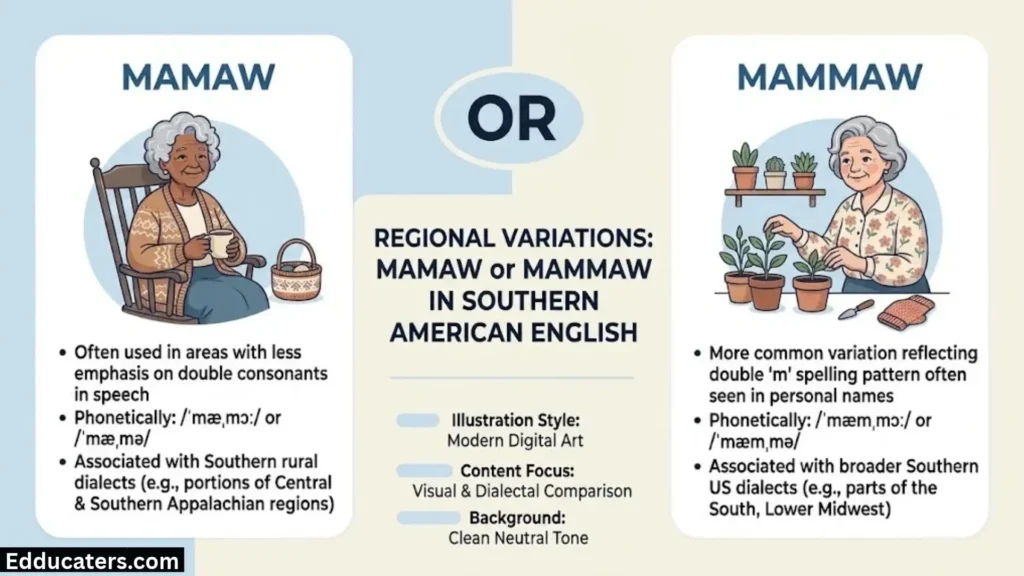
Mamaw is strongly associated with Southern American English and Appalachian family vocabulary. In these communities, it can serve as a familiar name for a grandmother rather than a formal kinship term.
The Southern United States contains many regional speech traditions. Words and expressions may differ across states, towns, and even neighboring families. Grandparent names are part of that variation.
Some families use Mamaw, while others prefer Mawmaw, Meemaw, Granny, Nana, or Grandma. These choices can reflect family history, the names older relatives used, and the sounds children found easiest to say.
The name may also remain in use after family members move away from their original community. A person raised in Appalachia might continue calling a grandmother Mamaw after moving to another state. In that case, the term reflects family tradition as well as regional background.
It’s important not to treat the entire South as one uniform speech community. Not every Southern family uses Mamaw, and the term isn’t limited to people who currently live in Southern states.
Why Do Some Southern Families Say Mamaw Instead of Grandma?
The answer often comes down to family tradition and affectionate naming.
Grandparent names frequently develop during early childhood. A child may begin using a simple, familiar sound for a grandmother, and the family adopts it. Parents and other relatives then repeat the name until it becomes an established part of everyday speech.
Over time, that name may pass to younger generations. A grandmother who was called Mamaw by her first grandchild might keep the same name when additional grandchildren arrive.
Several factors can influence the choice:
- Family history: Children may inherit the names their parents used for their own grandparents.
- Regional speech: Local vocabulary can influence which names feel familiar.
- Pronunciation: Families may prefer a name that young children find easy to say.
- Personal preference: Some grandparents choose their own names.
- Family identity: A particular name may carry memories of relatives, traditions, and childhood experiences.
For example, a family might use Mamaw because the children’s great-grandmother had the same name. Another family might choose Nana because that was the name used by an older relative.
Neither choice is inherently better. The name becomes meaningful through the relationship and the people who use it.
Is Mammaw a Southern Word?
Mammaw is used as an informal family name in some Southern and regional American contexts. However, it isn’t exclusive to the South.
Families move, marry, and share traditions across geographic boundaries. As a result, a regional name can appear far from the place most closely associated with it.
It’s also important to distinguish between Mammaw and related forms such as Mamaw, Mawmaw, and Meemaw. They may serve similar purposes, but that doesn’t mean every community uses them in exactly the same way.
The most accurate description is that these names belong to a wider pattern of regional and family-specific grandparent vocabulary.
Does Mamaw Have a Scottish Meaning?
The Scottish connection requires a careful distinction. Scottish English and Scots use forms such as maw to mean mother, but that doesn’t prove that the American grandmother name Mamaw originated from a Scottish expression.
Scottish vocabulary includes ma, maw, and mither, with meanings related to a mother. The Dictionaries of the Scots Language and the Scottish Corpus provide resources for examining these forms in context.
In Scots, ma can mean “my,” and maw can mean “mother.” The expression ma maw can therefore mean “my mother” in an appropriate context.
This is different from the common Southern American use of Mamaw for a grandmother. The words may look related, but similar spelling doesn’t establish a shared history or identical meaning.
A historical relationship is possible, but it needs evidence from etymological sources rather than a guess based on appearance.
Does Mamaw Mean Mother in Scottish English?
The form maw is documented in Scottish vocabulary as a word for mother. Some secondary dictionary resources also list mamaw as a Scottish Lowlands dialect form meaning mother.
However, the precise status and distribution of mamaw in Scottish usage should be checked against authoritative dialect references before making a broad claim.
The distinction is important:
- In Southern American family usage, Mamaw commonly means grandmother.
- In Scottish vocabulary, maw can mean mother.
- The expression ma maw can mean “my mother.”
- These facts alone don’t prove that the American grandparent name developed directly from the Scottish expression.
When discussing regional words, it’s better to describe the documented meaning in each setting than to assume one meaning applies everywhere.
What Is the Origin of Mamaw or Mammaw?
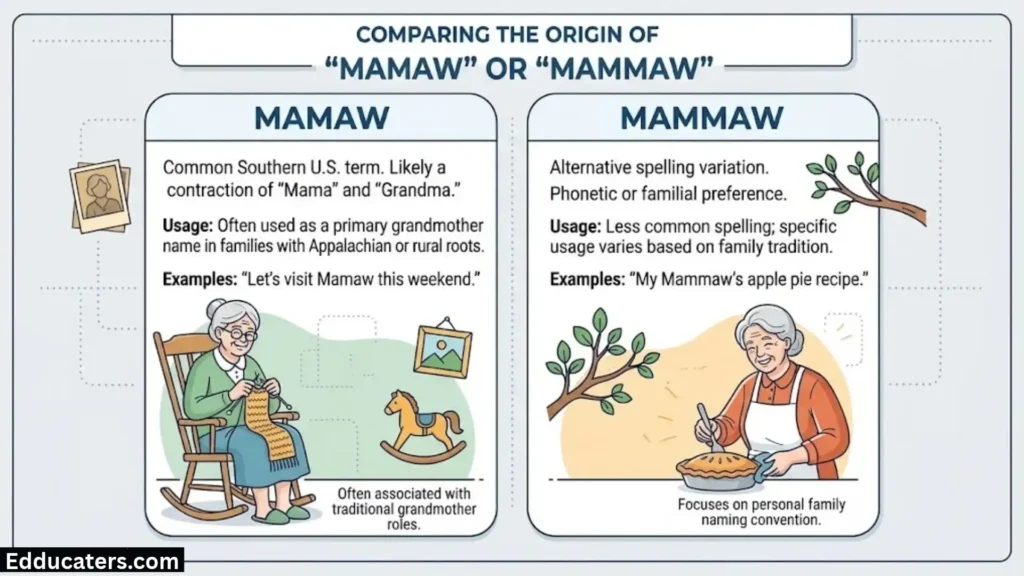
The exact origin of Mamaw or Mammaw isn’t straightforward enough to state as a settled fact without strong etymological evidence.
One possible connection is with familiar words such as Mama and Ma, which have long served as names for mothers. Many family terms develop from simple sounds, affectionate forms, and repeated speech within households.
A proposed connection with Scottish ma maw has also appeared in discussions of Southern and Appalachian vocabulary. Such a theory may seem plausible given historical connections between Scotland, Ulster, and parts of Appalachia. However, a plausible cultural or linguistic connection isn’t the same as a proven word origin.
To establish an origin confidently, researchers would look for dated examples, historical dictionaries, regional records, and evidence showing how the form changed over time.
Did Mamaw Come From Mama?
It may be related to Mama or other affectionate mother names, but that relationship shouldn’t be presented as certain without reliable etymological support.
Words used within families often develop through repetition. Children may simplify longer names, and adults may adopt those forms because they sound affectionate or familiar. Similar patterns occur in names such as Nana, Granny, and Meemaw.
Still, resemblance alone doesn’t establish a direct origin. To prove that Mamaw came from Mama, a historical record would need to support that development.
The safest conclusion is that Mamaw belongs to a broader group of informal family names, while its precise historical development requires careful documentation.
Why Are There Different Spellings of Mamaw?
Regional and family names often lack a single spelling that everyone follows. This happens because people may learn the word by hearing it rather than reading it.
Several factors can explain the variations:
- Sound-based spelling: People choose letters that seem to match their pronunciation.
- Family tradition: Relatives pass down a spelling that becomes familiar over generations.
- Regional variation: Different communities may favor different forms.
- Informal use: Family names don’t always follow the same conventions as formal written vocabulary.
- Personal choice: A grandmother may choose the spelling she likes best.
The difference between Mamaw or Mammaw illustrates this process. An extra letter can become part of a family spelling without creating a separate meaning.
Is Mamaw or Mammaw More Common?
It’s difficult to determine which spelling is more common across all English-speaking communities without a reliable, clearly defined dataset.
Mamaw is widely documented in descriptions of Southern and Appalachian vocabulary. Mammaw also appears as an alternative form, but its relative frequency may vary by location and source.
The answer depends on what you’re measuring. A search engine may show how often pages use a spelling, while a book database measures occurrences in published material. Neither automatically tells you how many families use the name in everyday conversation.
A useful comparison should consider:
- Geographic coverage
- The period being studied
- Published books versus online writing
- Whether spelling variants are grouped together
- Whether the results distinguish grandmother-related uses from unrelated occurrences
Without those details, a statement that one spelling is universally more popular would go beyond the evidence.
Is Mamaw or Mammaw Listed in Dictionaries?
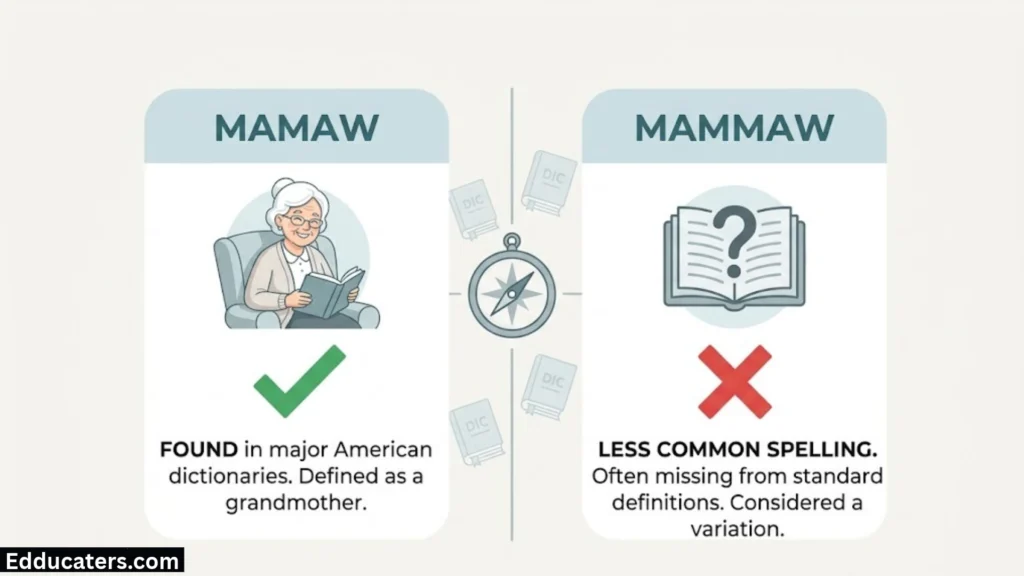
Dictionary coverage can help explain how a word is used, but dictionary recognition and everyday language use aren’t the same thing.
Some dictionaries focus on broadly used standard English. Others include regional vocabulary, slang, dialect forms, and informal expressions. As a result, one reference may list a term while another omits it.
For a reliable investigation, consult more than one source:
- Cambridge Dictionary for general English vocabulary and usage.
- Merriam-Webster for American English definitions and word information.
- Dictionary of American Regional English for regional American vocabulary.
- Dictionaries of the Scots Language for Scottish and Scots usage.
These resources serve different purposes, so their coverage may not match.
If a dictionary lists Mamaw as a regional noun, check the definition and usage label. If it doesn’t list Mammaw, don’t immediately conclude that the spelling is meaningless. Look for regional sources, alternative-form entries, and examples of actual use.
The same principle applies to any informal family name. Dictionaries describe language, but they don’t create every word people use at home.
Mamaw or Grandma: Which Should You Use?
Choosing between Mamaw and Grandma depends on the person, family, and situation.
Grandma is widely understood across English-speaking communities. Mamaw is more regionally marked and may be especially familiar in some Southern and Appalachian families. Mammaw can serve the same affectionate purpose in families that prefer that spelling.
Use the name that fits your circumstances.
| Situation | Recommended choice |
| Writing about your own grandmother | Use the name your family uses |
| Writing a birthday card | Use her preferred spelling |
| Writing a family history | Preserve the spelling used in family records |
| Explaining the term to a general audience | Introduce the name and define it |
| Writing formal or academic prose | Use grandmother unless the family name matters |
| Quoting someone who uses Mammaw | Preserve the original spelling |
For example, “My grandmother lives in Tennessee” is clear to a broad audience. “My Mamaw lives in Tennessee” adds a personal or regional touch.
Neither sentence is inherently better. The right choice depends on what you’re trying to communicate.
Is Mamaw More Personal Than Grandma?
It can feel more personal to people who grew up using it. However, the emotional meaning comes from the relationship rather than the word alone.
Someone who calls their grandmother Mamaw may associate the name with family meals, childhood visits, holidays, or stories from older relatives. Another person may feel the same connection to Grandma, Nana, or Granny.
These names work as terms of endearment because families give them meaning through repeated use. A familiar name can become part of a person’s identity within the family.
When writing about someone else’s grandmother, avoid assuming which name she prefers. Ask if you’re unsure.
Common Questions About Mamaw or Mammaw
Is Mamaw a real word?
Yes. Mamaw is documented as an informal regional American English term for a grandmother, especially in Southern and Appalachian usage. Its exact recognition and labeling may vary by dictionary.
Is Mammaw a real word?
Mammaw is used as an alternative spelling of Mamaw in some families and regional contexts. Its absence from a particular dictionary wouldn’t automatically make the family name invalid.
What does Mamaw mean?
Mamaw commonly means grandmother in parts of the Southern United States and Appalachia. Some references also record less common mother-related uses.
What does Mammaw mean?
Mammaw commonly serves as an affectionate name for a grandmother. It often carries the same meaning as Mamaw, although usage depends on the family or community.
Is Mamaw or Mammaw more common?
Mamaw is widely documented in Southern and Appalachian vocabulary, but determining which spelling is more common overall requires comparable frequency evidence. Book databases alone cannot settle the question for spoken language.
Does Mamaw mean Mom?
In some documented regional uses, Mamaw can refer to a mother, but its common Southern American meaning is grandmother. The intended meaning depends on the region and context.
What do people in the Southern United States call their grandmothers?
Names include Mamaw, Mawmaw, Meemaw, Nana, Granny, and Grandma. The preferred name varies by family and location.
What is the origin of Mamaw?
Its precise origin isn’t conclusively established here. A relationship with Mama or Ma has been proposed, but a firm etymology requires historical evidence. The proposed Scottish connection should likewise be treated cautiously.
Does the Cambridge Dictionary recognize Mamaw or Mammaw?
Check the Cambridge Dictionary for the exact spellings and any listed variants. Dictionary coverage can change, and an omitted regional term may still be used by a language community.
How is Mamaw different from Mammaw?
The principal difference is spelling. Both can mean grandmother, and the additional m doesn’t necessarily change pronunciation or meaning.
Conclusion: Mammaw or Mamaw?
Both Mammaw or Mamaw can be appropriate informal names for a grandmother. Mamaw is a documented regional term associated with Southern American English and Appalachia, while Mammaw appears as an alternative spelling in some families.
The two spellings generally overlap in meaning, although individual families may prefer one form. Neither spelling automatically identifies a maternal or paternal grandmother, and the exact historical origin deserves more research than a simple resemblance to Mama can provide.
If you’re writing about your own family, follow the spelling your grandmother uses. If you’re writing for a general audience, explain the term the first time it appears. When you need a universally familiar description, grandmother or grandma will usually communicate the relationship clearly.
Ultimately, the best spelling is the one that accurately reflects the name used by the person and family you’re describing.

Hello, I’m Claire Holloway. I have always been passionate about the English language and enjoy turning complex grammar rules into simple, easy-to-follow lessons. I believe that every learner can become a confident English writer with the right guidance.
I create educational content focused on grammar, vocabulary, sentence structure, and writing improvement. Every article I publish is designed to help readers learn with confidence and accuracy.
Books
Grammar Without Confusion
Modern English Usage Guide
 Nathan Whitmore
 Julian Mercer