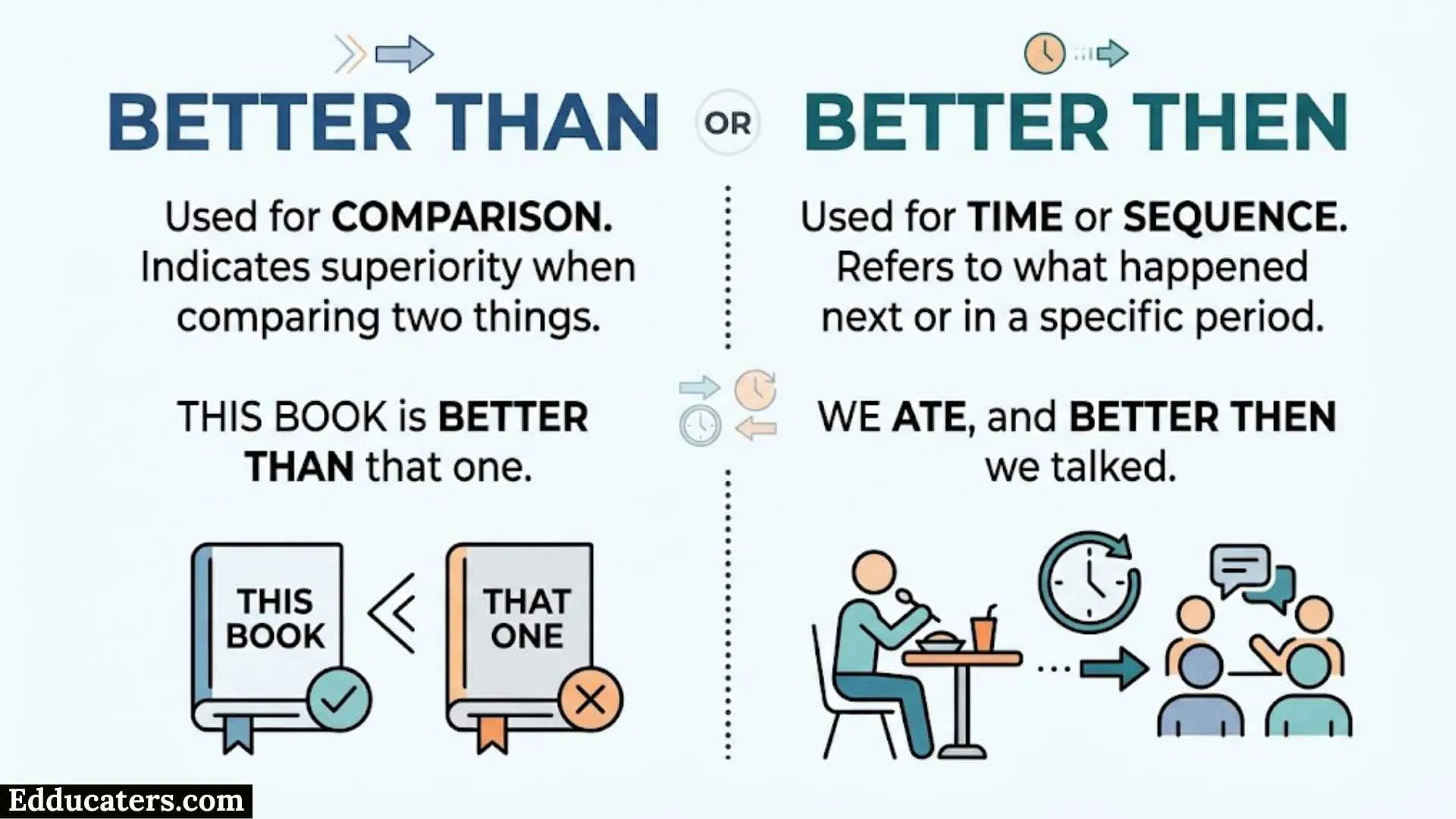
If you’re unsure whether to write better than or better then, the correct choice depends on what you mean. When you are making a comparison, the correct phrase is better than. The word than introduces the second part of a comparison, while then is normally used for time, sequence, or a result.
For example:
This laptop is better than my old one.
Here, than connects the two sides of the comparison.
By contrast:
Make the changes, then send me the file.
Here, then means “after that” and shows sequence.
The difference is easy to understand once you focus on the job each word performs. Than is associated with comparison, while then is associated with time, order, or consequence. Cambridge and Oxford both describe than as a word used to introduce the second part of a comparison.
Quick Answer: Better Than or Better Then?
Better than is correct when you are comparing one person, thing, action, result, or situation with another.
Better then is not the correct form for a comparison.
| Form | Main use | Example |
| better than | Comparison | This option is better than the other one. |
| then | Time | I was happier then. |
| then | Sequence | Finish the work, then submit it. |
| then | Result or consequence | If that’s true, then we should check again. |
A useful rule is:
Than = comparison
Then = time, sequence, or result
This distinction applies well beyond better than. The same principle helps you choose the correct word after comparative expressions such as more, less, faster, slower, higher, or lower.
Better Than: Meaning and Grammar
Better is the comparative form associated with good when discussing qualities, conditions, or things, and it is also the comparative form of well when describing how an action is performed.
When better is followed by than, the phrase normally creates a comparison.
For example:
- This restaurant is better than the one we visited last week.
- She feels better than she did yesterday.
- He plays tennis better than I do.
- The new system works better than the old system.
- This explanation is better than the first one.
Oxford lists than as a preposition or conjunction used to introduce the second part of a comparison. Cambridge likewise explains that than joins two parts of a comparison.
Better Than as a Comparative Adjective
When better describes a noun, it can function as a comparative adjective.
For example:
This is a better solution than the previous one.
The sentence compares the quality or suitability of two solutions.
Other examples include:
- We need a better plan than this.
- She found a better job than her previous one.
- This is a better choice than the first option.
Better Than as a Comparative Adverb
Better can also describe how an action is performed.
For example:
Maria sings better than I do.
Here, better describes the way Maria sings. Cambridge notes that well has the comparative form better, which can be used when comparing how actions are performed.
More examples:
- He drives better than I do.
- She explains grammar better than most teachers.
- The new software performs better than the previous version.
Then: Meaning and Grammar
Then has several meanings, but it is not normally used to introduce the second part of a comparison.
Cambridge explains that then can refer to a particular time, indicate what happens next, or show a result in certain contexts.
Then Meaning “At That Time”
Use then when referring to a particular time in the past or future.
Examples:
- I lived in London then.
- Things were different then.
- I didn’t understand the rule then.
- I’ll call you tomorrow. I’ll have the information by then.
In these examples, then has a time-related meaning. Oxford also defines this use as referring to a particular time in the past or future.
Then Meaning “Next”
Then can indicate the next step in a sequence.
Examples:
- Finish the introduction, then write the main section.
- Read the instructions, then answer the questions.
- We had dinner, then we watched a movie.
- Save the document, then close the program.
Cambridge specifically identifies this use of then as meaning “next.”
Then Meaning “In That Case”
Then can also introduce a result or consequence, especially after an if clause.
Examples:
- If you agree, then we can continue.
- If the information is correct, then the answer is clear.
- If you’re finished, then you can leave.
This use does not involve a comparison. It expresses a relationship between a condition and its result.
Why Is Better Than Correct?
The reason is simple: than is the word used to introduce the second part of a comparison.
Consider:
This phone is better than that phone.
The sentence has two sides:
- the phone being described as better
- the phone used as the comparison
Than connects those two parts.
Cambridge’s grammar guidance explains that a comparative adjective or adverb can be followed by a than-clause, such as “higher than we expected” or “more quickly than he did.”
That is why these sentences are correct:
- This route is better than the other route.
- She performed better than expected.
- The second draft is better than the first.
- The results were better than we predicted.
Replacing than with then would remove the standard comparison structure.
Better Than or Better Then: The Main Difference
The easiest way to understand the difference is to look at the function of the word.
| Word | Function | Example |
| than | Introduces a comparison | This is better than that. |
| then | Refers to a time | I lived there then. |
| then | Shows sequence | Read this, then answer. |
| then | Shows a result | If that’s true, then we need more evidence. |
So if you are asking whether something is better in comparison with something else, use than.
If you are talking about what happened next, when something happened, or what follows from a condition, use then.
Better Than Examples
Here are natural examples of better than in everyday English.
- This book is better than the previous one.
- I feel better than I did yesterday.
- This restaurant is better than I expected.
- She speaks English better than I do.
- The new version works better than the old version.
- This route is better than the one we used before.
- The second draft is better than the first.
- His results were better than mine.
- This solution is better than the original idea.
- The weather is much better than it was yesterday.
Each sentence contains a comparison, so than is the correct word.
Better Than in Common Expressions
The phrase better than appears in many familiar English expressions.
Better Than Ever
Better than ever means that something is in a better state or condition now than at any earlier point.
Examples:
- The website is working better than ever.
- She feels better than ever.
- The team is performing better than ever.
Cambridge specifically gives than ever as a way of strengthening a comparative adjective.
Better Than Expected
Use better than expected when the result is more favorable than someone anticipated.
Examples:
- The exam went better than expected.
- Sales were better than expected.
- The project performed better than expected.
Better Than Before
Use better than before when you compare the current state with an earlier state.
Examples:
- My writing is better than before.
- The new software works better than before.
- I understand the subject better than before.
Better Than Nothing
Better than nothing is a common expression meaning that having something is preferable to having nothing.
Examples:
- Ten minutes is better than nothing.
- It’s not perfect, but it’s better than nothing.
- A small improvement is better than nothing.
When Can Better and Then Appear Together?
This is an important exception to understand.
The phrase better then is usually incorrect when someone is trying to write a comparison. However, better and then can legitimately occur next to each other when they have separate grammatical functions.
For example:
Make the article better, then publish it.
Here, better means improve the article, while then means “after that.”
Another example:
Think about the problem carefully, make the explanation better, then submit it.
The word then is describing the next action. It is not comparing two things.
So it would be inaccurate to say that the sequence better then can never occur. The real rule is more precise:
Use “better than” for comparison. Use “then” according to its normal time, sequence, or result meaning.
This distinction is useful because it prevents an overly simple grammar rule from creating a new mistake.
Better Than or Better Then in a Sentence
The correct choice becomes easy when you examine the sentence’s meaning.
Comparison
This computer is better than mine.
Than is correct because the sentence compares two computers.
Time
I was much happier then.
Then is correct because it refers to a particular time.
Sequence
Improve the sentence, then check the punctuation.
Then is correct because it introduces the next action.
Result
If the evidence is reliable, then we can use it.
Then is correct because it introduces a consequence.
Comparison With an Expected Result
The project went better than we expected.
Than is correct because the actual result is being compared with the expected result.
Cambridge’s grammar guidance confirms that than can introduce a clause after a comparative adjective or adverb, including structures such as “better than I expected.”
Better Than or Better Then: Common Mistakes
Mistake 1: Using Then for a Comparison
Incorrect:
This laptop is better then mine.
Correct:
This laptop is better than mine.
The sentence compares two laptops, so than is required.
Mistake 2: Writing Better Then Ever
Incorrect:
The business is doing better then ever.
Correct:
The business is doing better than ever.
The expression describes an improvement compared with all previous times.
Mistake 3: Writing Better Then Before
Incorrect:
My English is better then before.
Correct:
My English is better than before.
The sentence compares the current level with an earlier level.
Mistake 4: Confusing Then With Than in Comparative Expressions
The same mistake can happen with other comparative expressions.
Incorrect:
faster then expected
Correct:
faster than expected
Incorrect:
more expensive then before
Correct:
more expensive than before
Incorrect:
less useful then the old version
Correct:
less useful than the old version
The underlying rule stays the same: than introduces the comparison.
Better Than or Better Then: A Simple Decision Guide
When proofreading, use this quick decision process.
Are you comparing something with something else?
→ Yes: use than.
This method is better than the old one.
Are you referring to a particular time?
→ Yes: use then.
Things were different then.
Are you showing what happens next?
→ Yes: use then.
Finish the report, then send it.
Are you showing a result after a condition?
→ Yes: use then.
If the figures are correct, then the calculation works.
This decision guide is especially useful during proofreading because it focuses on meaning rather than spelling.
Better Than or Better Then: Pronunciation
The two words are also easy to confuse because their pronunciation is similar in ordinary speech.
Than is commonly pronounced:
/ðæn/ in its strong form
/ðən/ in its weak form
Then is commonly pronounced:
/ðen/
Cambridge gives these pronunciation forms for than and then.
In natural conversation, than is often pronounced with a weak vowel, which can make it sound closer to then. That similarity can contribute to spelling mistakes.
However, their meanings and grammatical functions remain different.
How to Remember the Pronunciation Difference
Don’t rely only on sound when choosing the spelling.
Instead, ask:
Am I making a comparison?
If yes, write than.
This is especially helpful because pronunciation alone may not make the distinction obvious in fast everyday speech.
Better Than or Better Then: Synonyms and Related Expressions
The phrase better than can sometimes be replaced with another comparative expression, depending on the intended meaning.
Possible alternatives include:
- superior to
- preferable to
- more effective than
- more useful than
- more suitable than
- more successful than
- an improvement over
- more beneficial than
For example:
This method is better than the previous method.
Depending on the context, you might write:
This method is more effective than the previous method.
Or:
This method is an improvement over the previous method.
These alternatives are not exact replacements in every sentence. Better is a broad comparative word, while expressions such as more effective or more suitable identify a particular quality.
Better Than or Better Then in Formal Writing
In formal writing, accuracy matters because than and then perform different grammatical functions.
Examples of correct formal usage include:
The revised method produced better results than the original method.
The researchers reviewed the findings, then prepared the final report.
The second proposal was better than the first.
The committee considered the evidence and then reached a decision.
The same rule applies in academic, professional, business, and everyday writing. The distinction is grammatical rather than a difference between formal English and informal English.
Better Than or Better Then in Business and Academic Writing
In professional writing, confusing the two words can make a sentence look careless even when the intended meaning is obvious.
Consider:
The revised process is more efficient than the previous process.
This clearly identifies a comparison.
Now consider:
The team reviewed the revised process, then documented the results.
This clearly establishes a sequence.
Both words are useful in professional writing, but they should not be substituted for each other.
Business Example
The new system performs better than the previous system. The team tested both systems, then prepared a report.
Academic Example
The second experiment produced better results than the first. The researchers then analyzed the data.
These examples show why context matters more than visual similarity.
Better Than or Better Then Quiz
Choose than or then in each sentence.
- This book is better ___ the previous one.
- We finished the meeting, ___ we went home.
- She performed better ___ expected.
- I lived there ___.
- The new system is better ___ the old one.
- Read the instructions, ___ answer the questions.
- He feels better ___ he did yesterday.
- If the information is correct, ___ we can continue.
- This route is better ___ the alternative.
- Things were different back ___.
Quiz Answers
- than
- then
- than
- then
- than
- then
- than
- then
- than
- then
The key is not memorizing each sentence. Identify the function first. A comparison calls for than; time, sequence, or consequence calls for then.
Better Than or Better Then: Key Takeaways
Keep these points in mind:
- Better than is the standard phrase for making a comparison.
- Than introduces the second part of a comparison.
- Then can refer to a particular time.
- Then can introduce the next step in a sequence.
- Then can indicate a result or consequence.
- Better then should not replace better than in a comparison.
- Better, then… can be correct when then means “after that.”
- Similar pronunciation can make the words easy to confuse.
- The best way to choose the word is to identify its grammatical function.
FAQs About Better Than or Better Then
Is it better than or better then?
Use better than when making a comparison. Better then is not the standard form for a comparative sentence.
Which is correct: better than or better then?
Better than is correct when you mean that one thing has a higher quality, performance, or value in comparison with another.
For example:
This option is better than the first one.
Is “better then ever” correct?
No, not when you mean that something is now better compared with any earlier time. The standard expression is better than ever. Cambridge identifies than ever as a construction used with comparative adjectives.
Is “better then before” correct?
When you mean an improvement compared with an earlier condition, write better than before.
Example:
My writing is better than before.
What does better than mean?
Better than is a comparative expression. It indicates that one person, thing, action, result, or situation has a more favorable quality or performance compared with another.
What does then mean?
Then can mean “at that time,” “next,” or “in that case,” depending on context.
Why do people confuse than with then?
The words have similar spelling and pronunciation, especially in fast speech. Their grammatical functions are different, however. Than is associated with comparison, while then commonly expresses time, sequence, or consequence.
Can better and then appear next to each other?
Yes, when they have separate functions.
For example:
Make the explanation better, then publish it.
Here, better describes the desired improvement, while then introduces the next action.
What is the pronunciation of than?
Cambridge gives /ðæn/ as a strong pronunciation and /ðən/ as a weak pronunciation.
What is the pronunciation of then?
Cambridge gives /ðen/ for then.
Is better than formal English?
Yes. Better than is standard English and is appropriate in everyday, academic, business, and formal writing.
References
- Cambridge Dictionary — Than
- Cambridge Grammar — Comparison Clauses
- Cambridge Grammar — Then
- Cambridge Grammar — Comparative Adjectives
- Oxford Learner’s Dictionaries — Than
- Oxford Learner’s Dictionaries — Then
Conclusion
The answer is straightforward: use better than when you are making a comparison.
This option is better than that one.
Use then when you are referring to a time, showing the next step, or indicating a consequence:
Finish the work, then send it.
The words are easy to confuse because they look and sound similar, but their grammatical roles are different. Remember the simplest rule:
Than = comparison
Then = time, sequence, or result
Once you identify what the word is doing in the sentence, choosing better than or then becomes much easier.

I’m Julian Mercer, an English language writer dedicated to helping people master grammar through practical examples and clear explanations. I enjoy teaching grammar in a way that is both engaging and easy to remember.
My work focuses on grammar rules, punctuation, word usage, and writing techniques that readers can apply in everyday life. I believe learning English should be simple, enjoyable, and useful.
Books
English Grammar in Practice
Writing with Precision
 Nathan Whitmore
 Claire Holloway