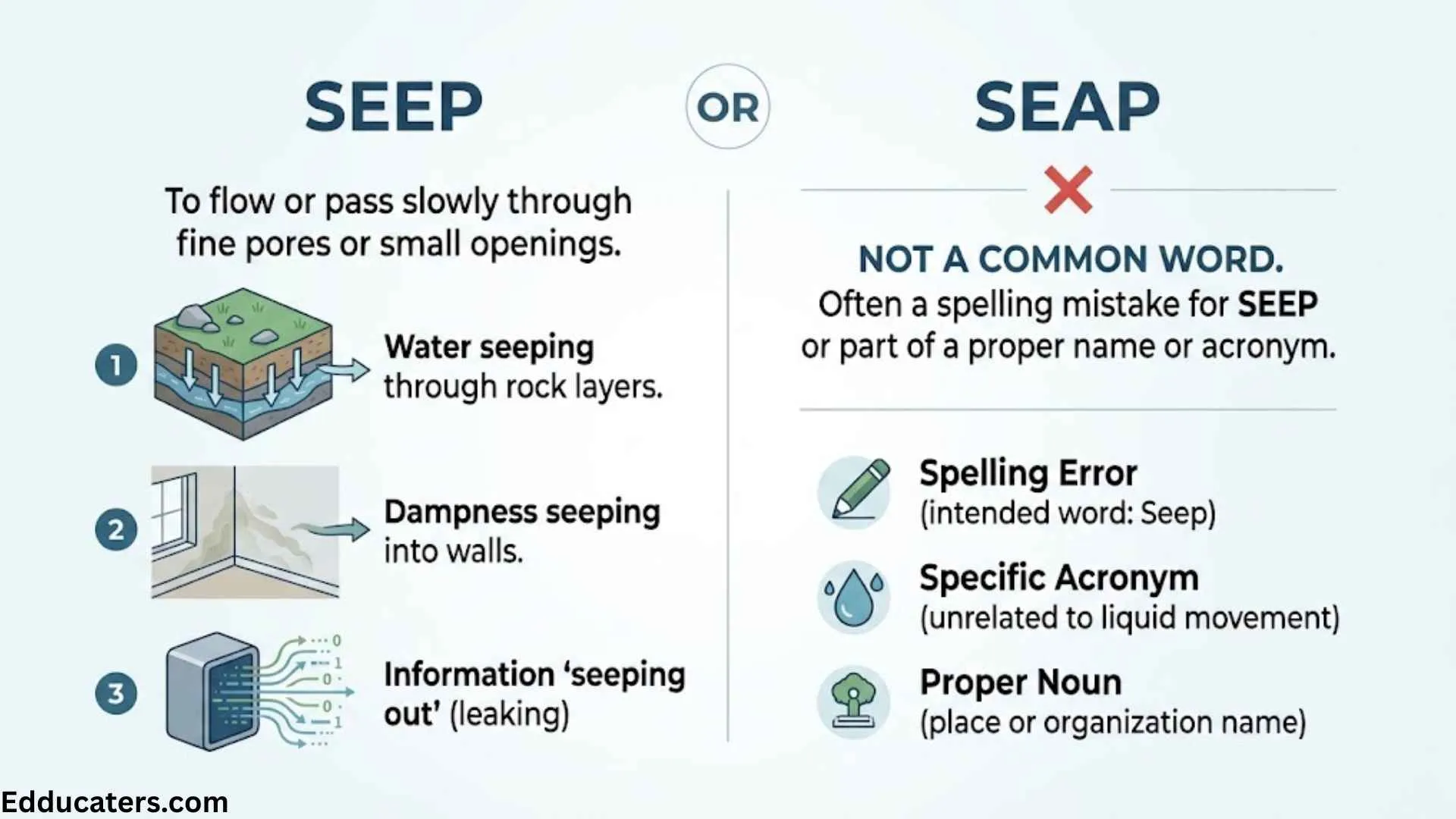
If you’re wondering whether the correct spelling is seep or seap, use seep when you mean to move, flow, or spread slowly through or out of something. Seap is not the standard spelling of this English verb.
The confusion mainly comes from pronunciation. Seep is pronounced /siːp/, so when you hear the word rather than see it written, it can be easy to guess the spelling incorrectly.
For example:
Water began to seep through the cracks in the wall.
The correct forms are seep, seeps, seeping, or seeped. If you’re writing a sentence about water, liquid, gas, moisture, light, information, or something gradually spreading, seep is the word you want.
Seep or Seap: Which Is Correct?
Seep is the correct standard English spelling.
Seap is generally a misspelling when the intended meaning is “to move or spread slowly through something.”
| Form | Correct? | Meaning | Example |
| Seep | Yes | To move or spread slowly through or out of something | Water began to seep through the wall. |
| Seap | No, for this meaning | Not the standard spelling of the verb | ❌ Water began to seap through the wall. |
So, if you are deciding between seep or seap, choose seep.
There is also no standard British or American spelling difference between these two forms. English speakers in both varieties use seep.
What Does Seep Mean?
Seep means to move, flow, or spread slowly through, into, or out of something, usually in a small amount.
It is often used for liquids such as:
- Water
- Oil
- Rain
- Moisture
- Gas
- Chemicals
For example:
Rainwater began to seep into the soil.
Water was seeping through the ceiling.
Oil seeped into the ground.
The word can also have a figurative meaning. Something that isn’t physical, such as fear, doubt, information, or influence, can seep into a situation when it gradually spreads or becomes noticeable.
Doubt began to seep into her thoughts.
The news gradually seeped out.
The key idea is slow or gradual movement.
Seep Meaning in English
In simple English, seep means:
To move or spread slowly through or out of something.
For example:
Water seeped through the damaged roof.
This means that water slowly passed through the damaged part of the roof.
Another example is:
Smoke began to seep into the room.
Here, the smoke gradually entered the room.
Seep doesn’t normally suggest a sudden or rapid movement. It emphasizes something happening gradually.
Is Seap a Word in English?
If you searched for “seap meaning in English,” you may actually be looking for seep.
Seap is not the standard English spelling of the verb meaning “to flow or spread slowly.”
Therefore:
Correct:
Water began to seep through the floor.
Incorrect:
Water began to seap through the floor.
There can be isolated uses of SEAP as an abbreviation, acronym, proper name, or specialized term, but those are different from the ordinary English verb seep. They should not be confused with the standard word used for gradual movement of a liquid or other substance.
What Is the Past Tense of Seep?
The past tense of seep is seeped.
The past participle is also seeped.
| Verb Form | Correct Form |
| Base form | seep |
| Third-person singular | seeps |
| -ing form | seeping |
| Past tense | seeped |
| Past participle | seeped |
Examples:
Water seeped through the cracks.
Oil seeped into the soil.
Moisture has seeped into the walls.
A common mistake is to assume that the past tense is seapt. It isn’t.
Seep → seeped
not
Seep → seapt
How Do You Pronounce Seep?
Seep is pronounced:
/siːp/
It has one syllable and contains the long ee sound.
It rhymes with:
- Deep
- Keep
- Sleep
- Steep
- Cheap
A simple pronunciation guide is:
seep = “seep”
The pronunciation is essentially the same in standard British and American English.
Because seep sounds like other words containing the /iː/ sound, some people may incorrectly guess that it is spelled seap. However, pronunciation doesn’t change the standard spelling.
Seep in a Sentence
Here are natural examples showing how seep works in different contexts:
- Water began to seep through the cracks in the wall.
- Rainwater can seep into the ground.
- Oil seeped into the soil after the leak.
- Moisture was seeping through the wooden floor.
- Gas began to seep out of the pipe.
- The smell of smoke seeped into the house.
- Sunlight seeped through the curtains.
- Cold air was seeping through the windows.
- Doubt began to seep into his mind.
- The information gradually seeped out to the public.
These examples show that seep can describe both physical and figurative movement.
Seep Synonym: What Are Other Words for Seep?
If you’re looking for a synonym for seep, the best choice depends on the context.
Common related words include:
- Ooze
- Trickle
- Leak
- Flow
- Percolate
- Filter
- Spread
- Drip
However, these words don’t always mean exactly the same thing.
Seep or Ooze
Ooze often describes a thick liquid or substance slowly coming out.
Mud oozed from the crack.
Seep more commonly emphasizes gradual movement through or into something.
Water seeped through the soil.
Seep or Leak
Leak usually suggests that liquid or gas is escaping through a hole or damaged area.
The pipe is leaking water.
Seep focuses more on slow movement through a material or small opening.
Water is seeping through the wall.
Seep or Trickle
A trickle is a small, slow stream of liquid.
Water trickled down the hill.
Seep suggests that the substance gradually passes through or out of something.
Water seeped through the rocks.
So, ooze, leak, and trickle can sometimes replace seep, but the exact meaning and context matter.
Is Seep a Slang Word?
No. Seep is a standard English word, not primarily a slang term.
If you see seep in casual conversation, online writing, news, literature, or everyday English, it normally has its regular meaning of gradually moving or spreading.
It can be used figuratively, which may sometimes make it sound more expressive:
Fear began to seep into the community.
The truth eventually seeped out.
These are ordinary figurative uses rather than special slang meanings.
So, if your search is “seep or seap slang,” you can generally treat seep as a normal English vocabulary word.
How Is Seep Used in a Sentence?
The most common sentence patterns are:
Seep through + something
Water began to seep through the wall.
Seep into + something
Rainwater seeped into the basement.
Seep out of + something
Gas was seeping out of the pipe.
Seep from + something
Water seeped from the damaged roof.
Seep out
The information slowly seeped out.
These patterns make it easier to use the word naturally rather than simply memorizing its definition.
Seep or Seap: Common Mistakes
The most common mistake is replacing ee with ea.
Incorrect Spelling
The water began to seap through the wall.
Correct Spelling
The water began to seep through the wall.
The same applies to the past tense.
Incorrect
The rainwater seapt into the basement.
Correct
The rainwater seeped into the basement.
Remember:
seep → seeped → seeping
The spelling remains based on seep.
Is Seep Used in American or British English?
Seep is standard in both American English and British English.
Unlike spelling pairs such as color or colour or tire or tyre, there is no standard American/British spelling difference here.
| Variety | Standard Form |
| American English | seep |
| British English | seep |
| Canadian English | seep |
| Australian English | seep |
So you don’t need to change seep based on the variety of English you’re writing.
Seep or Seap: Quick Grammar Guide
Seep is primarily an intransitive verb. It commonly appears with prepositions such as through, into, from, and out of.
Examples:
Water seeped through the cracks.
Oil seeped into the soil.
Smoke seeped out of the building.
Moisture seeped from the wall.
The word can also be used figuratively:
Anxiety seeped into the conversation.
The news seeped out slowly.
This makes seep useful in both everyday and formal writing.
Seep or Seap: Quick Comparison
| Feature | Seep | Seap |
| Standard spelling | Yes | No, for this meaning |
| Meaning | Move or spread slowly | Not the standard verb |
| Part of speech | Verb | — |
| Pronunciation | /siːp/ | — |
| Past tense | Seeped | — |
| -ing form | Seeping | — |
| American English | Yes | No |
| British English | Yes | No |
| Common mistake | No | Yes, when intended as seep |
How to Remember the Spelling of Seep
A simple way to remember seep is to connect it with words that have the same -eep pattern:
- Deep
- Keep
- Sleep
- Steep
- Seep
You can remember the phrase:
Water can seep deep into the ground.
Both seep or deep contain ee, which makes the spelling easier to remember.
Also remember the main verb forms:
Seep → seeps → seeping → seeped
Frequently Asked Questions
Is It Seep or Seap?
Seep is the correct standard spelling when you mean to move, flow, or spread slowly through or out of something. Seap is generally a misspelling in this context.
What Does Seep Mean?
Seep means to move or spread slowly through, into, or out of something. It is commonly used for water, oil, moisture, gas, and other substances.
Is Seap a Word in English?
Seap is not the standard spelling of the ordinary English verb meaning “to move slowly through something.” For that meaning, use seep.
What Is the Past Tense of Seep?
The past tense of seep is seeped.
Water seeped through the cracks.
What Is a Synonym for Seep?
Depending on the context, related words include ooze, trickle, leak, flow, and percolate. They aren’t always exact replacements.
How Do You Pronounce Seep?
Seep is pronounced /siːp/. It has one syllable and rhymes with deep, keep, sleep, or steep.
Is Seep a Verb?
Yes. Seep is primarily a verb describing slow movement or gradual spreading through or out of something.
Can Seep Be Used Figuratively?
Yes. You can use seep for abstract things such as doubt, fear, tension, information, or influence.
Doubt began to seep into his thoughts.
Is Seep American or British English?
Seep is standard in both American and British English. There is no standard regional spelling seap.
Conclusion
If you’re choosing between seep or seap, the standard English word you need is seep.
Use seep when something moves, flows, or spreads gradually through, into, or out of something:
Water began to seep through the wall.
The main forms are:
- Seep — base form
- Seeps — third-person singular
- Seeping — present participle
- Seeped — past tense and past participle
Seap is generally a misspelling when it is intended to mean seep. It isn’t a British or American alternative spelling.
So the easiest rule is:
Seep is correct; seap is not the standard spelling for this meaning.

Hi, I’m Nathan Whitmore, and I enjoy making English grammar easy for learners of all ages. I believe grammar should be practical, not confusing. I write simple, well-researched guides that help readers improve their writing, speaking, and overall communication skills.
I spend a lot of time studying grammar patterns, sentence construction, punctuation, and modern English usage. My goal is to create lessons that anyone can understand, whether they are students, teachers, or professionals.
Books
Clear English Grammar
The Smart Writer’s Grammar Handbook
 Claire Holloway
 Julian Mercer